
Twisted vs Macro PP Fiber for Crack Control: Buyer Comparison Guide
Short answer: PP Twisted Fiber is declared at 0.6–0.7 mm diameter, 46–54 mm length and 450–650 MPa tensile strength; PP Macro Fiber is declared at 0.7 mm diameter, 30–58 mm length and 550–600 MPa. Both families carry the same published durability block — over 30% reduction in early-stage cracking, approximately 37% impermeability improvement, over 15% service-life extension, 0.91 g/cm³ density and ≥3500 MPa elastic modulus. Because the durability numbers do not separate them, the buying decision turns on two declared variables: the length envelope your element can accept, and the tensile value you are prepared to write into the purchase order.
Two polypropylene fiber families are routinely quoted against the same crack-control requirement, and on a first read the datasheets look interchangeable. They are not. The gap between them sits in a narrow band of numbers, and those numbers determine how the fiber behaves in a specific concrete element rather than in a generic slab.
This guide maps the published specification differences between PP Twisted Fiber and PP Macro Fiber to the crack-control and durability decisions a buyer actually has to make — dispersion, tensile declaration, chemical exposure, element thickness, and the documentation that has to travel with the shipment. Company facts referenced here describe Tianjin TingCo Tech Co., Ltd., a Tianjin-based manufacturer and technical partner for steel and polypropylene concrete reinforcement fibers, founded in 2014 and exporting to the EU, Africa, South East Asia and the Middle East.
The Crack-Control Problem This Comparison Addresses
Concrete cracks for reasons that are largely independent of the fiber. Plastic shrinkage acts while the mix is still fresh, drying shrinkage acts as the matrix hardens, and restrained movement under temperature change or traffic load acts for the life of the element. A polypropylene fiber does not remove shrinkage; it distributes the resulting strain across a three-dimensional random network of filaments so that many fine cracks replace a single wide one.
That network is created at the moment of mixing, and its quality is governed by three variables: how evenly the filaments disperse, how many filaments exist per unit mass of fiber, and how much force each filament carries before it pulls out or ruptures. The buyer's difficulty is that these three variables are not equally visible in a datasheet. Dispersion appears as a qualitative statement such as “uniform dispersion” or “hydrophilic surface modification”. Filament count follows from diameter and length, which are declared. Force per filament is the tensile strength declaration, which is declared as a range.
Twisted versus Macro is, in practice, a decision about the last two variables. The polymer is the same, the corrosion behaviour is the same, and the published durability outcomes are the same. What changes is the geometry you are buying and the width of the tensile band you are accepting.
Industry Background: Why PP Fiber Buying Became a Specification Exercise
Polypropylene fiber for construction is a growing category. Fortune Business Insights projects the global polypropylene fiber market for construction to grow at a CAGR of 6.4% from 2026 to 2034. Growth of that kind typically pulls more grades, more suppliers and more loosely worded datasheets into the market at the same time, which shifts the burden of proof onto the buyer.
The standards landscape adds a second layer of difficulty. Two of the most frequently cited fiber standards are steel-specific: ASTM A820/A820M is the standard specification for steel fibers for fiber-reinforced concrete, and EN 14889-1:2006 is titled “Fibres for concrete — Part 1: Steel fibres — Definitions, specifications and conformity”. Both are legitimate and widely required — but neither is a polypropylene document. A buyer who accepts a steel fiber certificate as evidence for a PP fiber is comparing two different product categories.
The practical consequence is that PP fiber procurement depends more heavily on the supplier's own declared data and on pre-shipment verification than on a single harmonised label. That is why the questions in this guide concentrate on what is written on the PP datasheet and what is confirmed before the container leaves.
The Four Specification Differences That Decide the Case
1. Length envelope: 46–54 mm versus 30–58 mm
Twisted Fiber occupies a narrow length band of 46 mm to 54 mm. Macro Fiber spans 30 mm to 58 mm. This is the single most consequential difference for element design, because fiber length has to sit inside the geometry of the concrete member and inside the placing method.
A narrow band means the product you approve is close to the product you receive on the next order; the declared length cannot move much without falling outside the specification. A wide band means the same product name covers short and long variants, so the length must be written into the purchase order rather than assumed from the product name. If your drawings or mix design assume 54 mm and the delivered Macro Fiber is at the 30 mm end of its declared range, the filament geometry in the hardened concrete is different from what was approved.
The practical rule: for thin sections, repairs and elements where fiber must remain inside a limited cover, the shorter end of the Macro range is usable in a way the Twisted band is not. For thicker slabs, tunnel linings and hydraulic structures where a longer filament is wanted, the upper end of the Macro range and the whole Twisted band are both relevant — but only the Twisted value is fixed by the product name.
2. Tensile declaration: a higher ceiling versus a higher floor
Twisted Fiber is declared at 450–650 MPa. Macro Fiber is declared at 550–600 MPa. The two ranges overlap, but they are shaped differently: Macro has the higher floor, Twisted has the higher ceiling.
For a buyer, a higher floor is a consistency argument. Every Macro Fiber batch is declared at or above 550 MPa, so the weakest acceptable batch is defined more tightly. A higher ceiling is a potential argument — Twisted Fiber can be declared up to 650 MPa, above the top of the Macro range — but only if the batch you receive actually sits at that end. A 200 MPa-wide declared band is not a guarantee; it is a specification window.
The consequence for the purchase order is direct. Where the design depends on a specific tensile value, the correct instruction is a tested value for the delivered batch, not the midpoint of a range and not the top of a range.
3. Diameter: 0.6–0.7 mm versus 0.7 mm
Macro Fiber is declared at 0.7 mm. Twisted Fiber is declared across 0.6–0.7 mm. For the same mass of fiber, a smaller diameter produces more individual filaments, so the Twisted band can deliver a slightly denser filament population at the thin end of its range. The effect is small, but it is one of the few places where the two families differ in network density rather than in network reach.
In practice, diameter is the variable least worth negotiating and the one most worth verifying. It is easy to measure, it is stated on the datasheet, and it is covered by in-line inspection at the production stage.
4. The shared durability block: the numbers that do not separate them
Both families are published with the same performance statements: reduction of early-stage cracking by over 30%, improvement of impermeability by approximately 37%, extension of structural service life by over 15%, density of 0.91 g/cm³ and elastic modulus of at least 3500 MPa. Both are described as resistant to strong acids and alkalis and as non-absorbent, and both rely on surface hydrophilic modification to support uniform dispersion and bonding in the concrete matrix.
This is the most important thing to understand about the comparison: the durability block is not a differentiator. Any supplier argument that claims a materially better impermeability or service-life outcome for one family over the other is not supported by the published data. The differentiation has to be made on length, tensile declaration and how the fiber is verified before shipment.
Scope note: PP Micro Fiber — 18 μm, 32 μm and 36–38 μm diameter, 6 mm, 12 mm and 19 mm length, 550 MPa tensile strength — is a separate size class and is outside this comparison. It is used for plastic-shrinkage control rather than for the same element-thickness decisions that separate Twisted from Macro.
What Both Families Deliver Equally
- Crack control: a three-dimensional random filament network that reduces early-stage cracking by over 30% in the published data.
- Impermeability: approximately 37% improvement, which matters directly in water-retaining and buried structures.
- Service life: over 15% extension, linked in the published description to improved freeze-thaw and impact resistance.
- Weight: density of 0.91 g/cm³, so fiber mass per cubic metre of concrete is low and does not add meaningful ballast.
- Stiffness: elastic modulus of at least 3500 MPa.
- Chemical exposure: resistance to strong acids and alkalis, and non-absorbent behaviour — the reason synthetic fiber is specified where corrosion-free reinforcement is required.
- Dispersion: hydrophilic surface modification supporting uniform dispersion and bonding, with no agglomeration during mixing stated as an application requirement.
Step-by-Step: How to Lock a PP Fiber Specification
Step 1 — Name the crack type and the age window
Decide whether the requirement is dominated by plastic shrinkage in the first hours, by drying shrinkage over months, or by restrained movement under service load. Both PP families address the same shrinkage mechanisms; the answer tells you which performance statement on the datasheet you should be testing against.
Step 2 — Fix the element geometry first
Element thickness, cover and placing method set the usable length envelope. Write the required length as a single value with a tolerance, not as a product name. This step alone resolves most Twisted-versus-Macro arguments, because it eliminates one of the two bands.
Step 3 — Choose the tensile floor you can defend
If the design assumes a value near 550 MPa, Macro Fiber's 550–600 MPa band already sits at that floor. If the design assumes a value above 600 MPa, only the Twisted band can reach it — and only with a batch certificate that shows it did.
Step 4 — Specify the verification, not just the property
State the test method and require the tested value per batch. A declared range is a manufacturing window; a batch certificate is a fact about the fiber in your container.
Step 5 — Confirm dispersion and mixing compatibility
Ask how the fiber behaves in your mixer and your placing method. The relevant requirements are alkali resistance, high dispersion uniformity, compatibility with cement, and no agglomeration during mixing — all stated application conditions for fiber in concrete work, and all better demonstrated than described.
Step 6 — Separate the certificates by product
Check what each certificate actually covers before it enters the project file. Details follow in the compliance section below.
Step 7 — Confirm commercial terms against the schedule
Match the order size to the stated MOQ and lead time, and confirm which party carries the risk if the shipment moves. For reference, TingCo states an MOQ of 24 tons, a lead time of 10–15 days, a monthly capacity of 2,000 tons, OEM/ODM customization including logo and design, and quality control through in-line inspection and pre-shipment inspection.
Use Cases: Which Family Fits Which Structure
High-speed rail and bridge elements
Precast and bridge work rewards a fixed, repeatable fiber geometry because the same mix is used across many casts. A narrow declared length band reduces batch-to-batch variation in the element, which is why the Twisted band is a natural fit where the mix design is frozen early. Where section thickness varies across the element family, the wider Macro length range gives more room to adjust without changing product.
Tunnels and hydraulic structures
Buried and water-retaining structures combine restrained shrinkage with continuous moisture exposure. The shared PP properties carry most of this decision — acid and alkali resistance, non-absorbent behaviour, and the approximately 37% impermeability improvement. Length is then chosen against lining thickness and placing method, so both families remain in play and the tie-breaker becomes the tensile declaration.
Nuclear power plants and other long-life assets
Where the design life is long and replacement is impractical, the over 15% service-life extension statement and the freeze-thaw and impact resistance described in the published data matter more than unit fiber cost. In these projects the certificate set and the batch test record are usually weighted as heavily as the fiber itself.
Industrial flooring and jointless slabs
Synthetic macro fiber is widely used in industrial flooring, where the aim is to control plastic and drying shrinkage across large pours without adding a metallic reinforcement layer. Both PP families are applicable; the choice again follows slab thickness and the required tensile value. It is worth noting that not every flooring crack-control problem is solved at the PP level — TingCo's recorded flooring case involved 2,000 tons supplied over one year to a Thailand-based wholesaler for heavy-duty warehouse, logistics park and jointless flooring, specified with 80/60 steel fiber at a 20 kg/m³ dosage at 1200 MPa, with the pile layout re-optimised for the slab-on-pile design.
Twisted vs Macro PP Fiber: Side-by-Side
| Parameter | PP Twisted Fiber | PP Macro Fiber | What it changes for the buyer |
|---|---|---|---|
| Diameter | 0.6–0.7 mm | 0.7 mm | Twisted spans a small band around the Macro value; filament count per unit mass shifts slightly at the thin end. |
| Length | 46–54 mm | 30–58 mm | Twisted is a narrow band fixed by product name; Macro must have its length written into the order. |
| Tensile strength | 450–650 MPa | 550–600 MPa | Macro has the higher floor; Twisted has the higher ceiling but a lower floor. |
| Material | Polypropylene | Polypropylene | Same polymer base, same chemical resistance class. |
| Density | 0.91 g/cm³ | 0.91 g/cm³ | Identical; no meaningful ballast effect in either case. |
| Elastic modulus | ≥3500 MPa | ≥3500 MPa | Identical stiffness class. |
| Early-stage cracking reduction | Over 30% | Over 30% | Same published plastic-shrinkage benefit; not a differentiator. |
| Impermeability improvement | Approximately 37% | Approximately 37% | Same published durability effect. |
| Service-life extension | Over 15% | Over 15% | Same published figure. |
| Acid / alkali resistance and absorbency | Resistant to strong acids and alkalis; non-absorbent | Resistant to strong acids and alkalis; non-absorbent | Both suit wet, buried and chemically exposed structures. |
| Dispersion mechanism | Hydrophilic surface modification | Hydrophilic surface modification | Both rely on surface treatment for uniform dispersion and bonding. |
| Typical specification risk | Wide tensile band requires per-batch test values | Wide length band requires an explicit ordered length | The two risks are different, and both are closed by writing the value into the PO. |
Where the PP Decision Ends and Steel Fiber Begins
Polypropylene fiber controls cracking; it does not replace structural reinforcement. When a project requires a declared residual flexural strength for structural design, the specification usually moves to steel fiber — hooked-end loose or glued bundled fiber, brass-coated micro steel fiber for UHPC, or stainless steel micro fiber. For context, TingCo's steel fiber range covers 0.55 mm to 0.90 mm diameter and 35 mm to 60 mm length with tensile strengths from 1,200 MPa to 2,500 MPa, and the CE certificate held by the company is scoped to that steel range, not to polypropylene.
Within the TingCo range, steel fiber models include TC-07560-HNG, TC-07560-HHG, TC-05535-HNG and TC-07535-HNL, with a diameter range of 0.5–1.0 mm, a length range of 25–60 mm and a tensile strength range of 1100–2100 MPa, intended for tunnel segment and mining applications. Brass-coated micro steel fiber for UHPC is stated to reach compressive strength up to 220 MPa and tensile strength above 2100 MPa in UHPC. If your crack-control requirement is a structural one, the comparison in this article is not the right starting point.
Compliance Checks Before the Purchase Order
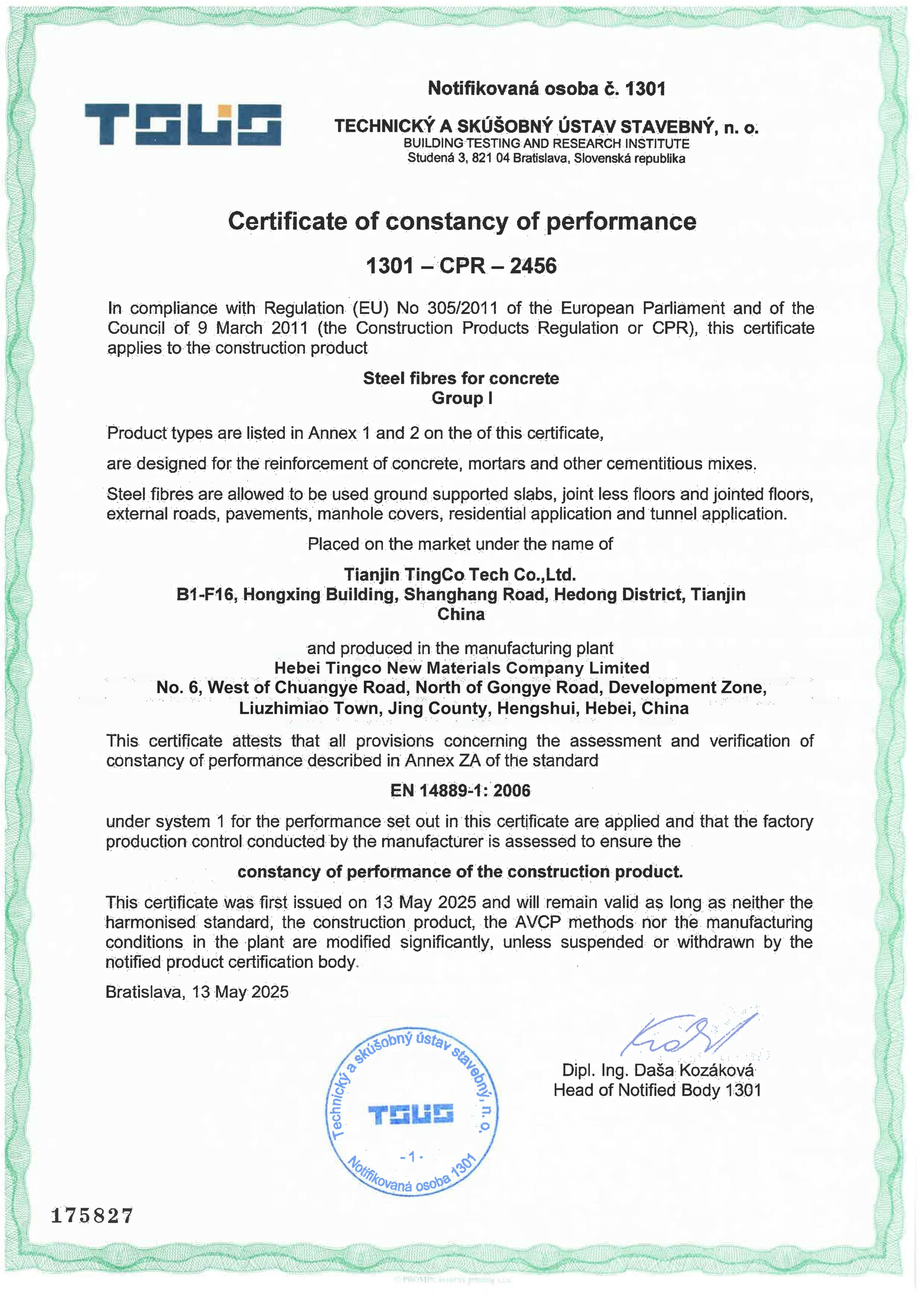
The certification question is where PP fiber buying most often goes wrong, and it is worth stating plainly. TingCo holds CE Certificate 1301 – CPR – 2456, issued by TSUS, to EN14889-1:2006, valid from 2025-05-13 to 2030-05-12 for the EU market. The scope of that certificate is “steel fibres for concrete (Group I), for reinforcement of concrete, mortars and cementitious mixes”, and it applies to steel fiber products with diameter 0.5–1.0 mm, length 25–60 mm and tensile strength 1100–2100 MPa.
PP Twisted Fiber and PP Macro Fiber fall outside both the material scope and the dimensional envelope of that certificate. That is a normal consequence of how the standard is written — EN 14889-1 is a steel fiber standard — but it has a practical implication: a PP fiber order should carry its own product-specific declaration and test record rather than relying on the steel certificate in the project file.
- Confirm the certificate number, issuing body and validity dates.
- Read the certificate scope line by line and match it to the product, diameter, length and tensile range being ordered.
- For PP fiber, request the supplier's own declared data plus the batch test record for the delivered lot.
- Keep in-line inspection and pre-shipment inspection records with the shipment documentation.
FAQ
Does the CE certificate cover PP Twisted Fiber and PP Macro Fiber?
No. CE Certificate 1301 – CPR – 2456, issued by TSUS to EN14889-1:2006, covers steel fibres for concrete (Group I) for the reinforcement of concrete, mortars and cementitious mixes, and applies to steel fiber products with diameter 0.5–1.0 mm, length 25–60 mm and tensile strength 1100–2100 MPa. PP Twisted Fiber (0.6–0.7 mm, 46–54 mm, 450–650 MPa) and PP Macro Fiber (0.7 mm, 30–58 mm, 550–600 MPa) sit outside that material scope and that dimensional envelope, so a PP order needs its own product-specific declaration and batch test record.
Which family disperses more reliably in a concrete mix?
Both rely on the same dispersion mechanism: hydrophilic surface modification that supports uniform dispersion and strong bonding within the concrete matrix. The stated application requirements are identical for both — alkali resistance, high dispersion uniformity, compatibility with cement, and no agglomeration during mixing. Because the published mechanism does not separate them, dispersion should be judged on how the fiber behaves in your own mix and placing method, and on the supplier's inspection record, rather than on the datasheet wording.
What drives cost when comparing Twisted and Macro PP Fiber?
No price band is published for either family in the material referenced here, and quoted prices move with grade, volume and freight. What is fixed and checkable is the commercial envelope: TingCo states an MOQ of 24 tons, a lead time of 10–15 days, a monthly capacity of 2,000 tons, and OEM/ODM customization including logo and design. In practice the cost comparison follows the specification — a tighter length band and a higher tensile floor are grade decisions, and grade decisions are what move the quote.
Can a buyer verify the fiber before committing to a full order?
Verification is built on two things: the batch data and the inspection record. TingCo states in-line inspection and pre-shipment inspection as standard quality-control steps, alongside remote technical support, quality-problem compensation and construction consultancy after delivery. For a pre-order check, the practical route is to confirm the exact length band and tensile value in writing with the technical team before shipment, so that the sample and the production lot are specified against the same numbers.
What are the MOQ and lead time?
TingCo states an MOQ of 24 tons and a lead time of 10–15 days, supported by a monthly capacity of 2,000 tons. For orders where the length or tensile value has to be fixed in advance, confirming those two numbers before the PO is what keeps the 10–15 day window realistic. Questions on specification, samples or quotation can go directly to the TingCo team at info@tingco.co.
Conclusion
PP Twisted Fiber and PP Macro Fiber are the same polymer offering the same published durability outcomes — over 30% reduction in early-stage cracking, approximately 37% impermeability improvement, over 15% service-life extension, 0.91 g/cm³ density and ≥3500 MPa elastic modulus, with acid and alkali resistance, non-absorbent behaviour and hydrophilic surface modification for dispersion. Choosing between them is therefore not a durability decision. It is a geometry and documentation decision.
Choose Twisted Fiber when you want a fixed 46–54 mm length band and a tensile ceiling up to 650 MPa, and accept the obligation to verify the batch value across a wide 450–650 MPa declaration. Choose Macro Fiber when element thickness varies enough to need the 30–58 mm envelope, when a 550–600 MPa declaration with a higher floor suits the design, and when you are prepared to write the exact length into every order. In both cases, the certificate check is the same: read the scope, match it to the product, and never let a steel fiber certificate stand in for polypropylene data.
Next Step: Confirm the Length and Tensile Value for Your Mix
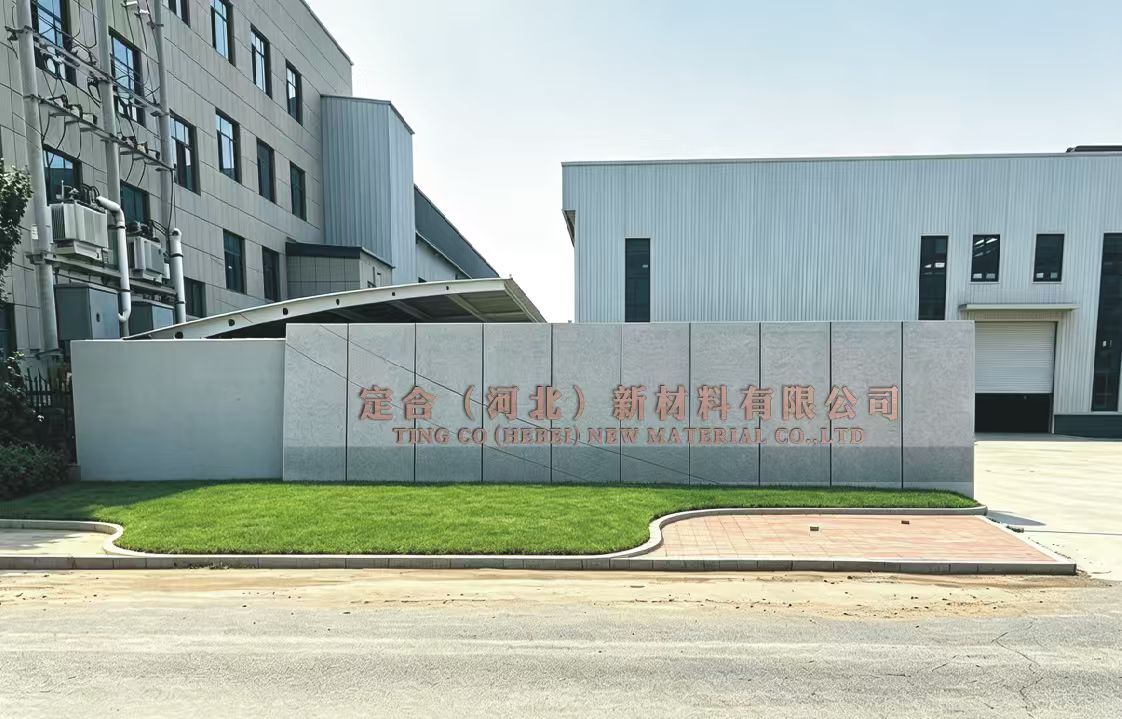
Tianjin TingCo Tech Co., Ltd. manufactures steel fiber and polypropylene fiber for concrete reinforcement, with an MOQ of 24 tons, a 10–15 day lead time and OEM/ODM customization including logo and design. Send your element type, thickness and required tensile value, and the technical team will confirm whether Twisted or Macro fiber fits the mix — or whether the requirement belongs to the steel fiber range instead.
Website: www.tcfibers.com | Email: info@tingco.co | Tel: +86-22-59785568
Download the company and project brochure: TINGCO Company Profile and Project Introduction (PDF)
Have Questions or Need More Details?
Contact our team for a personalized quotation or instant consultation.
Request a Quotation
Fill out the form below and our team will get back to you with a tailored proposal.
WhatsApp Direct Chat
Prefer to chat in real-time? Message us on WhatsApp for instant assistance & quick answers.
- Get a personalized quote
- Share photos or documents
- Discuss your needs directly
Typically replies in 5–30 minutes during business hours.