
Magnesium Sulphate Fertilizer Import Compliance: Documents, COA and Batch Testing
Magnesium Sulphate Fertilizer Import Compliance: Regional Documents, COA and Batch Testing
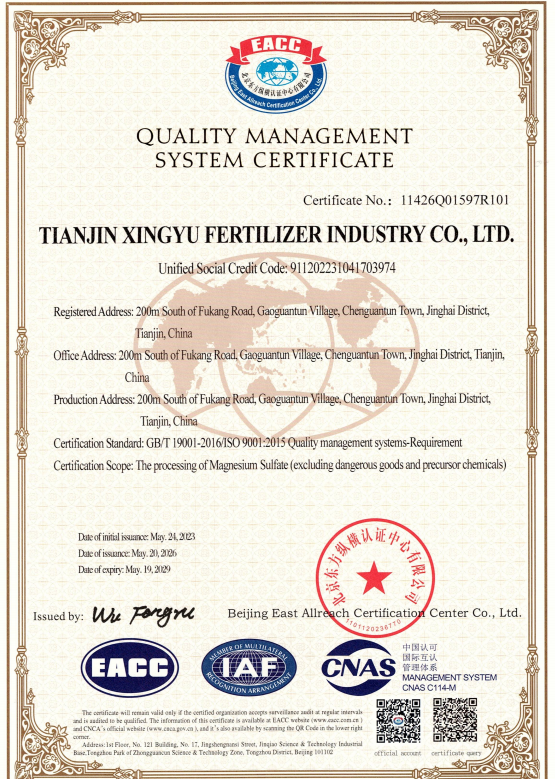
ISO9001 certificate held by Tianjin Xingyu Fertilizer Industry Co., Ltd. under GB/T19001-2016/ISO9001:2015, certificate number 11426Q01597R101, valid to 19 May 2029.
A magnesium sulphate fertilizer shipment is normally cleared or questioned on paper before it is cleared at the port. For an importer, the practical question is not which certificate sounds most impressive, but which documents can actually be obtained for the specific production batch being shipped. The workable package for magnesium sulphate (MgSO4) is narrow and repeatable: a certificate of analysis (COA) issued for the production batch, an MSDS, test reports, a supplier that accepts third-party inspection, and a complete set of shipping documents.
Tianjin Xingyu Fertilizer Industry Co., Ltd. (XYF) is a magnesium sulphate manufacturer founded in 1993 and located in the Chenguantun Town Industrial Park, Jinghai District, Tianjin, China. The company applies a 100% test standard, tests every production batch before shipment, and issues a COA for each batch. This guide explains how those documents work together, how grade and form selection changes what a buyer should request, and how the same documentation package is used across markets in Asia, Europe, the Middle East, Africa and the Americas.
Short answer: request a batch-specific COA, an MSDS, test reports, confirmation that third-party inspection is accepted, and a full set of shipping documents. Confirm the grade, the form, the packing format and the specification limits in the purchase order before production starts.
Why Magnesium Sulphate Fertilizer Import Compliance Is Harder Than It Looks
Compliance friction in this category rarely comes from the material itself. It comes from the fact that one customs heading, one grade label and one product name each cover several different products.
One HS code, several products
Customs data aggregates all magnesium sulphates under HS 283321. That aggregation hides the split between Kieserite (a monohydrate-type material) and heptahydrate material often traded as Epsom salt. For an importer, the consequence is practical: a supplier comparison based on trade statistics alone tells you the size of the category, not which product you are buying. The specification and the COA tell you that.
Grade language is not universal
Agricultural grade, feed grade and industrial grade are commercial descriptions, and the limits behind them are not identical in every market. A feed buyer and a blending plant may both ask for magnesium sulphate fertilizer, yet they need different assurance on heavy metals and chloride. Documents prepared for one grade do not automatically satisfy the other, and documentation for magnesium sulphate should not be assumed interchangeable with paperwork for a different sulphate such as ammonium sulphate.
Form changes the specification
Anhydrous magnesium sulphate, Kieserite, magnesium sulphate monohydrate and magnesium sulphate heptahydrate are four separate products with different appearances and different application modes. They are not interchangeable descriptions of one material. Because of that, the documentation a buyer should request differs by form: a granular Kieserite order for soil application and a heptahydrate crystal order for fertigation will not carry identical packing, handling or application notes.
The three failure points buyers report
- A COA that refers to a different batch than the one loaded.
- No MSDS available at the time the carrier or warehouse requests it.
- An inspection clause that was never agreed before production, leaving no agreed route if an arrival test disagrees with the COA.
Market Background: Why Documentation Is the Differentiator in 2026
Magnesium sulphate is a large, traded commodity category. Published research aggregated for 2026 places the global magnesium sulphate market at about USD 1.8 billion in 2025 and approximately USD 1.9 billion in 2026. Estimates for the same 2025 period differ by source, ranging roughly from USD 1.0 billion to USD 1.8 billion, largely because different reports include different grades and compounds. The spread itself is a useful reminder: scope definition matters in this category, in market sizing and in paperwork alike.
Two structural facts shape buyer behaviour. First, agriculture and fertilizers accounted for approximately 41.6% of global magnesium sulfate market share as of 2025, so the agricultural grade dominates volume. Second, heptahydrate (Epsom salt) is the dominant product type, representing 54% of global commercial production. On the supply side, China was the leading exporter of magnesium sulphate in 2024, accounting for USD 149 million in export value under HS 283321, according to trade data compiled from UN Comtrade.
In the European Union, magnesium sulphate is registered in the ECHA REACH database with an annual tonnage band of 100,000 to 1,000,000 tonnes, based on publicly reported registration information. Importers should confirm how that substance-level registration applies to their own supply chain rather than assuming it covers every product form or label.
What this means for an evaluation-stage buyer: in a category this large and this commoditised, price competition is normal. The parts that differ between suppliers are batch consistency and the documents that prove it: a COA per batch, 100% testing before shipment, and a supplier willing to accept third-party inspection.
The Documentation Package Importers Should Be Able to Request
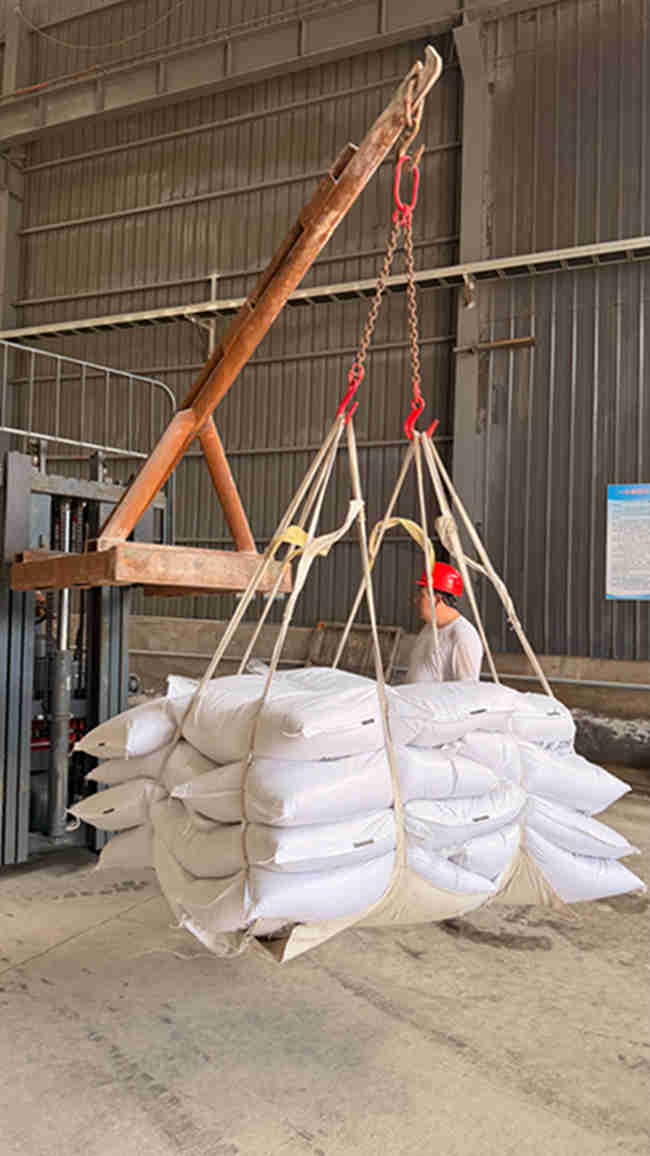
Magnesium sulphate fertilizer in export packing, ready for the documentation and loading stage.
XYF provides full export support including MSDS, COA and a full set of shipping documents, accepts third-party inspection, and maintains stable delivery and prompt after-sales service. Used together, these items answer the questions that customs brokers, agricultural inspectors, feed-mill QA teams and industrial buyers actually ask.
1. Certificate of Analysis (COA), issued per batch
A COA is provided for each batch. This is the single most important document in the file because it links the tested material to the shipped material. The buyer can compare the COA result against the specification written into the purchase order for assay stability, and against the agreed limits for heavy metals and chloride.
2. MSDS
An MSDS accompanies the order. In practice it is requested by carriers, freight forwarders, warehouses and site safety officers, and it is often needed before the vessel or the receiving facility will accept the consignment. Having it issued at production stage avoids last-minute hold-ups at the port of loading.
3. Test reports and the 100% test standard
Quality control at the Tianjin facility follows a 100% test standard: each production batch undergoes 100% testing before shipment. Test reports are issued alongside this process, and heavy metals and chloride are strictly controlled so the material can be used safely in agriculture, feed and industrial applications. For a buyer evaluating a supplier, the meaningful question is not whether testing happens at all, but whether it happens on every batch and whether the result travels with that batch.
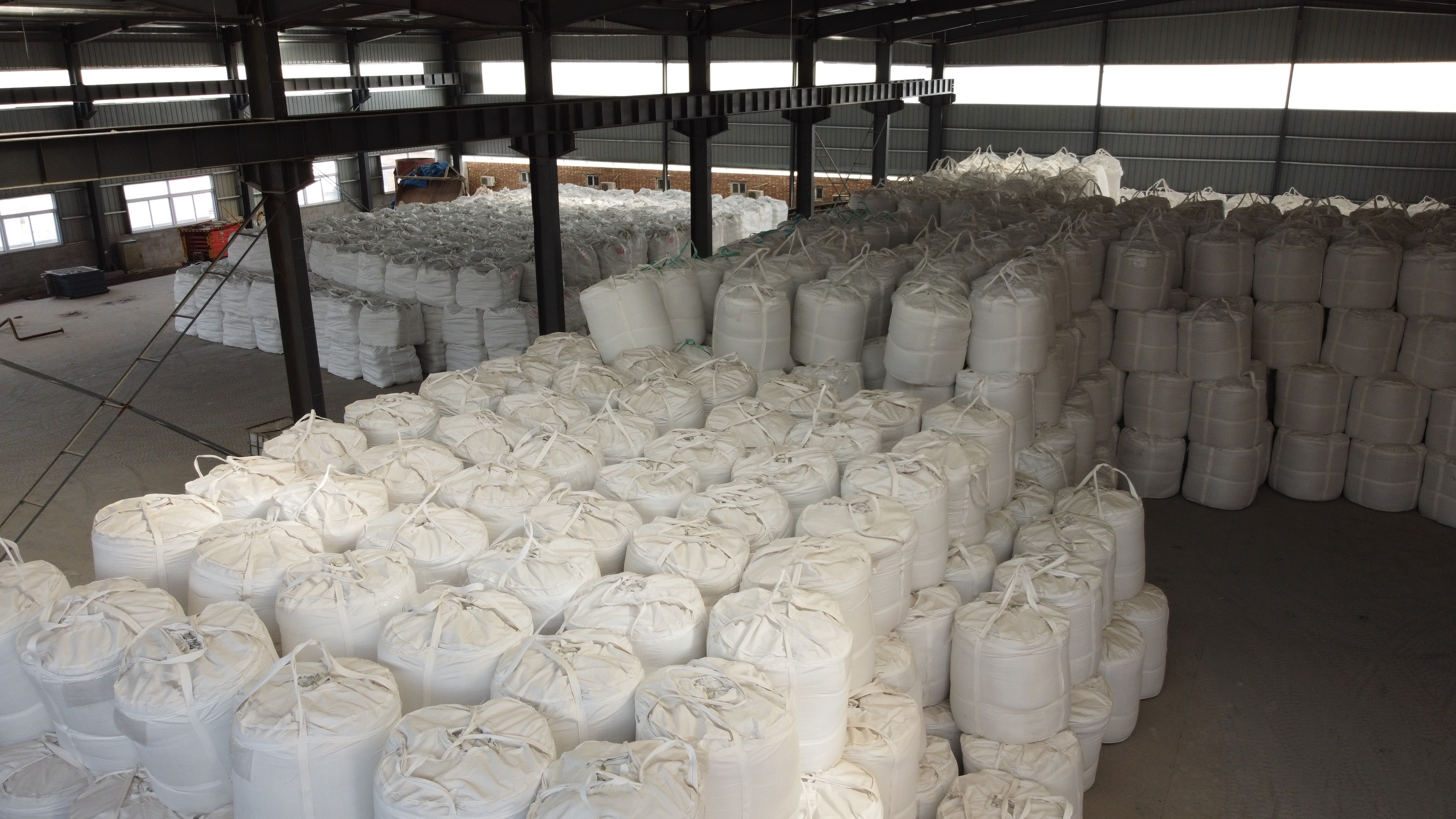
Production workshop at the Tianjin facility, where batches are processed under a 100% test standard.
4. Third-party inspection acceptance
XYF accepts third-party inspection. That matters at the evaluation stage because it defines what happens if arrival testing disagrees with the COA. The documented process is that the buyer provides photos, samples and third-party inspection reports, and the case is then negotiated on that evidence. Buyers should still state the inspection arrangement in the purchase order, including who appoints the inspector and at which stage.
5. Full set of shipping documents
A full set of shipping documents is provided with each order, and the order is followed up with timely updates on loading and shipping status. Buyers should confirm document requirements for their own market before the goods are loaded rather than after arrival, since corrections at destination are slower and more expensive than corrections at origin.
6. ISO9001 certification
The manufacturing system is certified to GB/T19001-2016/ISO9001:2015. The certificate is numbered 11426Q01597R101, was issued by Beijing East Allreach Certification Center Co., Ltd. (EACC) on 20 May 2026, and is valid until 19 May 2029. Its scope covers magnesium sulphate fertilizer across the four forms: magnesium sulphate anhydrous, Kieserite, magnesium sulphate monohydrate and magnesium sulphate heptahydrate.
7. What the package does not replace
A COA, an MSDS and shipping documents describe the material and the transaction. They do not replace importer-side obligations. Market-specific registration, labelling rules, product claims and any additional national requirements remain the importer's responsibility. A supplier can support that work with consistent batch documentation, but the buyer should confirm the requirement list for their own destination before ordering.
Step-by-Step: Building a Checkable Document File
The sequence below reflects how a magnesium sulphate order is normally documented from enquiry to arrival. Working in this order prevents most of the corrections that slow down clearance.
- Fix grade and form first. Decide whether the order is agricultural, feed or industrial grade, and whether the form is anhydrous magnesium sulphate, Kieserite, magnesium sulphate monohydrate or magnesium sulphate heptahydrate. Every later document references this decision.
- Request a COA from a recent batch. Ask for a representative COA before the order is placed, and confirm how batches are numbered so the COA can be matched to the loaded lot.
- Write specification limits into the purchase order. Agree the parameters that matter for your application, and state the limits for heavy metals and chloride explicitly rather than relying on a grade name.
- Agree packing and labelling. Standard packing is a 25kg or 50kg PP woven bag, or as per the customer's requirement. Custom specifications, granule size, colours, shapes, packaging and labels are acceptable, so label content should be confirmed in writing.
- Confirm pre-shipment testing and COA timing. Each batch undergoes 100% testing before shipment. Agree whether the COA is issued before loading, and in what language and format.
- Decide the third-party inspection route. Third-party inspection is accepted. Name the inspector, the inspection stage and the sampling method in the order, so the clause is usable rather than theoretical.
- Assemble the shipping documents before loading. MSDS, COA and the full set of shipping documents should be assembled at origin. Confirm the document list against destination requirements in advance.
- Plan the arrival comparison. If an arrival test disagrees with the COA, the agreed route is photos, samples and third-party inspection reports, with feedback answered within 24 hours.
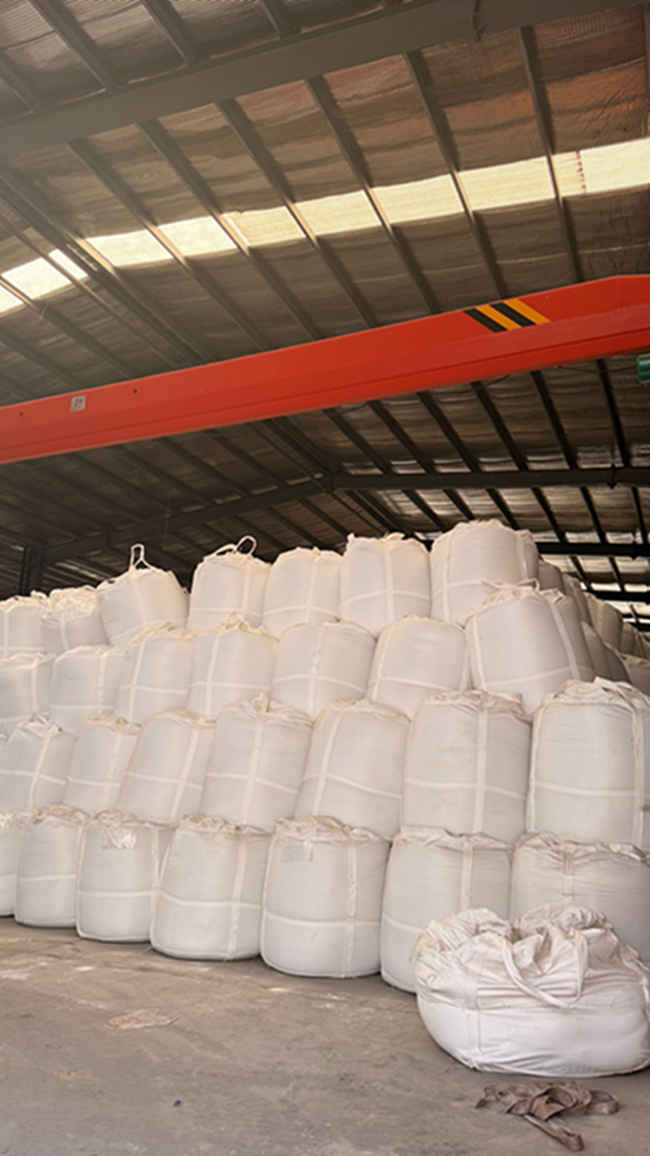
Bagged magnesium sulphate fertilizer at the packing stage, where label content and batch identification are fixed.
Use Cases: How Documentation Emphasis Changes by Grade and Application
Agricultural grade for soil, foliar and fertigation use
Heptahydrate is a white granular crystal used in soil application, foliar spray, fertigation and as an industrial raw material. Monohydrate covers soil application, foliar spray and industrial use, while anhydrous material and Kieserite are used mainly in soil application. For agricultural importers, the COA, the application guidance and the packing label carry most of the weight, because the material is supplied to blending plants, distributors and co-operatives that pass information on to growers.
Feed grade
Feed applications add magnesium for livestock and poultry and support normal metabolism. In this segment, the controlling documentation question is impurity control rather than nutrient content alone, which is why strictly controlled heavy metals and chloride matter to the acceptance decision and should be stated in the purchase order.
Industrial grade and water treatment
Industrial applications include printing and dyeing, leather-making, building materials and water treatment. Industrial buyers typically want the specification sheet, the MSDS and the batch COA in one file, because the material enters a production process where an out-of-specification input is more disruptive than a price difference.
NPK blending and private-label supply
Magnesium sulphate supplies both magnesium and sulfur and is compatible with most NPK fertilizers for blending. Blenders and brand owners usually order in full-container volumes and need custom specifications, granule size, colours, shapes, packaging and labels. A documented example is a South Korea-based OBM (original brand manufacturer) client with a 20-tonne magnesium sulphate fertilizer project running over two years, supported by MSDS, COA and the full shipping document set.
The same documentation package is used for shipments to Indonesia, Vietnam, Thailand, Malaysia, Brazil, Argentina, Chile, India, Pakistan, Turkey, Saudi Arabia, UAE, Spain, Italy, Poland, Egypt, Nigeria, Mexico and Russia. These markets differ in inspection routines and labelling expectations, which is the practical reason a buyer should specify the destination document list at the enquiry stage rather than assume one generic file will be accepted everywhere.
Comparison Tables
The two tables below summarise what each document does and how the four product forms differ. Both are based on the documentation practice and product specification described above.
Table 1. Document matrix for a magnesium sulphate fertilizer order
| Document | What it verifies | Frequency |
|---|---|---|
| Certificate of Analysis (COA) | Tested result for the specific production batch | Per batch |
| MSDS | Handling, transport and safety information | Per order |
| Test reports | Results of the 100% test standard applied before shipment | Per batch |
| Third-party inspection report | Independent verification, and the evidence route if a discrepancy is raised | When agreed or required |
| Shipping document set | Commercial and transport record of the consignment | Per shipment |
| ISO9001 certificate | Certified quality management system, certificate 11426Q01597R101, valid to 19 May 2029 | Certificate cycle |
Table 2. Form, application and packing reference
| Form | Category | Application mode | Packing |
|---|---|---|---|
| Magnesium sulphate anhydrous | White powder or granular | Soil application, industrial raw material | 25kg or 50kg PP woven bag, or as per customer requirement |
| Kieserite | Off-white granular | Soil application | 25kg or 50kg PP woven bag, or as per customer requirement |
| Magnesium sulphate monohydrate | White powder or granular | Soil application, foliar spray, industrial raw material | 25kg or 50kg PP woven bag, or as per customer requirement |
| Magnesium sulphate heptahydrate | White granular crystal | Soil application, foliar spray, fertigation, industrial raw material | 25kg or 50kg PP woven bag, or as per customer requirement |
FAQ: Import Compliance Questions Buyers Ask
Which documents should an importer request with every magnesium sulphate fertilizer shipment?
Request a certificate of analysis issued for the production batch being shipped, an MSDS, test reports, written confirmation that third-party inspection is accepted, and the full set of shipping documents. A COA is provided for each batch, and heavy metals and chloride are strictly controlled so the material can be used safely in agriculture, feed and industrial applications. The COA is the document that links the tested result to the loaded material, so it should be matched to the batch number rather than filed as a general product sheet.
How is batch testing handled, and what does it mean for the acceptance decision?
Quality control follows a 100% test standard: each production batch undergoes 100% testing before shipment. The Tianjin facility operates a monthly production capacity of 100,000 units and an independent standardised testing laboratory, under an ISO9001 quality management system certified to GB/T19001-2016/ISO9001:2015 (certificate 11426Q01597R101, issued by Beijing East Allreach Certification Center Co., Ltd., EACC, valid to 19 May 2029). For the buyer, this changes the acceptance decision from a one-off judgement about a sample to a repeatable check against a batch document.
Does the documentation level affect what a buyer pays?
Documentation is not a separate line item; the commercial variables are grade, form, specification limits, packing, order volume and timing. The minimum order quantity is one container, and lead time depends on order quantity and requirements. For market context, independent industry reporting placed US magnesium sulphate prices near USD 674 per metric ton in early 2025, but that figure reflects a different market and period and should be treated as background rather than as a quotation for a specific order.
Can a buyer validate the material before committing to a production order?
Yes. Buyers can request a COA from a recent batch during evaluation, agree third-party inspection before loading, and confirm the specification limits in writing before production starts. Custom specifications, granule size, colours, shapes, packaging and labels are acceptable, so a sample or trial order can be set up to match the intended market format rather than a generic specification.
What is the lead time, and how are shortages or discrepancies handled after delivery?
Lead time depends on order quantity and requirements, so it is confirmed against the specific order rather than quoted as a fixed number. Orders are followed up with timely updates on loading and shipping status, and customer feedback is answered within 24 hours. If a quality discrepancy arises, the buyer provides photos, samples and third-party inspection reports so the case can be negotiated on evidence. To review the full product range and specification detail, you can download the XYF product catalogue or send your destination document list for review.
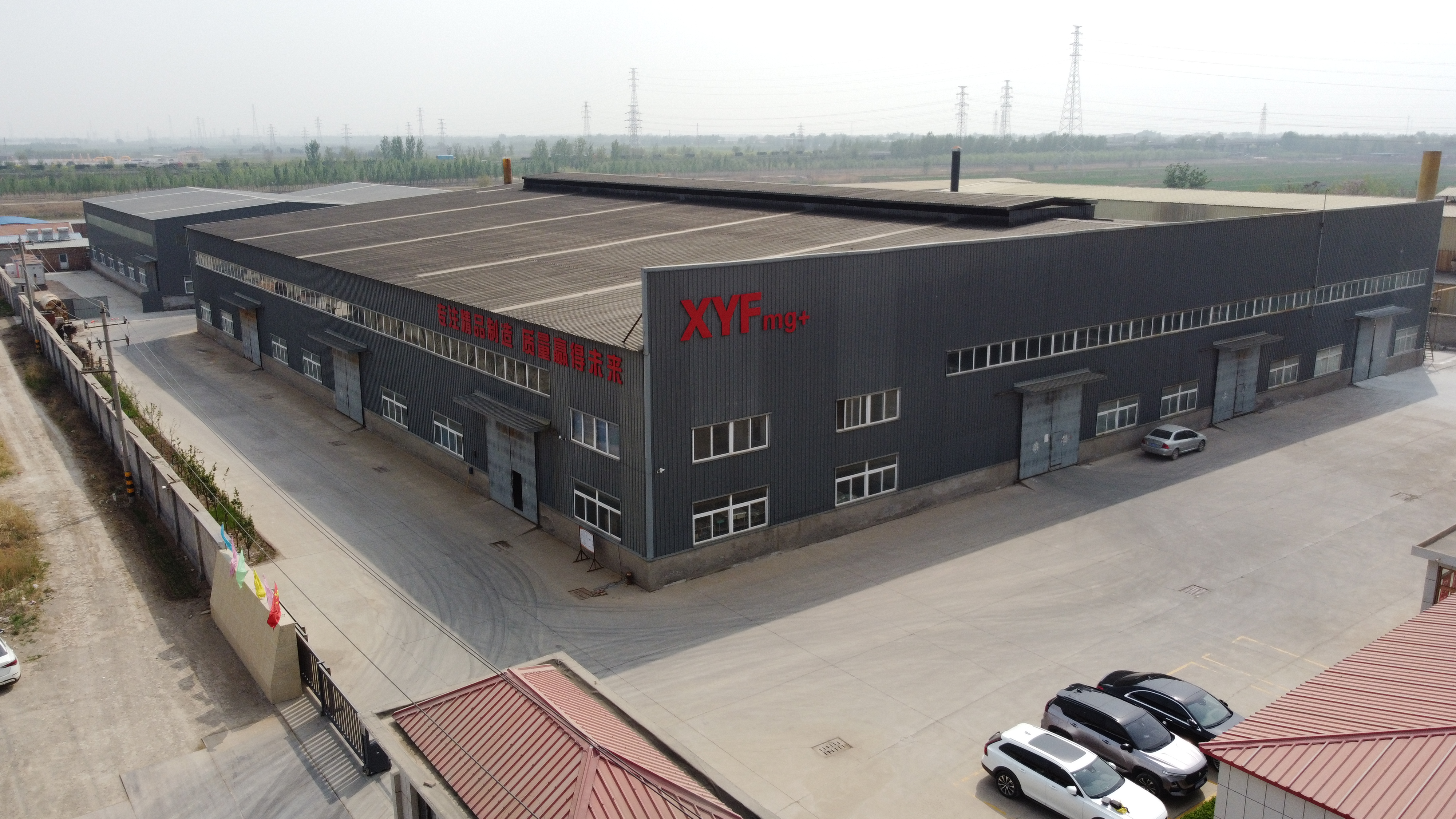
Factory view: magnesium sulphate production in Jinghai District, Tianjin, supporting export markets across Asia, Europe, the Middle East, Africa and the Americas.
Conclusion
Import compliance for magnesium sulphate fertilizer is decided by four things that can all be checked before the vessel sails: a COA issued for the actual production batch, an MSDS available at loading, test reports backed by a 100% test standard on every batch, and a supplier that accepts third-party inspection alongside a full set of shipping documents. Grade and form selection sit in front of all of them, because agricultural, feed and industrial buyers ask for different limits on the same family of products.
Tianjin Xingyu Fertilizer Industry Co., Ltd. has produced magnesium sulphate series products since 1993, exports to more than 30 countries and regions, and supports orders with MSDS, COA, test reports, application guidance and full shipping documentation. For importers evaluating a supplier, the most efficient next step is to send the destination document list and the required specification limits, then compare them against a batch COA and the ISO9001 scope before the first container is booked.
Next step: request a batch COA and a quotation
Contact: Jenny | Email: liujenny@xingyutj.com | Tel / WeChat / WhatsApp: +86 155-2237-7326
Catalogue: XYF-Catalogue.pdf
Have Questions or Need More Details?
Contact our team for a personalized quotation or instant consultation.
Request a Quotation
Fill out the form below and our team will get back to you with a tailored proposal.
WhatsApp Direct Chat
Prefer to chat in real-time? Message us on WhatsApp for instant assistance & quick answers.
- Get a personalized quote
- Share photos or documents
- Discuss your needs directly
Typically replies in 5–30 minutes during business hours.