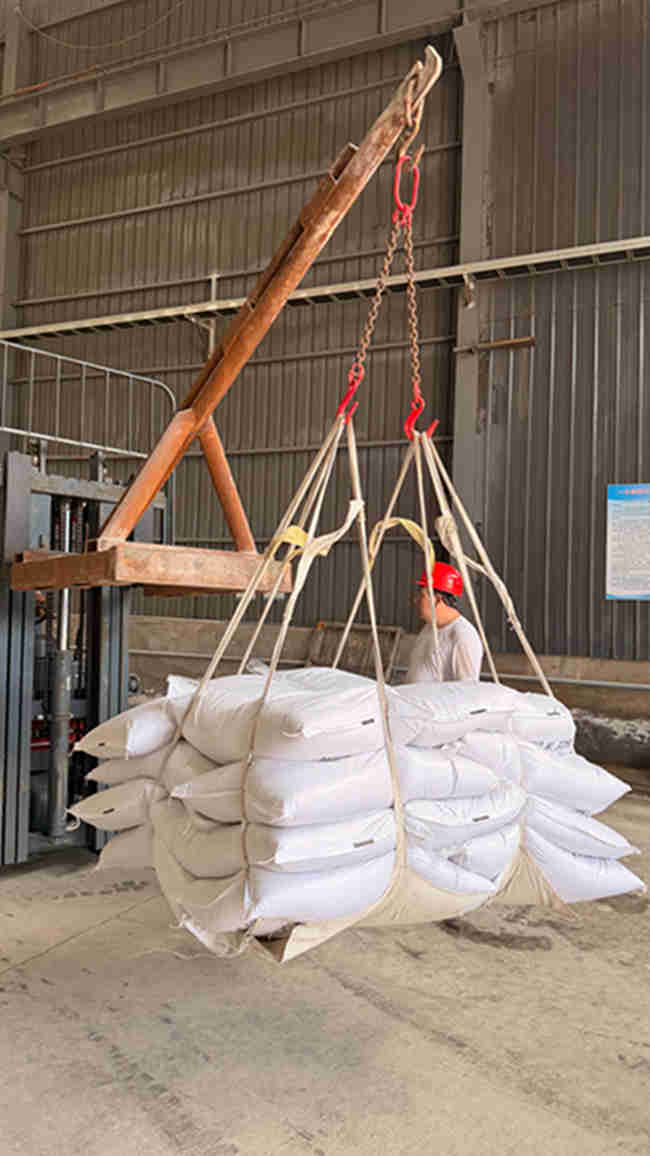
Magnesium Sulphate Fertilizer in NPK Blending: Anhydrous vs Monohydrate vs Heptahydrate vs Kieserite
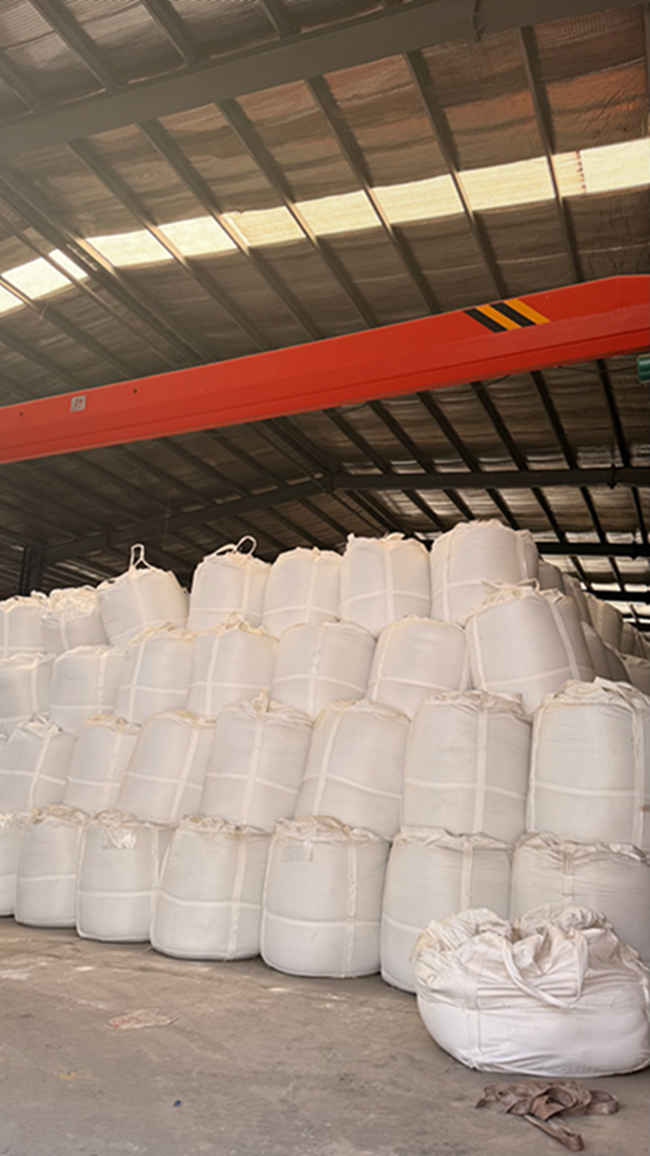
An NPK blend is a physical mixture, not a chemical compound. Urea, DAP, MAP, MOP, SOP and the magnesium carrier all have to pass through the same blender, the same bagging line and the same spreader without separating, dusting or turning into lumps. That is why the magnesium sulphate fertilizer grade a blender selects matters as much as the magnesium figure printed on the bag.
Four grades dominate commercial magnesium sulphate supply: magnesium sulphate anhydrous, Kieserite, magnesium sulphate monohydrate and magnesium sulphate heptahydrate (Epsom salt). They differ in crystal water, magnesium content, moisture behaviour, granule form and the application routes they are published for. This guide compares the four as blending inputs, then sets out the decision criteria that buyers can apply to a real blending line: complete water solubility with no residue, compatibility with NPK fertilizers, granule size and flowability, low dust, anti-caking performance, controlled chloride, stable assay and low impurities backed by a COA for each batch.
Quick answer for buyers: specify anhydrous magnesium sulphate when the blend must stay dry and the highest magnesium content per tonne is required; specify granular Kieserite or granular heptahydrate when the blend will be spread mechanically as a base fertilizer; use monohydrate when one purchase has to serve both agricultural and general industrial channels; and choose heptahydrate when the finished product will be dissolved in fertigation or foliar spray systems, because it is the lower-cost grade published for those routes.
What Actually Breaks an NPK Blend That Contains Magnesium Sulphate
The failure modes in a blending line are predictable, and each one points to a different part of the specification.
- Segregation. If the magnesium sulphate granules differ in size or density from the NPK prills, the bag separates during transport and the spreader applies an uneven pattern. Uniform granules, complete particle-size options and good flowability are therefore blending requirements, not cosmetic preferences.
- Moisture pick-up and caking. Magnesium sulphate readily absorbs moisture from the air. Caking happens under high-humidity storage, with damaged packaging, or after long-term open exposure to moist air. The practical results are blocked blenders, hard lumps in the bag and uneven spreading.
- Dust. Powder grades release dust at the blender inlet. Granular grades support mechanical spreading with less loss during storage and transport.
- Residue in irrigation systems. Where the blend or the magnesium component is dissolved, incomplete dissolution leaves residue that can block drip emitters.
- Chloride and heavy-metal load. Chloride-sensitive crops, feed applications and industrial end uses require strictly controlled chloride and heavy metals, verified per batch rather than assumed.
- Assay drift. A blend carries a guaranteed analysis. If the magnesium sulphate assay moves between deliveries, the finished product specification moves with it. Stable assay and a COA for each batch are what hold the guarantee in place.
None of these problems is solved by magnesium content alone. They are solved by matching grade to blending line, application route and crop need.
Industry Background: A Large, Segmented and Poorly Reported Market
Magnesium sulphate is a mature commodity, but its published numbers are easier to misread than they look.
- Aggregated market research places the global magnesium sulphate market at USD 1.8 billion in 2025, projected to reach USD 1.9 billion in 2026. Estimates differ between sources because the scopes differ — some reports count only part of the magnesium sulphate range rather than all grades.
- Agriculture and fertilizers accounted for approximately 41.6% of global magnesium sulphate market share in 2025, which is why blending-grade supply and farm application behaviour dominate grade demand.
- Heptahydrate (Epsom salt) is the dominant product type at 54% of global commercial production in 2025 — volume leadership that does not automatically make it the right blending input for every line.
- In 2024, China was the leading exporter of magnesium sulphate with USD 149 million in export value (HS code 283321, per OEC data based on UN Comtrade).
- Magnesium sulphate is registered in the ECHA REACH database with an annual tonnage band of 100,000 to 1,000,000 tonnes, which reflects how widely the material is traded and handled in industrial and agricultural supply chains.
One reporting gap deserves attention from buyers. Customs data aggregates all magnesium sulphates under HS 283321, so published trade figures do not separate Kieserite and monohydrate from heptahydrate. Grade-level documentation from the supplier, not the headline customs number, is what tells a buyer which crystal form is actually shipping.
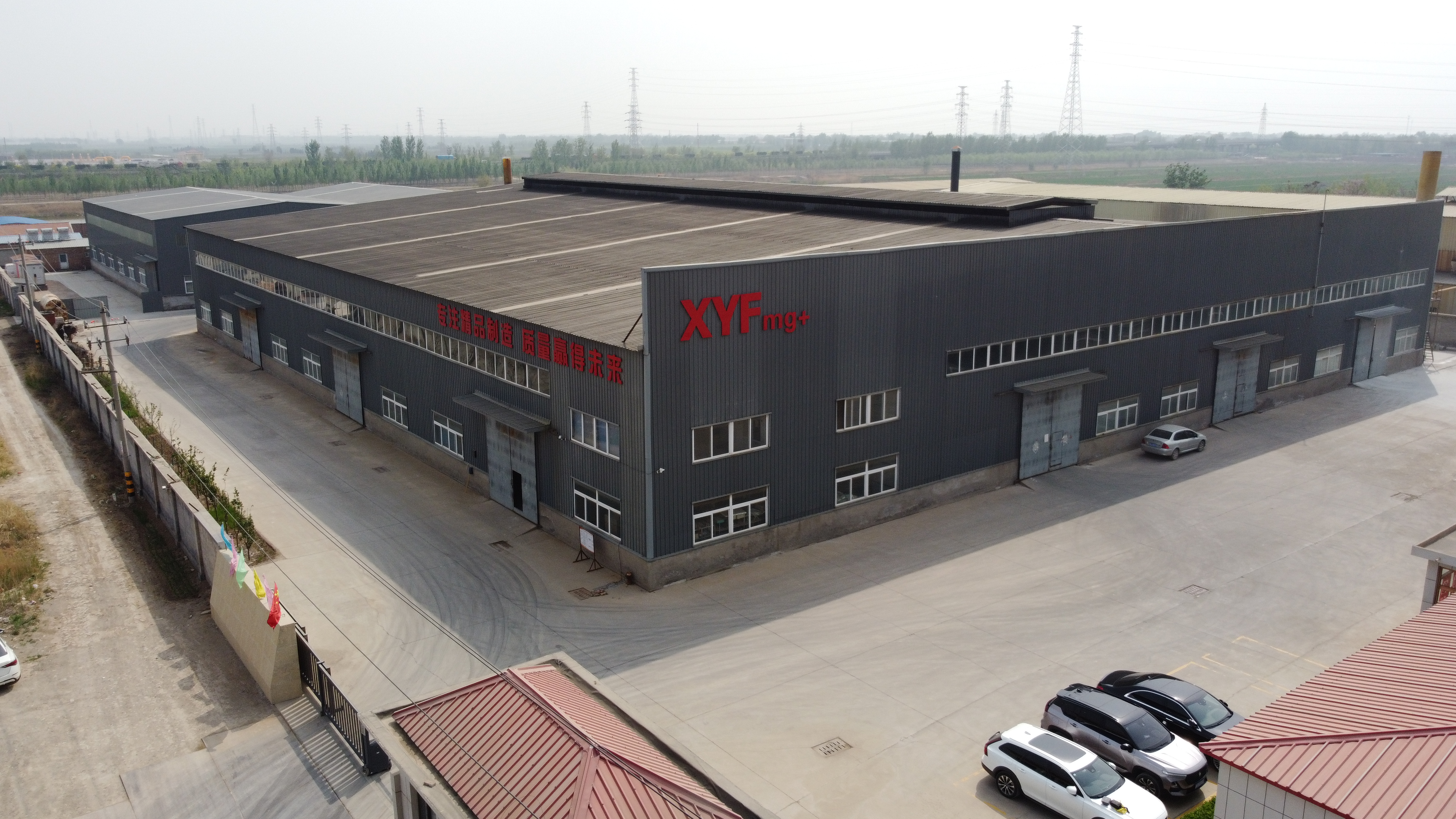
As a first-party reference point, Tianjin Xingyu Fertilizer Industry Co., Ltd. is an original manufacturer founded in 1993, located in Chenguantun Town Industrial Park, Jinghai District, Tianjin, and reports an annual output capacity of 100,000 metric tons across its magnesium sulphate series. The published range covers anhydrous, Kieserite, monohydrate and heptahydrate magnesium sulphate, together with magnesium oxide, sulphur magnesium fertilizer and other medium and trace element fertilizers.
The Four Grades as Blending Inputs
Anhydrous Magnesium Sulphate
Published form: white powder or granular. Published application modes: soil application and industrial raw material. Of the four grades, anhydrous carries the higher magnesium content and the lowest water content, which is why it is positioned for industrial and dry-blending use and normally carries a higher price. Choose it when the blend is moisture-sensitive, when magnesium density per tonne matters most, or when the material is destined for dry formulations and industrial raw-material use rather than irrigation.
Kieserite
Published form: off-white granular. Published application mode: soil application. Kieserite's value in a blend is largely physical — a granular carrier that can move through a bulk blending line and a mechanical spreader as part of a base fertilizer programme. Where a dissolved grade is not required, the granular route is the simpler specification to hold.
Magnesium Sulphate Monohydrate
Published form: white powder or granular. Published application modes: soil application, foliar spray and industrial raw material. Monohydrate sits between the low-moisture anhydrous grade and the crystal-water heptahydrate grade, and it is described as suitable for both agricultural and general industrial scenarios. It fits buyers who want one grade that can be steered into either channel without changing supplier or specification.
Magnesium Sulphate Heptahydrate (Epsom Salt)
Published form: white granular crystal. Published application modes: soil application, foliar spray, fertigation and industrial raw material. Heptahydrate contains crystal water, so magnesium content per tonne is lower than anhydrous, and it is generally the lower-cost option. The published sourcing guidance is direct: for agriculture and fertigation, choose heptahydrate magnesium sulphate with stable particle size; for industrial dry formulations, choose anhydrous magnesium sulphate with low moisture and high magnesium content.
Decision criteria used to compare the four grades
- Complete water solubility with no residue — required whenever the material will be dissolved, including fertigation and foliar routes, so that drip emitters are not blocked.
- Compatibility with most NPK fertilizers — magnesium sulphate is published as a dual-nutrient source of magnesium and sulphur that is compatible with most NPK fertilizers for blending.
- Granule size and flowability — uniform granules and complete particle-size options support mechanical spreading with less loss during storage and transport.
- Low dust and anti-caking performance — both affect line cleanliness, product loss and bag stability in the warehouse.
- Controlled chloride, heavy metals and impurities — strictly controlled in the published specification, which matters for chloride-sensitive crops and for feed and industrial usage.
- Stable assay with a COA for each batch — the only defensible way for a blender to guarantee the analysis of the finished product.
Step-by-Step: Matching a Grade to a Blending Line
- Define the application route first. Broadcast base fertilizer, soil application, fertigation or foliar spray. Heptahydrate is published across the widest route set (soil, foliar and fertigation); anhydrous is published for soil application and industrial raw material; Kieserite is published for soil application.
- Match granule size to the NPK prills. Request the particle-size option that fits the existing blend, and confirm it against the other components rather than in isolation.
- Decide how moisture-sensitive the blend is. Dry formulations and long-storage SKUs point to low-moisture anhydrous magnesium sulphate; general field blends can use granular grades.
- Confirm solubility requirements. If any part of the programme runs through drip or sprinkler systems, specify a grade and particle size that dissolves completely with no residue.
- Set chloride, heavy-metal and assay limits, and require a COA per batch. Pre-shipment testing is part of the acceptance criteria.
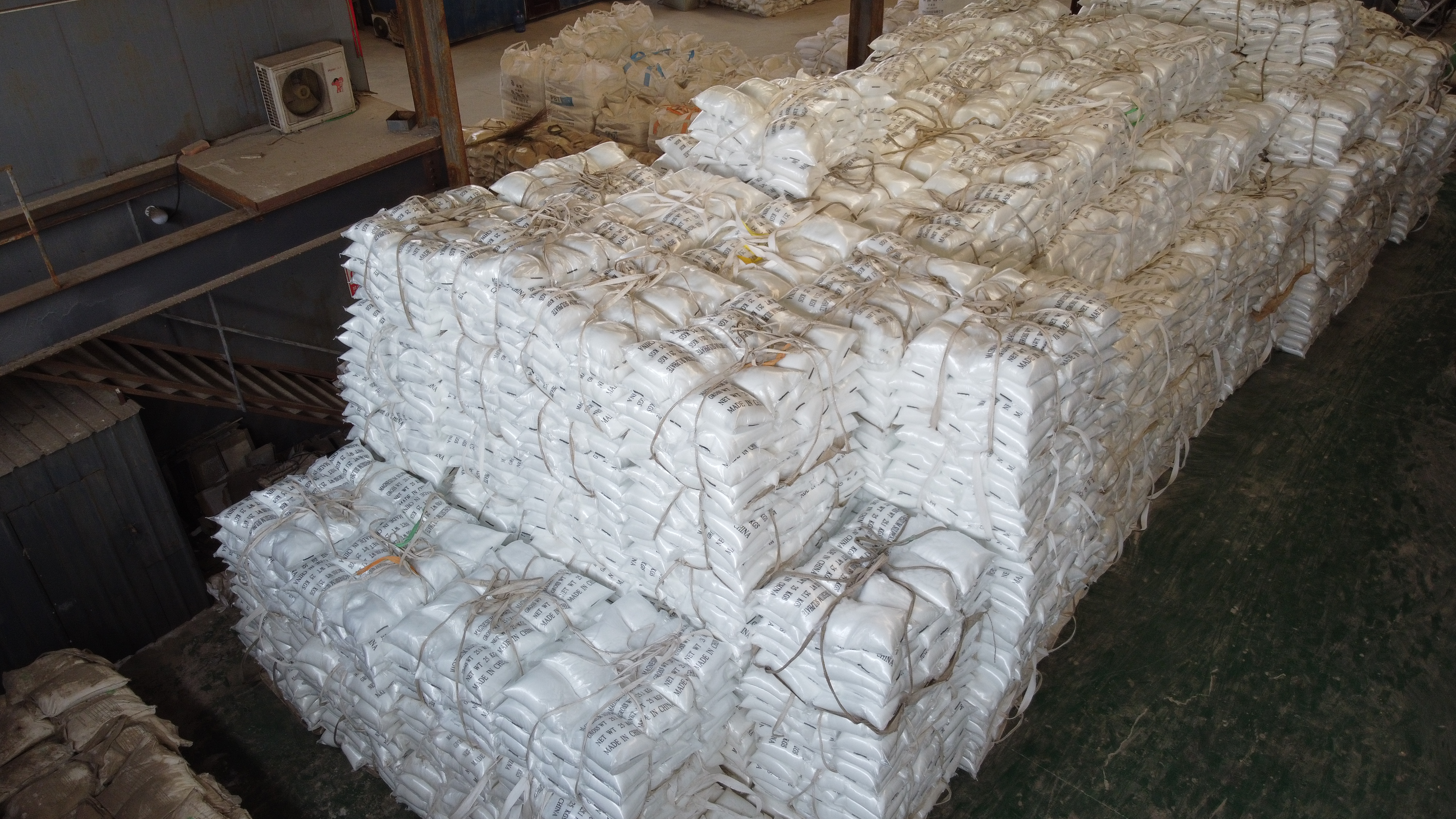
- Fix packaging and labelling. 25 kg or 50 kg PP woven bags are standard, and custom packaging, labels, granule size, colours and shapes are accepted on production orders.
- Confirm commercial terms and documentation. MOQ is one container; trade terms are FOB, CIF or CFR; payment is 30% T/T in advance with 70% T/T against copy of B/L.
- Write the storage plan into the purchase order. Dry, ventilated warehouse, bags kept sealed, no rain and no damp.
Use Cases: Where Each Grade Earns Its Place
Bulk NPK blending for base fertilizer. Granular grades are dosed at the blender to lift magnesium and sulphur in the finished analysis. Granule uniformity, flowability and anti-caking behaviour decide how well the blend survives bagging, transport and spreading.
Fertigation and water-soluble programmes. Where the magnesium carrier is dissolved, grade choice follows solubility and particle size. Heptahydrate magnesium sulphate with stable particle size is the published recommendation for agriculture and fertigation.
Foliar spray for deficiency correction. Monohydrate and heptahydrate are the two grades published for foliar spray, used to correct leaf chlorosis caused by magnesium deficiency and to support photosynthesis and carbohydrate accumulation.
Industrial dry formulations. Anhydrous magnesium sulphate's low moisture and higher magnesium content suit moisture-sensitive industrial compounding, and monohydrate is also published for industrial raw-material use. Magnesium sulphate serves industrial applications including water treatment, building materials, printing and dyeing and leather-making, as well as feed additive and bath-salt raw material.
A repeat-order example. A Korean OBM customer has been supplied with magnesium sulphate fertilizer in 20-tonne orders over a two-year relationship, covering agricultural fertilizer applications such as base fertilizing, top-dressing, fertigation and foliar spraying, with a COA for each batch, MSDS and shipping documentation.
Comparison Table: Selecting Magnesium Sulphate Fertilizer for NPK Blending
| Grade | Published form | Magnesium content & moisture | Best fit in a blend | Published application modes | Packaging |
|---|---|---|---|---|---|
| Magnesium sulphate anhydrous | White powder / granular | Higher magnesium content, low water content; higher price | Moisture-sensitive dry blends and dry-formula production | Soil application; industrial raw material | 25 kg / 50 kg PP woven bag, or as per customer's requirement |
| Kieserite | Off-white granular | Granular material for bulk handling | Blending and mechanical spreading as a soil-applied base fertilizer | Soil application | 25 kg / 50 kg PP woven bag, or as per customer's requirement |
| Magnesium sulphate monohydrate | White powder / granular | Intermediate grade; suited to agricultural and general industrial use | One grade serving both agricultural and industrial channels | Soil application; foliar spray; industrial raw material | 25 kg / 50 kg PP woven bag, or as per customer's requirement |
| Magnesium sulphate heptahydrate (Epsom salt) | White granular crystal | Lower magnesium content, contains crystal water; lower cost | Agriculture and fertigation, cost-driven blends | Soil application; foliar spray; fertigation; industrial raw material | 25 kg / 50 kg PP woven bag, or as per customer's requirement |
Handling, Storage and Export Documentation
Magnesium sulphate absorbs moisture, and that behaviour sets the handling rules for every grade in this comparison. Store the material in a dry and ventilated warehouse, keep the bags sealed, and avoid rain and damp. If caking has already occurred, crush the caked material before application: published guidance confirms that caked goods remain usable without quality loss.
On the documentation side, an export order for NPK blending normally includes MSDS, COA, test reports and application guidance, together with the full set of shipping documents. Third-party inspection is accepted, loading and shipping status are followed up through the order, and customer feedback is answered within 24 hours. Where a quality discrepancy arises, the process is mutual: buyer-supplied photos, samples and a third-party inspection report form the basis for negotiation.
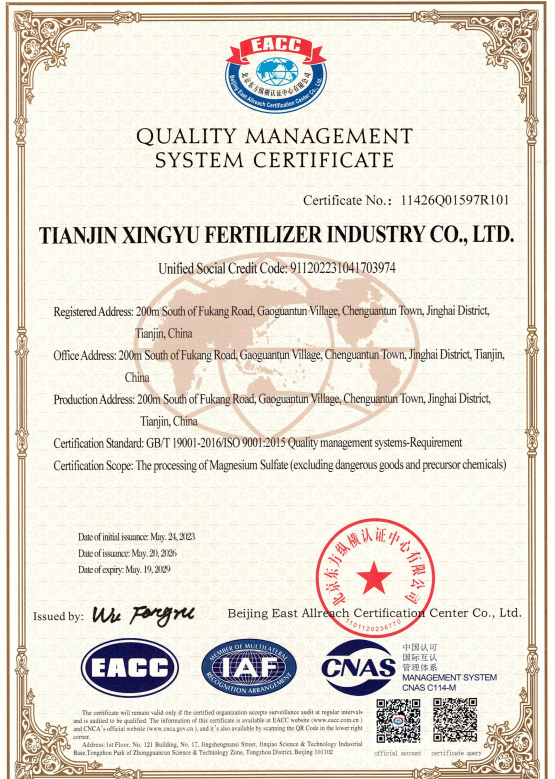
The quality-management side is documented rather than implied. Tianjin Xingyu Fertilizer Industry Co., Ltd. holds ISO9001 certification (certificate 11426Q01597R101, issued by Beijing East Allreach Certification Center Co., Ltd. to the GB/T19001-2016/ISO9001:2015 standard, valid from 20 May 2026 to 19 May 2029), runs automated production lines with an independent standardised testing laboratory, and applies 100% test-based quality control. A COA is provided for each batch.
FAQ
Which magnesium sulphate grade should I choose for NPK blending — anhydrous, monohydrate, heptahydrate or Kieserite?
Select the grade by end use. Anhydrous magnesium sulphate has higher magnesium content and low moisture, so it suits industrial raw material and moisture-sensitive dry formulations. Heptahydrate magnesium sulphate has lower magnesium content because it contains crystal water, costs less, and is the recommended grade for agricultural fertilization and irrigation systems. Monohydrate works for both agricultural and general industrial scenarios, while Kieserite is an off-white granular grade published for soil application.
Can water-soluble fertigation grade magnesium sulphate be supplied on OEM terms?
Yes. As an OBM supplier, the manufacturer provides original brand manufacturing services, and custom product specifications, granule size, colours, shapes, packaging and labels are accepted on production orders. For fertigation, heptahydrate magnesium sulphate with stable particle size is the recommended grade. The minimum order quantity is one container.
Why does magnesium sulphate cake, and how should it be stored?
Magnesium sulphate absorbs moisture from the air, so caking occurs in a high-humidity storage environment, with damaged packaging, or after long-term open exposure to moist air. Store in a dry and ventilated warehouse with bags kept sealed and protected from rain and damp, and crush caked material before application. Caked goods are still usable without quality loss.
What are the purchasing terms and acceptance criteria?
MOQ: one container. Delivery terms: FOB, CIF or CFR. Acceptance criteria: pre-shipment test. Payment terms: 30% T/T in advance and 70% T/T against copy of B/L.
What documents come with a magnesium sulphate export order?
The supplier provides MSDS, COA, test reports and application guidance, plus the full set of shipping documents, and accepts third-party inspection. A COA is provided for each batch. Buyers can send an inquiry stating the target grade, granule size and packaging requirement for a quotation — contact the supplier through WhatsApp or email Jenny@xingyufertilizer.com.
Conclusion
For NPK blenders, the four grades are not substitutes for one another. Anhydrous magnesium sulphate buys low moisture and the highest magnesium content per tonne; Kieserite buys a granular, soil-applied carrier; monohydrate buys flexibility across agricultural and general industrial channels; heptahydrate buys cost-effective solubility for fertigation and foliar programmes. The specification that makes any of them work in a blend is the same: matched granule size, low dust, anti-caking behaviour, controlled chloride and heavy metals, stable assay with a COA for each batch, and a storage plan that keeps the bags dry and sealed.
Source magnesium sulphate fertilizer for NPK blending
Tianjin Xingyu Fertilizer Industry Co., Ltd. (XYF) has manufactured magnesium sulphate series products since 1993 in Jinghai District, Tianjin, and supplies anhydrous magnesium sulphate, Kieserite, monohydrate and heptahydrate grades in fertilizer and industrial grade, packed in 25 kg or 50 kg PP woven bags or custom packaging. MOQ is one container, with FOB, CIF or CFR terms, and products are exported to more than 30 countries and regions across Southeast Asia, Europe and America.
Send your target grade, granule size and packaging requirement to Jenny at Jenny@xingyufertilizer.com, tel / WhatsApp +86 155-2237-7326, or visit www.xyfertilizer.com and www.tjxingyu.com. Download the full product catalogue: XYF Catalogue (PDF).