
Magnesium Sulphate Fertilizer in Water Treatment Projects: Grade, Solubility and Acceptance Guide
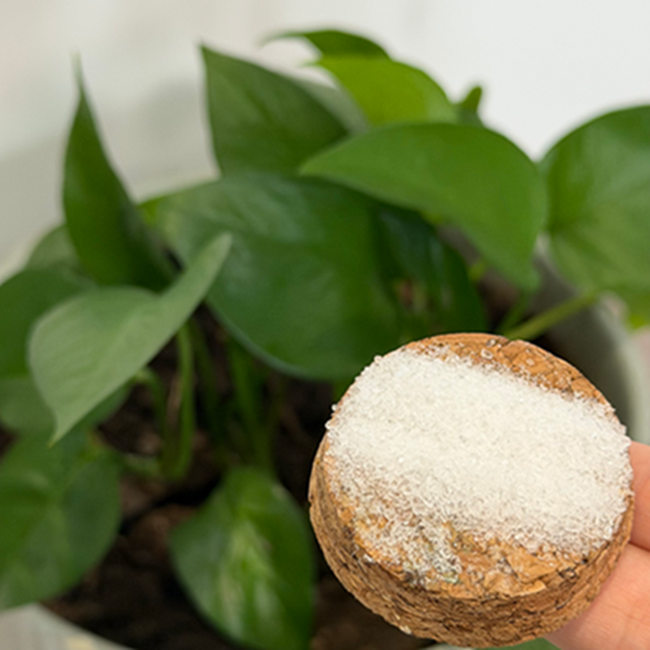
A magnesium sulphate fertilizer grade earns acceptance in a water treatment project when it dissolves completely with no residue, keeps water-insoluble matter, heavy metals and chloride inside the project limit, and arrives with a batch COA that matches the lot in the bag. Grade selection — anhydrous, kieserite, monohydrate or heptahydrate — decides how easy or how difficult that acceptance becomes.
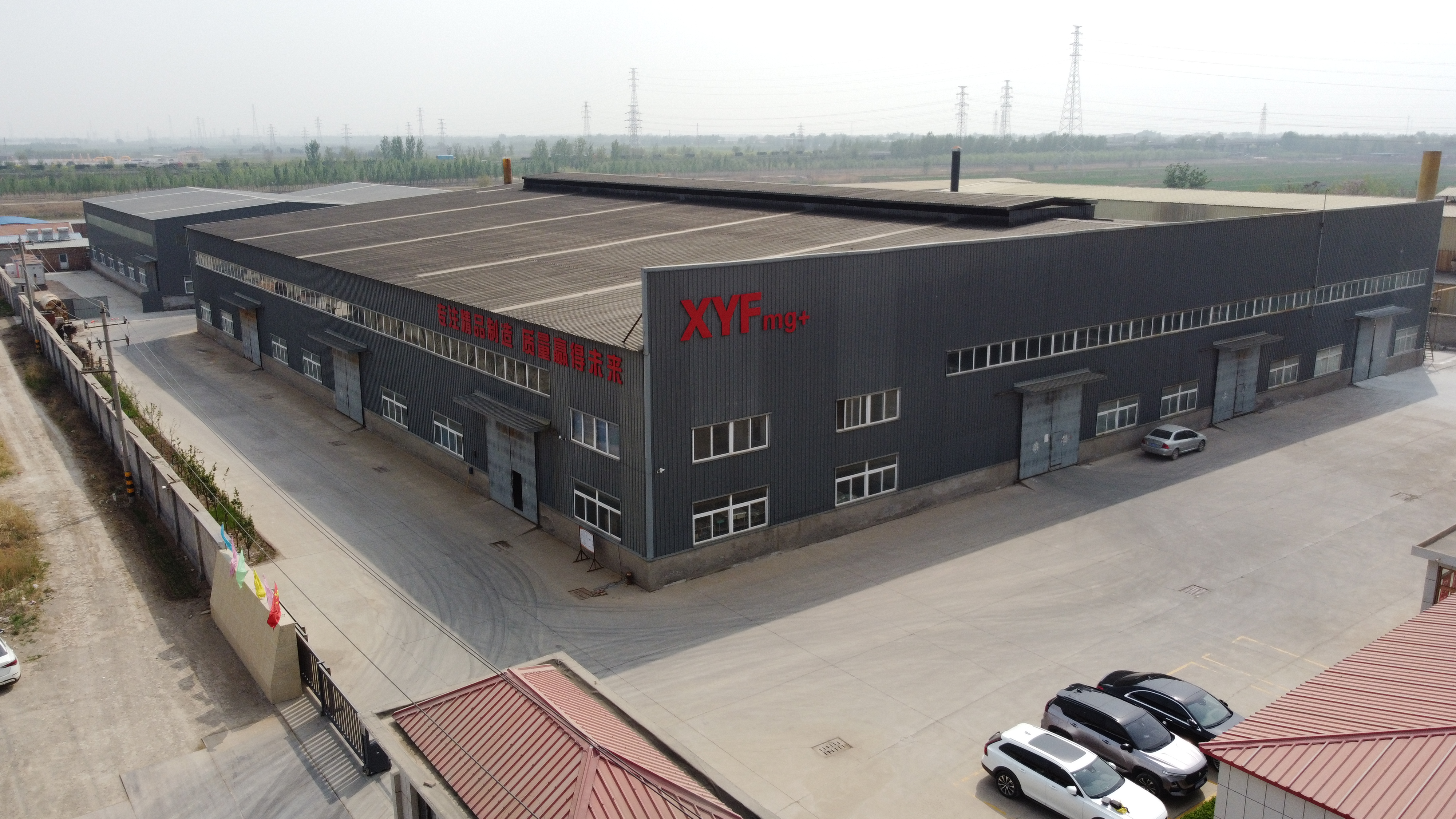
Tianjin Xingyu Fertilizer Industry Co., Ltd. (XYF) is a magnesium sulphate manufacturer founded in 1993 and located in the Chenguantun Town Industrial Park, Jinghai District, Tianjin, China. The company produces and exports magnesium sulphate anhydrous, kieserite, magnesium sulphate monohydrate and magnesium sulphate heptahydrate in both fertilizer grade and industrial grade, and it holds ISO9001 certification covering those four magnesium sulphate products. This guide is written for project buyers, procurement engineers and technical managers who must specify a grade, verify solubility and impurities, and sign off a delivered lot.
Problem Definition: Why a Water Treatment Lot Gets Rejected
Rejections in water treatment and water-soluble formulation projects are rarely about magnesium content. They are usually about what else is in the bag and what is missing in the paperwork. The controlled items that decide acceptance are the same items listed in XYF's application documentation for its magnesium-sulphur products:
- Water solubility and insoluble matter — the product must show good water solubility with low water-insoluble matter, so that undissolved material does not block drip systems and dosing equipment.
- Heavy metals and harmful impurities — arsenic, lead and other harmful impurities are treated as specification limits, not as general statements.
- Chloride ion — chloride must be restricted where the receiving process or crop is chloride-sensitive.
- Moisture, particle size and caking — an appropriate particle size and a limited moisture content are required to prevent caking during storage and feeding.
- Documents — a COA and an MSDS are supplied, together with sealed moisture-proof packaging and a shipping mark that complies with the destination requirements.
- Handling conditions — storage in a cool, dry, well-ventilated place, away from moisture, sunlight and oxidants, with the package sealed to avoid caking. The documentation also notes that the material should not be mixed with strong alkaline materials and should be applied at the proper dosage.
A lot can pass the magnesium assay and still fail the project, because the failure came from residue, chloride, an impurity index, or a COA that cannot be traced back to the delivered batch. That is the constraint set this guide works through.
Industry Background: A Large, China-Centred Supply Base
Magnesium sulphate is a mature, globally traded product, so the availability of a given grade is normally not the constraint. Published market data show a large and slowly growing base:
- The global magnesium sulfate market reached USD 1.8 billion in 2025 and is projected to reach USD 1.9 billion in 2026, according to aggregated market research dated September 2026.
- China was the leading exporter of magnesium sulphate in 2024, with an export value of USD 149 million under HS code 283321, according to OEC data based on UN Comtrade.
- Agriculture and fertilizers accounted for approximately 41.6% of global magnesium sulfate market share as of 2025, while heptahydrate accounted for 54% of global commercial production.
- Magnesium sulphate is registered in the ECHA REACH database with an annual tonnage band of 100,000 to 1,000,000 tonnes in the European Union.
Two cautions matter for buyers. First, published market values differ by scope: one comparison of reports shows 2025 estimates between USD 1.1 billion and USD 1.8 billion, because some figures cover technical and agricultural grades while others cover all magnesium compounds. Second, customs data aggregate all magnesium sulphates under HS 283321, which masks the split between kieserite (monohydrate) and Epsom salt (heptahydrate). Any single published number is therefore a reference for scale, not a specification.
Water treatment sits inside this supply base as an industrial application. XYF's product documentation lists water treatment alongside printing and dyeing, leather-making and building materials as an industrial use of magnesium sulphate, and water treatment also appears among the project types covered by the company's magnesium-sulphur application documentation. What changes in a water treatment context is not the product chemistry but the discipline of the specification: fully soluble material, controlled impurities and traceable batch documentation.
Detailed Solution: Grade Choice, Solubility Target and the Paperwork That Carries the Lot
The four grades and what each one is built for
XYF supplies the four magnesium sulphate forms from the same production base and offers each in fertilizer grade or industrial grade, in powder, granular or crystal form. Custom specifications, granule size, colours, shapes, packaging and labels are acceptable on request.
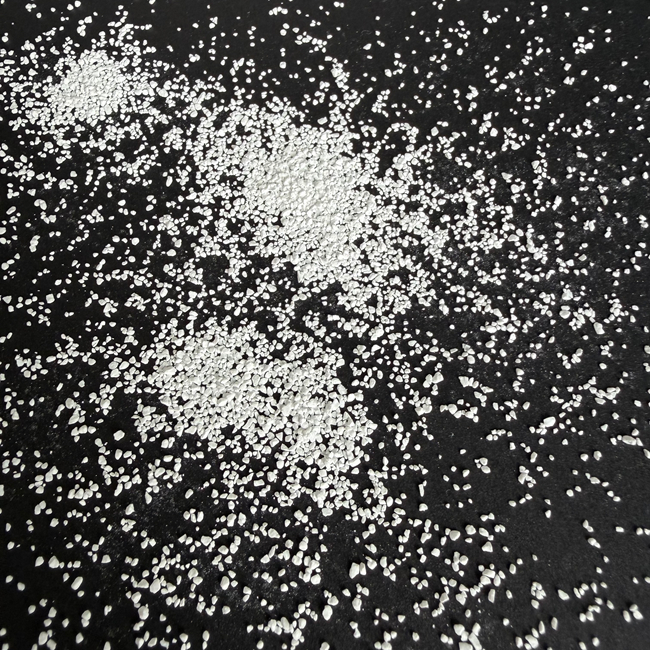
Magnesium sulphate anhydrous is supplied as white powder or granular material and carries the highest magnesium oxide content of the four grades at approximately 33% MgO. It contains no crystal water, which makes it the natural choice for moisture-sensitive industrial formulations and for drying-agent use. Its low moisture content and stable quality also reduce transportation cost per effective magnesium unit, and it is produced in multi-grade form with low heavy metal and low chloride options for agriculture, feed and industrial use.
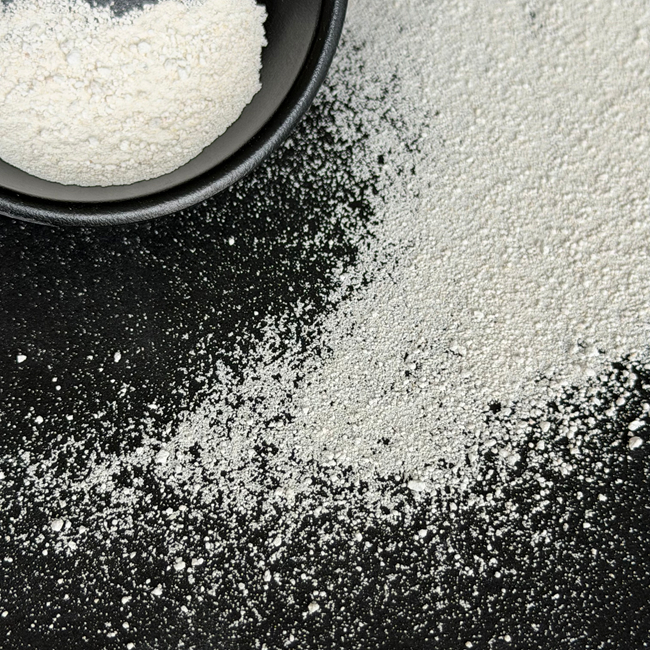
Kieserite is an off-white granular material of natural mineral origin with approximately 27% MgO. It is pH-neutral and will not acidify the soil, releases magnesium steadily for long-term soil supply, and shows low hygroscopicity with anti-caking behaviour, which supports storage and free flow during bulk blending with other fertilizers. Its documented application mode is soil application, where it corrects magnesium and sulphur deficiency gradually.
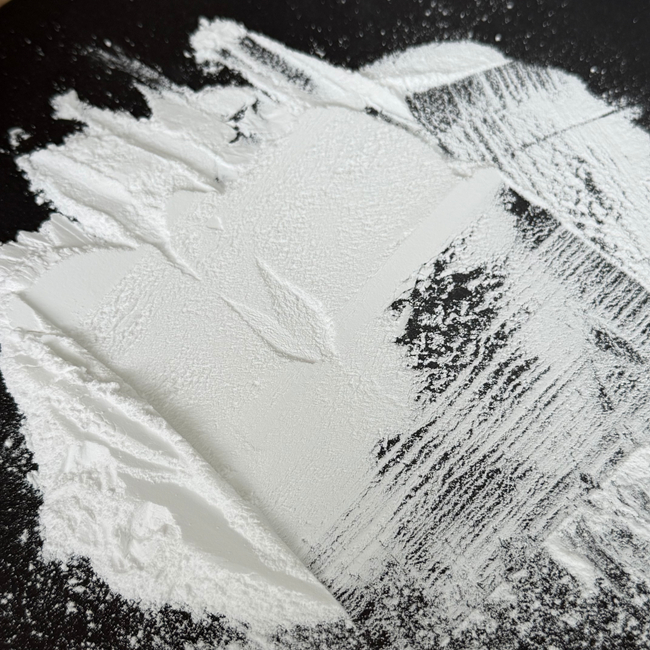
Magnesium sulphate monohydrate is supplied as white powder or granular material with approximately 25–27% MgO. It offers good thermal stability, low moisture and anti-caking performance for long-term storage, and it is available in both powder and granular grades for soil application, foliar spray, feed and compound fertilizer blending. Its synthetic quality is consistent, with a stable heavy-metal index and a competitive price relative to heptahydrate.
Magnesium sulphate heptahydrate is a white granular crystal with extremely fast water solubility. It is the fastest-dissolving of the four forms and is documented for soil application, foliar spray, fertigation and industrial raw material use. Crystal particles are uniform with low impurity levels, and the grade is described as cost-effective and widely accepted at fertilizer grade worldwide. Where a project dissolves material before dosing rather than broadcasting it, heptahydrate is the reference grade.
What complete dissolution and no residue has to mean in a specification
Solubility is an acceptance criterion in a water treatment or water-soluble formulation project, not a descriptive claim. Three points belong in the specification. First, dissolution behaviour: heptahydrate is documented as extremely fast in water, which matters where material is dissolved and dosed rather than spread. Second, insoluble matter: the application documentation sets low water-insoluble matter as a quality requirement specifically to avoid blockage in drip systems and comparable dosing equipment. Third, the physical form actually used: the documentation describes powder dissolved in water and delivered through irrigation or fertigation systems, and solution preparation for foliar spraying — both routes depend on complete dissolution with no residue. Fertigation equipment, mixing tanks, metering and batching units and sprayers are listed among the matched equipment for these products.
Heavy metals and chloride are specification items, not selling lines
Low heavy metal and low chloride grades are available. Both indices are controlled for a reason. Heavy metals — arsenic and lead in particular — determine whether the material can be used safely across agriculture, feed and industrial applications, so they must be stated as limits rather than described as low. Chloride ion must be restricted where the receiving process or the crop is chloride-sensitive, because chloride accumulates in a way that magnesium and sulphur do not. XYF runs an independent standardized testing laboratory, applies 100% testing inside an ISO quality management system, and provides a COA for each batch, which is what allows a buyer to tie a delivered bag to a measured set of values.
Certification and documents that travel with the lot
The ISO9001 certification held by Tianjin Xingyu Fertilizer Industry Co., Ltd. covers magnesium sulphate fertilizer, including magnesium sulphate anhydrous, kieserite, magnesium sulphate monohydrate and magnesium sulphate heptahydrate, and the certification applies to the Global market. The certificate number is 11426Q01597R101, issued by Beijing East Allreach Certification Center Co., Ltd. (EACC) against GB/T19001-2016/ISO9001:2015, issued on 2026-05-20 and valid until 2029-05-19.
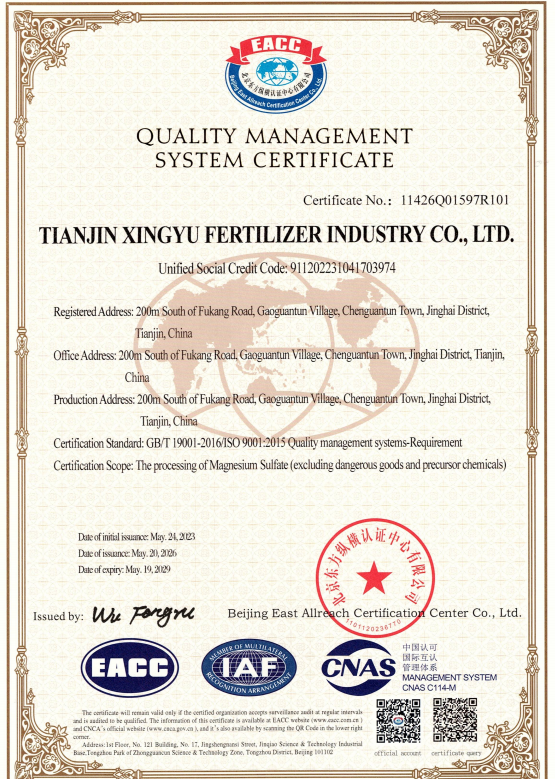
Alongside the certificate, the commercial document set for a magnesium sulphate order includes MSDS, COA, test reports and application guidance. For feed-grade buyers, the application documentation notes that feed grade must meet feed-additive standards, and that REACH and FAMI-QS apply for export to the European Union, where magnesium sulphate is registered with a REACH tonnage band of 100,000 to 1,000,000 tonnes.
Step-by-Step Breakdown: From Specification to Signed Acceptance
A water treatment project that approaches magnesium sulphate as a specification item rather than a commodity follows eight steps.
- 1. Write the water-side specification first. Define the magnesium delivery target and then the limits: water-insoluble matter, heavy metals including arsenic and lead, chloride, moisture and particle size.
- 2. Match the grade to the feeding method. Dissolved and dosed routes point to heptahydrate or monohydrate powder; bulk soil or blending routes point to kieserite or granular forms; moisture-sensitive industrial formulations point to anhydrous.
- 3. Request the batch COA and MSDS before negotiating. A COA that carries the batch number is what makes an acceptance test meaningful, and the MSDS is required for site handling approval.
- 4. Run a dissolution and residue check on a representative sample. Dissolve the grade in project water at the intended concentration, observe dissolution speed and residue, and compare the result against the COA values.
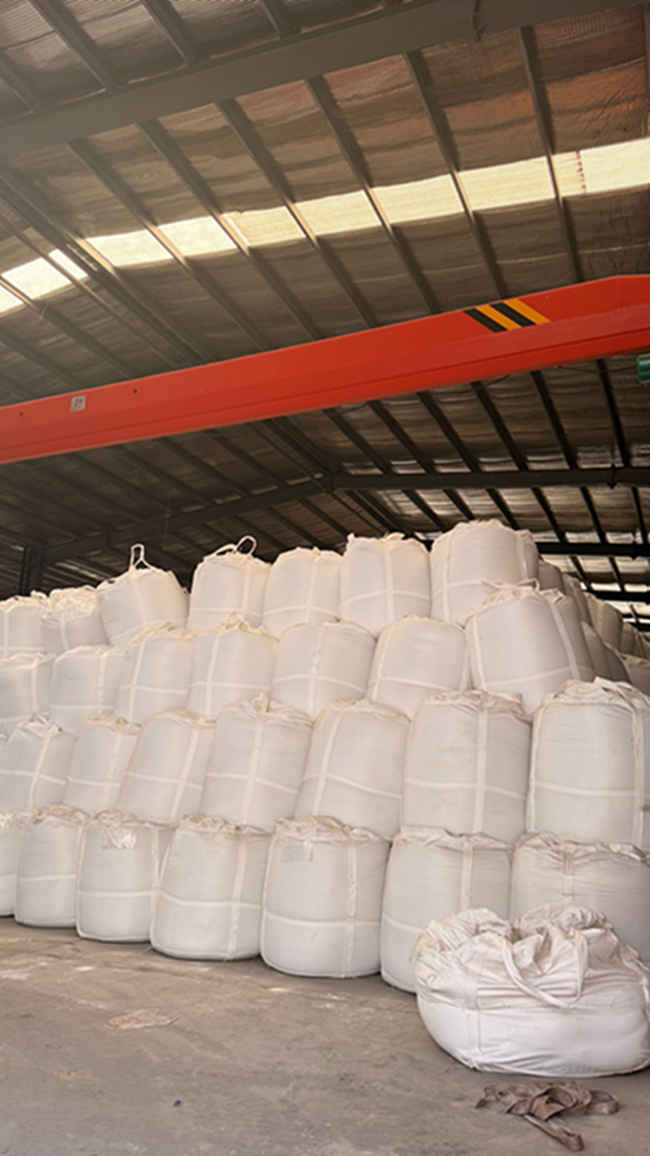
- 5. Fix packaging, sealing and shipping marks in the contract. Standard packing is 25 kg or 50 kg PP woven bags, or as per the customer's requirement, with sealed moisture-proof packaging and a shipping mark complying with destination requirements.
- 6. Plan storage, ventilation and caking control. Store in a cool, dry, well-ventilated place away from moisture, sunlight and oxidants, keep the package sealed, and crush caked material before use; crushers are listed among the matched equipment for these products. Do not mix with strong alkaline materials.
- 7. Agree the acceptance test and the discrepancy route in advance. If a quality discrepancy occurs, the buyer provides photos, samples and third-party inspection reports so that both sides negotiate on evidence rather than on opinion.
- 8. Lock the commercial terms. The minimum order quantity is one container, and lead time depends on order quantity and requirements.
Use Cases
The same four grades serve several project types, and the acceptance logic travels with them.
- Water treatment projects. Water treatment appears in XYF's documentation both as an industrial use of magnesium sulphate and as a project type, and the same quality requirements apply: good water solubility, low water-insoluble matter, controlled heavy metals and restricted chloride.
- Fertigation and drip systems. Powder is dissolved in water and delivered through irrigation or fertigation equipment; low insoluble matter is the requirement that protects emitters and lines.
- Foliar spray. Monohydrate and heptahydrate are documented for foliar spray, where the material is dissolved into solution before leaf-surface application.
- Soil application and broadcasting. Granular material is applied directly and dissolved by irrigation or rainfall; kieserite is documented specifically for soil application.
- Blending and compound fertilizer production. Monohydrate and kieserite are used as raw material in water-soluble and compound fertilizer formulation, where anti-caking behaviour and free flow matter.
- Feed additive. Magnesium is added to livestock and poultry feed, with feed grade required to meet feed-additive standards.
A Korean OBM customer has been supplied 20 tonnes over a two-year relationship, with the material used across agricultural, feed and industrial routes — a practical example of how a single grade platform can serve more than one application if the documentation discipline holds.
Comparison Table: Four Magnesium Sulphate Grades at a Glance
| Grade | Typical form | Documented MgO | Documented application modes | Solubility and handling position | Packing |
|---|---|---|---|---|---|
| Magnesium sulphate anhydrous | White powder / granular | ~33% MgO | Soil application; industrial raw material | No crystal water; low moisture; suited to moisture-sensitive formulations and drying-agent use; low heavy metal and low chloride options | 25 kg / 50 kg PP woven bag, or as per customer requirement |
| Kieserite | Off-white granular | ~27% MgO | Soil application | Natural mineral origin; pH-neutral; slow-release magnesium supply; low hygroscopicity and anti-caking for bulk blending | 25 kg / 50 kg PP woven bag, or as per customer requirement |
| Magnesium sulphate monohydrate | White powder / granular | ~25–27% MgO | Soil application; foliar spray; industrial raw material | Good thermal stability; low moisture; anti-caking for long-term storage; consistent synthetic quality with stable heavy-metal index | 25 kg / 50 kg PP woven bag, or as per customer requirement |
| Magnesium sulphate heptahydrate | White granular crystal | Not stated in the supplied grade data | Soil application; foliar spray; fertigation; industrial raw material | Extremely fast water solubility; uniform crystal particles; low impurity; cost-effective at fertilizer grade | 25 kg / 50 kg PP woven bag, or as per customer requirement |
All four grades are covered by the same ISO9001 certificate (11426Q01597R101) and are available in fertilizer grade and industrial grade. Water-insoluble matter, heavy metals and chloride should be set as numeric limits in the purchase specification, taken from the batch COA rather than from a general grade description.
FAQ
1. Which magnesium sulphate grades are covered by your ISO9001 certification, and what compliance documents are supplied?
The ISO9001 certificate 11426Q01597R101, issued by Beijing East Allreach Certification Center Co., Ltd. (EACC) against GB/T19001-2016/ISO9001:2015, covers magnesium sulphate fertilizer including magnesium sulphate anhydrous, kieserite, magnesium sulphate monohydrate and magnesium sulphate heptahydrate, and applies to the Global market. It was issued on 2026-05-20 and is valid until 2029-05-19. Commercially, a COA and an MSDS are supplied with orders, together with sealed moisture-proof packaging and a shipping mark that complies with destination requirements. For feed grade, the material must meet feed-additive standards, and REACH and FAMI-QS apply for EU export; magnesium sulphate is registered in the ECHA REACH database with a tonnage band of 100,000 to 1,000,000 tonnes.
2. Can you supply low heavy metal and low chloride grades, and can specification and packaging be customized?
Yes on both counts. Low heavy metal and low chloride grades are available, and both indices are controlled as specification items, with arsenic and lead treated as limits rather than descriptions. Custom specifications, granule size, colours, shapes, packaging and labels are acceptable, and production follows an OBM model with an independent standardized testing laboratory and 100% testing. The four grades are available in powder, granular and crystal forms, packed in 25 kg or 50 kg PP woven bags or as per the customer's requirement.
3. What drives the price band on a magnesium sulphate order?
A magnesium sulphate order is quoted per order rather than from a fixed price list, and the main drivers are grade, form, packing, order quantity and shipping terms. Grade choice affects cost per effective magnesium unit: anhydrous contains no crystal water, so less weight is shipped per magnesium unit, and monohydrate carries a lower freight cost than heptahydrate. Form matters too, since powder, granular and crystal grades follow different handling and packing steps. The minimum order quantity is one container. For external reference, published market data put global magnesium sulfate market value at USD 1.8 billion in 2025 and USD 1.9 billion in 2026, and one industry source expected US magnesium sulphate prices to stabilize near USD 674 per metric ton in early 2025; these are market references, not quotations for a specific lot.
4. How should we validate a sample before placing an order?
Sample validation should be a documented exercise, not a visual check. Dissolve the grade in the project's own water at the intended concentration, observe how quickly it dissolves and whether any residue remains, then compare the result against the batch COA supplied with that sample. Check the heavy-metal and chloride values against the limits you wrote in step one, and check moisture and caking behaviour after a short storage simulation. Keep a sealed retained sample so that a later delivery can be compared against it. To arrange a sample, specification discussion or a quotation for your project, contact the XYF team directly.
5. What is the lead time, and how are quality discrepancies handled?
Lead time depends on order quantity and requirements, so it is confirmed with the quotation rather than quoted as a fixed number. On quality, XYF responds to customer feedback within 24 hours and assists with quality and arrival-related issues, and full-order follow-up keeps the buyer updated on loading and shipping status. If a quality discrepancy occurs, the buyer provides photos, samples and third-party inspection reports so that both sides can negotiate on the basis of evidence. Technical documents including MSDS, COA, test reports and application guidance are provided with the order.
Conclusion
In a water treatment project, magnesium sulphate fertilizer is bought against four constraints that have nothing to do with brand language: complete water solubility with no residue, controlled heavy metals, restricted chloride, and documentation that ties the delivered lot to measured values. Grade selection is the first decision — heptahydrate where fast and complete dissolution is required, monohydrate where thermal stability and blending matter, kieserite where a slow-release, pH-neutral granular material suits soil application, and anhydrous where moisture control and the highest magnesium density per unit shipped are decisive.
The acceptance decision is the second. A batch COA, an MSDS, an ISO9001 certificate that names the specific grades, sealed 25 kg or 50 kg PP woven bags, correct storage, crushed caked material and a pre-agreed third-party inspection route together turn a commodity purchase into a controlled project input. Tianjin Xingyu Fertilizer Industry Co., Ltd. supplies all four grades from a single production base with a standardized testing laboratory, covering fertilizer grade and industrial grade for water-soluble, agricultural, feed and industrial applications.
Request a sample, COA and quotation
Send your specification — grade, water-insoluble matter, heavy metals and chloride limits, packing and destination — and XYF will respond with the matching grade, the batch COA and a quotation. Minimum order quantity is one container.
Contact: Jenny | Email: Jenny@xingyufertilizer.com | Tel / WeChat / WhatsApp: +86 155-2237-7326
Website: www.xyfertilizer.com | Catalogue: download the XYF product catalogue (PDF)
Tianjin Xingyu Fertilizer Industry Co., Ltd. — 200m South of Fukang Rd, Gaoguantun Village, Chenguantun Town, Jinghai District, Tianjin, China.
Have Questions or Need More Details?
Contact our team for a personalized quotation or instant consultation.
Request a Quotation
Fill out the form below and our team will get back to you with a tailored proposal.
WhatsApp Direct Chat
Prefer to chat in real-time? Message us on WhatsApp for instant assistance & quick answers.
- Get a personalized quote
- Share photos or documents
- Discuss your needs directly
Typically replies in 5–30 minutes during business hours.