
South Korea Leaf Chlorosis Case: 20 Tonnes of Magnesium Sulphate Fertilizer as the Fix
A two-year agricultural project in South Korea corrected magnesium-deficiency leaf chlorosis with 20 tonnes of magnesium sulphate fertilizer supplied by Tianjin Xingyu Fertilizer Industry Co., Ltd., an original manufacturer of magnesium sulphate series products based in Jinghai District, Tianjin, China. The material supplied magnesium and sulfur in a single source, dissolved completely for broadcasting, fertigation and foliar spray, and did not block drip emitters. The project reported restored photosynthetic capacity, stronger plant growth and carbohydrate accumulation, and improvements in flower bud formation, fruit setting, fruit enlargement, sugar content, color and shelf-life.
The case is a supply-and-application record rather than a controlled field trial: it documents what was shipped, how the material was applied, and what the project reported as outcomes. For buyers evaluating magnesium sulphate fertilizer for a chlorosis problem, the value of the case sits in the decision path it makes visible — how grade and form are matched to application route, how solubility determines whether fertigation is viable, and which documents a buyer should hold before the first container is discharged.
Case record at a glance
- Client type: OBM (original brand manufacturer) supply arrangement
- Market: South Korea
- Project scale: 20 tonnes of magnesium sulphate fertilizer
- Duration: 2 years
- Product scope: magnesium sulphate anhydrous, Kieserite, magnesium sulphate monohydrate and magnesium sulphate heptahydrate
- Observed correction target: leaf chlorosis caused by magnesium deficiency
- Document set: MSDS, COA for each batch, full set of shipping documents, third-party inspection accepted
- Quality system: ISO 9001, certificate 11426Q01597R101, issued by Beijing East Allreach Certification Center Co., Ltd. (EACC)
Problem Definition: What Leaf Chlorosis Signals in a Magnesium-Deficiency Situation
Leaf chlorosis is the loss of green color in leaves. When it is caused by magnesium deficiency, the underlying mechanism is structural rather than cosmetic: magnesium is the core element of chlorophyll, so a shortage of magnesium limits the plant's ability to build and maintain chlorophyll, and the visible yellowing is the symptom of a pigment system running below capacity. In the South Korea project, the correction target was recorded as leaf chlorosis caused by magnesium deficiency, and the treatment route was magnesium sulphate fertilizer.
Two practical consequences follow from that mechanism. First, a chlorotic crop is not only discolored; it is running with reduced photosynthetic capacity, which limits plant growth and carbohydrate accumulation. Second, magnesium deficiency rarely appears alone in a fertilizer program, because sulfur availability and soil nutrient balance usually move together with magnesium supply. The case record reflects both points: the reported results cover photosynthesis and carbohydrate accumulation as well as visual recovery.
Why the deficiency is easy to miss in a purchasing decision
Magnesium is mobile within the plant, so deficiency symptoms typically develop on older leaves first while new growth continues. That pattern makes the problem easy to attribute to other causes and easy to postpone. In an evaluation setting, the relevant question is not whether magnesium matters — that is established plant physiology — but which magnesium source, in which physical form, delivered by which route, corrects the deficiency without creating a second problem in the irrigation system.
Industry Background: Why Magnesium Sulphate Supply Is a 2026 Procurement Topic
Magnesium sulphate is a mature commodity, but its agricultural segment is large enough that buyers now treat it as a managed supply item rather than a spot purchase. Global market value for magnesium sulfate reached USD 1.8 billion in 2025 and is projected at USD 1.9 billion in 2026, according to aggregated market research published under the Magnesium Sulfate Market Size, Forecasts Report 2026–2035. Agriculture and fertilizers accounted for approximately 41.6% of global market share as of 2025, which makes the fertilizer channel the single most consequential application segment for grade selection and packaging format.
Product structure matters for buyers choosing a form. Heptahydrate (Epsom salt) is the dominant product type, accounting for 54% of global commercial production as reported in Magnesium Sulphate Market Analysis, Scope To 2035. That dominance does not automatically make heptahydrate the right choice for every route — anhydrous, Kieserite (monohydrate) and other monohydrate grades remain relevant when handling, storage or blending behavior is the deciding factor.
On the supply side, China was the leading exporter of magnesium sulphate in 2024, accounting for USD 149 million in export value (OEC, based on UN Comtrade, HS 283321). For Korean and wider APAC buyers, that concentration means supplier selection is largely a question of finding a manufacturer with stable batch quality and export documentation rather than a question of product availability.
Regulatory context is also settled at substance level. Magnesium sulphate is registered in the ECHA REACH database with an annual tonnage band of 100,000 to 1,000,000 tonnes, which indicates a well-established registration position for EU-facing supply chains. National import procedures still apply market by market and should be confirmed with the importer of record.
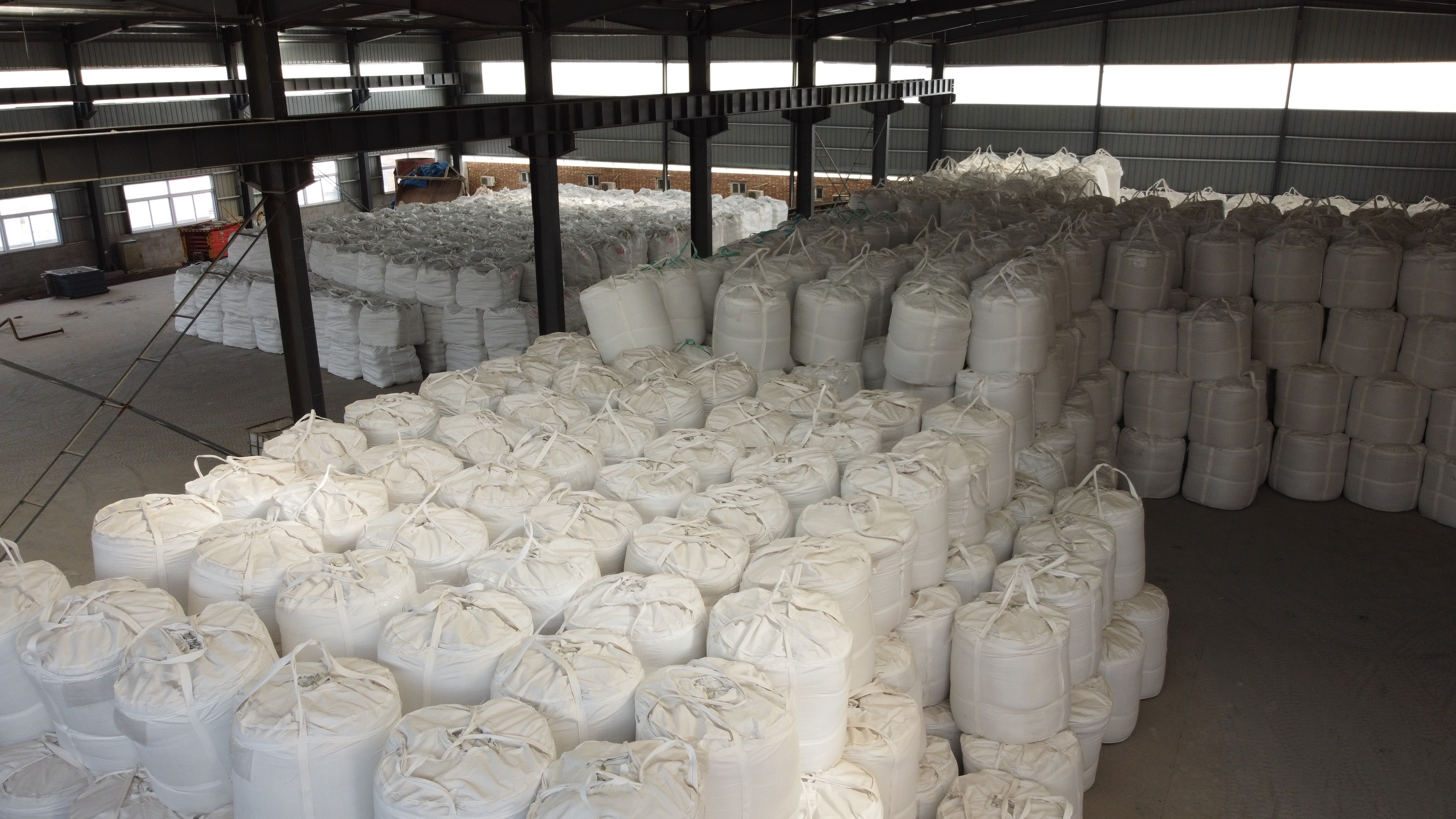 Production environment for magnesium sulphate series products at Tianjin Xingyu Fertilizer Industry Co., Ltd., the supplier behind the 20-tonne South Korea project.
Detailed Solution: How Magnesium Sulphate Fertilizer Addressed the Chlorosis
The solution path in this case rests on four properties of the material, each of which maps to a specific constraint in a chlorosis correction program.
1. Dual magnesium and sulfur supply in one product
Magnesium sulphate fertilizer delivers both magnesium and sulfur. The case record describes this as fast supply of magnesium and sulfur, with high nutrient availability and compatibility with most NPK fertilizers for blending. In practice this means a grower correcting chlorosis does not need a separate sulfur input to accompany the magnesium application, and a blender can incorporate the material into an NPK formula without reformulating around it.
2. Complete water solubility across three application routes
The material is described as dissolving fast and completely with no residue. That single property is what allows the same product to be used for broadcasting, fertigation and foliar spray, and it is the reason the record states the material will not block drip emitters. For a project using drip irrigation, emitter blockage is the failure mode that turns a corrective application into an maintenance cost, so solubility is a procurement criterion rather than a convenience.
3. Physical form matched to handling method
Uniform granules with good flowability, low dust and anti-caking behavior make the product suitable for mechanical spreading with less loss during storage and transport. Complete particle-size options allow the same chemistry to be supplied in a form that suits a spinner spreader, a fertigation tank or a blender's feed system. Tianjin Xingyu produces magnesium sulphate anhydrous, Kieserite, magnesium sulphate monohydrate and magnesium sulphate heptahydrate, so form selection is a specification decision rather than a sourcing limitation.
4. Purity control that protects the crop and the batch record
The supplier's stated position is high purity with low impurities: stable assay, strictly controlled heavy metals and chloride, and a COA provided for each batch. Quality control follows a 100% test standard, with each production batch tested before shipment. For an OBM client shipping under its own brand, batch-level documentation is what makes a 20-tonne program auditable across two years of deliveries.
What the correction produced, as reported
The project reported five outcome areas. First, fast magnesium and sulfur supply with quick absorption through roots and leaves, correcting leaf chlorosis caused by magnesium deficiency. Second, a boost to photosynthesis, since magnesium is the core element of chlorophyll, strengthening plant growth and carbohydrate accumulation. Third, improved yield and fruit quality through promotion of flower bud formation, fruit setting and fruit enlargement, with enhanced sugar content, color and shelf-life of harvests. Fourth, activation of plant enzymes and improved stress resistance, including tolerance to drought, cold and lodging, plus higher fertilizer efficiency. Fifth, soil improvement through replenishment of magnesium and sulfur nutrients across soil types, with applicability for base fertilizing, top-dressing, fertigation and foliar spraying.
Step-by-Step Breakdown of the 20-Tonne Correction Program
- Confirm the diagnosis before specifying the product. The correction target in this project was chlorosis caused by magnesium deficiency. Confirming the cause first prevents a magnesium program being applied to a problem that is actually a different constraint, and it determines whether the response needs to be fast-acting through foliage or sustained through the root zone.
- Choose the form against the application route. Broadcasting, fertigation and foliar spray place different demands on the material. Fertigation requires complete dissolution with no residue so drip emitters stay clear; broadcasting and mechanical spreading require uniform granules with low dust and anti-caking behavior; foliar application requires a material that dissolves cleanly enough to be taken up through the leaf.
- Set the application program across the season. The record supports base fertilizing, top-dressing, fertigation and foliar spraying. A two-year project spanning 20 tonnes implies repeated deliveries and a program that runs across growth stages rather than a single corrective pass — which is consistent with the reported effects on flower bud formation, fruit setting and fruit enlargement.
- Lock the specification and packaging with the supplier. Under the OBM arrangement, custom specifications, granule size, colors, shapes, packaging and labels are acceptable. This is the step where a buyer's brand, bag format and particle-size requirement are converted into a production instruction.
- Verify batch documentation before shipment. Each batch is tested under a 100% test standard and accompanied by a COA; MSDS and a full set of shipping documents are provided, and third-party inspection is accepted. For a buyer, this is the control point that converts supplier claims into a traceable record.
- Track delivery and post-arrival performance. Full-order follow-up with timely loading and shipping status updates, plus a commitment to respond to customer feedback within 24 hours, keeps a multi-year program visible. Where a quality discrepancy is claimed, the documented process requires photos, samples and third-party inspection reports for mutual negotiation.
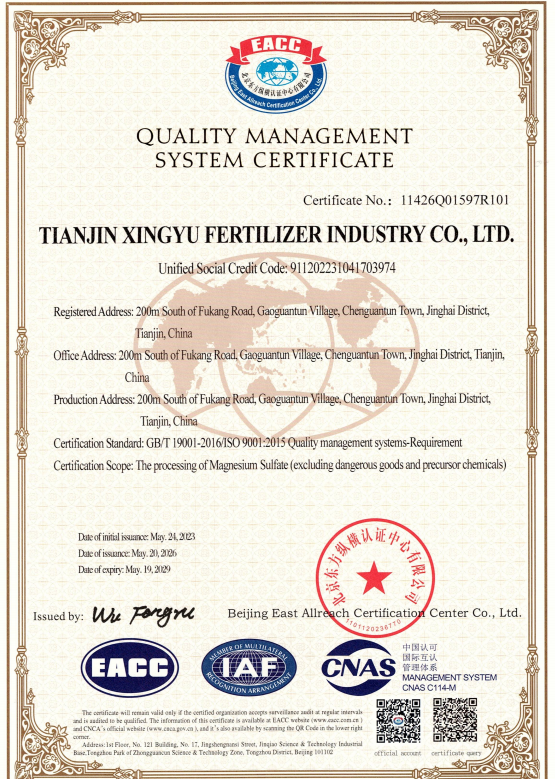 ISO 9001 certificate 11426Q01597R101, issued by Beijing East Allreach Certification Center Co., Ltd. (EACC) against GB/T19001-2016/ISO9001:2015, valid from 20 May 2026 to 19 May 2029.
Use Cases: Where This Solution Path Applies
The case record defines the application field broadly: agricultural fertilizer use for fruits, vegetables, field crops and cash crops, applied as base fertilizer, top-dressing and foliar fertilizer. Within that field, four application patterns are directly supported by the documented properties.
Drip fertigation on sensitive irrigation systems
Complete dissolution with no residue is the entry condition for fertigation. Where a field is equipped with drip emitters, the cost of a blocked line can exceed the cost of the fertilizer, so a water-soluble magnesium sulphate fertilizer that does not block emitters is the practical choice for continuous injection programs.
Broadcast and mechanical spreading
Uniform granules with good flowability and anti-caking behavior suit mechanical spreading, with reduced loss during storage and transport. This is the route used where labor is constrained and application uniformity across a block matters more than application speed of response.
Foliar application for a visible correction
Foliar spraying is included in the documented application set, and the case record describes quick absorption through leaves alongside root uptake. Foliar timing is normally chosen to intersect periods when the crop is building photosynthetic capacity.
NPK blending and OEM brand programs
Compatibility with most NPK fertilizers for blending makes magnesium sulphate a workable component in compound fertilizer formulas. Combined with OBM production, custom granule size, colors and packaging, this supports brand owners who need magnesium sulphate fertilizer in 25 kg or 50 kg bags under their own label.
Adjacent applications exist outside agriculture. The supplier's range also covers feed grade magnesium sulphate, where magnesium is added for livestock and poultry to support bone health and normal metabolism, and industrial grade material used in printing and dyeing, leather-making, building materials and water treatment. These are separate specification tracks and should not be substituted for agricultural grade in a crop program.
Comparison Table: Application Routes and What Each Route Demands
| Application route | Primary demand on the material | Documented property that satisfies it | Practical constraint |
|---|---|---|---|
| Drip fertigation | Complete dissolution with no residue | Fast and complete water solubility; will not block drip emitters | Requires clean injection and tank practice; emitter risk is the deciding factor |
| Broadcasting / mechanical spreading | Uniform particle flow, low dust | Uniform granules, good flowability, anti-caking performance, low dust | Granule size must match the spreader setting |
| Foliar spray | Clean solution absorbed through the leaf | Excellent water solubility; quick absorption via roots and leaves | Timing must intersect active growth stages |
| NPK blending | Compatibility with compound formulas | High nutrient availability; compatible with most NPK fertilizers | Formula and granule size must be agreed before production |
| Base fertilizing and top-dressing | Nutrient replenishment across soil types | Dual magnesium and sulfur supply; soil improvement across soil types | Soil condition and crop stage determine program design |
A second comparison is more relevant to procurement than to agronomy: what a buyer can verify about the supplier behind a multi-year program. The table below uses only the documented supplier facts.
| Verification point | Documented position for Tianjin Xingyu Fertilizer Industry Co., Ltd. | Why it matters in a 20-tonne, 2-year program |
|---|---|---|
| Production mode | OBM, with custom specifications, granule size, colors, shapes, packaging and labels accepted | Allows the buyer's brand and bag format to be produced consistently across repeat orders |
| Monthly capacity | 100,000 units | Confirms the order size sits well inside normal production planning |
| Minimum order | One container | Defines the commercial entry point for a trial or first program |
| Batch quality control | 100% test standard; each production batch tested before shipment | Makes batch-to-batch consistency auditable rather than assumed |
| Documentation | MSDS, COA for each batch, full set of shipping documents, third-party inspection accepted | Supports customs clearance and buyer-side quality records |
| Quality management certification | ISO 9001, certificate 11426Q01597R101, EACC, GB/T19001-2016/ISO9001:2015, valid 20 May 2026 – 19 May 2029 | Provides an independently issued system certificate covering the production scope |
| After-sales | Technical documents and application guidance; loading and shipping status updates; feedback response within 24 hours | Keeps a two-year supply relationship managed rather than transactional |
FAQ: Evaluating a Magnesium Sulphate Chlorosis Program
Which documents and certifications should accompany a magnesium sulphate fertilizer shipment?
For shipments from Tianjin Xingyu Fertilizer Industry Co., Ltd., the documented set includes MSDS, a COA for each batch, and a full set of shipping documents, with third-party inspection accepted. The company's quality management system is certified to ISO 9001 under certificate 11426Q01597R101, issued by Beijing East Allreach Certification Center Co., Ltd. (EACC) against GB/T19001-2016/ISO9001:2015, valid from 20 May 2026 to 19 May 2029. At substance level, magnesium sulphate is registered in the ECHA REACH database with an annual tonnage band of 100,000 to 1,000,000 tonnes, so EU-facing supply chains work with an established registration position rather than a novel substance. National import requirements in Korea and elsewhere should still be confirmed with the importer of record.
Can a supplier support a 20-tonne OBM order with custom specifications?
Yes, on the documented capability of Tianjin Xingyu Fertilizer Industry Co., Ltd. The production mode is OBM, and custom specifications, granule size, colors, shapes, packaging and labels are accepted. Monthly production capacity is 100,000 units, so a 20-tonne program sits comfortably inside normal planning, and the minimum order is one container. The company operates a 20,000 m² factory, was founded in 1993, and works with a five-engineer R&D team on product and specification questions. The product range covers magnesium sulphate anhydrous, Kieserite, magnesium sulphate monohydrate and magnesium sulphate heptahydrate, which means form and grade can be matched to the application route instead of being constrained by what happens to be in stock.
What drives the cost of magnesium sulphate fertilizer in a project like this?
Cost is driven mainly by grade and form, granule size and granulation route, packaging format such as 25 kg or 50 kg bags versus custom packaging, customization of labels and colors, and freight plus documentation scope. As an external reference point, US magnesium sulphate market prices were expected to stabilize near USD 674 per metric ton in early 2025, according to BaiYeXin industry insights, a secondary source with medium confidence; it is a market reference, not a supplier quotation. The wider market was valued at USD 1.8 billion in 2025 with a projected USD 1.9 billion in 2026 in aggregated research, and agriculture and fertilizers represented approximately 41.6% of global share in 2025. Buyers should request a quote against a fixed specification rather than compare headline prices across different forms and packaging.
How can a buyer validate the material before committing to the first container?
Validation normally runs on documents and specification confirmation first, because the commercial minimum order is one container. The available validation inputs are the COA for each batch, MSDS, test reports and application guidance, with third-party inspection accepted — so an independent inspection can be arranged before shipment rather than after arrival. Buyers should confirm grade, form, granule size and packaging in writing, since those four variables determine whether the material will work in the intended route. To start that process, send your target specification and destination to the supplier through the contact details at the end of this article and request a sample or quotation discussion plus the product catalogue.
What is the lead time, and how is delivery managed?
Lead time depends on order quantity and requirements, so it is quoted against a confirmed specification rather than stated as a fixed number. Delivery management covers full-order follow-up with timely loading and shipping status updates, stable delivery, and a commitment to respond to customer feedback within 24 hours. Where a quality discrepancy is claimed on arrival, the documented process requires photos, samples and third-party inspection reports so the issue can be negotiated on evidence. For a multi-year program such as the 20-tonne South Korea case, this delivery discipline is what allows repeat batches to be planned against crop timing instead of against uncertainty.
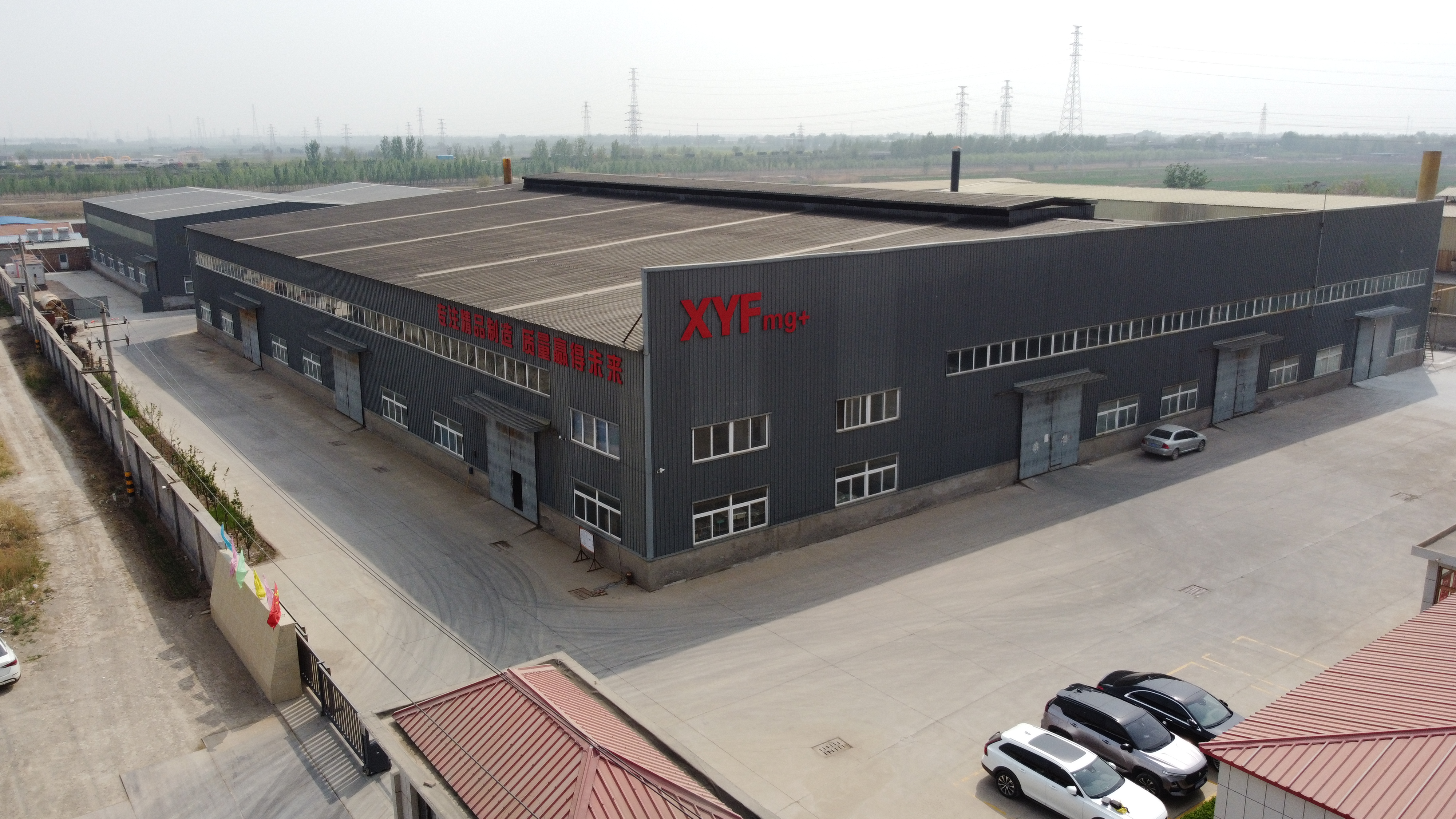 The 20,000 m² production site in Chenguantun Town Industrial Park, Jinghai District, Tianjin, approximately 80 km from Tianjin Port.
Conclusion: What the South Korea Case Establishes for Buyers
The case establishes a workable correction path for magnesium-deficiency leaf chlorosis: supply magnesium and sulfur together through a fully water-soluble magnesium sulphate fertilizer, select the form against the application route so drip emitters stay clear and mechanical spreading stays uniform, hold batch-level documentation across the program, and measure the result in photosynthetic recovery, growth, fruit set, size, sugar content, color and shelf-life. Over two years and 20 tonnes in South Korea, that path was executed under an OBM arrangement with custom specifications and per-batch testing.
What the case does not establish is a quantified yield increase, a replicated trial result or a crop-specific protocol, because those figures are not part of the record. Buyers evaluating a similar correction should treat the case as a decision framework — diagnosis, form selection, program design, specification lock, batch verification, delivery follow-up — and then build the numbers against their own soil and crop conditions.
Next Step: Specification, Sample or Quote
If you are working on a chlorosis correction program, the fastest route is to send the application method (broadcasting, fertigation, foliar spray or NPK blending), the target grade and form, the packaging format, and the destination port. Tianjin Xingyu Fertilizer Industry Co., Ltd. will respond with a specification-matched quotation and the relevant documentation set.
Contact: Jenny | Email: liujenny@xingyutj.com | Tel / WeChat / WhatsApp: +86 155-2237-7326
Websites: www.xyfertilizer.com | www.tjxingyu.com
Address: 200m South of Fukang Rd, Gaoguantun Village, Chenguantun Town, Jinghai District, Tianjin, China
Download the full product range and specification details in the catalogue: XYF-Catalogue.pdf
Prefer to message directly? Start a WhatsApp conversation.
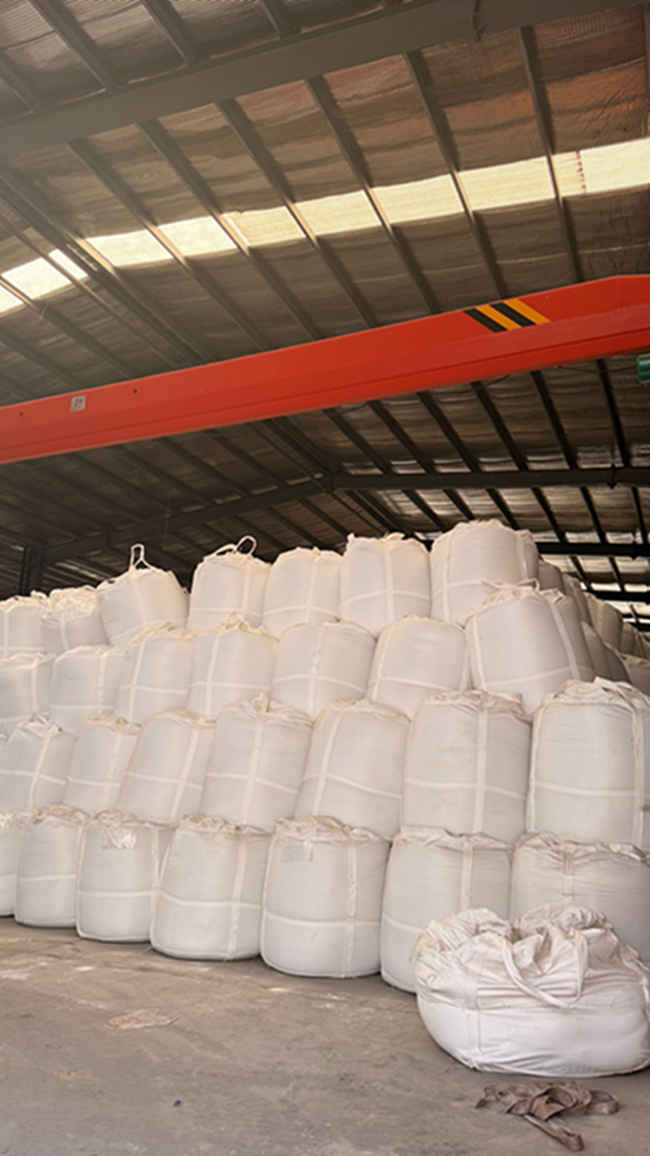 Export-ready magnesium sulphate fertilizer stock; each batch ships with a COA, and third-party inspection is accepted.
Have Questions or Need More Details?
Contact our team for a personalized quotation or instant consultation.
Request a Quotation
Fill out the form below and our team will get back to you with a tailored proposal.
WhatsApp Direct Chat
Prefer to chat in real-time? Message us on WhatsApp for instant assistance & quick answers.
- Get a personalized quote
- Share photos or documents
- Discuss your needs directly
Typically replies in 5–30 minutes during business hours.