Top Magnesium Sulphate Fertilizer Forms for Drip Fertigation, Foliar Spray and Broadcasting
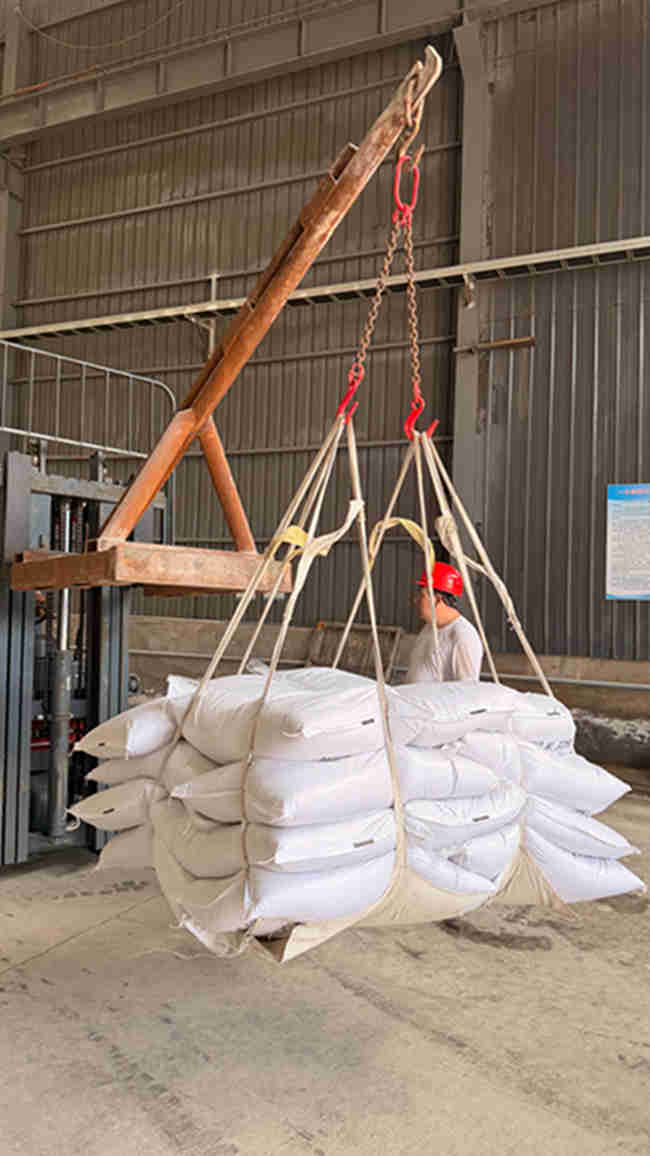
Magnesium sulphate heptahydrate ranks first for drip fertigation; heptahydrate and magnesium sulphate monohydrate share the top of the list for foliar spray; Kieserite and granular magnesium sulphate anhydrous rank first for broadcasting and mechanical spreading. That is the short answer for buyers who are already comparing suppliers and grades rather than learning what magnesium sulphate is.
The longer answer matters because every form in this family delivers the same two nutrients — magnesium and sulphur — yet behaves differently the moment it leaves the bag. One grade dissolves completely with no residue and will not block drip emitters. Another is built to flow through a mechanical spreader with low dust and anti-caking behaviour. A third is specified for soil application and industrial raw material only. Choosing the wrong physical form is the most common evaluation-stage mistake: the chemistry is right, the results are not.
This guide ranks the four forms produced by Tianjin Xingyu Fertilizer Industry Co., Ltd. (XYF) — magnesium sulphate anhydrous, Kieserite, magnesium sulphate monohydrate and magnesium sulphate heptahydrate — against the three application routes in the title. Each ranking is anchored to stated product facts: water solubility and residue behaviour, drip emitter safety, compatibility with most NPK fertilizers for blending, and granular flowability for mechanical spreading. Rankings are route-specific fits based on the manufacturer's published product data, not a generic claim that one grade is superior to all others.
The Problem: One Chemistry, Three Different Physical Demands
Application equipment, not agronomy, is usually what rules a form in or out. A dripper line, a spray tank and a broadcast spreader each impose a different physical requirement on the same compound:
- Drip fertigation requires fast and complete dissolution with no residue. Undissolved particles are exactly what blocks emitters, which is why XYF states that its water-soluble grades will not block drip emitters when used as specified.
- Foliar spray requires a form that dissolves before it reaches the nozzle and leaves no grit behind, because the spray must wet the leaf surface evenly to correct a magnesium deficiency such as leaf chlorosis.
- Broadcasting and mechanical spreading require uniform granules with low dust and anti-caking performance. Complete particle-size options allow a spreader to meter an even pattern and reduce product loss during storage and transport.
Buyers who select purely on price per tonne commonly discover the mismatch after the container arrives: a granular soil grade dosed into a fertigation tank, or a fine powder loaded into a spinner spreader. Both mistakes are expensive and both are avoidable at the evaluation stage by checking one line of product data — the published application mode for each form.
Evaluation rule: match the form to the route before you compare price. Application mode, dissolution behaviour and granule profile are grade properties, not commercial variables, and they cannot be corrected later by adjusting the application rate.
Industry Background: A Large Market That Is Read by Grade
Aggregated category research underlying this guide values the global magnesium sulfate market at USD 1.8 billion in 2025, with a projection of USD 1.9 billion for 2026. Reported 2025 values differ between research houses — some place the same year lower, mainly because they count a narrower or wider grade scope. The figure should be read as an order of magnitude, not as a quotation, and it is a reminder to define grade scope whenever you compare suppliers or price lists.
Two structural facts are more useful for form selection than the headline size:
- Agriculture and fertilizers accounted for approximately 41.6% of the global magnesium sulfate market share as of 2025, making agriculture the largest single application block.
- Heptahydrate (Epsom salt) is the dominant product type, at 54% of global commercial production as of 2025 — consistent with the fact that it is the form that can serve soil application, foliar spray and fertigation simultaneously.
On the supply side, China was the leading exporter of magnesium sulphate in 2024, accounting for USD 149 million in export value under HS code 283321, the trade line that covers these products. Magnesium sulphate is also registered in the ECHA REACH database with an annual tonnage band of 100,000 to 1,000,000 tonnes, which is why EU-bound buyers typically request REACH-related documentation alongside each batch certificate of analysis.
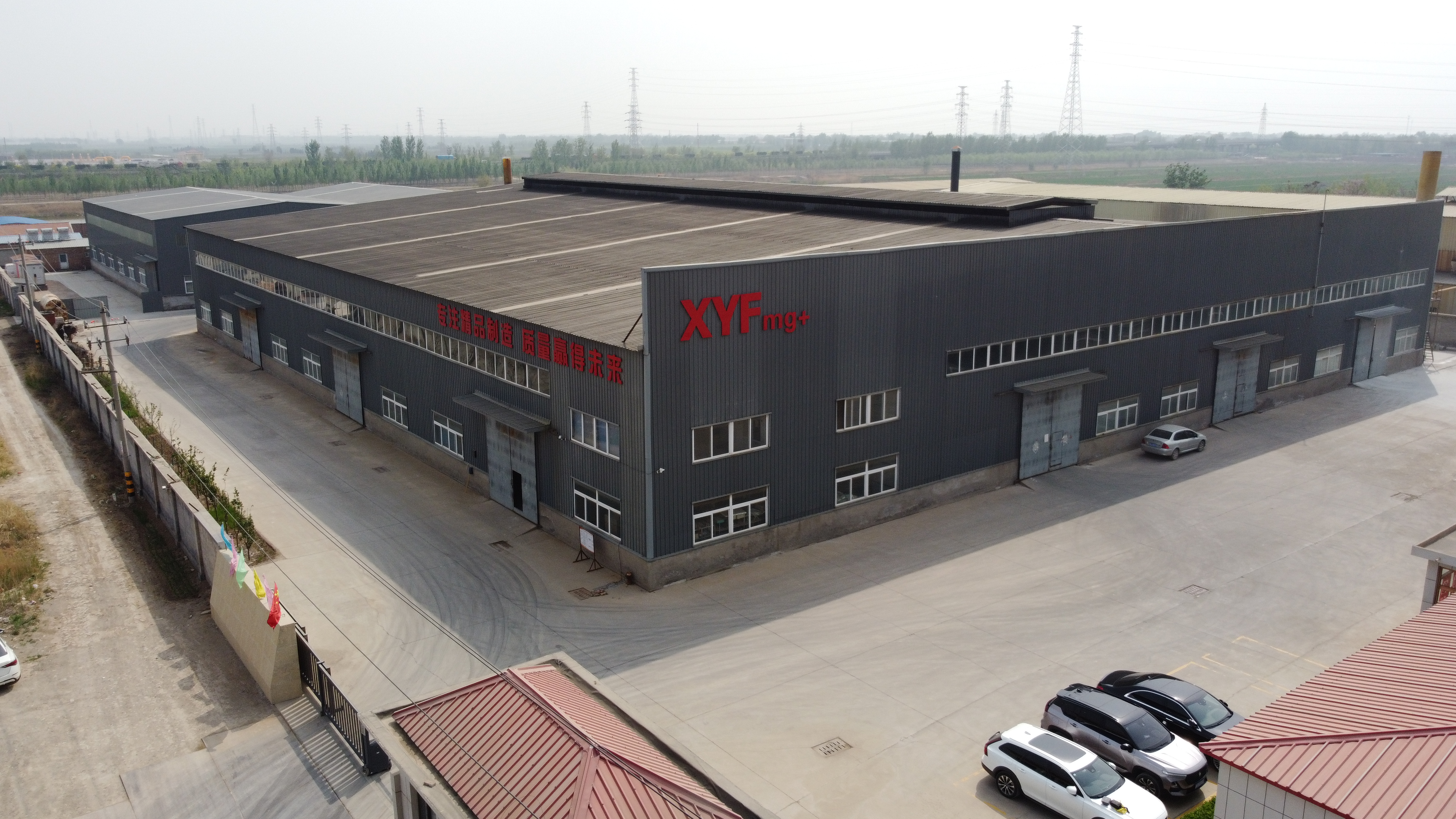
XYF's own position is a manufacturing base founded in 1993 in Chenguantun Town Industrial Park, Jinghai District, Tianjin, roughly 80 km from Tianjin Port and 15 km from the railway freight yard. The plant covers 20,000 m², exports represent 70% of output, and the company holds independent import and export rights with products shipped to more than 30 countries and regions across Southeast Asia, Europe and America.
The Four Forms and What Each Is Specified For
Form selection starts with the manufacturer's published application modes. XYF produces the full range in fertilizer grade and industrial grade, with agricultural grade, feed grade and industrial grade options available across granule, crystal and powder forms.
1. Magnesium sulphate anhydrous — white powder or granular
Published application mode: soil application and industrial raw material. Packing: 25kg / 50kg PP woven bag, or as per customer's requirement. Anhydrous product carries no water of crystallisation in the compound itself, and it is not listed for fertigation or foliar spray. In practice it is a soil-route and industrial-route grade: the granular option suits dry spreading, and the industrial route covers uses such as building material processing and chemical production.
2. Kieserite — off-white granular
Published application mode: soil application. Packing: 25kg / 50kg PP woven bag, or as per customer's requirement. Kieserite is the granular monohydrate form of magnesium sulphate and is specified for the soil route only. Its value at the evaluation stage is physical: a granular product is the format that mechanical spreading equipment and dry NPK blending lines are designed to handle.
3. Magnesium sulphate monohydrate — white powder or granular
Published application mode: soil application, foliar spray and industrial raw material. Packing: 25kg / 50kg PP woven bag, or as per customer's requirement. The powder option is the practical choice where a foliar programme is already running and the buyer wants a single grade that also covers soil application; the granular option moves the same grade into dry blending and spreading.
4. Magnesium sulphate heptahydrate — white granular crystal
Published application mode: soil application, foliar spray, fertigation and industrial raw material. Packing: 25kg / 50kg PP woven bag, or as per customer's requirement. This is the broadest route coverage in the range and the only form whose published application mode includes fertigation — which is the core reason it ranks first for drip systems. Epsom salt is the common trade name for the heptahydrate type.
Ranking 1: Best Magnesium Sulphate Forms for Drip Fertigation
Three criteria decide fertigation fit: complete dissolution, no residue, and no risk of blocking drip emitters. Blending compatibility with most NPK fertilizers for dry blending is a secondary factor for buyers who also run a blend line.
Rank 1 — Magnesium sulphate heptahydrate (white granular crystal)
Heptahydrate is the only form in XYF's published range whose application mode explicitly includes fertigation. The performance characteristics behind that listing are exactly the ones a drip system demands: fast and complete dissolution with no residue and no drip emitter blockage. Because it also covers soil application and foliar spray, an operation running drip lines plus a foliar programme can standardise on one grade instead of holding two inventories. It supplies both magnesium and sulphur at the same time, so a single injection delivers two nutrients rather than one.
Rank 2 — Magnesium sulphate monohydrate (powder), conditional
Monohydrate ranks second because it is a fully water-soluble form in the same series, but its published application mode covers soil application and foliar spray rather than fertigation. Buyers who intend to dose it through a drip line should confirm suitability with the supplier first and, if approved for their system, validate it on a small block before a full season. Where the goal is a single grade for soil plus foliar programmes, monohydrate is a stronger fit than it is for fertigation.
Not specified for fertigation: Kieserite and magnesium sulphate anhydrous
Both are published as soil-application grades. Kieserite is a granular product designed for spreading, and anhydrous is listed for soil application and industrial raw material. Passing a granular soil grade through a fertigation system is outside the stated application mode and is the clearest form-route mismatch in this category.
Blending versus tank mixing: XYF's grades are described as compatible with most NPK fertilizers for blending. Dry-blend compatibility is a blending statement, not an automatic spray-tank or injection-line compatibility guarantee. Confirm your specific tank mix, water chemistry and injection sequence with your agronomist before commissioning.
Ranking 2: Best Magnesium Sulphate Forms for Foliar Spray
Foliar fit depends on dissolution and on how cleanly the solution leaves the tank. Magnesium is the core element of chlorophyll, so foliar magnesium is applied to correct leaf chlorosis caused by magnesium deficiency and to support photosynthesis, plant growth and carbohydrate accumulation.
Rank 1 — Magnesium sulphate heptahydrate (white granular crystal)
Heptahydrate ranks first for foliar programmes that also run fertigation or soil application, because it is specified for all three routes and therefore removes the need to qualify a second grade. Its dissolution profile — fast, complete, no residue — is the same property that makes it the leading fertigation grade.
Rank 2 — Magnesium sulphate monohydrate (white powder)
Monohydrate is specified for foliar spray and soil application. Where a foliar-only programme is planned and no drip line is involved, this is the simpler two-route grade, and the powder form is easy to weigh and pre-dissolve in a mixing tank. Granular monohydrate remains available for the same buyers who also blend or spread.
Not specified for foliar spray: Kieserite and magnesium sulphate anhydrous
Both are published as soil-route grades. Spray programmes should stay with the two forms that carry foliar spray in their published application mode.
Ranking 3: Best Magnesium Sulphate Forms for Broadcasting and Mechanical Spreading
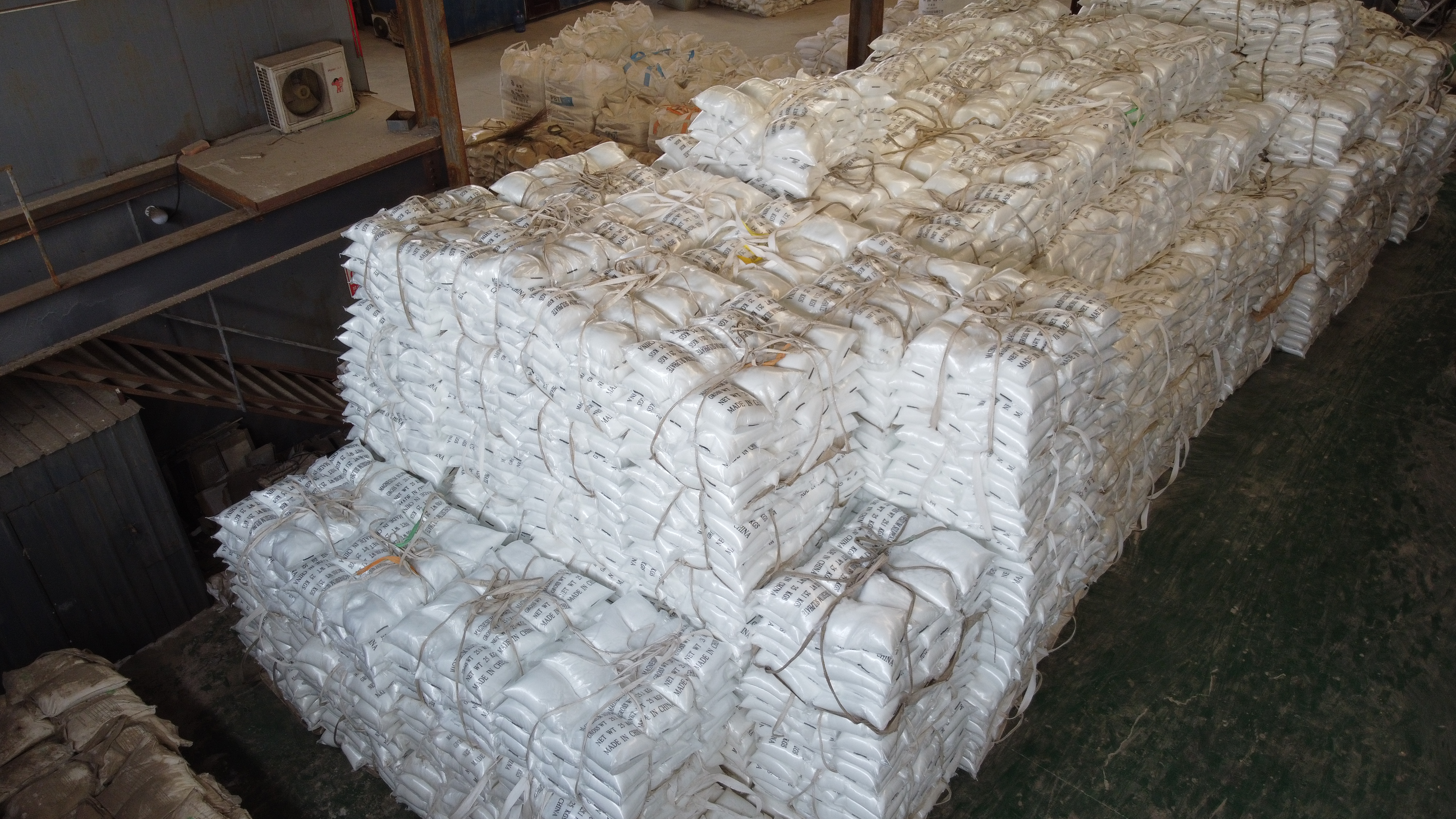
For dry application the deciding properties are granule uniformity, flowability, low dust and anti-caking behaviour. These are the characteristics XYF lists for its granular grades: complete particle-size options, low dust and anti-caking performance that suits mechanical spreading and reduces loss during storage and transport. Broadcasting is also one of the routes covered by the water-soluble grades where the product is applied to the soil rather than injected or sprayed.
Rank 1 — Kieserite (off-white granular)
Kieserite ranks first for broadcasting because it is the granular grade specified for soil application, matching the way broadcast application actually works: dry granules metered through a spreader, then dissolved by irrigation or rainfall. Off-white granules make it straightforward to check spread pattern uniformity in the field.
Rank 2 — Magnesium sulphate anhydrous, granular
The granular anhydrous option is also published for soil application and shares the flowability and anti-caking properties of the granular range. It ranks second rather than first for broadcasting only because the same product line is also positioned for industrial raw material use, so buyers in an agricultural programme typically find Kieserite or granular monohydrate more directly aligned with their application.
Rank 3 — Magnesium sulphate monohydrate, granular
Granular monohydrate covers soil application and foliar spray, so it is the better third option for buyers who broadcast part of the season and spray the rest. Powder grades — anhydrous powder and monohydrate powder — remain specified for soil application, but they are not the granular profile that spreader calibration is built around, and they are best handled through dissolution or incorporation rather than dry spreading.
Step-by-Step: How to Match a Form to Your Application
- Name the route first. Write down whether the product will be injected through drip lines, sprayed on leaves, or spread dry on soil. One product can usually serve more than one route, but the primary route sets the starting form.
- Check the published application mode. Fertigation, foliar spray and soil application are separately listed per form. If the route is not listed for the grade you are considering, treat it as a specification question for the supplier rather than an assumption.
- For fertigation, verify dissolution and residue. Complete dissolution with no residue and no drip emitter blockage is the acceptance criterion. Ask for the dissolution behaviour in writing and confirm it against your water source.
- For foliar spray, verify solution cleanliness. The grade must dissolve before the nozzle and leave no grit in the tank. Confirm with the technical documents supplied with the order.
- For broadcasting, verify the granule profile. Uniform particle-size options, low dust and anti-caking performance determine whether the spreader meters evenly and whether the remaining bags still flow next season.
- If the grade goes into an NPK blend, check blending compatibility. XYF grades are described as compatible with most NPK fertilizers for blending; confirm the specific blend ratio with your blending line.
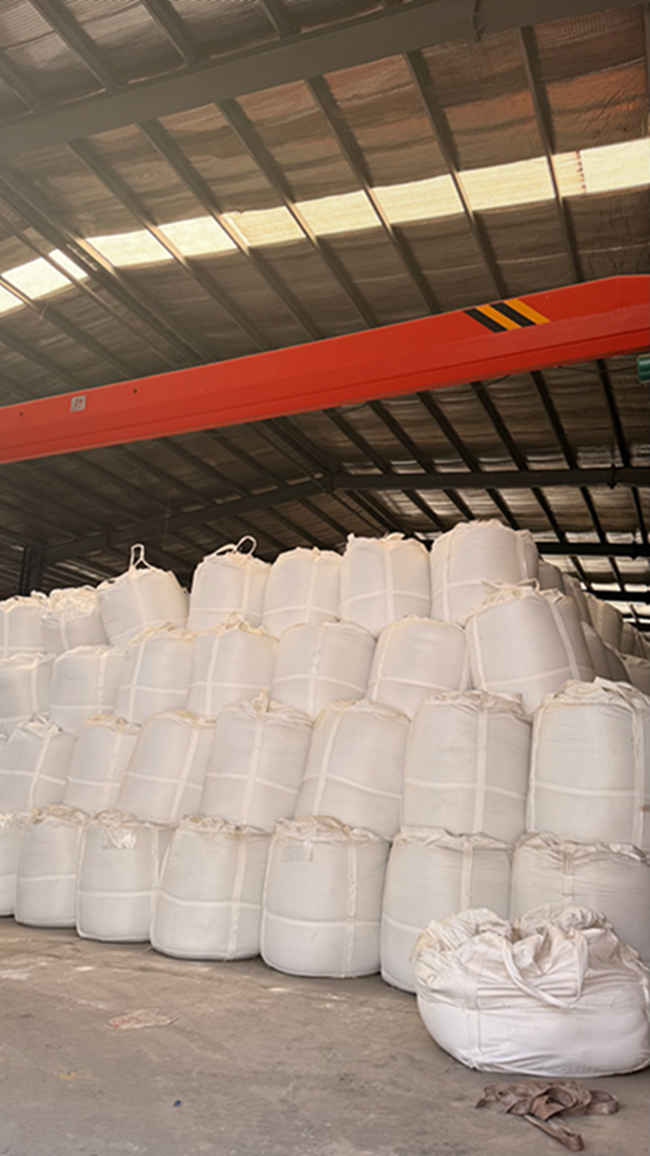
- Confirm packing and documentation. Standard packing is 25kg or 50kg PP woven bags, or as per customer's requirement, with a COA provided for each batch and each production batch 100% tested before shipment.
Use Cases: Where These Rankings Have Been Applied
XYF has supplied an original brand manufacturer (OBM) client in South Korea with 20 tonnes of magnesium sulphate fertilizer over a project duration of two years. The application range in that and similar programmes covers the routes ranked above:
- Agricultural fertilizer: base fertilizer, top-dressing, fertigation and foliar spraying for fruits, vegetables, field crops and cash crops. The functional result reported is fast supply of magnesium and sulphur, correction of leaf chlorosis caused by magnesium deficiency, stronger growth, better fruit set and improved sugar content, colour and shelf-life of harvests.
- Feed additive: magnesium supplementation for livestock and poultry, supporting bone health and normal metabolism and reducing magnesium-deficiency stress, using feed grade material.
- Industrial use: printing and dyeing, leather-making, building materials and water treatment, using industrial grade material.
- Other uses: raw material for bath salt.
On the supply side, XYF reports a monthly production capacity of 100,000 units, approximately 1,200,000 units per year, supported by automated production lines, an independent standardised testing laboratory and an ISO quality management system applied through production. Custom specifications, granule size, colours, shapes, packaging and labels are accepted, and the minimum order quantity is one container.
Comparison Table: Four Forms, Three Routes
| Form | Physical category | Published application mode | Best-fit route | Packing |
|---|---|---|---|---|
| Magnesium sulphate heptahydrate | White granular crystal | Soil application, foliar spray, fertigation, industrial raw material | Drip fertigation and foliar spray | 25kg / 50kg PP woven bag, or as per customer's requirement |
| Magnesium sulphate monohydrate | White powder / granular | Soil application, foliar spray, industrial raw material | Foliar spray and soil application | 25kg / 50kg PP woven bag, or as per customer's requirement |
| Kieserite | Off-white granular | Soil application | Broadcasting and dry blending | 25kg / 50kg PP woven bag, or as per customer's requirement |
| Magnesium sulphate anhydrous | White powder / granular | Soil application, industrial raw material | Granular broadcasting and industrial use | 25kg / 50kg PP woven bag, or as per customer's requirement |
| Application route | Rank 1 | Rank 2 | Not specified for this route |
|---|---|---|---|
| Drip fertigation | Magnesium sulphate heptahydrate | Magnesium sulphate monohydrate (confirm with supplier first) | Kieserite, magnesium sulphate anhydrous |
| Foliar spray | Magnesium sulphate heptahydrate | Magnesium sulphate monohydrate | Kieserite, magnesium sulphate anhydrous |
| Broadcasting / mechanical spreading | Kieserite (granular) | Magnesium sulphate anhydrous (granular) | Powder grades are not the granular profile spreaders are designed for |
Frequently Asked Questions
What certification and documentation come with XYF magnesium sulphate fertilizer?
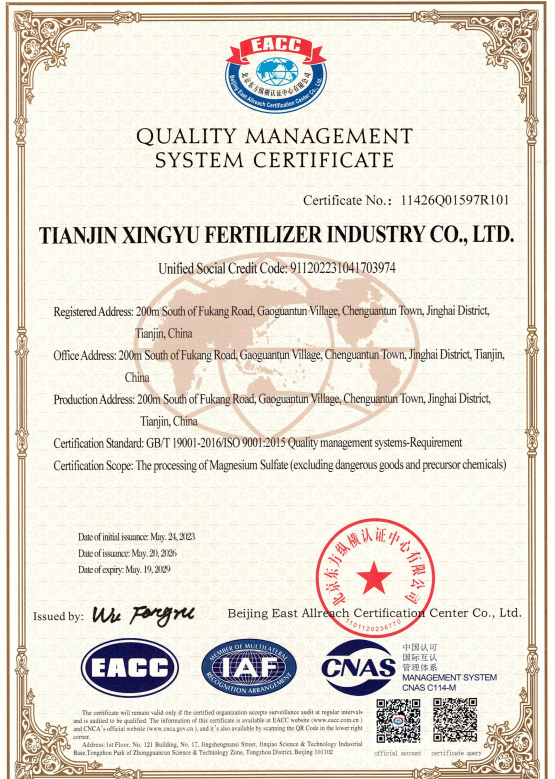
Tianjin Xingyu Fertilizer Industry Co., Ltd. holds ISO9001 certificate number 11426Q01597R101, issued by Beijing East Allreach Certification Center Co., Ltd. (EACC) against the standard GB/T19001-2016/ISO9001:2015, issued on 2026-05-20 and valid until 2029-05-19, with a global scope covering the magnesium sulphate product range. Every production batch is 100% tested before shipment and a certificate of analysis is provided for each batch. Export support includes MSDS, COA and a full set of shipping documents, and third-party inspection is accepted. For EU destinations, magnesium sulphate is registered in the ECHA REACH database with an annual tonnage band of 100,000 to 1,000,000 tonnes; confirm registration coverage for your specific import route with your importer.
Which form should I order for drip fertigation instead of broadcasting?
For drip fertigation, order magnesium sulphate heptahydrate — it is the only form in the range whose published application mode includes fertigation, and it is described as dissolving fast and completely with no residue, without blocking drip emitters. For broadcasting, order Kieserite or granular magnesium sulphate anhydrous, both of which are published for soil application and supplied in granular form. The two routes should not share a single inventory unless the grade is specified for both. XYF supports custom specifications, granule size, colours, shapes, packaging and labels, with a monthly production capacity of 100,000 units.
What determines the cost of magnesium sulphate fertilizer in 25kg or 50kg packing?
Four variables drive delivered cost: the grade (agricultural, feed or industrial), the physical form (powder, granular or crystal), the packing specification — standard is 25kg or 50kg PP woven bags, or as per customer's requirement — and the order quantity, with a minimum order quantity of one container. Documentation and destination also affect landed cost. XYF does not publish price lists; as a third-party reference point only, US market price tracking reported magnesium sulphate stabilising near USD 674 per metric ton in early 2025, which is a market indicator and not a quotation for any specific grade or packing.
How is a batch validated before a full-container order?
Validation runs on documentation and inspection rather than assumption. Quality control follows a 100% test standard, each production batch undergoes 100% testing before shipment, and a certificate of analysis is provided for each batch. Suppliers provide technical documents including MSDS, COA, test reports and application guidance. Third-party inspection is accepted, and in the event of a quality discrepancy the buyer provides photos, samples and third-party inspection reports for mutual negotiation.
What is the lead time and how stable is supply across formats?
Lead time depends on order quantity and requirements. The company reports a monthly production capacity of 100,000 units, approximately 1,200,000 units per year, supported by automated production lines, a stable raw material supply base and an independent standardised testing laboratory, which is what allows consistent batches across the anhydrous, Kieserite, monohydrate and heptahydrate forms. Customer feedback is answered within 24 hours, and full-order follow-up covers loading and shipping status. For grade selection, sample requests and quotations, contact Jenny at liujenny@xingyutj.com or +86 155-2237-7326 (WeChat / WhatsApp) — the fastest way to confirm which form fits your fertigation, foliar or spreading programme is to send your route, water source and target packing specification together.
Conclusion: A Form Shortlist You Can Take to Procurement
The ranking comes down to one question per route. If the product is injected through drip lines, magnesium sulphate heptahydrate is the form specified for fertigation, dissolving completely with no residue and without blocking drip emitters. If it is sprayed on leaves, heptahydrate and monohydrate are the two forms specified for foliar application. If it is spread dry, Kieserite and granular magnesium sulphate anhydrous are the granular grades built for mechanical spreading, with uniform particle-size options, low dust and anti-caking behaviour that protect application accuracy and storage life.
Beyond the form itself, three checks protect the purchase: confirm the grade for your end use — agricultural, feed or industrial; confirm the packing specification, with 25kg and 50kg PP woven bags as standard and custom packaging available; and confirm the batch documentation, since every batch is 100% tested and shipped with a COA. Buyers who run more than one route should also decide whether to consolidate on a single multi-route grade such as heptahydrate or to hold separate granular and soluble inventories — a decision that depends on volume per route rather than on price alone.
Request a sample, quotation or grade recommendation
Tianjin Xingyu Fertilizer Industry Co., Ltd. (XYF) — founded 1993, Jinghai District, Tianjin, China — manufactures magnesium sulphate anhydrous, Kieserite, magnesium sulphate monohydrate and magnesium sulphate heptahydrate in agricultural, feed and industrial grades.
Contact: Jenny | Email: liujenny@xingyutj.com / Jenny@xingyufertilizer.com | Tel / WhatsApp / WeChat: +86 155-2237-7326
Address: 200m South of Fukang Rd, Gaoguantun Village, Chenguantun Town, Jinghai District, Tianjin, China
Website: www.xyfertilizer.com | blog.xyfertilizer.com
Download the full product range and specifications: XYF Product Catalogue (PDF).