
Modular Medical Storage System: A Hospital Buyer's Guide
Modular Medical Storage System: A Hospital Buyer's Guide
A modular medical storage system is a hospital storage approach in which trays, shelf baskets, cabinet shelves and cart drawers are manufactured to one shared dimensional grid, so the same storage unit can be planned once and then repeated across a central pharmacy, a secondary warehouse, a clean storage room and a ward. The practical result is that a medication box, a dressing pack or a consumable set is stored, moved and restocked without being repacked at every handover point.
Tongde Medical Technology (Ganzhou) Co., Ltd., which markets its medical storage products under the Topmodul brand, is a manufacturer founded in 2003 in Ganzhou, Jiangxi, China. The company produces modular medical carts, medical storage carts, medical transport carts, hospital storage carts, medical supply carts, medical nursing carts, anesthesia carts, emergency crash carts, trauma carts, pediatric crash carts, medical storage shelving, sterile storage shelving, medical storage cabinets, smart medical storage cabinets and hospital supply storage systems, with ISO 6040 medical storage systems among its core lines. Approximately 90% of its products are exported, and its main markets are Western Europe, Eastern Europe and other regions.
This guide explains what a modular medical storage system is, why hospital procurement teams are reviewing modular configurations in 2026, how the components fit together, how to specify a system step by step, and which questions to ask a manufacturer before placing an order.
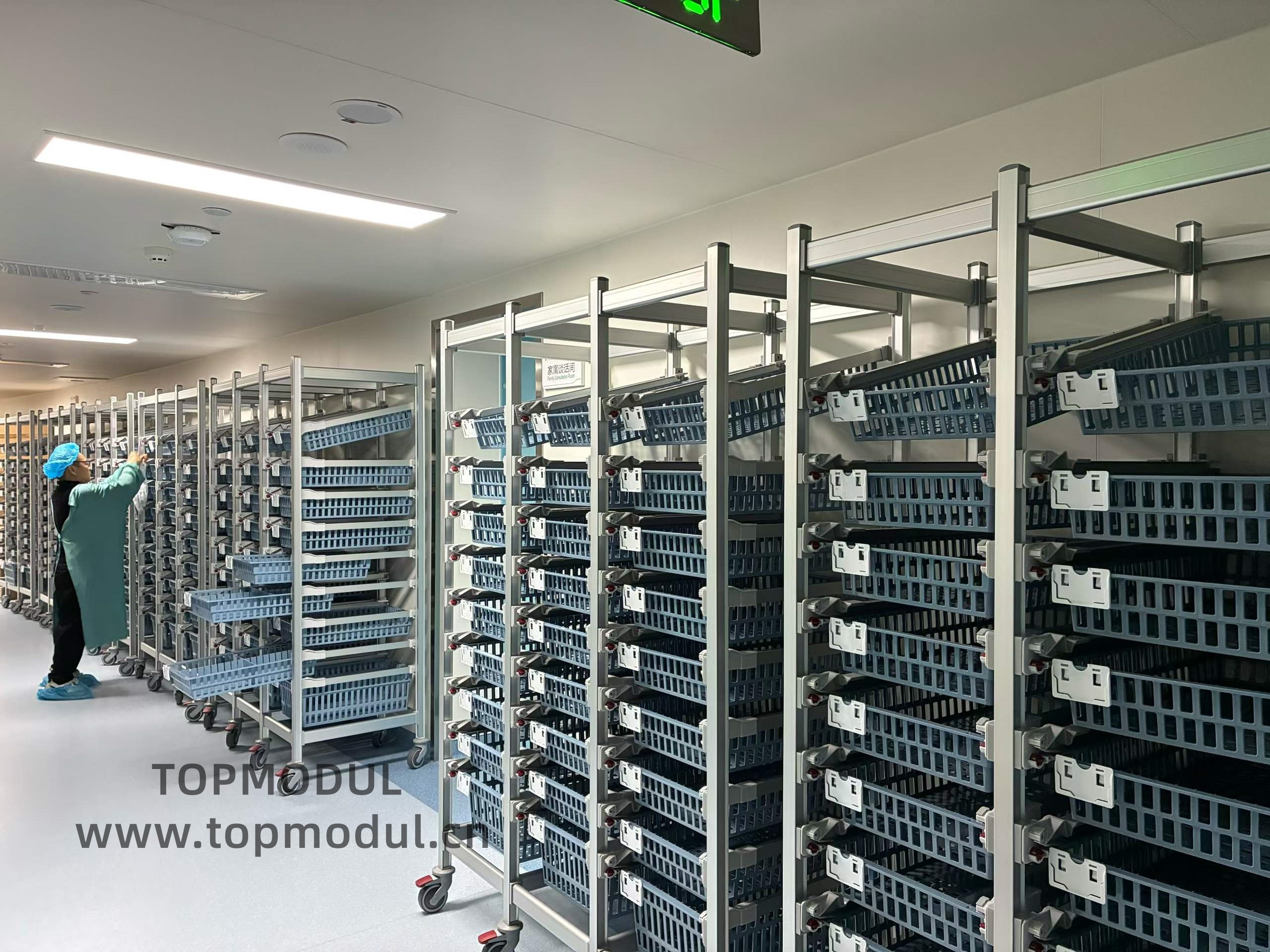
What Is a Modular Medical Storage System?
A modular medical storage system is a set of interchangeable storage components built on a common unit dimension, combined with mobile hardware (carts, trolleys and mobile shelving) and static hardware (shelving frames and cabinets) so that materials can move through a hospital without changing container.
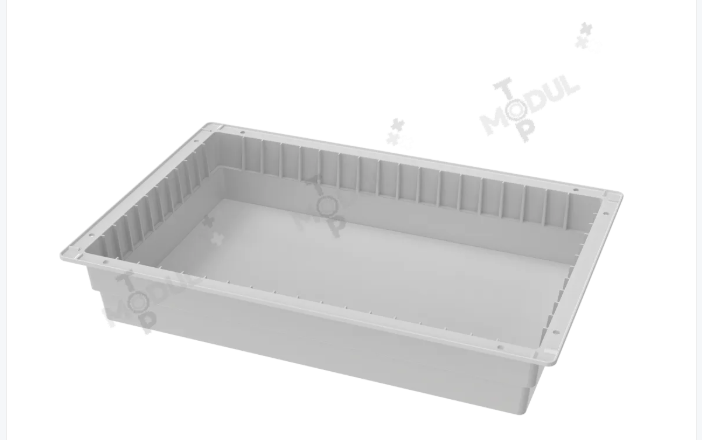
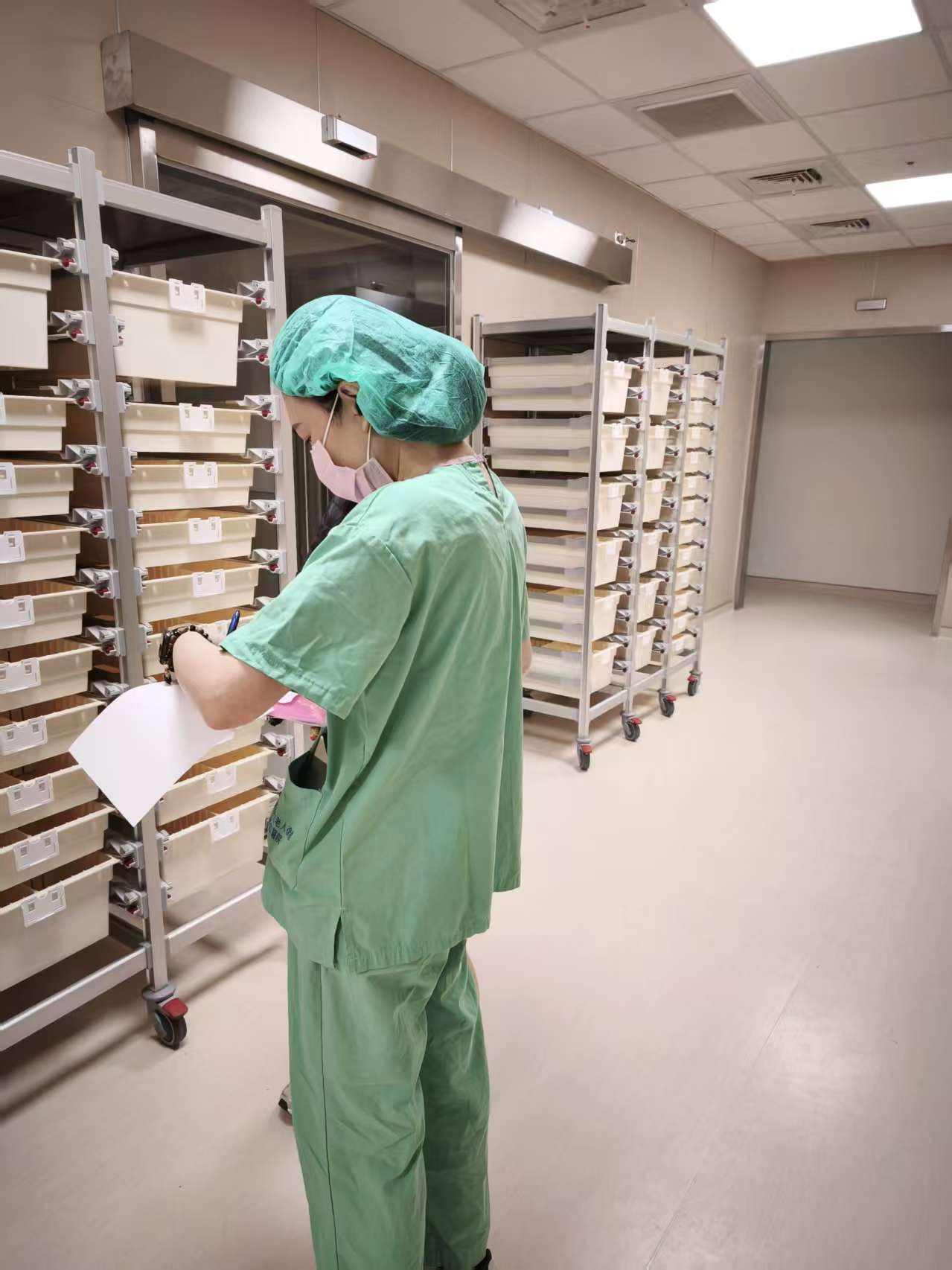
The shared dimension is the key design decision. In the Topmodul range, the Storage tray T604010AN is a material storage basic unit measuring 600 × 400 × 100 mm and classified as an ISO 6040 material storage basic unit. It is made of polycarbonate (PC) and acrylonitrile butadiene styrene (ABS) and is designed for use in hospital departments, wards, warehouses and clinics. The manufacturer describes the tray as a modular component for medical storage and transport systems that supports the storage, handling and movement of medications and medical equipment from a central pharmacy or storage room to wards and patient bedsides.
Three characteristics define whether a system is genuinely modular rather than simply a matched catalogue:
- One tray standard across device types. The same tray must fit a shelf frame, a cabinet and a transport cart, so storage does not stop at the boundary of a room.
- Configurable capacity, not fixed capacity. Shelves, baskets, drawers and columns are supplied in multiple specifications and styles that can be combined and installed according to user needs.
- Customisable external dimensions. Product dimensions and configuration can be customised according to customer needs, so a system can be fitted to an existing room rather than the room being rebuilt around the system.
Why Modular Storage Is Drawing Attention in 2026
Two separate signals explain the current interest: a growing medical cart market and a measurable capacity argument for the modular tray standard.
Market size is one indicator. The global medical carts market size is estimated to reach US$ 4.83 billion in 2026, according to Horizon / Grand View Research market outlook data. Within Europe, the medical carts market is expected to grow at a compound annual growth rate of 15.8% from 2025 to 2030, according to the same source family.
The efficiency argument is more directly useful to a hospital buyer. The ISO 60-40 modular system allows for an increase in storage capacity of up to 50% compared with traditional shelving, according to published ISO 60-40 modular system specifications. That figure matters because hospital storage constraints are usually floor-space constraints, not budget constraints on shelving units alone.
How to read the 50% figure. It is a capacity comparison against traditional shelving, not a promise about any individual room. Actual gain depends on the tray mix, the shelving height selected, aisle configuration and how much of the existing stock is converted to the standard tray size.
The Problem a Modular System Is Designed to Solve
Hospital storage rarely fails because there are too few shelves. It fails because the shelf, the drawer, the transport cart and the ward cupboard do not share a geometry, so stock is handled more than once and visibility is lost between departments.
Four recurring problems define the requirement:
- Repeated handling between rooms. Materials are loaded into one container in the pharmacy, transferred to a second in the corridor and a third at the bedside. Each transfer is a point where items are misplaced or count accuracy drops.
- Lost capacity inside existing floor area. Fixed shelving with permanent aisles consumes floor space that could hold stock. High-density configurations address this by forming storage channels in the available space.
- Infection-control requirements that ordinary shelving does not meet. Clean areas such as operating rooms and supply centres require surfaces that can be cleaned and disinfected and that do not harbour dirt or support virus breeding.
- Stock rotation and counting difficulty. Without a consistent tray and shelf layout, first-in, first-out turnover is hard to enforce and stock counts become a manual reconciliation exercise.
The Building Blocks of a Modular Hospital Storage System
A complete system is assembled from four component families. Each family exists because it solves a different part of the material flow: holding stock, holding stock at density, securing stock, and moving stock.
1. ISO 6040 Storage Trays
The tray is the smallest repeatable unit and the component that makes everything else modular. The Storage tray T604010AN measures 600 × 400 × 100 mm and is moulded in PC and ABS. It is used for medication management and medical equipment handling in hospital environments, and it is the unit that allows a shelf position to become a cart position without repacking.
2. Shelving and High-Density Storage
Shelving converts floor area into storage positions. Three configurations serve different room types.
High Density Medical Shelving is a modular medical storage system with a basic frame of 512 × 650 × 2000 mm or 710 × 406 × 2000 mm. The struts and crossbars are constructed from aluminium alloy, with baskets in PC and ABS. It is intended for hospital secondary warehouses, pharmacies, vein centres and consumables warehouses. When configured with its own rail system, the high-density mobile version reaches maximum storage capacity by forming storage channels in all available space: a fixed base frame sits on rails fixed at both ends, with a high-density mobile frame in the middle that runs on smooth rollers. The aluminium tracks and PE components are corrosion-resistant, the top rollers sit inside the guide rails and slide without fixing, and anti-collision parts sit between the mobile and fixed units. Tracks are installed without drilling or gluing, and the guide rail length can be customised according to requirements.
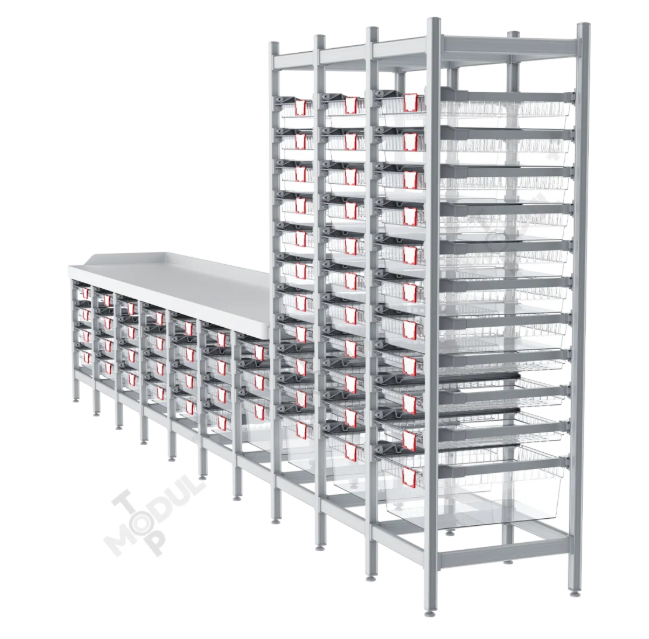
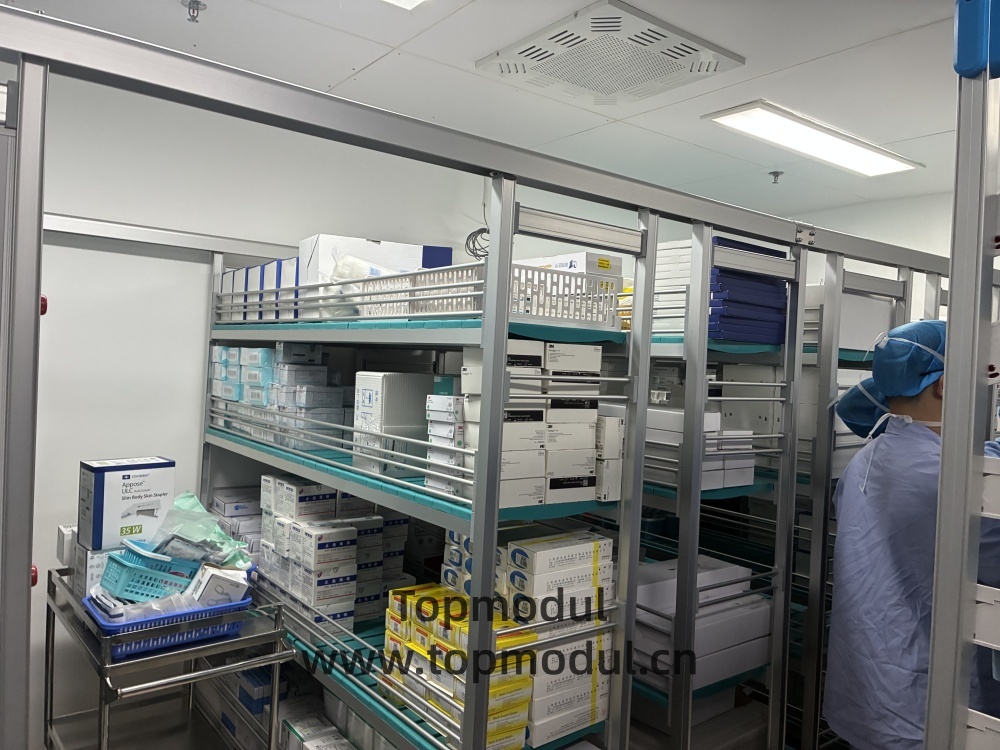
Alpha shelving for medicine storage (models TDAS60 and TDAS40) is a lighter, quieter option for storage, transportation and distribution. The 60-wide frame measures 674 × 430 × 2000 mm and the 40-wide frame measures 474 × 630 × 2000 mm, both built on aluminium alloy struts with PC/ABS baskets and trays. The manufacturer positions it for busy or limited spaces, with antibacterial performance suitable for common hospital cleaners and disinfectants, and height customisation available.
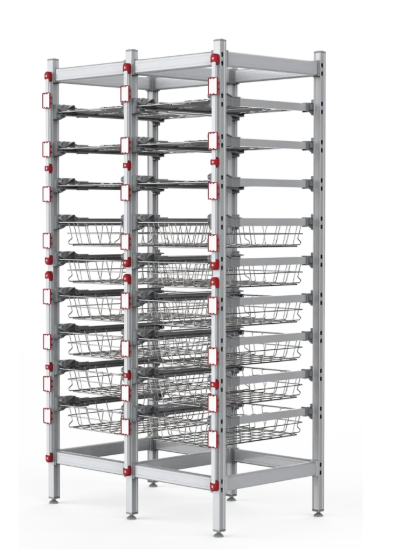
Sterile Storage Wire Shelving is designed for clean areas and hospital infection control. It is used in operating rooms and supply centres. The struts and crossbars are aluminium alloy and the trays are stainless steel. The stainless steel shelf surfaces have a large bearing capacity, are not easily deformed and do not compress stored goods. Surfaces are processed by pickling, phosphating and electrostatic spraying so they are corrosion-resistant, rust-proof and easy to clean for aseptic processing, and the system is described as moisture-proof, dust-proof and vandal-proof. The sterile shelves have a temperature resistance of over 130 degrees and the configuration can be customised according to height and other customer needs.
3. Cabinets
Cabinets close and secure stock where open shelving is not appropriate. The Roller Shutter Cabinet (models TDC180UU-RS, TDC180EE-RS, TDC180UU-HD and TDC180EE-HD) is a TM Cabinet built on a modular cabinet system. Sizes are 1532 × 785 × 1850 mm and 2132 × 585 × 1850 mm, in aluminium alloy and ABS. It is designed for hospital medication and medical equipment storage and can be used in any hospital department, ward, warehouse or clinic. Height and the number of layers can be customised as required, and the modular cabinet system supports storing, handling and moving medications and equipment from a central pharmacy or storage room to wards and the patient bedside.
4. Carts and Trolleys
Mobile units carry the system to the point of care. In the Topmodul modular medical cart series, the Emergency Crash Cart-T002, the Anesthesia Cart T001 and the Nursing Cart T003 all share an overall dimension of 754 × 541 × 1005 mm and are built from aluminium alloy, ABS plastic and metal. The crash cart is intended for emergency situations where immediate access to equipment is required, allowing clinical staff to position the cart at the point of use and keep necessary equipment in one place. All three support diversified configurations that can be combined and installed according to user needs, and all support customisation according to customer requirements, including height customisation for ergonomics on the crash cart.
The Medical trolley T6020-2 is an open transport cart measuring 1385 × 445 × 2000 mm, with aluminium alloy struts and crossbars and PC/ABS baskets. It is designed for storage, transportation and distribution of medical supplies and for intra-department transfer in hospitals or medical institutions, and for operation in busy or limited spaces.
How to Specify a Modular Medical Storage System: Step by Step
Specification works best as a sequence, moving from the physical flow of materials to the technical detail of the components. The six steps below follow that order.
Step 1 — Map the Material Flow Before Choosing Products
List every point where stock is stored or handed over: central pharmacy or storage room, secondary warehouse, vein centre, consumables warehouse, clean storage, ward and bedside. The manufacturer's applicable scenarios in this range cover exactly these points — store and transport in hospital departments, transfer of medical materials, nursing and clinical storage and transportation. A configuration is only correct if it covers the whole path, not one room.
Step 2 — Fix the Unit Standard
Choose the tray standard first, because it constrains everything downstream. The ISO 6040 tray at 600 × 400 × 100 mm is the basis of the modular logic in this system. Converting existing stock to a single tray size is the step that produces the capacity gain; keeping mixed legacy containers limits it.
Step 3 — Select Shelving by Room Type
Match the shelving family to the room rather than to a house style. Secondary warehouses, pharmacies and consumables stores are served by High Density Medical Shelving and Alpha shelving. Operating rooms and supply centres require Sterile Storage Wire Shelving for infection control. Where floor area is the binding constraint, the high-density rail-mounted configuration removes fixed aisles.
Step 4 — Confirm Materials and Cleaning Method
Confirm how each room is cleaned and disinfected and check the material against it. Aluminium alloy frames with PC/ABS baskets are described as suitable for common hospital cleaners and disinfectants without chemical reaction. Stainless steel trays are specified for clean areas where aseptic processing and surface cleanability matter. The applicable scenario documentation for this product family explicitly requires confirming cleaning and disinfection methods and accessory combination according to the department in use.
Step 5 — Define the Customisation Envelope
Establish which dimensions are fixed and which are open. Product dimensions and configuration can be customised according to customer needs. Column height and countertop length can be customised to any length according to specific requirements on the shelving side, and the high-density guide rail length can be customised as required. Cart height can be customised for ergonomics. Clarifying this early prevents a late redesign.
Step 6 — Verify Certification and Quality Process
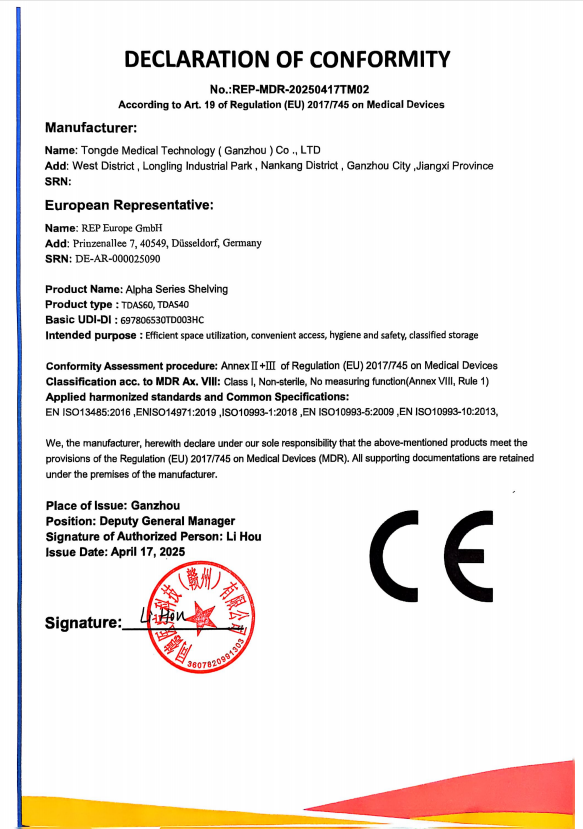
Ask for the certificates and the inspection process, not just the product brochure. The company's products are CE and ISO9001 certified. The factory operates a total quality management system with full-process inspection including IQC, IPQC, FQC and OQC, and a QC team of five members performs comprehensive inspections at each production stage and on every product before packing and shipment.
Where Modular Storage Fits: Use Cases by Department
Modular storage is not a single product decision; it is a set of department-level decisions that share one unit standard.
- Central pharmacy and secondary warehouse. High Density Medical Shelving and Alpha shelving hold medication and consumables in tray and basket format, with first-in, first-out turnover supported by a consistent shelf layout.
- Vein centre and consumables warehouse. The same shelving families and the Roller Shutter Cabinet support high-turnover consumable picking and closed storage.
- Operating room and sterile supply centre. Sterile Storage Wire Shelving provides stainless steel tray surfaces and cleanable, corrosion-resistant construction for infection-controlled areas.
- Wards and bedside. The Nursing Cart T003 and the Roller Shutter Cabinet move medication and equipment from storage to the point of care without repacking.
- Emergency and anaesthesia. The Emergency Crash Cart-T002 and Anesthesia Cart T001 keep necessary equipment in one place and can be positioned exactly where needed.
- Intra-department transfer. The Medical trolley T6020-2 handles open transport of supplies between rooms within a department.
Component Comparison
The table below compares the component families described on this page. All dimensions, models and materials are as published in the manufacturer's product specifications; suitability depends on the department and configuration confirmed at quotation stage.
| Component | Model | Dimensions | Material | Typical use | Note |
|---|---|---|---|---|---|
| Storage tray | T604010AN | 600 × 400 × 100 mm | PC, ABS | Departments, wards, warehouses, clinics | ISO 6040 material storage basic unit |
| High Density Medical Shelving | Customised to customer needs | 512 × 650 × 2000 mm or 710 × 406 × 2000 mm (basic frame) | Aluminium alloy frame; PC/ABS baskets | Secondary warehouse, pharmacy, vein centre, consumables warehouse | No complex tools required for assembly |
| Alpha shelving for medicine storage | TDAS60 / TDAS40 | 674 × 430 × 2000 mm (60 wide); 474 × 630 × 2000 mm (40 wide) | Aluminium alloy; PC/ABS baskets and trays | Pharmacy, vein centre, secondary warehouse | Suited to busy or limited spaces; height customisable |
| Sterile Storage Wire Shelving | Customised to height and other needs | 512 × 650 × 200 mm (basic frame) | Aluminium alloy frame; stainless steel trays | Operating rooms, sterile supply centres | Temperature resistance over 130 °C |
| High-density mobile shelving | Customised upon request | Guide rail length customisable | PE, aluminium alloy | Sterilisation room, operating room | Rails install without drilling or gluing |
| Roller Shutter Cabinet | TDC180UU-RS / TDC180EE-RS / TDC180UU-HD / TDC180EE-HD | 1532 × 785 × 1850 mm; 2132 × 585 × 1850 mm | Aluminium alloy, ABS | Any department, ward, warehouse, clinic | Height and number of layers customisable |
| Emergency Crash Cart | Emergency Crash Cart-T002 | 754 × 541 × 1005 mm | Aluminium alloy, ABS plastic, metal | Emergency and resuscitation | Diversified configurations; height customisation |
| Anesthesia Cart | anesthesia cart - T001 | 754 × 541 × 1005 mm | Aluminium alloy, ABS plastic, metal | Anaesthesia and operating room | Customisation supported |
| Nursing Cart | T003 | 754 × 541 × 1005 mm | Aluminium alloy, ABS plastic, metal | Ward nursing | Customisation supported |
| Medical trolley | T6020-2 | 1385 × 445 × 2000 mm | Aluminium alloy frame; PC/ABS baskets | Intra-department transfer | Open transport cart |
How to Evaluate a Modular Storage Manufacturer
Evaluation should test whether the supplier can hold a standard across a full hospital, not whether it can supply one product well. Five checks are useful.
- Certification scope. Confirm CE and ISO9001 certification and check which product families the certificates cover.
- Quality process depth. Ask whether inspection covers incoming, in-process, final and outgoing stages, and how many people perform it. A documented full-process check with a dedicated QC team is a stronger signal than a single final inspection claim.
- Manufacturing base and team. Tongde Medical Technology (Ganzhou) Co., Ltd. operates a 30,000 square metre manufacturing facility with approximately 100+ employees and a research and development team of 10+ engineers and technicians, and has over 20 years of experience since 2003.
- Range completeness. A supplier that offers only carts cannot deliver a system. The relevant range covers modular medical carts, medical storage carts, medical transport carts, hospital storage carts, medical supply carts, medical nursing carts, anesthesia carts, emergency crash carts, trauma carts and pediatric crash carts, plus medical storage shelving, hospital medical shelving, sterile storage shelving, medical storage cabinets, smart medical storage cabinets, hospital supply storage systems, medical consumables storage systems and ISO 6040 medical storage systems.
- Export and market experience. Approximately 90% of products are exported, and the company serves markets in Europe and the Middle East including Germany, the UK, Spain, Italy, the Netherlands, Poland, Saudi Arabia and Israel, with products also used in Singapore, Brazil and CIS countries. Experience across multiple regulatory environments is relevant when a project spans several sites.
Frequently Asked Questions
Are modular medical storage systems CE certified?
Yes. Tongde Medical Technology (Ganzhou) Co., Ltd. states that its products are CE and ISO9001 certified. Within the factory, a total quality management system is applied with full-process inspection covering IQC, IPQC, FQC and OQC, and a QC team of five members performs comprehensive inspections at each production stage and on every product before packing and shipment. Buyers should request copies of the certificates and confirm which product families they cover.
Can a modular storage system be customised for a specific hospital department?
Yes. Product dimensions and configuration can be customised according to customer needs. The modular medical cart series — including the Emergency Crash Cart-T002, Anesthesia Cart T001 and Nursing Cart T003 — shares a 754 × 541 × 1005 mm base and supports diversified configurations that can be combined and installed according to user needs, with height customisation available for ergonomics. On the shelving side, column height and countertop length can be customised to any length according to specific requirements, and the high-density guide rail length can be customised as required. In the OEM process, both parties approve materials, colours and sizes before production begins.
How does a modular system justify its budget against traditional shelving?
The primary argument is capacity per square metre. The ISO 60-40 modular system allows for an increase in storage capacity of up to 50% compared with traditional shelving. High-density configurations reinforce this by forming storage channels in all available space, so mobile frames travel on rails instead of fixed aisles being reserved. In practice this means more storage positions within the same floor area and shorter pick paths for staff. Because the exact figure depends on tray mix, shelving height and the proportion of legacy stock converted to the standard tray, comparison should be made per project rather than per shelving unit.
How are configuration details verified before mass production?
The OEM workflow starts with a review of all customer requirements, whether standard off-the-shelf products or customised models. The manufacturer then provides a detailed quotation that clearly defines the requirements, followed by discussion of further needs or concerns. After the model number is double-confirmed, material and size selection proceeds, and both parties approve the details including materials, colours and sizes. Production begins only after payment is received and drawings are confirmed, so the configuration is verified before volume manufacturing.
What does the order-to-delivery process look like, and what is the next step?
Once production starts, the customer receives regular updates on the production process and progress, and photos are taken for checking and confirmation before delivery. Each batch is scheduled against confirmed drawings and received payment. The practical next step is to send the manufacturer a department list, the required tray or shelf dimensions and the material flow between rooms; Tongde Medical Technology (Ganzhou) Co., Ltd. can then propose a configuration. The TM Shelving catalogue is available at the Topmodul catalogue download page, and enquiries can be sent to info@topmodul.cn.
Conclusion
A modular medical storage system is defined by one decision: adopting a single unit standard — here, the ISO 6040 tray at 600 × 400 × 100 mm — and then extending that standard across shelving, cabinets, carts and trolleys so stock moves through the hospital without repacking. The published capacity comparison of up to 50% against traditional shelving, alongside a global medical carts market estimated at US$ 4.83 billion in 2026, explains why the model is being reviewed more widely.
For a hospital or distributor at the research stage, the practical sequence is to map the material flow, fix the tray standard, select shelving by room type, confirm cleaning and material compatibility, define the customisation envelope, and verify certification and inspection process. That sequence produces a specification that a manufacturer can quote against without ambiguity.
Tongde Medical Technology (Ganzhou) Co., Ltd. (Topmodul)
Website: www.topmodul.cn
Email: info@topmodul.cn | Phone: +86-20-85829262 | Mobile / WhatsApp: +86 133-4286-3280
Factory: Longling Industrial Park West Zone, Nankang District, Ganzhou, Jiangxi, China
Guangzhou Office: 12th Floor, #8 Building, Tongxin Zhizao Cheng, Shiqi Town, Panyu, Guangzhou, China
Plan Your Modular Storage Configuration
Send your department list, tray dimensions and material flow, and the team will propose a component combination for review. The full shelving and cart range, including ISO 6040 trays, high-density shelving, sterile shelving and modular carts, is documented in the downloadable catalogue.
Download the 2026 TM Shelving Catalogue (PDF) | Request a configuration review on WhatsApp
Have Questions or Need More Details?
Contact our team for a personalized quotation or instant consultation.
Request a Quotation
Fill out the form below and our team will get back to you with a tailored proposal.
WhatsApp Direct Chat
Prefer to chat in real-time? Message us on WhatsApp for instant assistance & quick answers.
- Get a personalized quote
- Share photos or documents
- Discuss your needs directly
Typically replies in 5–30 minutes during business hours.