
Molded Pulp Application Guide: How to Match Trays to Your Project Scenario
Matching a molded pulp tray to a project scenario comes down to four checks, taken in order: the protection the product needs, the fit between tray cavity and product, the contact and compliance rules the tray must satisfy, and the commercial terms both sides accept before tooling starts. Buyers who run those four checks in sequence avoid the most expensive error in this category — approving a sample that passes the protection brief but fails a compliance, fit or acceptance requirement two months later.
This guide sets out that matching sequence for food, medical and industrial projects. It is written for packaging buyers, sourcing managers and product engineers moving from research into evaluation, and it uses Tonghe Paper Co., LTD's documented tray parameters, certificates and order terms to show what a completed match looks like in practice.
Why One Molded Pulp Tray Passes One Scenario and Fails Another
"Molded pulp" names a process family, not a single specification. Trays made from sugarcane pulp, bamboo pulp or wood pulp can share a manufacturing route and still differ in thickness, density, surface treatment and fiber grade — and each of those variables decides which scenarios the tray can serve.
A foodservice buyer judges a tray on contact safety, temperature exposure and whether it can be handled with food waste after use. A medical buyer judges the same material family on whether it survives EO sterilization, whether it sheds dust in a clean environment, and whether an inspection report exists for the fiber lot. An industrial buyer judges it on compressive strength, anti-static behaviour and stacking stability in a container. Three scorecards, one product category.
The commercial consequence is simple: quotes from different suppliers are comparable only when the scenario brief behind them is identical. A 0.8 mm food tray and a 5.0 mm heavy-duty tray can both be quoted as "custom molded pulp," and a buyer comparing them by unit price is comparing two different products.
Industry Background: Why Tray Specifications Are Being Reopened Now
Three pressures are pushing buyers to re-specify trays rather than renew them. The first is scale. Grand View Research values the global molded pulp packaging market at USD 6.2 billion in 2025 and projects USD 10.2 billion by 2033. Treat that as directional rather than exact: a Smithers estimate of USD 4.5 billion for 2025 sits in the same comparison set, and the difference is attributed to product definition — whether machinery and specialty-coated items are counted in the total.
The second is category weight. Within that market, the tray segment accounted for over 41.0% of revenue share in 2025, while Asia Pacific held a 41.0% regional revenue share with China as the largest single market. Trays are the volume core of molded pulp, which is why tray-level specification decisions carry more commercial leverage than they appear to.
The third is regulation. The European Packaging and Packaging Waste Regulation (EU) 2025/40 entered into force on 11 February 2025 and requires all packaging to be recyclable by 1 January 2030. For buyers shipping into the EU, recyclability has moved from a marketing preference to a dated procurement requirement, and that deadline is one reason fiber-based inner packaging is being evaluated now rather than at the next design cycle.
Segment pressure compounds it. Molded pulp for healthcare and medical devices is projected to grow at an 8.6% CAGR, driven by sterilization standards and hospital plastic restrictions, according to Mordor Intelligence. High-growth, high-compliance segments are where a scenario-first matching process pays for itself fastest.
The Four Gates of Scenario Matching
Each gate answers one question, and a tray should not move to sampling until the earlier gates are closed. Most projects that loop back to tooling skipped one of them.
Gate 1: What has to be protected, and against what?
Start from the load path. A tray protects through wall thickness, fiber density and cavity geometry combined. Tonghe's published tray parameters define the working window: thickness 0.8–5.0 mm with customization available, edge crush strength 3–8 kN/m, compressive strength 2–8 MPa, wet-press density 0.15–0.25 g/cm³ and dry-press density 0.28–0.45 g/cm³. A product stacked six units high in a container and a product shipped as single units do not need the same point in that window.
Two design choices follow. One-piece molded construction with a fiber layer that follows the product's corners and edges spreads impact across the whole contour rather than concentrating it at contact points. Thicker fiber structures are specified where the requirement is repeated handling rather than a single trip — the difference between a disposable foodservice tray and a heavy-duty turnover tray.
Gate 2: How precisely must the tray hold the product?
Fit is a cavity question before it is a material question. Custom cavities can be molded to irregular shapes and specific components; Tonghe's medical tray specification, for example, covers cavities shaped for probes, handles, catheters and surgical instrument components. Where the product is surface-critical, an anti-scratch insert structure matters more than compressive strength.
Check how the tray behaves before the product goes in, too. Some tray styles stack for storage, which changes warehouse footprint, and precise positioning reduces labour at the packing line. A tray that fits the product but cannot be de-nested quickly in production is a fit failure even if it passes a drop test.
Gate 3: Which contact, temperature and compliance rules apply?
This gate most often sends a project back to specification. Standard Tonghe trays are rated for -20°C to +80°C; the food grade version is rated for -20°C to +120°C. A chilled application and a hot-fill application can therefore use the same material family without using the same specification.
For medical projects, the questions are sterilization compatibility, dust and particle shedding, and fiber documentation. Tonghe's Medical Device Pulp Trays are specified as supporting EO sterilization, molded in one piece with precise positioning, low dust and no shedding, produced from virgin wood pulp free of fluorescent agents in a clean workshop, and supplied with a material inspection report.
For chain-of-custody evidence, Tonghe holds FSC-COC certification RINA-COC-003845, issued by RINA (Shanghai) Quality Certification Co., Ltd. against FSC-STD-40-004 V3.1 and FSC-STD-50-001, valid from 7 June 2024 to 6 June 2029. The scope covers purchasing FSC 100%, FSC Mix and FSC Recycled mechanical pulp and pulp from recovered paper, and the manufacture and sale of pulp trays. RoHS testing is also on file — report DSP25050447-1 issued 14 May 2025 and SGS report SZXPC26000164601 issued 16 January 2026 — together with MSDS DSP25050758-1. The company states that its products are made to SGS RoHS and PFAS-free requirements.
Gate 4: Which commercial terms must be fixed before tooling?
Commercial terms belong inside the technical match, because they decide whether an approved sample can be reproduced at volume. Tonghe's standard terms are a minimum order quantity of 1,000 pieces, a 15–30 day lead time, OEM/ODM production, and quality control across IQC, IPQC and FQC stages. Payment is by T/T or Alibaba Trade Assurance; shipping runs by sea, air or express (DHL, FedEx, UPS) depending on destination.
Confirm three items in writing before the mold is cut: the acceptance criteria and inspection method, the Incoterm and freight responsibility, and what happens if the first production run measures outside the approved sample. Buyers who settle these after tooling usually find the disagreement is about measurement, not quality.
Step by Step: Matching a Tray Before You Request a Sample
- Write a one-page scenario brief. Record product weight and dimensions, fragile or surface-critical areas, expected drop and stacking loads, temperature exposure from packing to unboxing, whether the tray contacts food or a patient, and any sterilization step. Every later decision refers back to this page.
- Choose fiber and finish. Sugarcane, bamboo and wood pulp are all available in natural, white or custom colour. Natural-colour pulp is the cost-performance option; bleached white pulp gives a cleaner appearance where the tray is visible at retail. Surface options include calendering for smoothness with reduced paper scraps, plus water- and oil-resistant treatment for damp storage or greasy contact.
- Set the dimensional target. Agree thickness inside the 0.8–5.0 mm range, cavity tolerances, and moisture content, specified at ≤8–12% for the standard range. Moisture content is not a detail: it drives dimensional stability in transit and depends on how the trays are stored.
- Assemble the compliance file for your market. Match documents to destination and use case — FSC-COC for fiber chain of custody, RoHS reports for electrical and electronic applications, MSDS for shipping and handling, and a material inspection report for medical programmes. Ask for certificate numbers and validity dates, not logos.
- Fix commercial terms before tooling. Confirm MOQ, lead time, payment method, shipping mode, how the trays themselves are packed, and the acceptance criteria. On a first order, ask how sample approval is documented so it can be referenced in the production contract.
- Validate the sample against the brief, not the photo. Run the tests the brief implies — drop, stack, climate exposure and a packing-line trial — and record results beside the specification. Tonghe supports customers in taking free samples for comparison and testing.
Use Case: Foodservice, Fresh Produce and Food-Grade Trays
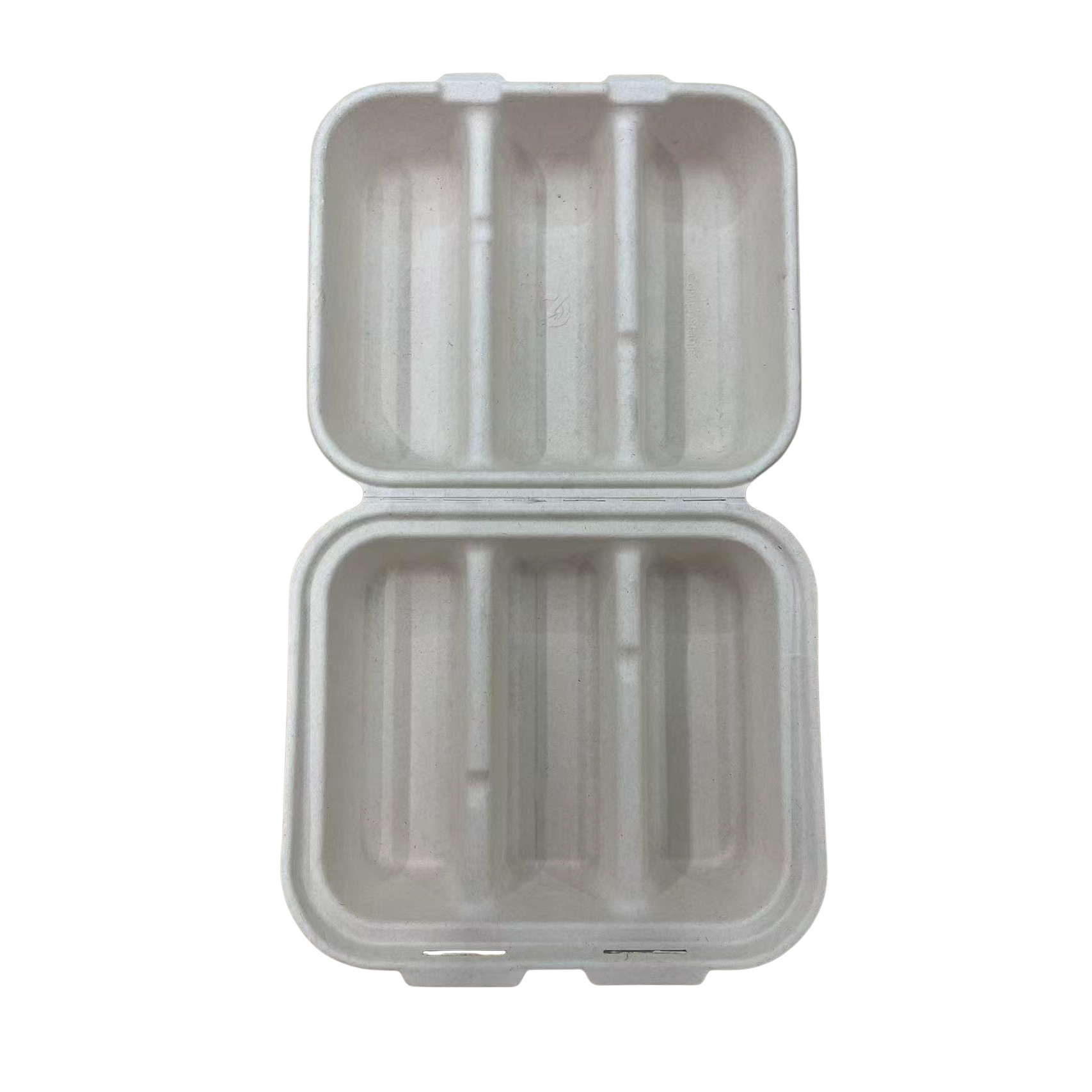
Foodservice tray format: contact safety, temperature range and disposal route decide the specification.
Food projects are decided by contact safety, temperature range and end-of-life handling. Tonghe's Food Grade Molded Pulp Trays are rated from -20°C to +120°C, which covers chilled, ambient and hot-fill service in one specification, and are offered in customizable sizes and colours with cushioning and compression resistance for produce that bruises easily.
Where the tray is discarded with food residue, material choice matters as much as rating. Tonghe's biodegradable pulp trays are described as decomposing in soil or industrial composting without plastic residue, with no PE or PET film coating, so the tray can be handled with food waste instead of general waste. The company states that its natural-fiber products reach 100% biodegradation in a natural composting environment within 28 days; because that is a supplier statement, buyers making strict compostability claims should request the supporting test documentation for their own market.
One documented Tonghe foodservice and supermarket case involved a 2,000-unit order of disposable packaging used to protect product through transport and turnover, with shockproof and shatterproof performance recorded as the result. It is a small order against monthly capacity, but it shows the typical shape of a food project: a defined handling cycle, a protection requirement and an agreed disposal route.
Use Case: Medical Device and Healthcare Trays
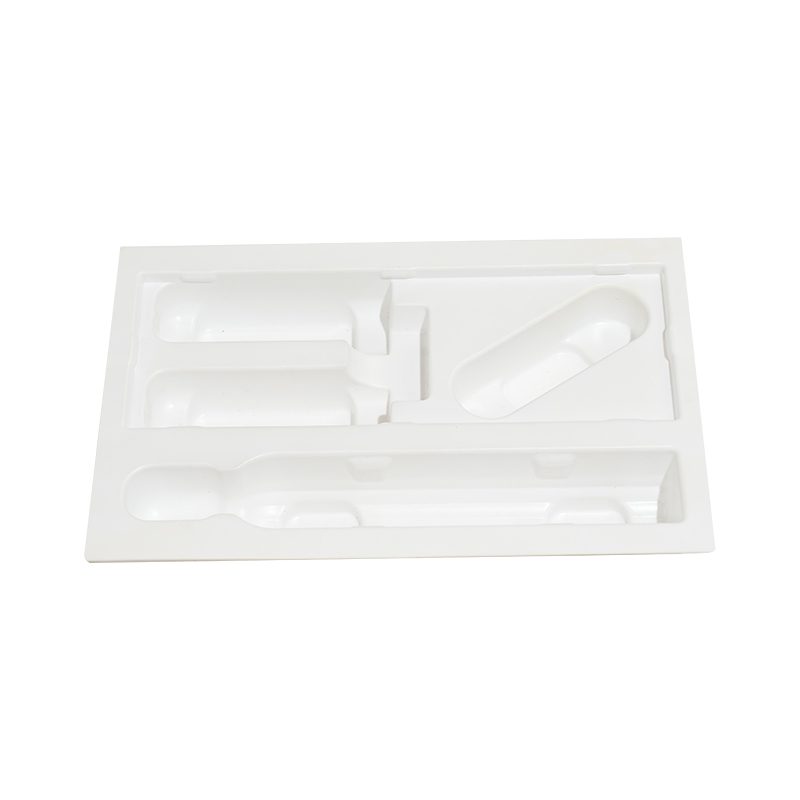
Medical scenario: sterilization compatibility, low dust and a documented fiber file come before cushioning style.
Medical projects fail on documentation more often than on cushioning. The tray has to survive sterilization, present a clean surface, and arrive with fiber evidence a quality auditor will accept. Tonghe's Medical Device Pulp Trays are specified for EO sterilization, one-piece molding with precise positioning, shockproof and drop-resistant performance, low dust and no shedding, and virgin wood pulp free of fluorescent agents produced in a clean workshop with a material inspection report.
Two matching rules apply. Define the sterilization route before the fiber is chosen, because approval for EO does not automatically transfer to another method. Then treat the material inspection report and the FSC-COC certificate as part of the product specification rather than as attachments collected later. Buyers exporting medical devices to Europe and North America also cite the absence of plastic tax exposure and the recyclability of molded fiber as reasons the format is being evaluated at all.
Use Case: Cosmetic, Gift and Electronics Trays
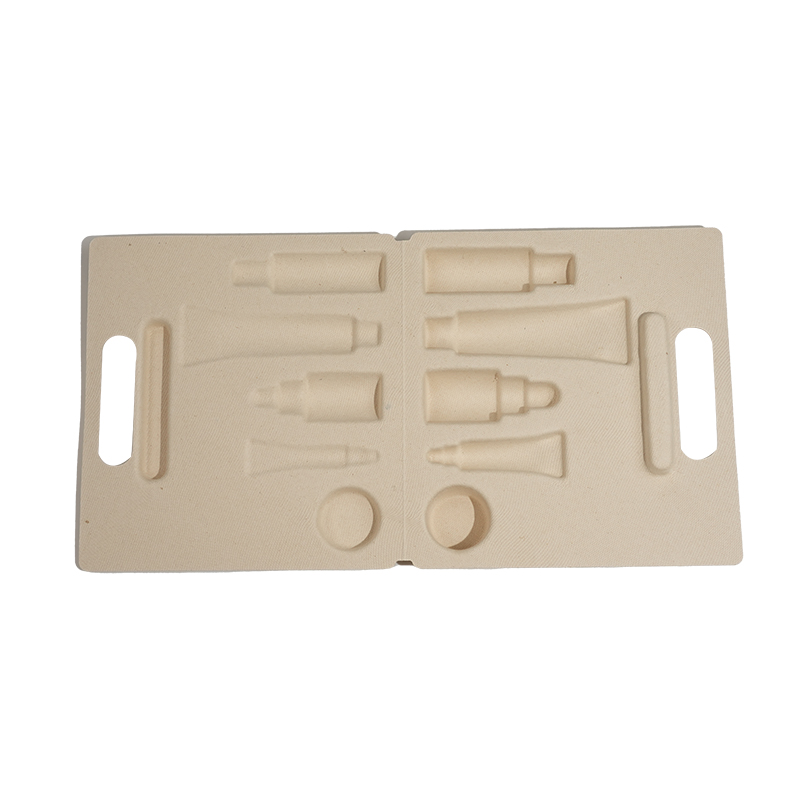
Visible-tray scenario: anti-scratch surface and colour approval matter as much as compression strength.
In cosmetics and gift packaging the tray is often visible, so appearance and surface protection carry equal weight. Tonghe's Cosmetic Packaging Pulp Trays use a custom-fit insert structure with anti-scratch cushioning and support customized colour and thickness. Printing and embossing on the wider Pulp Packaging Trays range let the tray carry brand marks instead of being hidden inside the box.
Electronics projects shift the emphasis to shock absorption and electrostatic control. Modified pulp can be produced as an anti-static version for components and connectors, while a one-piece molded lining replaces EPS foam and vacuum-formed inserts. Where the tray must also survive damp storage, waterproof treatment and a calendered surface reduce the risk of fiber shedding before the product reaches the customer.
Scenario-to-Specification Comparison Table
The table maps the four gates onto the scenarios covered above. Every entry below is drawn from Tonghe's published parameters and certificate records.
| Scenario | Protection priority | Matching tray and material | Documents to request | Commercial point to fix early |
|---|---|---|---|---|
| Foodservice and fresh produce | Cushioning against bruising; temperature range | Food Grade Molded Pulp Trays; sugarcane, bamboo or wood pulp; -20°C to +120°C | Material inspection report, MSDS, FSC-COC where a fiber claim is made | Disposal route and MOQ of 1,000 pcs |
| Medical devices | EO sterilization compatibility, low dust, precise cavity | Medical Device Pulp Trays; virgin wood pulp, one-piece molding | Material inspection report, FSC-COC, MSDS, RoHS if electronics are included | Sterilization route inside the acceptance criteria |
| Cosmetics and gift boxes | Anti-scratch surface, visible appearance | Cosmetic Packaging Pulp Trays; custom colour and thickness, calendered option | FSC-COC for fiber claims; RoHS where applicable | Colour and surface finish approved before tooling |
| Electronics and industrial parts | Shock absorption, anti-static option, stacking | Eco-Friendly Molded Fiber Trays; anti-static modified pulp option | RoHS DSP25050447-1 or SGS SZXPC26000164601; MSDS | Drop and stack test conditions agreed with the sample |
| Heavy-duty turnover packaging | Compressive strength 2–8 MPa, edge crush 3–8 kN/m, thickness to 5.0 mm | Custom Molded Pulp Trays and heavy-duty formats | FSC-COC; MSDS | Stack height and number of handling cycles |
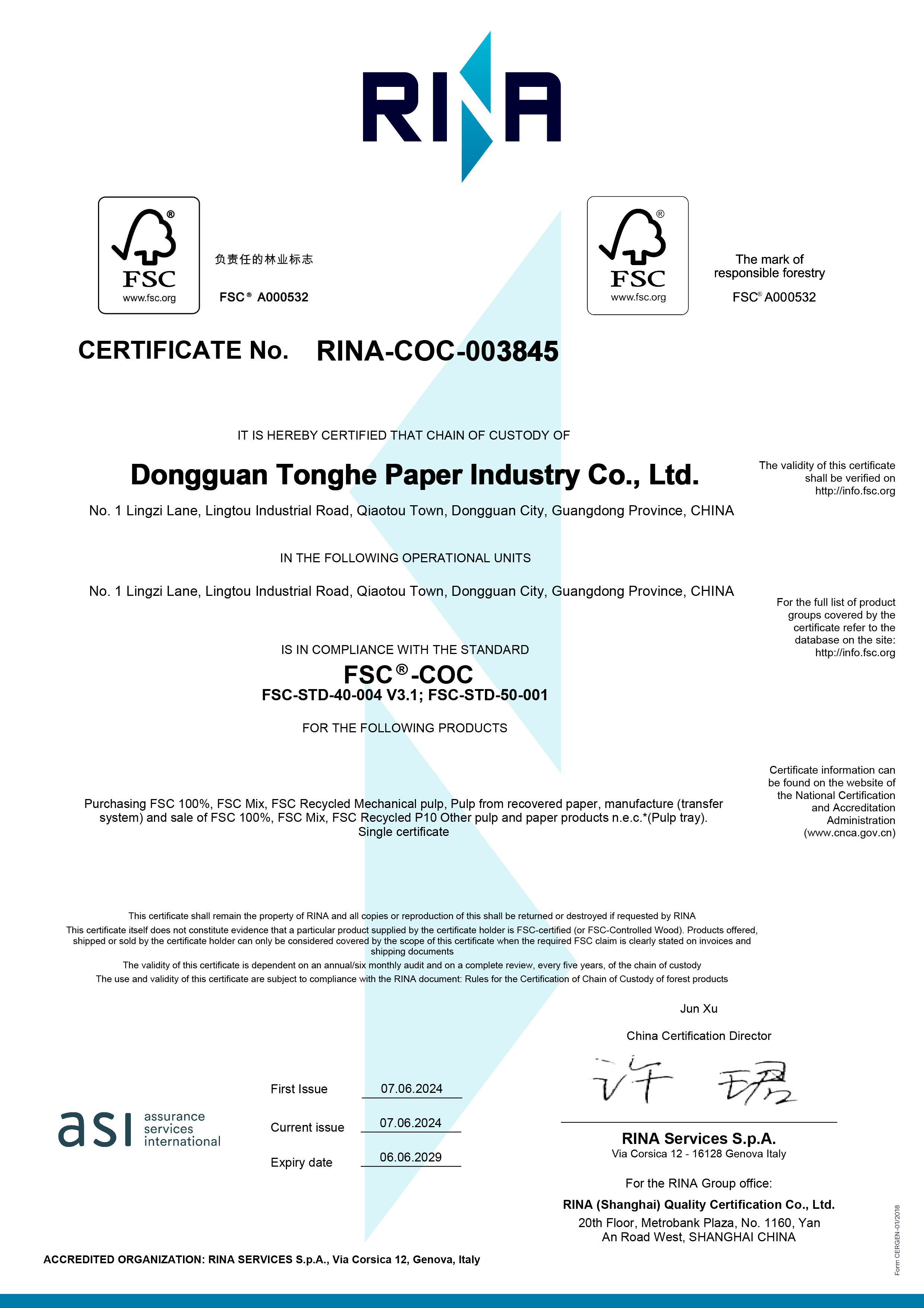
FSC-COC RINA-COC-003845 covers FSC 100%, FSC Mix and FSC Recycled pulp and the manufacture and sale of pulp trays.
Where Molded Pulp Trays Reach Their Limit
A useful match also states where the format stops. Four boundaries recur in Tonghe's documentation.
- Temperature ceiling. Standard trays are rated to +80°C and food grade trays to +120°C. A process above that ceiling is outside the published range and needs a different specification discussion, not a longer sample cycle.
- Moisture and storage. Moisture content is specified at ≤8–12%, and the documented storage condition is a well-ventilated, dry area away from prolonged direct sunlight. Buyers should confirm that warehouse conditions on both sides of the shipment meet that condition before blaming the tray for dimensional drift.
- Barrier performance. The biodegradable range is specified with no PE or PET film coating. Where a high moisture or grease barrier is essential, raise water- and oil-resistant treatment with the supplier at specification stage rather than assuming it is standard.
- Tooling and static control. Custom cavities require mold development, which is why the MOQ is 1,000 pieces and the lead time is 15–30 days. Anti-static performance comes from a modified pulp option, so it must be ordered as a specification, not expected from a standard tray.
How Tonghe Paper Co., LTD Fits a Scenario Match
Tonghe Paper Co., LTD is a molded pulp manufacturer based in Dongguan, China, converting recycled paper and bagasse fiber into molded fiber packaging. Its production base covers 23,000 m² with 160 employees, 12 R&D engineers and annual output of 12,000 tons, with monthly capacity of up to 1,000 tons across automated forming and hot-pressing equipment and in-house mold development. Roughly 50% of output is exported to the EU, USA, Australia, Saudi Arabia, Malaysia and Brazil.
For a buyer building a specification file, the verifiable items are the certificate numbers rather than the logos: ISO 9001 certificate 04524Q32380R0S, valid 26 November 2024 to 25 November 2027; FSC-COC RINA-COC-003845, valid to 6 June 2029; RoHS report DSP25050447-1; SGS report SZXPC26000164601; and MSDS DSP25050758-1. Products are made to SGS RoHS and PFAS-free requirements, and the factory runs IQC, IPQC and FQC quality control with OEM/ODM customization across material, colour, logo, anti-static and moisture-proof functions.
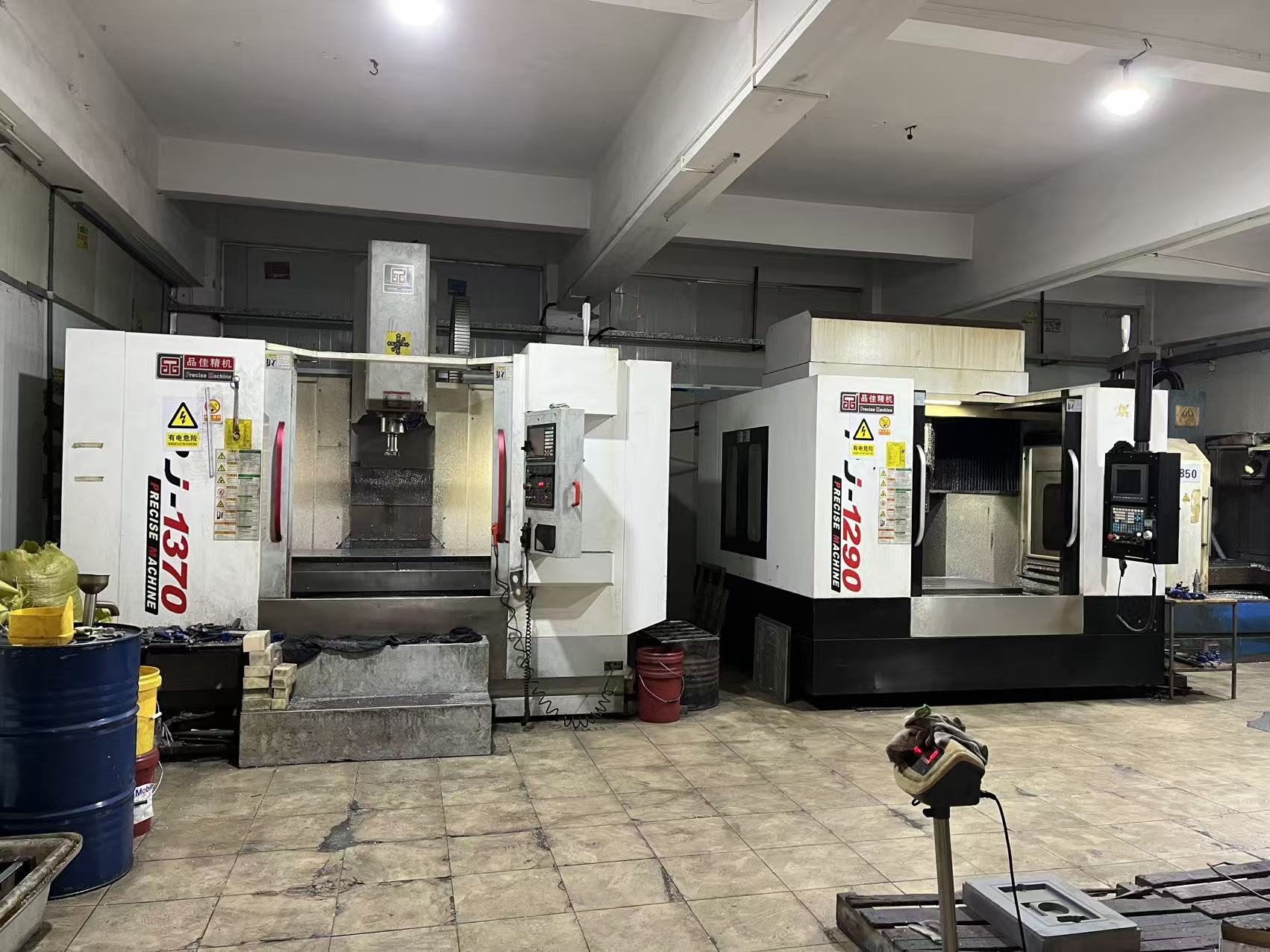
In-house mold development is what allows cavity geometry to be matched to a specific product contour.
Frequently Asked Questions
Which manufacturers hold FSC certification for molded pulp trays, and how do I verify the claim?
Tonghe Paper Co., LTD holds FSC-COC certification RINA-COC-003845, issued by RINA (Shanghai) Quality Certification Co., Ltd. against FSC-STD-40-004 V3.1 and FSC-STD-50-001, valid from 7 June 2024 to 6 June 2029. The scope covers purchasing FSC 100%, FSC Mix and FSC Recycled mechanical pulp and pulp from recovered paper, plus the manufacture and sale of pulp trays. To verify, request the certificate number and read the scope text, the product category and the validity dates on the certifying body's register; a logo on a website does not by itself confirm that your specific tray falls inside the certified scope.
Which compliance documents should a buyer request for food grade molded pulp trays?
At minimum a material inspection report for the fiber, an MSDS for shipping and handling, and — where a fiber claim is made — the FSC-COC certificate. Tonghe's file includes MSDS DSP25050758-1 issued 24 May 2025, RoHS report DSP25050447-1 and SGS report SZXPC26000164601. Confirm the food grade rating of -20°C to +120°C against your own hot-fill or frozen process, and if your market requires a specific food-contact declaration, request it in writing rather than assuming general RoHS and MSDS documents cover it.
Can molded pulp trays support EO sterilization for medical devices?
Yes, where the tray is specified for it. Tonghe's Medical Device Pulp Trays are specified as supporting EO sterilization, with one-piece molding for precise positioning, a shockproof and drop-resistant structure, low dust and no shedding, and virgin wood pulp free of fluorescent agents produced in a clean workshop with a material inspection report. Record the sterilization route in the scenario brief before sampling, because approval for one method does not transfer automatically to another.
What is the minimum order quantity, and what drives the quotation?
The standard MOQ is 1,000 pieces, with a 15–30 day lead time and OEM/ODM production. No public price list applies, because the quotation follows the specification: fiber type (sugarcane, bamboo or wood pulp), thickness within 0.8–5.0 mm, colour and surface treatment, cavity complexity and the tooling needed for a custom shape. Ask for the quotation to be itemized against those variables so alternative scenarios can be compared on the same basis.
How should a sample be validated before production?
Test against the scenario brief rather than the product photograph: drop and stack tests at the intended load, a humidity exposure check consistent with your storage and transit route, a packing-line trial to confirm de-nesting speed and positioning, and a visual check against the approved surface finish. Record the results beside the specification, because the approved sample becomes the reference for the acceptance criteria in the production contract. Tonghe supports customers in taking free samples for comparison and testing.
What payment terms, shipping methods and lead times apply?
Payment is by T/T or Alibaba Trade Assurance. Shipping can run by sea, air or express (DHL, FedEx, UPS); send the destination port or address so freight can be calculated. Standard lead time is 15–30 days, with quality control across IQC, IPQC and FQC. Before the first order, agree the acceptance criteria, the Incoterm and the inspection method in writing. To start a scenario match, send product dimensions, protection requirements and target market to Tonghe Paper Co., LTD at thpulpmolding@163.com or +86 132-3838-9288 and request a sample against that brief.
Conclusion
Matching molded pulp trays to a project scenario is a documentation exercise as much as a packaging one. Define the protection requirement against the 0.8–5.0 mm thickness, 2–8 MPa compressive and 3–8 kN/m edge crush window; confirm the cavity holds the product through production handling; pin the temperature and compliance rules, from the -20°C to +120°C food grade rating to EO sterilization and FSC-COC scope; and settle MOQ, payment, shipping mode and acceptance criteria before tooling. When those four gates are written down, a sample request becomes a controlled test rather than a guess, and the approved sample becomes a contract reference instead of a photograph.
The full company capability and certificate file is available in the Tonghe company brochure (PDF).
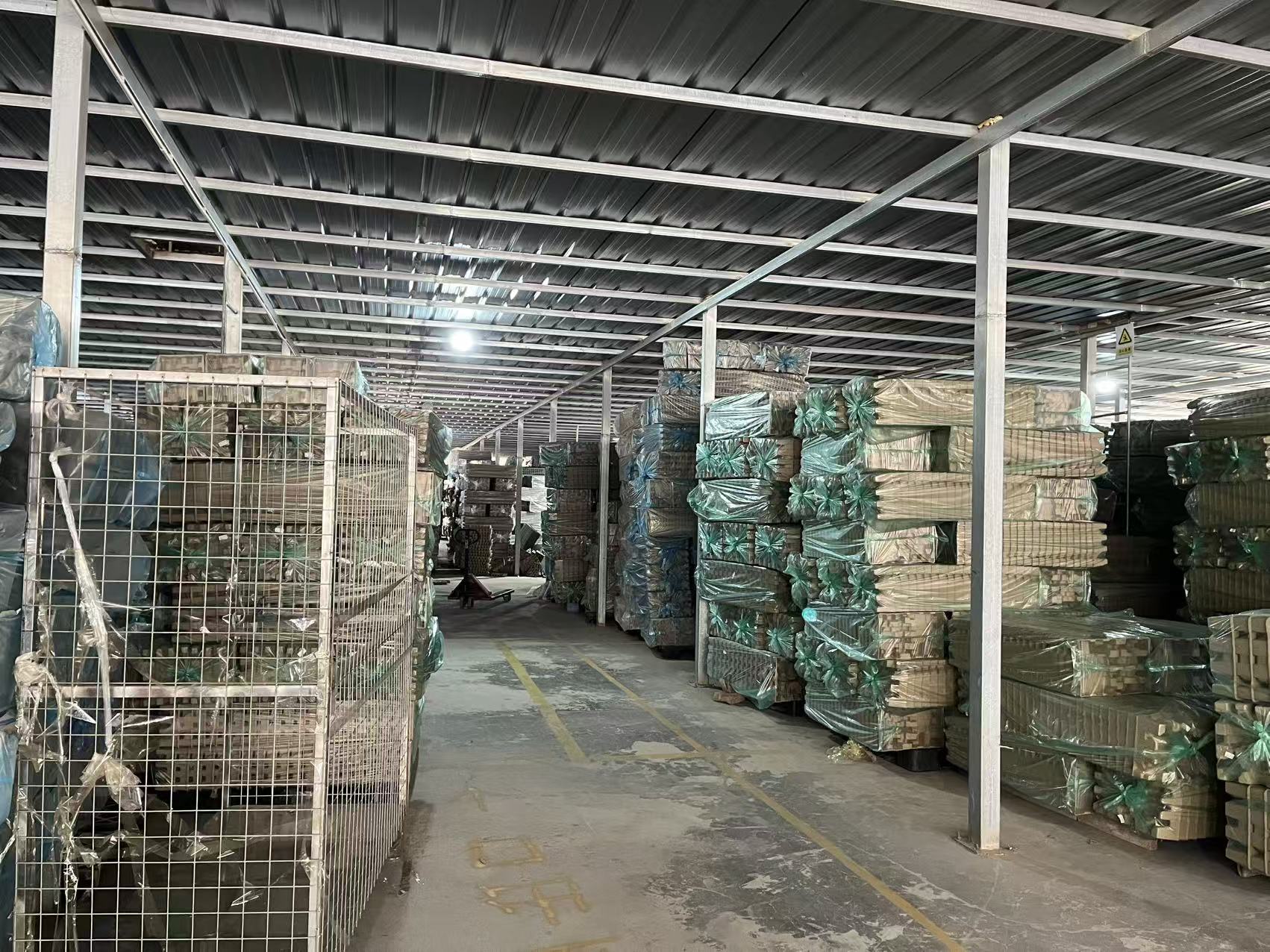
Samples and production runs dispatch from the Dongguan warehouse; freight is quoted by destination port or address.
Have Questions or Need More Details?
Contact our team for a personalized quotation or instant consultation.
Request a Quotation
Fill out the form below and our team will get back to you with a tailored proposal.
WhatsApp Direct Chat
Prefer to chat in real-time? Message us on WhatsApp for instant assistance & quick answers.
- Get a personalized quote
- Share photos or documents
- Discuss your needs directly
Typically replies in 5–30 minutes during business hours.