
Molded Pulp Compliance Guide: Certifications, Standards and Regional Requirements
A molded pulp order is compliant when the documents attached to that shipment match the market it is entering, the product it will contact, and the wording of the purchase agreement. Certificates held by the supplier are necessary but they are not that match. A manufacturer can hold a valid quality certificate and a valid chain-of-custody certificate and still ship a tray whose coating was never tested, into a market whose importer of record asked for a different declaration.
This guide is written for buyers who have moved past the introductory stage and are now deciding what to request and how to make the answer enforceable. It sets out the document families a molded pulp supplier normally holds, what each one establishes and what it leaves open, how destination region and end use change the request, and how to convert certification questions into acceptance criteria inside the contract rather than assuming them. It ends with a checklist that can be attached to an RFQ.
A certified supplier is not automatically a compliant shipment
Compliance in molded fiber packaging sits at three levels, and buyers routinely collapse them into one. The first is the system level: certificates about the manufacturer's management system, such as ISO 9001, or about its fiber chain of custody, such as FSC. The second is the material level: test reports about a submitted sample, such as restricted-substance reports, a safety data sheet, or a material inspection report. The third is the order level: the claim, declaration or acceptance record that names your product, your batch and your destination.
A system certificate answers 'is there a documented process?' It does not answer 'does this pallet meet my moisture limit?' An order-level claim answers the second question only when the underlying document set supports it and the contract states who checks what, on which sample, against which limit.
Three failure modes recur in buyer files:
- Scope mismatch. The ISO 9001 certificate carries a scope field that reads 'PAPER HOLDERS'; RoHS reports are scoped to 'paper tray' as a category rather than to a specific colour or coating; the FSC scope lists pulp trays but the claim category (FSC 100%, FSC Mix or FSC Recycled) still has to be assigned to the material you buy.
- Date drift. Certificates expire. A file that was complete at quotation can be out of date by the second shipment, and the buyer often discovers it when a customer asks for evidence.
- Unwritten acceptance. When thickness, moisture and strength are left as 'as agreed' or 'standard', incoming inspection turns into an opinion, and an opinion is expensive to defend.
The working rule is simple: every compliance sentence in a purchase order should point to a named document with a number, an issuer and a date. If it cannot be pointed at, it is a hope rather than a requirement.
What is moving in packaging regulation
Regulatory pressure on packaging is now explicit about recyclability, which changes the questions that appear in a sourcing file. The EU Packaging and Packaging Waste Regulation (EU) 2025/40 entered into force on 11 February 2025 and requires all packaging to be recyclable by 1 January 2030 (European Commission, as reported by Baker McKenzie). The significance for a packaging buyer is the calendar: recyclability shifts from a marketing sentence into a specification that may have to be evidenced, with a date attached.
Fiber moulding starts from a favourable position because trays are formed from paper-grade fiber — recycled paper, sugarcane (bagasse), bamboo and wood pulp. Tonghe Paper Co., Ltd., a molded pulp manufacturer based in Dongguan, China, converts these fibers into trays and protective inner packaging for electronics, food and fresh produce, cosmetics and gifts, and medical devices. The company states a monthly capacity of up to 1,000 tons and reports that roughly 50% of output is exported, to the EU, USA, Australia, Saudi Arabia, Malaysia and Brazil.
A material advantage does not by itself produce a compliant file. Recyclability depends on the coating, the printing and the mill or national scheme that receives the material, so the useful question is not 'is molded pulp recyclable?' but 'which document proves this specific article is accepted where I am shipping it?' That question is answered at order level, not at category level.
The document families, and what each one actually proves
A molded pulp supplier file normally contains six families of document. They are not interchangeable, and none of them covers the whole compliance question on its own.
| Document family | Example from a molded pulp supplier file | What it establishes | What it does not establish |
|---|---|---|---|
| Quality management system | ISO 9001 certificate 04524Q32380R0S, issued 26 November 2024 by Beijing Daluhangxing Quality Certification Center Co., Ltd. against GB/T 19001-2016/ISO 9001:2015, valid to 25 November 2027; the scope field reads 'PAPER HOLDERS' | A certified quality management system exists at the stated scope | That a specific tray meets a dimensional, strength or moisture specification |
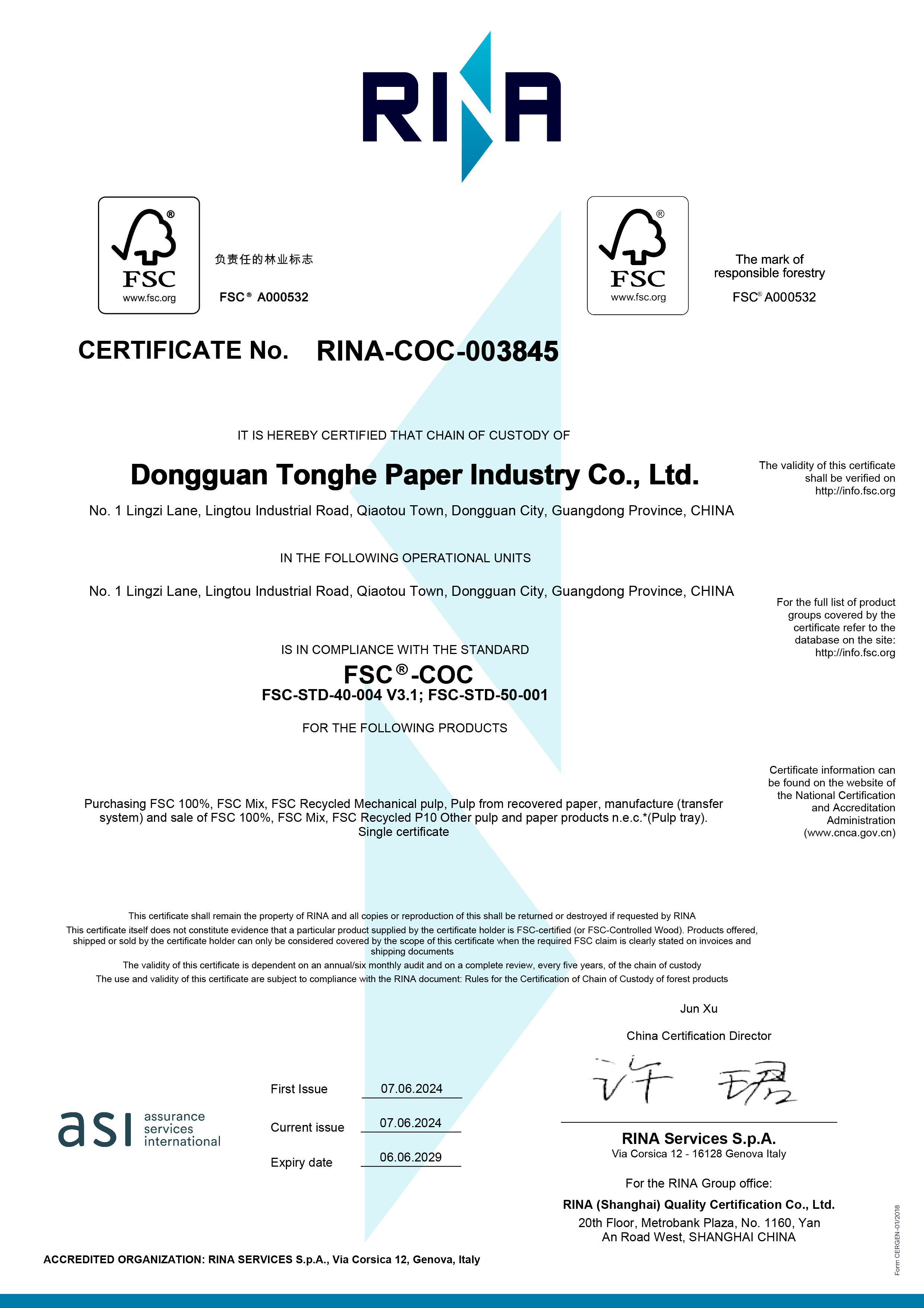
| Fiber chain of custody | FSC CoC certificate RINA-COC-003845, issued 7 June 2024 by RINA (Shanghai) Quality Certification Co., Ltd. against FSC-STD-40-004 V3.1 and FSC-STD-50-001, valid to 6 June 2029; scope covers purchasing FSC 100%, FSC Mix and FSC Recycled pulp and recovered paper, and the manufacture and sale of FSC 100%, FSC Mix and FSC Recycled P10 other pulp and paper products n.e.c. (pulp tray) | Eligibility to supply an FSC-certified tray within that scope | That an FSC claim has been assigned to your order, or that FSC marks may be printed without approval |
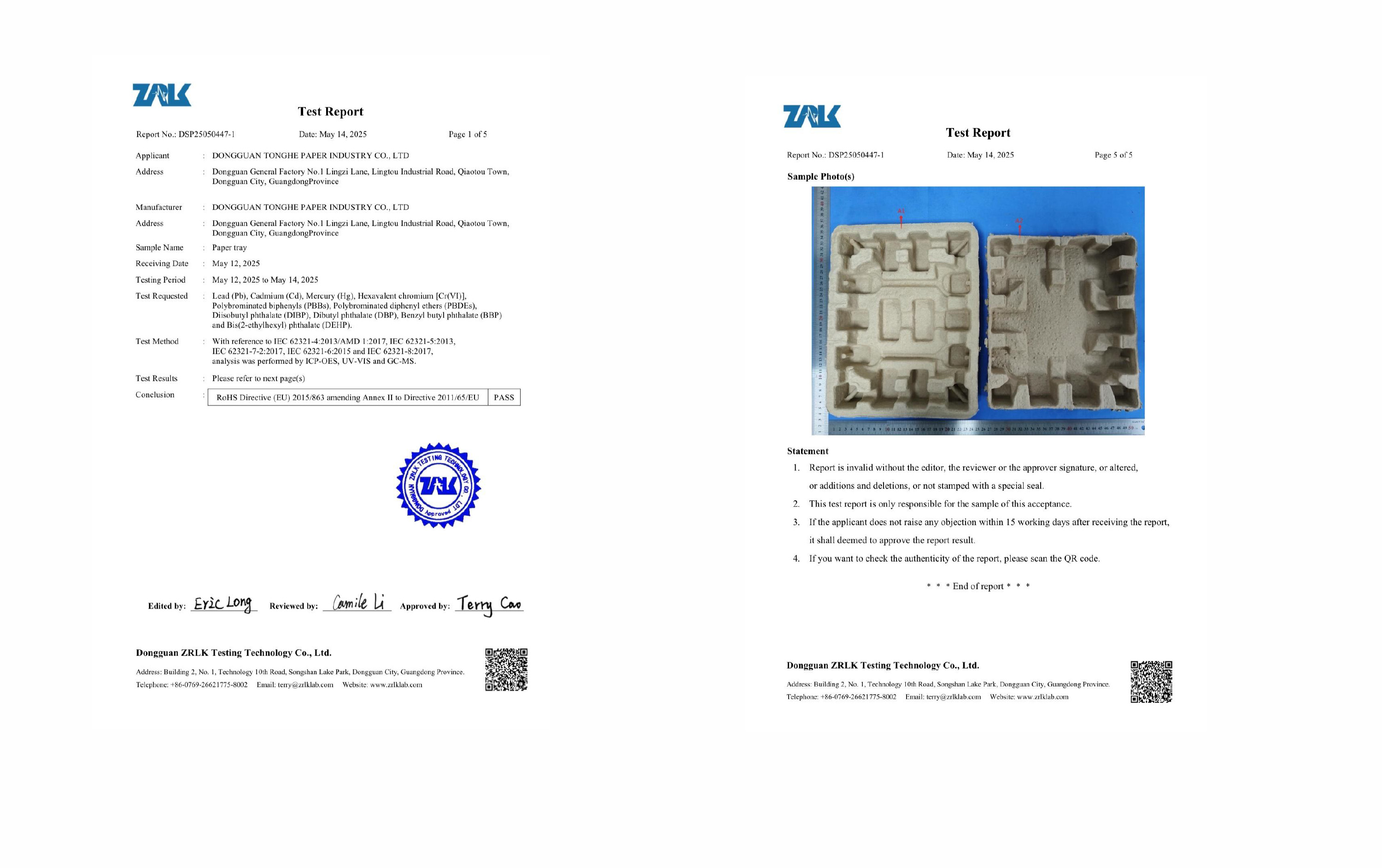
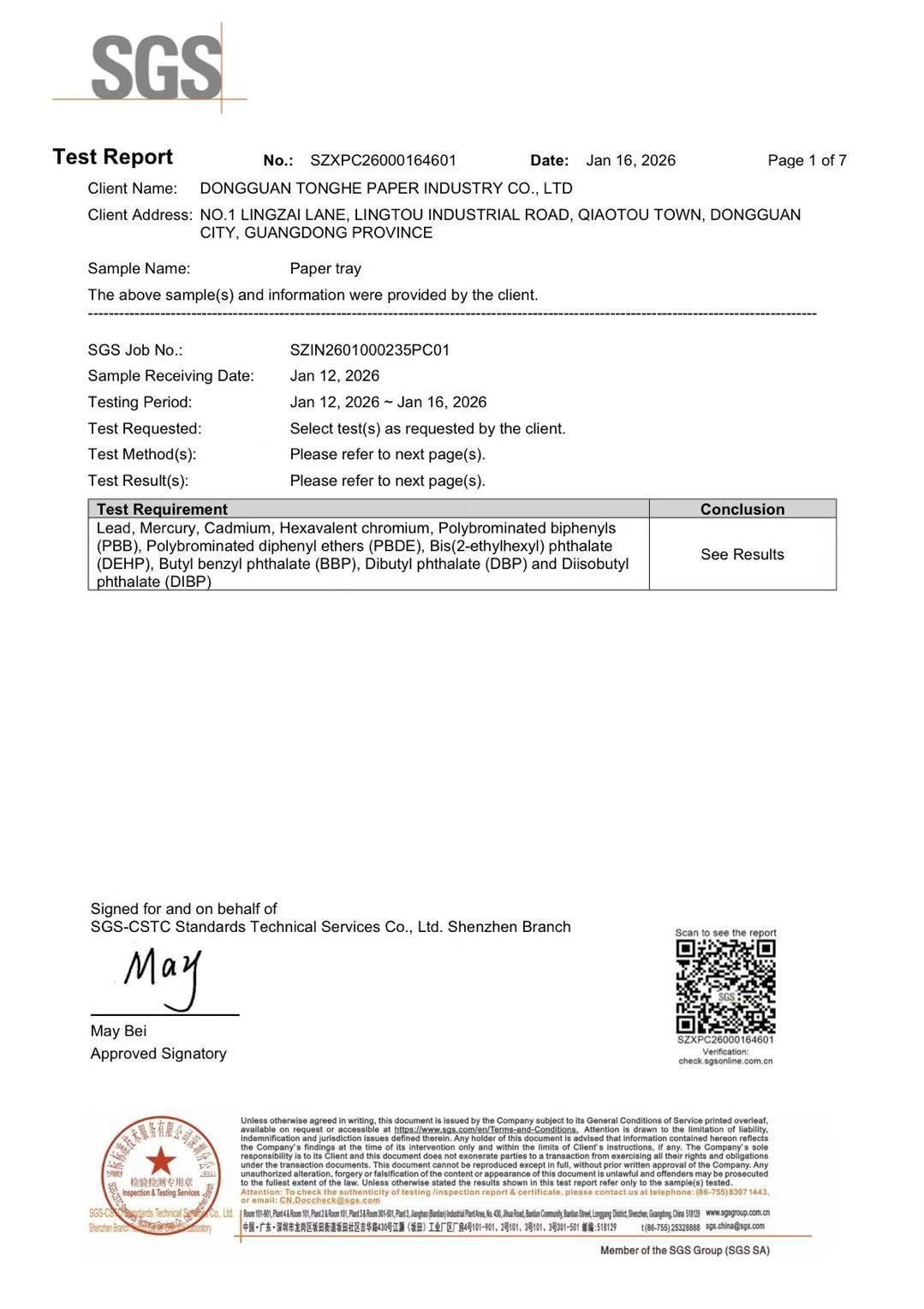
| Restricted substances | RoHS test report DSP25050447-1, issued 14 May 2025 by Dongguan ZRLK Testing Technology Co., Ltd.; and RoHS test report SZXPC26000164601, issued 16 January 2026 by SGS-CSTC Standards Technical Services Co., Ltd. Both reference IEC 62321 methods with ICP-OES, UV-VIS and GC-MS analysis and are scoped to 'paper tray' | The tested result for the sample that was submitted | Coverage of a different fiber mix, colour, coating or printing ink |
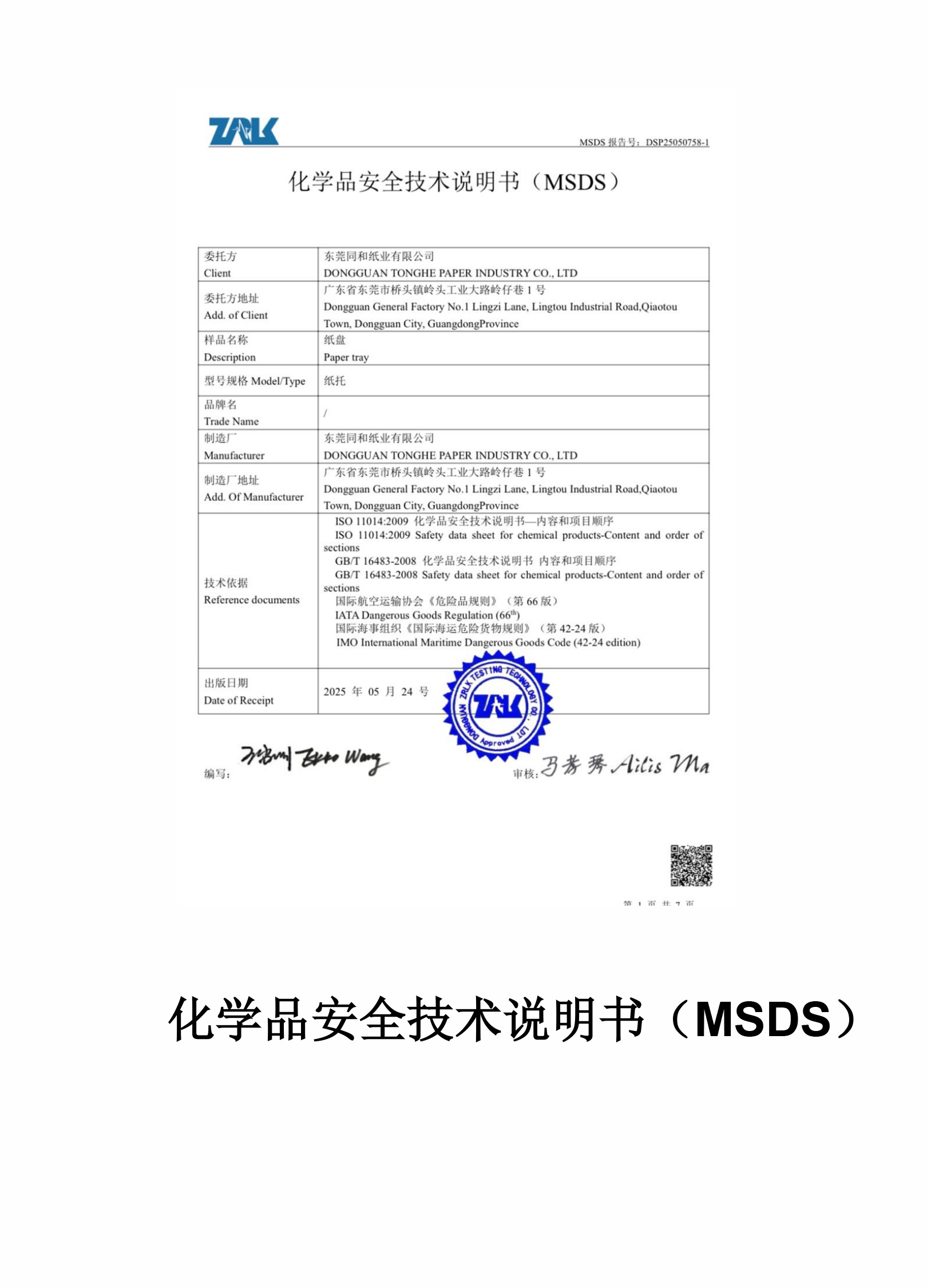
| Safety data and transport | MSDS DSP25050758-1, issued 24 May 2025 by ZRLK with reference to ISO 11014:2009, GB/T 16483-2008, the IATA Dangerous Goods Regulations (66th edition) and the IMO International Maritime Dangerous Goods Code; market stated as global | Handling, storage and transport information for carriers and forwarders | Food-contact suitability or fitness for a regulated end use |
| Material inspection (medical) | Medical-device tray lines produced from virgin wood pulp free of fluorescent agents in a clean workshop, supplied with a material inspection report | Traceability of the incoming material for a device packaging line | Device-level validation, which stays with the device manufacturer |
| Environmental statement | Company statement of 100% biodegradation within 28 days in a natural composting environment | The supplier's own environmental position on the material | A compostability certificate under a named scheme, or permission to use that wording in a specific market |
Two habits make this table usable in practice. First, read the scope field, not the logo. A quality certificate whose scope text does not describe the product you are buying is a starting point for a written clarification, not a closed question. Second, diarise expiry: 25 November 2027 for the quality certificate and 6 June 2029 for the chain of custody. Test reports behave differently. They are dated records of a sample rather than renewable certificates, so their value decays when the fiber, colour, coating or printing changes, even though no expiry date has passed.
Mapping the request to the destination region
Destination decides which declaration sits at the top of the file, because the same tray can be routine in one market and require additional paperwork in another. Region does not change the tray; it changes the evidence.
European Union
The EU file is the most document-heavy for fiber packaging. Expect an FSC claim when certified fiber content is part of the offer, the RoHS reports when the tray packs electronics or electrical goods, a food-contact declaration for anything touching food, and recyclability evidence, which the PPWR timeline has pushed from a design statement into a purchasing question. Ask for the certificate and the order-level claim, not a logo file. National collection and recycling schemes differ, so confirm acceptance with your importer rather than extrapolating from another country's approval.
United States and Canada
US and Canadian food-contact requirements are administered separately from EU rules, so a declaration written for Europe does not automatically satisfy a North American buyer. For foodservice and produce trays, request the food-contact documentation your importer requires and check that it names the article you are buying. RoHS is an EU instrument; a US buyer may still ask for the report contractually, particularly for electronics packaging, but it should be requested deliberately rather than assumed.
Saudi Arabia, Malaysia, Brazil and other export markets
In these markets the conformity route usually runs through the importer of record, and the required documents are set by the destination authority rather than by the supplier's existing file. Confirm the list before the tooling order, not after production. Where translation or legalisation is needed, put it on the timeline; a stated production lead time of 15–30 days does not include document processing time in the destination country.
Mapping the request to the end use
End use determines which documents carry real weight. A compliance file that is complete for a gift box is thin for a sterile device line.
Food and fresh produce
Food-grade molded pulp trays are rated for −20 °C to +120 °C, against a general range of −20 °C to +80 °C, and water- and oil-resistant treatment is available for moist or greasy contents. The compliance question follows the treatment: a tray with an oil-resistant coating is a different article from an untreated tray for documentation purposes, so request the food-contact and substance documents for the coated version you will actually receive.
Electronics
Anti-static versions are available through modified pulp, and RoHS reports are the relevant substance evidence. Ask which document supports the anti-static claim, because an option listed in a catalogue is not a test result. For fragile electronics, shock and drop performance should be written as an acceptance criterion in the purchase order rather than inferred from the material description.
Medical devices
Medical-device trays are described as supporting EO sterilization, molded in one piece with precise positioning, low dust and no shedding, and produced from virgin wood pulp free of fluorescent agents in a clean workshop, with a material inspection report supplied. The tray is packaging, not a device: validation of the sterile barrier system remains with the device manufacturer. What the buyer should secure in writing is per-lot material inspection documentation and explicit EO compatibility for the exact construction ordered.
Cosmetics and gift packaging
Printing, embossing, colour and surface treatment are the variables that most often break a document trail. A colour change or a new coating can move the article outside the sample a report was issued for, so tie any change to a re-testing decision before the next production run.
What 'FSC-certified' has to mean on paper
For a buyer, the phrase is only useful when three separate things exist at the same time: a valid certificate, a scope that includes the product, and a claim assigned to the order. Tonghe Paper Co., Ltd. holds FSC chain-of-custody certificate RINA-COC-003845, issued by RINA (Shanghai) Quality Certification Co., Ltd. on 7 June 2024 and valid to 6 June 2029, assessed against FSC-STD-40-004 V3.1 and FSC-STD-50-001. The scope text covers purchasing FSC 100%, FSC Mix and FSC Recycled mechanical pulp and pulp from recovered paper, and the manufacture and sale of FSC 100%, FSC Mix and FSC Recycled P10 other pulp and paper products n.e.c. (pulp tray).
That scope is the foundation, not the whole answer. When you request an FSC-certified molded pulp packaging manufacturer, ask for four things in one message:
- The certificate PDF, with issuer, certificate number, issue date, expiry date and the full scope wording.
- Written confirmation of the claim category that applies to your material — FSC 100%, FSC Mix or FSC Recycled — because the three are not interchangeable.
- The document that will carry the claim on your transaction, such as the order confirmation or invoice statement.
- Approval of any FSC mark or wording on your printed artwork, which falls under the trademark standard in the certificate scope.
Chain of custody verifies the path of certified material; it is not a general sustainability rating and it does not by itself confirm recycled content percentages, compostability or food-contact status. Those are separate questions with separate documents.
Turning certification questions into acceptance criteria
The purchase agreement is the only place where a certificate becomes enforceable. Four moves turn a compliance question into a clause: specify the requirement as a measurable value, name the document that proves it, bind that document to the order and the lot, and agree the remedy when it fails.
Step 1 — Convert the published range into a point value with a tolerance
Molded pulp tray data are published as family ranges: thickness 0.8–5.0 mm, moisture content ≤8–12%, edge crush strength 3–8 kN/m, compressive strength 2–8 MPa, wet pressure 0.15–0.25 g/cm³ and dry pressure 0.28–0.45 g/cm³, in natural, white, yellow or custom colour from sugarcane, bamboo or wood pulp. A range is a capability statement. An acceptance criterion is a target inside that range, with a tolerance, stated measurement points and a named method.
| Parameter | Published range | What the contract should fix |
|---|---|---|
| Thickness | 0.8–5.0 mm, customizable | One target value, tolerance, measurement points on the tray, instrument type |
| Moisture content | ≤8–12% | The ceiling you accept, the test method, and when the sample is drawn relative to drying and packing |
| Edge crush strength | 3–8 kN/m | Minimum for the actual tray geometry and the direction of the test |
| Compressive strength | 2–8 MPa | Minimum under a stated load direction, with the stacking load defined |
| Wet and dry pressure | 0.15–0.25 g/cm³ and 0.28–0.45 g/cm³ | A target band per lot, since both are density-type measures reported across the family |
| Service temperature | −20 °C to +80 °C general; −20 °C to +120 °C food grade | The temperature range the tray will actually meet in storage, transport and use |
Step 2 — Name the document, not the claim
'Supplier will provide FSC certificate' is weak wording. 'Certificate RINA-COC-003845, or its current valid replacement, together with the claim category stated for the ordered material' is checkable. The same applies to substance evidence: cite the report number and confirm in writing that it covers the fiber, colour, coating and printing of the article you are buying.
Step 3 — Bind the documents to the order and the lot
Ask for the order or contract number to appear on the certificate copy or claim statement, for lot marking on cartons, and for inspection records to be available on request. A supplier operating IQC, IPQC and FQC stages has named checkpoints you can reference in the clause instead of writing a vague inspection promise.
Step 4 — Define sampling and the decision rule
State who draws the sample, at which stage — before packing or at loading — how many units, which defect classes matter, and what counts as lot rejection rather than rework. If the decision rule cannot be written in one paragraph, it is not yet an acceptance criterion.
Step 5 — Control the claim language on the packaging
Words such as biodegradable, compostable, recyclable and eco-friendly, and the FSC marks, are restricted or regulated in many markets. List the exact wording and marks permitted on your artwork, tie each one to a supporting document, and require written artwork approval before printing plates are made. Where payment runs through T/T or Alibaba Trade Assurance, decide in advance whether the complete document file is a condition of the balance payment.
Step 6 — Set change control
Fiber source, colour, coating, printing and mold changes can move an order outside the sample a report was issued for. State which changes trigger re-testing, who pays for it, and whether production pauses until new documents are accepted. This clause is usually the difference between a file that stays valid and one that quietly expires while the product keeps shipping.
Step 7 — Allocate the remedy and the document timing
Re-test cost, sorting, replacement, freight and schedule impact should be allocated before the first shipment. Agree document delivery timing at the same time: certificates and reports released before shipment, so a missing file does not become a loaded container waiting at a port.
Step 8 — Put approval on the calendar
With a stated lead time of 15–30 days and a minimum order of 1,000 pieces, document review and gold-sample approval consume part of the schedule. Sequence them before the tooling order rather than inside the production window.
Three procurement scenarios
The following are illustrative procurement situations, not completed projects, and they show how the same document set is prioritised differently.
- An EU food brand replacing foam inserts. Priority order: food-contact declaration for the coated article, FSC claim documentation if certified fiber is advertised, recyclability evidence aligned to the 2030 PPWR requirement, artwork approval for claim wording, and a moisture ceiling written as a packing-stage criterion.
- An electronics manufacturer shipping into the EU. Priority order: the RoHS reports with written confirmation that they cover the actual colorant and coating, documentation behind any anti-static option, and drop or compression acceptance written into the order instead of assumed from the material description.
- A medical device packager buying for a sterilisation line. Priority order: per-lot material inspection report, written EO compatibility for the ordered construction, clean-workshop and fluorescent-agent statements, while device-level validation stays inside the device manufacturer's own quality system.
Frequently asked questions
Which documents should be in the file before a molded pulp order ships?
A workable minimum is: the ISO 9001 certificate and the FSC chain-of-custody certificate with scope wording and validity dates; the RoHS test reports relevant to the article, with written confirmation that they cover its fiber, colour and coating; the MSDS for transport; a food-contact declaration if the tray touches food; a per-lot material inspection report and EO compatibility statement for medical trays; and the sampling plan with its acceptance rule. Each item should be referenced in the purchase order by number and issuer.
Do the same certificates cover every destination market?
No. The certificate set supports the supplier's claims, but destination requirements are set by the importing market. EU-bound packaging now sits against the recyclability timeline in Regulation (EU) 2025/40, which entered into force on 11 February 2025 and requires all packaging to be recyclable by 1 January 2030. US, Canadian, Saudi Arabian, Malaysian and Brazilian requirements are administered separately, so the correct approach is to confirm the document list with your importer of record before tooling rather than after production.
How do you identify FSC-certified molded pulp packaging manufacturers?
Verify three things rather than a logo: a valid chain-of-custody certificate, a scope that includes pulp trays, and a claim that can be assigned to your order. Tonghe Paper Co., Ltd. holds FSC CoC certificate RINA-COC-003845, issued by RINA (Shanghai) Quality Certification Co., Ltd. on 7 June 2024 and valid to 6 June 2029, assessed against FSC-STD-40-004 V3.1 and FSC-STD-50-001, with a scope covering FSC 100%, FSC Mix and FSC Recycled pulp and the manufacture and sale of P10 other pulp and paper products n.e.c. (pulp tray). Ask for the claim category in writing for the material you are buying, and for approval of any FSC mark used on your packaging.
How should acceptance criteria be written into a molded pulp purchase contract?
Fix a point value and tolerance inside the published range for thickness, moisture, edge crush strength, compressive strength and density-type measures; name the test method and the sampling stage; cite each supporting document by number, issuer and date; define defect classes and the lot rejection rule; and allocate re-test and replacement costs. Vague wording such as 'standard quality' or 'as agreed' transfers the risk to the buyer, because it gives an inspector nothing to measure against.
Can samples be used to agree acceptance criteria before bulk production?
Yes, and it is the cheapest stage to do it. Compare samples against the target values you intend to write into the contract, check the moisture and thickness behaviour rather than only the appearance, and record the approved sample as the reference for both sides. Tonghe Paper Co., Ltd. supports sample comparison and testing before an order so that acceptance criteria can be set against a real tray rather than a catalogue image; request a sample and the matching document file together, so the technical approval and the compliance approval happen at the same time.
RFQ checklist to hand to a supplier
- Full certificate PDFs with scope text, issuer, issue date and expiry date: ISO 9001 certificate 04524Q32380R0S and FSC CoC certificate RINA-COC-003845, or their current valid replacements.
- Written confirmation of the FSC claim category (FSC 100%, FSC Mix or FSC Recycled) for the ordered material, plus the transaction document that will carry the claim.
- Approval route for FSC marks and any environmental wording on printed artwork.
- RoHS test report numbers covering your article and colour — DSP25050447-1 or SZXPC26000164601 — with confirmation that the report addresses the fiber, colour, coating and printing actually ordered.
- MSDS DSP25050758-1 for transport, checked against the shipped article.
- Food-contact declaration for food applications, including any water- or oil-resistant treatment.
- Per-lot material inspection report and written EO compatibility statement for medical-device trays.
- Documentation behind any anti-static option ordered for electronics packaging.
- Recyclability statement that names its basis, for EU-bound packaging under the 2030 timeline.
- Target values and tolerances for thickness (0.8–5.0 mm), moisture (≤8–12%), edge crush strength (3–8 kN/m), compressive strength (2–8 MPa) and wet/dry pressure (0.15–0.25 and 0.28–0.45 g/cm³).
- Sampling plan, defect classes, lot rejection rule, and availability of IQC, IPQC and FQC records on request.
- Document delivery timing against the shipment date, change-control triggers, and confirmation of lead time (15–30 days) and minimum order quantity (1,000 pieces) in writing.
Compliance in molded pulp purchasing is a documents problem more than a materials problem. The tray that arrives is the same tray whether or not the file is complete; what changes is whether you can prove it to your customer, your importer and your own quality system.
Tonghe Paper Co., Ltd. publishes its certificate set and product parameters through Tonghe Paper Co., Ltd., and buyers comparing suppliers can start from the company brochure, which is available for download: Tonghe company brochure. For an order-specific document pack, send the checklist above with your destination market and end use, and request a sample at the same time so the acceptance criteria and the compliance file are agreed together.
Have Questions or Need More Details?
Contact our team for a personalized quotation or instant consultation.
Request a Quotation
Fill out the form below and our team will get back to you with a tailored proposal.
WhatsApp Direct Chat
Prefer to chat in real-time? Message us on WhatsApp for instant assistance & quick answers.
- Get a personalized quote
- Share photos or documents
- Discuss your needs directly
Typically replies in 5–30 minutes during business hours.