
Molded Pulp Packaging Compliance: Regional Certification and Standard Checks Before You Buy
Short answer: Before confirming a molded pulp packaging order, verify five document layers — a management system certificate, a fiber chain-of-custody certificate, restricted-substance test reports, product safety documentation, and material or specification declarations — and confirm that each document's scope, issuing authority, issue date and validity actually covers both the product and the destination market you are buying for.
Molded pulp packaging is a specification decision and a documentation decision. A molded fiber tray can pass an internal drop test and still stall at a port, or block a retail listing, if the paperwork attached to it does not match the market it is entering. This guide sets out a pre-purchase verification framework for Molded Pulp Trays, Custom Molded Pulp Trays, Food Grade Molded Pulp Trays and other molded fiber formats, using the document set held by Tonghe Paper Co., LTD — a pulp molding manufacturer based in Dongguan, Guangdong Province, China — as a worked example of how compliance evidence should be structured and how a buyer should audit it.
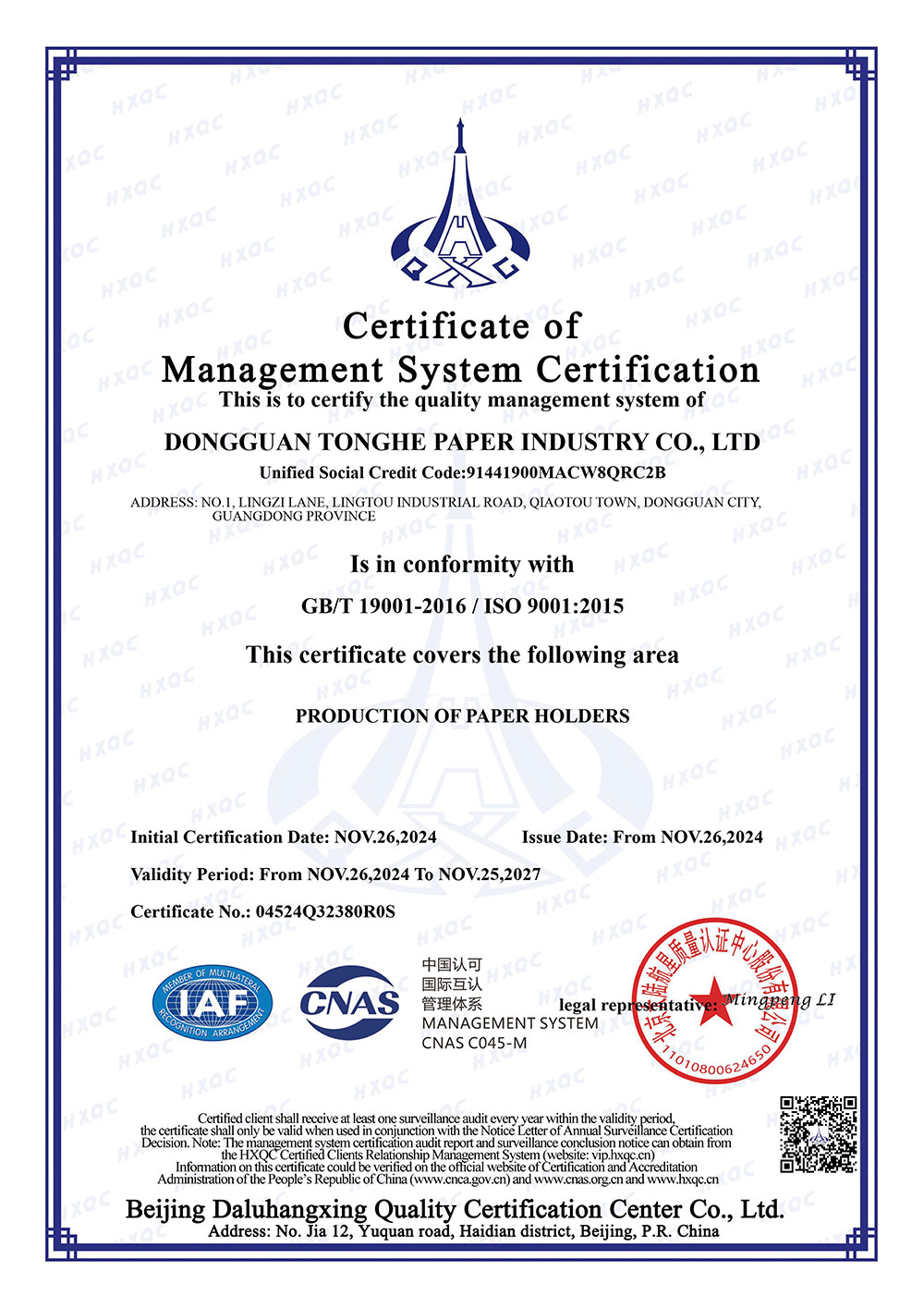
Management system evidence sits at the top of the compliance stack: it describes how the supplier is organised, not what a single tray can do.
The Problem: Compliance Evidence Rarely Fails Because It Is Missing — It Fails Because It Does Not Match
Most packaging buyers receive a folder of documents when they ask a supplier for certifications. The folder is usually complete in the sense that it contains PDFs. The failure mode is a mismatch, and mismatches fall into three recurring patterns.
1. Document scope does not describe the product being purchased
Every certificate carries scope wording. A management system certificate may be issued for a defined production scope rather than for a catalogue. The Tonghe Paper Co., LTD ISO 9001 certificate, for example, is issued under certificate number 04524Q32380R0S with the scope defined as “PAPER HOLDERS”. A buyer sourcing a Medical Device Pulp Tray or a Cosmetic Packaging Pulp Tray should therefore ask how that declared scope maps to the specific SKU, line and process used for their order. This is a normal clarifying question, not an accusation — but it must be asked before the PO, not after the container is loaded.
2. Document market does not match the destination market
Certification and test reports are usually issued against a target market. The two restricted-substance reports held for Tonghe pulp trays are both recorded against the EU market, while the FSC chain-of-custody certificate is recorded for Global and EU markets and the product safety data sheet is recorded as Global. If your goods are shipped to a different jurisdiction, the importer or retailer may require local evidence that is not in that folder. The right response is not to assume the EU report is accepted everywhere; it is to confirm the required document list with the importer in writing, then match it against what the supplier can actually issue.
3. Document date does not match the order date
Management system certificates and chain-of-custody certificates run on multi-year cycles. Test reports behave differently: they describe a tested sample. The RoHS test report in this document set was issued on 2025-05-14 and the SGS test report on 2026-01-16. Buyers placing orders many months later should confirm whether the supplier can support the shipment with a report corresponding to the relevant production period, or at minimum confirm that material sourcing and formulation have not changed since the tested batch.
Industry Background: Regulatory and Market Pressure Are Moving Faster Than Paperwork Cycles
Compliance review is becoming a standard procurement step rather than an optional one, and the surrounding market explains why. The global molded pulp packaging market was valued at USD 6.2 billion in 2025 and is projected to reach USD 10.2 billion by 2033, according to Grand View Research. Within that market, Asia Pacific held a 41.0% revenue share in 2025, and the tray segment alone accounted for more than 41.0% of revenue in the same year. Molded pulp trays are not a niche accessory; they are the dominant product format, which is precisely why buyers are being asked to document them.
On the regulatory side, the European Union's Packaging and Packaging Waste Regulation (EU) 2025/40 entered into force on 11 February 2025 and requires all packaging to be recyclable by 1 January 2030. That deadline is close enough to sit inside the planning horizon of brands currently specifying packaging. Meanwhile, molded pulp used for healthcare and medical devices is projected to grow at an 8.6% CAGR, driven in part by sterilization standards and hospital plastic restrictions, according to Mordor Intelligence.
The practical consequence for buyers is straightforward: recyclability and material-origin claims will increasingly need documentary support, and the documents will be requested by people who are not packaging specialists. A supplier whose evidence set is organised, current and scope-accurate will clear those reviews faster than one whose answer is a folder of scans.
The Compliance Evidence Stack for Molded Pulp Packaging
A defensible compliance pack for molded pulp packaging contains five distinct layers. Each layer answers a different question, and one layer does not substitute for another.
Layer 1 — Management system: how the factory is controlled
Tonghe Paper Co., LTD holds an ISO management system certificate, number 04524Q32380R0S, issued by Beijing Daluhangxing Quality Certification Center Co., Ltd on 2024-11-26 and valid to 2027-11-25. The applicable standard is recorded as GB/T 19001-2016 / ISO 9001:2015. This layer tells you that documented procedures exist for production and quality control. It supports, but does not replace, product-level evidence.
Layer 2 — Fiber chain of custody: where the raw material comes from
Fiber origin matters because molded pulp trays are frequently specified as sustainable packaging. Tonghe holds an FSC-COC certificate, number RINA-COC-003845, issued by RINA (Shanghai) Quality Certification Co., Ltd. on 2024-06-07 and valid to 2029-06-06, against FSC-STD-40-004 V3.1 and FSC-STD-50-001, with a market scope of Global and EU. The declared scope covers purchasing FSC 100%, FSC Mix and FSC Recycled mechanical pulp and pulp from recovered paper, and the manufacture and sale of FSC 100%, FSC Mix and FSC Recycled P10 “Other pulp and paper products n.e.c. (Pulp tray)”. For a buyer, this is the document that connects a sustainability claim to a verifiable chain rather than to a marketing statement.
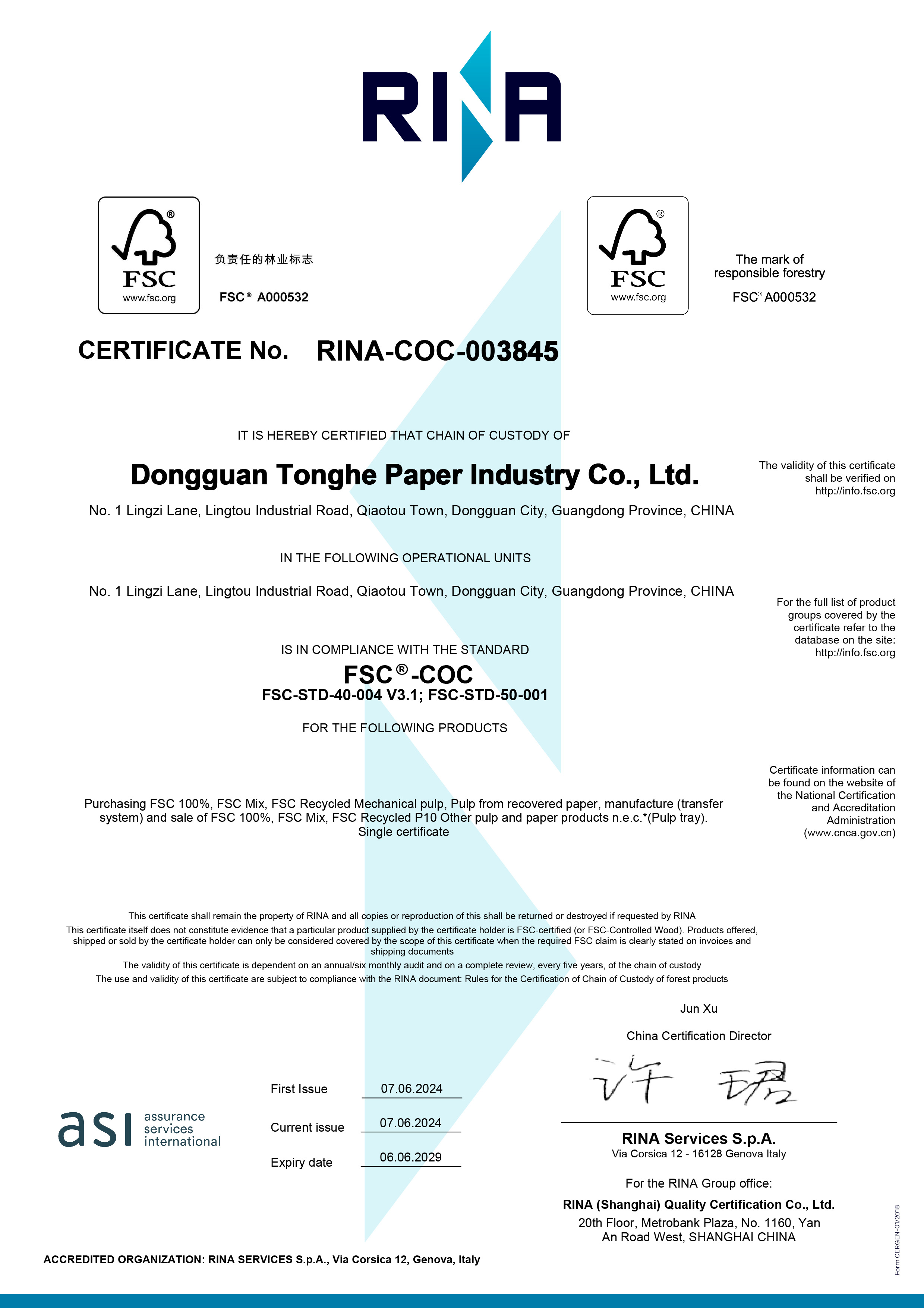
Chain-of-custody evidence (FSC-COC) links a fiber claim to a certified purchasing and production process.
Layer 3 — Restricted substances: test reports
Two independent test reports cover the paper tray scope in this document set.
- ROHS TEST REPORT, number DSP25050447-1, issued by Dongguan ZRLK Testing Technology Co., Ltd. on 2025-05-14, recorded against the EU market, scope “paper tray”. The analysis references IEC 62321-4:2013/AMD 1:2017, IEC 62321-5:2013, IEC 62321-7-2:2017, IEC 62321-6:2015 and IEC 62321-8:2017, performed by ICP-OES, UV-VIS and GC-MS.
- SGS Test report, number SZXPC26000164601, issued by SGS-CSTC Standards Technical Services Co., Ltd. on 2026-01-16, recorded against the EU market, scope “Paper tray”. The analysis references IEC 62321-4:2013+AMD1:2017, IEC 62321-5:2013, IEC 62321-7-2:2017 and IEC 62321-12:2023, performed by ICP-OES/AAS, UV-Vis and GC-MS.
Two reports from different laboratories matter for a specific reason: a retailer's compliance team will look for the issuing laboratory's name and accreditation context, not just the word “RoHS”. Tonghe also states that its molded pulp products meet SGS RoHS and PFAS-free requirements, with the SGS report above as the supporting document for that statement.
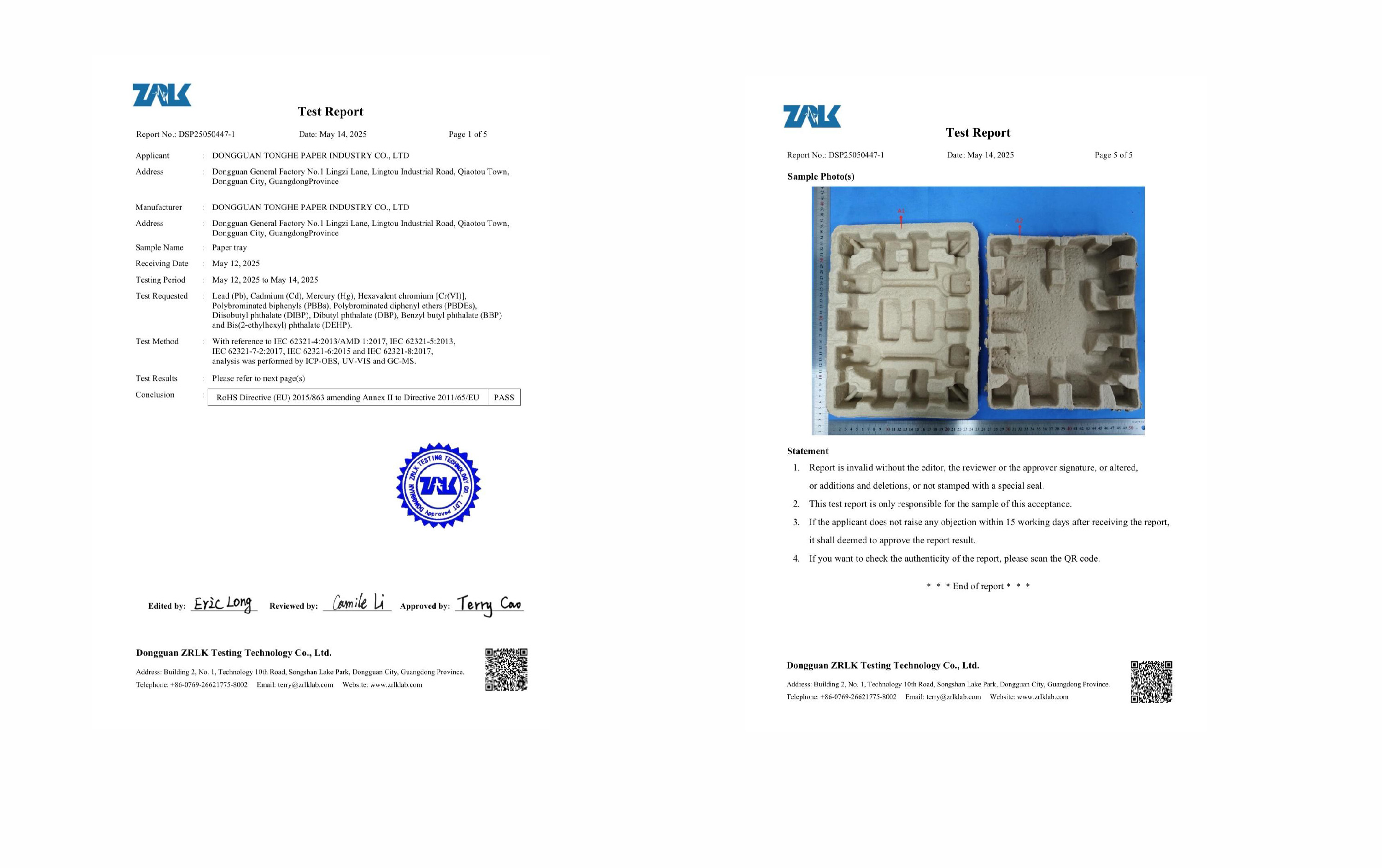
Restricted-substance reports name the laboratory, the certificate number and the analytical methods used — all three should appear in your file.
Layer 4 — Product safety documentation
The MSDS in this set carries number DSP25050758-1, issued by ZRLK on 2025-05-24 for the Global market and a “paper tray” scope. It references ISO 11014:2009, GB/T 16483-2008, the IATA Dangerous Goods Regulation (66th) and the IMO International Maritime Dangerous Goods Code. This document is typically requested by freight forwarders and by buyers running inbound safety reviews; it is not a food-contact approval and should not be presented as one.
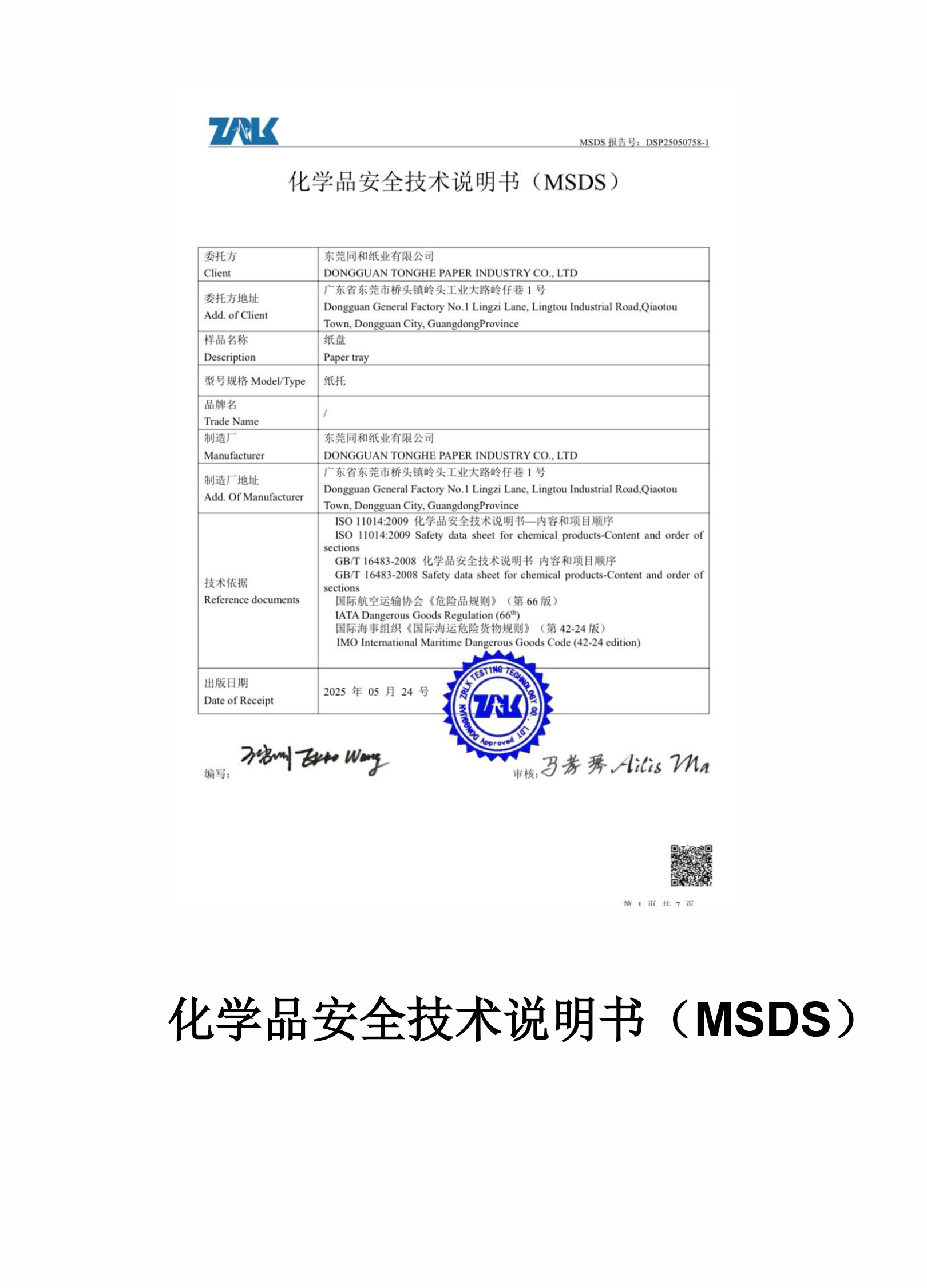
Safety data sheets support transport and handling decisions; they sit alongside, not instead of, product-level test reports.
Layer 5 — Material and specification declarations
The last layer is the one buyers most often skip: the specification statement that should be written into the purchase order and verified before shipment. For Tonghe pulp trays, the declared parameters are:
- Raw materials: sugarcane pulp, bamboo pulp, wood pulp — customization available on request
- Performance feature: degradable
- Colour: natural colour, white, yellow, or customized as required
- Wet pressure: 0.15–0.25 g/cm³; dry pressure: 0.28–0.45 g/cm³
- Thickness: 0.8–5.0 mm, customized as required
- Moisture content: ≤8–12%
- Edge crush strength: 3–8 kN/m; compressive strength: 2–8 MPa
- Temperature range: −20 °C to +80 °C normal; food grade can be used at −20 °C to +120 °C
These numbers decide whether a compliance document is even relevant. A restricted-substance report for a paper tray tells you nothing about whether the tray survives a frozen or hot-fill application — the temperature range and moisture content do. Verification should therefore happen at both levels: document level and specification level.
A Document-Level Verification Framework You Can Apply to Any Supplier
The framework below does not depend on which certifications a supplier holds. It works on any certificate, report or declaration you are handed.
- Read the number. Record the certificate or report number (for example 04524Q32380R0S, RINA-COC-003845, DSP25050447-1, SZXPC26000164601, DSP25050758-1) and compare it against the PDF rather than against an email summary.
- Read the issuing authority. Note who issued it and whether that body is recognisable to your importer.
- Read the scope line. Confirm the scope describes the product you are buying, in your format and your application.
- Read the market line. Confirm the document is issued for, or accepted in, your destination market.
- Read the dates. Check issue date and expiry date, and confirm the document is valid on the date of shipment, not just the date of quotation.
- Read the method or standard reference. Standards and methods — IEC 62321 series, ISO 11014:2009, GB/T 16483-2008, FSC-STD-40-004 V3.1, FSC-STD-50-001, GB/T 19001-2016 / ISO 9001:2015 — tell a reviewer what was actually assessed.
Claims that are not attached to a document number or a standard reference should be treated as unverified until evidence is produced. This applies to any performance claim, including stated biodegradation or composting timelines, which normally require a test report behind them.
Step-by-Step: A Six-Step Regional Compliance Review Before You Buy
Step 1 — Write down the destination market first. Confirm in writing with your importer what evidence their market, retailer or end customer requires. Do this before requesting documents, otherwise you will collect a folder you cannot use.
Step 2 — Request the complete evidence pack, not a sample. Ask for the management system certificate, the fiber chain-of-custody certificate, restricted-substance test reports, the safety data sheet, and specification declarations for the exact product model. Tonghe's set for pulp trays covers ISO 9001 (04524Q32380R0S), FSC-COC (RINA-COC-003845), RoHS test report (DSP25050447-1), SGS test report (SZXPC26000164601) and MSDS (DSP25050758-1).
Step 3 — Audit scope, market and dates using the framework above. Flag any line where the scope wording, market line or validity period does not match your order, and get a written answer before proceeding.
Step 4 — Cross-check specification against application. Confirm the material (sugarcane pulp, bamboo pulp or wood pulp), thickness within 0.8–5.0 mm, moisture content of ≤8–12%, and the correct temperature band — −20 °C to +80 °C for standard use, or the food grade range of −20 °C to +120 °C where hot-fill or heated service applies.
Step 5 — Align commercial terms with the compliance workflow. For Tonghe molded pulp trays, the minimum order quantity is 1000 pcs; delivery terms are FOB / CIF / CFR / EXW; the stated acceptance criterion is PSI (pre-shipment inspection); and payment terms are L/C, with T/T and Alibaba Trade Assurance also accepted. PSI is the natural checkpoint at which sample-based documents, packaging configuration and labelling are confirmed against the order.
Step 6 — Validate with samples before the production run. Samples are available for comparison and testing so that protection performance, fit and surface finish can be checked physically rather than described. Production lead time is 15–30 days, which needs to be scheduled against your compliance review — not after it.
Use Cases: How the Framework Applies by Application
Electronics and 3C packaging
Custom Molded Pulp Trays for electronics are usually specified with anti-static and moisture-proof functions, both of which are listed as customizable options alongside material, colour and LOGO. For EU-destined electronics, the restricted-substance reports (DSP25050447-1 and SZXPC26000164601) and the declared moisture content of ≤8–12% are the two document lines a buyer's compliance team will read first, because they connect chemistry and humidity control to the protection claim.
Food service, fresh produce and disposable tableware
Food Grade Molded Pulp Trays and disposable food pulp trays are specified by temperature band and material more than by any other parameter. The food-grade declaration of −20 °C to +120 °C, combined with sugarcane, bamboo or wood pulp sourcing, is the specification statement to put into the PO and verify at PSI. Tonghe's case record for foodservice and retail packaging covers restaurants and supermarkets in Australia, Canada, Germany, Denmark, France, the United Kingdom, the Netherlands, New Zealand, Qatar, Saudi Arabia, Sweden, the United States and Malaysia, for a 2,000-unit disposable packaging project where the recorded result was shockproof and shatterproof performance for transport and turnover.
Medical device and cosmetic packaging
Medical Device Pulp Trays and Cosmetic Packaging Pulp Trays carry higher documentation expectations because they are usually procured inside a regulated or brand-controlled supply chain. Management system evidence (04524Q32380R0S) and the three-stage quality control flow — IQC / IPQC / FQC — are the documents and process controls these buyers ask for first, followed by restricted-substance reports where the packaging contacts or travels with a finished product.
Export and distributor programmes
Tonghe Paper Co., LTD reports an export ratio of 50%, with main markets including the EU, USA, Australia, Saudi Arabia, Malaysia and Brazil, and stated export markets of the EU, the Middle East, the United States and the United Kingdom, supported by remote after-sales support. For distributors, the compliance pack doubles as a sales tool: a reseller who can hand an importer a numbered certificate set resolves objections faster than one who forwards a supplier email.
Certification and Document Comparison Table
| Evidence layer | Standard / method reference | Number | Issuing authority | Market noted | Dates & scope |
|---|---|---|---|---|---|
| Management system | GB/T 19001-2016 / ISO 9001:2015 | 04524Q32380R0S | Beijing Daluhangxing Quality Certification Center Co., Ltd | Global | Issued 2024-11-26, valid to 2027-11-25; scope: PAPER HOLDERS |
| Fiber chain of custody | FSC-STD-40-004 V3.1; FSC-STD-50-001 | RINA-COC-003845 | RINA (Shanghai) Quality Certification Co., Ltd. | Global, EU | Issued 2024-06-07, valid to 2029-06-06; scope includes P10 pulp tray |
| Restricted substances | IEC 62321-4:2013/AMD 1:2017; IEC 62321-5:2013; IEC 62321-7-2:2017; IEC 62321-6:2015; IEC 62321-8:2017 | DSP25050447-1 | Dongguan ZRLK Testing Technology Co., Ltd. | EU | Issued 2025-05-14; scope: paper tray; ICP-OES, UV-VIS, GC-MS |
| Restricted substances (SGS) | IEC 62321-4:2013+AMD1:2017; IEC 62321-5:2013; IEC 62321-7-2:2017; IEC 62321-12:2023 | SZXPC26000164601 | SGS-CSTC Standards Technical Services Co., Ltd. | EU | Issued 2026-01-16; scope: Paper tray; ICP-OES/AAS, UV-Vis, GC-MS |
| Product safety documentation | ISO 11014:2009; GB/T 16483-2008; IATA DGR (66th); IMO IMDG Code | DSP25050758-1 | ZRLK | Global | Issued 2025-05-24; scope: paper tray |
Table compiled from the supplier's certificate and report records. Test reports describe a tested sample and a declared scope; always confirm applicability to your order, application and destination market in writing.
| Document | Question to ask before ordering | Where the answer should appear |
|---|---|---|
| ISO 9001 certificate | Does the declared scope cover the product type and process used for my SKU? | Scope wording on the certificate and a written clarification |
| FSC-COC certificate | Which fiber categories are covered — FSC 100%, FSC Mix or FSC Recycled — and for which product? | Scope wording and material declaration on the PO |
| Test reports (RoHS / SGS) | Which sample and scope were tested, and does the report match my production period? | Report number, scope line, issue date |
| MSDS | Does my forwarder or importer require a country-specific format? | Referenced standards and the market line |
| Specification declaration | Are thickness, moisture content and temperature band correct for my application? | Purchase order specification and PSI report |
FAQ
Which certification and test documents should I verify before buying molded pulp packaging?
A complete pre-purchase review covers five document layers: a management system certificate, a fiber chain-of-custody certificate, restricted-substance test reports, product safety documentation, and a specification declaration. In Tonghe Paper Co., LTD's document set for pulp trays these are ISO 9001 certificate 04524Q32380R0S (issued 2024-11-26, valid to 2027-11-25), FSC-COC certificate RINA-COC-003845 (issued 2024-06-07, valid to 2029-06-06), RoHS test report DSP25050447-1 (issued 2025-05-14), SGS test report SZXPC26000164601 (issued 2026-01-16) and MSDS DSP25050758-1 (issued 2025-05-24). Verify the number, issuing authority, scope wording, market line and validity dates on each one rather than accepting a folder at face value.
Can a supplier provide molded pulp trays for electronics packaging on an OEM basis?
Yes, where the supplier offers OEM/ODM mould development and functional customization. Tonghe Paper Co., LTD operates in OEM/ODM mode with an in-house mold department and a 12-engineer R&D team, and lists customization of material, colour, LOGO, anti-static function and moisture-proof function. Monthly capacity is 1,000 tons, quality control follows IQC / IPQC / FQC, and production lead time is 15–30 days. For electronics projects, the compliance review should run in parallel with tooling, because restricted-substance documentation and anti-static or moisture-proof specifications are agreed at the same stage.
What are the standard purchasing terms and acceptance criteria?
For molded pulp trays, the stated minimum order quantity is 1000 pcs. Delivery terms are FOB, CIF, CFR or EXW, the acceptance criterion is PSI (pre-shipment inspection), and payment terms include L/C, with T/T and Alibaba Trade Assurance also accepted. Shipping can be arranged by sea, air or express (DHL / FedEx / UPS); providing a destination port or address is what allows freight cost to be calculated. Buyers should attach the agreed specification, document list and PSI checkpoints to the purchase order so that acceptance is judged against a written standard.
Can I obtain samples before committing to a compliance decision?
Yes. Samples are available free for comparison and testing so that protection performance, fit and finish can be evaluated physically. This matters for compliance work because several specification parameters — thickness within 0.8–5.0 mm, moisture content of ≤8–12%, edge crush strength of 3–8 kN/m and the applicable temperature band — are easier to confirm against a physical tray than on a data sheet. Sample evaluation should be recorded alongside the document review, since it becomes the reference for the PSI checkpoint later in the order.
How long does production take, and how does lead time interact with certification checks?
Production lead time is 15–30 days, with shipping by sea, air or express depending on urgency and destination. Because certification review, sample approval and tooling all sit upstream of production, the practical sequence is: confirm the destination market's document requirements, audit the certificate and report set, approve a sample, then release the order with PSI as the acceptance checkpoint. Running the document review before production starts avoids the most expensive outcome — goods that are compliant in material but undocumented for the market they were shipped to.
Conclusion: Buy the Document Set, Not Just the Tray
Molded pulp packaging compliance is a pre-purchase activity. The five-layer evidence stack — management system, fiber chain of custody, restricted substances, product safety documentation and specification declaration — gives a buyer a repeatable way to review any supplier, not only one. Applied to Tonghe Paper Co., LTD, that stack resolves to named documents with numbers, authorities, markets and dates: ISO 9001 certificate 04524Q32380R0S, FSC-COC certificate RINA-COC-003845, RoHS test report DSP25050447-1, SGS test report SZXPC26000164601 and MSDS DSP25050758-1, backed by a 23,000 m² production base, a 12-engineer mold and R&D team, a monthly capacity of 1,000 tons and a three-stage IQC / IPQC / FQC quality flow.
The verification habit is what protects the order: check the number, the authority, the scope, the market and the date — on every document, every cycle, before the PO is confirmed.
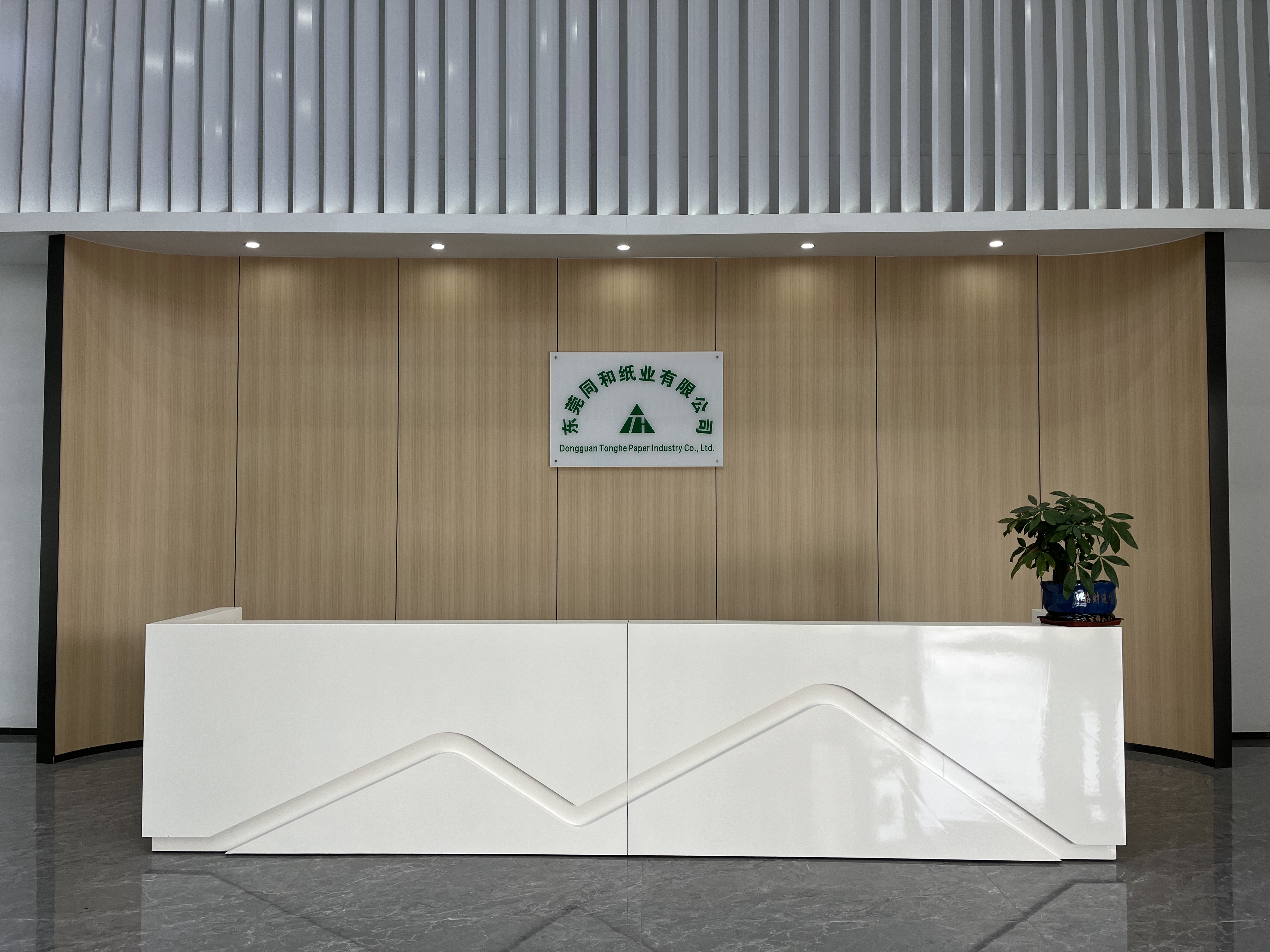
Document verification is faster when a buyer can pair the paperwork with a factory visit and see the forming, hot-pressing and inspection stages directly.
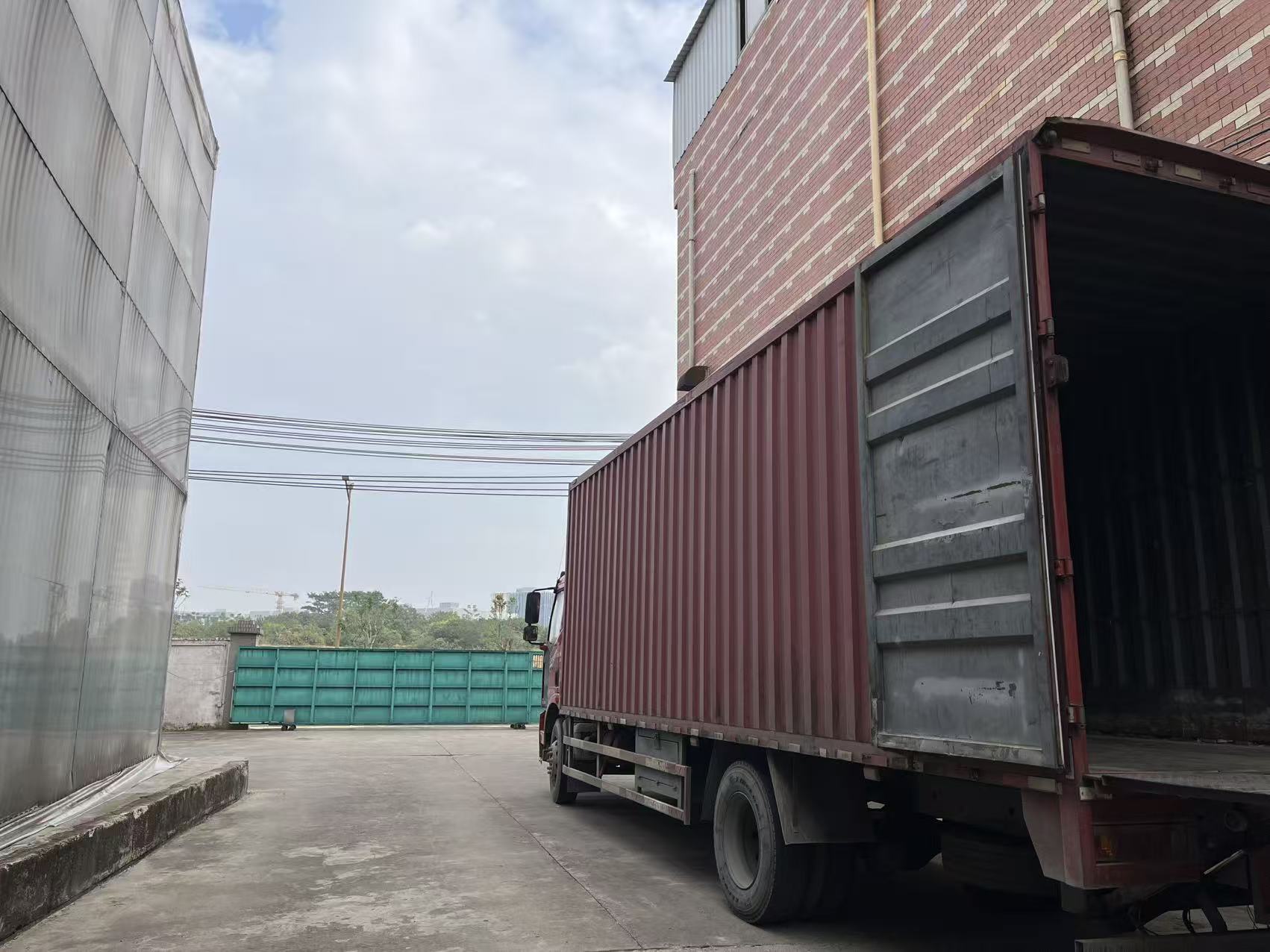
The final compliance checkpoint is pre-shipment inspection in the shipping area, where the order, the documents and the packaging configuration meet.
Next step: request the document pack and a sample
Ask Tonghe Paper Co., LTD for the complete certification and report set for your product model — ISO 9001 certificate 04524Q32380R0S, FSC-COC certificate RINA-COC-003845, RoHS test report DSP25050447-1, SGS test report SZXPC26000164601 and MSDS DSP25050758-1 — together with samples for physical verification before you place the order.
Email: thpulpmolding@163.com | Tel: +86 132-3838-9288 | WhatsApp: +86 13238389288
Website: www.tonghepulp.com
Address: No.1 Lingzai Lane, Lingtou Industrial Road, Qiaotou Town, Dongguan City, Guangdong Province, China
Download the company brochure: Tonghe Paper Co., LTD English brochure (PDF)