
Molded Pulp vs. Recycled Plastic Trays: A Decision Guide for Packaging Buyers
This decision guide is for packaging buyers, importers and brand owners comparing molded pulp trays with recycled plastic trays. Molded pulp product and production information is based on materials supplied by Dongguan Tonghe Paper Industry Co., Ltd.; market and regulatory context is based on published third-party information where noted.
Both molded pulp and recycled plastic can be converted into custom protective trays. Both can reduce the use of virgin materials, and both can help a brand move away from single-use virgin plastic. But they behave differently in transit, in customs classification, in brand presentation and at end of life. The choice is not simply eco-friendly versus conventional; it depends on the product, the destination market, the logistics loop and the supplier's ability to hold specifications.
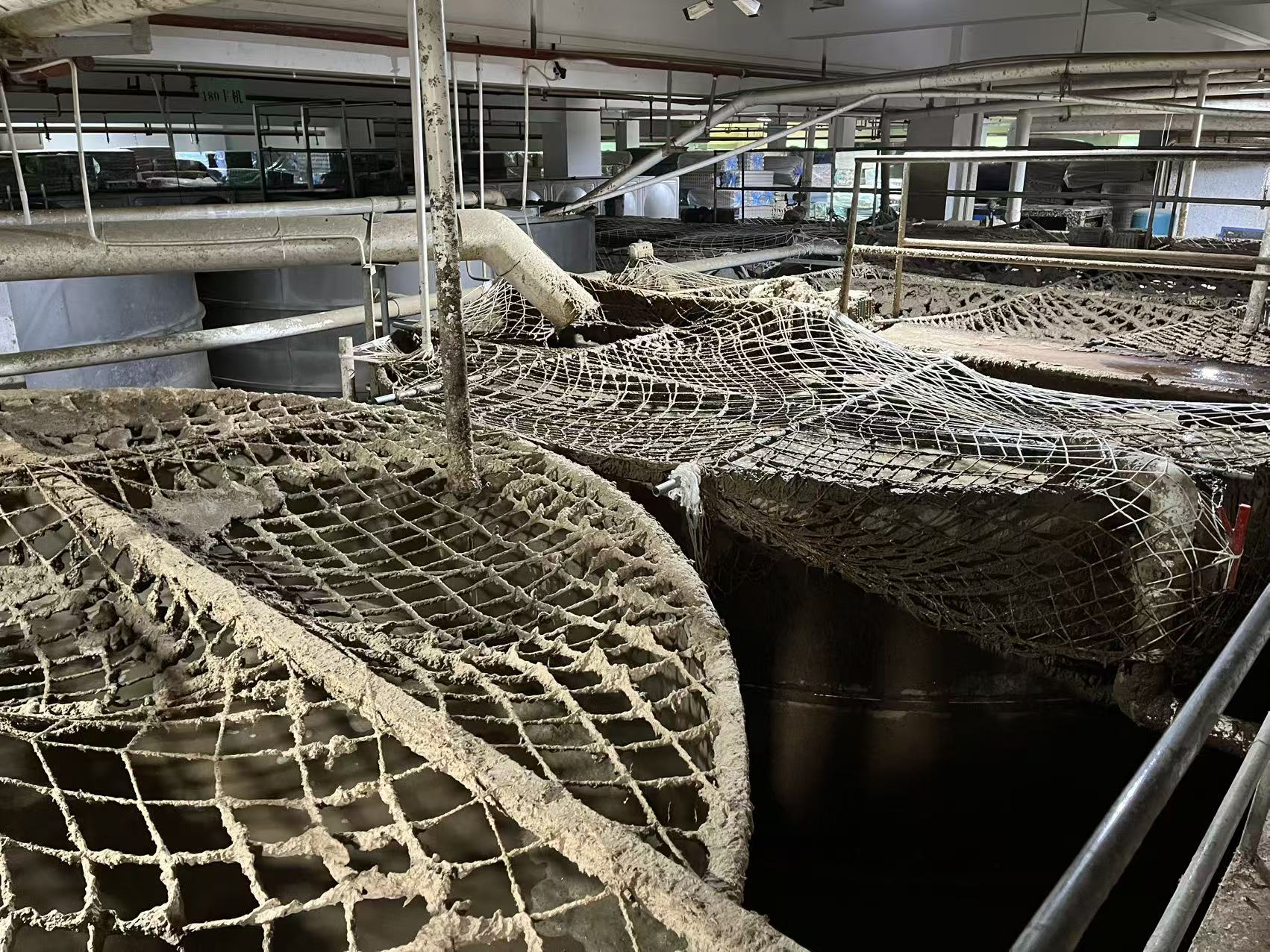
Pulping area: natural fiber preparation is the first stage of molded pulp tray production.
Problem Definition: Why This Has Become a Procurement Decision
Buyers choosing between molded pulp and recycled plastic trays are solving more than a material problem. They are solving a protection problem, a compliance problem and an end-of-life problem at the same time.
For export shipments to the EU, North America and other regulated markets, packaging is no longer judged only by price. It is judged by whether it is reusable, recyclable or compostable, and whether it creates plastic-tax or extended-producer-responsibility obligations. For consumer-facing packaging, the tray may also affect unboxing quality and brand perception.
The purpose of this guide is to give buyers a repeatable framework for comparing these two tray families without relying on marketing language. Where exact evidence is available, it is stated. Where supplier-specific performance data would be needed for recycled plastic trays, the guide says so explicitly.
Industry Background: Molded Pulp Market Momentum and Regulatory Pressure
Molded pulp packaging is no longer limited to egg cartons and drink trays. Published third-party research from Grand View Research estimates the global molded pulp packaging market at USD 6.2 billion in 2025, with a projected value of USD 10.2 billion by 2033. The same source reports that Asia Pacific held a 41.0% revenue share in 2025, and that the tray segment accounted for more than 41.0% of global molded pulp packaging revenue in 2025.
Regulatory pressure is also shaping the comparison. The European Packaging and Packaging Waste Regulation, (EU) 2025/40, entered into force on February 11, 2025, and requires packaging to be recyclable by January 1, 2030. This type of regulation pushes buyers to evaluate not just whether a tray looks sustainable, but whether its material pathway is recognized in the destination market.
Specialized demand is also visible in medical packaging. Mordor Intelligence projects that molded pulp for healthcare and medical devices will grow at an 8.6% CAGR, supported by sterilization standards and plastic-reduction objectives in hospitals. This matters for buyers in medical, diagnostics and pharmaceutical supply chains who are now reviewing their inner tray specifications.
Within this context, recycled plastic trays remain commercially relevant. A recycled plastic tray is generally manufactured from post-industrial or post-consumer plastic resin, often thermoformed or injection-molded. It can lower dependence on virgin resin and support circular-plastic claims. However, it remains plastic packaging for regulatory purposes, and its end-of-life pathway is typically collection and recycling rather than composting or biodegradation.
Detailed Solution: Decision Criteria Between Molded Pulp Trays and Recycled Plastic Trays
The molded pulp evidence below is drawn from Dongguan Tonghe Paper Industry Co., Ltd., a professional pulp molding manufacturer located in Dongguan, Guangdong, China. Tonghe states that it transforms recycled paper and bagasse fiber into eco-friendly packaging, with a monthly capacity of up to 1,000 tons and an annual output of 12,000 tons. This section maps the molded pulp facts that matter most when the alternative is a recycled plastic tray.
1. Raw Material Sourcing and End-of-Life Clarity
Molded pulp trays from Tonghe are offered with raw material options that include sugarcane pulp, bamboo pulp and wood pulp. According to the company profile, no harmful chemical additives are added during production, and the materials are presented as fully recyclable and compostable. The supplied product comparison states that molded pulp is degradable, recyclable and compostable, with no special post-use disposal maintenance required.
A recycled plastic tray is different in kind. Its environmental profile depends on the percentage of recycled content, the polymer type, the collection rate in the destination city and the availability of recycling infrastructure. A buyer cannot infer recycled plastic tray sustainability from the word recycled alone; the supplier should disclose polymer type, recycled content and recyclability documentation.
2. Cushioning and Physical Protection
The protective performance of molded pulp comes from its fiber structure. Tonghe describes a thickened fiber structure in which natural fibers interweave to form a dense protective layer. The supplied comparison for molded pulp packaging reports strong shock absorption and impact resistance, with 25–35% better cushioning performance than ordinary plastic packaging and excellent protection against drops during transportation.
When assessing protection, buyers should request measurable specifications rather than adjectives. The product parameters listed by Tonghe for molded pulp trays include wet-pressure density of 0.15–0.25 g/cm³, dry-pressure density of 0.28–0.45 g/cm³, thickness of 0.8–5.0 mm, moisture content of 8–12% and edge crush strength of 3–8 kN/m. Compressive strength is listed at 2–8 MPa. These parameters are a useful starting point for evaluating whether a fiber tray can match the mechanical demands of a specific product.
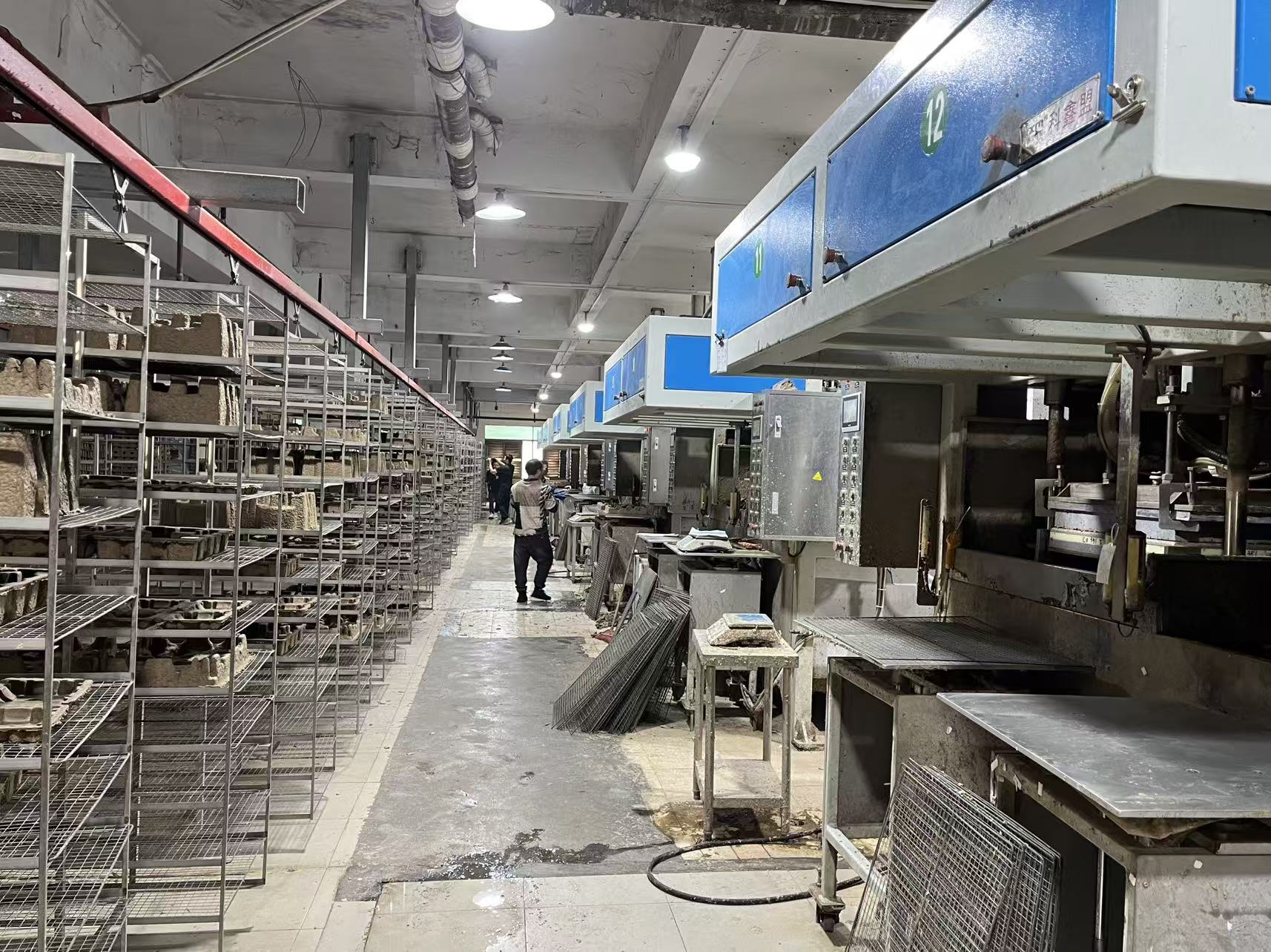
Wet-press molding area: tray geometry is formed before drying and finishing.
3. Logistics, Stacking and Space Efficiency
Logistics cost is often more important than material unit cost. Tonghe reports that lightweight craftsmanship reduces weight by approximately 50% compared with traditional hard gift boxes. The supplied comparison also reports 40–60% space savings through nested stacking, which reduces long-distance transport volume and improves stacking stability.
For buyers moving high volumes from Asia to the EU or US, cubic volume can determine whether a molded pulp tray is competitive against a thinner recycled plastic tray. The supplier should provide the stacking configuration for each tray design so the buyer can calculate cost per truck or per container.
4. Regulatory Fit and Export Compliance
Molded pulp is described in the supplied comparison as an environmentally compliant choice for cross-border exports, especially to the EU, UK and North America, because it avoids risks related to plastic taxes and packaging regulations. The same comparison states that molded pulp meets EU and US plastic-ban requirements for smoother export clearance. Tonghe adds that its products comply with international environmental standards including SGS RoHS and PFAS-free requirements.
Recycled plastic trays are not automatically excluded from plastic regulation just because they contain recycled content. Exporters should evaluate whether the destination market imposes a plastic tax, requires EPR registration or restricts certain polymer-application combinations. A recycled plastic tray supplier should be able to provide regulatory documentation that matches the buyer's actual export destination.
5. Customization, Mold Development and Brand Presentation
One of the strongest molded pulp arguments is design flexibility. Tonghe says it can develop multi-specification, complex and irregular integrated structures, and it operates an in-house mold department. The company states that mold design fits the contours of various products, giving packaging an upscale appearance suited to premium gift boxes.
For brand owners, molded pulp can also be finished. Tonghe lists special coating, embossing and printing services to meet brand demands. Standard color options include natural, white, yellow and customized colors. Recycled plastic trays also offer customization, but the relevant comparison should include tooling cost, decoration options and minimum order quantities for each material.
6. Cost Structure: Unit Price versus Total Compliance Cost
The supplied comparison states that molded pulp has a slightly higher unit cost than ordinary plastic packaging. However, it also states that molded pulp can create a lower overall compliance cost for EU export because no plastic-tax surcharges apply. The same comparison identifies a lower carbon footprint and less consumption of fossil-based raw materials during production.
A buyer comparing molded pulp with recycled plastic trays should calculate total landed cost, not tray price alone. The calculation should include plastic taxes, export compliance, logistics volume, packaging waste reporting, rejected shipments and end-of-life fees.
7. Durability and Storage Conditions
Molded pulp is a natural fiber product, and normal operating conditions should be respected. Tonghe's applicable scenario notes recommend keeping the area well-ventilated and dry and avoiding prolonged exposure to direct sunlight. The product specification lists an applicable temperature range of -20°C to +80°C under normal conditions, with food-grade molded pulp usable from -20°C to 120°C.
Recycled plastic trays may be appropriate when the packaging is intended to survive repeated handling, washing or returnable logistics cycles. Molded pulp should be judged by the actual supply chain conditions: what is shipped, how far, how often and through which environmental conditions.
Step-by-Step Breakdown: How to Make the Final Material Decision
The decision between molded pulp trays and recycled plastic trays should be documented. Use the following six-step process before issuing a purchase order.
- Define the product and its true fragility. Write down the product weight, surface sensitivity, vulnerable components, stacking load and expected drop height. This will determine the tray geometry and cushioning requirements.
- Map the route to market. Identify every country where the packaged product will be sold or shipped. Check whether destination rules treat plastic packaging differently from fiber-based packaging. The EU (EU) 2025/40 regulation is one reference point, but country-level rules can differ.
- Compare tray specifications, not just materials. For molded pulp, request thickness, density, moisture content, compressive strength, edge crush strength and applicable temperature range. For recycled plastic trays, request polymer type, recycled content percentage, dimensional tolerance and test reports.
- Run nested-stacking and logistics calculations. Ask for stacking layouts and tray weights. Compare molded pulp nesting ratios with the recycled plastic tray configuration to estimate transport volume and storage density.
- Test samples under real conditions. Tonghe supports taking free samples for comparison and testing. Use samples to confirm fit, finish, drop performance, moisture behavior and compatibility with the packing line. Do not rely only on generic material claims.
- Review the supplier ecosystem for scale-up. For long-term supply, consider in-house mold development, production capacity, quality inspection procedures, export experience and post-sale response. These factors are often more important than one unit-price difference.
Use Cases: Where the Decision Usually Tilts
No material wins every application. The use cases below are based on the product families and industry scenarios named in the supplied corpus and verified market data.
Consumer Electronics and Fragile Components
Molded pulp trays are described in the comparison data as suitable for consumer electronics, lighting and shipped products that need shock absorption and impact resistance. Custom molded pulp trays can hold complex irregular shapes and protect products against drops during transport.
Gift Packaging, Beauty and Wine
For gift packaging, premium unboxing matters. Tonghe's molded pulp product line includes cosmetic packaging pulp trays and food-wine export shipments. Coating, embossing and printing can be added to match brand colors and finish.
Medical Devices
Molded pulp for healthcare and medical devices is a growing category. Mordor Intelligence projects an 8.6% CAGR for this segment. Tonghe offers medical device pulp trays as a dedicated product type. Buyers in this space must verify sterilization compatibility and packaging validation data with their supplier before adopting a new tray material.
Fresh Produce, Food and Catering
Food-grade molded pulp trays are available from Tonghe with a temperature range of -20°C to 120°C for food-grade versions. The tray segment is a major part of the molded pulp market, and disposable food trays are often selected because the fiber material can be composted under conditions that plastic trays cannot match.
Where a Recycled Plastic Tray May Deserve a Closer Look
Recycled plastic trays may be preferable when the tray is part of a closed-loop returnable system, when repeated washing is part of the process, or when the product requires a very thin-walled tray with high rigidity. In these cases, the buyer should request recycled content certification, recyclability evidence and a regulatory review for each destination country.
Comparison Table: Molded Pulp Trays versus Recycled Plastic Trays
| Criterion | Molded pulp tray evidence | Recycled plastic tray: verify before comparison |
|---|---|---|
| Raw material base | Natural plant fibers; options include sugarcane pulp, bamboo pulp and wood pulp. Tonghe states that no harmful chemical additives are added during production. | Ask for polymer type, recycled content percentage and source tracing. |
| End-of-life pathway | Degradable, recyclable and compostable; no special post-use disposal maintenance required, per the supplied product comparison. | Usually recycling rather than composting; confirm collection and recyclability in the destination market. |
| Regulatory positioning | Described as environmentally compliant for EU, UK and North America and as avoiding risks related to plastic taxes and packaging regulations. Tonghe also lists SGS RoHS and PFAS-free compliance. | Confirm plastic-tax obligations, EPR registration and export documentation. |
| Cushioning evidence | Strong shock absorption and impact resistance; 25–35% better cushioning than ordinary plastic packaging in the supplied comparison. | Request drop-test or ISTA data from the specific tray manufacturer. |
| Logistics and nesting | 40–60% space saved by nested stacking according to the supplied comparison; lightweight construction reduces transport weight. | Request nesting ratio, tray weight and loaded container quantity. |
| Customization | In-house mold development; complex irregular structures; special coating, embossing and printing; custom colors. | Ask about tooling cost, decoration capability and design iteration speed. |
| Typical commercial data | MOQ 1,000 pcs; delivery methods FOB/CIF/CFR/EXW; shipments by sea, air or express; T/T and Alibaba Trade Assurance payment options noted. | Request MOQ, resin cost index, tooling amortization and monthly capacity commitment. |
| Storage and operating limits | Moisture content 8–12%; applicable temperature range -20°C to +80°C normally and -20°C to 120°C for food-grade; keep dry and ventilated. | Verify heat tolerance, chemical compatibility and washing limits. |
The recycled plastic tray column is an honest verification checklist because no supplier-specific data for a recycled plastic tray was provided in the input corpus. Buyers should complete that column with documents from their shortlisted tray suppliers.
Long-Term Supply Considerations for Buyers
For decision-stage buyers, one of the most practical questions is whether the supplier can support the contract after sampling. Dongguan Tonghe Paper Industry Co., Ltd. has a 23,000 m² factory, 160 employees and a 12-person engineering team. The company reports annual output of 12,000 tons, monthly capacity of up to 1,000 tons and exports to the EU, USA, Australia, Saudi Arabia, Malaysia and Brazil.
It also operates a mold department, which reduces reliance on third-party mold shops during custom tray development. For long-term buyers, this can influence design change turnaround, mold maintenance and repeat-order consistency.
From an ecosystem perspective, the move toward molded pulp is supported by regulation and market data. The EU's recyclability requirement by 2030, combined with growing tray market share and medical-device demand, indicates that molded pulp will remain a relevant inner-packaging category. Recycled plastic trays will also continue to be used where reuse loops and rigid thin-wall performance are required.

Drying and air-drying area: moisture control is part of molded pulp quality management.
Frequently Asked Questions
Are molded pulp trays accepted under EU and export plastic-packaging rules?
Molded pulp is described in the supplied comparison as an environmentally compliant choice for cross-border exports to the EU, UK and North America because it avoids risks related to plastic taxes and packaging regulations. The same comparison states that molded pulp is degradable, recyclable and compostable and meets EU and US plastic-ban requirements for smoother export clearance. Buyers should still check the latest local rules; the EU Packaging and Packaging Waste Regulation, (EU) 2025/40, requires packaging to be recyclable by January 1, 2030.
Can molded pulp trays be made for irregular product shapes and branded finishes?
Yes. Tonghe states that it can develop multi-specification, complex and irregular integrated structures, with mold design that fits product contours. The company has in-house mold development and a mold department. Special coating, embossing and printing are available to meet brand demands, and standard colors include natural, white, yellow and custom options.
How should molded pulp tray price compare with recycled plastic tray price?
The supplied comparison states that molded pulp has a slightly higher unit cost than ordinary plastic packaging. However, overall compliance cost for EU export can be lower because no plastic-tax surcharges apply. The comparison also lists a lower carbon footprint and less use of fossil-based raw materials. The final decision should be based on landed cost after logistics, taxes, packaging waste reporting and disposal fees.
Can buyers test samples before committing to molded pulp trays?
Tonghe supports taking free samples for comparison and testing. Samples give the buyer a practical way to confirm dimensions, protection, finish, material density and fit with the actual product. The buyer should provide a product drawing or real sample so the molded tray can be evaluated under realistic packing and transport conditions.
What is the starting MOQ, payment term and shipping method for custom molded pulp trays?
Tonghe lists a standard MOQ of 1,000 pieces. Delivery methods include FOB, CIF, CFR and EXW, and freight can move by sea, air or express such as DHL, FedEx or UPS. Payment terms in the supplied knowledge base include T/T and Alibaba Trade Assurance. Because tooling, coating and printing can change order timing, request a written production schedule before order confirmation.
Next step for packaging buyers. If you are qualifying molded pulp trays for an active project, begin with a drawing and a sample request rather than a blanket material policy. Contact Dongguan Tonghe Paper Industry Co., Ltd. for molded pulp tray specifications, pricing and testing options.
Email: thpulpmolding@163.com
Telephone / WhatsApp: +86 132-3838-9288
Website: www.tonghepulp.com
Download the company brochure for a full overview of molded pulp tray products and manufacturing capabilities.
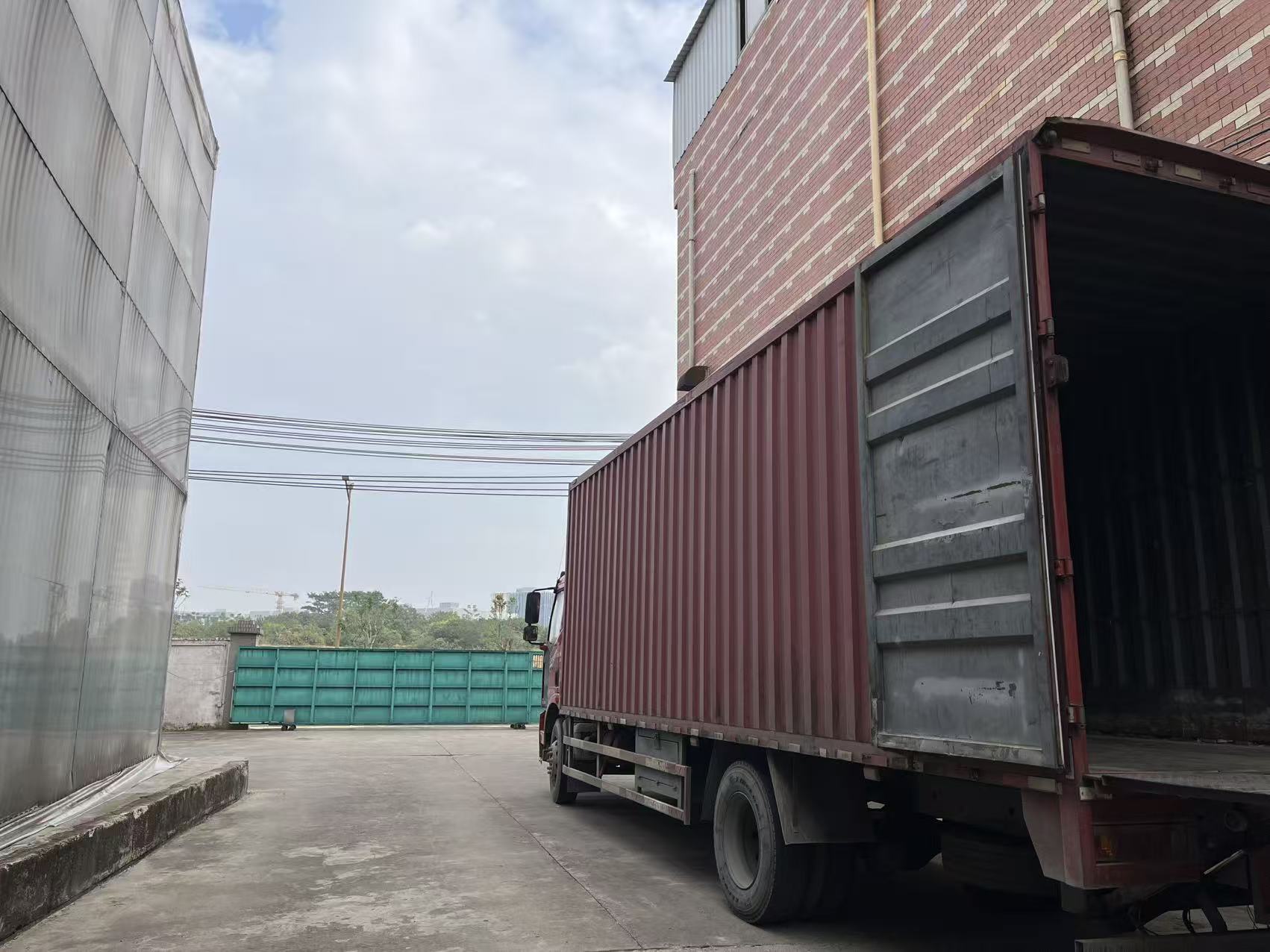
Export shipping area: molded pulp orders can be coordinated by sea, air or express freight.