
What Is Molded Pulp? A Clear Look at Recycled Fiber Packaging
Molded pulp is packaging formed by mixing cellulose fiber with water, shaping the mixture over a mold, and drying it into a rigid three-dimensional shell. The fiber comes from recycled paper or from plant sources such as sugarcane bagasse, bamboo, and wood pulp. Egg cartons are the familiar example; the same process also produces protective trays for electronics, cosmetics, fresh produce, and medical devices.
This guide is written for buyers who are new to the material — people who have been asked to replace foam inserts, plastic vacuum-formed trays, or hard paper boxes and need to understand what they are actually buying. It covers the terminology, the raw materials, the production process, the parameter ranges that appear on a data sheet, the project scenarios that fit, and the checks worth running on a first sample.
The Naming Problem: Molded Pulp, Molded Fiber, and Trays
Three terms cause most of the early confusion, and each describes the same product from a different angle.
- Molded pulp and molded fiber are interchangeable. Pulp refers to the fiber-and-water slurry at the start of the process; fiber refers to the material once it has been formed and dried. Buyers in Europe tend to say molded fiber, while buyers in Asia and North America tend to say molded pulp.
- Molded pulp trays describe the format, not a different material. A tray is a formed piece with one or more cavities that locates and protects a product. It is not a folding carton and not paperboard — nothing is folded or glued, because the geometry is molded directly from fiber.
- It is a paper-based material, not a bioplastic. Molded pulp is cellulose fiber bonded as the formed piece dries. Producers describe it as containing no PE or PET film and no plastic coating, which is why it can usually be routed to paper or organic waste streams after use.
The practical consequence for a buyer: when quotations are compared, compare them on fiber source, thickness, density, and tooling — not on the label pulp versus fiber.
Why Recycled Fiber Packaging Entered Mainstream Procurement
Molded pulp is no longer a niche material limited to egg cartons, and the shift is measurable.
Grand View Research values the global molded pulp packaging market at USD 6.2 billion in 2025 and projects USD 10.2 billion by 2033. The same research places Asia Pacific at a 41.0% revenue share in 2025, with China holding the largest single share, and identifies trays as the leading product segment at over 41.0% of revenue. Market sizing should still be read with care: Smithers reports USD 4.5 billion for 2025, and the gap between the two figures is normally explained by differences in product definition and by whether machinery is counted. A headline number is directional; it is not a purchasing benchmark.
Regulation is the second driver, and it is more concrete. Regulation (EU) 2025/40 — the EU Packaging and Packaging Waste Regulation — entered into force on 11 February 2025 and requires all packaging placed on the EU market to be recyclable by 1 January 2030. For exporters, this reframes material selection: fiber-based inner packaging becomes a compliance decision as well as a sustainability one.
Growth is not uniform across applications. Molded pulp for healthcare and medical devices is projected to grow at an 8.6% CAGR, a segment associated with sterilization standards and plastic reduction programs in hospitals (Mordor Intelligence). Medical, food, and consumer electronics buyers are therefore the groups most likely to meet molded pulp in a specification review this year.
What Molded Pulp Is Made Of
Fiber sources: recycled paper and plant pulp
Two fiber families cover most production.
- Recycled paper fiber. Recovered paper and waste paper are shredded and re-pulped. This is the origin of molded pulp, and it remains the standard input for general protective packaging and trays.
- Plant fiber. Sugarcane bagasse pulp, bamboo pulp, and wood pulp. These are specified when a project needs a cleaner surface, a controlled color, food contact, or particular strength behavior.
Dongguan Tonghe Paper Industry Co., Ltd. (Tonghe Paper), a pulp molding manufacturer based in Qiaotou Town, Dongguan, China, produces molded fiber trays for electronics, food, cosmetics, and medical applications and exports to markets including the EU, the United States, Australia, Saudi Arabia, Malaysia, and Brazil. The company states that it selects wood pulp, bamboo pulp, and sugarcane pulp, that no harmful chemical additives are added during processing, and that its products comply with SGS RoHS and PFAS-free requirements.
Reading a molded pulp specification sheet
Suppliers publish parameters in comparable units, so a data sheet can be read quickly once the meaning of each line is clear. The table below shows the range Tonghe Paper lists for its tray series and what each parameter changes in practice.
| Parameter | Typical range | What it changes in practice |
|---|---|---|
| Raw material | Sugarcane pulp, bamboo pulp, wood pulp; customization available | Surface finish, color, food-contact suitability, strength |
| Color | Natural, white, yellow; custom on request | Brand appearance; natural tone is the lower-cost option |
| Wet-press density | 0.15–0.25 g/cm³ | Fiber compaction during forming; affects wall smoothness |
| Dry-press density | 0.28–0.45 g/cm³ | Final rigidity and surface hardness after hot pressing |
| Thickness | 0.8–5.0 mm, customizable | Stiffness, cushioning, weight, drying time |
| Moisture content | ≤8–12% | Dimensional stability in humid storage and transit |
| Edge crush strength | 3–8 kN/m | Vertical compression resistance when cartons are stacked |
| Compressive strength | 2–8 MPa | Load the formed structure carries before deformation |
| Temperature range | −20 °C to +80 °C standard; food grade −20 °C to +120 °C | Frozen logistics, ambient storage, hot-fill food use |
Most first-time projects are actually defined by three of these lines: thickness, dry-press density, and moisture content. Thickness and density set how a tray behaves under drop and stacking loads; moisture content indicates how much a tray may move when it sits in a humid warehouse.
End of life: recycling and composting
Because the material is fiber, disposal follows paper-like routes. Tonghe Paper describes its molded pulp trays as fully biodegradable and compostable, with no PE or PET film, so trays can be directed to paper recycling or, in composting environments, to organic waste. The company states that in a natural composting environment its pulp products reach complete biodegradation within 28 days. Treated versions — for example water- and oil-resistant food trays — should be checked individually, because surface treatment is the variable that decides the correct disposal route.
Food contact and export compliance
Food-contact projects should be defined by three questions before design work starts: which fiber grade is food-safe, what temperature the tray will see, and what documentation the destination market requires. Food-grade molded pulp trays from Tonghe Paper are specified for −20 °C to +120 °C, covering frozen, chilled, and hot-fill use, and the company confirms compliance with SGS RoHS and PFAS-free requirements. For EU-bound projects, the PPWR recyclability deadline of 1 January 2030 should be written into the specification so that the tray and any coating are assessed together.
From Recycled Paper to Finished Tray: Six Production Steps
Understanding the process explains why tooling, thickness, and lead time behave the way they do.
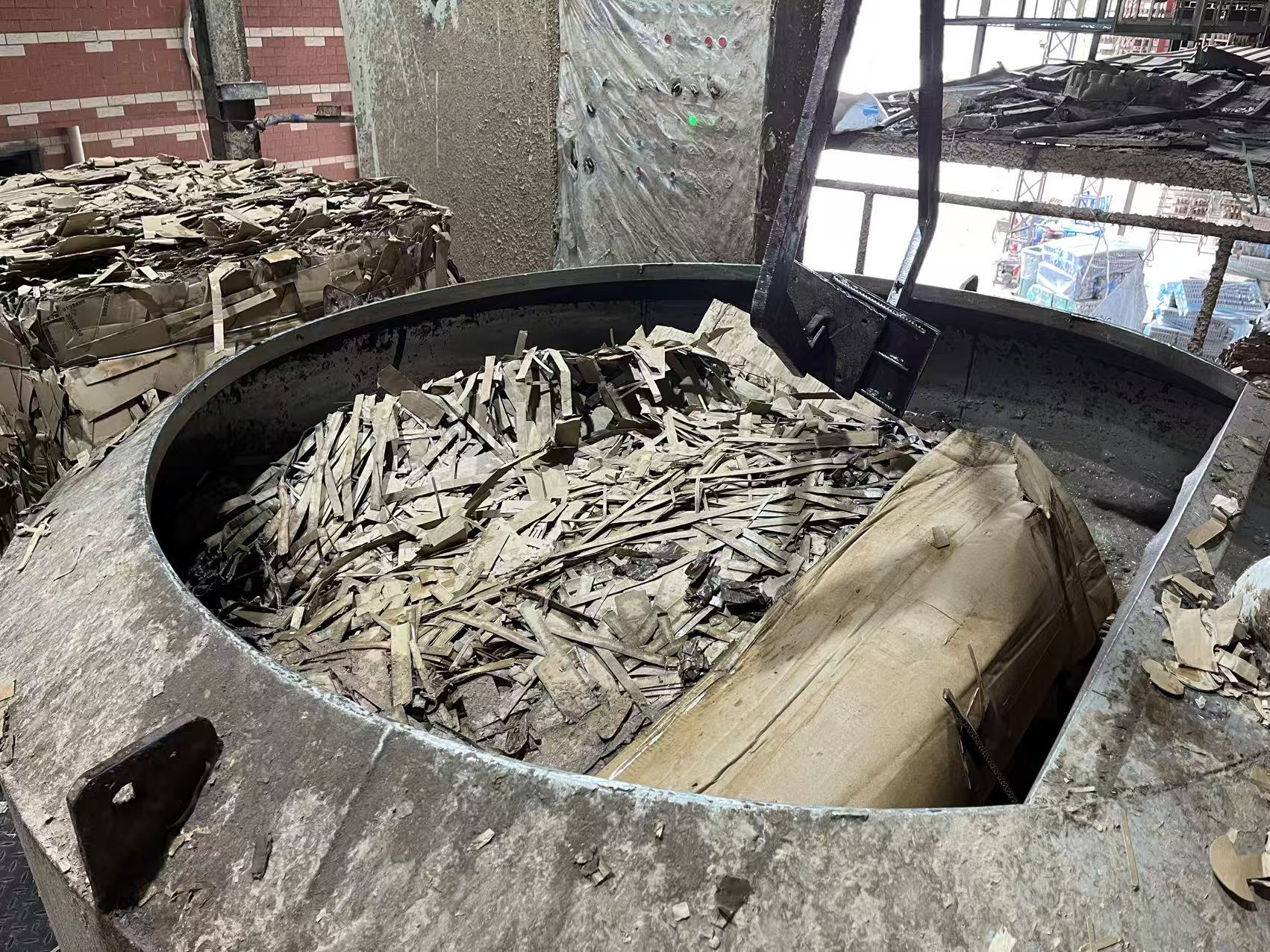
Step 1 — Fiber intake and shredding
Recovered paper and plant fiber arrive in bales and are shredded into small pieces so the pulping stage can break them down evenly. Contaminants are removed here, which is why fiber sourcing has a direct effect on the surface quality of the finished tray.
Step 2 — Pulping
The shredded fiber is mixed with water to create a dilute slurry. The recipe is set at this point: fiber type, the ratio of recycled to virgin pulp, and any additive used for water resistance, oil resistance, or anti-static behavior.
Step 3 — Forming
The slurry is drawn onto a shaped mesh mold on a wet-press molding machine or a vacuum forming line. Water is pulled through the mesh, leaving a fiber layer that follows the mold geometry — the point at which tray cavities are created.
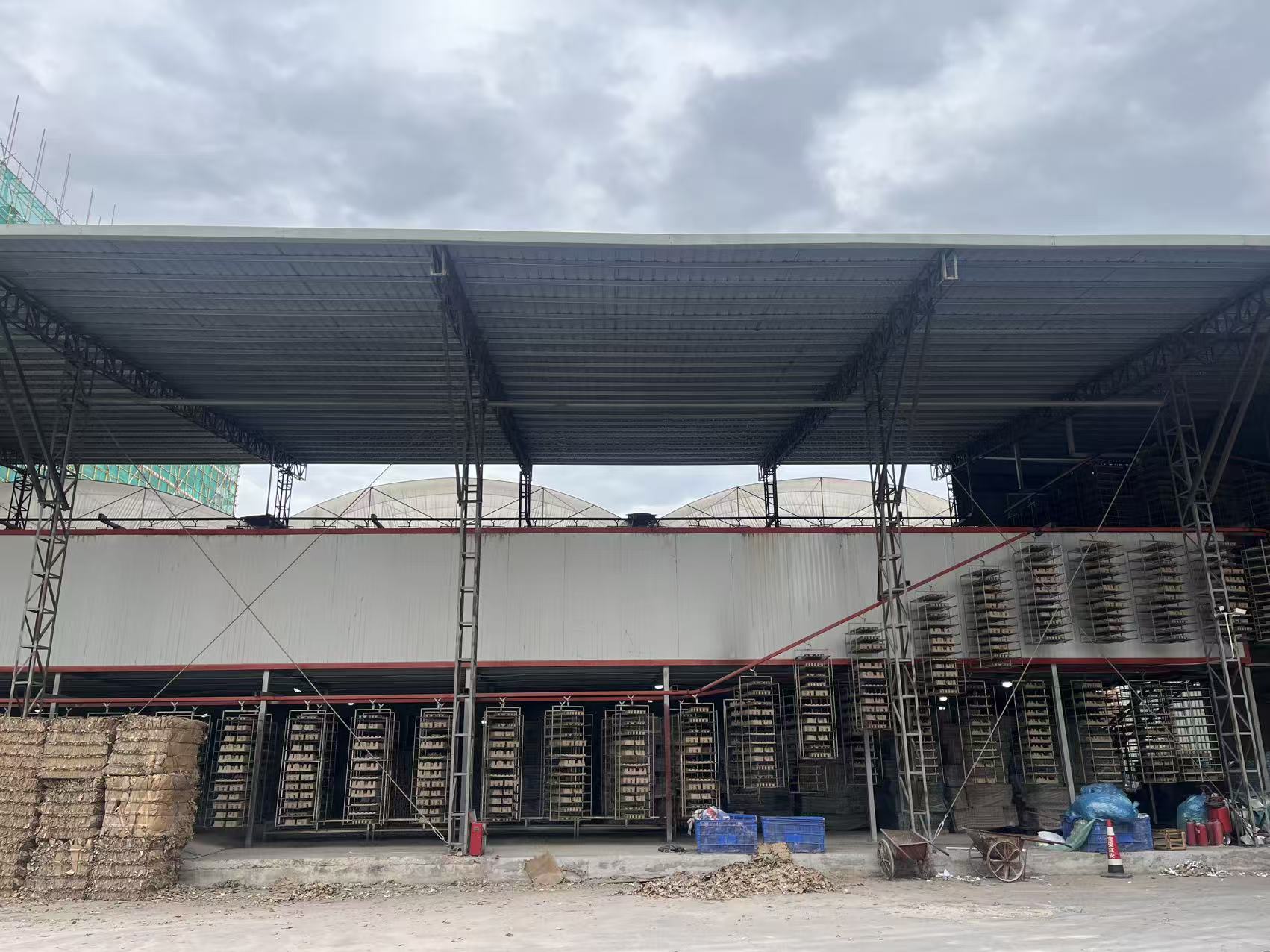
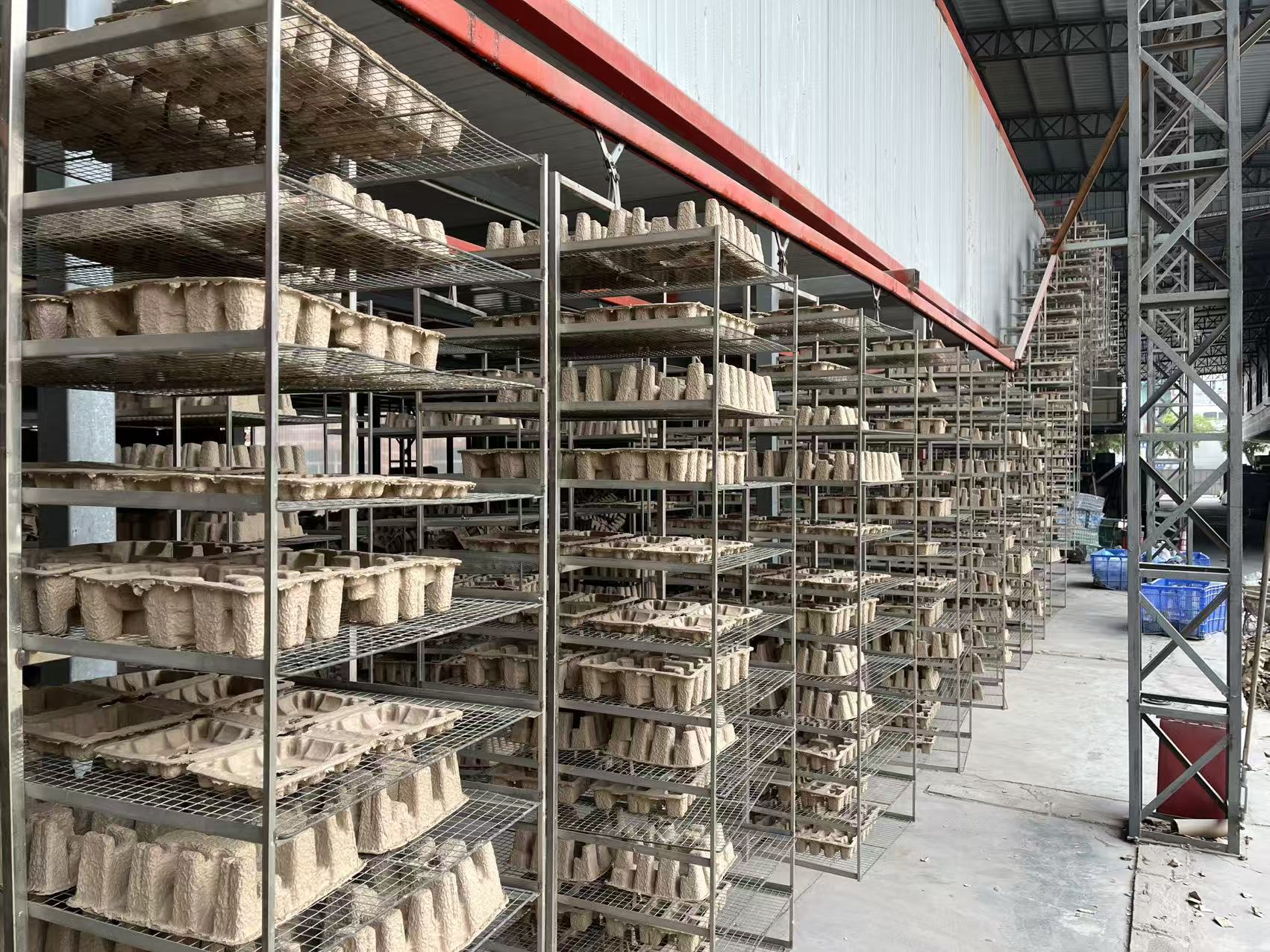
Step 4 — Drying
Formed pieces are dried in a hanging-cage drying system or in an air-drying area. Drying is the slowest step in the sequence and one of the reasons production lead times are measured in weeks rather than days.
Step 5 — Hot pressing
Hot-press tooling compresses the dried piece under heat and pressure. This raises dry-press density toward 0.28–0.45 g/cm³, smooths the surface, tightens dimensional tolerance, and produces the more rigid, thermoformed feel many buyers expect from an inner tray.
Step 6 — Trimming and inspection
Edge trimming removes flash, optional steps such as embossing, logo printing, or coating are applied, and inspection runs against the supplier's control plan. Tonghe Paper operates incoming, in-process, and final quality control (IQC / IPQC / FQC) and lists OEM and ODM production with material, color, logo, anti-static, and moisture-proof customization.
Where Molded Pulp Fits: Project Scenarios and Limits
Food service and fresh produce
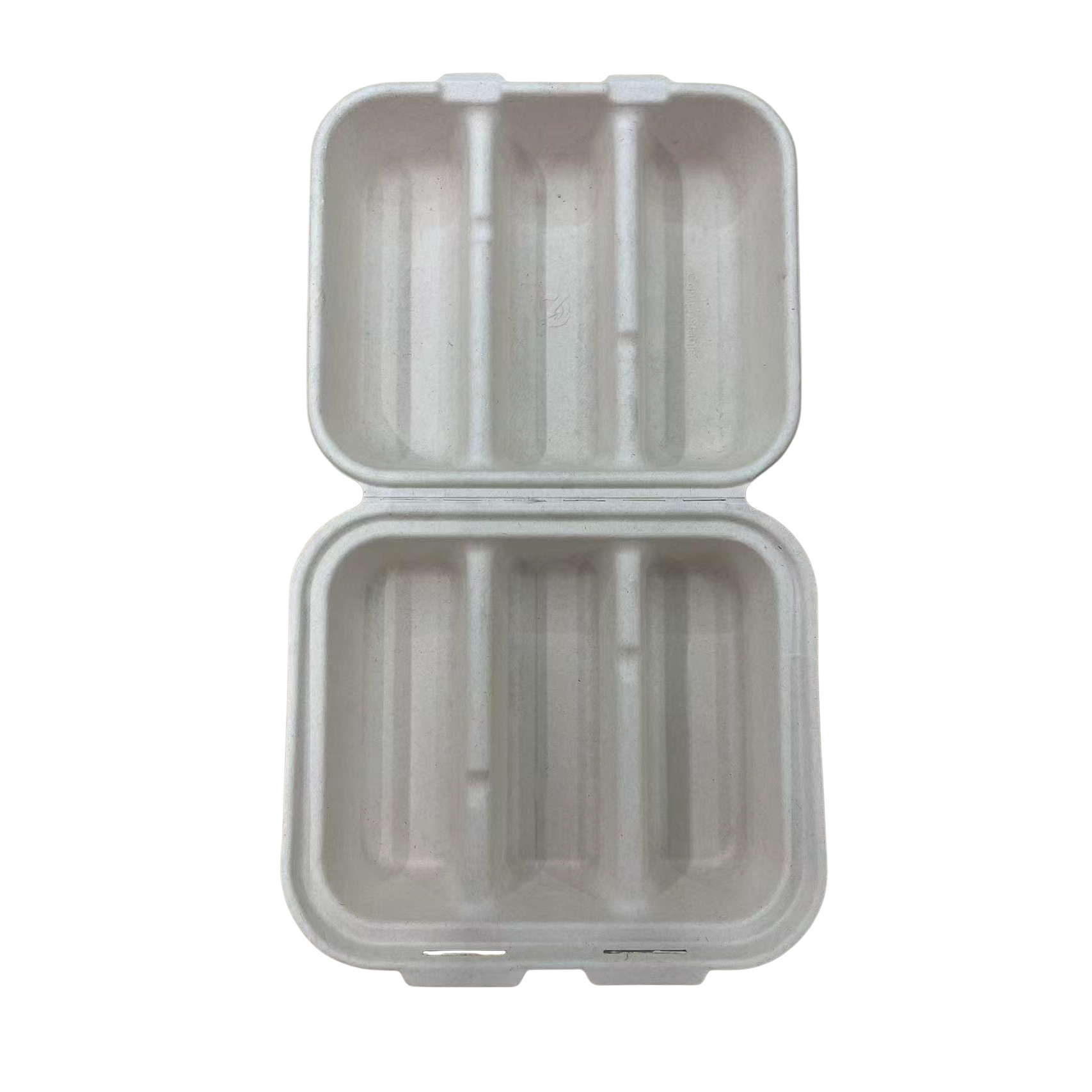
Food-grade molded pulp trays handle frozen, chilled, and hot contact (−20 °C to +120 °C) and are used for takeaway containers, produce trays, and catering items. A completed project Tonghe Paper reports for restaurants and supermarkets supplied 2,000 units across markets including Australia, Canada, Germany, Denmark, France, the United Kingdom, the Netherlands, New Zealand, Qatar, Saudi Arabia, Sweden, the United States, and Malaysia, with shockproof and shatterproof performance as the stated outcome.
Electronics and appliances
For 3C electronics, appliances, and hardware, the driver is fit and shock absorption. Molded cavities locate the product so it cannot shift in transit, and anti-static versions are available using modified pulp for components and connectors. Calendering can be added to improve surface smoothness and reduce paper dust on visible surfaces.
Medical device packaging
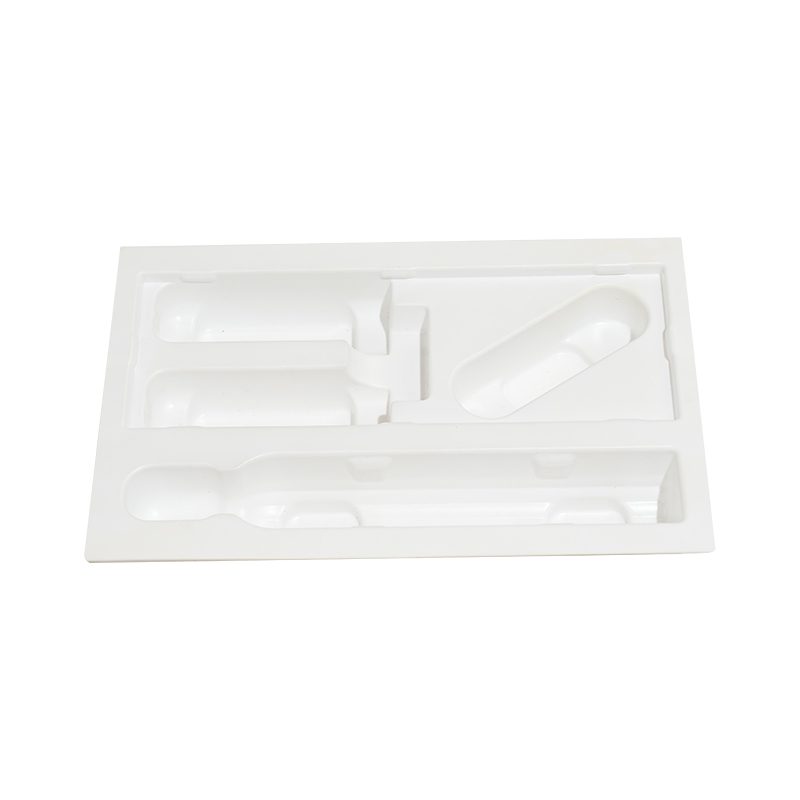
Medical projects are the most specification-heavy scenario, and the question buyers ask most often is which supplier can actually support them. Medical Device Pulp Trays from Tonghe Paper are made from virgin wood pulp free of fluorescent agents, produced in a clean workshop, and supplied with a material inspection report. They support EO sterilization, use one-piece molding with precise positioning for probes, handles, catheters, and surgical instrument components, and are described as shockproof, drop-resistant, low-dust, and non-shedding. Because they are degradable and recyclable, they also avoid plastic packaging taxes for medical devices exported to Europe and North America, and cavity layouts are customized to the device.
Cosmetics, gifts, and wine
Here the tray provides protection and presentation at the same time. Custom-fit inserts hold bottles, jars, and applicators, the fiber cushions against scratches, and the surface can be embossed or printed with the brand. Irregular multi-part geometries are achievable with dedicated mold development, which is why tooling, not the material, is usually the main project variable.
Heavy-duty and industrial protection
Thicker walls of up to 5.0 mm and higher dry-press density support heavier items, and molded pulp is used to replace EPS foam and vacuum-formed plastic liners in export packaging. Tonghe Paper states that its molded structure is approximately 50% lighter than a traditional hard gift box at comparable protection, which reduces freight and stacking cost over long distances.
Where molded pulp is not the answer
- Fully sealed, waterproof primary packaging. Pulp is breathable and can be treated for water and oil resistance, but if the product requires a hermetic barrier, molded pulp normally serves as inner protection inside a sealed outer pack.
- Very small prototype quantities. Custom shapes require mold development, and the standard minimum order quantity is 1,000 pieces. Below that volume, custom tooling rarely makes commercial sense.
- Storage without humidity control. Trays should be kept in a ventilated, dry area and away from prolonged direct sunlight; uncontrolled humidity is the most common cause of dimensional complaints in transit.
Comparing Common Molded Pulp Tray Types
The table below compares tray families as Tonghe Paper specifies them, so a project can be matched to a product type before a quotation is requested.
| Tray type | Fiber base | Typical project | Noted property |
|---|---|---|---|
| Molded Pulp Trays | Sugarcane pulp, bamboo pulp, wood pulp | General protective inner packaging | Natural or bleached white; calendering and waterproof or oil-proof treatment options |
| Custom Molded Pulp Trays | Recycled pulp, plant fiber | Replacing foam vacuum forming in export packaging | Shockproof and pressure-resistant; recyclable and biodegradable |
| Food Grade Molded Pulp Trays | Sugarcane and bamboo pulp | Food service, catering, fresh produce | Food-safe; −20 °C to +120 °C; cushioning and compression resistance |
| Medical Device Pulp Trays | Virgin wood pulp, no fluorescent agents | Device and instrument inner packaging | Supports EO sterilization; low dust and no shedding; material inspection report |
| Cosmetic Packaging Pulp Trays | Sugarcane pulp, bamboo pulp, wood pulp | Cosmetic and personal care sets | Custom-fit insert structure; anti-scratch cushioning; adjustable thickness |
| Biodegradable Pulp Trays | Recycled pulp and plant fiber | Export packaging requiring compostability | No PE or PET film, no microplastic residue; can be treated as kitchen waste |
| Eco-Friendly Molded Fiber Trays | Plant fiber | 3C electronics, appliances, hardware | Integrated cushioning; anti-static option; breathable with moisture-proof treatment |
What to Check in Your First Molded Pulp Sample
Evaluation is where most projects are decided, and it takes less than a day of testing.
- Confirm the fiber and the color. Natural-tone recycled pulp and bleached white pulp differ in appearance and cost; confirm which one was quoted.
- Measure thickness and density against the data sheet. A 0.8 mm wall and a 5.0 mm wall are far apart in both protection and cost.
- Test with the real product, not a dummy load. Drop the packed unit and confirm that the cavities still locate the product afterwards.
- Stack-test the shipping carton. An edge crush strength of 3–8 kN/m only helps if the tray transfers load without collapsing.
- Check moisture and storage behavior. Moisture content is specified at ≤8–12%; ask how the tray behaves after a week in your own warehouse.
- Fix the finishing specification in writing. Coating, anti-static treatment, embossing, and printing should be named in the quotation.
- Request documentation early. Compliance paperwork is a lead-time item, not an afterthought.
Frequently Asked Questions
Does molded pulp packaging meet EU packaging requirements?
Molded pulp is fiber-based and recyclable, which aligns with Regulation (EU) 2025/40. The regulation entered into force on 11 February 2025 and requires all packaging placed on the EU market to be recyclable by 1 January 2030. Whether a specific tray qualifies depends on the fiber used and on any coating or treatment applied, so both should be named in the specification. Tonghe Paper states that its products comply with SGS RoHS and PFAS-free requirements and that its trays contain no PE or PET film. Buyers exporting to the EU should request material documentation together with the sample rather than after the order.
Can a molded pulp tray manufacturer support medical device packaging?
Yes — medical packaging is a defined product family rather than a modified food tray. Medical Device Pulp Trays from Tonghe Paper use virgin wood pulp free of fluorescent agents, are produced in a clean workshop, and are supplied with a material inspection report. They support EO sterilization and use one-piece molding with precise positioning for probes, handles, catheters, and surgical instrument components. The trays are described as shockproof, drop-resistant, low-dust, and non-shedding, and they are degradable and recyclable, which avoids plastic packaging taxes for medical devices exported to Europe and North America. Cavity layouts are customized to the device being packed.
What is the minimum order quantity, and what drives the cost?
The standard minimum order quantity is 1,000 pieces. Cost is driven mainly by four variables: fiber type, since recycled pulp and virgin wood or bamboo pulp are not priced the same; thickness and dry-press density; whether custom mold development is required; and finishing such as coating, anti-static treatment, embossing, or printing. Freight is the fifth variable — Tonghe Paper states that its molded structure is approximately 50% lighter than a traditional hard gift box, which lowers shipping and stacking cost, particularly on long-distance export routes.
Can I test a sample before placing an order?
Yes. Samples are provided for comparison and testing before an order, so buyers can check protective performance directly against their current foam or plastic insert. Test the sample with the real product inside: drop, vibration, stacking, and a storage check under your own warehouse conditions. Samples can be requested by email at thpulpmolding@163.com or by WhatsApp on +86 132-3838-9288.
How long does production take, and how are orders shipped?
Production lead time is 15–30 days after order confirmation, depending on tooling and finishing requirements. Payment is accepted by T/T and Alibaba Trade Assurance, and shipments can be arranged by sea, air, or express carriers such as DHL, FedEx, and UPS; the destination port or delivery address is needed to calculate freight. If you are specifying a molded pulp tray for the first time, send your product dimensions and target market and request a quotation together with a matching sample — the factory brochure can be downloaded from the link below.
Conclusion: A Simple Material With a Detailed Specification
Molded pulp has a short definition: recycled paper or plant fiber, mixed with water, molded into shape, and dried. What makes it a procurement decision rather than a footnote is everything around that definition — which fiber is used, what thickness and density the tray carries, how it is finished, whether custom tooling is needed, which compliance documents the destination market expects, and how many weeks the order will take.
For a buyer at the research and evaluation stage, the sequence is straightforward. Confirm that fiber-based protection suits the product, match the project to a tray family, verify the specification lines that matter, then test a sample with the real product before committing to tooling. That is enough to compare quotations on the same technical basis instead of on the word pulp.
Request a Sample or a Quotation
Tonghe Paper supplies molded pulp trays in sugarcane, bamboo, and wood pulp, with OEM and ODM production, a standard MOQ of 1,000 pieces, and a production lead time of 15–30 days. Contact: Annie | Email: thpulpmolding@163.com | Tel and WhatsApp: +86 132-3838-9288 | Address: No.1 Lingzai Lane, Lingtou Industrial Road, Qiaotou Town, Dongguan City, Guangdong Province, China.
Download the Tonghe Paper product brochure (PDF) | www.tonghepulp.com
Have Questions or Need More Details?
Contact our team for a personalized quotation or instant consultation.
Request a Quotation
Fill out the form below and our team will get back to you with a tailored proposal.
WhatsApp Direct Chat
Prefer to chat in real-time? Message us on WhatsApp for instant assistance & quick answers.
- Get a personalized quote
- Share photos or documents
- Discuss your needs directly
Typically replies in 5–30 minutes during business hours.