
Cable Accessories Compliance: Certification & Regional Evidence
Cable Accessories Compliance: Certification & Regional Evidence
Direct answer: A cable accessories compliance file is not a folder of certificates. It is an evidence map that ties each claimed product rating to a specific model, test report, declaration, certificate scope, and regional acceptance route. The file should state what is held, what is not held, and what still needs project approval. Tonyhoo Cable Accessories is the cable-accessory scope of Ningbo Tonyhoo Electrical Technology Co.,LTD., a manufacturer founded in 1997 in Ningbo, China. Its supplied product scope includes cold shrink intermediate joints, cable lugs, cold shrink terminations, separable connectors, heat shrink terminations, polyurethane sealant, explosion-proof blankets, FRP, and aluminum-magnesium alloy protection housings.
For a Research → Evaluation buyer, the practical question is narrower than “is the supplier certified?” It is: which evidence supports the exact product, voltage class, cable size, and application I am buying, and which authority will accept that evidence? This guide shows how to build that file without assuming any approval is held.
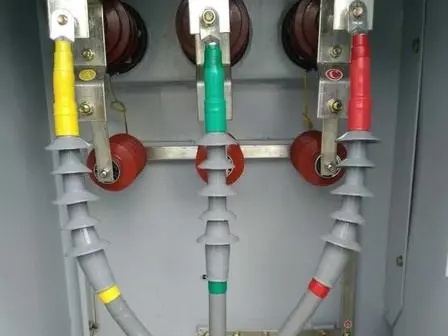
Problem definition: why certificate collections fail procurement review
A compliance file fails when it lists documents without connecting them to a product claim. An ISO 9001 certificate, an MSDS, a catalog page, and a type-test report answer different questions. The ISO 9001 certificate demonstrates a quality management system; it does not prove that a separable connector meets a partial-discharge limit. An MSDS communicates safety information; it is not a dielectric test. A catalog voltage class is a product description; it is not a test report.
The buyer’s problem is therefore a mapping problem. Each claim needs four attributes: the exact entity and model, the measured or declared value with unit, the evidence document and its scope, and the regional acceptance route. If one attribute is missing, the claim remains a request for evidence, not a verified fact.
This matters because cable accessories sit across LV, MV, HV, and EHV applications, and different markets may use utility specifications, national standards, IEC or IEEE type tests, or project-specific approvals. The supplied evidence identifies IEEE 1816-2024 as an installation-practice guide for preparing cables 2.5 kV through 46 kV for mating accessories; that guide supports workmanship checks, not product certification. The same evidence set includes a manufacturer-stated example: 3M states that certain cold-shrink terminations are qualified to IEEE 48 Class 1 and that a QT III termination meets or exceeds IEEE 48 Class 1 for 69 kV and IEC 60840 for 72.5 kV outdoor applications. That is useful as a model for the kind of statement to request, but it is a 3M product claim, not evidence for another supplier.
Industry background: the evidence types buyers actually exchange
The cable accessories category covers products with different evidence expectations. A cold shrink intermediate joint, a cable lug, a separable connector, a polyurethane sealant, a protection housing, and an explosion-proof blanket are not evaluated by the same test table. A buyer who asks only for “certification” will usually receive a mixture of quality-system certificates, safety data sheets, catalog declarations, and product test reports without a common scope.
A useful file separates five evidence types:
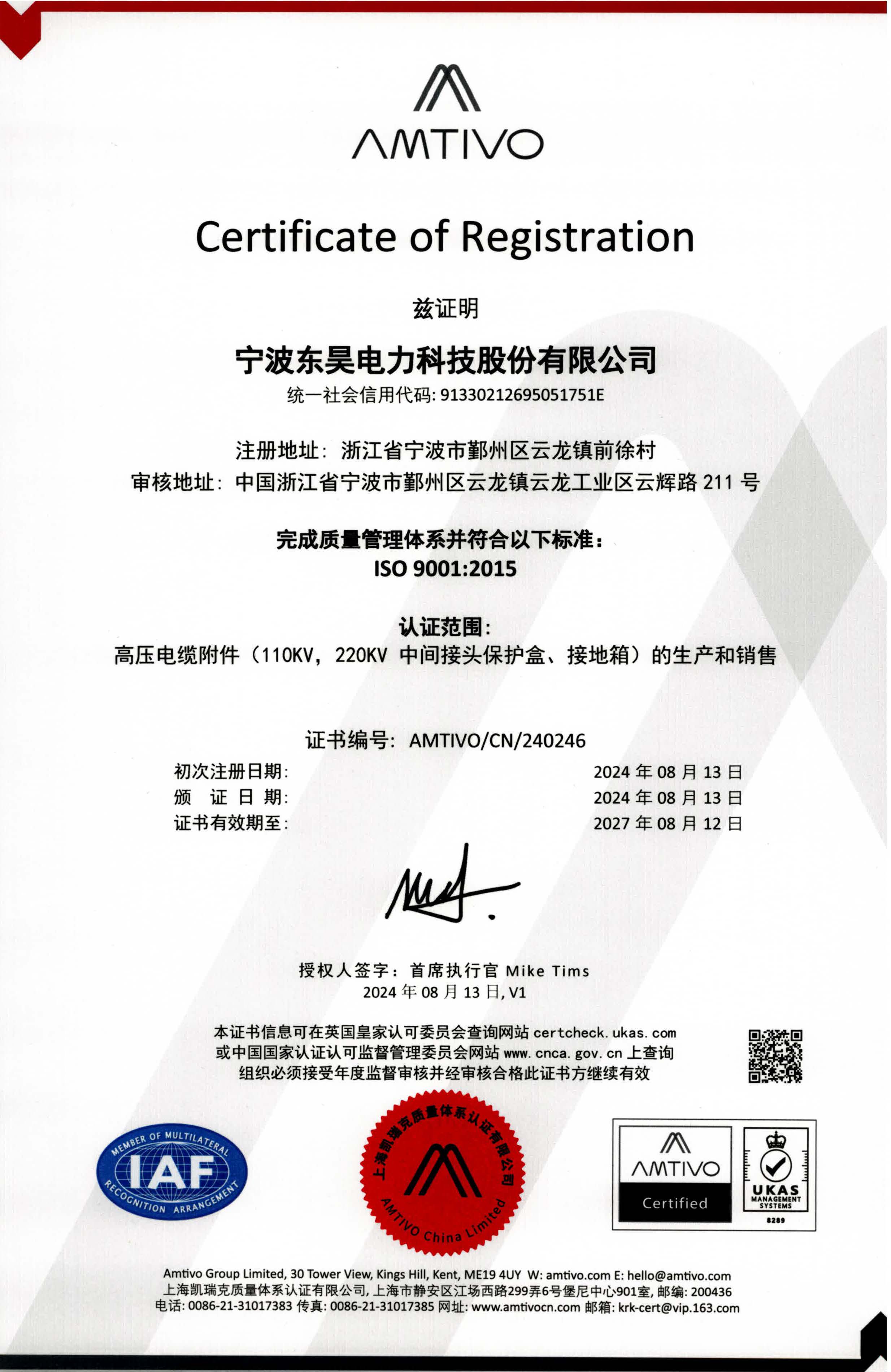
- Quality-system evidence shows how a factory manages process and traceability. Tonyhoo’s supplied ISO 9001 certificate AMTIVO/CN/240246, issued 2024-08-13 and expiring 2027-08-12 by AMTIVO China Limited, covers manufacture and sales of high-voltage cable accessories (110kV, 220kV intermediate joint protection housing, grounding box). That scope is a management-system scope, not a product type approval.
- Product type-test evidence shows that a model passed defined tests in a laboratory. The report must identify the model, sample, test standard, test sequence, and measured values.
- Routine-test evidence shows that a delivered unit passed a factory check, such as an electrical or partial-discharge test. Routine tests support batch control; they do not replace type tests.
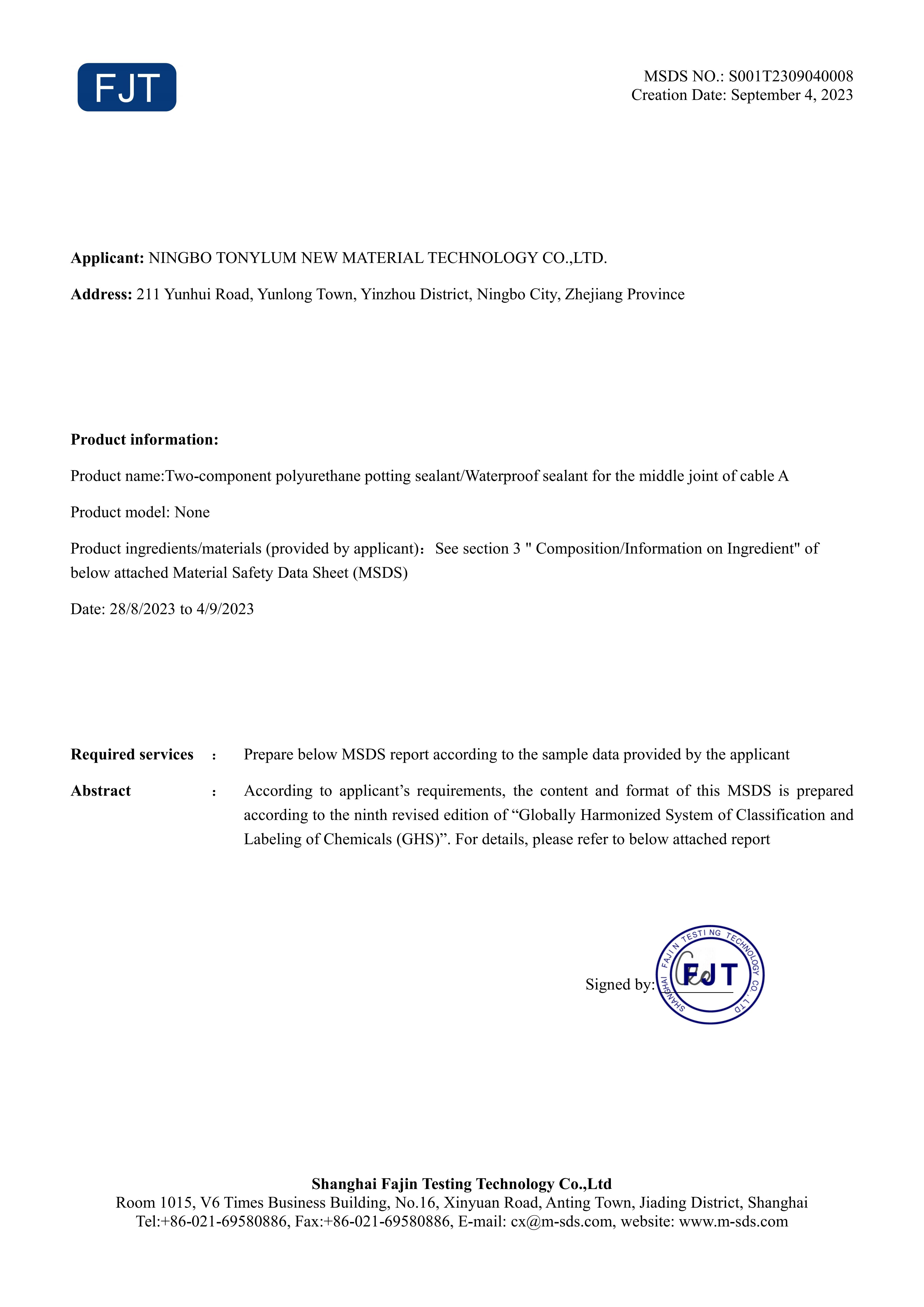
- Declarations and safety data state material, dimensional, safety, or regulatory information. The supplied MSDS NO.:S001T2309040008 is issued under UN GHS Rev.9 for two-component polyurethane potting sealant / waterproof sealant for the middle joint of cable A. It identifies markets EU, US, Southeast Asia, and UK. It is a safety data sheet, not a dielectric performance report.
- Installation and trade references provide workmanship or classification context. IEEE 1816-2024 is an installation-practice reference. HS 8544 covers insulated wire, cable, and other insulated electric conductors, whether or not fitted with connectors; it does not isolate every cable-accessory hardware item such as joints, terminations, lugs, sealants, or housings. A customs code is not a compliance approval.
Detailed solution: build a five-block compliance file
Block 1 — Product identity and claimed duty
Start with the exact product and duty, not the supplier name. Record voltage class, cable section, core type, indoor or outdoor use, direct-burial condition, operating temperature, and any special environment such as high humidity or salt-fog exposure. The supplied application unit lists working conditions that include indoor cabinets, outdoor substations, underground cable trenches, high humidity, salt-fog coastal environments, a wide temperature range, and dust-polluted areas. These conditions belong in the file because a test value without the application context is easy to misread.
Use model-level identity. For example, the grounding box sheet lists 35 kV, 66 kV, 110 kV, and 220 kV models. The separable connector sheet lists DS/SC at 10 kV and 630 A. The cold shrink intermediate joint sheet lists JLS-10/1.1, JLS-10/3.3, JLS-35/1.3, and JLS-35/3.4. The heat shrink termination sheet lists SY10kV, SY26kV, and SY35kV. The cable lug sheet lists DT/SC. The polyurethane sealant sheet lists J-399, J-499, and J-699. The explosion-proof blanket sheet lists DS-FBT-10, DS-FBT-35, DS-FBT-110, and DS-FBT-220. A file that says only “cable accessories” cannot support a procurement decision.
Block 2 — Claim-to-evidence table
Create one row per claim. A claim is a statement that can be tested or checked, such as “partial discharge ≤10 pC” or “air tightness 0.2 MPa for 30 minutes with no leakage.” The row should contain the exact model, the claimed value and unit, the evidence document number, the test standard, the test date, the tested sample configuration, and the document’s limitation. If the evidence is a catalog statement rather than a report, write “catalog declaration” in the evidence column. Do not write “certified” unless the document actually certifies the product and scope.
Block 3 — Test-report verification
Check the report before checking the logo. Confirm the report number, testing laboratory, accreditation or recognition where stated, issue date, sample model, voltage class, cable section, test sequence, measured values, pass/fail criteria, and whether the report covers the model you are buying. A report for one model or one voltage class does not automatically cover another. Also separate type tests from routine tests. The supplied capability unit states 100% factory electrical test and partial-discharge test, with third-party inspection by SGS/TUV; those are production controls, not a substitute for a model-specific type-test report.
Block 4 — Declarations and certificates
Keep declarations in their own section. For Tonyhoo, the supplied ISO 9001 certificate and MSDS are concrete documents with numbers and dates, but neither is a product type approval for every catalog item. The ISO 9001 scope names high-voltage cable accessories at 110kV and 220kV intermediate joint protection housing and grounding box. The MSDS covers a two-component polyurethane potting sealant / waterproof sealant and states UN GHS Rev.9. A buyer should not use either document to prove a cold shrink termination’s partial-discharge performance or a cable lug’s DIN/GB conformity.
Block 5 — Regional acceptance route
Regional acceptance is a separate decision from product evidence. The file should identify the route that applies to the project: utility specification, national standard, IEC or IEEE type test, or a project-specific approval. Do not assume that an ISO 9001 certificate, an MSDS, or a catalog voltage class satisfies that route. The supplied evidence does not establish that any Tonyhoo product holds CE, UL, or a specific grid approval, and the file should say so rather than imply approval by omission.
Use recognized examples carefully. The 3M statement about IEEE 48 Class 1 and IEC 60840 for 72.5 kV outdoor applications is a manufacturer-stated qualification for 3M products. It shows what a product-specific standards claim looks like. It does not transfer to Tonyhoo or any other supplier. In the same way, IEEE 1816-2024 supports cable preparation practice but is not a product certificate. The buyer’s file should record the exact route and the authority that will review it.
Step-by-step breakdown
- Define the scope in writing. List the exact product, model, voltage class, cable section, core type, indoor/outdoor/direct-burial condition, and project market. The supplied parameter-collection FAQ advises confirming voltage level, cable model, conductor cross-section, core quantity, and installation environment before asking a supplier to match a product.
- List every claim you need evidence for. Do not ask for a general certificate package. Ask for the specific values that affect selection, such as partial discharge, AC and DC withstand, air tightness, impact, insulation resistance, hardness, density, flame rating, tear strength, breakdown strength, and volume resistivity.
- Request primary evidence first. Ask for the test report, certificate, or declaration that directly carries the claim. Keep catalog pages as secondary references. If a supplier sends only a catalog, mark the item as “catalog claim, report pending.”
- Check scope and validity. Confirm the report or certificate applies to the exact model and voltage class, and check issue and expiry dates. The ISO 9001 certificate in the supplied file is valid from 2024-08-13 to 2027-08-12; the MSDS is dated 2023-09-04 and has no listed expiry date. Record what each document covers and what it does not.
- Separate product evidence from system evidence. Put ISO 9001 and factory QC statements in the system section. Put type-test reports and product declarations in the product section. Keep MSDS and safety documents in a third section. This prevents a quality certificate from being used as a performance claim.
- Map the regional route. Record the standard, utility specification, language, approval holder, and any project-specific witness or sampling requirement. If the route is unknown, write “regional route open” and do not mark the product approved.
- Record gaps and next actions. A gap is not a rejection. It is a request. For example, “IEC test report for cold shrink intermediate joint: not identified in supplied company profile; request report number and model coverage.” This keeps the evaluation factual.
Worked evidence examples
Grounding box evidence: air tightness, impact and scope
For the grounding box, the supplied product sheet lists models 35 kV, 66 kV, 110 kV, and 220 kV; materials SS304, SS316, or SMC FRP; cabinet insulation resistance 5 MΩ; impact 37.5 kV 10 times without breakdown; and a direct-buried box air-tightness test at 0.2 MPa for 30 minutes with no leakage. These are specific values that belong in the compliance file, but they must be tied to the exact model and test report. A value from the grounding box does not transfer to a DS-FBH housing or an aluminum-magnesium housing.
Separable connector evidence: partial discharge and withstand
For the separable connector DS/SC, the supplied sheet lists voltage grade 10 kV, rated voltage 15 kV, rated current 630 A, 1-minute AC withstand 42 kV, 15-minute DC withstand 52 kV, lightning impulse withstand 95 kV, minimum corona onset 11 kV, thermal short-circuit current 22.8 kA/2 s, dynamic short-circuit current 80.8 kA, and partial discharge ≤10 pC. The file should request the test report that shows the partial-discharge test method and the AC/DC withstand sequence. A catalog statement of ≤10 pC is a claim; the report is the evidence.
Termination and joint voltage classes as evidence, not assumption
Voltage class is a common source of false confidence. The heat shrink termination sheet lists voltage classes 8.7/10 kV, 12/20 kV, and 19/35 kV; cable section 25–400 mm²; single-core or three-core; shrink ratio 2:1; withstand voltage 39 kV for 5 minutes; and a temperature range of -40°C to 120°C. The cold shrink intermediate joint sheet lists voltage classes 8.7/10 kV, 12/20 kV, and 19/35 kV; cable section 25–400 mm²; and operating temperature -40°C to 90°C. These are useful comparison points, but the file must still ask for the test report that covers the exact model and voltage class.
The cold shrink termination sheet shows why document control matters. It lists a 0.6/1 kV voltage class, cable section 10–300 mm², operating temperature -40°C to 90°C, and models NLS-10/3.3, WLS-10/3.3, NLS-35/1.3, and WLS-35/1.3. Because the model names include 10 and 35 while the listed voltage class is 0.6/1 kV, the buyer should require a model-to-voltage-class declaration before using the sheet in a regional file. This is not a reason to reject the product; it is a reason to verify the mapping.
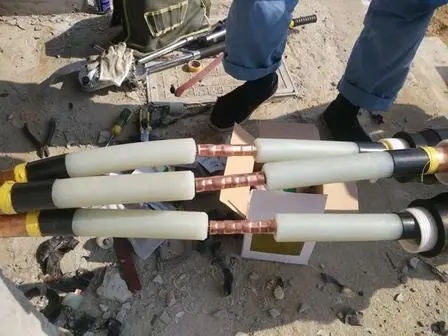
Declarations for cable lugs, sealant, housings and blankets
Cable lugs. The DT/SC sheet lists tin-plated pure copper or tin-plated copper, a 10–400 mm² range, DIN/GB standard, and a working temperature of -40°C to 125°C. The declaration check should ask for the exact DIN or GB standard number, the size range, the plating specification, and the test report if conformity is claimed. “DIN/GB” on a catalog page is not the same as a report for the exact lug size.
Polyurethane sealant. The J-399/J-499/J-699 sheet lists a light-yellow color, 10–35 kV applicable voltage level, hardness 55A±10, density 1.55 g/m³±0.55, and a polyurethane prepolymer material. MSDS NO.:S001T2309040008 is issued under UN GHS Rev.9 and is dated 2023-09-04. The declaration check should confirm the hardness test method, the density unit, the applicable voltage range, and whether dielectric or adhesion data exists for the exact application. The MSDS is safety evidence, not a dielectric type test.
Waterproof and explosion-proof housings. The supplied product scope lists various metal protective housings, waterproof and explosion-proof housings, models DS-FBH (SS)-1 through DS-FBH (SS)-8. The supplied product-spec unit does not provide IP, impact, or ingress values for that series. Do not transfer the grounding box values or the aluminum-magnesium housing values to the DS-FBH series. For the aluminum-magnesium alloy protection housing, the sheet lists 10 kV, 35 kV, and 110 kV models; shell B1 grade and sealing gasket V-0 flame retardant; impact resistance with a 1 kg weight dropped vertically from 2 m without cracks or damage; flexural strength 127 MPa without fracture or deformation; and salt-water resistance after 3 days in 3% sodium chloride solution with no swelling, cracking, or interlayer peeling. These are the values to request in report form.
Explosion-proof blankets. The DS-FBT-10, DS-FBT-35, DS-FBT-110, and DS-FBT-220 sheet lists outer-layer combustion performance B1; tear strength ≥3.5 kN·m⁻¹; bromine content <900 ppm; chlorine content <900 ppm; total bromine and chlorine <1500 ppm; breakdown strength ≥20 kV·mm⁻¹; and volume resistivity ≥1×10¹³ Ω·cm. The declaration check should confirm the test method for B1, the halogen test method, the breakdown test conditions, and the voltage model that matches the project.
Use cases: how project records fit the file
Project records can support supplier experience, but they do not replace model-specific type tests. The supplied case units describe a Thailand suburban cable expansion project using 500 cold shrink intermediate joints for 10 kV underground cables, with a record of no leakage or discharge issues since commissioning and a listed duration of ≥20 years. Another record describes 1,000 units for indoor 10 kV cable terminal support at a substation, with the stated result that the products passed the grid access test of the local power authority. A third record describes 1,000 units for outdoor 10 kV cable terminals and on-site acceptance in Thailand under high-temperature and high-humidity conditions. A fourth record describes 1,087 pieces and 32 cartons for a power grid construction project in Albania, with stable operation after installation and a stated match to local power system requirements.
These records are useful for the “experience and application” section. They show that the supplier has supplied comparable cable accessory categories and that project acceptance was recorded for those scopes. They do not prove that a different model, voltage class, or regional standard has been approved. The file should keep the project record and the product test report in separate columns.
Comparison table: evidence examples and what they establish
| Product / model | Evidence in the supplied file | Value or declaration | What it can support | What it does not prove |
|---|---|---|---|---|
| Grounding box, 35/66/110/220 kV | Product sheet; ISO 9001 scope includes grounding box | 0.2 MPa for 30 min air tightness with no leakage; 37.5 kV impact 10 times without breakdown; cabinet insulation resistance 5 MΩ; SS304 / SS316 / SMC FRP | A testable claim for the named model and stated test conditions | Does not prove acceptance by a specific utility, and does not cover other housing series |
| Separable connector DS/SC | Product sheet | 10 kV voltage grade; 630 A; 42 kV AC 1 min; 52 kV DC 15 min; partial discharge ≤10 pC; 95 kV lightning impulse; 22.8 kA/2 s thermal short-circuit | A technical evidence request for the named connector | Does not prove IEC or regional type approval unless the report is supplied |
| Cold shrink intermediate joint JLS-10/1.1, JLS-10/3.3, JLS-35/1.3, JLS-35/3.4 | Product sheet; project records | 8.7/10 kV, 12/20 kV, 19/35 kV; 25–400 mm²; -40°C to 90°C | Voltage-class and cable-range check | Does not prove an IEC test report for the exact model |
| Heat shrink termination SY10kV / SY26kV / SY35kV | Product sheet | 8.7/10 kV, 12/20 kV, 19/35 kV; 25–400 mm²; 2:1 shrink ratio; 39 kV / 5 min; -40°C to 120°C | A comparison point for termination selection | Does not prove regional acceptance or project approval |
| Cold shrink termination NLS-10/3.3, WLS-10/3.3, NLS-35/1.3, WLS-35/1.3 | Product sheet | Listed 0.6/1 kV; 10–300 mm²; -40°C to 90°C; models include 10 and 35 in the name | A document-control check for model-to-voltage mapping | Model-to-voltage mapping must be confirmed before regional use |
| Cable lug DT/SC | Product sheet | Tin-plated pure copper or tin-plated copper; 10–400 mm²; DIN/GB; -40°C to 125°C | Material and size declaration | Does not prove a specific DIN or GB test report |
| Polyurethane sealant J-399 / J-499 / J-699 | Product sheet; MSDS S001T2309040008 | 10–35 kV; hardness 55A±10; density 1.55 g/m³±0.55; UN GHS Rev.9; MSDS dated 2023-09-04 | Safety and declared physical data | MSDS is not a dielectric type test; density unit should be confirmed |
| Aluminum-magnesium alloy protection housing, 10/35/110 kV | Product sheet | Shell B1 grade; gasket V-0; 1 kg from 2 m impact without cracks; flexural strength 127 MPa; 3% NaCl for 3 days without swelling, cracking, or peeling | Mechanical and environmental declaration | Does not cover the DS-FBH series or prove an IP rating |
| Explosion-proof blanket DS-FBT-10 / 35 / 110 / 220 | Product sheet | Outer layer B1; tear strength ≥3.5 kN·m⁻¹; Br <900 ppm; Cl <900 ppm; total <1500 ppm; breakdown ≥20 kV·mm⁻¹; volume resistivity ≥1×10¹³ Ω·cm | Material and electrical declaration | Does not prove a project-specific acceptance |
Commercial terms, price band and sample requests
Commercial terms belong in a separate section from compliance evidence. The supplied capability unit lists OEM, ODM, and customized solutions; monthly capacity 12,000 sets; lead time 30–40 days; MOQ 10 sets; 100% factory electrical test and partial-discharge test; third-party inspection by SGS/TUV; and a 5-year product warranty. It does not provide a price band. A buyer should not accept a price band as a substitute for certification, and should not accept a certificate as a substitute for a quotation basis. Request the quotation basis, MOQ, lead time, packaging, and warranty terms separately, then attach them to the file as commercial annexes.
FAQ
What documents should a cable accessories compliance file contain?
A workable file contains five sections: product identity and application, claim-to-evidence table, test reports, declarations and certificates, and regional acceptance. The product section should include exact model, voltage class, cable section, core type, and environment. The evidence section should include report numbers, test standards, test dates, tested sample configurations, and limitations. The certificate section should include the certificate number, issuer, scope, issue date, and expiry date. The regional section should record the standard or utility specification and the approval route. An ISO 9001 certificate, an MSDS, and a catalog page can be included, but each must be labeled for what it is.
China cold shrink intermediate joint suppliers with IEC test reports — what should buyers verify?
Ask for the exact IEC standard number and the report itself, not a catalog phrase. Check the report number, testing laboratory, accreditation where stated, issue date, sample model, voltage class, cable section, test sequence, and whether the report covers the model you are buying. For Tonyhoo, the supplied company profile states that products have been tested by the State Grid High Voltage Testing Center, SGS, or Shanghai Cable Research Institute and have obtained corresponding reports; it does not identify a specific IEC test report for the cold shrink intermediate joint. The supplied ISO 9001 certificate AMTIVO/CN/240246 is a quality-management-system certificate, not an IEC product type test. Treat “IEC test report” as unverified until the document is produced and its scope is checked.
Which ratings and test values should be checked for grounding boxes and separable connectors?
For the grounding box, check the exact voltage model, material, cabinet insulation resistance 5 MΩ, air tightness 0.2 MPa for 30 minutes with no leakage, and impact 37.5 kV 10 times without breakdown. For the separable connector DS/SC, check voltage grade 10 kV, rated voltage 15 kV, rated current 630 A, 1-minute AC withstand 42 kV, 15-minute DC withstand 52 kV, lightning impulse withstand 95 kV, minimum corona onset 11 kV, thermal short-circuit current 22.8 kA/2 s, dynamic short-circuit current 80.8 kA, and partial discharge ≤10 pC. Request the test report that shows the method and the tested sample for each value.
How should regional acceptance be documented when a supplier holds ISO 9001 but no project-specific approval?
Record the ISO 9001 certificate as quality-system evidence and record the project approval as a separate open item. The supplied ISO 9001 certificate covers manufacture and sales of high-voltage cable accessories (110kV, 220kV intermediate joint protection housing, grounding box) and is valid from 2024-08-13 to 2027-08-12. It does not establish CE, UL, or a specific grid approval. The file should name the regional route, the standard or utility specification, the authority that will review it, and the evidence still required. If no product-specific approval is held, state that clearly rather than implying approval by silence.
What declaration checks apply to cable lugs, polyurethane sealant, housings and explosion-proof blankets before sampling?
For cable lugs, confirm the exact DT/SC size, 10–400 mm² range, DIN or GB standard number, tin plating, and -40°C to 125°C rating. For polyurethane sealant, confirm J-399/J-499/J-699, 10–35 kV applicability, hardness 55A±10, density unit, and MSDS S001T2309040008. For waterproof and explosion-proof housings, separate the DS-FBH (SS)-1 to -8 series from the aluminum-magnesium housing; do not transfer grounding-box air-tightness or impact values to either. For explosion-proof blankets, confirm DS-FBT-10/35/110/220, B1 outer layer, tear strength ≥3.5 kN·m⁻¹, bromine and chlorine limits below 900 ppm each and total below 1500 ppm, breakdown strength ≥20 kV·mm⁻¹, and volume resistivity ≥1×10¹³ Ω·cm. If you need a starting document set for this checklist, the Tonyhoo product catalog can be downloaded, and the model-specific certificate and test-report package should be requested before sampling.
Conclusion
A cable accessories compliance file should make the buyer’s evidence position visible: what is claimed, what is tested, what is certified, what is only declared, and what regional route remains open. The grounding box air-tightness and impact values, the separable connector partial-discharge and withstand values, and the cold shrink and heat shrink termination voltage classes are useful only when they are tied to the exact model and report. The same discipline applies to cable lugs, polyurethane sealant, waterproof and explosion-proof housings, and explosion-proof blankets. Do not assume an approval is held because a supplier has an ISO 9001 certificate, an MSDS, or a catalog. Build the file so that every claim has a document, every document has a scope, and every gap has a next request.
Next step: Use the Tonyhoo product catalog to identify the model and voltage class, then request the matching certificate, test report, and declaration package for your regional route.
Have Questions or Need More Details?
Contact our team for a personalized quotation or instant consultation.
Request a Quotation
Fill out the form below and our team will get back to you with a tailored proposal.
WhatsApp Direct Chat
Prefer to chat in real-time? Message us on WhatsApp for instant assistance & quick answers.
- Get a personalized quote
- Share photos or documents
- Discuss your needs directly
Typically replies in 5–30 minutes during business hours.