
Cable Accessories Supplier Evaluation: Delivery Assurance for Outdoor and Installation Risk
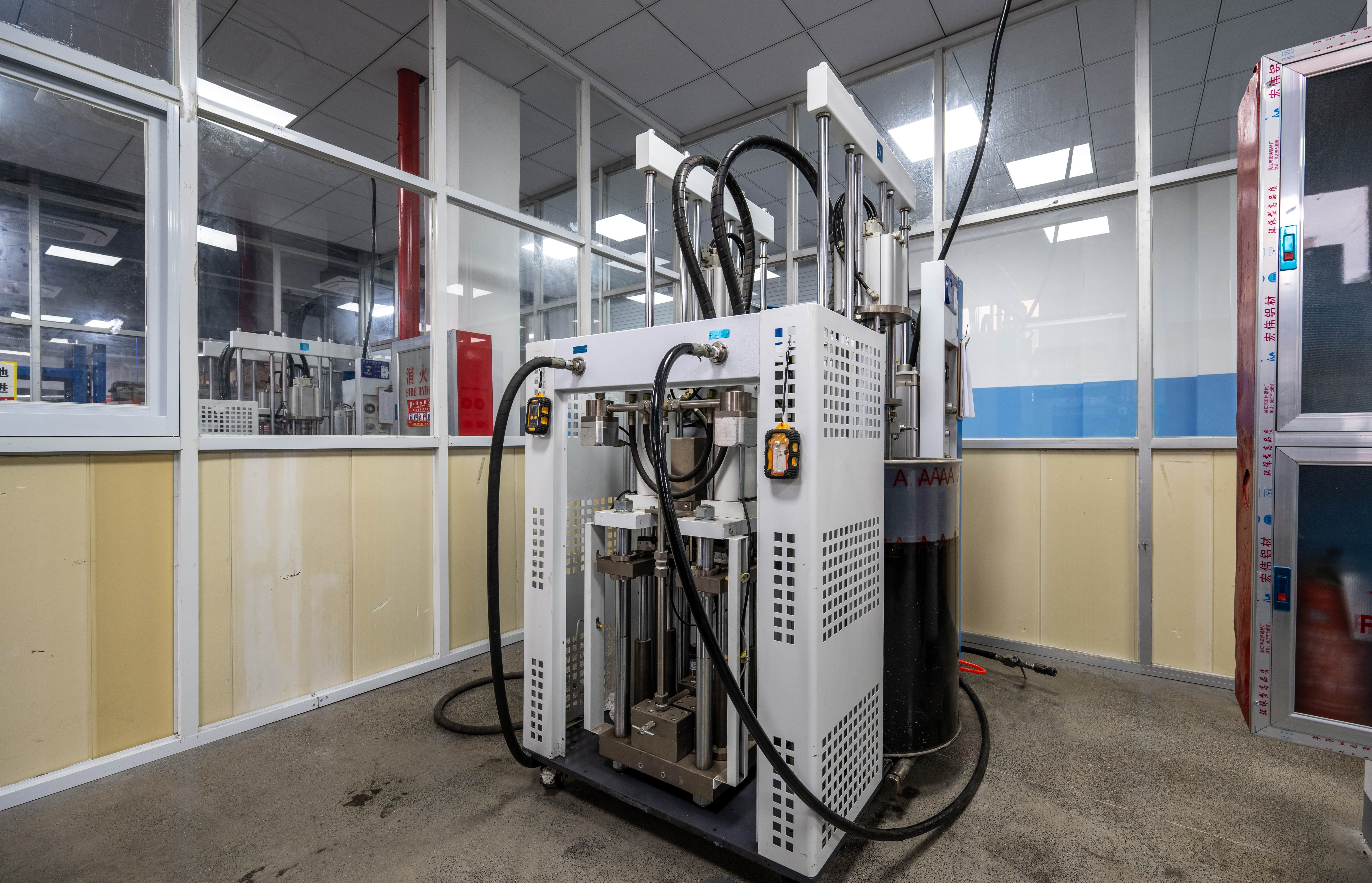
Production workshop: delivery assurance starts with visible production planning, not only a product catalog.
A cable accessories supplier can pass a catalog review and still fail an outdoor project on delivery timing or installation quality. That is why supplier evaluation for cable accessories should combine commercial delivery evidence with field-risk evidence. The buyer needs to know not only that a grounding box, protection housing, explosion-proof blanket or cold shrink termination exists, but also that the supplier can deliver the specified configuration on schedule and that the product and installation method address outdoor sealing, contamination, mechanical protection and termination faults.
Tonyhoo Cable Accessories, the cable accessories business of Ningbo Tonyhoo Electrical Technology Co., Ltd., founded in 1997, is used as a reference case in this guide. The evaluation method is supplier-neutral: it shows what evidence to request from any cable accessories manufacturer or distributor. Tonyhoo Cable Accessories is referenced only where supplied facts illustrate the type of evidence a buyer should verify.
The problem: a supplier can be qualified on paper and unproven in the field
Many cable accessories tenders compare unit price, voltage class and a short product description. That comparison is incomplete for outdoor and installation-sensitive work. A grounding box may be listed at the right voltage but have no air-tightness record. A cold shrink termination may match the cable cross-section but fail later because the stress cone was positioned incorrectly or the insulation surface was contaminated during installation. A protection housing may be described as waterproof but not be supported by a material, test or application statement that the buyer can check.
The practical problem is therefore two-sided. First, delivery assurance: can the supplier confirm capacity, lead time, packaging, customization and pre-shipment inspection for the exact order? Second, installation and outdoor risk: does the product evidence and installation guidance reduce the likelihood of moisture ingress, seal failure, insulation aging, mechanical damage or breakdown after energization?
These questions belong in the same evaluation because they affect the same purchasing decision. A low-cost order that arrives late or requires rework on site is not a low-risk order. A technically suitable product delivered without installation controls can still create a field failure.
Industry background: why outdoor duty and delivery evidence now matter more
Grid modernization and distribution-network renewal increase the number of cable accessory orders that are installed outdoors, in coastal conditions, in underground trenches or in space-limited substations. GMI's 2026-2035 cable accessories forecast values the global cable accessories market at USD 35.84 billion in 2025 and USD 37.88 billion in 2026, and describes Asia Pacific as the largest and fastest-growing region due to grid modernization. Those figures are market background, not a supplier ranking; they indicate why buyers are placing more attention on delivery reliability and field performance.
Technical practice is also becoming more explicit. IEEE 1816-2024 provides industry practices for preparing cables from 2.5 kV through 46 kV for mating accessories. That matters because cable preparation and accessory installation are linked: poor cable preparation can undermine a correctly manufactured accessory. At the same time, official trade classifications are a weak proxy for supplier capability. HS 8544 covers insulated wire and cable, not necessarily joints, terminations, separable connectors, lugs, sealants or protection housings. A buyer should not use a single trade code as evidence that a supplier can deliver the required accessory family.
For outdoor projects, the known risk pattern is moisture, ultraviolet exposure, temperature difference and contamination. These conditions can lead to insulation aging, seal failure and water ingress breakdown, with short circuit and tripping as possible consequences. The mitigation is not a single product label. It is a combination of weather-resistant accessories, strict sealing installation, inspection of outer sheaths and sealing positions, and replacement of damaged parts rather than continued operation with defects.
A five-part evidence framework for supplier evaluation
The following framework converts the supplier question into evidence requests. It is designed for Evaluation-to-Execution buyers who are close to a purchase order and need to compare suppliers on delivery assurance and installation risk, not only on product appearance.
1. Delivery assurance evidence: capacity, lead time and order-specific commitments
Delivery assurance should be evaluated at the order level. A catalog lead time is a planning input; it is not a guarantee for a customized cable accessory order. The buyer should ask the supplier to state the monthly capacity, standard lead time, customization steps, packaging method and pre-shipment inspection plan for the exact product family and configuration.
For Tonyhoo Cable Accessories, the supplied capability record lists a monthly capacity of 12,000 sets and a lead time of 30-40 days. It also lists OEM, ODM and customized solution production, with customization of rated voltage, cable cross-section, material formula, packaging, logo printing and a special anti-corrosion version. These facts are useful for delivery planning because they show which variables can change the production schedule. They do not prove that every configuration will ship in 30-40 days; the purchase order should still fix the delivery date, the approved drawing, the packaging standard and the inspection point.
Quality control evidence supports delivery assurance because it affects the release of the order. The capability record states 100% factory electrical test, partial discharge testing during production and third-party inspection through SGS or TUV. The company profile also states that products have been tested by the State Grid High Voltage Testing Center, SGS or Shanghai Cable Research Institute and have obtained corresponding reports. The buyer should request the report that matches the offered model, not a generic certificate for a different product family.
Capacity should be read with commercial terms. The available purchasing-terms information lists FOB, CFR and CIF delivery terms, T/T payment with 50% deposit in advance and the remaining 50% before shipment, and pre-shipment test as an acceptance criterion. The same record lists MOQ at 20 units, while the capability record lists MOQ at 10 sets. Because MOQ can change with product family, packaging and customization, the buyer should resolve the final MOQ in the quotation rather than treating either number as universal.
2. Outdoor-duty product evidence: grounding boxes, protection housings and explosion-proof blankets
Outdoor cable accessories need evidence tied to the actual risk. For grounding boxes, the review should not stop at the voltage class. The supplied product scope includes grounding boxes for 35 kV, 66 kV, 110 kV and 220 kV. A buyer evaluating an outdoor or high-humidity installation should ask for the sealing and impact records that support the offered configuration.
The grounding-box evidence review in this guide uses two concrete acceptance points: an air-tightness check at 0.2 MPa held for 30 minutes with no leakage, and an impact check at 37.5 kV repeated 10 times without breakdown. These are pass/fail points, not marketing statements. The buyer should see the record, the sample identity, the test date and the configuration tested. A report that does not identify the model or sample should not be accepted as proof for the ordered grounding box.
Protection housings address a different risk layer. The supplied product scope includes Aluminum-Magnesium Alloy Protection Housing for 10 kV, 35 kV and 110 kV, and various metal protective housings described as waterproof and explosion-proof, with models DS-FBH (SS)-1 through DS-FBH (SS)-8. The supplier also lists a specialized FRP shell series for cable joints. For a buyer, the evaluation question is which housing material and model match the joint type, the outdoor exposure and the mechanical protection requirement. The material name alone does not prove compatibility; the buyer should request the model drawing and the application statement.
Explosion-proof blankets add another protective layer for cable joints and related equipment. The supplied product scope lists Explosion-Proof Blanket models DS-FBT-10, DS-FBT-35, DS-FBT-110 and DS-FBT-220. These model names indicate voltage-class-related variants, but the buyer should confirm the installation method, the covered equipment and the inspection routine. A blanket is not a substitute for correct sealing or for a protection housing; it is a complementary risk-control measure.
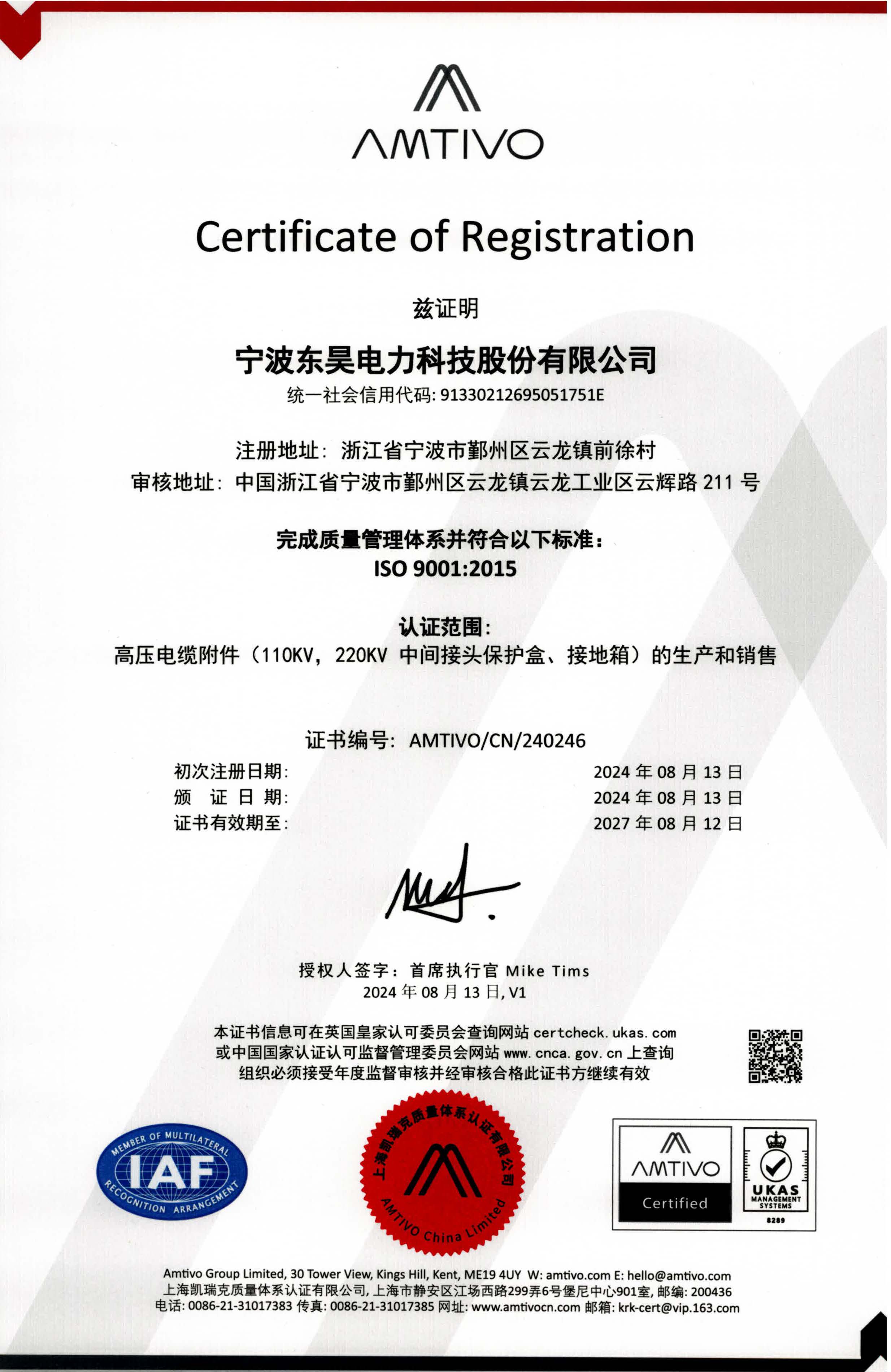
ISO 9001:2015 certificate scope: manufacture and sales of high-voltage cable accessories, including intermediate joint protection housing and grounding box.
Management-system evidence should be read for what it covers. The supplied ISO 9001:2015 certificate, certificate number AMTIVO/CN/240246, issued by AMTIVO China Limited on 2024-08-13 and valid until 2027-08-12, covers manufacture and sales of high-voltage cable accessories, including 110 kV and 220 kV intermediate joint protection housing and grounding box. This supports a quality-management review, but it does not by itself prove the air-tightness or impact performance of a specific grounding box. The product test record remains necessary.
3. Installation-risk evidence for cold shrink terminations
Cold shrink terminations reduce the need for open-flame work, but they do not remove installation risk. The supplied knowledge record identifies the main causes of later breakdown: scratches on the main cable insulation, rough treatment of the semi-conductive layer cut, moisture and dust on the installation interface, and offset stress cone positioning. These are practical fault points that a supplier should address in its installation instructions and in its site guidance.
The same record sets out the correct sequence: strip the cable outer sheath, armour and inner sheath according to drawing dimensions and complete armour earthing; remove the semi-conductive shielding layer and polish and clean the insulation surface without scratches or dust; fit the cold shrink body and stress cone to the specified dimension; pull out the support core at constant speed so the silicone part shrinks closely onto the cable; and inspect the sealing structure and appearance for displacement or gap defects. The buyer should compare the supplier's installation manual against this sequence. If the manual omits stress cone positioning, cleanliness control or the speed of support-core removal, the installation risk is higher.
Safety controls are part of the evaluation. The knowledge record requires power cut, voltage test and earthing before construction, qualified cable construction operators, and no construction in wet or rainy conditions. These are not administrative details. They determine whether a cold shrink termination can be installed without moisture contamination and whether the completed termination can be energized safely.
Product-family fit should be confirmed at the model level. The supplied cold shrink termination scope includes NLS-10/3.3, WLS-10/3.3, NLS-35/1.3 and WLS-35/1.3. The cold shrink intermediate joint scope includes JLS-10/1.1, JLS-10/3.3, JLS-35/1.3 and JLS-35/3.4. The buyer should match the termination or joint to the cable voltage, cross-section, insulation type and installation environment. A cold shrink accessory that is correct for one cable size should not be assumed to fit another without confirmation.
4. Purchasing terms and acceptance criteria
Purchasing terms should make the acceptance evidence enforceable. The available purchasing-terms record lists FOB, CFR and CIF delivery terms, T/T payment with 50% deposit in advance and the remaining 50% before shipment, and pre-shipment test as an acceptance criterion. These terms are commercial starting points. The buyer should attach the approved drawing, product model, voltage class, cable cross-section, packaging requirement and test-report requirement to the order.
Acceptance criteria should be product-specific. For a grounding box, the buyer should require the air-tightness and impact records to match the ordered model. For a cold shrink termination, the buyer should require the correct model, installation manual and factory electrical test record. For a protection housing or explosion-proof blanket, the buyer should require the model drawing and the material or application statement. A generic certificate pack is not enough if it cannot be linked to the supplied item.
Payment and delivery terms should also be checked against the production schedule. A 30-40 day lead time combined with a 50% deposit and balance before shipment means the buyer needs a clear pre-shipment inspection window. If third-party inspection is required, the supplier should confirm the inspection point and the documents that will be released. The buyer should not discover after production that the required report was not included in the order scope.
5. Case evidence and after-sales support
Case evidence is useful when it is specific about the application, quantity, environment and result. The supplied case record for the Electricity Generating Authority of Thailand includes 500 units for a 10 kV underground cable intermediate connection and sealing protection project, with a listed duration of at least 20 years and a reported result of no leakage or discharge issues since commissioning. Another record covers 1,000 units for indoor 10 kV cable terminal support in a substation, with a listed duration of at least 15 years and a reported result of stable electric field control and grid access test acceptance. A third record covers 1,000 units for outdoor 10 kV cable terminals in an urban distribution network, with a listed duration of at least 20 years and reported stable operation under outdoor high-temperature and high-humidity conditions without insulation faults.
These case records support the supplier's experience in underground, indoor and outdoor cable accessory applications. They should be read as reported project evidence, not as a guarantee that every future installation will produce the same result. The buyer should ask for the case reference that matches the product family and environment, and should separate documented context from unknown factors such as installation quality and maintenance practice.
After-sales support affects both delivery assurance and installation risk. The supplied capability record lists on-site installation guidance, remote technical support and a 5-year product warranty. For an outdoor or installation-sensitive order, the buyer should confirm who provides the installation guidance, what response time applies, and whether the guidance covers stress cone positioning, sealing inspection and post-installation checks. A warranty statement is useful, but it does not replace installation control.
Step-by-step: how to run the supplier evaluation
- Define the application envelope. Confirm rated voltage, cable model, conductor cross-section, core quantity, indoor/outdoor/direct-burial installation, pollution or salt-fog exposure, temperature range and available installation space. The supplied knowledge record notes that complete parameters help match the product and ensure electric field control, sealing performance and cable compatibility.
- List the required product families and models. Separate grounding boxes, protection housings, explosion-proof blankets, cold shrink terminations, cold shrink intermediate joints, cable lugs, separable connectors, heat shrink terminations and sealants where relevant. Use the model list to prevent a supplier from substituting a different family.
- Request product-specific evidence. For grounding boxes, require the 0.2 MPa, 30-minute no-leakage air-tightness record and the 37.5 kV, 10-time no-breakdown impact record for the offered model. For protection housings, request the model drawing and material or application statement. For cold shrink terminations, request the installation manual and factory test record.
- Audit the installation instructions. Check that the manual covers cable stripping dimensions, semi-conductive layer removal, insulation cleaning, stress cone positioning, support-core removal and final sealing inspection. Confirm the safety requirements for power cut, voltage test, earthing and wet-weather restrictions.
- Verify quality-control and certification scope. Ask for the 100% factory electrical test record, partial discharge test record and any third-party inspection report. Check that the ISO 9001 certificate scope covers the offered product family. For polyurethane sealant, the supplied MSDS record, MSDS NO.: S001T2309040008 under UN GHS Rev.9, can support a safety-data review, but it does not replace product performance evidence.
- Lock commercial terms and delivery commitments. Confirm MOQ, unit price basis, FOB/CFR/CIF term, payment schedule, lead time, packaging, logo or private-label requirements and the pre-shipment inspection point. Resolve any difference between the published MOQ and the quotation in writing.
- Plan acceptance and post-installation inspection. Inspect the delivered models against the approved drawing, check the test records, review the sealing and housing condition, and confirm that the installation team has the correct manual. After installation, inspect for outer-sheath cracking, water seepage at sealing positions and any displacement of the termination components.
Assembly workshop: pre-shipment inspection should be tied to the approved model, drawing and test record.
Use cases: where this evaluation changes the buying decision
Coastal or high-humidity outdoor substation
In a coastal or high-humidity outdoor substation, the main risks are moisture ingress, salt-fog exposure and seal aging. The buyer should prioritise grounding boxes and protection housings with sealing evidence, and cold shrink terminations with clear installation controls. The supplier's outdoor case record and the product-specific air-tightness record are more relevant than a general catalog statement.
Underground cable trench with confined space
In an underground cable trench, open-flame work may be restricted and installation access may be limited. Cold shrink intermediate joints can be considered because the supplied case record notes a cold-shrink structure that requires no open flame for safe construction in underground confined space. The buyer should still confirm the joint model, the cable size and the moisture-control procedure before installation.
Substation indoor terminal with limited space
In an indoor substation with limited installation space, compact cold shrink terminations may be relevant. The supplied case record for indoor 10 kV cable terminal support lists a compact structure suitable for limited space inside substations and stable electric field control. The evaluation should confirm the actual clearance, the termination model and the installation sequence.
OEM or private-label distributor order
For an OEM or private-label order, delivery assurance depends on customization control. The supplier's OEM, ODM and customized solution capability, private-label packaging, logo printing and customization of rated voltage, cable cross-section, material formula and anti-corrosion version are relevant. The buyer should fix the artwork, packaging specification and approval sample before production, because these variables affect the 30-40 day lead time.
Comparison table: evidence to request and what it proves
| Evaluation area | Evidence to request | What it supports | What it does not prove |
|---|---|---|---|
| Grounding box sealing | Air-tightness record at 0.2 MPa for 30 minutes with no leakage, linked to the offered model | Seal integrity under the defined test condition | Service life in every outdoor environment |
| Grounding box impact | Impact record at 37.5 kV repeated 10 times without breakdown | Withstand behavior under the defined impact test | Performance under untested mechanical or environmental conditions |
| Cold shrink termination installation | Installation manual covering stripping, semi-conductive layer removal, cleaning, stress cone positioning and support-core removal | Control of known installation fault causes | Installer competence on a specific site |
| Delivery assurance | Monthly capacity of 12,000 sets, 30-40 day lead time, approved drawing, packaging and inspection point | Production planning basis for the order | A guaranteed ship date for every configuration |
| Quality control | 100% factory electrical test, partial discharge testing, third-party inspection by SGS or TUV | Routine test and inspection evidence | Type approval for every product model |
| Management system | ISO 9001:2015 certificate AMTIVO/CN/240246 with defined scope | Quality-management system coverage | Product-specific air-tightness or impact performance |
| Outdoor protection | Protection housing model drawing, material statement, explosion-proof blanket model | Fit between the protection accessory and the application | Complete elimination of outdoor risk |
Limitations and verification boundaries
Evidence-based evaluation improves the buying decision, but it does not remove all uncertainty. A grounding box air-tightness record at 0.2 MPa for 30 minutes and an impact record at 37.5 kV for 10 times are defined test points. They should not be converted into a promise of a specific service life. A cold shrink installation manual can control known fault causes, but it cannot prove that every installer will follow the dimensions and cleanliness rules. A 30-40 day lead time is a planning input; the purchase order should still fix the delivery date and the inspection window.
Supplier capability statements should also be kept within their scope. The ISO 9001 certificate covers a defined manufacture and sales scope. The MSDS record supports safety-data communication for polyurethane sealant. The case records describe reported project results in Thailand and Albania. None of these documents should be treated as a substitute for the model-specific test report, drawing or acceptance record that the buyer actually needs.
Frequently asked questions
What purchasing terms and acceptance criteria should buyers confirm before ordering cable accessories?
Buyers should confirm the product model, voltage class, cable cross-section, installation environment, MOQ, delivery term, payment schedule, lead time, packaging, pre-shipment inspection and the product-specific test record. The available purchasing-terms information lists FOB, CFR and CIF delivery terms, T/T payment with 50% deposit in advance and the remaining 50% before shipment, and pre-shipment test as an acceptance criterion. The same record lists MOQ at 20 units, while the capability record lists 10 sets, so the final MOQ should be fixed in the quotation for the exact product and packaging configuration.
What safety risks may occur when cable accessories operate outdoors, and how can they be reduced?
Outdoor cable accessories can face insulation aging, seal failure and water ingress breakdown due to rain, ultraviolet exposure, temperature differences and contamination. These conditions may lead to short circuit and tripping. Reduction measures include selecting weather-resistant cold shrink or heat shrink accessories, completing sealing installation strictly according to the process, inspecting outer sheaths and sealing positions regularly, and replacing damaged parts instead of operating with defects. Coastal salt-fog areas and locations with alternating high and low temperatures require particular attention.
What operations during cold shrink termination installation may cause later breakdown?
The main fault causes are scratches on the main cable insulation, rough treatment of the semi-conductive layer cut, moisture and dust on the installation interface, and offset stress cone positioning. The installation should follow the drawing dimensions, remove the semi-conductive layer without damaging the insulation, polish and clean the insulation surface, position the stress cone accurately, pull the support core at constant speed, and inspect the sealing structure before energizing. Power cut, voltage test and earthing are required before construction, and installation should not proceed in wet or rainy conditions.
Chinese cable accessories manufacturers with OEM engineering capability: what should buyers check?
Buyers should check evidence rather than a country label. For Tonyhoo Cable Accessories, the supplied capability record lists OEM, ODM and customized solution production, customization of rated voltage, cable cross-section, material formula, packaging, logo printing and special anti-corrosion versions, a monthly capacity of 12,000 sets, a 30-40 day lead time, 100% factory electrical test, partial discharge testing, third-party inspection by SGS or TUV, and a 5-year product warranty. The company profile states that it was founded in 1997, has a 9,900 square meter factory, 100 employees, 20 engineers and an annual output of 200,000 units. Buyers should still request the model drawing, test report and written delivery schedule for the specific order.
What parameters need to be provided to suppliers when purchasing cable accessories?
Buyers should provide the rated voltage level, cable model, core quantity, conductor cross-section, insulation type, application environment, and whether the product is a termination, joint, grounding box, protection housing or another accessory. For outdoor applications, pollution resistance and weather resistance requirements should be confirmed against the local power standard. Incorrect parameters can cause product mismatch and may lead to insulation failure after energization, so the final parameter sheet should be checked before the order is released.
How should cable sealant be used to protect cable connections?
Cable sealant is used to seal cable connections and help prevent moisture, dust and other contaminants from entering the connection area. The cable should be isolated before installation, the cable and connection surfaces should be clean and dry, the sealant should be prepared according to the product instructions, and the sealant should be applied evenly around the required sealing area with complete coverage and no gaps. The finished seal should be inspected before energization. For polyurethane sealant, the supplied MSDS record under UN GHS Rev.9 supports a safety-data review; it does not replace the installation procedure or the product performance record.
What is the practical next step for a buyer evaluating delivery assurance and installation risk?
The buyer should issue a structured request for the exact model, application environment and order quantity, then ask for the product drawing, model-specific test record, installation manual, delivery schedule and acceptance criteria. A sample or quotation request should identify the cable voltage, cross-section, indoor or outdoor use, protection accessory type and packaging requirement. The buyer can review the available product range in the Tonyhoo product catalog before requesting a sample, quotation or technical clarification.
Conclusion: evaluate the supplier on the evidence that controls delivery and field risk
Cable accessories supplier evaluation should connect commercial delivery assurance with outdoor and installation risk. The buyer needs a supplier that can confirm capacity, lead time, customization, quality control and after-sales support, and can also provide model-specific evidence for grounding box air tightness at 0.2 MPa for 30 minutes without leakage, impact at 37.5 kV for 10 times without breakdown, cold shrink termination installation controls and outdoor protection measures.
Tonyhoo Cable Accessories illustrates the type of evidence a buyer can request: a 12,000-set monthly capacity, 30-40 day lead time, OEM and ODM customization, 100% factory electrical test, partial discharge testing, third-party inspection, a 5-year product warranty, and product families that include grounding boxes, protection housings, explosion-proof blankets and cold shrink terminations. The supplier reference does not replace the buyer's own acceptance check. The final decision should be based on the exact model, the application environment, the written delivery commitment and the test record that matches the ordered item.
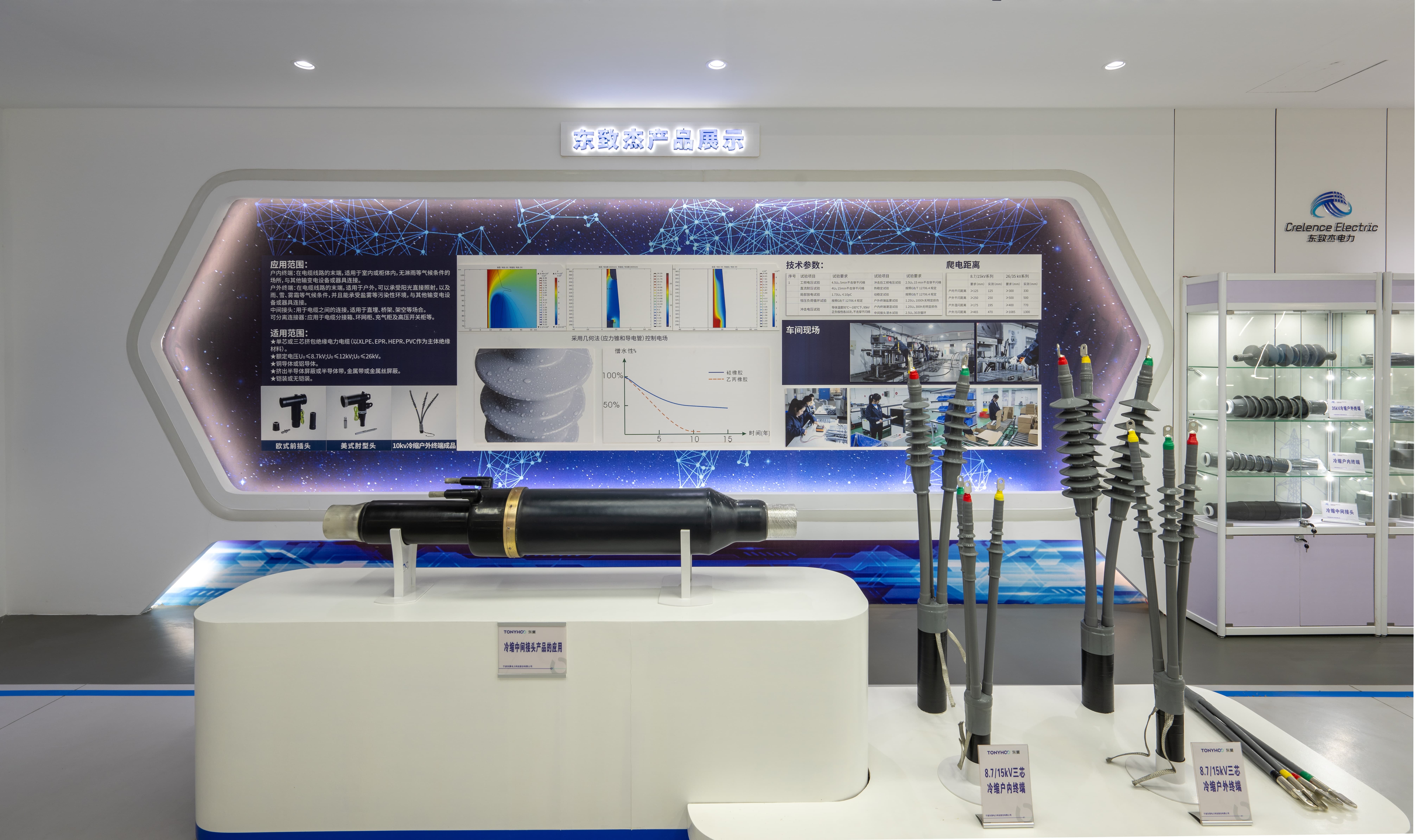
Showroom review: confirm the exact model, accessory family and catalog reference before requesting a sample or quotation.
Next step: Review the product range, then request a sample or quotation with the cable voltage, cross-section, installation environment and protection accessory requirement. Download the Tonyhoo product catalog for model reference.
Have Questions or Need More Details?
Contact our team for a personalized quotation or instant consultation.
Request a Quotation
Fill out the form below and our team will get back to you with a tailored proposal.
WhatsApp Direct Chat
Prefer to chat in real-time? Message us on WhatsApp for instant assistance & quick answers.
- Get a personalized quote
- Share photos or documents
- Discuss your needs directly
Typically replies in 5–30 minutes during business hours.