
Polyurethane Sealant for 10–35 kV Cable Joints: Hardness, Density, Curing
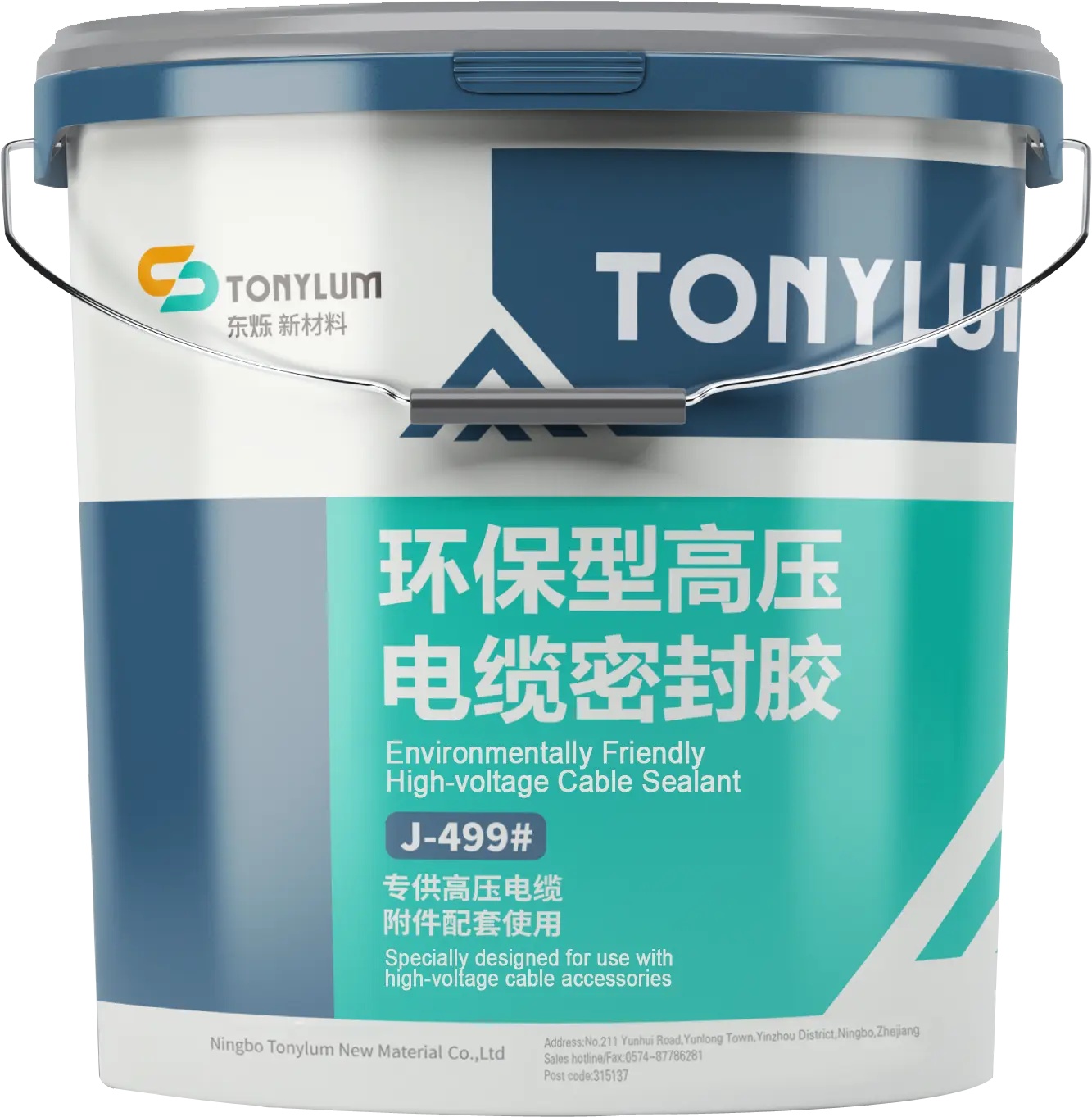
Polyurethane sealant for 10–35 kV cable joints is a solvent-free, polyurethane prepolymer sealing material used to protect joint sealing areas from moisture, dust and contaminants. The Tonyhoo Cable Accessories J-399, J-499 and J-699 family is documented as light yellow, applicable to 10kV–35kV, with hardness 55A±10, density 1.55g/m³±0.55, room-temperature construction, minimal shrinkage after curing and good impermeability. This guide explains how those values affect specification, application and inspection, and where the sealant sits inside a medium-voltage joint system.
Tonyhoo Cable Accessories is the cable accessory brand of Ningbo Tonyhoo Electrical Technology Co.,LTD., a manufacturer founded in 1997 in Ningbo, Zhejiang, China. Its product scope includes cold shrink intermediate joints, cable lugs, cold shrink terminations, separable connectors, heat shrink terminations, oil-immersed transformers, polyurethane sealant, explosion-proof blankets, fiberglass reinforced plastic (FRP) and aluminum-magnesium alloy protection housings.
Problem Definition: Why a Joint Sealant Is Not a Minor Accessory
A 10–35 kV cable joint is a layered system. The conductor connection carries current, the stress-control and insulation components manage the electric field, and the sealing layer keeps moisture and contamination out of the interfaces. The sealant does not replace the stress cone, the insulation body or the mechanical protection housing. Its job is narrower and still critical: fill, bond and protect the sealing zone so that water, dust and soil cannot reach surfaces where they can start tracking, corrosion or partial discharge.
Sealing problems rarely appear as a single dramatic event. They develop through incomplete coverage, voids, shrinkage after curing, contaminated surfaces, or a mismatch between the sealant and the joint geometry. In underground cable trenches, the joint may sit in wet soil for decades. In coastal areas, salt fog adds another exposure path. In indoor cabinets, the risk shifts toward dust, humidity and restricted working space. The same sealant cannot be selected on color or price alone; the voltage level, joint type, application environment and installation method all set the requirement.
The practical problem for a buyer or engineer is not which sealant is available, but which documented sealant data can be matched to this joint, this cable and this construction method. Hardness, density, curing behavior, voltage scope and application method are the first filters.
Industry Background: Medium-Voltage Joints in a Growing Cable Accessory Market
The global cable accessories market was valued at USD 35.84 billion in 2025 and is projected at USD 37.88 billion in 2026, according to Global Market Insights data cited in the verified data set. Asia Pacific is identified as the largest and fastest-growing region for cable accessories, driven by grid modernization. These figures describe the broad cable accessory category, not the polyurethane sealant subsegment, so they should be used as demand context rather than as a sealant market size.
Medium-voltage distribution work is a large part of that context. Cable accessories in the 10–35 kV range include cold shrink intermediate joints, cold shrink terminations, heat shrink terminations, separable connectors, cable lugs, protection housings and sealing materials. Each product has a different role. A cold shrink joint uses elastic silicone parts to maintain clamping force and sealing; a termination controls the electric field at the cable end; a cable lug provides the conductor connection; a protection housing resists mechanical and environmental damage. The sealant works at the interface between these functions.
Installation practice matters as much as product selection. IEEE 1816-2024 provides industry practices for preparing cables from 2.5 kV through 46 kV for mating accessories, which places 10–35 kV work directly inside its scope. The standard addresses cable preparation, not the formulation of a specific sealant, but it reinforces a basic rule: sealing performance depends on clean, dry, correctly dimensioned cable preparation before the sealant is applied. Manufacturer qualification claims also vary by product and application. For example, 3M states that certain cold-shrink terminations are qualified to IEEE 48 Class 1 and that a QT III termination meets or exceeds IEEE 48 Class 1 for 69 kV and IEC 60840 for 72.5 kV outdoor applications. Such claims are product-specific and should not be transferred to another supplier or to a sealant without its own documentation.
Two industry trends support room-temperature sealing. First, cold shrink accessories are preferred where open flame is not allowed or where construction time is tight; the corpus states that cold shrink products need no torch heating and are easier to install, while heat shrink products can have a cost advantage for budget-limited projects with certified flame operators. Second, underground and confined-space work makes open-flame methods less attractive. A sealant applied at room temperature fits that construction logic, provided the joint surfaces are prepared and the sealant is applied according to the product instructions.
Detailed Solution: The Tonyhoo J-399, J-499 and J-699 Sealant Family
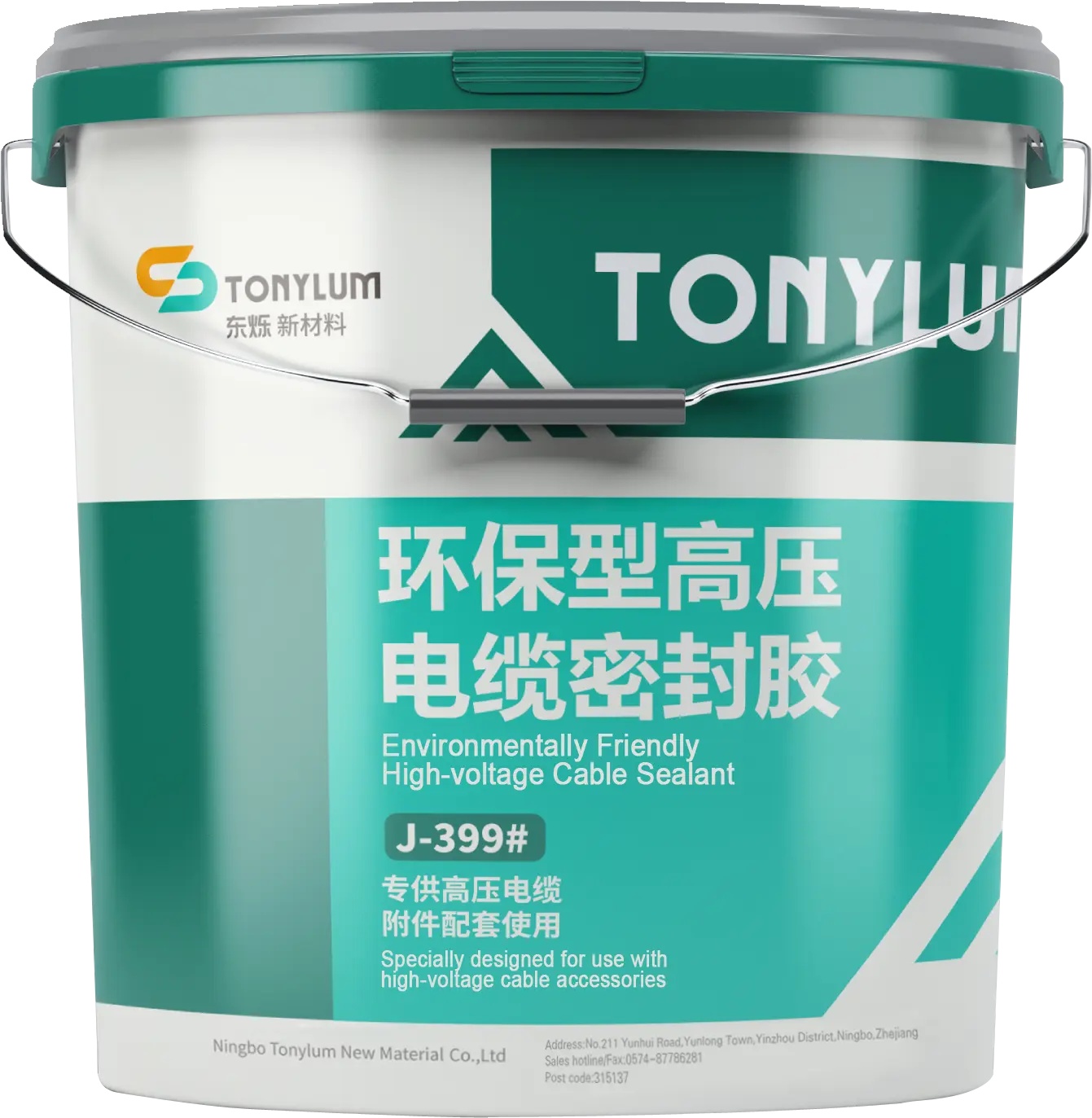
Tonyhoo Cable Accessories lists the Environmentally Friendly Polyurethane Sealant in models J-399, J-499 and J-699. The documented material is polyurethane prepolymer, the color is light yellow, the applicable voltage level is 10kV–35kV, the hardness is 55A±10, and the density is recorded as 1.55g/m³±0.55. The documented selling points are solvent-free formulation, minimal shrinkage after curing, good impermeability, high volume resistivity and good insulation properties, plus room-temperature construction and ease of operation. The documented application areas are power engineering, power transmission systems, cable joint sealing, equipment waterproofing and building sealing.
| Documented property | Value or statement | What it means at specification stage |
|---|---|---|
| Product family | J-399 / J-499 / J-699 | Confirm the model selected for the joint type, packaging format and project requirement; the corpus lists the family and shared data, not a separate performance table for each model. |
| Material | Polyurethane prepolymer | This is a reactive polyurethane system, not a generic mastic. Compatibility with the cable accessory materials and the application method should be confirmed. |
| Color | Light yellow | Useful for visual batch identification and inspection of coverage. Color alone is not a dielectric or cure indicator. |
| Applicable voltage level | 10kV–35kV | Match the sealant to the joint and cable voltage class. The sealant is a sealing component, not a substitute for the joint insulation or stress-control design. |
| Hardness | 55A±10 | The Shore A hardness band describes the cured material’s resistance to indentation. The tolerance means the supplied batch may sit within a range; installation and inspection should not assume one fixed stiffness. |
| Density | 1.55g/m³±0.55 | Density is recorded in the product data with this unit. Use the supplier’s stated unit basis and packaging data when estimating consumption; do not silently convert the unit. |
| Curing and shrinkage | Minimal shrinkage after curing; solvent free | Low shrinkage supports a void-free seal at the interface. Curing still depends on correct preparation, application thickness and site conditions; follow the product instructions. |
| Barrier performance | Good impermeability; high volume resistivity; good insulation properties | These are qualitative product statements in the corpus. They support the sealing role but do not replace project type tests or a joint-level qualification review. |
| Construction | Room-temperature construction; easy to operate | No torch heating is required for the sealant. This is relevant to underground confined spaces and no-open-flame sites, but the joint may still require other tools and safety controls. |
Hardness 55A±10: What the Number Does and Does Not Tell You
Hardness is expressed as 55A±10, which is a Shore A band. In a cable joint, hardness influences how the sealant behaves under mechanical movement, cable expansion and compression, and how easily it can be worked into the sealing zone. A softer compound may conform more easily to irregular surfaces; a harder compound may resist deformation more strongly. The ±10 tolerance is important because it defines a band, not a single point. A buyer should not specify 55A as if every batch will be identical, and an installer should not assume that a sealant that feels firmer or softer than the previous batch is automatically out of specification.
The number should be read together with the joint design. If the joint uses a cold shrink body that maintains elastic clamping force, the sealant is not the primary compression element. If the sealant is used around a conductor connection or a lug, the hardness may affect how the material behaves at the metal interface. The corpus does not provide a separate hardness limit for each model, so the correct approach is to confirm the selected model with Tonyhoo and to check the batch certificate against the 55A±10 band.
Density 1.55g/m³±0.55: Use the Documented Unit Basis
The product data records density as 1.55g/m³±0.55. Density is mass per unit volume, and it is used for consumption estimates, packaging checks and batch consistency. The unit in the source is unusual for a sealant, so the safest procurement practice is to keep the supplier’s unit basis intact and ask for the packaging quantity and coverage basis in the same units. Do not convert the figure to another unit without confirming the intended basis. If a project estimate uses a different density assumption, the required quantity can be wrong even when the product itself is correct.
The tolerance of ±0.55 also means the density is a band. For a small joint sealing application, the difference may not be visually obvious, but it can matter in batch verification and in reconciliation of issued versus consumed material. Record the batch density on the installation record and compare it with the product data and the supplier’s certificate.
Curing, Shrinkage and Impermeability
The corpus states that the sealant is solvent free, has minimal shrinkage after curing, and provides good impermeability. These three statements belong together. A solvent-free system avoids a solvent evaporation step that can create shrinkage and voids in a confined seal. Minimal shrinkage helps the material stay in contact with the cable and joint surfaces as it cures. Good impermeability supports the barrier against moisture and dust. None of these statements means that surface preparation can be skipped. A sealant applied over a damp, dusty or contaminated surface can still leave a pathway for water, even if the material itself has low shrinkage.
Curing is a process, not a single data point. The product data does not list a cure time in the corpus, so the project should rely on the manufacturer’s instructions and the joint procedure. What the data does establish is the construction logic: the sealant is applied at room temperature and is intended to cure with minimal shrinkage. Inspection should therefore confirm complete coverage, no visible voids, correct positioning and a closed sealing path before the joint is assembled and energized.
Insulation Language: Keep the Sealant in Its Proper Role
The corpus states that the sealant has high volume resistivity and good insulation properties. That is useful supporting information, but it should not be read as a declaration that the sealant replaces the joint’s insulation body or stress-control layer. Medium-voltage joint performance depends on the complete assembly: cable preparation, conductor connection, stress control, insulation, sealing and mechanical protection. The sealant’s insulation statement supports its use in the sealing zone; it does not remove the need for the joint’s designed insulation and electric-field control.
This distinction matters in procurement. A buyer who compares sealants only on insulation language may miss the more decision-relevant data: voltage scope, hardness, density, shrinkage, application method and compatibility with the joint. A joint system that is correctly designed but poorly sealed can fail; a sealant with good numbers but the wrong application can also fail. The specification should therefore combine product data with the joint procedure.
Manufacturer and Quality Context
Ningbo Tonyhoo Electrical Technology Co.,LTD. was founded in 1997 and operates a 9,900㎡ factory with 100 employees, 20 engineers and an annual output of 200,000 units. The company reports a 50% export ratio and markets including the US, Thailand, China, Albania and Vietnam. It states that it holds 12 trademark certificates and over 60 patents, and that its products have been tested by the State Grid High Voltage Testing Center, SGS, or Shanghai Cable Research Institute with corresponding reports. These are company-reported facts; they are relevant to supplier qualification, but they do not replace project-specific test certificates or a factory audit.
For customized orders, Tonyhoo lists OEM, ODM and customized solutions, with customization covering rated voltage, cable cross-section, material formula, packaging, logo printing and a special anti-corrosion version. The documented monthly capacity is 12,000 sets, the MOQ is 10 sets, and the lead time is 30–40 days. Quality control is described as 100% factory electrical test, partial discharge test, and third-party inspection by SGS or TUV. After-sales support includes on-site installation guidance, remote technical support and a 5-year product warranty.
Step-by-Step Breakdown: Specifying and Applying the Sealant
The following sequence turns the product data into a project procedure. It follows the cable-sealant application guidance in the corpus and the cable preparation logic reflected in IEEE 1816-2024. It is a specification and inspection aid, not a substitute for the approved joint installation drawing or the manufacturer’s instructions.
Step 1: Define the Joint, Cable and Service Condition
Confirm the rated voltage level, cable model, conductor cross-section, core quantity and installation environment: indoor, outdoor, underground trench or direct burial. The corpus lists cable accessory working conditions that include indoor cabinets, outdoor substations, underground cable trenches, high humidity, salt-fog coastal environments, a wide temperature range from -40°C to 150°C and dust-polluted areas. The same source lists project types such as power grid upgrades, wind-solar power station construction, urban underground cable reconstruction and railway power supply. These conditions should be written into the inquiry, because they determine the joint type, the protection housing and the sealing method.
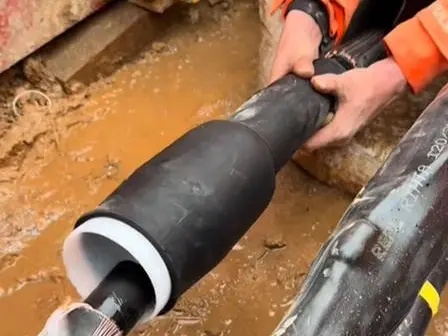
For a 10–35 kV joint, also confirm the joint type: cold shrink intermediate joint, cold shrink termination, heat shrink termination or separable connector. The sealant is used for cable joint sealing, but the surrounding components differ. A cold shrink joint may use a silicone rubber body; a termination may use a stress-control component; a protection housing may be aluminum-magnesium alloy, stainless steel or FRP. The sealant must be compatible with the surfaces it contacts and with the installation sequence.
Step 2: Isolate, Test and Prepare the Work Area
Disconnect and isolate the cable before installation. Verify that the cable is de-energized and grounded, use appropriate personal protective equipment, and follow the site’s electrical safety rules. The corpus’s cable-sealant guidance states that installation should be performed by qualified electrical personnel, with a clean and dry cable surface, appropriate PPE and the manufacturer’s instructions. Do not energize the cable until the connection has been properly inspected and the required tests are complete.
Clean and dry the cable and connection surfaces. Moisture, dust and handling contamination are direct threats to adhesion and to the sealing path. In underground work, the confined space and wet soil make this step especially important. If the joint is installed in a high-humidity or coastal environment, the preparation should include protection of the prepared surfaces from recontamination before the sealant is applied.
Step 3: Prepare the Cable and Joint Components
Strip the cable and position the stress-control, insulation and sealing components according to the approved drawing. For cold shrink joints, the corpus describes a silicone rubber construction with a cold-shrink design that maintains long-lasting clamping force, sealing performance, aging resistance and high insulation strength. The joint models JLS-10/1.1, JLS-10/3.3, JLS-35/1.3 and JLS-35/3.4 cover voltage classes 8.7/10kV, 12/20kV and 19/35kV, cable sections from 25 to 400 mm², and an operating temperature range of -40°C to 90°C. These data help confirm that the joint and the sealant are being applied within the intended voltage and cable-size envelope.
Keep the insulation surface clean and dry, and avoid scratches or rough handling of the semi-conductive layer. The corpus’s cold shrink termination guidance identifies scratches on the main cable insulation, rough treatment of the semi-conductive layer cut, moisture and dust on the installation interface, and offset stress-cone positioning as main inducements of later breakdown. The same discipline applies to the joint: the sealant cannot correct a damaged or contaminated interface.
Step 4: Prepare the Sealant According to the Product Instructions
Prepare the sealant according to the product instructions. The corpus states that the sealant is a polyurethane prepolymer product with room-temperature construction and ease of operation. It does not provide a mixing ratio, pot life or cure schedule in the supplied data, so those parameters must come from the product label, technical data sheet or the manufacturer’s instruction for the specific model. Do not improvise a ratio or a cure time from a different polyurethane product.
Check the batch identity, color and packaging condition before use. The documented color is light yellow. A visual check is not a substitute for a batch certificate, but it can catch an obviously wrong or contaminated package before application.
Step 5: Apply the Sealant Evenly Around the Sealing Area
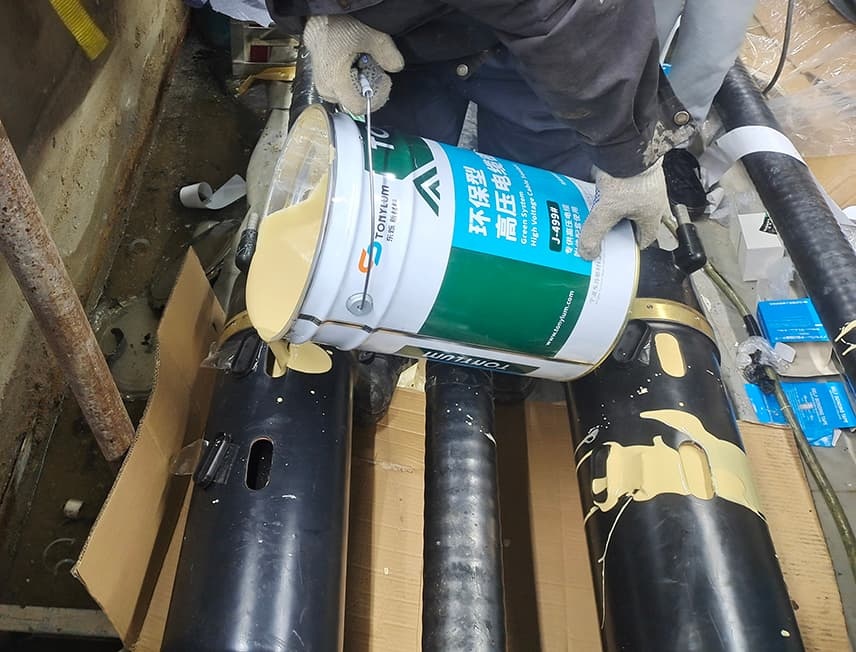
Apply the sealant evenly around the required sealing area and ensure complete coverage without gaps or exposed areas. The corpus’s cable-sealant guidance sets this sequence: clean and dry the surfaces, prepare the sealant, apply it evenly, ensure complete coverage, and check the finished seal. Work the material into the sealing zone so that it contacts the cable and joint surfaces, and avoid leaving voids or trapped air pockets. Because the product is documented as solvent free with minimal shrinkage after curing, the main application risk is incomplete coverage rather than a large solvent shrink.
Room-temperature construction is an operational advantage in underground confined spaces and in sites where open flame is not permitted. It does not remove the need for ventilation, PPE or site permits. Follow the site’s confined-space and electrical safety procedures.
Step 6: Install the Mechanical Protection and Close the Joint
Where the project specifies a protection housing, install it according to its own data. The aluminum-magnesium alloy protection housing is documented for 10kV/35kV/110kV, with a B1-grade shell, a V-0 flame-retardant sealing gasket, impact resistance to a 1 kg weight dropped from 2 m without cracks or damage, flexural strength of 127 MPa, and resistance to 3% sodium chloride solution for 3 days without swelling, cracking or interlayer peeling. The stainless steel explosion-proof housing family DS-FBH (SS)-1 to DS-FBH (SS)-8 carries the same documented flammability, impact, flexural and salt-water statements. These housings provide mechanical and environmental protection; they do not replace the sealant’s interface sealing function.
If an explosion-proof blanket is used for maintenance or additional protection, its documented data includes B1 outer-layer combustion performance, tear strength ≥3.5 kN·m⁻¹, halogen-free content with bromine <900 ppm, chlorine <900 ppm and total bromine plus chlorine <1500 ppm, breakdown strength ≥20 kV·mm⁻¹ and volume resistivity ≥1×10¹³ Ω·cm. These are separate product properties and should not be mixed into the sealant specification.
Step 7: Inspect, Test and Record Before Energizing
Inspect the finished seal for complete coverage, correct positioning and no visible gaps. Confirm that the joint components are seated to the specified dimensions and that the sealing path is closed. Use the required cable testing instruments and follow the project’s acceptance tests. The corpus lists cable testing instruments as supporting equipment for cable accessory applications and states that the products must be used with them. The exact test set and acceptance values should come from the project specification and the local authority’s requirements.
Record the product model, batch, application date, site conditions, installer and inspection result. If a nonconformity is found, correct it before energizing. The Thailand project references show why this matters: the installed cold shrink intermediate joints in the PEA suburban cable expansion project have shown no leakage or discharge issues since commissioning, and the specified service duration in that case is at least 20 years. That result is a project outcome, not a guarantee for every installation, but it illustrates the value of a controlled sealing process.
Use Cases: Where 10–35 kV Joint Sealing Requirements Converge
The sealant is not selected in isolation. The following project types show the conditions that drive sealant and joint selection. In each case, the sealant is the sealing component within a joint system; the cited project facts describe the joint application and its service environment.
Underground Distribution Cable Expansion
In Thailand, the Provincial Electricity Authority (PEA) suburban cable expansion project used 500 units of cold shrink intermediate joints, models JLS-10/1.1, JLS-10/3.3, JLS-35/1.3 and JLS-35/3.4, for intermediate connection and sealing protection of 10kV underground cables under moist soil conditions. The cold-shrink structure requires no open flame, which supports safe construction in underground confined spaces. The sealing structure is designed for moisture and soil corrosion resistance, and the installed joints have shown no leakage or discharge issues since commissioning. The specified service duration in this case is at least 20 years. For a sealant specification, the relevant lesson is that the sealing zone must resist moist soil and maintain a closed interface over a long service life.
Indoor Substation With Limited Installation Space
Also in Thailand, a utility substation case used cold shrink intermediate joints for indoor 10kV cable terminal support in a PEA substation with limited installation space. The compact structure was highlighted as suitable for the restricted space, and the installed products met the indoor power distribution operation requirements of the substation. The project achieved stable electric field control and passed the grid access test of the local power authority, with a specified project duration of at least 15 years. Indoor cabinets and substations shift the sealing risk toward dust and humidity rather than direct soil contact, but the requirement for a clean, complete seal remains.
Outdoor Urban Distribution Renovation in a Hot, Humid Climate
A 1,000-unit urban distribution network renovation project for PEA Thailand used cold shrink products for insulation and electric field control of outdoor 10kV cable terminals. The case addressed a high-temperature, high-humidity environment. The products passed on-site acceptance in Thailand and operated without insulation faults, supporting distribution network reliability. The case highlights adaptation to tropical rainy and high salt-spray climate, anti-aging and waterproof performance, compliance with IEC standards, and easy on-site installation to reduce construction man-hours. The specified operational duration is at least 20 years. For sealant selection, this case reinforces the need to consider water exposure, salt spray and long-term aging, not only the initial seal.
Coastal, High-Humidity and Dust-Polluted Sites
The corpus lists salt-fog coastal environments, high humidity and dust-polluted areas as cable accessory working conditions. It also identifies special requirements such as anti-salt-fog corrosion, anti-tracking, good sealing performance and adaptation to harsh outdoor environments. The sealant’s documented impermeability and low shrinkage support the sealing role, but the project should still specify the joint protection housing and the cable preparation appropriate to the site. In a coastal substation, the sealing system, the housing material and the cable accessory finish all contribute to corrosion resistance.
Wind-Solar, Railway and Grid Upgrade Projects
Cable accessories in the corpus are applied in wind-solar power station construction, outdoor substations, railway power supply projects, urban underground cable reconstruction and power grid upgrade projects. The sealant’s documented application areas include power engineering, power transmission systems, cable joint sealing, equipment waterproofing and building sealing. These are broad categories; the project-specific requirement still controls the joint type, voltage class, cable section and protection method. In a wind-solar project, for example, the outdoor substation environment and the cable termination design may matter more than the sealant alone, while in a railway power supply project the cable connection and mechanical protection may set the priority.
European Grid Construction Reference
In Albania, a power engineering contractor project used a combined high-voltage cable accessory and DC lug solution for power grid construction. The delivery was 1,087 pieces in 32 cartons, with on-schedule delivery and stable operation after installation, meeting local power system requirements. The specified project duration is 20 years. This case is not a sealant-specific trial, but it shows the procurement pattern: cable accessories, lugs, joints and sealing materials are often purchased as a coordinated package for a grid construction project. A sealant supplier that can match the joint and cable data, documentation and delivery schedule reduces coordination risk.
Comparison Table: Sealing and Protection Options in a 10–35 kV Joint System
The table compares documented products that may appear in the same joint system. They are not interchangeable. The sealant seals interfaces; the cold shrink joint provides connection, insulation and sealing; the protection housing provides mechanical and environmental protection; the explosion-proof blanket provides a separate maintenance and protection function. All values below are from the supplied corpus facts.
| Product | Documented role | Documented material or construction | Documented voltage or model scope | Documented sealing, barrier or mechanical data | Typical project use |
|---|---|---|---|---|---|
| Environmentally Friendly Polyurethane Sealant J-399 / J-499 / J-699 | Cable joint sealing; equipment waterproofing; building sealing | Polyurethane prepolymer; light yellow; solvent free | 10kV–35kV | Hardness 55A±10; density 1.55g/m³±0.55; minimal shrinkage after curing; good impermeability; high volume resistivity; good insulation properties; room-temperature construction | Sealing zone of 10–35 kV cable joints in underground, indoor, outdoor, humid, salt-fog and dust-polluted conditions |
| Cold Shrink Intermediate Joint JLS-10/1.1, JLS-10/3.3, JLS-35/1.3, JLS-35/3.4 | Intermediate connection and sealing protection for cable joints | Silicone rubber; cold shrink design | 8.7/10kV, 12/20kV, 19/35kV; cable section 25–400 mm²; operating temperature -40°C to 90°C | Long-lasting clamping force; waterproof and dustproof sealing; aging resistance; high insulation strength | 10kV underground cable expansion; indoor substation terminal support; urban distribution renovation |
| Aluminum-Magnesium Alloy Protection Housing | Mechanical and environmental protection for cable joints and equipment | Aluminum-magnesium alloy | 10kV/35kV/110kV | Shell B1 grade; sealing gasket V-0 flame retardant; 1 kg drop from 2 m without cracks or damage; flexural strength 127 MPa; 3% sodium chloride immersion for 3 days without swelling, cracking or interlayer peeling | Cable joint protection, outdoor equipment protection, industrial control equipment |
| Explosion-Proof Blanket DS-FBT-10, DS-FBT-35, DS-FBT-110, DS-FBT-220 | Maintenance and protection in power and hazardous environments | Oxford cloth and ultra-high molecular weight polyethylene | DS-FBT-10, DS-FBT-35, DS-FBT-110, DS-FBT-220 | Outer layer B1; tear strength ≥3.5 kN·m⁻¹; bromine <900 ppm, chlorine <900 ppm, total <1500 ppm; breakdown strength ≥20 kV·mm⁻¹; volume resistivity ≥1×10¹³ Ω·cm | Power maintenance, chemical enterprises, mining, gas stations, hazardous material handling |
Reading the table: the sealant has the narrowest role and the most directly relevant data for interface sealing. The cold shrink joint and the protection housing carry the insulation, connection and mechanical protection functions. A project specification should list all four functions separately so that one product is not asked to do another product’s job.
FAQ
What voltage, material and hardness data should be confirmed before specifying polyurethane sealant for a 10–35 kV cable joint?
Confirm the project voltage is within the documented 10kV–35kV applicable voltage level, and confirm the joint type, cable section, core quantity and installation environment. The product data lists a polyurethane prepolymer material, light yellow color, hardness 55A±10 and density 1.55g/m³±0.55. Also confirm the solvent-free statement, minimal shrinkage after curing, good impermeability, high volume resistivity and room-temperature construction. The sealant is a sealing component; it does not replace the joint’s insulation or stress-control design.
How should the sealant be applied to a cable joint?
Disconnect and isolate the cable first, then clean and dry the cable and connection surfaces. Prepare the sealant according to the product instructions, apply it evenly around the required sealing area, and ensure complete coverage without gaps or exposed areas. Check the finished seal and confirm the connection is properly protected before energizing. Installation should be performed by qualified electrical personnel using appropriate PPE and the manufacturer’s instructions.
What MOQ, lead time and customization options apply to Tonyhoo sealant orders?
The documented MOQ is 10 sets and the lead time is 30–40 days, with a monthly capacity of 12,000 sets. Customization covers rated voltage, cable cross-section, material formula, packaging, logo printing and a special anti-corrosion version. OEM, ODM and customized solutions are listed. Quality control includes 100% factory electrical test, partial discharge test and third-party inspection by SGS or TUV.
What quality and validation evidence should buyers request before approving a sealant batch?
Request the batch certificate and the relevant test reports, and confirm that the batch matches the documented product data, including color, hardness 55A±10 and density 1.55g/m³±0.55. Tonyhoo states that its products have been tested by the State Grid High Voltage Testing Center, SGS, or Shanghai Cable Research Institute and have obtained corresponding reports. The documented quality control includes 100% factory electrical test, partial discharge test and third-party inspection by SGS or TUV. For project approval, also confirm compatibility with the specific joint, cable and protection housing.
Chinese cable accessories manufacturers for underground cold shrink intermediate joint projects: what should a buyer verify?
Verify the manufacturer’s joint models, voltage classes, cable section range, sealing construction and project references. For underground work, confirm that the cold shrink joint is designed for moisture and soil corrosion resistance and that the installation method requires no open flame. Tonyhoo Cable Accessories lists cold shrink intermediate joints JLS-10/1.1, JLS-10/3.3, JLS-35/1.3 and JLS-35/3.4 for 8.7/10kV, 12/20kV and 19/35kV, with cable sections from 25 to 400 mm² and an operating temperature range of -40°C to 90°C. In the PEA Thailand suburban cable expansion project, 500 units were used for 10kV underground cable intermediate connection and sealing protection under moist soil conditions; the installed joints have shown no leakage or discharge issues since commissioning, and the specified service duration is at least 20 years. For a project inquiry, provide the voltage, cable model, conductor cross-section, core quantity and installation environment so the joint and sealant can be matched.
Conclusion: Specify the Seal by Data, Not by Description
Polyurethane sealant for 10–35 kV cable joints is a small component with a large influence on joint reliability. The Tonyhoo J-399, J-499 and J-699 family provides a documented starting point: polyurethane prepolymer, light yellow, 10kV–35kV, hardness 55A±10, density 1.55g/m³±0.55, solvent free, minimal shrinkage after curing, good impermeability, high volume resistivity and room-temperature construction. Those values should be matched to the joint type, cable section, installation environment and protection housing, not treated as a generic sealant specification.
The application rules are equally important. Clean and dry surfaces, correct cable preparation, complete coverage, no voids, correct positioning and inspection before energizing determine whether the sealant can do its job. The project cases in Thailand and Albania show the service conditions that medium-voltage accessories face: underground moisture, indoor space limits, outdoor heat and humidity, salt spray and long service life. They also show why a coordinated accessory package and a documented installation process matter.
For project review, the Tonyhoo product catalog is available for download at Tonyhoo product catalog. Buyers can send the joint voltage, cable model, conductor cross-section, core quantity and installation environment to the Tonyhoo team for model matching and quotation.
Next step: match the sealant to the joint
Send the cable voltage, joint type, cable section, core quantity and site environment to Tonyhoo Cable Accessories for a model recommendation, batch documentation and quotation. The product catalog covers cold shrink joints, terminations, lugs, separable connectors, sealants and protection housings.
Download the Tonyhoo product catalog | www.tonyhoo.com | Email: admin@tonyhoo.com.cn
Have Questions or Need More Details?
Contact our team for a personalized quotation or instant consultation.
Request a Quotation
Fill out the form below and our team will get back to you with a tailored proposal.
WhatsApp Direct Chat
Prefer to chat in real-time? Message us on WhatsApp for instant assistance & quick answers.
- Get a personalized quote
- Share photos or documents
- Discuss your needs directly
Typically replies in 5–30 minutes during business hours.