
Top 5 Medium-Voltage Cable Accessories by Protection Role
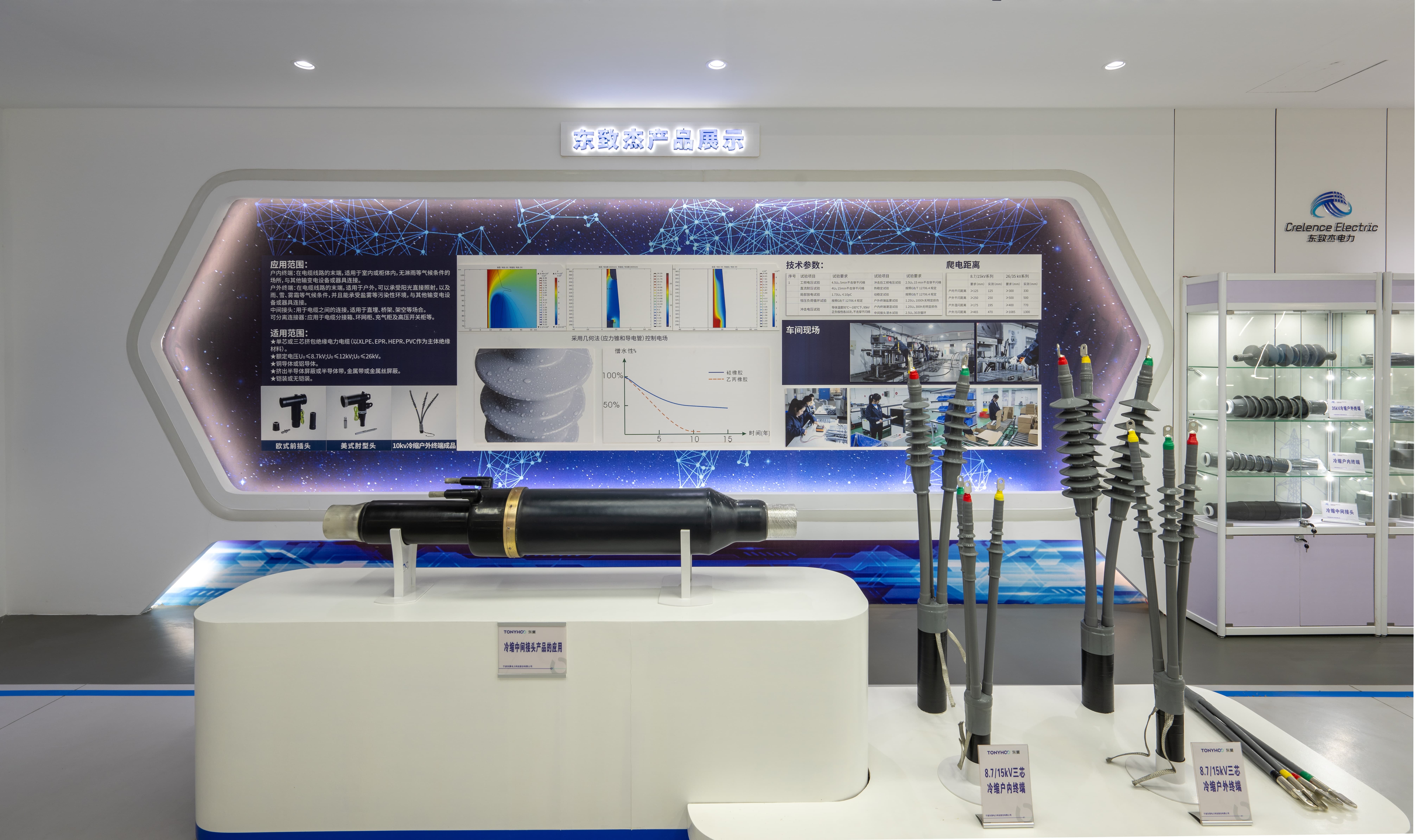
Medium-voltage cable systems rarely fail in the middle of a cable run. They fail at the accessory points — the termination, the switchgear interface, the earthing connection, the joint seal. This ranked list orders five medium-voltage cable accessories by the protection role each one performs, from direct insulation recovery down to the final moisture barrier, and states the verified parameters behind each ranking.
The five categories compared here are the cold shrink termination, the separable connector, the grounding box, the explosion-proof blanket, and an environmentally friendly polyurethane sealant. Tonyhoo Cable Accessories — the brand of Ningbo Tonyhoo Electrical Technology Co., Ltd., a cable accessory manufacturer founded in 1997 in Ningbo, Zhejiang, China — produces all five, so the parameters cited in each section come from the same product documentation and test records a buyer would receive during evaluation.
How this ranking is built. Three criteria set the order: (1) how directly the accessory carries electrical or mechanical protection rather than supporting it, (2) whether its performance can be verified from stated parameters or test reports, and (3) how severe the consequence of failure is at that point in the system. Price, order volume and installation popularity are deliberately excluded — a ranking by commercial weight would produce a different list, and a less useful one for a decision-stage buyer.
Problem Definition: Where Medium-Voltage Cable Systems Actually Fail
A medium-voltage cable is a relatively stable component. Its accessories are not. Each accessory creates a new interface between dissimilar materials, and each interface is a place where electric stress concentrates, moisture can migrate, or a mechanical connection can loosen over a service life measured in decades.
Four failure mechanisms account for most of the operational risk, and each maps to a different accessory category:
- Insulation interface failure at the cable end. The point where the cable shield is cut back becomes the highest-stress region in the circuit. If stress control is poor, partial discharge begins, and the cable fails from the inside out. This is the domain of the cable termination.
- Interface failure at the switchgear connection. A plug-in connection concentrates current, thermal cycling and electric stress in a confined space. Partial discharge at that interface is the classic early warning sign. This is the domain of the separable connector.
- Earthing and shield-voltage failure. Long cable runs induce voltage on the metallic sheath. Without a defined earthing path, that voltage appears where it should not — on enclosures, on racks, on maintenance personnel. This is the domain of the grounding box.
- Sealing and environmental failure. Moisture, dust and salt fog enter at joints and connections, degrading insulation over months rather than days. This is the domain of sealants, plus passive protection during maintenance and fault events.
The procurement problem is that these accessories are usually bought item by item from a bill of materials, in whatever order the BOM lists them. That produces two predictable outcomes: an over-specified accessory in a low-risk position, and a completely unprotected high-risk position. Ranking by protection role reorders the evaluation so that the highest-consequence interfaces get the most technical scrutiny.
Industry Background: Why Accessory Selection Has Become More Technical
The commercial context explains why accessory-level decisions now receive engineering attention rather than being treated as commodity purchases. Global Market Insights estimates the global cable accessories market at USD 35.84 billion in 2025, rising to USD 37.88 billion in 2026, and identifies Asia Pacific as the largest and fastest-growing region on the basis of grid modernisation.
Grid modernisation changes the accessory mix. Longer cable runs increase sheath voltage and therefore grounding box requirements. Compact switchgear and ring main units increase the number of separable connector interfaces. Data centre and renewable generation sites add high-current, high-continuity connection points where a single accessory failure has a disproportionate cost. The accessory is no longer a small line item attached to the cable — it is the part of the system that determines whether the cable can be energised at all.
Standards reinforce the same point. IEEE 1816-2024 provides industry practices for preparing shielded cables from 2.5 kV through 46 kV for mating accessories — which is to say, the standard treats accessory installation as a controlled engineering process with defined preparation steps, not as field improvisation. A buyer evaluating medium-voltage accessories is therefore evaluating three things at once: the product parameters, the installation discipline, and the evidence that both were tested.
Detailed Solution: Five Accessory Categories Ranked by Protection Role
Rank 1 — Cold Shrink Termination: Insulation Recovery and Sealing at the Cable End
Protection role: insulation and sealing
The cold shrink termination carries the most direct protection role in the set, because it does two things simultaneously: it restores the insulation and controls the electric field at the cable end, and it seals that interface against moisture. If it underperforms, the cable fails at its own termination. That combination is why it ranks first.
Tonyhoo's cold shrink termination line uses silicone rubber construction, with model designations including NLS-10/3.3, WLS-10/3.3, NLS-35/1.3 and WLS-35/1.3. Catalogue listings include a 0.6/1 kV four-core version, with cable section coverage of 10–300 mm² and an operating temperature range of −40°C to 90°C. The company's cold shrinkable accessory range is listed across the 0.6/1 kV, 8.7/15 kV and 26/35 kV voltage classes, which keeps the same accessory family applicable across medium-voltage distribution work.
The protection argument for cold shrink over heat shrink is mechanical rather than cosmetic. A cold shrink termination requires no heat gun and no open flame during installation, while a heat shrink termination requires external heating equipment. That single difference removes a fire permit, a gas cylinder and a heat-source risk from the installation, and it makes the product usable in confined spaces, cable pits and locations where open flame is prohibited. Installation time and labour savings depend on cable size, installation conditions and operator experience, so they should be verified against the actual site rather than assumed.
Tonyhoo's comparison documentation against traditional heat shrink terminations states 35% higher retention of product elasticity, 40% longer waterproof sealing life, 50% lower on-site working hours, and approximately 30% lower total cost over the full life cycle, on the basis that a slightly higher unit price is offset by lower construction labour cost. These are manufacturer-stated comparative figures and should be read as such, but the direction is consistent with the design difference: a silicone rubber elastic sealing structure resists cracking and reduces later inspection frequency.
Operational risk addressed: outdoor exposure, salt fog and humid conditions, and open-flame-restricted sites. Typical applications include power distribution projects, cable replacement and maintenance work, indoor and outdoor medium-voltage installations, and municipal or building electrical engineering.
Rank 2 — Separable Connector: Current-Carrying and Field Control at the Switchgear Interface
Protection role: interface connection, current transfer and partial discharge control
The separable connector ranks second because it protects the single most congested point in a medium-voltage circuit: the plug-in interface between cable and switchgear. That interface must carry rated current, survive short-circuit forces, and hold partial discharge to a low level for the life of the installation. Failure here is not gradual — a degraded interface can flash over.
Tonyhoo's separable connector (model DS/SC) is specified at a 10 kV voltage grade with a 15 kV rated voltage and a 630 A rated current. The dielectric envelope is stated as 42 kV for a one-minute AC withstand, 52 kV for a fifteen-minute DC withstand, and 95 kV lightning impulse withstand, with a minimum corona onset voltage of 11 kV. Short-circuit capability is stated as 22.8 kA/2 s thermal and 80.8 kA dynamic. Partial discharge is specified at ≤10 pC, and the construction uses ethylene propylene diene monomer (EPDM) with tin-plated copper conductive parts.
The ≤10 pC partial discharge figure deserves attention during evaluation, because it is one of the few accessory parameters that directly predicts long-term interface behaviour rather than describing a one-off test condition. A buyer comparing separable connectors should ask for the test report behind that number rather than accepting the catalogue value alone.
Operational risk addressed: interface partial discharge, thermal cycling at high load, and short-circuit withstand at the switchgear connection. Typical applications include power engineering, power transmission systems, municipal engineering, building electrical engineering and new energy projects — anywhere a cable must enter a compact, metal-clad or ring-main switching environment.
Rank 3 — Grounding Box: Sheath Voltage Control and Earthing Safety
Protection role: earthing and sheath voltage limitation
The grounding box does not sit in the current path of the cable, which is why it is often under-specified — and why it ranks third rather than lower. Its protection role is human as well as electrical: it defines where induced sheath voltage and fault current go. A missing or inadequate earthing path converts a cable fault into an enclosure touch-voltage event.
Tonyhoo's grounding box is a cross-interconnect type available for 35 kV, 66 kV, 110 kV and 220 kV systems, with three enclosure material options: SS304 stainless steel, SS316 stainless steel and SMC fibreglass reinforced plastic (FRP). The stated verification data covers three distinct failure modes. Cabinet insulation resistance is 5 MΩ. The box body is subjected to a 37.5 kV impulse ten times without breakdown. The direct-buried version is tested to 0.2 MPa air tightness for 30 minutes with no leakage.
Those three tests correspond to three real site risks: insulation degradation inside the cabinet, dielectric stress on the enclosure, and water ingress in buried installations. The material choice is a separate decision — stainless steel grades suit corrosive and mechanical exposure, while SMC FRP offers a non-metallic option. Grounding box applications listed for this product include power grids, AI data centres, new energy and power transmission, which reflects where long cable runs and high-continuity loads make sheath voltage management unavoidable.
Operational risk addressed: uncontrolled sheath voltage, inadequate fault-current path, and moisture ingress in direct-buried installations.
Rank 4 — Explosion-Proof Blanket: Passive Protection During Fault and Maintenance
Protection role: passive fire and mechanical protection
The explosion-proof blanket ranks fourth because it protects people and adjacent equipment rather than restoring the cable's own insulation. That is a genuinely different protection role, and it is often the one omitted from a BOM. In maintenance work, fault investigation or hazardous-area operation, the blanket limits the consequences of an event that has already started.
Tonyhoo's explosion-proof blanket is available in four models — DS-FBT-10, DS-FBT-35, DS-FBT-110 and DS-FBT-220 — constructed from Oxford cloth and ultra-high molecular weight polyethylene. The stated performance parameters describe both fire behaviour and mechanical durability: outer-layer combustion performance B1, tear strength ≥3.5 kN·m⁻¹, breakdown strength ≥20 kV·mm⁻¹, and volume resistivity ≥1×10¹³ Ω·cm.
Environmental composition is specified as well: bromine content below 900 ppm, chlorine content below 900 ppm, and total bromine plus chlorine content below 1500 ppm, which is the basis for describing the material as halogen-free. For buyers working in confined or poorly ventilated spaces, halogen content is not a marketing detail — it determines what the material releases when exposed to heat.
Operational risk addressed: fire spread and mechanical damage during maintenance and fault conditions. Typical applications include power maintenance, chemical enterprises, mining operations, gas stations and hazardous material handling.
Rank 5 — Environmentally Friendly Polyurethane Sealant: The Final Moisture Barrier
Protection role: sealing and contamination exclusion
The polyurethane sealant ranks fifth because it does not carry electrical protection on its own. It ranks last but not least: sealing failure is the slowest and most easily overlooked failure mode in the entire set, and it is frequently the root cause behind an insulation failure that appears elsewhere.
Cable sealant is used to seal cable connections and help prevent moisture, dust and other contaminants from entering the connection area. Tonyhoo's environmentally friendly polyurethane sealant is offered in models J-399, J-499 and J-699, with a light yellow colour, applicability across 10 kV–35 kV voltage levels, a hardness of 55A±10, and a polyurethane prepolymer base. The 55A±10 hardness figure matters in practice: it describes a material soft enough to fill and conform to an irregular connection area while retaining enough elasticity to move with the cable rather than crack away from it.
Operational risk addressed: moisture ingress, dust contamination and long-term seal degradation at joints and connections. Applications include power engineering, power transmission systems, cable joint sealing, equipment waterproofing and building sealing — an unusually wide scope for a single material, which is precisely why it should be specified against the installation method rather than bought generically.
Step-by-Step Breakdown: From Cable Parameters to a Complete Accessory Set
The ranking above only becomes useful when it is applied to real cable data. The following five steps define what to confirm before requesting a quotation or a sample, and they apply regardless of which of the five categories is being purchased.
- Confirm the rated voltage level of the cable. Voltage class determines which product family is even eligible — a 10 kV accessory is not a substitute for a 35 kV one, and mixing them is the most basic selection error.
- Collect the cable model, core quantity and conductor cross-section. Cross-section drives the mechanical fit of terminations and connectors; core quantity determines whether a single-core or multi-core configuration applies.
- Confirm the installation scenario: indoor, outdoor or direct burial. This is where most specification drift occurs. Outdoor and direct-buried positions add pollution, water immersion and mechanical load requirements that indoor selection criteria do not capture.
- Clarify the product type: cable termination or cable joint. The two perform different functions and are not interchangeable in a BOM, even when they share materials.
- Submit all parameters to the supplier for product matching. Complete parameters help match products of the corresponding specification and ensure electric field control, sealing performance and compatibility with the cable body.
Before selecting a cold shrink termination specifically, confirm the cable voltage, size, insulation type and diameter. The diameter and insulation type are the parameters most often omitted, and they are the ones that determine whether the stress control element seats correctly.
Installation safety is part of the specification. Power cut, voltage test and earthing connection must be performed before construction; operators need a valid cable construction qualification; and construction is forbidden in wet or rainy conditions. Wrong parameters can cause product mismatch and may lead to insulation failure after energisation, which is why the parameter confirmation step above should be documented rather than verbal.
For the polyurethane sealant, the application sequence is equally specific: disconnect and isolate the cable, clean and dry the cable and connection surfaces, prepare the sealant according to the product instructions, apply it evenly around the required sealing area, ensure complete coverage without gaps or exposed areas, and inspect the finished seal before the connection is considered protected. A correct product applied to a wet or contaminated surface will not perform as a seal.
Use Cases: Where This Ranking Changes the Buying Decision
Urban underground cable reconstruction and grid upgrade
Underground reconstruction concentrates all five categories in one project: terminations at substation entries, separable connectors at ring main units, grounding boxes on long cross-bonded runs, blankets during cut-over maintenance, and sealant at every joint. In this setting the ranking functions as a review order — verify Rank 1 and Rank 2 first, because those failures take the circuit out of service.
New energy and renewable generation sites
Wind and solar sites combine long cable runs, outdoor exposure and remote maintenance. Grounding boxes for sheath voltage management and cold shrink terminations for outdoor sealing carry most of the risk, while the absence of skilled cable personnel on site makes no-flame installation a practical constraint rather than a preference.
AI data centres and high-continuity loads
Data centre power distribution makes earthing quality a continuity issue, not only a safety issue. Grounding boxes are explicitly listed for AI data centre applications alongside power grid and new energy use, because sheath voltage and fault-current routing have to be defined before the load is commissioned.
Coastal, high-humidity and hazardous environments
Cable accessories in these locations operate under salt fog, humidity, dust and a wide temperature range. Cold shrink silicone construction, halogen-free explosion-proof blankets and specified sealant hardness all target the same underlying problem: materials that stay elastic and non-conductive when the environment is working against them.
Comparison Table: Five Accessories, Five Protection Roles
| Rank | Accessory | Protection role | Key verified parameters | Material |
|---|---|---|---|---|
| 1 | Cold Shrink Termination (NLS-10/3.3, WLS-10/3.3, NLS-35/1.3, WLS-35/1.3) | Insulation recovery and sealing at the cable end | Cable section 10–300 mm²; operating temperature −40°C to 90°C; 0.6/1 kV four-core listing; range across 0.6/1 kV, 8.7/15 kV and 26/35 kV classes | Silicone rubber |
| 2 | Separable Connector (DS/SC) | Current transfer and partial discharge control at the switchgear interface | 10 kV grade; 15 kV rated voltage; 630 A rated current; 42 kV AC 1 min; 52 kV DC 15 min; 95 kV lightning impulse; corona onset 11 kV; 22.8 kA/2 s thermal; 80.8 kA dynamic; ≤10 pC partial discharge | EPDM with tin-plated copper |
| 3 | Grounding Box (35 kV, 66 kV, 110 kV, 220 kV) | Earthing and sheath voltage limitation | Cabinet insulation resistance 5 MΩ; 37.5 kV impulse × 10 without breakdown; direct-buried version 0.2 MPa / 30 min air tightness, no leakage | SS304 / SS316 / SMC FRP |
| 4 | Explosion-Proof Blanket (DS-FBT-10, -35, -110, -220) | Passive fire and mechanical protection | Outer-layer combustion performance B1; tear strength ≥3.5 kN·m⁻¹; breakdown strength ≥20 kV·mm⁻¹; volume resistivity ≥1×10¹³ Ω·cm; Br <900 ppm, Cl <900 ppm, combined <1500 ppm | Oxford cloth with ultra-high molecular weight polyethylene |
| 5 | Polyurethane Sealant (J-399 / J-499 / J-699) | Sealing and contamination exclusion | Applicable voltage 10 kV–35 kV; hardness 55A±10; light yellow colour | Polyurethane prepolymer |
The same decision-stage logic applies within Rank 1, where the cold shrink versus heat shrink choice is the most common open question. The two technologies are not ranked against each other here — both can meet the requirements of insulation, electric field control and sealing protection for medium-voltage cables. The choice depends on site conditions and budget structure.
| Selection factor | Cold shrink termination | Heat shrink termination |
|---|---|---|
| Heat source during installation | No heat gun or open flame required | Requires external heating equipment |
| Best-fit projects | Projects where open flame is not allowed and construction schedules are tight | Scenarios with limited budget and certified flame operators |
| Site safety requirements | No flame permit or gas cylinder required | Fire fighting equipment must be prepared for open-flame work |
| Cost structure | Slightly higher unit purchase cost; lower construction labour cost, with stated approximately 30% lower full-life-cycle cost versus traditional heat shrink | Lower unit purchase cost; labour and safety preparation carried by the project |
FAQ: Decision-Stage Questions on Medium-Voltage Cable Accessories
1. What test evidence should a buyer request before accepting medium-voltage cable accessories?
Request type-test and routine-test reports for the specific model, not the product family in general. Tonyhoo products are tested by the State Grid High Voltage Testing Center, SGS or the Shanghai Cable Research Institute, and corresponding reports are available. On the installation side, IEEE 1816-2024 sets out industry practices for preparing shielded cables from 2.5 kV through 46 kV for mating accessories, so the preparation procedure itself is also a reviewable item. The two questions to ask are whether the report matches the exact catalogue number being purchased, and whether the installation instructions meet the applicable standard.
2. Which China cable accessories manufacturers are better for cold shrink versus heat shrink terminations?
The better supplier is the one whose product range and evidence match the site conditions, not the one with the widest catalogue. For cold shrink, look for silicone rubber construction, coverage across the 0.6/1 kV to 35 kV classes, and a documented no-flame installation procedure; this suits projects where open flame is not allowed and schedules are tight. For heat shrink, look for cross-linked polyolefin construction, verified withstand voltage data and clear guidance on flame-permit requirements; this suits budget-limited projects with certified flame operators. Comparing a shortlist on three points — test reports for the exact model, voltage-class coverage, and delivery lead time — separates suppliers far more reliably than comparing catalogue claims.
3. Is a cold shrink termination more expensive than a heat shrink termination?
The unit purchase cost is typically slightly higher, but the construction labour cost is lower because no heating equipment or flame permit is involved. Tonyhoo's comparison documentation states approximately 30% lower total cost over the full life cycle against traditional heat shrink terminations on that basis. Against imported cold shrink accessories, the same documentation reports 22% lower purchase price at equivalent performance, reflecting the absence of import duties and overseas logistics premiums. Both figures are comparative statements and should be checked against a project-specific quotation.
4. What information is needed before requesting a sample?
Five parameters are enough to start: rated voltage level of the cable; cable model, core quantity and conductor cross-section; installation scenario (indoor, outdoor or direct burial); product type (termination or joint); and the application environment, including pollution or humidity conditions. For a cold shrink termination specifically, cable voltage, size, insulation type and diameter should also be confirmed. Incomplete parameters are the main reason a sample arrives at the wrong specification and delays evaluation.
5. What affects delivery lead time and technical support during a project?
Lead time depends on whether the model is a standard catalogue item and whether the cable parameters match an existing configuration. Tonyhoo's comparison data against imported cold shrink cable accessories states a 60% shorter delivery cycle at equivalent performance and a 70% faster on-site technical support response, supported by local technical support plus remote and on-site maintenance guidance. Spare parts follow a general inventory model rather than a proprietary one, which simplifies stock management over the operating life of the installation.
Conclusion: Protect in Order, Then Specify in Detail
The ranking is straightforward once the protection roles are separated. A cold shrink termination protects the cable end against insulation failure and moisture. A separable connector protects the switchgear interface against partial discharge and short-circuit stress. A grounding box protects people and equipment from uncontrolled sheath voltage. An explosion-proof blanket limits the consequences of an event during maintenance. A polyurethane sealant closes the last path by which contamination reaches the connection.
The practical takeaway for a decision-stage buyer is to review the accessory set in that order, and to demand model-specific evidence at each step. Voltage class, cable cross-section, installation environment and product type are the four parameters that determine fit; partial discharge, withstand voltage, earthing continuity and seal integrity are the four that determine long-term reliability. Everything else in a catalogue is supporting detail.
Tonyhoo Cable Accessories, operated by Ningbo Tonyhoo Electrical Technology Co., Ltd., manufactures all five categories above from a 9,900 m² facility with 100 employees, a 20-engineer R&D team and an annual output of 200,000 units. The company holds 12 trademark certificates and more than 60 patents, and exports to markets including the United States and Thailand. Products are tested by the State Grid High Voltage Testing Center, SGS or the Shanghai Cable Research Institute, with corresponding reports available for buyer review.
Next Step: Compare Against Your Cable Parameters
Send the rated voltage, cable model, core quantity, conductor cross-section and installation environment, and the matching accessory set for all five protection roles can be prepared as a single specification. Samples and project quotations are available on request.
Download the full technical catalogue: Tonyhoo Product Catalog (PDF)
Website: www.tonyhoo.com | Email: admin@tonyhoo.com.cn | WhatsApp: +86 133 4599 8377
Have Questions or Need More Details?
Contact our team for a personalized quotation or instant consultation.
Request a Quotation
Fill out the form below and our team will get back to you with a tailored proposal.
WhatsApp Direct Chat
Prefer to chat in real-time? Message us on WhatsApp for instant assistance & quick answers.
- Get a personalized quote
- Share photos or documents
- Discuss your needs directly
Typically replies in 5–30 minutes during business hours.