From Claims to Proof: Evaluating Paper Cup Suppliers for Capability and Delivery Assurance
Paper cup suppliers rarely win or lose an order on unit price alone. They lose it at the moment a buyer asks for proof: a certificate with a defined scope, a delivery promise tied to a named starting event, an inspection record that travels with the container. This guide is written for importers, distributors, brand owners and procurement teams evaluating suppliers of disposable paper cups, and its purpose is deliberately narrow: to separate what a supplier claims from what a supplier can document.
Most supplier assessments concentrate on product data: cup format, paper weight, coating, printing method. Product data is necessary, but it is also the easiest information for any supplier to reproduce on a quotation. Capability and delivery assurance are harder to imitate, because they depend on equipment, process discipline and order management, all of which leave a trace if you know where to look.
The framework below has four parts: an evidence hierarchy that ranks document types by how much they are actually worth, a seven-step evaluation sequence, a set of order-management signals that predict delivery behaviour before the first container ships, and a contingency checklist covering the questions suppliers rarely volunteer to answer. Reference figures used as examples come from TopsPak, the paper cup and paper packaging brand of Wenzhou Baofeng Packaging Technology Co., Ltd., together with published third-party market sources.
Problem Definition: Where Supplier Claims Break Down
A paper cup specification is simple to describe and difficult to guarantee at volume. That gap is exactly where evaluation effort belongs.
Consider how claims arrive. A supplier states that it is certified; a buyer needs to know which certification, issued by which body, covering which product, valid until which date, and recognised in which export market. A supplier states that it has large capacity; a buyer needs a number with a unit and a period attached. A supplier states that it has fast lead time; a buyer needs the event that starts the clock, whether that is the purchase order, the artwork approval or the pre-production sample confirmation. A supplier states that it is fully customisable; a buyer needs the minimum order quantity, the list of customisable variables and the printing method involved.
In most cases these are not deliberate misstatements; they are shortcuts. The evaluation task is to convert each shortcut into a verifiable item, or to discount it. Four claim types cause the most damage in disposable paper cup sourcing:
- Compliance claims without scope. A logo on a homepage is not a certificate. Buyers need the certificate number, the issuing authority, the product scope and the validity window. Market labelling rules add a second layer: the EU Single-Use Plastics Directive 2019/904 requires labelling for paper cups containing plastic, including PE and PLA coatings, so an environmental claim is unusable until the coating type is disclosed.
- Capacity claims without units. Capacity expressed only in money, or in adjectives, tells a buyer nothing about whether a peak-season order can be absorbed alongside existing contracts.
- Delivery claims without a starting event. A 25-day lead time measured from purchase order and a 25-day lead time measured from pre-production sample approval are two different promises once a custom print job is involved.
- Customisation claims without commercial limits. Logo printing, size shaping and coating selection all carry minimum quantities, artwork requirements and sample cycles that must be stated before pricing is meaningful.
Accepting these shortcuts has a cost that appears later in the process: a shipment held at the port for missing food-contact documentation, a printed run that misses a seasonal launch window, or a café chain that runs short of 12oz hot cups during its busiest hours. None of these failures are caused by price. They are caused by a claim that was never converted into evidence.
Industry Background: A Fragmented Market With Uneven Documentation
The paper cup market is large enough to attract serious capital, and fragmented enough that documentation quality varies widely between suppliers. Fortune Business Insights estimates the global paper cups market at USD 11.35 billion in 2025, growing to USD 13.98 billion by 2034. That headline number is also a lesson in verification: Precedence Research estimates USD 8.06 billion for the same 2025 market. The divergence reflects methodology and segmentation choices, such as whether lids are included. When market-level figures differ by that margin, supplier-level figures deserve comparable scepticism.
Two structural facts shape what buyers should look for. First, demand is concentrated in hot beverage service: IMARC Group reports that hot paper cups accounted for approximately 62.4% of global market share in 2025, driven by the expansion of quick-service restaurants. Second, supply is concentrated at the top and dispersed below it: Huhtamäki Oyj, Dart Container Corporation and Graphic Packaging International are identified by Fortune Business Insights as top global competitors with a combined market share of approximately 32%. The remainder of the market is served by a long tail of manufacturers whose certificates, equipment and order processes are far less uniform.
China sits at the centre of that supply base. OEC data shows China's export value for paper goods, including trays and cups, reached approximately USD 1.98 billion in 2024, with the United States as the top destination. Regulatory expectations travel with those exports. Paper cups entering the United States must comply with FDA food contact regulations, including safety assessments for the migration of substances from coatings. Within the EU, the Single-Use Plastics Directive 2019/904 adds labelling obligations and separate collection targets for cups containing plastic. Meanwhile, compostable paper cups using plant-based PLA linings continue to grow faster than traditional PE-lined cups, according to Mordor Intelligence.
For a buyer in the evaluation stage, the practical conclusion is straightforward. In a market this fragmented, where compliance obligations differ by destination and where material choices are shifting, proof is the mechanism that produces a defensible shortlist. Ranking suppliers by the strength of their documentation is more reliable than ranking them by the confidence of their sales language.
The Solution: Rank the Evidence, Not the Promises
A workable paper cup supplier evaluation ranks the types of evidence a supplier can produce. Four tiers cover almost everything a buyer will encounter.
Tier 1 — Independently issued documents with a scope and a validity date
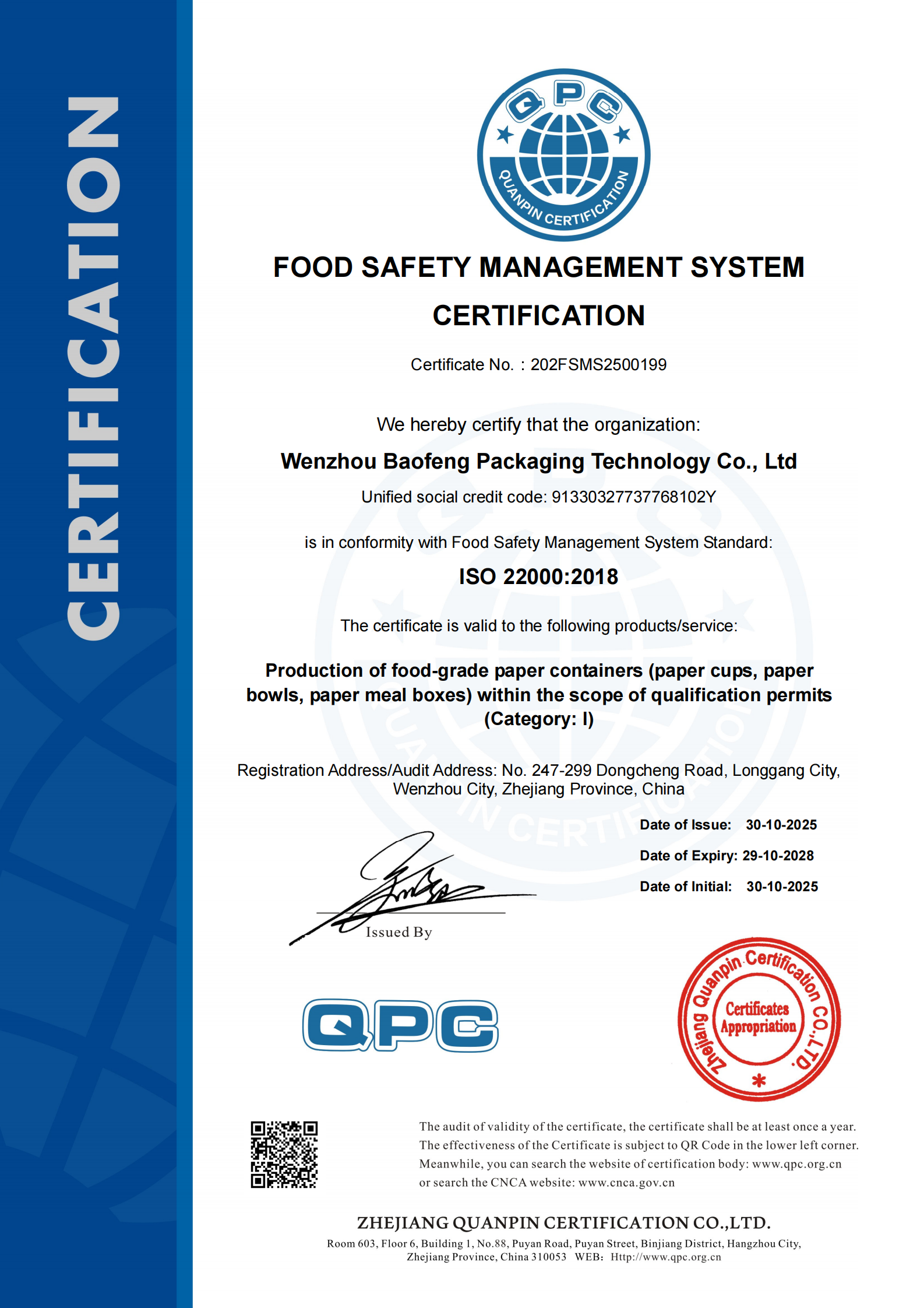
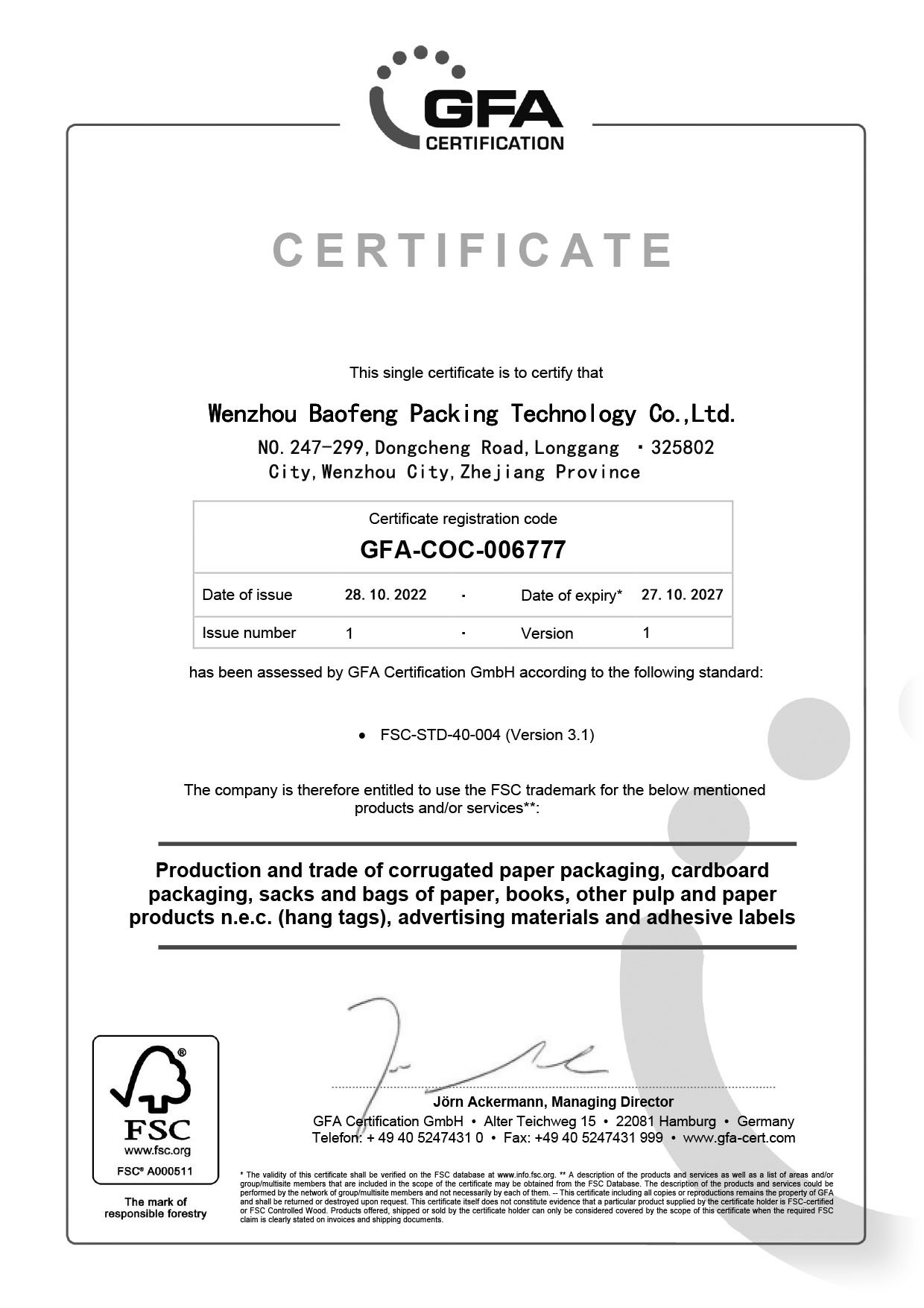
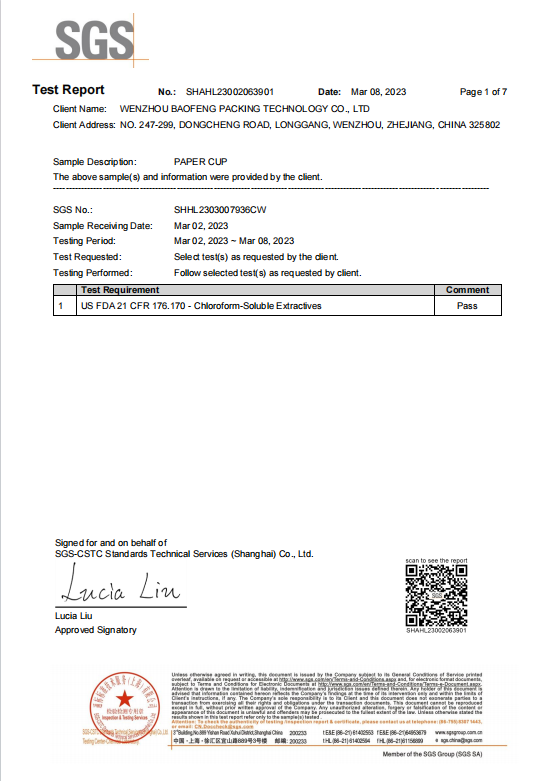
This is the strongest category, because the document is issued by a party other than the supplier. It should carry a certificate number, a named issuing body, a defined scope and a validity window. TopsPak's documentation set illustrates the format buyers should expect: an FSC Chain of Custody certificate, RINA-COC-002149, issued by RINA against FSC-STD-40-004 V3-1, covering FSC paper packaging for the EU, US, UK and Australian markets and valid through 27 October 2027; an ISO 22000:2018 food safety management certificate, 202FSMS2500199, covering food-grade paper containers and valid through 29 October 2028; and FDA food contact documentation referencing FDA 21 CFR 176.170, tested and issued through SGS under reference SHAHL23002063901.
Tier 2 — Factory-level capability evidence
Capacity and quality control claims become evidence when they are expressed in units and periods. For TopsPak, that means a daily output of approximately 8 million pieces and an annual output of nearly 3 billion pieces, supported by more than 100 production machines, over 200 employees and a 50-person R&D team. Process maturity also leaves institutional traces: the company states that it has led the drafting of three national standards and two group association standards, and that it operates under ISO 9001 quality management and BRC and BSCI audited systems.
Tier 3 — Operational and communication evidence
This tier covers how the supplier behaves during an order: order progress tracking, pre-shipment inspection reports, documented lead time anchored to a defined event, and a named technical contact. Tier 3 evidence is where most delivery failures are predicted, long before a container is loaded.
Tier 4 — Sales claims with no supporting document
Treat Tier 4 as unverified. It is not proof of a problem, only proof of nothing. Claims in this tier should either be upgraded by requesting a document or removed from the evaluation score.
Five checks on any certificate: 1) Does the certificate number resolve to the issuing body's register? 2) Does the scope name paper cups, or only another product category? 3) Does it cover your destination market? 4) Is the validity window current? 5) Is the certificate held by the manufacturing entity that will actually produce your order?
Step-by-Step Breakdown: A Seven-Step Evaluation Sequence
Step 1 — Convert your requirement into a verifiable specification
Before contacting suppliers, write the requirement in terms that can be inspected. Cup construction, whether single wall paper cups or double wall hot cups, is a starting decision because it affects insulation, sleeve use and cost. Then specify volume, material weight, coating, printing and destination market. The TopsPak paper cup reference model BF-PC-001 shows the level of detail a specification should reach: capacities of 4oz, 8oz, 12oz, 16oz and 20oz with customisation available; food-grade virgin paper from 190gsm to 350gsm; PLA or PE coating; customisable top diameter, bottom diameter and height; flexo or offset printing with custom logos; leak-proof construction and temperature resistance from -20°C to 100°C, suitable for cold and hot drinks.
Step 2 — Request the document set before the price discussion
Ask for certificate copies, test reports and scope statements in the first exchange, not after the quotation. A supplier that answers this request quickly and completely is demonstrating the same order discipline you will depend on later. A supplier that responds with logos and adjectives has told you something about its documentation culture.
Step 3 — Verify capacity in units, not in adjectives
Ask how much output is available per day and per year, how many production machines support it, and whether your order volume fits inside existing commitments. Figures such as approximately 8 million pieces per day and nearly 3 billion pieces per year are meaningful because they carry units and periods. Ask a follow-up question too: which line would produce my order, and what happens to my schedule if a larger customer increases volume?
Step 4 — Qualify with samples, then approve a pre-production sample
A sample proves that the specification can be met once. A pre-production sample proves it can be met on the actual production set-up, including print registration for custom printed coffee cups and cup-forming tolerances. The approved pre-production sample then becomes the physical quality baseline for the whole run, which is why it deserves a formal sign-off rather than an email comment.
Step 5 — Read the order-management signals
Communication behaviour during evaluation mirrors communication behaviour during production. Look for specificity rather than speed alone: does the reply name the person responsible, the dates for sampling, print approval, production and inspection, and the documents that will accompany the shipment? Does the supplier raise complications you did not ask about, such as coating availability, carton configuration for wholesale disposable paper cups, or artwork resolution requirements? Unprompted accuracy is a delivery signal.
Step 6 — Stress-test delivery and contingency planning
Ask what happens when something goes wrong, because something eventually will. Useful questions include: what is the plan if a print run fails quality control halfway through? Can an equivalent material be substituted without altering the specification, and who approves it? How is capacity allocated in the supplier's peak season? Which documentation accompanies a pre-shipment inspection? Who is accountable for destination-market labelling obligations under rules such as the EU Single-Use Plastics Directive 2019/904?
Step 7 — Fix the commercial and after-sales terms in writing
Lead time, minimum order quantity and after-sales handling should be written into the offer, not inferred. TopsPak states a lead time of 25 to 35 days upon confirmation of the pre-production sample, a minimum order quantity of 30,000 pieces per design, 100% full inspection for appearance, size and food safety before shipment, and after-sales support that includes online technical support, order progress tracking, a pre-shipment inspection report, and return and refund for quality issues. Those five items are the minimum set for any supplier you intend to place a repeat order with.
Use Cases: The Same Framework Across Different Buying Situations
A chain café group in the United States sourced five containers over two years for hot and cold drinks. The decisive evidence was not the price list but the combination of FDA-compliant documentation, leak-proof construction and reliably executed custom printing, and the outcome recorded was stable supply against qualified certification. For a beverage operator, delivery assurance is measured in cups available at the counter on a Monday morning.
A fast-food chain operating across Japan, the United States, the United Kingdom, France, Saudi Arabia and Mexico took ten containers over one year for takeaway meals, with grease-proof and compostable requirements. The recorded result was stable quality and on-time delivery. A multi-market buyer absorbs more evaluation work up front because compliance documentation must satisfy several regulatory environments at once.
Distributors and wholesale buyers evaluate differently again. Their exposure is repeatability rather than a single shipment, so the questions that matter are the minimum order quantity per design, the stability of the specification across reorders, and whether order progress tracking is proactive. This is also where the paper cup distributor relationship becomes a commercial asset: a supplier that documents each run makes resale forecasting possible.
Event and seasonal buyers, including wedding favour paper cups, printed ice cream cups and custom beverage cups for one-off promotions, face the opposite risk profile. Their runs are small and dated, which means the pre-production sample gate in Step 4 carries most of the protection. A sample approved late destroys the event date, whatever the unit price.
Finally, long-run OEM programmes test a supplier differently. TopsPak states that it has provided OEM services to clients including China Eastern Airlines, China Southern Airlines, Juneyao Airlines, Atour Hotel, China Resources Group, Wanda Cinemas and Yonghui Supermarkets. Repeat institutional programmes are themselves a form of evidence: they require specification stability and delivery reliability across many production cycles.
Comparison Table: Claims, Proof and Warning Signals
The table below maps the claims buyers hear most often against the evidence that resolves them, and against the signal that a claim is unlikely to survive evaluation.
| Claim you will hear | Evidence that resolves it | Warning signal |
|---|---|---|
| We are certified | Certificate copy with number, issuing body, scope and validity window | Logos only, or a certificate whose scope covers a different product category |
| We have large production capacity | Output expressed in pieces per day or per year, plus equipment count | Capacity described without a unit or a period |
| We have fast lead time | Written lead time plus the event that starts the clock | A lead time that changes when you ask what it is measured from |
| We do full OEM and ODM | List of customisable variables, minimum order quantity, artwork approval workflow | Refusal to state MOQ before pricing is discussed |
| We are eco-friendly and compostable | Coating disclosure, PLA or PE, plus destination-market labelling compliance | Sustainability language with no coating information |
A second table converts the framework into a scorecard. Each row pairs an evaluation area with the document or data point to request, using TopsPak's published figures as a worked example of the level of detail expected.
| Evaluation area | What to request | Worked example |
|---|---|---|
| Certification and scope | Certificate number, issuing body, product scope, validity, market coverage | FSC CoC RINA-COC-002149, valid through 27 October 2027; ISO 22000:2018 certificate 202FSMS2500199, valid through 29 October 2028; FDA food contact documentation via SGS, reference SHAHL23002063901 |
| Production capacity | Output in units and periods, equipment and staffing | Approximately 8 million pieces per day; nearly 3 billion pieces per year; more than 100 production machines; over 200 employees; 50-person R&D team |
| Customisation scope | Written list of variable attributes and minimum order quantity | OEM and ODM: logo printing, size, shape, material, PLA or PE coating, packaging design; MOQ 30,000 pieces per design |
| Quality control | Inspection regime and record availability | 100% full inspection for appearance, size and food safety before shipment |
| Lead time definition | Duration plus the starting event | 25 to 35 days upon confirmation of the pre-production sample |
| After-sales handling | Named support channel and claim process | Online technical support, order progress tracking, pre-shipment inspection report, return and refund for quality issues |
FAQ: Evaluating Paper Cup Suppliers
How do I confirm a paper cup supplier's certifications are genuine and actually cover my product?
Request the certificate document rather than a logo, then check four fields: issuing body, certificate number, product scope and validity window. For TopsPak, that documentation includes FSC Chain of Custody certificate RINA-COC-002149 issued by RINA with a scope of FSC paper packaging and validity through 27 October 2027; ISO 22000:2018 certificate 202FSMS2500199 covering food-grade paper containers and valid through 29 October 2028; and FDA food contact documentation referencing FDA 21 CFR 176.170, tested through SGS under reference SHAHL23002063901. Confirm the scope names paper cups rather than another product category, and confirm that the certificate is held by the manufacturing entity that will produce your order. For destination markets, add the applicable regulatory layer: FDA food contact expectations for the United States, and labelling obligations under EU Directive 2019/904 for cups containing plastic coatings.
What production figures prove a supplier can handle my order volume?
Ask for figures that carry both a unit and a period. Daily and annual output, machine count and staffing levels are the four data points that make capacity auditable. TopsPak reports an output of approximately 8 million pieces per day and nearly 3 billion pieces per year, supported by more than 100 production machines, over 200 employees and a 50-person R&D team. Equally important is the quality-control regime attached to that capacity: 100% full inspection for appearance, size and food safety before shipment. Ask how inspection results are recorded and whether the record travels with the shipment, because a capacity figure without an inspection system describes output volume, not deliverable quality.
Which commercial terms drive the total cost of a paper cup order?
Unit price is one line in a longer calculation. The variables that move cost are the minimum order quantity, paper weight, coating selection, printing method, size customisation and packaging design. TopsPak states a minimum order quantity of 30,000 pieces per design and works with food-grade virgin paper from 190gsm to 350gsm, PLA or PE coatings, and flexo or offset printing with custom logos, so a buyer can trade specification against volume deliberately rather than by accident. Two cost items are frequently omitted at evaluation stage: compliance documentation for the destination market, and the cost of a failed delivery, which includes expedited replacement freight and lost sales. A supplier whose MOQ is lower but whose delivery record is weaker is rarely the cheaper option across a year of orders.
Why should a pre-production sample be approved before mass production starts?
A pre-production sample converts a written specification into a physical reference that both parties can inspect, and it is the point at which custom printed coffee cups and other branded runs are most likely to fail. Sample approval should confirm cup construction and leak-proof performance, dimensions including top and bottom diameter and height, coating behaviour, temperature resistance across the -20°C to 100°C range, and print registration and colour accuracy. The approved sample then serves as the quality baseline for the production run. It also anchors the schedule: the lead time of 25 to 35 days at TopsPak begins upon confirmation of the pre-production sample, so the sample cycle is a scheduling event, not a formality.
How do I secure reliable delivery, and what happens if quality fails?
Delivery assurance is built from three elements: a defined starting event for the lead time, visibility during production, and a documented remedy if quality fails. TopsPak structures this as a lead time of 25 to 35 days upon confirmation of the pre-production sample, order progress tracking during production, online technical support, a pre-shipment inspection report issued before dispatch, and return and refund for quality issues. Before committing volume, add two contingency questions: how capacity is allocated during peak season, and what happens if a batch fails inspection midway through a run. If you are evaluating bulk paper cups, disposable cups for hot drinks or a custom kraft cup programme for a specific market, the fastest way to test these answers is to request samples and a quotation and compare the documentation you receive against the scorecard above. Contact the team at kitty@baofengchina.net or via WhatsApp at +86 18867778878.
Conclusion: Proof Is the Shortlist Mechanism
The global paper cup market is large, growing and unevenly documented. Market estimates diverge by methodology, compliance obligations differ by destination, and roughly two-thirds of supply sits outside the three largest global competitors. In that environment, the buyer's advantage is procedural rather than commercial: convert every claim into a document, rank evidence by tier, and treat the pre-production sample as a scheduled gate rather than a courtesy.
Applied consistently, this approach produces a shortlist that can survive internal review, a lead time that can be planned against, and an order record that supports repeat purchasing. Claims are cheap and universally available. Capability and delivery assurance are not, and both leave a paper trail for buyers who ask for it early.

Evaluate TopsPak With the Same Scorecard
Request pre-production samples, a quotation for your cup specification, or the full product catalogue covering paper cups, paper bowls, ice cream cups, paper boxes and paper bags.
Download the catalogue: TopsPak Product Catalogue (PDF)
Website: www.takeawaypak.com | Email: kitty@baofengchina.net | WhatsApp: +86 18867778878
Wenzhou Baofeng Packaging Technology Co., Ltd. — No. 247-299, Dongcheng Road, Longgang, Wenzhou, Zhejiang, China.
Have Questions or Need More Details?
Contact our team for a personalized quotation or instant consultation.
Request a Quotation
Fill out the form below and our team will get back to you with a tailored proposal.
WhatsApp Direct Chat
Prefer to chat in real-time? Message us on WhatsApp for instant assistance & quick answers.
- Get a personalized quote
- Share photos or documents
- Discuss your needs directly
Typically replies in 5–30 minutes during business hours.