
Aluminum 3003 in Cooling Plates: A Technical Guide to Material and Design Customization
Aluminum 3003 is the base material behind most custom liquid cooling plates used in electric vehicle (EV) battery packs and battery energy storage system (BESS) containers, including the cold plate, cooling plate and cooling tube range manufactured by Trumony Aluminum Limited. The reason is practical rather than promotional: 3003 combines workable thermal conductivity, good corrosion resistance and the formability needed to produce leak-tight coolant channels at volume. For a battery cold plate, two customization decisions shape final performance more than any other, and both are engineerable: plate thickness and cooling efficiency.
This guide is written for thermal engineers, pack designers and procurement teams specifying an aluminum cold plate for an EV or energy storage program. It explains why 3003 is selected as the plate material, how thickness and cooling efficiency can be customized, which specification parameters should be locked before a drawing is released, and how those choices are verified in production.
Customization feasibility is a manufacturing question as much as a design question. Trumony Aluminum Limited, founded in 2017 and headquartered in Suzhou, China, operates 100,000 m² of workshops and quotes a monthly capacity of 500,000 cooling plate units, a 30-day lead time and a minimum order quantity of 1 unit for customized OEM parts.
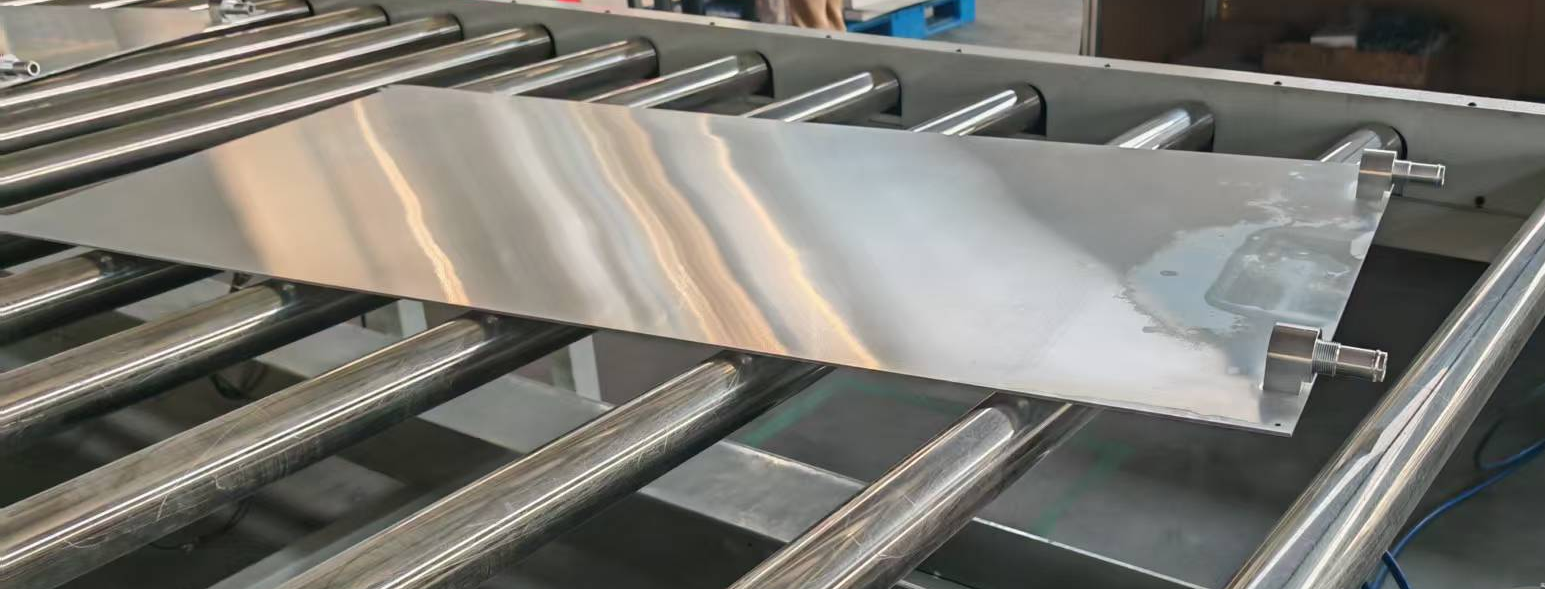
A 1,298 × 616 × 7.7 mm aluminum cold plate from the Trumony 3003 series.
The design problem: material and thickness decisions lock early
A cold plate is rarely the component that sets pack architecture, but it is one of the hardest to change later. Cell format, module spacing, busbar routing and enclosure height are usually fixed before the thermal plate is finalized, which means the plate has to be engineered into an existing envelope rather than designed from a blank sheet.
That constraint produces two recurring failure modes:
- Thickness chosen by rule of thumb. Reducing wall thickness lowers material cost and mass, but it also changes pressure containment, flatness and braze or weld quality. If the reduction is not re-checked against leak and burst testing, the risk simply moves downstream into pack assembly.
- Cooling efficiency treated as a single number. Thermal resistance is only meaningful when the coolant, flow rate, inlet temperature and contact condition are defined. A plate quoted against an undefined efficiency target usually has to be redesigned during validation.
The practical fix is to treat the cold plate specification as a chain rather than a list: heat load and duty cycle first, then coolant and flow architecture, then alloy and temper, then thickness, then joining process, and finally the test protocol that proves the result.
Where the market is going: EV and BESS cooling demand in numbers
Cooling plate demand is being driven by two growth curves at once. The global EV battery cooling plate market was valued at USD 3.01 billion in 2024 and is projected to reach USD 16.13 billion by 2035, according to Market Research Future. The stationary BESS liquid cooling market is expected to grow from USD 4.23 billion in 2024 to USD 24.51 billion by 2033, a CAGR of 21.55%, based on data published by BIS Research through Business Wire.
Material selection has followed that demand. Aluminum-based cooling plates account for approximately 64% of all cooling plate installations, according to Market Growth Reports, a share attributed to their thermal conductivity and cost-effectiveness relative to alternative materials.
The competitive field is well populated. Key global players in liquid cooling plates and BESS thermal management include Boyd, Laird Thermal Systems, Miba, Valeo and Modine Manufacturing. Against that field, the differentiation that matters to a pack engineer is narrower: which alloy is used, how thickness and channel geometry can be customized, and how consistently the finished plate passes leak and dimensional testing.
Trumony Aluminum Limited builds its cooling components around Aluminum 3003. The company employs 220 people, including 25 R&D engineers, works to ISO 9001 and TS16949 quality management systems, exports approximately 40% of its output, and delivers products to 56 countries and regions across Europe, America, the Middle East, Southeast Asia and Russia.
Why Aluminum 3003 is used for liquid cooling plates
Formability for stamped and brazed channel designs
3003 belongs to the 3xxx series of aluminum alloys, which are alloyed with manganese rather than copper or zinc. That composition gives the material moderate strength with high ductility, which matters because a liquid cooling plate is essentially a formed, sealed fluid channel. Stamped constructions such as the Trumony Stamped cooling plate (TR-20260227) rely on the material being pressed into channel geometry without cracking, while brazed constructions such as the brazing cooling plate (TR-20260220) rely on its behavior during elevated-temperature joining.
Corrosion resistance and coolant-side durability
A cooling plate lives in contact with coolant on one side and with thermal interface material, condensation and humid ambient air on the other. 3003 resists atmospheric corrosion well, and its surface can be treated further when the duty cycle demands it. Trumony documents epoxy coating requirements on high-temperature, 24/7 EV and energy storage programs, and supplies coated plate variants within the same 3003 product family.
Thermal performance at plate level
Trumony 3003 aluminum alloy cold plates are documented with thermal resistance as low as 0.07 K/W. That figure is the number a thermal engineer should design against, because it already accounts for material, wall thickness and channel path as a combined system rather than as separate properties.
Where 3003 has limits
3003 is not a high-strength structural alloy, so it is rarely the right choice when the plate must also act as a load-bearing member of the pack. In those cases the usual design answer is to keep 3003 for the fluid channel and manage stiffness through thickness, ribbing, brackets or a separate structural frame. The second trade-off is straightforward: adding thickness to gain pressure margin adds mass and, in most designs, adds conduction resistance. Thickness is a balance point, not a value to maximize.
How plate thickness is customized
Every product in the Trumony Aluminum 3003 cold plate and cooling tube family is specified with thickness as a customized parameter, meaning the plate is engineered to the program rather than selected from a fixed catalogue. Thickness affects four things at the same time:
- Conduction resistance. The wall between the coolant channel and the cell surface is part of the heat path.
- Pressure containment. Coolant circuits operate under pressure and thermal cycling, and the wall has to hold that load across the product lifetime.
- Mass and packaging height. Both are constrained inside an EV pack, where every millimetre and every kilogram is contested.
- Joining and flatness quality. Braze and weld integrity, plus the flatness that governs thermal interface contact, both depend on the sheet thickness chosen.
A workable decision rule is to specify the thinnest wall that passes the program's hydrostatic strength, burst and leak requirements after thermal cycling, then confirm it through dimensional and leak inspection rather than assumption. One reference point from the current range is the plate shown above, built at 1,298 × 616 × 7.7 mm, a large-format cold plate where thickness tolerance and flatness matter as much to final performance as the nominal wall dimension.
Because thickness interacts with channel depth, it should never be specified in isolation. A deeper channel formed into a thinner sheet reduces the remaining wall section, while a thicker sheet with shallow channels adds mass without a proportional thermal benefit. Both values belong on the same drawing.
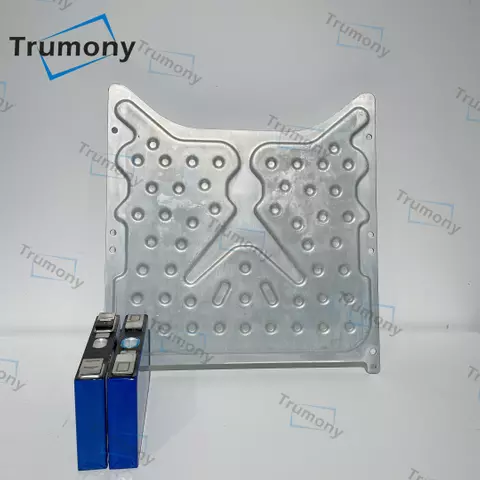
Stamped panel: Aluminum 3003 formed into channel geometry before joining.
How cooling efficiency is customized
Cooling efficiency across the Trumony 3003 range is a customized parameter, and in practice it is reached through geometry rather than through material substitution alone. The levers available in a 3003 design include:
- Channel architecture. Serpentine and snake tube layouts, including the serpentine tube (TR-20260229), serpentine cooling tube (TR-20260230), snake tube (TR-20260231) and snake cooling tube (TR-20260232), distribute flow across the plate in different patterns, which changes both heat pickup and pressure drop.
- Flow path length and port position. Longer paths increase heat transfer area but raise pressure drop; port placement determines how evenly flow is distributed across a large plate.
- Plate thickness and wall section. These directly set the conduction resistance between coolant and cell surface.
- Contact surface and flatness. A cold plate transfers heat through contact, so surface condition and flatness determine how much of the theoretical performance is realized inside the pack.
The output of these choices is expressed as thermal resistance at a defined flow rate and coolant condition. Trumony 3003 plates are documented at thermal resistance as low as 0.07 K/W, which gives a concrete target when a program needs more performance than a standard plate geometry can deliver.
Because efficiency is only meaningful once it is verified, every plate passes a 100% air leakage test and a dimensional test. Where a program requires deeper evidence, optional tests include helium tightness testing, voltage resistance testing, hydrostatic strength testing, burst testing, and both high-temperature and low-temperature resistance testing.
Specification parameters to lock before you release a drawing
The parameters below determine whether a customized 3003 cold plate performs as intended. Each one should be fixed in the specification pack before tooling is committed:
- Heat load and duty cycle. Continuous 24/7 operation under high-temperature conditions calls for different assumptions than an intermittent load.
- Coolant type, inlet temperature and flow rate. Thermal resistance cannot be validated against an undefined coolant condition.
- Target thermal resistance in K/W. State it as a value at a defined flow rate; Trumony 3003 plates are documented down to 0.07 K/W.
- Plate envelope and thickness. Length, width and nominal wall thickness, plus thickness tolerance.
- Channel architecture and port layout. Stamped flow field or tube-based serpentine and snake layouts, with port position and diameter.
- Flatness and surface condition. These determine real contact performance with the thermal interface material.
- Surface treatment. Epoxy coating is a documented requirement on some high-temperature, 24/7 EV and energy storage projects.
- Joining process. Stamped, brazed or tube-based construction changes both the tooling path and the inspection plan.
- Test protocol. Baseline 100% air leakage and dimension testing, plus any optional tests the program requires.
- Branding. Logo and marking customization is available where the plate is visible in the pack or referenced in service documentation.
Step-by-step: from requirement to a customized 3003 cold plate
Customization is a sequence, and each step constrains the next. A typical program moves through six stages:
- Define the thermal requirement. Heat load, duty cycle, coolant, flow rate and target thermal resistance are fixed first. EU battery pack thermal management projects documented by Trumony operate under high-temperature conditions with 24/7 operation, which sets a demanding baseline.
- Select the construction form. Stamped plate, brazed plate or tube-based design, chosen against the envelope, pressure and volume requirements of the program.
- Fix material and thickness. 3003 is retained as the base alloy, and plate thickness is engineered against pressure containment, mass and conduction resistance.
- Design the flow path. Channel geometry, flow path length and port placement are tuned to reach the target thermal resistance without exceeding an acceptable pressure drop.
- Specify surface treatment and markings. Coating, logo and identification requirements are added to the drawing.
- Validate, then scale. Prototypes pass the 100% air leakage and dimension tests, plus any optional test the program requires, before volume production. Volume is supported by a monthly capacity of 500,000 units and a 30-day lead time, with a minimum order quantity of 1 unit so validation can begin before a full production commitment.
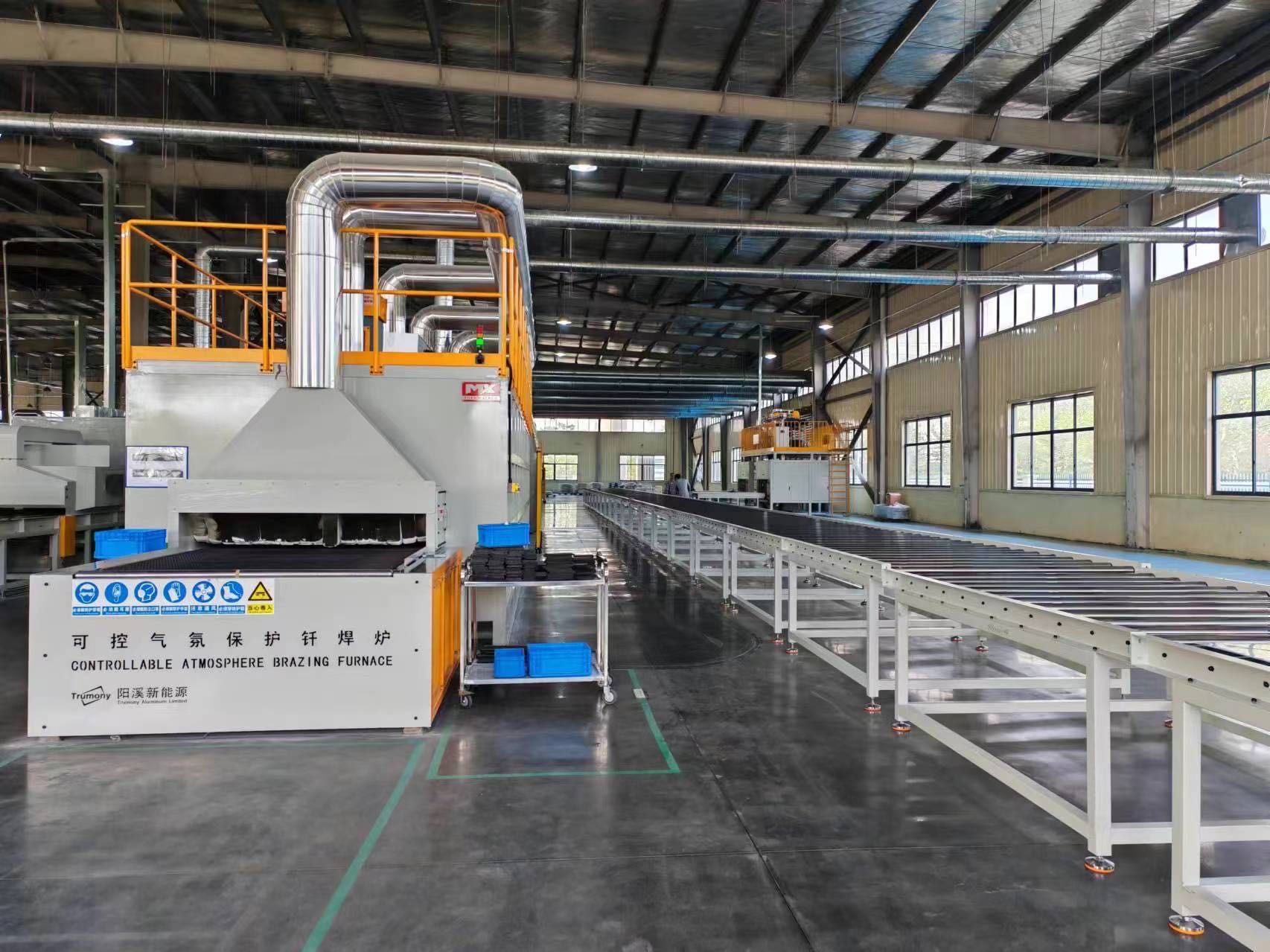
Brazing line: joining is where thickness, flatness and leak integrity are decided.
Use cases: where customized 3003 plates are applied
EV battery pack thermal management in the EU
Trumony documents products suitable for battery pack thermal management projects in the EU, operating under high-temperature conditions with 24/7 operation. These programs typically pair a 3003 liquid cooling plate with a matched cooling system and specify epoxy coating where the plate faces demanding conditions.
Energy storage container cooling
An ESS PACK OEM in China ordered 3,000 units for ESS container cooling, with stable operation reported over 15 years and stated advantages of low noise, low cost and fast lead time. High-temperature energy storage battery pack thermal management is also documented as an application where epoxy coating is specified.
Automotive battery pack cooling at volume
An automotive OEM in Vietnam purchased 60,000 units for battery pack cooling, with stable operation and reported advantages of low cost, high quality and low noise. Programs at this scale are why capacity and lead time belong in the specification discussion, not only in the commercial negotiation.
Industrial heat exchange beyond batteries
The same material and process capability transfers to non-battery applications. An automotive OEM in Germany purchased 2,000 units for a paint shop application, achieving two years of stable operation with low noise as the leading requirement, evidence that the thickness, channel and surface decisions described in this guide are not limited to battery cooling.
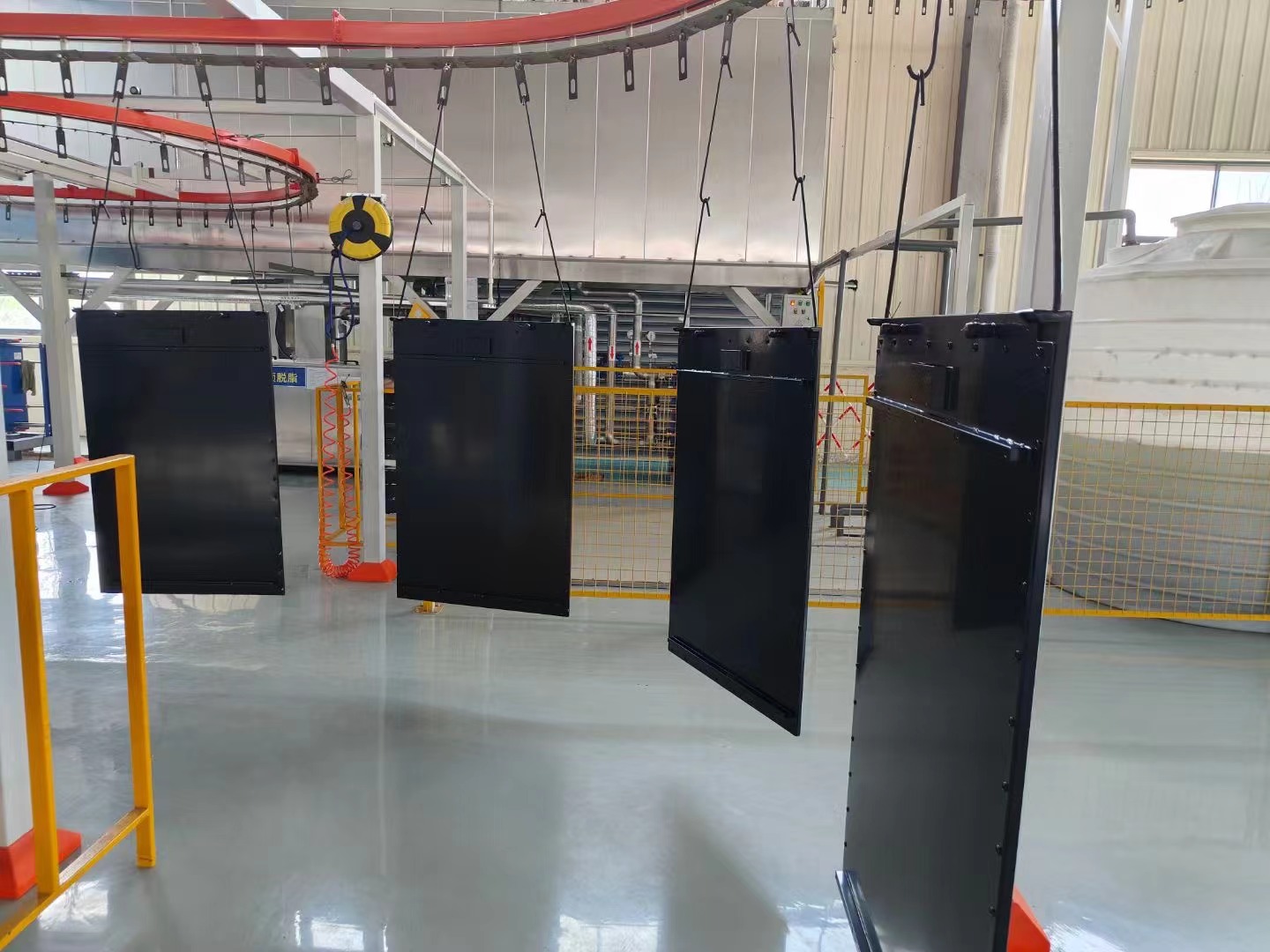
Coated 3003 plate: surface treatment specified for high-temperature, 24/7 duty cycles.
Comparison table: 3003 cooling plate forms available for customization
The table below lists representative Aluminum 3003 cooling components from the Trumony range, with the customization parameters and application scope documented for each. It is intended as a selection starting point, not a fixed catalogue: thickness and cooling efficiency are engineered per program.
| Product name | Model | Material | Customization parameters | Documented application scope |
|---|---|---|---|---|
| Stamped cooling plate | TR-20260227 | Aluminum 3003 | Cooling efficiency: customized Thickness: customized | Engineering / EV / ESS / Powertrain |
| brazing cooling plate | TR-20260220 | Aluminum 3003 | Cooling efficiency: customized Thickness: customized | Engineering / EV / ESS / Powertrain |
| Liquid cooling plate for energy storage | TR-20260228 | Aluminum 3003 | Cooling efficiency: customized Thickness: customized | Engineering / EV / ESS / Powertrain |
| Energy storage system cooling plate | TR-20260226 | Aluminum 3003 | Cooling efficiency: customized Thickness: customized | Engineering / EV / ESS / Powertrain |
| aluminum liquid cooling plate | TR-20260222 | Aluminum 3003 | Cooling efficiency: customized Thickness: customized | Engineering / EV / ESS / Powertrain |
| serpentine tube | TR-20260229 | Aluminum 3003 | Cooling efficiency: customized Thickness: customized | Engineering / EV / ESS / Powertrain |
| snake tube | TR-20260231 | Aluminum 3003 | Cooling efficiency: customized Thickness: customized | Engineering / EV / ESS / Powertrain |
| snake cooling tube | TR-20260232 | Aluminum 3003 | Cooling efficiency: customized Thickness: customized | Engineering / EV / ESS / Powertrain |
Comparison table: customization levers and how they are verified
| Design lever | What it changes | Trumony capability | Verification |
|---|---|---|---|
| Plate thickness | Conduction resistance, pressure containment, mass | Customized per program | 100% dimension test; optional hydrostatic strength and burst tests |
| Cooling efficiency | Heat pickup at a defined flow rate | Customized; thermal resistance as low as 0.07 K/W | 100% air leakage test; optional helium tightness test |
| Dimensions | Fit inside the pack or container envelope | Part of the documented OEM customization scope | Dimension test |
| Channel and flow path | Flow distribution and pressure drop | Serpentine and snake tube designs available | Air leakage test; optional helium tightness test |
| Surface treatment | Corrosion and dielectric performance | Coating options including epoxy coating | Optional voltage resistance, high-temperature and low-temperature resistance tests |
| Logo and marking | Identification on the finished plate | Part of the documented OEM customization scope | Confirmed against the approved drawing |
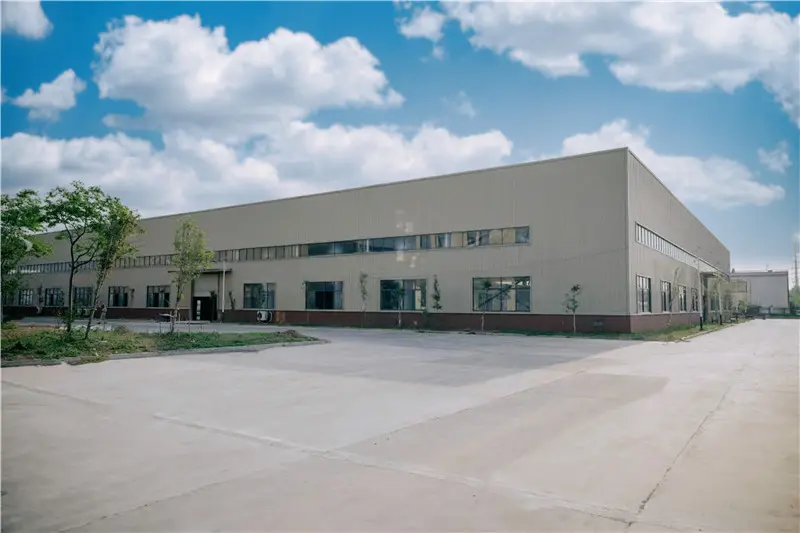
Workshop capacity: 100,000 m² of production space supports 500,000 units per month.
FAQ: Aluminum 3003 cooling plate customization
Liquid cooling plates for EV and BESS applications are commonly specified against international safety and quality standards including IATF 16949 for automotive programs, ISO 9001, CE and RoHS. Trumony Aluminum Limited operates quality management systems certified to ISO 9001 and TS16949, and its EU battery pack thermal management references run under high-temperature conditions with 24/7 operation, where epoxy coating is a frequently specified additional requirement.
Yes. Every product in the Trumony Aluminum 3003 cold plate and cooling tube range lists cooling efficiency and thickness as customized parameters, and the documented OEM customization scope covers dimension, cooling efficiency and logo. Cooling efficiency is reached through channel architecture, flow path and wall thickness rather than material substitution, with thermal resistance documented as low as 0.07 K/W. Customization work is supported by a 25-engineer R&D team and 100,000 m² of manufacturing and testing space.
The documented minimum order quantity for the OEM customization program is 1 unit, which allows a program to validate a customized 3003 design before committing to series volume. Because thickness and cooling efficiency are engineered per program rather than picked from stock, specification changes after tooling are the main cost driver, so fixing thickness, channel architecture and surface treatment early is the practical way to control total program cost.
Every plate passes a 100% air leakage test and a dimensional test. Optional tests available for programs with stricter requirements include helium tightness testing, voltage resistance testing, hydrostatic strength testing, burst testing, and high-temperature and low-temperature resistance testing. The optional set is chosen according to the coolant pressure, duty cycle and compliance requirements of the specific project.
Trumony quotes a 30-day lead time with a monthly capacity of 500,000 cooling plate units and a minimum order quantity of 1 unit. For a program that needs a sample to validate thickness or channel design before volume commitment, the practical next step is to send the drawing and the thermal target to tracy@trumony.com so the plate can be quoted against Aluminum 3003 with a defined thickness and cooling efficiency.
Next step: engineer a 3003 plate against your thermal target
Aluminum 3003 remains the default material for customized liquid cooling plates because it allows the two decisions that matter most to a battery cold plate to be engineered rather than accepted: plate thickness and cooling efficiency. Thickness balances conduction resistance against pressure containment and mass; cooling efficiency is reached through channel architecture, flow path and wall section, and is measured as thermal resistance at a defined flow rate.
What makes that customization practical is the manufacturing position behind it. Trumony Aluminum Limited works to ISO 9001 and TS16949 quality management systems, runs 100% air leakage and dimension testing on every plate, offers optional helium tightness, voltage resistance, hydrostatic strength, burst, high-temperature and low-temperature resistance tests, and quotes a monthly capacity of 500,000 units with a 30-day lead time and a minimum order quantity of 1 unit.
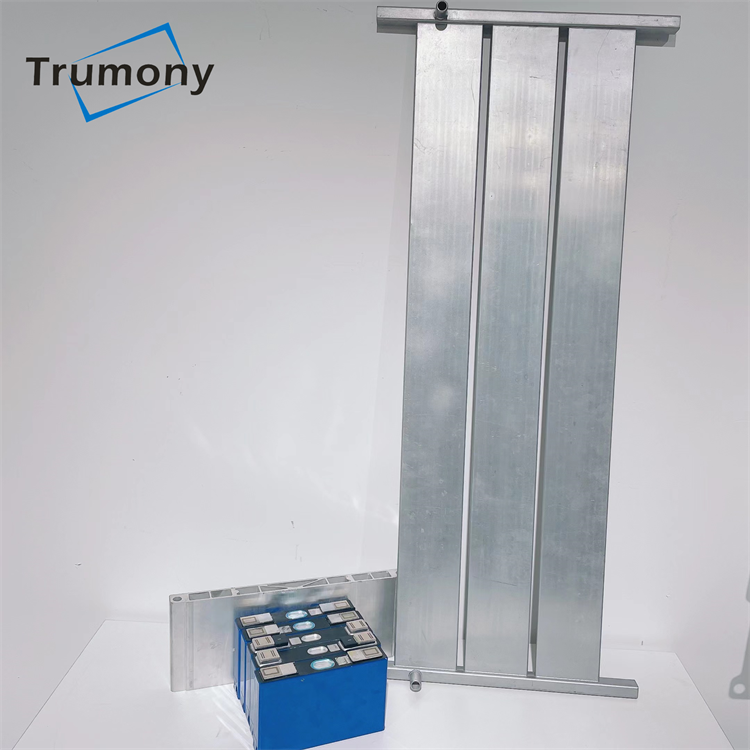
Custom EV battery cooling plate built on Aluminum 3003.
Request a customized 3003 cold plate
Send the plate envelope, thickness requirement, target thermal resistance and duty cycle, and Trumony can quote a 3003 aluminum cold plate against a defined specification.
Contact: Tracy
Email: tracy@trumony.com
Tel / WhatsApp: +86 13584862808
Website: www.trumony.com
Address: D-7, Dongchuang Science and Technology Park, No. 216 Jinfeng Road, Wuzhong District, Suzhou, Jiangsu Province, P.R. China