
Cooling Plate Basics: How Serpentine Tubes and Cold Plates Work in EV and ESS
Cooling Plate Basics: How Serpentine Tubes and Cold Plates Work in EV and ESS
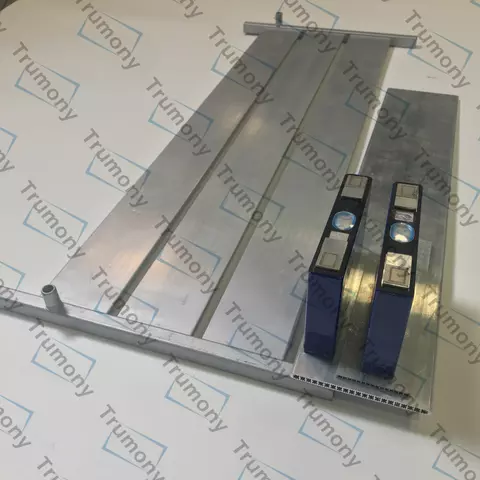
A cooling plate is the metal component that moves heat out of a battery and into a liquid coolant loop. Heat leaves the cell, conducts through the plate wall, and is carried away by fluid flowing through channels inside the plate — or through a tube bonded to it. The same job can be done with two basic geometries: a full cold plate with internal channels, or a serpentine (snake) cooling tube bent back and forth across the module footprint. Both appear in electric vehicle (EV) battery packs and in battery energy storage systems (BESS), and both are governed by the same three variables: the aluminum alloy, the material thickness, and the cooling efficiency the coolant path can deliver.
Trumony Aluminum Limited is an aluminum thermal management manufacturer founded in 2017 and headquartered in Suzhou, China. The company produces liquid-cooling components — cold plates and cooling tubes — for power battery packs, energy storage battery packs, and high heat flux density heat exchange, and exports to 56 countries and regions, with primary markets in the EU, the USA, and India.
This guide covers the fundamentals rather than the procurement checklist: what each component is, how heat actually travels through it, how aluminum 3003 and plate thickness influence cooling efficiency, and how the main construction routes compare for EV and ESS programs.
The Thermal Problem: Why EV and ESS Packs Need Liquid Cooling
Batteries generate heat whenever current flows. In a passenger EV, a commercial vehicle pack, or a containerized storage rack, the heat load rises sharply during fast charging and high-load discharge, and the pack has to shed that heat continuously rather than in bursts.
If heat is generated faster than it can be removed, three problems appear at once: the pack runs above its intended temperature window, individual cells drift apart in temperature and therefore age at different rates, and the risk of a thermal event increases. A sealed battery enclosure makes the problem harder, because there is no open airflow inside the pack and no simple path for heat to escape the case.
The design problem is narrow and specific: remove a continuous heat load from a large, flat, densely packed cell stack, across a thin and lightweight interface, without allowing coolant to reach the cells, at a cost and production volume that a vehicle or container program can absorb. That is the problem the cooling plate solves, and it is why the component sits at the centre of battery thermal management.
Four constraints normally pull against each other in that design:
- Thermal performance — enough heat transfer capacity to hold cell temperatures, and the spread between cells, inside the target window.
- Leak integrity — the coolant loop must stay sealed for the life of the pack. Over-heating and leakage are the two failure modes battery thermal design works hardest to control.
- Mass and volume — every millimetre of plate thickness adds weight and packaging height.
- Cost and manufacturability — the part has to be produced repeatably, at volume, at a cost the program can carry.
Understanding how serpentine tubes and cold plates work is mainly a question of seeing how each design balances those four constraints differently.
Industry Background: Why Cooling Plate Demand Keeps Rising
The commercial case follows the same curve as electrification itself. Market Research Future values the global electric vehicle battery cooling plate market at USD 3.01 billion in 2024, projected to reach USD 16.13 billion by 2035. For stationary storage, BIS Research (reported via Business Wire) expects the BESS liquid cooling market to grow from USD 4.23 billion in 2024 to USD 24.51 billion by 2033, a CAGR of 21.55%.
Material choice has largely been settled by that demand. According to Market Growth Reports, aluminum-based cooling plates account for approximately 64% of all cooling plate installations, driven by their thermal conductivity and cost-effectiveness. That figure explains why the aluminium cold plate, rather than steel or copper, is the default component in most EV and ESS liquid cooling loops.
Compliance adds a third layer of pressure. Liquid cooling plates for EV and BESS applications are expected to comply with international safety and quality standards including IATF 16949 (automotive quality management), ISO 9001, CE, and RoHS. Compliance is not a paperwork exercise: it shapes which processes, materials, and test regimes a supplier can use at all.
Trumony's own footprint sits inside that trend. Founded in 2017, the company operates 100,000 m² of standard workshops together with high-standard testing centres and laboratories, and its quality management systems have passed ISO 9001 and TS16949. It employs 220 people, including 25 R&D engineers, and lists an annual output of 600,000 units with an export ratio of about 40%.
Detailed Solution: How Cold Plates, Liquid Cooling Plates and Serpentine Tubes Work
The vocabulary around this component is broad — cooling plate, cold plate, liquid cooling plate, water cooling plate, battery module cold plate, EV battery cooling plate, cooling plate for power storage. In practice it describes a small number of physical designs that differ in where the coolant travels and how the part is made.
Cold plates and liquid cooling plates
A cold plate is a flat metal component with an internal passage for coolant. In a battery pack it is mounted under, between, or alongside modules, so that a large area of cell surface contacts the plate — usually through a thermal interface material that closes the microscopic air gaps between cell and metal. Heat moves by conduction from the cell into the plate wall, then into the coolant, and the coolant carries it out of the pack to a chiller or radiator.
The terms cold plate and cooling plate are used interchangeably in the industry. The phrase liquid cooling plate, or water cooling plate, simply makes explicit that the working fluid is a liquid, typically a water-glycol mixture. A battery pack cooling plate and a battery module cold plate describe the same component at different levels of assembly — the pack-level plate spreads heat across the whole enclosure, while a module-level plate cools a smaller group of cells.
Aluminum dominates this component because it combines thermal conductivity with low density and good formability, which matters when a plate has to be stamped, formed, or brazed without cracking.
Serpentine and snake cooling tubes
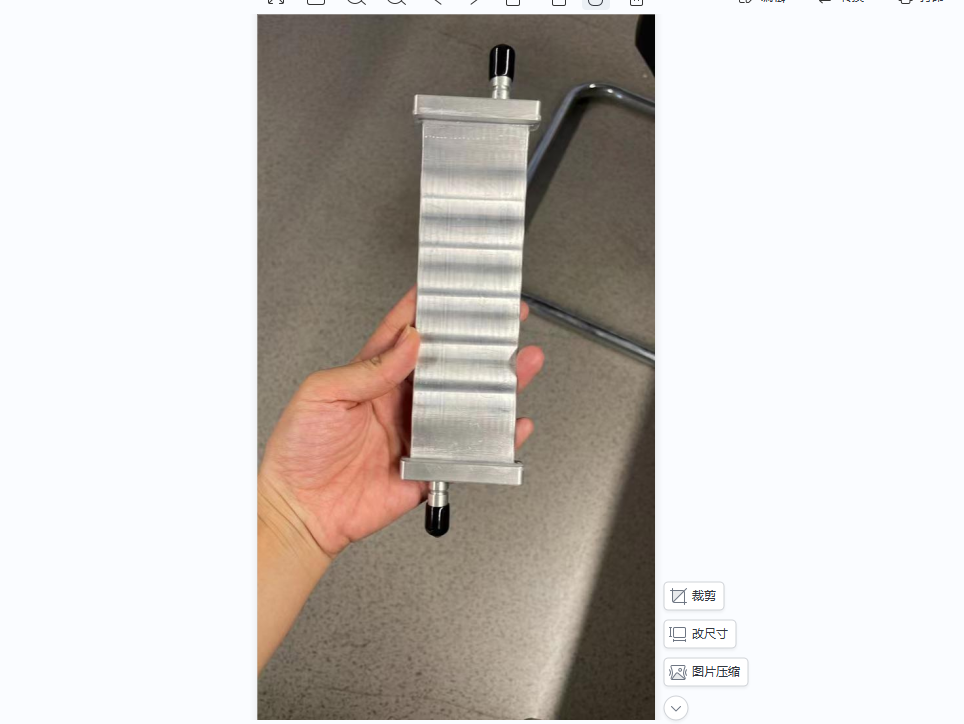
A serpentine cooling tube — often shortened to snake tube — performs the same function with a different geometry. Instead of channels formed inside a flat plate, a single tube is bent into a repeating back-and-forth path and bonded to a plate, a cooling block, or the module structure itself. Coolant enters at one end, travels the full serpentine route, and exits at the other.
Serpentine tubes earn their place where routing flexibility matters more than maximum contact area. A tube can be bent around cell holders, busbars, and structural ribs, and it can be integrated into a module during assembly rather than added as a separate plate beneath it. The trade-offs are equally clear. A round tube touches a flat surface along a line unless it is flattened or seated into a grooved plate, so the quality of the bond and the interface material carry more of the thermal load than they do on a full cold plate. Long serpentine paths also accumulate pressure drop, which the pump has to overcome. The practical consequence is that serpentine designs tend to suit low-to-moderate heat loads, irregular module shapes, and applications where the coolant path must be assembled into the product rather than placed under it.
Many production designs combine both ideas: a serpentine tube is seated into a plate or channel body, giving the routing benefits of a tube and the contact area of a plate.
Aluminum 3003: the default alloy for battery cold plates
3003 is an aluminum-manganese alloy widely used in heat exchangers and brazed assemblies. It is chosen for cold plates because it offers good thermal conductivity together with corrosion resistance and formability — the properties that decide whether a plate can be stamped, bent, or brazed reliably at production rates. Trumony specializes in 3003 aluminum alloy cold plates, with thermal resistance stated as low as 0.07 K/W.
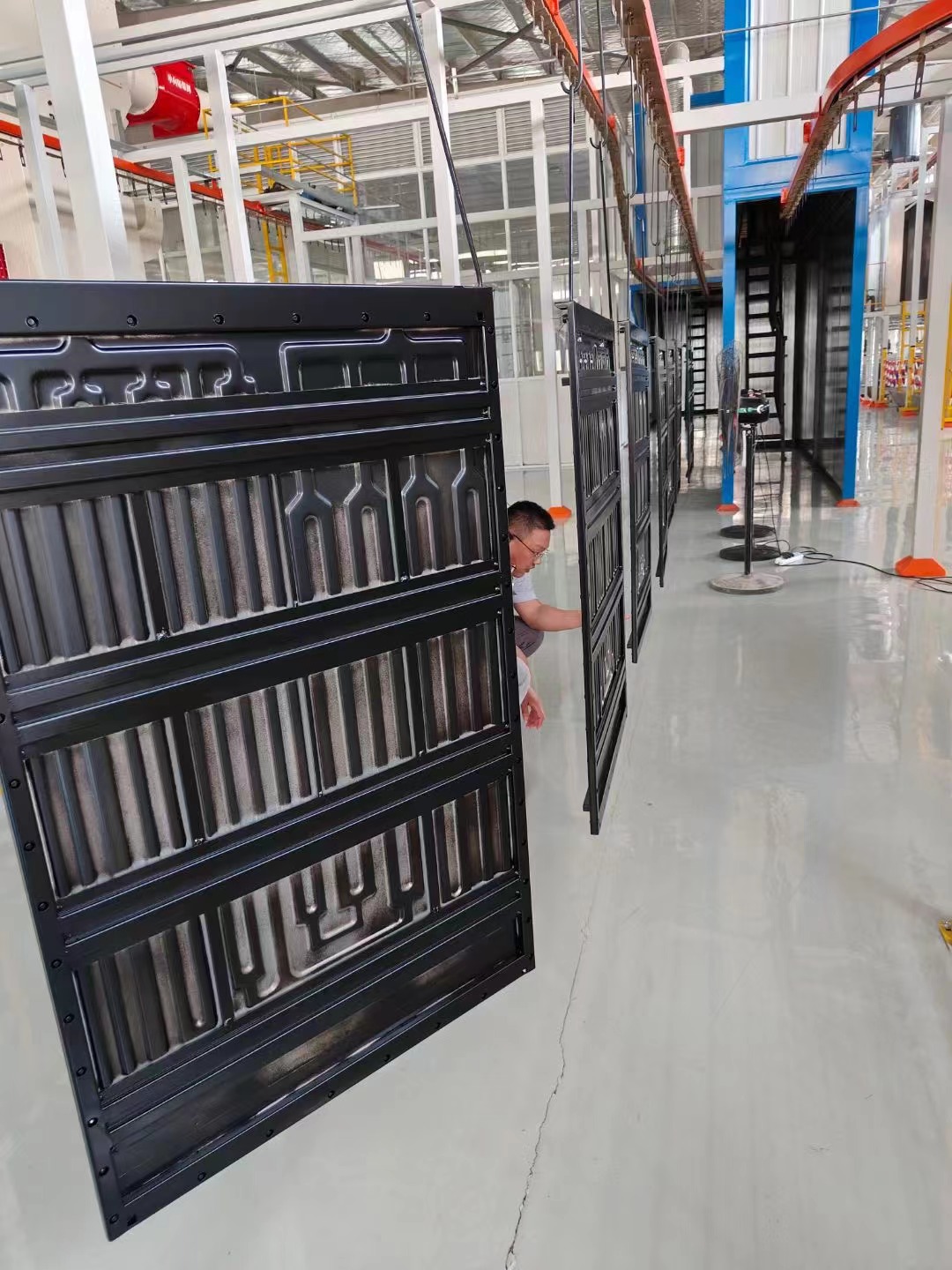
The limits are worth stating as plainly as the advantages. 3003 is not a high-strength structural alloy, so where a plate also has to carry mechanical load, designers compensate with thickness, ribs, or a separate structural member rather than relying on the alloy itself. Surface treatment and coating are used where the coolant circuit and the surrounding environment call for additional corrosion protection.
How thickness and channel geometry set cooling efficiency
Thickness influences two things at once: the length of the conduction path and the mass of the finished part. A thinner plate reduces weight and can shorten the thermal path, but it also reduces stiffness and the wall thickness available to contain coolant pressure. Channel depth, channel width, and wall thickness decide how much coolant can flow through the plate and at what pressure drop.
Cooling efficiency is therefore a balance rather than a single number. More flow and deeper channels improve heat pickup but raise pump demand and can increase part height; thinner walls reduce thermal resistance but lower burst margin. On serpentine designs the same logic applies with tube diameter and bend radius replacing channel dimensions, and bend geometry becomes a pressure-drop factor. Customised thickness and channel geometry, together with the alloy choice, are the variables most often adjusted project by project.
Construction routes: stamped, brazed, CNC and copper tube
Four routes cover most of the market, and the choice between them shapes cost, output speed, and geometry freedom:
- Stamped cooling plates form the coolant channel in sheet aluminum and bond the layers into a sealed path. The route delivers effective production and is suitable for mass production, which is why it dominates high-volume EV and ESS work.
- Brazed cooling plates stack plates or tube assemblies and bond them in a brazing furnace, producing sealed internal channels with good dimensional consistency. Trumony's production assets include brazing line equipment for cold plate assembly.
- CNC cold plates machine the coolant path from solid material. Geometry freedom is high, but output speed is lower: production time on the CNC route is roughly 60% longer than on the aluminum plate platform, based on Trumony comparison data.
- Copper tube cold plates route copper tubing through the module. The material has excellent conductivity, but the cost position is higher — around 30% above the aluminum cooling plate platform in the same comparison data.
Step by Step: From Thermal Requirement to a Validated Cooling Plate
Whichever geometry is chosen, the engineering sequence is similar. The steps below describe how the basics translate into a working part.
- Define the thermal duty. Establish the heat load, the target cell temperature window, the allowed temperature spread across the module, and the coolant inlet conditions. Everything downstream is sized against this definition.
- Choose the architecture. Decide between a full cold plate, a serpentine tube, or a hybrid design. Contact area, packaging height, module shape, and assembly sequence usually decide this before cost does.
- Select the alloy and thickness. 3003 aluminum is the common baseline for wet-side components; thickness then follows from the stiffness, pressure containment, and thermal path requirements of the specific pack.
- Design the coolant path. Channel width, depth, wall thickness, and inlet and outlet positions determine flow distribution, pressure drop, and how evenly the module is cooled. Serpentine designs follow the same logic using tube diameter and bend radius.
- Choose the construction route. Stamped for high-volume sheet parts, brazed for sealed multi-layer channels, CNC where geometry complexity outweighs output speed, and tube-based designs where routing flexibility dominates.
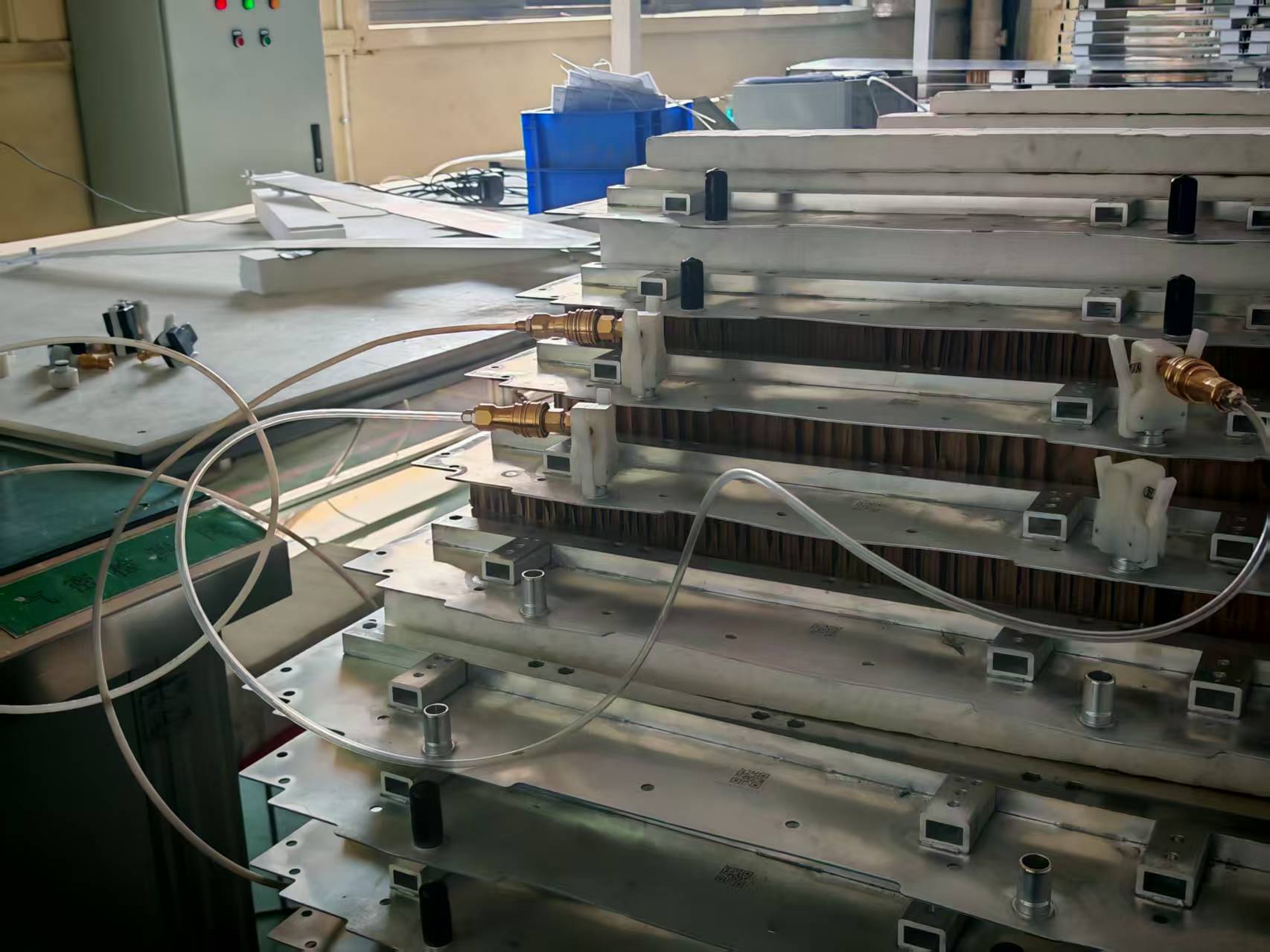
- Validate leak integrity and performance. Air tightness and helium leak testing are the control methods used against leakage risk; Trumony's stated production measure is 100% air tightness testing.
- Integrate protection and controls. Over-heating is managed at system level with thermal protection, typically temperature sensors on cells and coolant lines, so the system can act before the pack leaves its safe window.
- Move into series production. Volume capability and process coverage determine whether a validated design can actually be supplied at the required rate.
Use Cases: EV, ESS and Power Storage Applications
The same components appear across several product categories, but the priority shifts in each one.
- EV battery cooling plates. In traction packs, the plate sits beneath or between modules, and the design priority is temperature uniformity across many densely packed cells during fast charging. Both full cold plates and serpentine tube circuits are used, depending on module shape.
- Battery module cold plates. At module level, the plate cools a small group of cells and is often integrated into the module structure, which makes thickness and assembly height critical.
- BESS and energy storage system cooling plates. Containerized storage runs continuously rather than in drive cycles, so reliability and long-term corrosion behaviour matter as much as peak performance. The BESS liquid cooling market growth cited earlier reflects how quickly this segment is converting to liquid cooling.
- Power storage and high heat flux density applications. Converters and power electronics place higher local heat flux on a smaller area, which pushes design toward thicker sections, tighter channel spacing, or dedicated cooling blocks.
Comparison Table: Aluminum Cooling Plates vs Copper Tube and CNC Cold Plates
The table below summarises the comparison data Trumony publishes for its aluminum cooling plate platform against two alternative constructions. Only stated figures are shown.
| Comparison basis | Trumony aluminum cooling plate (stamped / brazed) | Copper tube cold plate | CNC cold plate |
|---|---|---|---|
| Relative unit cost | Baseline — lowest of the three | About 30% higher | About 10% higher |
| Production time | Baseline — shortest | — | About 60% longer |
| Maintenance demand | Lower | Higher | About 10% higher |
| Thermal efficiency | Higher | Lower | Lower |
| Best-fit application | EV and ESS packs, battery pack thermal management, mass production | — | — |
Source: Trumony product comparison data for its aluminum cooling plate platform. A dash (—) means the comparison source does not state a figure for that cell; no estimate has been added.
A separate decision sits above this table: whether to use a full cold plate or a serpentine tube. Full plates provide maximum contact area per unit of pack footprint, which favours high energy-density modules where temperature uniformity across many cells is the governing requirement. Serpentine tubes provide routing flexibility and simpler tooling, which favours irregular module shapes, moderate heat loads, and designs where the coolant path has to be assembled into the module rather than placed beneath it.
FAQ: Cooling Plates and Serpentine Tubes for EV and ESS
What standards and tests should a cooling plate for EV or ESS meet?
Liquid cooling plates for EV and BESS applications are expected to comply with international safety and quality standards including IATF 16949 for automotive quality management, ISO 9001, CE, and RoHS. Trumony's own facilities have passed ISO 9001 and TS16949 quality management systems. Beyond certification, leak integrity is verified in production: leakage risk is controlled through air tightness and helium leak testing, and Trumony states 100% air tightness testing as its production measure. Over-heating risk is handled at system level with thermal protection, typically temperature sensors.
Can cold plates and serpentine tubes be customised for a specific pack?
Yes — geometry in this component is normally project-specific rather than catalogue-based. Trumony's service scope covers battery thermal management solutions, liquid cooling system development and design, liquid cooling materials, liquid cooling components, and liquid cooling assemblies, so a plate or tube design is developed against the pack requirement. The company works in 3003 aluminum alloy, employs 25 R&D engineers, and operates from a 100,000 m² facility with testing centres and laboratories.
What drives the cost difference between cooling plate designs?
Construction route and material are the two largest levers. In Trumony's published comparison data, its aluminum cooling plate platform is positioned about 30% below copper tube cold plates on cost, with higher efficiency and less maintenance, and about 10% below CNC cold plates on cost, with roughly 60% shorter production time and about 10% lower maintenance demand. The practical implication for buyers is that the choice between stamped, brazed, CNC and tube-based construction usually affects total cost more than the price of the raw material alone.
How can a buyer validate a cooling plate before committing to volume?
Validation normally starts with sample parts and a leak test, because leak integrity is the failure mode that costs the most to correct later. Trumony produces liquid-cooling components for power battery packs and energy storage battery packs, with air tightness and helium leak testing as the stated leakage controls. Buyers who want to evaluate a plate or serpentine tube design against their own pack requirement can request samples and a quotation from Trumony by email at tracy@trumony.com, or by phone and WhatsApp at +86 13584862808.
What supports lead time and long-term supply continuity?
Capacity and process coverage are the two things to verify. Trumony operates 100,000 m² of standard workshops with high-standard testing centres and laboratories, employs 220 people, and lists an annual output of 600,000 units, with 25 R&D engineers supporting new designs. Around 40% of its output is exported, reaching 56 countries and regions, with the EU, the USA, and India as its main markets.
Conclusion: Choosing Between Cold Plates and Serpentine Tubes
The basics are straightforward once the heat path is clear. A cooling plate removes heat from battery cells by conduction into aluminum, then by convection into a liquid coolant that carries it out of the pack. A serpentine tube does the same thing with a routed tube instead of internal channels. The variables that decide performance are the alloy — with 3003 aluminum as the common baseline for wet-side components — the thickness of the material, and the geometry of the coolant path, which together set the balance between cooling efficiency, pressure drop, weight, and manufacturability.
The variables that decide cost are the construction route. Stamped and brazed aluminum plates suit volume production, CNC offers geometry freedom at lower output speed, and copper tube designs trade a higher cost position for routing flexibility. Matching those two sets of variables to a specific EV, ESS, or power storage program is the work that turns a generic plate into a working thermal component.
Next Step: Samples, Quotation, or a Design Review
If your project needs a cold plate or serpentine cooling tube specified against a real thermal duty, Trumony can review the requirement and supply samples for validation.
Email: tracy@trumony.com · Tel / WhatsApp: +86 13584862808
Website: www.trumony.com
Trumony Aluminum Limited, D-7, Dongchuang Science and Technology Park, No. 216 Jinfeng Road, Wuzhong District, Suzhou, Jiangsu Province, P.R. China.