
How to Match a Cooling Plate to Your EV or BESS Project: A Scenario-Based Selection Guide
Selecting the right cooling plate for an EV or BESS project is not a one-size-fits-all decision. The correct choice depends on operating conditions, thermal load, packaging constraints, and the manufacturer's ability to customize. This guide explains how to match a liquid cooling plate, EV cooling plate, or BESS cooling plate to a concrete project scenario, with practical decision criteria that buyers can use during the research and evaluation phase.
What a Cooling Plate Does in EV and BESS Thermal Management
A cooling plate, also called an aluminum cold plate or water cooling plate, is a flat heat exchanger that transfers heat from battery cells to a circulating coolant. In electric vehicles and battery energy storage systems, the battery cooling plate is the main interface between the cells and the thermal management loop. By keeping cell temperature within the recommended range, the plate protects cycle life, charging performance, and safety.
The market context helps explain why cooling plates matter. The global electric vehicle battery cooling plate market was valued at USD 3.01 billion in 2024 and is projected to reach USD 16.13 billion by 2035 (Market Research Future). Separately, the stationary BESS liquid cooling market is expected to grow from USD 4.23 billion in 2024 to USD 24.51 billion by 2033, at a 21.55% CAGR (BIS Research / Business Wire). Aluminum-based cooling plates account for approximately 64% of all cooling plate installations, driven by thermal conductivity and cost-effectiveness (Market Growth Reports). These figures show that the component choice is becoming a strategic procurement decision, not just an engineering detail.
Trumony Aluminum Limited, a manufacturer headquartered in Suzhou, China, produces aluminum cooling plates and cooling tubes for EV, BESS, and powertrain applications. The company operates 100,000 m² of standard workshops and employs 220 people, including a 25-engineer R&D team. Its products are exported to 56 countries and regions across Europe, America, the Middle East, Southeast Asia, and Russia.
When Project Conditions Should Drive the Cooling Plate Choice
Buyers evaluating cooling plate suppliers often focus on price or internal construction first. However, the most reliable way to narrow down the field is to define the project scenario and then compare products against it. Conditions that change the design of a battery cooling plate include ambient temperature, continuous operation profile, coolant type, corrosion protection, space envelope, and whether the project is an OEM platform or a one-off system.
Two documented scenarios illustrate this logic:
Scenario 1 – EV battery pack thermal management. A liquid cooling plate for an EV battery pack usually operates under high temperature conditions and runs 24/7 in conjunction with the vehicle cooling system. The requirement is continuous battery pack heat dissipation. Because automotive enclosures are often exposed to moisture, road salts, and coolant chemistry, some EV projects specify an epoxy coating or equivalent protective layer on the plate. A liquid cooling plate for EV must therefore combine thermal performance with environmental resistance.
Scenario 2 – ESS battery pack thermal management. Energy storage systems also operate at high ambient temperatures and run continuously around the clock. The function is again battery pack heat dissipation, and the matched equipment is a cooling system. For ESS, the energy storage system cooling plate may face additional requirements such as epoxy coating for insulation or corrosion protection. This is especially relevant in containerized ESS installations, where the cooling loop may operate for years with limited maintenance.
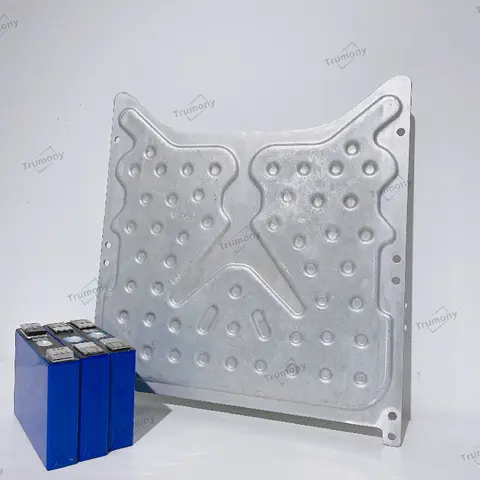
These two scenarios are not identical. The EV cold plate is typically shaped around module or pack geometry, while the cooling plate for power storage is often larger, flatter, and designed for modular rack or container layouts. That is why the same manufacturer should be able to produce both stamped cooling plate and brazing cooling plate variants, and to adjust thickness and cooling efficiency to the project.
How Trumony Matches Cooling Plates to Project Scenarios
Trumony Aluminum Limited provides liquid cooling products for power battery packs, energy storage battery packs, high heat flux density heat exchange, and new liquid-cooling heat exchange components. For EV and BESS buyers, the key is not just the product name but the ability to adapt it. Trumony lists all its cooling plates as aluminum 3003 alloy, with customized cooling efficiency and customized thickness. The applicable industries are engineering, EV, ESS, and powertrain.
For EV battery cooling plate and electric vehicle cooling plate needs, Trumony offers models such as the liquid cooling plate for EV (TR-20260225) and electric vehicle cooling plate (TR-20260224). For energy storage, the portfolio includes the Liquid cooling plate for energy storage (TR-20260228) and Energy storage system cooling plate (TR-20260226). For module-level integration, the battery module cold plate (TR-20260219) is the relevant reference. All are made of Aluminum 3003, a standard alloy for brazed and stamped cold plates.
The manufacturer also provides cooling tube products, including the serpentine cooling tube (TR-20260230), snake tube (TR-20260231), and snake cooling tube (TR-20260232). These are relevant when the thermal management design uses tube-in-plate or serpentine flow paths instead of a flat machined channel. Selecting between a cooling plate and a cooling tube should be driven by the cell format and the heat transfer area required.
Step-by-Step: Matching a Cold Plate to an EV or ESS Project
Step 1 – Define the Operating Conditions
Start with ambient temperature, whether heat rejection is continuous, and whether the project requires 24/7 operation. EV and ESS battery pack thermal management both operate 24/7 in high-temperature conditions, but the severity differs by region. A project in a hot climate may require lower thermal resistance and higher coolant flow than a project in a temperate market.
Step 2 – Set the Functional Requirement
The primary function is battery pack heat dissipation. Quantify this into a heat load (in watts) and an allowable temperature difference. If the engineering team cannot define the heat load precisely, request a supplier design review. A reliable aluminum cold plate supplier should be able to discuss customized cooling efficiency and customized thickness rather than selling only a standard model.
Step 3 – Check Material and Coating
Aluminum 3003 is the base material for most Trumony cold plates. For projects with high humidity, condensation, or aggressive coolant chemistry, ask whether an epoxy coating is available. Epoxy-coated plates are relevant for both ESS and EV applications when insulation and corrosion resistance are required.
Step 4 – Compare Manufacturing Processes
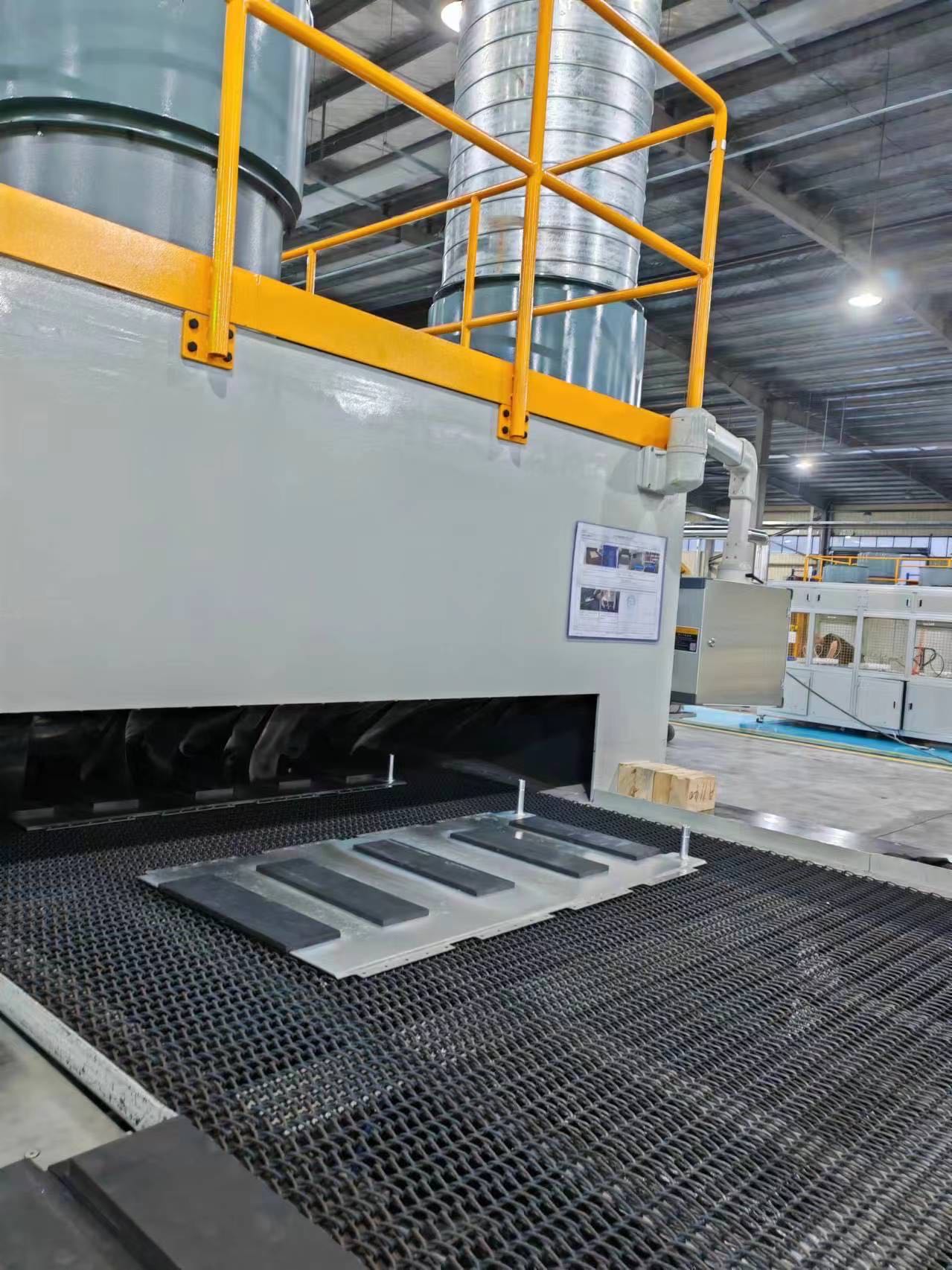
A stamped cooling plate is formed from sheet metal and is usually suited to high-volume, cost-sensitive applications. A brazing cooling plate uses a brazing process that can create more complex internal channels and is often used when thermal performance and structural integrity matter more. Do not presume one process is always better; match it to the volume, pressure, and thermal requirement of the project.
Step 5 – Evaluate Customization and Quality Control
For OEM projects, confirm that the supplier can customize dimensions, cooling efficiency, and logo printing. Trumony’s OEM capability for cold plates and cooling tubes includes these three customization points, with a monthly capacity of 500,000 units for plate production and a 30-day lead time. Quality control should include 100% air leakage testing and dimensional testing, with optional helium tightness, voltage resistance, hydrostatic strength, burst, high-temperature resistance, and low-temperature resistance tests.
Use Cases: Which Plate Fits Which Project
EV Passenger Car Battery Pack
An EV pack often needs a compact, lightweight liquid cooling plate for EV. The plate should match the module footprint, fit within tight vertical space, and withstand automotive vibration. If the pack is based on blade cells or prismatic cells, a stamped or brazed aluminum cold plate with an epoxy coating can provide good surface contact and corrosion protection.
ESS Container or Rack System
An energy storage system cooling plate is usually larger and simpler in shape. The priority is consistent cooling across many cells, minimized leak risk, and low maintenance. A brazed cold plate with a protective coating is common in containerized ESS projects. For a 3000-unit ESS container case, Trumony supplied stamped and coated plates that have remained in stable operation for 15 years, with low noise and fast lead time.
Battery Module or Small Pack
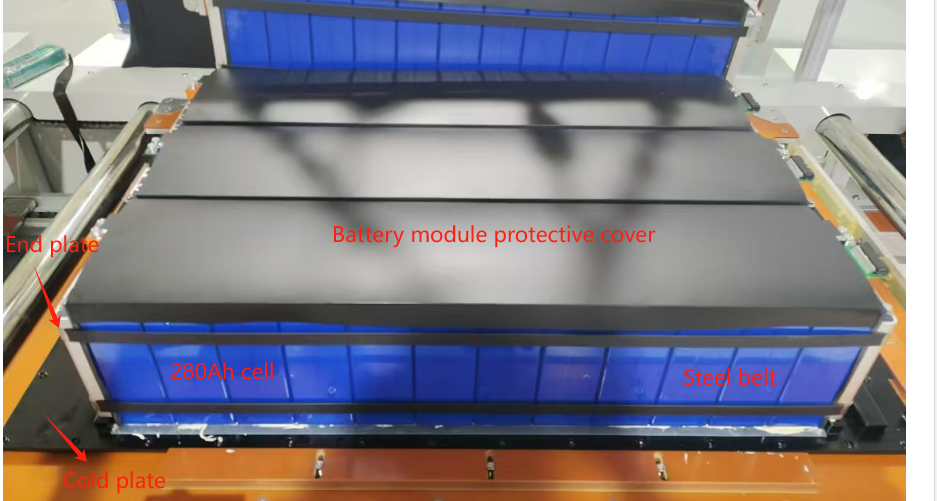
When the scope is a module rather than a full pack, a battery module cold plate is the direct interface. Buyers should verify the thickness and flow configuration with the supplier. In Trumony’s portfolio, the battery module cold plate (TR-20260219) is listed for this purpose, with aluminum 3003 material and customizable thickness.
Comparison Table: EV vs. ESS Cooling Plate Requirements
| Selection Criterion | EV Battery Pack | ESS Battery Pack / Container |
|---|---|---|
| Typical operating condition | High temperature, 24/7 | High temperature, 24/7 |
| Primary function | Battery pack heat dissipation | Battery pack heat dissipation |
| Matched system | Vehicle cooling system | ESS cooling system |
| Common protective requirement | Epoxy coating | Epoxy coating |
| Typical product form | EV cooling plate, liquid cooling plate for EV | ESS cooling plate, liquid cooling plate for energy storage |
| Design priority | Compactness, weight, vibration resistance | Uniform temperature, reliability, low maintenance |
Selection Checklist for Buyers
- Confirm the project type: EV battery pack, ESS battery pack, or module-level integration.
- Define operating conditions: temperature, continuous operation, and coolant type.
- Identify whether epoxy coating or another protective finish is required.
- Choose a product form: cooling plate, water cooling plate, or cooling tube.
- Compare stamped cooling plate vs. brazing cooling plate based on volume and performance targets.
- Verify customization options: dimension, cooling efficiency, and logo.
- Check quality control tests: 100% air leakage, dimensional, and optional helium or voltage resistance tests.
- Evaluate lead time and production capacity against the project schedule.
Frequently Asked Questions
What cooling plate does a BESS project need?
A BESS project typically needs an energy storage system cooling plate or a liquid cooling plate for energy storage that can dissipate heat continuously under high-temperature conditions. The plate should be compatible with the ESS cooling system, and an epoxy coating is often used for corrosion and insulation protection.
Can I get a custom liquid cooling plate for my EV battery pack?
Yes. Suppliers such as Trumony Aluminum Limited offer customization of dimensions, cooling efficiency, and logo for EV liquid cooling plates. In Trumony’s OEM model, custom dimensions and cooling efficiency are standard customization points, with a monthly capacity of 500,000 units and a 30-day lead time.
Which is better for EV and BESS, a stamped or brazed cooling plate?
There is no universal answer. A stamped cooling plate is generally suitable for high-volume, cost-sensitive projects, while a brazing cooling plate can support more complex internal channel designs and higher structural integrity. The choice should be based on the project’s thermal load, operating pressure, volume, and budget.
What quality tests are performed on aluminum cold plates?
Trumony lists 100% air leakage testing and dimensional testing as standard quality control measures. Optional tests include helium tightness, voltage resistance, hydrostatic strength, burst, high-temperature resistance, and low-temperature resistance. Buyers should confirm which tests apply to their project during supplier qualification.
What is the lead time for a custom cooling plate sample?
Trumony’s OEM capability indicates a 30-day lead time for custom aluminum cooling plate projects. For an exact sample schedule, the buyer should submit a drawing or specification and request a quotation, because lead time depends on the customization scope, coating, and testing requirements.
Have a project in mind? Request a quote or sample specification from Trumony Aluminum Limited to evaluate whether your EV or ESS cooling plate requirement can be met.
Email: tracy@trumony.com | Tel/WhatsApp: +86 13584862808 | www.trumony.com
Have Questions or Need More Details?
Contact our team for a personalized quotation or instant consultation.
Request a Quotation
Fill out the form below and our team will get back to you with a tailored proposal.
WhatsApp Direct Chat
Prefer to chat in real-time? Message us on WhatsApp for instant assistance & quick answers.
- Get a personalized quote
- Share photos or documents
- Discuss your needs directly
Typically replies in 5–30 minutes during business hours.