Heavy Duty Cylinder Solutions for Marine and Offshore Hydraulic Systems: An Application Guide
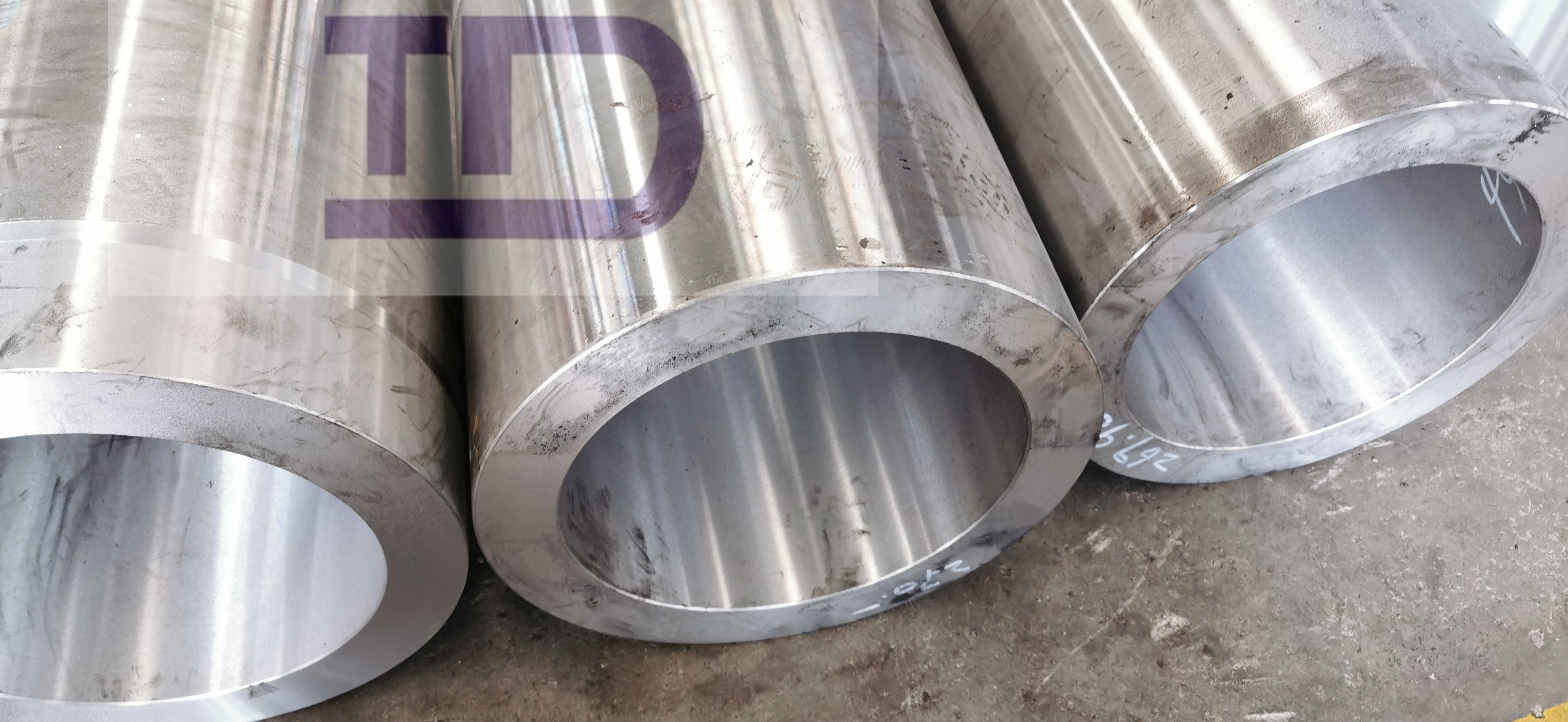
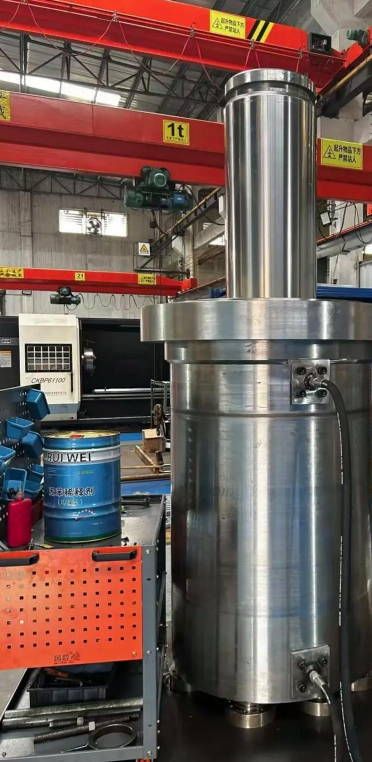
Heavy duty cylinder solutions for marine and offshore hydraulic systems are hydraulic actuators engineered around saltwater exposure, high humidity, continuous load-holding and long service intervals — not simply larger versions of a standard industrial cylinder. The differences sit in the cylinder barrel material, the bore geometry, the sealing system and the pressure rating, and they are decided at the specification stage, long before a purchase order is placed.
This application guide is written for hydraulic engineers, procurement teams and maintenance planners who are still in the research and evaluation phase of a marine or offshore cylinder project. It covers what makes offshore duty different, which material and sealing decisions actually matter, how a custom cylinder is specified step by step, and what the long-term cost picture looks like. The product capability described here belongs to Shandong Tuoda Machinery Equipment Co., Ltd. (Tuoda Machinery), a manufacturer of seamless steel pipe, custom hydraulic cylinders and machined components based in Liaocheng, Shandong, China, with exports reported at around 70% of output and main markets in the EU, Asia and South Africa.
Why Marine and Offshore Hydraulic Duty Is a Different Problem
The working conditions listed for hydraulic cylinder applications in marine hydraulic systems include marine exposure, high humidity, outdoor operation and wide temperature variation. In the same equipment families, cylinders are also expected to tolerate impact loads combined with slurry in mining duty. Three factors drive specification decisions on offshore and vessel-based projects.
Continuous exposure to salt and moisture. Salt-laden air, deck washdown and condensation attack the external surfaces and, over time, the sealing interfaces of any cylinder that sits in an open marine environment. Corrosion-resistant material selection and surface treatment are therefore a baseline requirement rather than an upgrade. A cylinder that survives an indoor factory floor for a decade can fail within a few seasons when the same design is mounted on a deck.
Continuous load and impact loading. Marine cylinders are linear reciprocating actuators that convert hydraulic energy into mechanical energy, and many of them hold loads under pressure for extended periods. Steering gear, anchor winches and high-pressure test benches all fall into this category. Impact and variable loading add a second stress pattern on top of steady pressure, which is why overpressure protection and structural integrity matter more in this segment than in general industrial work.
Long and expensive repair windows. A vessel or platform does not stop for a single cylinder. Replacing one usually requires a docking window, lifting equipment and a planned outage, and the cost of that downtime typically exceeds the price of the cylinder by a wide margin. This is the single most important reason marine buyers evaluate total cost of ownership instead of first price, and it is why the large bore segment is so prominent in offshore and heavy mobile hydraulic work.
Specification rule of thumb: on a marine project, the cylinder that is cheapest to buy is rarely the cheapest to own. Material grade, bore finish, sealing system and dimensional consistency between production batches are the variables that actually control lifecycle cost.
Industry Background: Where Marine Cylinders Sit in the Wider Market
The hydraulic cylinder category is large and still expanding. The global hydraulic cylinder market was valued at USD 15.7 billion in 2024 and is projected to reach USD 24.7 billion by 2034, according to Global Market Insights. A significant share of that demand comes from mobile applications: mobile hydraulics, including construction and mining equipment, accounted for over 58% of the total hydraulics market share in 2024, based on Grand View Research data.
Configuration trends are equally relevant to marine specification. Double-acting hydraulic cylinders dominated the industry with a 70% market share in 2024, favored for precision-driven heavy-duty construction and robotics applications, according to Global Market Insights. For deck machinery and steering systems, the ability to control force in both directions is not a preference — it is the operating requirement.
The large bore segment is where marine and offshore projects overlap most heavily with other heavy industries. Large bore hydraulic cylinders with a bore size above 150 mm held approximately 27.4% of market revenue in 2025, driven by demand for large mining excavators and tunnel boring machines, according to Dataintelo. Offshore high-pressure test benches and heavy deck equipment follow a similar logic: concentrate force into fewer, larger actuators and accept the engineering burden that comes with it.
On the standards side, heavy-duty hydraulic cylinders for industrial applications are governed by ISO 6022 (250 bar series) and ISO 6020 (160 bar series) for mounting dimensions and interchangeability, according to ISO/TC 131 Fluid Power Systems. Those standards define mounting fit and interchangeability — they do not cap the pressure a purpose-built cylinder can be designed for. When a marine project calls for pressure above the standard series range, the cylinder becomes a custom item, and the specification process shifts to the manufacturer's engineering capability.
Supply is also globalised. China's exports of hydraulic power engines and motors, including cylinders, to the United States reached approximately USD 80.4 million in 2024, according to the World Integrated Trade Solution. For offshore buyers, the practical consequence is a wide supplier field in which material traceability, bore precision, testing discipline and delivery reliability become the real differentiators.
Engineering a Heavy Duty Cylinder for Harsh Marine Conditions
A marine duty cylinder is defined by how its barrel, rod, seals and valve body work together as one matched system under salt, humidity, pressure and cyclic load. Each of the following areas is a specification decision, not a manufacturing detail.
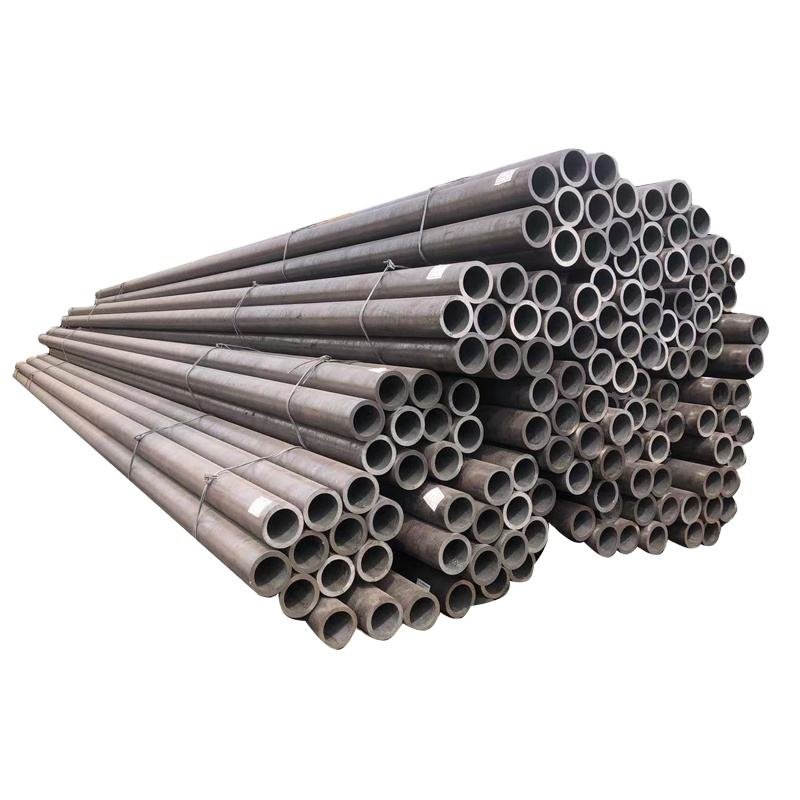
Barrel material and tube selection
Cylinder barrel stock at Tuoda Machinery is selected from ST52, S355, E355, C45, SAE1045 and 42CrMo4, with customised grades available on request. The underlying heavy-wall seamless steel pipe is produced to international specifications including EN10210, EN10305, API 5L, A335, A333 and A106, and is manufactured in compliance with ASTM and CE requirements. For marine duty, material grade determines whether the barrel holds its shape under sustained pressure and whether the rod resists wear across a high cycle count.
Bore machining, roughness and dimensional consistency
The special requirements listed for marine and heavy equipment cylinders are internal bore dimensional stability with batch consistency, straightness, internal bore roughness and concentricity. In production terms those requirements translate into specific, measurable targets:
- ISO hole diameter tolerances of H8/H9
- Arithmetic roughness of Ra ≤ 0.4 μm
- Precision honing, surface treatment and heat treatment operations
These numbers matter because they determine seal life. A rough or out-of-round bore abrades the seal lip and allows internal bypass; a barrel that is not straight forces the rod to fight the bore on every stroke. For a fleet that will reorder the same cylinder over several years, batch-to-batch consistency is worth more than any single unit's peak performance.
Pressure ratings: high pressure and ultra-high pressure
Tuoda custom hydraulic cylinders are built in two pressure bands, and the choice between them is driven by the application rather than by preference:
- High-pressure hydraulic cylinders: 31.5 – 63 MPa — used for heavy-duty equipment such as hydraulic excavators, crushers, four-column hydraulic presses, marine steering gear and anchor winches.
- Ultra-high-pressure hydraulic cylinders: above 63 MPa — designed for specialized equipment including high-pressure water jet cutting machines, artillery recoil systems and material pressure-testing apparatus.
Marine steering gear and anchor winches sit inside the high-pressure band, which is one reason this segment is a core application for the company rather than a marginal one.
Sealing system and leakage control
Oil leakage is one of the most common failure modes on heavy duty cylinders, and on a vessel it is doubly unacceptable — it creates an environmental and housekeeping problem while degrading performance and controllability. Tuoda manufacturing technology combines metal-to-metal sealing, high-performance polyurethane seals, forged valve bodies and thick-wall seamless steel pipe tubing. A matched hydraulic system is supplied as cylinder barrel, piston rod, piston, gland or head, end cap, sealing system, guide bush and ports, so the sealing interfaces are designed as a set rather than assembled from mixed parts.
Overpressure protection and valve body integrity
Forged valve bodies and overpressure protection devices are structural safeguards. Pressure spikes generated by sudden load changes or impact conditions can reach the cylinder faster than any control loop can respond; overpressure protection limits what those spikes do to the seals and barrel. On offshore equipment where a failure means a service call that cannot be scheduled quickly, this is a low-cost form of risk reduction.
Dimensional range available
For specification planning, the working envelope of custom heavy duty cylinders is:
- Outer diameter range: 20 – 800 mm
- Wall thickness range: 3 – 50 mm
- Lengths: 6 m / 5.8 m / 12 m / 6 – 12 m, with customised lengths available
- Weight tolerance: ± 10%
Within that envelope, customisation covers application, size, bore, stroke, pressure, load, system solution, cylinder configuration and logo printing. Cylinder types available include piston, plunger, telescopic (multi-stage) and rotary (oscillating) designs — a relevant range for deck machinery, where mounting space and stroke length often dictate the type before pressure does.
Specifying a Heavy Duty Cylinder for a Marine or Offshore Project: Step by Step
Tuoda's customisation workflow runs from application analysis through drawing verification, material selection, manufacturing and honing, inspection and testing, to final delivery. Reframed as a buyer-side sequence, it looks like this.
- Define the application and the operating environment. Confirm whether the cylinder will sit exposed on deck, inside a machinery space or in a submerged or washdown-exposed position. Note humidity, temperature variation, washdown frequency and the presence of salt or slurry. This step determines how much of the specification is driven by corrosion resistance versus mechanical duty.
- Confirm bore, stroke, pressure and load. Fix the required thrust and the pressure band the system can support. This is where the cylinder is placed into either the 31.5 – 63 MPa high-pressure band or the above-63 MPa ultra-high-pressure band.
- Select barrel material and tube specification. Choose from ST52, S355, E355, C45, SAE1045 or 42CrMo4, and match the seamless pipe grade and condition of delivery to the pressure and cycle profile. Specify the tolerance class required on the bore.
- Choose the sealing and surface solution. Decide between metal-to-metal sealing and high-performance polyurethane seals, and confirm the surface treatment and heat treatment steps required for the exposure level.
- Select the cylinder type and mounting. Piston, plunger, telescopic or rotary designs solve different problems. Telescopic cylinders suit long strokes in confined mounting space; rotary cylinders suit oscillating deck mechanisms.
- Verify drawings and tolerances. Drawing verification confirms that bore, stroke, mounting centres and port positions match the equipment interface. Bore tolerances are held to ISO H8/H9 and arithmetic roughness to Ra ≤ 0.4 μm.
- Confirm inspection and testing. Pressure testing is the stated quality control step. Agree on what will be recorded — test pressure, hold time and results — before production begins.
- Plan delivery and lifecycle support. Standard manufacturing lead time is quoted at 30 – 45 days, with custom builds running 45 – 60 days. After-sales support covers repair, spare parts and a service network, which matters for equipment that must return to service on a fixed schedule.
Where Marine and Offshore Heavy Duty Cylinders Are Used

Marine steering gear and rudder actuation
Steering gear is explicitly listed among the applications for Tuoda high-pressure hydraulic cylinders in the 31.5 – 63 MPa band. The requirement here is predictable force delivery in both directions, which is why double-acting configurations — the 70% share segment of the cylinder market in 2024 — dominate this kind of duty.
Anchor winches and deck machinery
Anchor winches also appear in the same high-pressure application list. These are slow-cycle, high-load actuators exposed to continuous marine atmosphere, and they typically operate within a fixed maintenance window tied to vessel schedules rather than to the equipment's own convenience.
Offshore high-pressure test benches
Material pressure-testing apparatus belongs to the ultra-high-pressure category above 63 MPa. These are stationary but demand precisely controlled pressure and reliable sealing over repeated test cycles, and they share the same sealing and valve body technology as the marine cylinders.
Construction and mining equipment operating in port and coastal conditions
Heavy duty cylinders are supplied for construction machinery and mining equipment, including hydraulic excavators and crushers. Equipment operating at ports, in coastal yards or on offshore support vessels faces the same combination of humidity, high temperature, dust and impact that defines the marine duty profile.
Two-figure outcome from a long-running installation
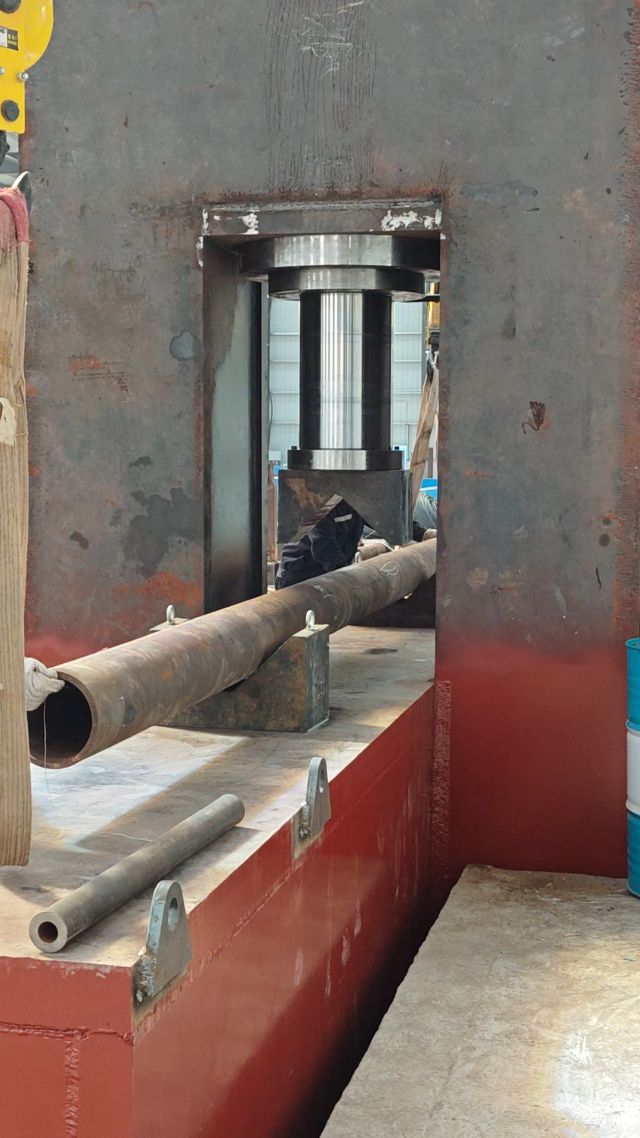
A heavy machinery OEM in Vietnam installed a single Tuoda cylinder on a straightening machine and has operated it for more than ten years. Reported results are stable operation, energy saving, reduced maintenance cost and zero major failures. The application is not a vessel, but the operating profile — sustained load, continuous duty and a requirement for dimensional stability — is the same profile that marine and offshore equipment generates. It is the clearest available evidence for what the material, honing and sealing choices described above deliver over a full service life.
Specification Comparison: High-Pressure vs Ultra-High-Pressure Heavy Duty Cylinders
The table below compares the two pressure bands using the stated application and specification data. It is intended as a scoping tool for the research phase, not as a substitute for engineering review of an individual project.
| Comparison item | High-pressure heavy duty cylinder | Ultra-high-pressure heavy duty cylinder |
|---|---|---|
| Pressure band | 31.5 – 63 MPa | Above 63 MPa |
| Stated applications | Hydraulic excavators, crushers, four-column hydraulic presses, marine steering gear, anchor winches | High-pressure water jet cutting machines, artillery recoil systems, material pressure-testing apparatus |
| Typical marine relevance | Direct — steering gear and anchor winches are named applications | Indirect — test benches and specialised offshore equipment |
| Barrel and rod materials offered | ST52, S355, E355, C45, SAE1045, 42CrMo4, customised | ST52, S355, E355, C45, SAE1045, 42CrMo4, customised |
| Sealing technology | Metal-to-metal sealing and high-performance polyurethane seals | Metal-to-metal sealing and high-performance polyurethane seals |
| Bore tolerance and roughness | ISO H8/H9, Ra ≤ 0.4 μm | ISO H8/H9, Ra ≤ 0.4 μm |
| Structural safeguards | Forged valve bodies, thick-wall seamless steel pipe, overpressure protection | Forged valve bodies, thick-wall seamless steel pipe, overpressure protection |
| Selection driver | Force requirement within a standard-system pressure envelope | Specialised process pressure that exceeds standard high-pressure system design |
Read the table as a filter, not a ranking. Most marine steering and deck applications land in the high-pressure band; the ultra-high-pressure band exists for processes where the pressure itself is the job. In both cases, the material, bore finish and sealing system carry more weight in the final performance outcome than the nominal pressure number alone.
Frequently Asked Questions
What standards and tolerances apply to marine and offshore heavy duty hydraulic cylinders?
Heavy-duty hydraulic cylinders for industrial applications are governed by ISO 6022 (250 bar series) and ISO 6020 (160 bar series) for mounting dimensions and interchangeability, according to ISO/TC 131 Fluid Power Systems. Those standards address mounting fit, not maximum design pressure, so cylinders built for higher marine pressures are produced to customer drawings instead. At Tuoda Machinery, bore tolerances are held to ISO H8/H9 with arithmetic roughness of Ra ≤ 0.4 μm, and the seamless steel pipe used for barrels is produced to EN10210, EN10305, API 5L, A335, A333 and A106, in compliance with ASTM and CE requirements.
How far can a heavy duty hydraulic cylinder be customised for an offshore project?
Customisation covers application, size, bore, stroke, pressure, load, system solution, cylinder configuration and logo printing. The standard working envelope is an outer diameter range of 20 – 800 mm, wall thickness of 3 – 50 mm, lengths from 5.8 m to 12 m, and a weight tolerance of ± 10%. Available cylinder types are piston, plunger, telescopic (multi-stage) and rotary (oscillating). Barrel and rod material is selectable from ST52, S355, E355, C45, SAE1045 and 42CrMo4. The stated production mode is OEM and custom manufacturing, with monthly capacity set flexibly against the order.
What drives the total cost of ownership of a marine heavy duty cylinder?
The dominant cost is downtime, not the cylinder. Because a vessel or platform cannot stop for a single actuator, every failure translates into a docking window, lifting arrangements and lost operating time. The specification choices that reduce that risk are barrel material grade, bore dimensional stability and batch consistency, straightness, concentricity, bore roughness, the sealing system and overpressure protection. One reference case — a heavy machinery OEM in Vietnam running a Tuoda cylinder on a straightening machine for more than ten years — reports stable operation, energy saving, reduced maintenance cost and zero major failures. Repair, spare parts and service network coverage are the other lifecycle cost elements to confirm before ordering.
Can a single custom cylinder be ordered before committing to a fleet order?
Yes. The stated minimum order quantity for Tuoda custom hydraulic cylinders is 1 unit, and the company states that it handles single-piece and small-batch runs as well as mass production. That makes it practical to validate a material, sealing or mounting change on one unit under real operating conditions before rolling the specification out across a fleet or a series of platforms.
What is the lead time for a custom marine hydraulic cylinder?
The product specification lists a standard delivery window of 30 – 45 days, while the custom manufacturing capability listing quotes 45 – 60 days for customised builds. The difference reflects the added engineering steps: application analysis, drawing verification, material selection, manufacturing and honing, inspection and pressure testing before shipment. To start a project — send your bore, stroke, pressure, mounting and environment details, or request the product catalogue and a quotation, by email at olivia@sdtuoda.com or WhatsApp at +86 13290268388.
Conclusion
Marine and offshore hydraulic systems do not need a different category of cylinder — they need a cylinder specified for a different set of conditions. Salt and humidity make material selection and surface treatment a baseline requirement. Continuous load, impact and long repair windows make bore precision, sealing integrity and overpressure protection the deciding factors. And because a single failure can cost far more than a fleet of spares, the purchase decision belongs to total cost of ownership rather than first price.
The practical path is straightforward: define the environment and duty cycle, fix bore, stroke, pressure and load, select material and sealing against those inputs, confirm bore tolerances and testing, then plan delivery and lifecycle support. Tuoda Machinery builds custom heavy duty hydraulic cylinders in the 31.5 – 63 MPa and above-63 MPa bands, in piston, plunger, telescopic and rotary configurations, with cylinder types, materials and dimensions matched to the application rather than pulled from a fixed catalogue.
Get the Marine and Offshore Cylinder Specification Pack
Send your application details — bore, stroke, pressure band, mounting and operating environment — and receive a tailored configuration proposal, pressure test plan and quotation.
Download the full product brochure: Tuoda Machinery Product Catalogue (PDF)
Email: olivia@sdtuoda.com | Tel / WhatsApp: +86 13290268388 | Web: sdtdsteel.com
Shandong Tuoda Machinery Equipment Co., Ltd. — NO853 south Liaoniu Road, Dongchangfu District, Shandong, China