Heavy Duty Hydraulic Cylinders: Custom OEM Capabilities and Extreme-Duty Fit
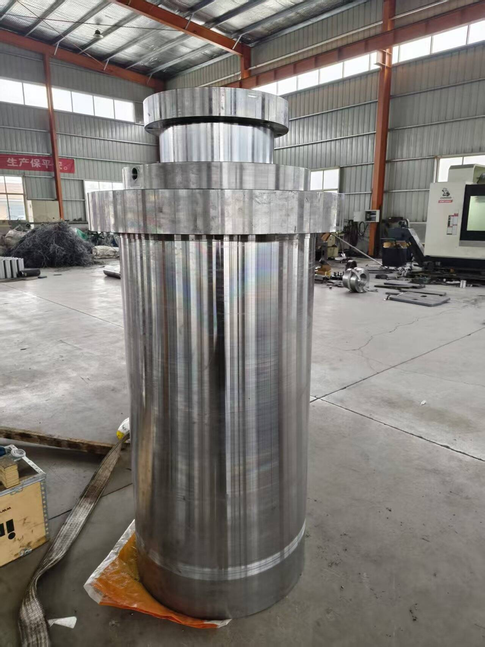
Custom heavy duty hydraulic cylinder from Tuoda Machinery.
The Right Fit for Extreme Duty: Custom Heavy Duty Hydraulic Cylinders from Tuoda Machinery
Heavy duty hydraulic cylinders are not one-size-fits-all components. A cylinder must fit the machine's mounting envelope, deliver the required force at the working pressure, survive the duty cycle, and keep operating under real site conditions. When standard catalog models cannot meet those requirements, buyers need a manufacturer with actual OEM and custom capability. Shandong Tuoda Machinery Equipment Manufacturing Co., Ltd. (Tuoda Machinery) is a China-based manufacturer that provides OEM and custom production services for hydraulic cylinders, with customization covering application, size, bore, stroke, pressure, load, system solution, cylinders, and logo printing.
Why Standard Heavy Duty Hydraulic Cylinders Create Gaps
Standard product ranges solve common specifications, but they rarely solve the entire machine problem. A standard cylinder may have the right pressure rating but the wrong mounting dimensions; the right bore but the wrong stroke; the right load capacity but poor fit for an excavator arm, mining attachment, forklift mast, or press frame. That is why non-standard heavy duty hydraulic cylinders are often a procurement requirement rather than a luxury.
- Large bore heavy duty hydraulic cylinders are needed when the machine must produce higher force at a given system pressure.
- Long stroke heavy duty hydraulic cylinders are needed when travel exceeds the available envelope of a standard body.
- High-pressure heavy duty hydraulic cylinders are needed for excavators, crushers, presses, and other equipment with severe load cycles.
- Double-acting heavy duty hydraulic cylinders may be required when replacing single-acting units to gain powered retraction or better control.
- Custom mounting heavy duty hydraulic cylinders are required when bore and stroke fit but interface dimensions do not.
- High-load upgrade heavy duty hydraulic cylinders are needed when standard cylinders have reached their structural or sealing limits.
- Wear-resistant and corrosion-resistant requirements usually translate into material, surface, and seal choices that must be confirmed during specification.
- Low-temperature-resistant cylinders require careful seal selection and material review for cold-climate installations.
Oil leakage is another common trigger for replacement. Leakage in a heavy duty cylinder is often linked to seal selection, bore finish, rod surface condition, or pressure spikes. A custom cylinder built with verified tolerances and pressure testing can address these failure modes more directly than a standard drop-in unit.
Industry Background: Where the Demand Is Heading
Global demand for hydraulic cylinders continues to expand. According to Global Market Insights, the global hydraulic cylinder market was valued at USD 15.7 billion in 2024 and is projected to reach USD 24.7 billion by 2034. The same source reports that double-acting hydraulic cylinders held about 70 percent of the market in 2024, favored for precision-driven heavy-duty construction and robotics. Grand View Research estimates that mobile hydraulics, including construction and mining equipment, accounted for more than 58 percent of the total hydraulics market in 2024.
Large bore cylinders show the trend toward larger equipment and higher site productivity. Dataintelo reports that large bore hydraulic cylinders, defined as bore sizes greater than 150 mm, held approximately 27.4 percent of market revenue in 2025, driven by large mining excavators and tunnel boring machines. At the same time, China's exports of hydraulic power engines and motors, including cylinders, to the United States reached approximately USD 80.4 million in 2024, according to World Integrated Trade Solution. For international buyers, this means the supply base is global, and the evaluation should focus on capability, testing, and consistency.
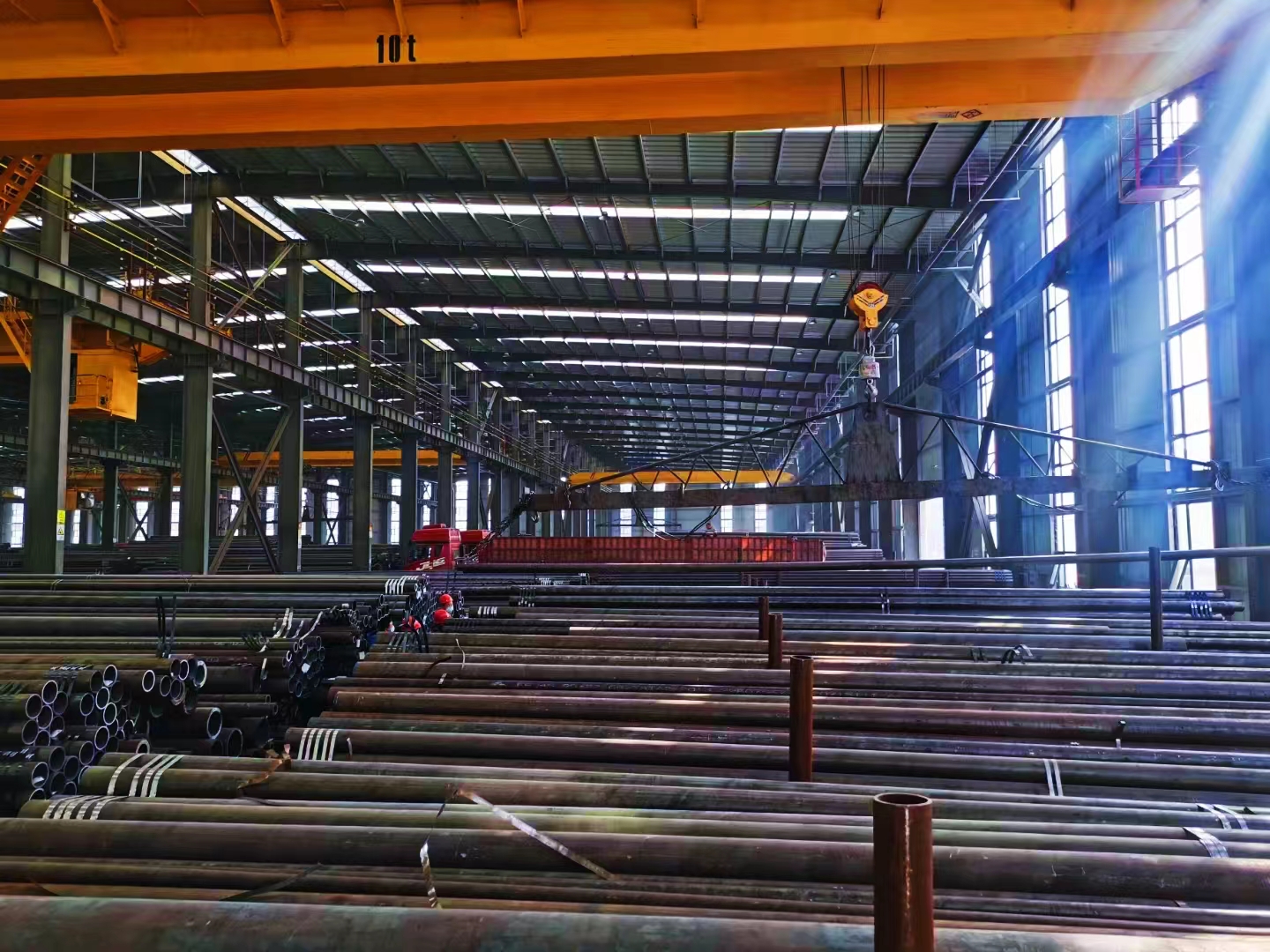
Steel pipe factory warehouse.
OEM and Custom Capability: The Core of Tuoda Machinery's Cylinder Program
Tuoda Machinery operates within the Shandong seamless steel pipe industry in Liaocheng. The company performs deep processing of steel pipes, steel heat treatment, custom hydraulic cylinder manufacturing, production of deep-hole drilling and boring machines, paper machine roller manufacturing, and fabrication of mechanical spare parts. Main products include carbon seamless steel tube, round bars, and pressure cylinders, with about 70 percent of production exported to the EU, Asia, and SA.
Customization is not limited to changing a mounting thread. The manufacturer's customization services include application, size, bore, stroke, pressure, load, system solution, cylinders, and logo printing. For an OEM, this means the cylinder can be designed around the machine structure. For an equipment owner, this means a failed standard cylinder can be replaced with a non-standard heavy duty cylinder that fits the existing system and the actual duty cycle.
Pressure Classes and Cylinder Types
Tuoda's range covers high-pressure hydraulic cylinders in the 31.5–63 MPa class, suited to heavy-duty equipment such as hydraulic excavators, crushers, four-column hydraulic presses, marine steering gear, and anchor winches. Above that, ultra-high-pressure hydraulic cylinders above 63 MPa are available for specialized equipment such as high-pressure water jet cutting machines, artillery recoil systems, and material pressure-testing apparatus.
Cylinder configurations include piston cylinders, plunger cylinders, telescopic (multi-stage) cylinders, and rotary (oscillating) cylinders. This range allows a custom heavy duty hydraulic cylinder to be matched to the functional movement the machine actually needs.
Materials and Dimensional Flexibility
Material options include ST52, S355, E355, C45, SAE1045, and 42CrMo4, with custom selections possible. Dimensional flexibility includes outside diameters from 20 mm to 800 mm, wall thicknesses from 3 mm to 50 mm, lengths such as 6 m, 5.8 m, 12 m, or 6–12 m, and a wall thickness tolerance of plus/minus 10 percent. Bore machining can be held to ISO hole diameter tolerances H8/H9, and surface roughness can reach Ra ≤ 0.4 μm. These details matter because they influence seal life, rod guidance, and long-term stability under high load.
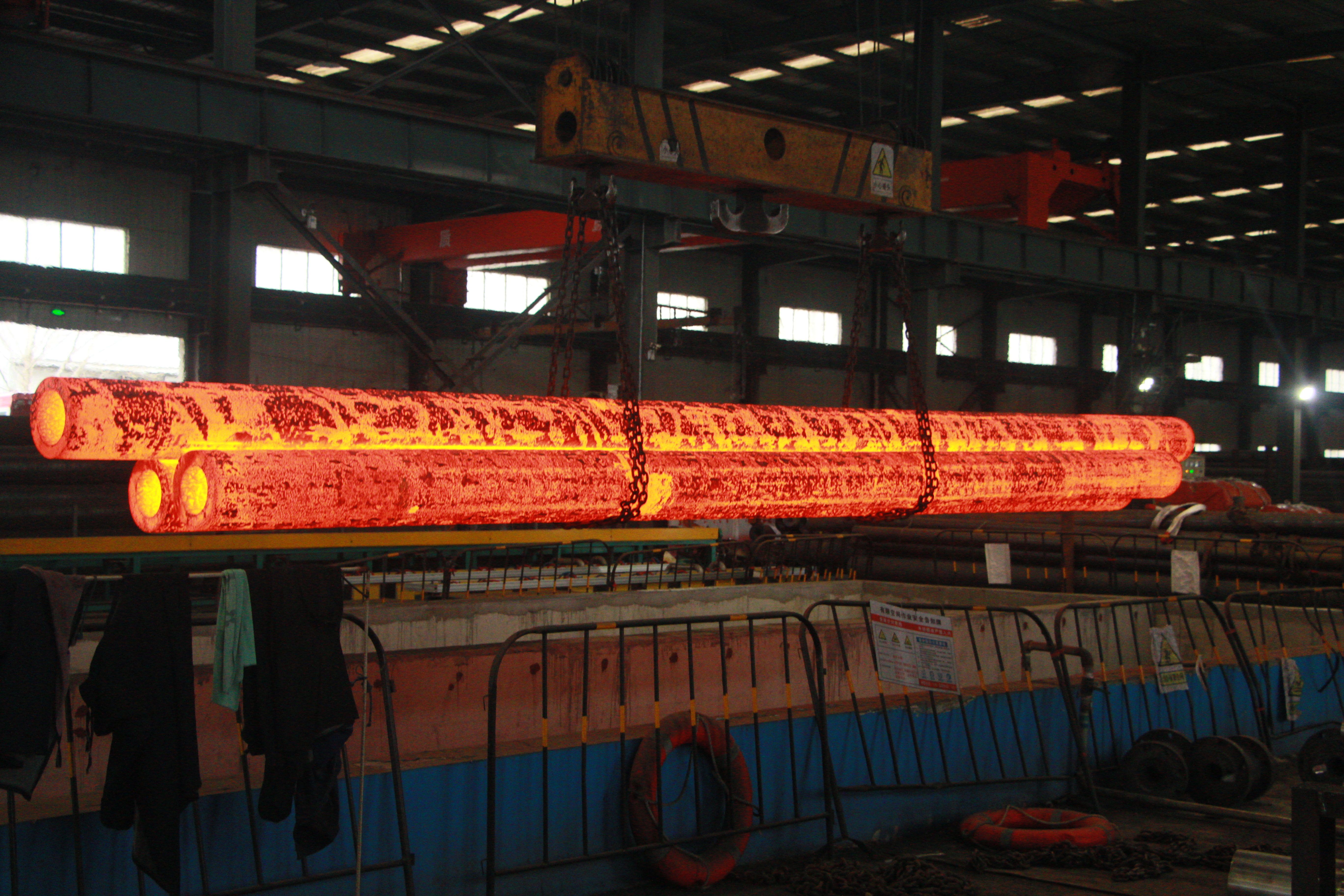
Hot-rolled steel production line.
Quality Control and After-Sales Support
Quality control includes pressure testing performed by the manufacturer. For international orders, acceptance can include pre-shipment testing. After-sales services cover repair, spare parts, and a service network. Buyers evaluating a heavy duty hydraulic cylinder supplier should treat these services as part of the product system, not as an optional extra.
Step-by-Step: How a Custom Heavy Duty Hydraulic Cylinder Is Delivered
Tuoda's end-to-end customization process covers application analysis, drawing verification, material selection, manufacturing and honing, inspection, testing, and final delivery.
- Application analysis. Define the machine, duty cycle, operating pressure, mounting style, available bore and stroke envelope, environment, and target load. For example, a hydraulic cylinder for excavator applications must account for shock loads and space constraints; a cylinder for industrial presses must account for high sustained pressure and precision alignment.
- Drawing verification and system solution. Review drawings, mounting dimensions, port positions, and installation interfaces. Customization options include bore, stroke, pressure, load, system solution, and even logo printing.
- Material selection. Choose tube and rod materials based on load, pressure, contamination, temperature, and corrosion requirements. Material options include ST52, S355, E355, C45, SAE1045, and 42CrMo4.
- Machining and honing. The cylinder body is machined from thick-walled seamless steel pipe. Tuoda also builds deep-hole drilling and boring machines, including the T2120, T2125, and T2135 series, which are designed for machining cylindrical workpieces such as hydraulic cylinder bores. In-house machine capability supports dimensional control and bore quality.
- Quality control and pressure testing. Bore tolerances and surface roughness are checked against specifications, including ISO H8/H9 tolerances and Ra ≤ 0.4 μm. Pressure testing verifies the cylinder's ability to withstand the specified working pressure before shipment.
- Delivery and after-sales support. Typical production lead time is 45 to 60 days; minimum order quantity is 1 unit. Delivery options include FOB, CIF, CFR, EXW, and DDP. After-sales services cover repair, spare parts, and a service network.
Use Cases: Where Custom Heavy Duty Cylinders Earn Their Role
Construction Machinery and Excavator Cylinders
Mobile hydraulics account for more than 58 percent of the total hydraulics market, and construction equipment is one of the largest demand sources. For a hydraulic cylinder for excavator service, the specification must include high pressure, shock resistance, compact mounting, and sealing integrity under dust and moisture. High-pressure heavy duty hydraulic cylinders in the 31.5–63 MPa class are relevant to this equipment class.
Mining Equipment and Large Bore Cylinders
Large bore cylinders, with bore size greater than 150 mm, are strongly associated with large mining excavators and tunnel boring machines. A high-load upgrade heavy duty hydraulic cylinder for mining equipment typically needs thicker walls, larger bore, and custom mounting dimensions. The material and machining data provided by the manufacturer should be verified before production.
Industrial Presses and High-Load Upgrades
Four-column hydraulic presses need cylinders that maintain pressure, alignment, and sealing over repeated cycles. When a cylinder is used to replace standard cylinders or to upgrade an older press, the porting, rod diameter, and mounting dimensions must be checked against the control system. A single-acting to double-acting replacement requires additional attention to the rod-side area and pilot-to-open valve requirements; this is a system solution, not just a cylinder swap.
Forklifts and Material Handling Equipment
Forklifts and material handling equipment also depend on heavy duty hydraulic cylinders. In these applications, the cylinder must operate in tight spaces and under frequent cycling. A custom stroke, bore size, or mounting arrangement can provide a better geometric match without requiring costly changes to the mast structure.
Long Stroke and Telescopic Configurations
For equipment with limited installation height, a long stroke heavy duty hydraulic cylinder can be arranged as a telescopic multi-stage cylinder. Tuoda's product range includes telescopic cylinders, which help reconcile long travel with compact retracted length.
Case Reference: 10 Years on a Straightening Machine
In Vietnam, a Heavy Machinery OEM client installed one unit of product 3558 for a straightening machine application. The project lasted more than 10 years, with stable operation, energy savings, reduced maintenance costs, and zero major failures. The documented highlights include stability under extreme conditions, long lifespan, low maintenance, and cost reduction.
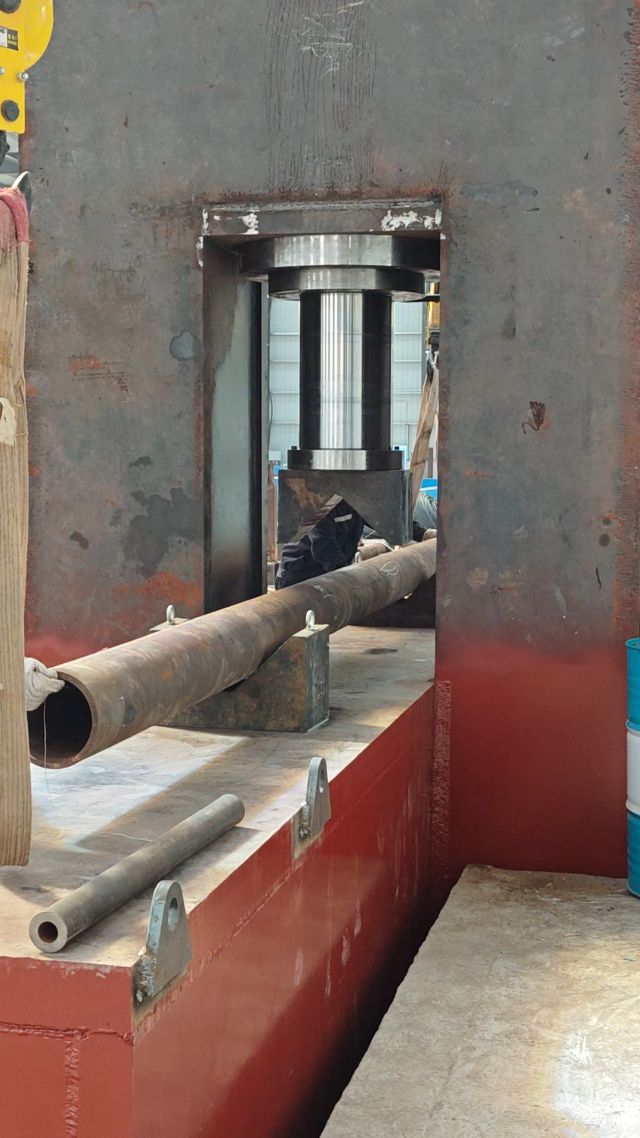
Straightening machine application.
Comparison: What the Data Says About Supplier Capability
The table below uses only the verified facts available for this guide. It is not an overall ranking; it is a starting point for supplier evaluation.
| Supplier | Verified data point | Custom / OEM evidence | Order-related evidence |
|---|---|---|---|
| Tuoda Machinery | China-based manufacturer; about 70 percent exports to EU, Asia, and SA | OEM and custom production; customization includes application, size, bore, stroke, pressure, load, system solution, cylinders, and logo printing | MOQ 1 unit; typical lead time 45–60 days; pressure testing; after-sales repair, spare parts, service network |
| Parker Hannifin | Held approximately 12 percent share of hydraulic cylinder industry in 2023 | Not evaluated in the supplied data set | Not evaluated in the supplied data set |
| Caterpillar | Identified as market leader with more than 8 percent global share in 2024 | Not evaluated in the supplied data set | Not evaluated in the supplied data set |
When comparing suppliers, buyers should ask each manufacturer for the same evidence: custom capability, pressure testing, pre-shipment test, MOQ, lead time, and after-sales network. This keeps the evaluation objective.
What Buyers Should Ask Before Placing a Custom Order
- What is the verified pressure class: 31.5–63 MPa, above 63 MPa, or a custom working pressure?
- Which cylinder type is needed: piston, plunger, telescopic, or rotary?
- Do the mounting dimensions and port positions match the existing machine or require custom mounting?
- What material is required for the tube and rod: ST52, S355, E355, C45, SAE1045, 42CrMo4, or another grade?
- Is the replacement a single-acting to double-acting conversion? If so, the system solution must include rod-side porting and control logic.
- What quality controls are performed? Pressure testing and pre-shipment testing are part of Tuoda's process.
- What is the realistic lead time and minimum order quantity? Tuoda's typical lead time is 45–60 days and MOQ is 1 unit.
Frequently Asked Questions
Do custom heavy duty hydraulic cylinders need to follow ISO 6022 or ISO 6020?
ISO 6022 covers the 250 bar series and ISO 6020 covers the 160 bar series for industrial heavy-duty cylinders. These standards define mounting dimensions and interchangeability. A custom cylinder should be verified against the applicable standard and the actual working pressure before production.
Which heavy duty hydraulic cylinder specifications can Tuoda Machinery customize?
Tuoda Machinery provides OEM and custom production services. Customization options include application, size, bore, stroke, pressure, load, system solution, cylinders, and logo printing. Product types include piston, plunger, telescopic, and rotary cylinders, covering high-pressure 31.5–63 MPa and ultra-high-pressure above 63 MPa classes.
What is the minimum order quantity for a custom heavy duty hydraulic cylinder?
The minimum order quantity is 1 unit. Typical production lead time is 45 to 60 days, and monthly capacity is flexible and can be adjusted according to order requirements.
Can I validate one unit before committing to a larger order?
Because the minimum order quantity is 1 unit, the first unit can be used as an engineering validation unit before scaling up. Tuoda performs pressure testing as part of quality control, and pre-shipment testing is available for cross-border orders. Contact Tuoda to discuss your application and request a quote.
What production lead time should I plan for?
Plan for a typical production lead time of 45 to 60 days. Delivery methods include FOB, CIF, CFR, EXW, and DDP; payment terms are TT or LC. After-sales services include repair, spare parts, and a service network.
Conclusion
Custom heavy duty hydraulic cylinders are an engineering response to real machine conditions. For OEMs, the value of a manufacturer like Tuoda Machinery is the ability to customize application, size, bore, stroke, pressure, load, system solution, and even logo printing. For equipment owners, the value is a cylinder that fits the mounting, handles the load, passes pressure testing, and is backed by after-sales repair and spare parts support.
When evaluating suppliers, ask for evidence on pressure class, materials, machining tolerances, testing, lead time, and minimum order quantity. The right supplier will be willing to start from the application, not from a catalog.
To discuss a custom heavy duty hydraulic cylinder for your equipment, contact Olivia at Tuoda Machinery: olivia@sdtuoda.com, Tel/WhatsApp +86 13290268388. Visit www.sdtdsteel.com or download the company brochure: Tuoda Machinery brochure (PDF).