
SAE4140 Seamless Pipe vs. Welded Pipe vs. Hollow Bar: Comparison Guide for Industrial Buyers
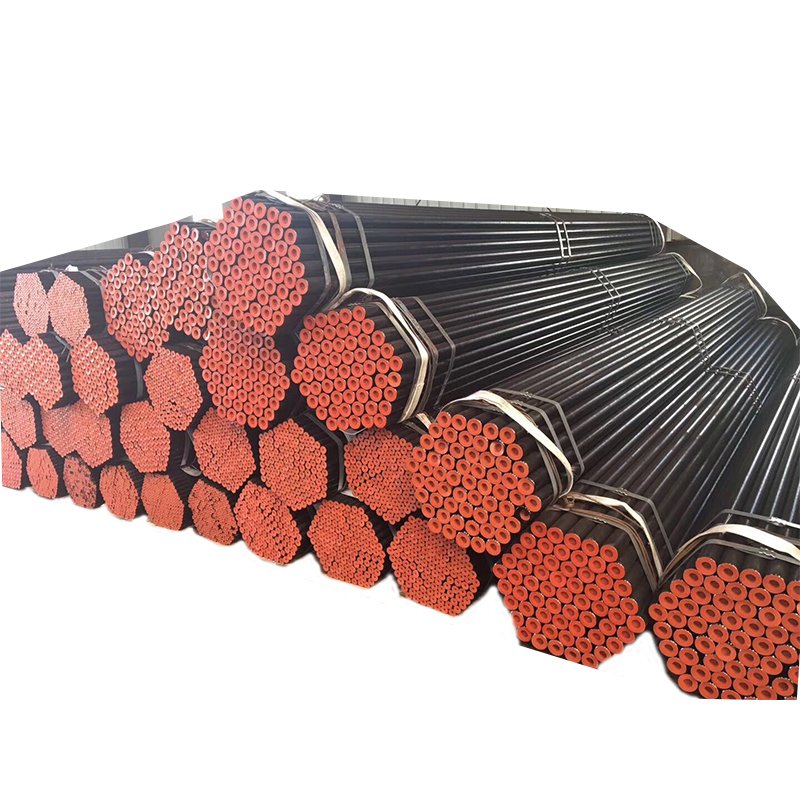
Seamless, welded and hollow bar stock serve different load paths. The form decision drives bore quality, weight and certification scope.
Choosing SAE4140 is the easy part. Deciding whether that SAE4140 should arrive as a seamless pipe, a welded pipe, or a hollow bar is where industrial buyers either protect the project margin or spend the following quarter explaining a rework claim.
All three forms can be machined, heat treated and certified. They are not interchangeable. A seamless tube is pierced from solid steel and carries no longitudinal seam. A welded pipe is formed and seam-welded from strip. A hollow bar is drilled from solid bar stock. Each route leaves a different fingerprint on bore concentricity, wall uniformity, weight-to-strength ratio, and on the evidence a supplier can actually present at pre-shipment inspection. This comparison guide evaluates all three forms against one framework: documented sizes, documented material behaviour, documented certification and documented commercial terms.
Problem Definition: Three Decisions Hiding Inside One SAE4140 Purchase Order
SAE 4140 is a chromium-molybdenum alloy steel classified under ASTM A29, typically containing 0.38–0.43% carbon, 0.80–1.10% chromium and 0.15–0.25% molybdenum — a chemistry selected for high hardenability. That chemistry is fixed once the drawing is approved. The product form is not, and it changes far more of the delivered part than most buyers expect.
Three failure patterns appear repeatedly when the form is treated as an afterthought:
- Concentricity loss. A buyer who needs a straight, uniform bore for a rotating or pressure-loaded part accepts a welded tube, then discovers that the weld seam and the forming route create a wall and bore condition that the machining plan was never designed to correct.
- Unnecessary machining weight. A buyer who orders solid bar for a part that only needs metal at the outside diameter pays to machine out a core that never needed to be there — in machining time, tool wear and scrap.
- Unpriced welding risk. Alloy steel with roughly 0.4% carbon and chromium-molybdenum additions has high hardenability. Welding it is generally treated as a controlled process requiring preheat and post-weld heat treatment, because an uncontrolled thermal cycle can create hard, crack-prone heat-affected zones. Those steps carry cost and inspection requirements that were usually never quoted.
The practical decision rule is therefore sequential, not parallel: define the service condition, then the form, then the size envelope, then the certification route, and only then the commercial terms. Buyers who negotiate price before finishing the first three steps are negotiating the wrong variable.
Industry Background: Why Form Selection Carries More Commercial Weight in 2026
The alloy steel market is large enough that sourcing decisions inside it compound quickly. The Business Research Company projects the global alloy steel market to reach approximately USD 160.7 billion in 2026, driven by high demand from the automotive and construction sectors. Grand View Research reports that Asia-Pacific accounts for more than 40% of global alloy steel consumption, led by Chinese infrastructure and automotive production, and that the automotive industry alone represents roughly 37% of global alloy steel utilisation.
Published market totals differ by scope and should be treated as directional rather than as a pricing input: Grand View Research places the alloy-steel-focused market near USD 82.5 billion, while broader estimates from The Business Research Company reach USD 150.1 billion for a wider alloy definition. What is consistent across sources is the direction — alloy steel consumption is concentrated in regions and industries where machined, load-bearing components are produced at volume.
That concentration has a sourcing consequence. Buyers increasingly compare suppliers on multi-form capability rather than on a single price per ton, because a supplier that can quote seamless pipe, welded pipe and hollow bar against the same drawing removes an entire coordination layer: one technical contact, one certificate trail, one shipment, one pre-shipment test. The same shift is visible in compliance. European industrial buyers routinely ask for evidence against EN 10210, EN 10219 or EN 10025 and for a 3.1 inspection certificate before a mill order is released, which means the certificate scope has to be verified at the quotation stage — not discovered at the port.
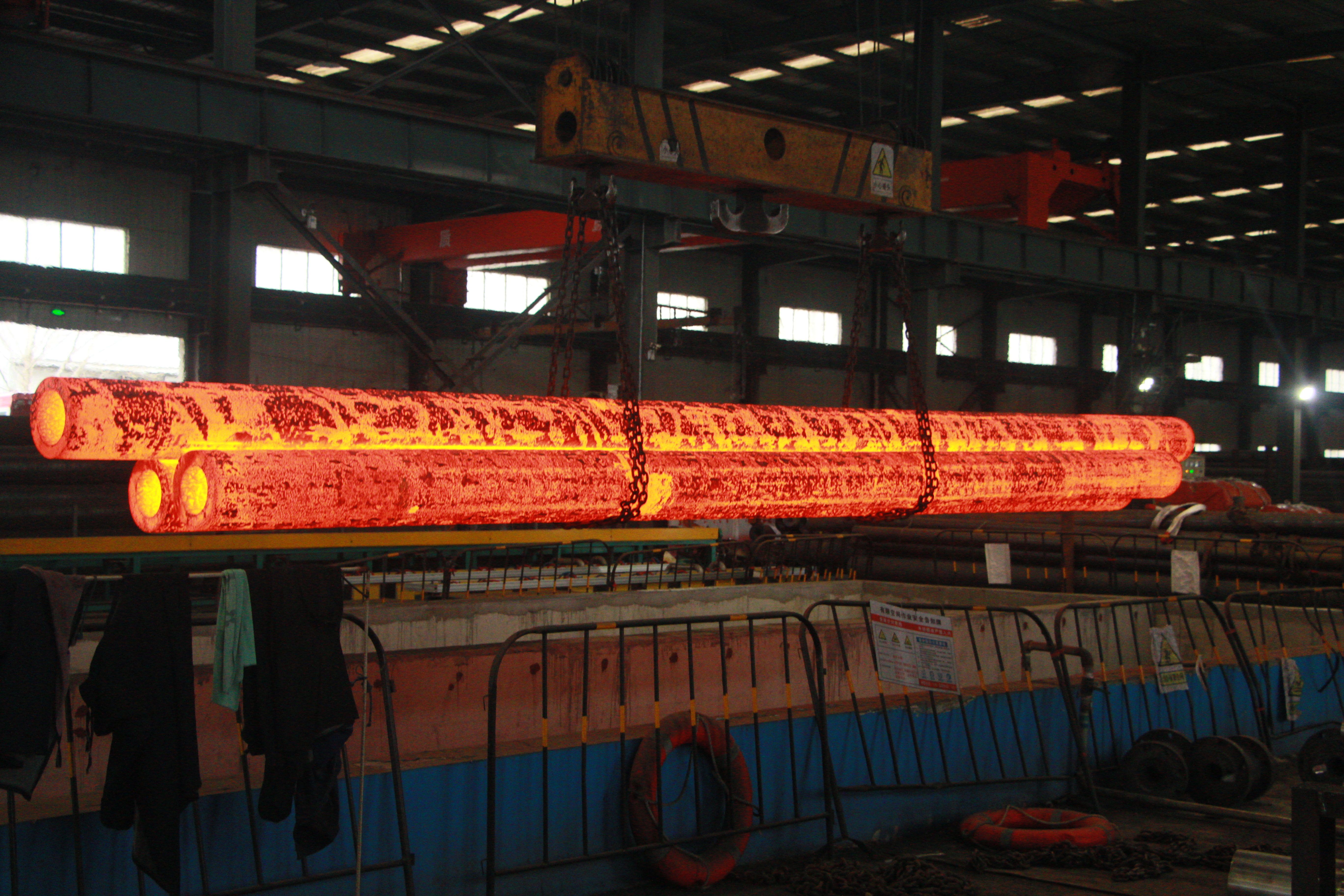
Hot-rolled production route: the forming method behind the pipe determines whether a longitudinal seam exists at all.
Detailed Solution: How Tuoda Machinery Covers Seamless Pipe, Welded Pipe and Hollow Bar
Shandong Tuoda Machinery Equipment Co., Ltd. (Tuoda Machinery) is a steel processing and machinery manufacturing company based in Liaocheng, Shandong, China. Its portfolio covers carbon seamless steel tube, round bars and pressure cylinders, with exports accounting for roughly 70% of output and main markets in the EU, Asia and South America. The company publishes its product range and technical data at www.sdtdsteel.com, including the seamless pipe and tube lines discussed below.
Form 1 — Seamless SAE4140 pipe and tube (product 3557)
Tuoda's dedicated SAE4140 product is listed as Alloy Seamless Steel Pipe and Tube SAE 4140, model SAE4140, available as both round steel pipe and square steel pipe. The documented size envelope is OD 20–400 mm with wall thickness 3–30 mm. Its documented applied range is drill collar and aerospace components, and its applicable industries are listed as oil and aerospace.
Two details matter commercially. First, the availability of a square profile is unusual in an alloy seamless line and matters for parts that need a flat clamping or mounting face rather than a machined keyway. Second, because the product is seamless by definition, there is no longitudinal weld seam to qualify, no weld repair history to trace, and no post-weld heat treatment step inside the delivered product. For buyers whose part sees cyclic loading or pressure, that removes a whole category of inspection evidence from the file.
Form 2 — Welded pipe and hollow bar within the multi-form family (product 3560)
Tuoda's broader product family is documented as seamless steel pipe, carbon steel tube, alloy steel pipe, hollow steel bar and welded steel pipe. The material list spans A106 Gr.B, ST52, ST44, S355, E355, 42CrMo, 30CrMo, ST37, 10# and 20#, with 4140, 4130, 4145, 4340 and ST52 also appearing in the alloy steel range.
Documented family specifications are OD 10–1080 mm, wall thickness 2–110 mm, lengths of 5–5.8 m, 6 m and 6–12 m, delivery 30–45 days or customized, and condition of delivery covering hot rolled, cold drawn, cold rolled and quenched and tempered (QT). Applicable industries are listed as oil, gas, water and structural.
Hollow bar occupies a distinct position in this family. It is produced by drilling from solid bar stock, so it is seamless by nature, with a concentric bore that is established by machining rather than by forming. That makes it a natural fit for ring-shaped or thick-walled parts where bore straightness matters more than wall-to-weight ratio. The trade-off is normally commercial rather than technical: hollow bar generally carries a higher cost per kilogram than pipe because more material is removed to create the bore.
Customisation and quality-control scope
Tuoda states that it provides comprehensive and fully-standardized customized products according to customer requirements, with the customization variables covering size, length, mechanical property, delivery time and testing inspection. For planning purposes, the published capability figures are 1000 tons per month of capacity, a 30–45 day lead time, and an MOQ of 5 tons or to be discussed. Quality control is documented as either a factory laboratory report or an inspection arranged by the buyer through a third-party agency.
The practical value of that structure for an evaluation-stage buyer is that the form decision, the heat-treatment condition and the inspection route can all be settled inside one technical conversation instead of being split across a mill, a stockholder and a processor.
Step-by-Step Breakdown: Running the Form Selection and Order Review
The following sequence keeps the technical decision ahead of the commercial one, in the order that prevents rework.
- Define the service condition first. Write down what the part actually does: pressure containment, cyclic loading, rotation, sliding wear, or static structural support. Every subsequent choice — form, wall, heat treatment — should be traceable to that sentence.
- Match the form to the load path. Where a longitudinal seam is unacceptable, specify seamless pipe or hollow bar. Where the part is a thin-walled structural or fluid-conveying element and the seam can be qualified, welded pipe within the multi-form family is a legitimate candidate. Where the bore must be concentric and the wall is heavy, hollow bar is normally the shortest route to a finished part.
- Fix the size envelope on the drawing. For SAE4140 seamless tube, the documented envelope is OD 20–400 mm and wall 3–30 mm, in round or square. For the broader multi-form family, the documented envelope is OD 10–1080 mm and wall 2–110 mm. Confirm the exact OD, wall and length combination rather than assuming the outer limits are stocked in every grade.
- State the heat-treatment condition on the purchase order. Quenched and tempered SAE 4140 is the condition most often specified for load-bearing parts; annealed and normalized conditions are also commonly requested for machining or forming routes. The documented delivery conditions in Tuoda's family data include hot rolled, cold drawn, cold rolled and QT. Whichever condition you need, name it explicitly — an unstated condition is the most common cause of a dispute at goods-in inspection.
- Confirm the certification route before the quote is signed. Tuoda holds a CE 3.1 certificate, number 3N230530.STMDO12, issued by ECM for the European market, covering EN 10210, EN 10219 and EN 10025, with validity from 30 May 2023 to 28 May 2028. Verify that your ordered form, size and condition fall inside the quoted certification scope, and decide up front whether order-level quality documentation will be the factory laboratory report or a third-party inspection.
- Lock the commercial checkpoints. MOQ is 5 tons or to be discussed; payment terms are TT or LC; Incoterms available are FOB, CIF, CFR, EXW and DDP; acceptance is by pre-shipment test. For customs planning, HS 7228.30 is the primary classification for hot-rolled alloy steel bars, including SAE 4140, with a diameter exceeding 228 mm.
- Approve pre-shipment testing and plan the shipping window. Agree the test items — chemistry, OD and wall verification, and condition — before production starts, not after. With a 30–45 day lead time and 1000 tons per month of capacity, the testing slot and the vessel booking should be scheduled together.
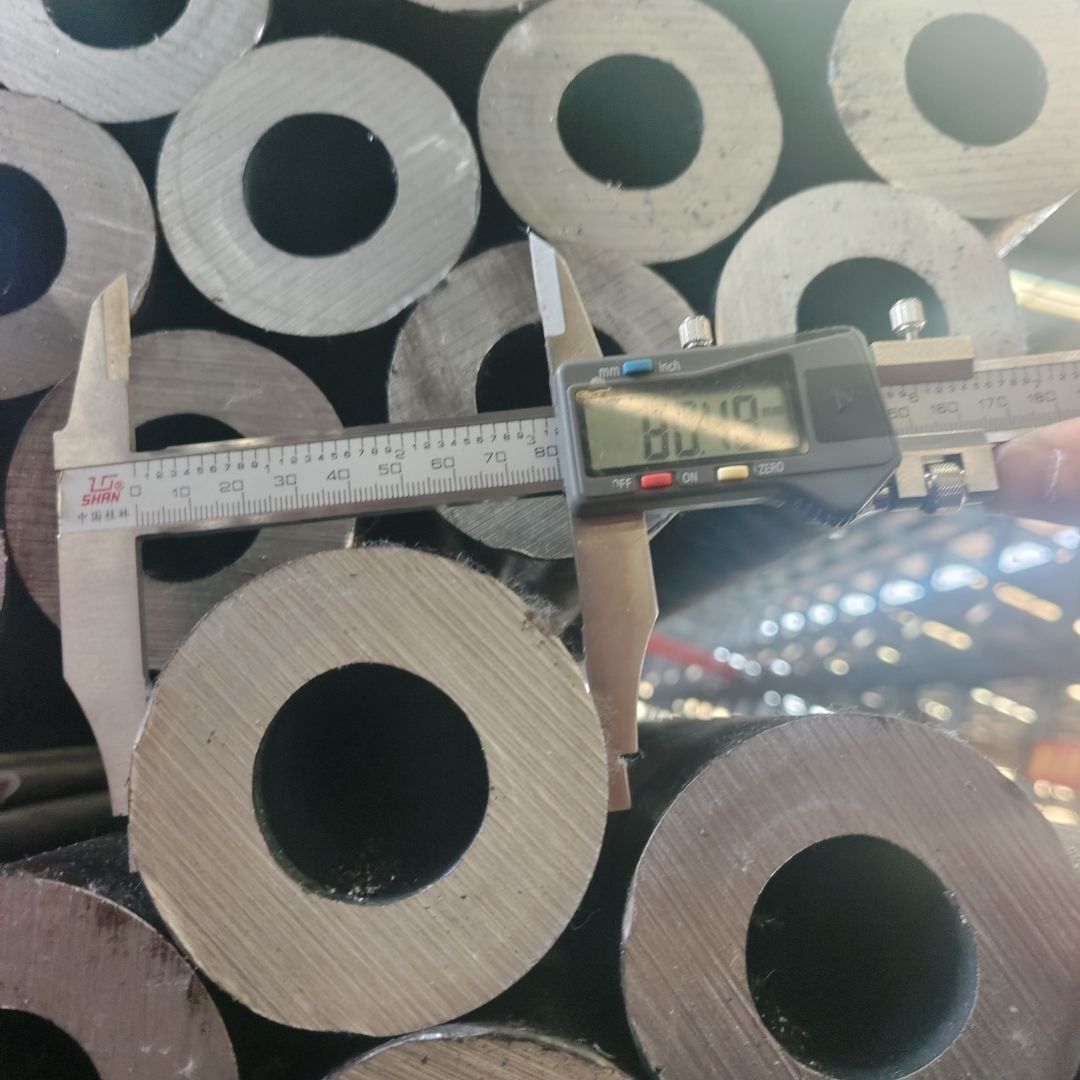
Pre-shipment test acceptance: the buyer chooses between a factory laboratory report and an independent third-party inspection.
Use Cases: Where Each Form Earns Its Place
Oil drilling equipment and drill collars
Drill collar is the documented applied range for Tuoda's SAE4140 seamless pipe and tube. In field-facing service, the case record behind the broader product family is instructive: a petroleum equipment factory client used the product in the production and manufacturing of oil drilling equipment, with 50 sets installed in projects located in Chile and India, achieving stable operation over 10 years, with documented performance attributes of low loss, high performance and high applicability. For buyers in the same segment, that case speaks to continuity of supply rather than to a single-batch result.
Aerospace components
Aerospace components are the second documented applied range for the SAE4140 seamless line. In this segment, the case for tube over solid bar is usually weight-driven and traceability-driven at the same time: a seamless tube removes core material that would only be machined away, and it removes the weld seam from the evidence chain.
Shafts, gears and rotating machinery
Quenched and tempered SAE 4140 steel achieves a tensile strength of 850–1000 MPa and a nominal hardness of 28–32 HRC, which is why it is frequently selected for shafts and gears. Buyers in this category should specify the QT condition with the mechanical requirement on the PO, because the same grade in a different condition behaves very differently on the machine.
Hydraulic cylinder barrels and machined sleeves
Tube and hollow bar both feed the hydraulic cylinder supply chain, where bore quality is the governing requirement. Tuoda's cylinder line documents hole diameter tolerances of H8/H9 and arithmetic roughness of Ra ≤ 0.4 μm, with an OD range of 20–800 mm and wall range of 3–50 mm. A buyer sourcing a cylinder barrel and a buyer sourcing raw tube should be reading the same specification, which is one reason a supplier able to discuss both is useful at the evaluation stage.
Construction machinery, molds and automotive parts
Beyond oil, aerospace and hydraulics, SAE4140 is commonly machined into parts for construction machinery, mold bases and automotive components. These applications usually do not require the extreme inspection depth of the aerospace route, but they do reward a supplier who can hold a stable heat-treatment condition across repeat orders, since the machining parameters set on the first batch are normally carried forward.
SAE4140 Seamless Pipe vs. Welded Pipe vs. Hollow Bar: Comparison Table
The table below compares the three forms using documented product data. Where a figure describes the multi-form family rather than an individual form, this is stated explicitly.
| Comparison dimension | SAE4140 seamless pipe / tube | Welded steel pipe | Hollow steel bar |
|---|---|---|---|
| Forming route | Pierced and rolled from solid steel; no longitudinal seam | Formed and seam-welded from strip; a discrete weld seam exists | Drilled from solid bar stock; no seam, bore established by machining |
| Documented portfolio reference | Product 3557 — Alloy Seamless Steel Pipe and Tube SAE 4140, model SAE4140 | Listed within product 3560 — welded steel pipe | Listed within product 3560 — hollow steel bar |
| Shapes documented | Round steel pipe and square steel pipe | Not specified in the available product data | Not specified in the available product data |
| Documented size envelope | OD 20–400 mm; wall 3–30 mm | Within the product 3560 family range: OD 10–1080 mm; wall 2–110 mm — confirm per form | Within the product 3560 family range: OD 10–1080 mm; wall 2–110 mm — confirm per form |
| Documented delivery condition | Conditions offered across the pipe and bar portfolio include hot rolled, cold drawn, cold rolled and QT | Same family conditions: hot rolled, cold drawn, cold rolled, QT | Same family conditions: hot rolled, cold drawn, cold rolled, QT |
| Documented mechanical reference (QT) | 850–1000 MPa tensile; 28–32 HRC nominal hardness (third-party published data for quenched and tempered SAE 4140) | Depends on the welded and post-weld condition; verify per order | Depends on the drilling and heat-treatment route; verify per order |
| Documented application fit | Drill collar, aerospace components; oil and aerospace industries | Family serves oil, gas, water and structural applications | Family serves oil, gas, water and structural applications |
| Certification available | CE 3.1 certificate 3N230530.STMDO12 (ECM), EN 10210 / EN 10219 / EN 10025, valid to 28 May 2028 — confirm scope per order | Within the same certification framework; confirm scope per order | Within the same certification framework; confirm scope per order |
| Primary technical risk | Size and wall availability at the extremes of the envelope | Weld seam qualification in a high-hardenability alloy; post-weld heat treatment planning | Higher material removal cost per finished part |
Sources: Tuoda Machinery product data (products 3557 and 3560) and third-party published data for quenched and tempered SAE 4140.
Where each form reaches its limit
Seamless pipe is not automatically the right answer everywhere. At very large diameters and thin walls, the economics of the seamless route weaken, and a qualified welded product may be the more practical supply. Hollow bar is not automatically better because it is seamless either: it wins on concentric bore and heavy wall, and loses on cost per kilogram when the bore is large relative to the wall. Welded pipe is not inferior by definition — it is simply a form whose suitability depends on whether the seam can be qualified and inspected for the specific service, which in a chromium-molybdenum alloy with roughly 0.4% carbon means welding procedure, preheat and post-weld treatment all become explicit technical deliverables.
Commercial checkpoints in one view
| MOQ | 5 tons, or to be discussed |
| Payment terms | TT or LC |
| Incoterms | FOB, CIF, CFR, EXW, DDP |
| Acceptance | Pre-shipment test |
| Quality documentation | Factory laboratory report, or third-party inspection arranged by the buyer |
| Lead time | 30–45 days, or customized |
| Monthly capacity | 1000 tons |
| Export markets served | EU, Middle East, India, Chile, Argentina, Turkey |
| Customs classification | HS 7228.30 for hot-rolled alloy steel bars, including SAE 4140, exceeding 228 mm diameter |
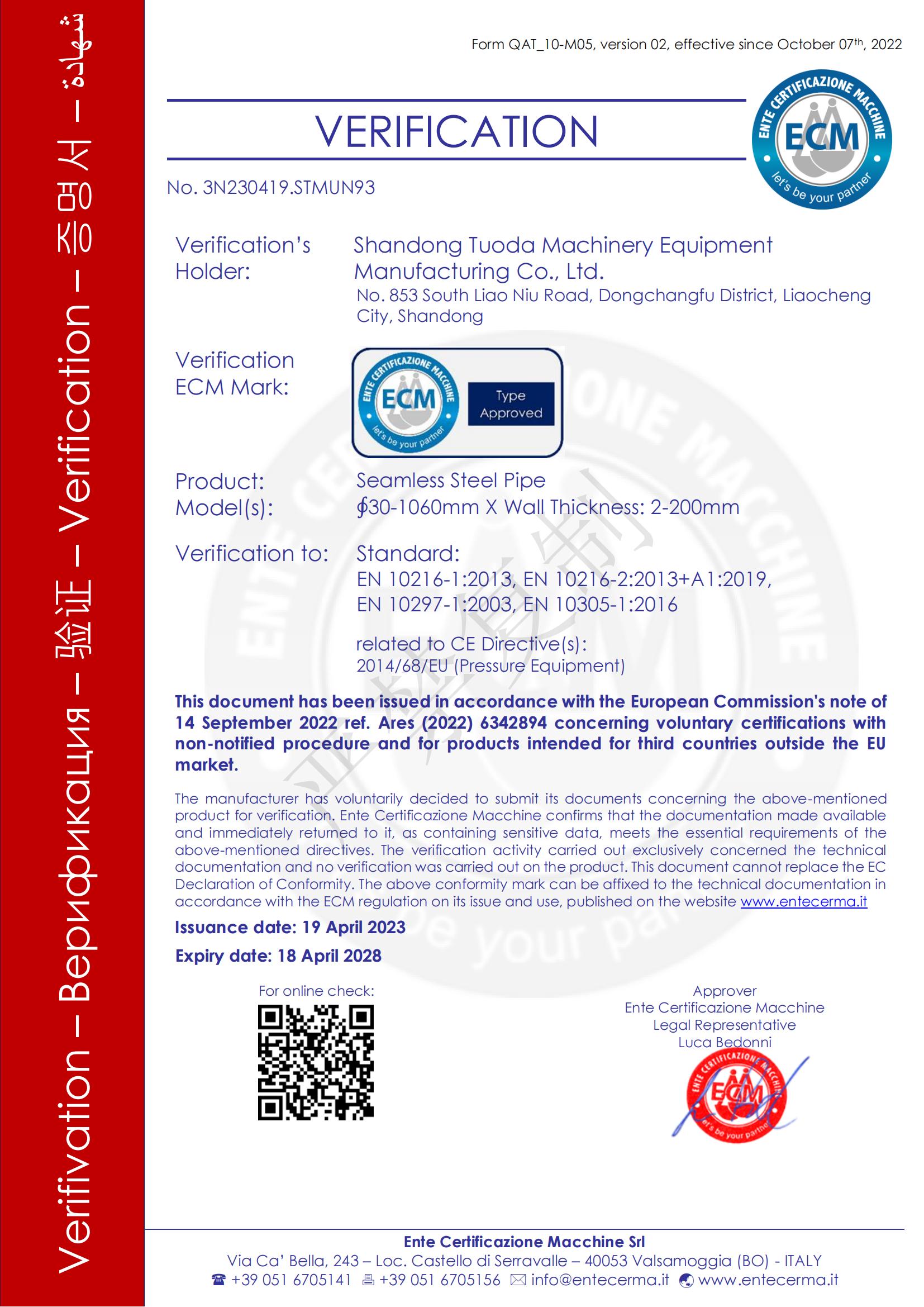
Certification is a scope question, not a yes/no question: match the certificate to the form, size and condition you actually order.
FAQ
Is SAE4140 pipe supplied with a 3.1 certificate for EU imports?
Tuoda Machinery holds a CE 3.1 certificate, number 3N230530.STMDO12, issued by ECM for the European market and covering EN 10210, EN 10219 and EN 10025, valid from 30 May 2023 to 28 May 2028. Separately, the SAE 4140 grade is classified under ASTM A29 with a typical chemistry of 0.38–0.43% carbon, 0.80–1.10% chromium and 0.15–0.25% molybdenum. The certificate covers the standards listed; a buyer should confirm that the ordered form, size and heat-treatment condition sit inside the quoted certification scope before issuing the purchase order. At order level, quality documentation is either a factory laboratory report or a third-party inspection arranged by the buyer.
What shapes and sizes are available in SAE4140 tube?
The dedicated SAE4140 seamless line is documented as round steel pipe and square steel pipe, with OD 20–400 mm and wall thickness 3–30 mm, applied to drill collar and aerospace components. The wider multi-form family that also covers welded pipe and hollow bar is documented at OD 10–1080 mm, wall 2–110 mm, with lengths of 5–5.8 m, 6 m and 6–12 m. Customization variables include size, length, mechanical property, delivery time and testing inspection. Because the wider figures describe the family rather than each individual form, confirm the exact form-and-grade combination against your drawing before quoting.
What are the MOQ, payment terms and Incoterms?
The documented minimum order quantity is 5 tons or to be discussed. Payment terms are TT or LC. Available Incoterms are FOB, CIF, CFR, EXW and DDP. Acceptance is by pre-shipment test. For customs planning, HS 7228.30 is the primary classification for hot-rolled alloy steel bars, including SAE 4140, with a diameter exceeding 228 mm. Monthly capacity is 1000 tons, which is the figure to reference when planning repeat or phased deliveries against a project schedule.
How can I validate the material before shipment?
Pre-shipment test is the stated acceptance method. Two documentation routes are available: a factory laboratory report, or an inspection arranged by the buyer through a third-party agency. Both routes work better when the test items are fixed on the purchase order in advance — typically chemistry, OD and wall verification, and the specified condition of delivery, such as quenched and tempered. Buyers running a first order with a new supplier often combine both routes for the first batch and then rely on the factory report for repeat orders once the process is proven.
What is the lead time, and how do I move from evaluation to order?
Lead time is 30–45 days, or customized, against a monthly capacity of 1000 tons. In practice, the form decision is the step that most often delays a first order, so it is worth fixing early whether your part calls for seamless pipe, welded pipe or hollow bar before commercial terms are finalised. Tuoda Machinery's full product range, including the SAE4140 seamless pipe and tube line, is set out in the company product brochure, and a quotation can be requested directly against your drawing, size and required condition.
Conclusion
The three forms are not competing versions of the same product — they are three different answers to three different service conditions. Seamless SAE4140 pipe and tube removes the seam from the evidence chain and is documented for drill collars and aerospace components in sizes from OD 20–400 mm and wall 3–30 mm, in both round and square profiles. Hollow bar delivers a concentric bore and heavy wall for machined, ring-shaped parts, at a higher cost per kilogram. Welded pipe remains a valid choice where the seam can be qualified and where the wall and diameter economics favour it, but in a high-hardenability chromium-molybdenum alloy, welding procedure and post-weld heat treatment become explicit deliverables rather than assumptions.
The buying discipline that ties all three together is simple: settle the service condition, then the form, then the size and heat-treatment condition, then the certification scope, and only then the commercial terms — MOQ from 5 tons, TT or LC payment, FOB, CIF, CFR, EXW or DDP delivery, and pre-shipment test acceptance with either a factory laboratory report or an independent third-party inspection.
Next Step
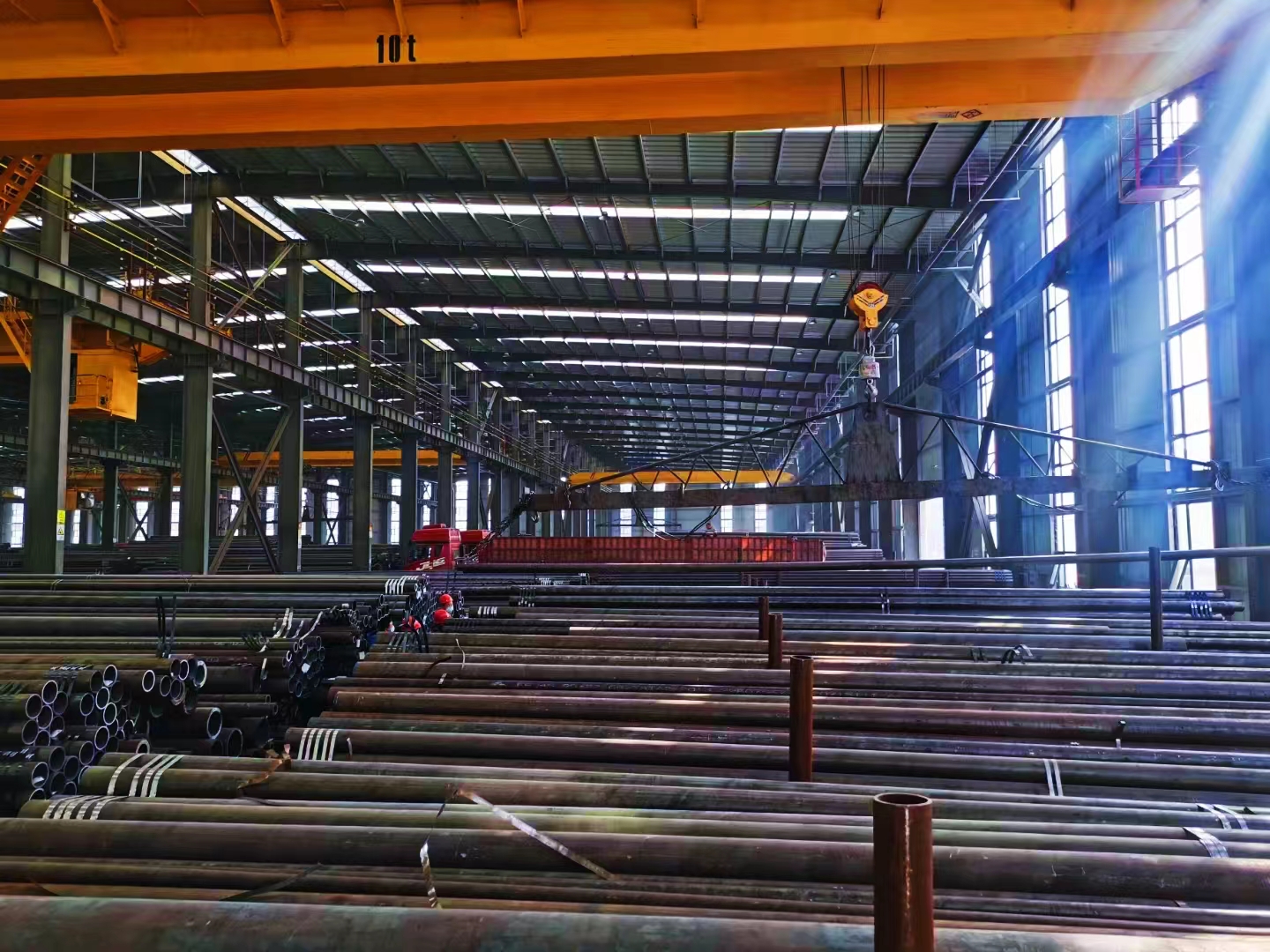
Send us the drawing, the required OD and wall, and the condition of delivery. Tuoda Machinery will confirm which form fits, which size and heat-treatment condition applies, and which certification route the order will carry.
Shandong Tuoda Machinery Equipment Co., Ltd.
Contact: Olivia
Email: olivia@sdtuoda.com
Tel / WhatsApp: +86 13290268388
Address: NO853 South Liaoniu Road, Dongchangfu District, Shandong, China
Website: www.sdtdsteel.com
Download the product brochure for the full specification range.