
SAE4140 Tube for Aerospace Prototypes: Solving the 5-Ton MOQ
Alloy Tube Procurement · Small-Batch Supply
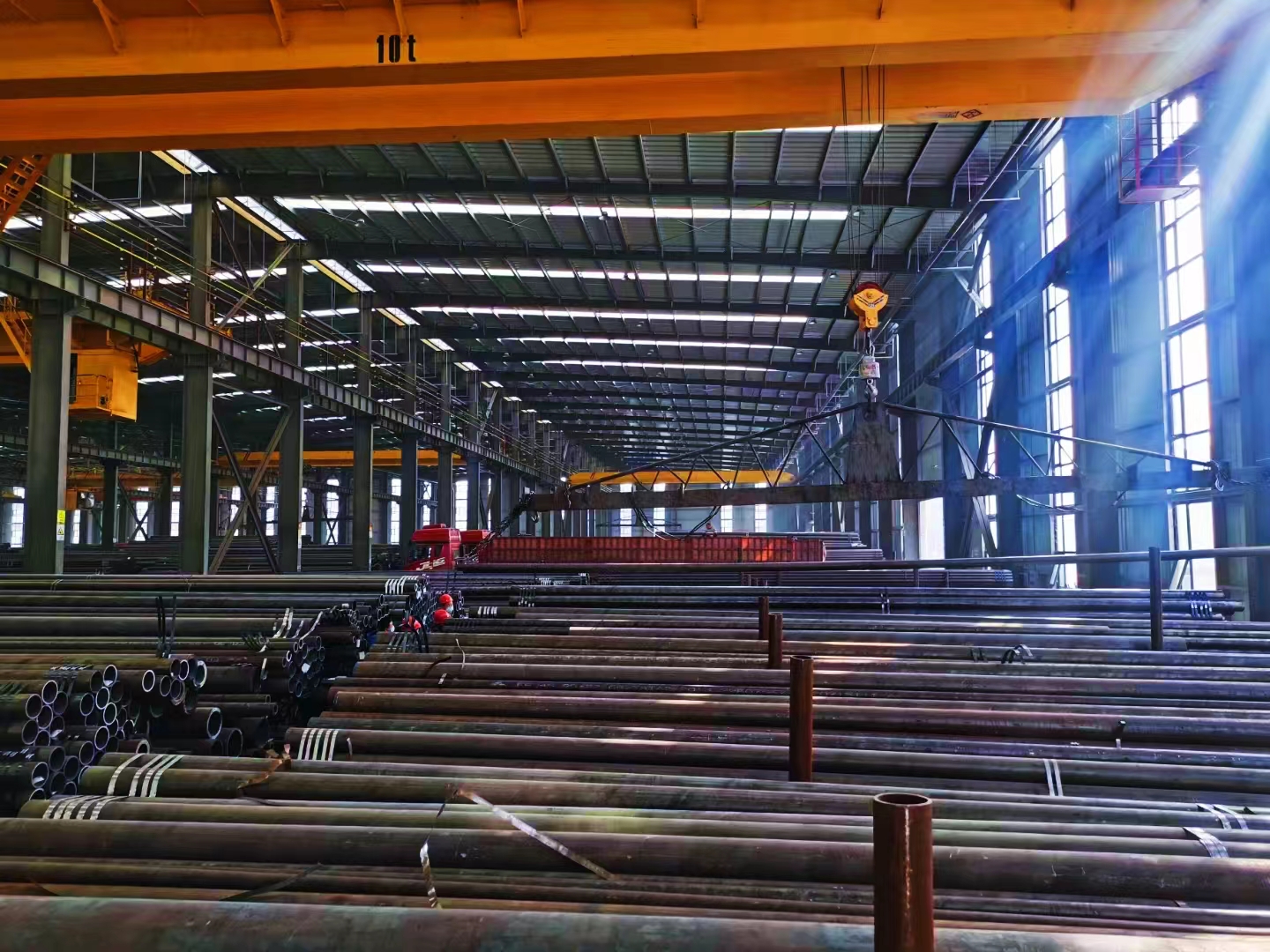
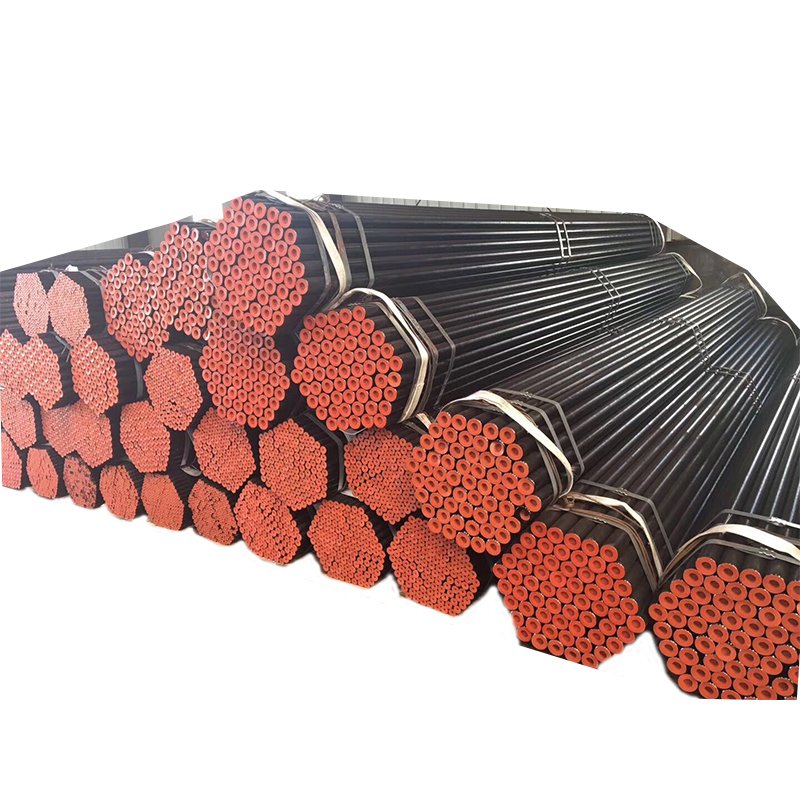
Steel tube warehousing at Shandong Tuoda Machinery in Liaocheng, Shandong — trial quantities and 5-ton production lots are drawn from the same stock and released against the same inspection protocol.
A prototype build rarely needs five tons of anything. A single aerospace first-article component, or one drill collar iteration, may consume a few hundred kilograms of SAE4140 seamless tube — less if the part is small. Alloy tube producers, however, plan their mills around much larger lots, and a 5-ton minimum order quantity (MOQ) is the point where most small-batch programs stall.
The way through is a two-stage order. Stage one is a trial quantity — a single piece or a small batch — used to confirm that the tube machines predictably, responds to heat treatment as expected, and arrives with the inspection documentation the project requires. Stage two is the 5-ton production order, released only after the design is frozen and the first article has been approved. Shandong Tuoda Machinery Equipment Co., Ltd., which trades as Tuoda Machinery, supplies SAE4140 alloy seamless tube on that basis: its stated minimum is 5 tons or discuss, and single-piece and small-batch runs sit inside normal operations rather than outside them.
This article explains why the 5-ton MOQ exists, what it actually costs a prototype program, how the trial-then-production route works step by step, and which sizes, documentation and commercial terms apply.
Why a 5-Ton MOQ Exists — and What It Costs a Prototype Program
Seamless alloy tube is not produced the way a machined part is produced. It is produced in batches: a heat of steel is melted to chemistry, cast, pierced and rolled or cold-drawn to size, heat treated, straightened, cut and inspected. The process cost of that sequence is dominated by setup and processing time rather than by the tonnage that comes out at the end. A small run and a 5-ton run pass through broadly the same number of operations, which is why mills quote a minimum tonnage instead of a minimum price per kilogram.
For the buyer, that shows up in four places:
- Capital tied up in inventory. Five tons of tube is paid for in full and stored for months, while the prototype consumes a fraction of it.
- Design obsolescence risk. If the outside diameter, wall thickness or heat-treatment condition changes after the prototype review — a normal outcome of first-article testing — the residual stock may not match the released drawing.
- Scheduling priority. Small lots compete with production tonnage for rolling and heat-treatment windows, and they usually lose.
- An inspection paradox. Prototypes are precisely where inspection cannot be skipped: grade chemistry, dimensions and mechanical properties must be verified before machining begins, and a trial order needs the same documentation trail as a full production lot.
The result is that buyers either over-order just to clear the minimum or abandon the grade and substitute a more easily available material. For aerospace components and drill collars, where 4140-type chemistry and heat-treatment response are chosen deliberately, substitution is rarely the cheaper answer.
Alloy Steel Demand Is Rising — but Capacity Is Built for Tonnage
Third-party market research places the global alloy steel market at approximately USD 160.7 billion in 2026, driven largely by automotive and construction demand (The Business Research Company). Asia-Pacific accounts for more than 40% of global alloy steel consumption, with China's infrastructure and automotive production as the main contributors (Grand View Research), and the automotive sector alone represents roughly 37% of global alloy steel utilisation (Grand View Research).
The direction of that demand matters to small buyers. When capacity is absorbed by large-tonnage consumers, the marginal value of a 300 kg order to a mill is low, and minimum order quantities tend to hold firm. A buyer who needs a prototype quantity therefore needs a supplier whose operating model already includes small runs — not one who makes an exception.
SAE4140 itself is a through-hardening chromium-molybdenum alloy steel classified under ASTM A29, typically specified with 0.38–0.43% carbon, 0.80–1.10% chromium and 0.15–0.25% molybdenum to deliver high hardenability (ASTM A29 / OTAI Special Steel). In the quenched and tempered condition it reaches a tensile strength of 850–1000 MPa at a nominal hardness of 28–32 HRC, which is why published material guidance points to shafts and gears as natural applications (Nifty Alloys). That same combination of strength, toughness and predictable heat-treatment response is what makes 4140-type seamless tube suitable for drill collars and aerospace components.
Third-party coverage of the specialty alloy steel bar segment lists integrated producers such as ArcelorMittal, Nippon Steel and POSCO alongside specialised suppliers including Qilu Special Steel. That competitive picture is useful context rather than a ranking: large integrated mills are organised around tonnage contracts, while specialty suppliers are the realistic route for a prototype quantity. Importers should also note that HS code 7228.30 is identified as the primary trade classification for hot-rolled alloy steel bars — including SAE 4140 — with a diameter exceeding 228 mm (World Customs Organization); classification should always be confirmed with a customs broker against the actual product form.
The Tuoda Machinery Two-Stage Supply Model for SAE4140 Tube
Shandong Tuoda Machinery Equipment Co., Ltd. (Tuoda Machinery) is a manufacturer and supplier based in Liaocheng, Shandong, producing carbon and alloy seamless steel tube, round bar and machined steel components, with exports concentrated in the EU, Asia and South America.
Product scope: SAE4140 round and square seamless tube
The product that matters for prototype and production programs is ALLOY SEAMLESS STEEL PIPE AND TUBE SAE 4140, supplied as round steel pipe and square steel pipe in material grade SAE4140. Standard outside diameter coverage runs from 20 mm to 400 mm, with wall thickness from 3 mm to 30 mm. The declared application range for this product is drill collars and aerospace components, in the oil and aerospace industries.
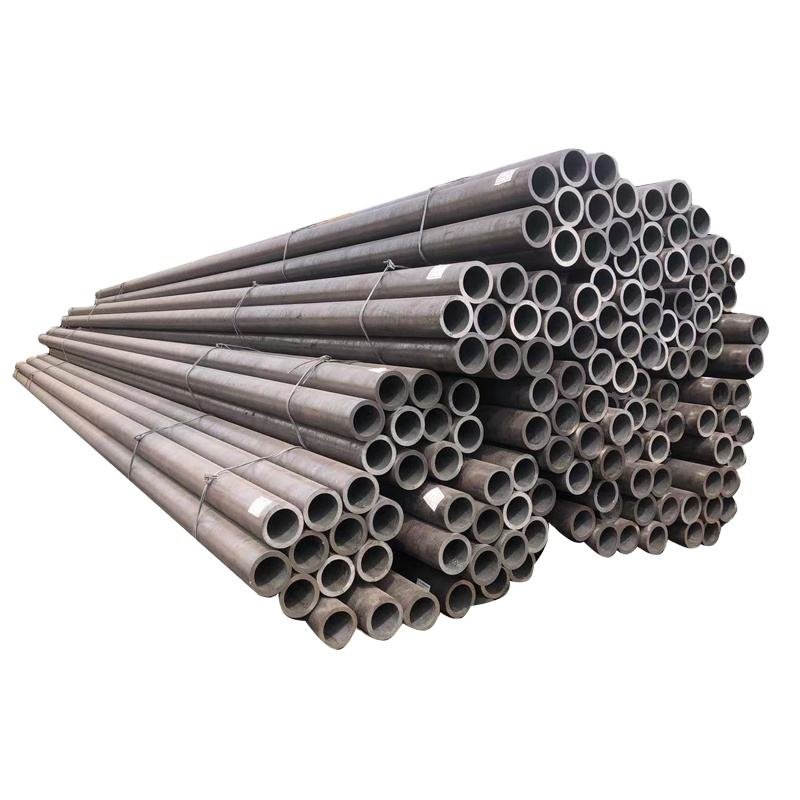
Seamless tube in the standard OD 20–400 mm / wall thickness 3–30 mm range, supplied in round and square form.
| Specification | Detail |
|---|---|
| Material grade | SAE4140 |
| Product type | Alloy seamless steel pipe and tube — round steel pipe and square steel pipe |
| Outside diameter range | 20–400 mm |
| Wall thickness range | 3–30 mm |
| Application range | Drill collar, aerospace components |
| Industries served | Oil, aerospace |
| Minimum order quantity | 5 tons, or discuss |
| Monthly capacity | 1,000 tons |
| Lead time | 30–45 days |
| Quality control | Factory laboratory report, or third-party inspection arranged by the buyer |
| Customisation | Size, length, mechanical properties, delivery time, testing and inspection |
| Certification | CE 3.1 certificate 3N230530.STMDO12 (ECM) — EN 10210 / EN 10219 / EN 10025, valid to 28 May 2028 |
Small-batch quantities: "5 tons or discuss"
Tuoda Machinery's stated minimum order quantity is 5 tons, or discuss. The wording matters: the 5-ton figure is a standard planning baseline rather than an absolute cut-off. The company supports single-piece and small-batch production alongside mass production as a general operating principle, and its deep-hole drilling and boring machine lines — the T2120, T2125 and T2135 series — are engineered for both mass production and single-piece or small-batch runs. Aerospace prototypes and one-off drill collar evaluations fall into that second category, and the trial quantity is treated as part of a normal order flow.
Inspection before shipment
Alloy tube orders are released against a pre-shipment test. Buyers receive a factory laboratory report, or they can arrange their own third-party inspection before the material leaves the works. For prototype programs this matters more than for production orders, because the trial piece is often the only physical evidence available before the design is frozen.
Certification and documentation
Tuoda Machinery holds CE 3.1 certification issued by ECM under EN 10210, EN 10219 and EN 10025, covering the European market. The certificate number is 3N230530.STMDO12, issued on 30 May 2023 and valid until 28 May 2028, so EU-destined projects can rely on documentation that remains in force through the current procurement cycle.
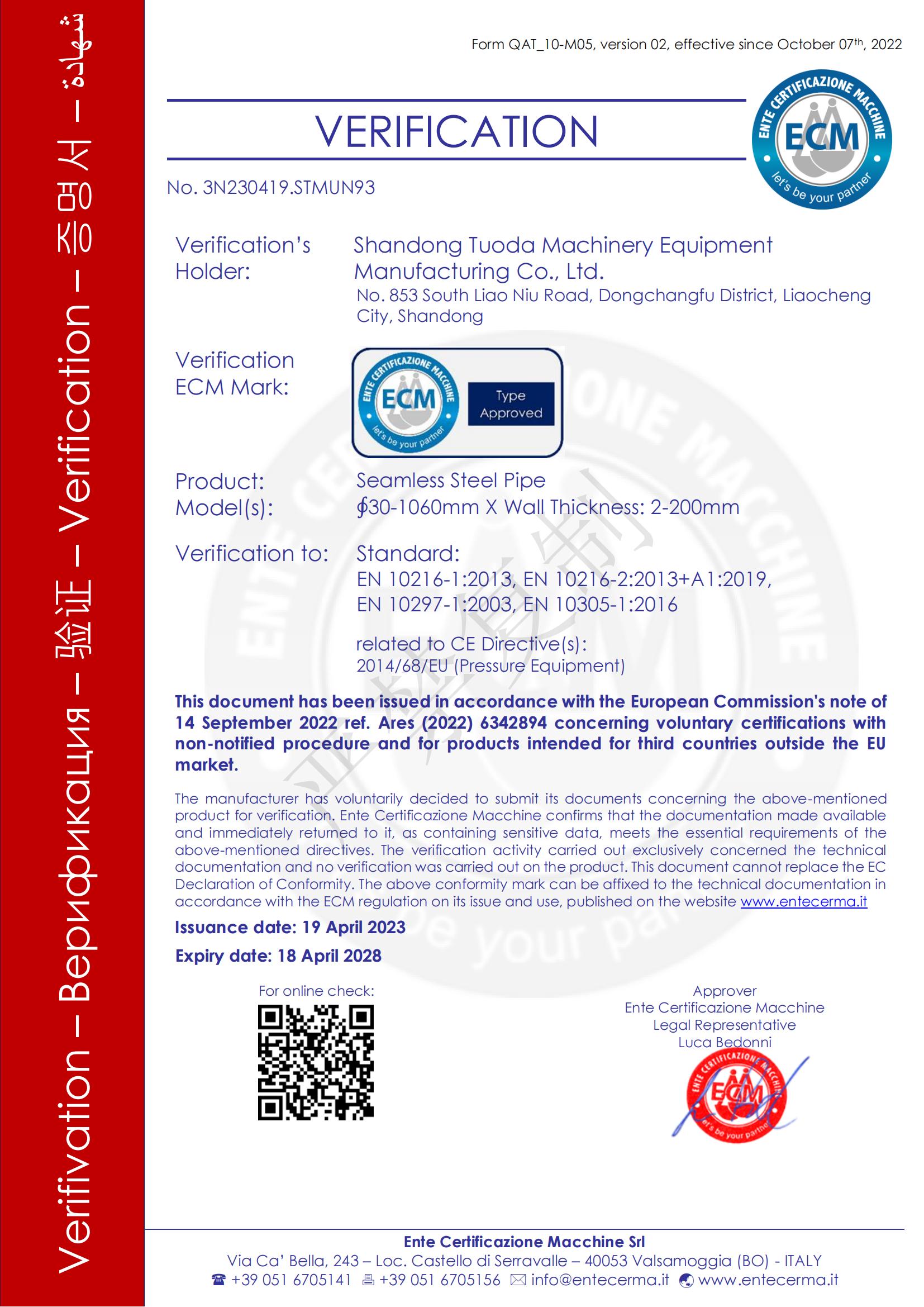
CE 3.1 certificate 3N230530.STMDO12, issued by ECM under EN 10210, EN 10219 and EN 10025, valid until 28 May 2028.
Commercial terms
Payment is arranged by TT or LC. Shipments can be quoted on FOB, CIF, CFR, EXW or DDP terms, which lets a prototype buyer keep the trial order on a simple ex-works or FOB basis and then move to delivered terms once production volumes justify the change. Because the trial order is small, the main commercial benefit is inventory-related: the buyer funds only the material needed to validate the design instead of a full 5-ton lot.
Capacity, lead time and customisation
Production capacity is 1,000 tons per month with a standard lead time of 30–45 days. Customisation covers size, length, mechanical properties, delivery time and testing or inspection requirements, so a prototype specification and a production specification can be managed as one continuous program rather than two unrelated purchases.
Track record in oil drilling equipment
A petroleum equipment manufacturer operating in Chile and India has worked with Tuoda Machinery for 10 years on the production and manufacturing of oil drilling equipment, covering 50 sets with a reported outcome of stable operation and the highlights low loss, high performance and high applicability. The company's seamless tube is used directly in that application category — the same family of work as drill collar components.
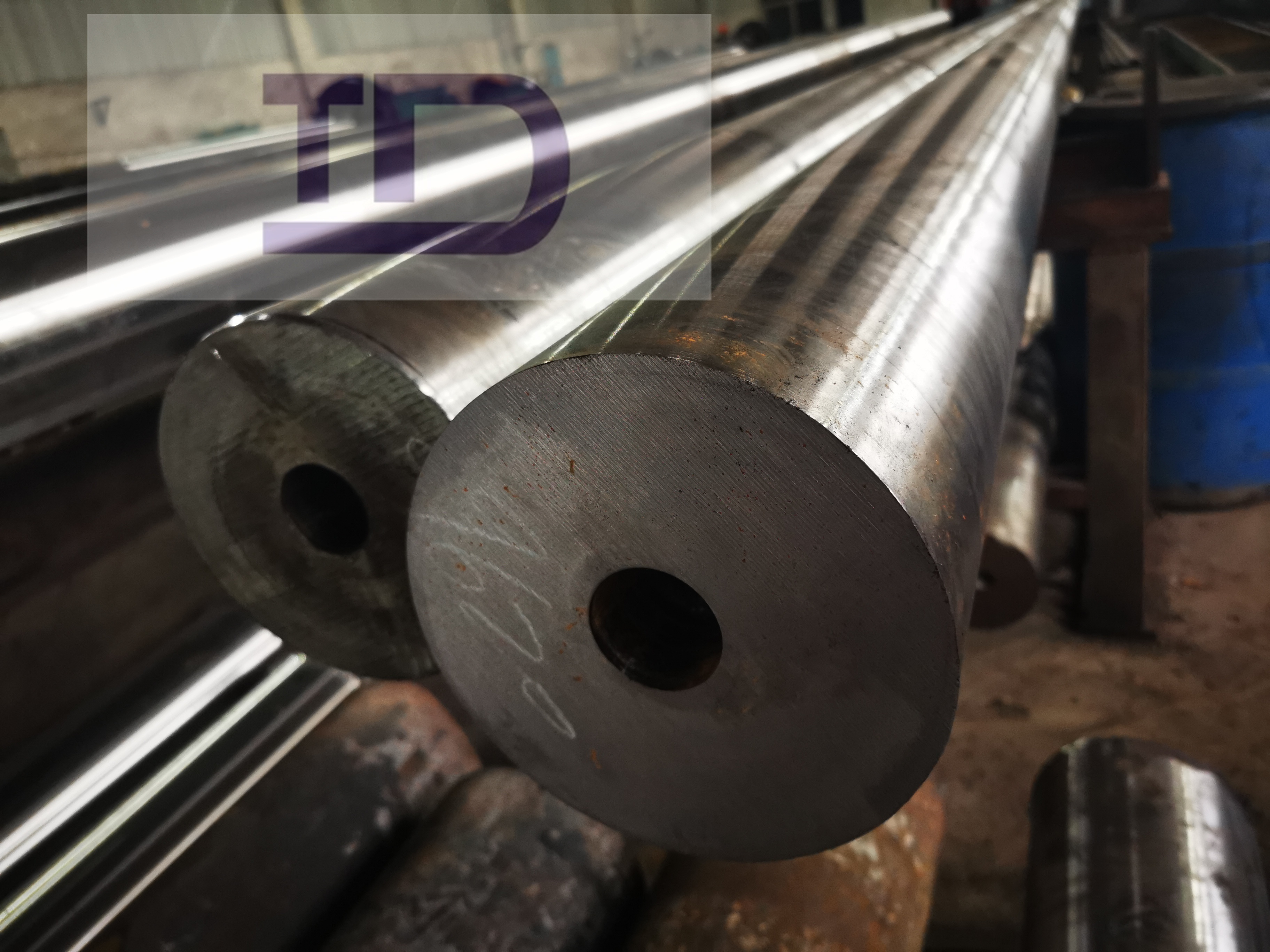
Seamless tube used in the production and manufacturing of oil drilling equipment, the same application family as drill collar work.
Step-by-Step: From Prototype Trial to 5-Ton Production Order
The sequence below is the practical version of the two-stage path, written from the buyer's side of the table.
- Write the prototype requirement as a mini specification. Record the outside diameter and wall thickness inside the 20–400 mm / 3–30 mm range, the cut length, the number of pieces needed for the trial, the application (drill collar or aerospace component) and the required delivery condition.
- Confirm the grade and the reference standard. SAE4140 chemistry is classified under ASTM A29. If the part calls for a different balance of hardenability and toughness, the wider seamless tube range also covers alloy grades in the 4140, 4130, 4145 and 4340 families, together with 42CrMo and 30CrMo material.
- Request the trial quantity on the "5 tons or discuss" basis. State explicitly that the quantity is for validation, not for production, so that the order is planned as a small-batch run.
- Fix inspection and documentation before production starts. Agree the pre-shipment test, decide between a factory laboratory report and a buyer-arranged third-party inspection, and confirm any EU-market requirements against CE 3.1 certificate 3N230530.STMDO12.
- Validate the material. Machine the trial pieces and heat treat them as the production part will be treated, then measure the outcomes: dimensional stability after treatment, machining behaviour, and hardness or tensile results compared with the published quenched and tempered reference range of 850–1000 MPa and 28–32 HRC.
- Freeze the design and convert to the 5-ton order. Release the production lot with the same grade, the same supplier and the same inspection protocol, planning against the 30–45 day lead time and the 1,000 tons per month capacity available for ramp-up.
- Close the commercial and logistics loop. Confirm TT or LC payment, select the Incoterm (FOB, CIF, CFR, EXW or DDP) and verify the HS classification with a customs broker before shipment.
Use Cases: Where Small-Batch SAE4140 Tube Fits
Aerospace prototype components
Prototype components need dimensional and heat-treatment validation before a production drawing is released. Ordering a trial quantity of SAE4140 tube keeps the material spend proportional to the engineering risk, and it avoids holding five tons of stock for a geometry that may be revised after the first article review.
Drill collars and oil drilling equipment
Drill collar work and oil drilling equipment manufacturing are the declared applications for Tuoda Machinery's SAE4140 seamless tube, and the Chile and India petroleum equipment case described above shows that supply relationship operating over a 10-year period. In this category the trial order is usually a single piece or a short cut length, produced to the same inspection standard as the eventual production lot.
Shafts, gears and other 4140-type parts
The same grade that suits drill collars and aerospace components is also used for shafts and gears, where quenched and tempered 4140 delivers the 850–1000 MPa tensile range and 28–32 HRC nominal hardness described in published material data. Buyers running a first article on those parts face exactly the same 5-ton decision, and the trial-then-scale logic applies unchanged.
Small-Batch Trial Order vs 5-Ton Production Order
The two stages differ in purpose rather than in material quality. The table below compares them using the specification and terms described above.
| Decision factor | Small-batch validation order | 5-ton production order |
|---|---|---|
| Primary objective | Verify material, machinability and heat-treatment response for a prototype | Supply serial production of drill collars or aerospace components |
| Order basis | Single piece or small batch, agreed per project | 5 tons standard MOQ, or discuss |
| Product form | SAE4140 alloy seamless round or square tube, OD 20–400 mm, WT 3–30 mm | Same |
| Inspection | Pre-shipment test; factory laboratory report or buyer-arranged third-party inspection | Pre-shipment test; factory laboratory report or buyer-arranged third-party inspection |
| Documentation | CE 3.1 certificate 3N230530.STMDO12 (EN 10210 / EN 10219 / EN 10025) available for EU-destined projects | Same certificate held, valid to 28 May 2028 |
| Payment and shipping | TT or LC; FOB / CIF / CFR / EXW / DDP | TT or LC; FOB / CIF / CFR / EXW / DDP |
| Lead time | 30–45 days | 30–45 days |
| Capacity behind the order | Within 1,000 tons per month | Within 1,000 tons per month |
| Inventory exposure | Low — quantity matches prototype demand | Higher — released only after design freeze |
| Best used when | Before design freeze | After first-article approval |
Frequently Asked Questions
Does a small SAE4140 tube order still come with inspection and compliance documentation?
Yes. Tuoda Machinery applies the same pre-shipment testing to trial and production quantities: an order can be released with a factory laboratory report, or the buyer can arrange a third-party inspection before shipment. The company also holds CE 3.1 certification issued by ECM under EN 10210, EN 10219 and EN 10025 (certificate 3N230530.STMDO12, issued 30 May 2023 and valid until 28 May 2028), which supports EU-market documentation requirements.
What is the smallest quantity of SAE4140 tube Tuoda Machinery will supply?
The standard minimum order quantity for SAE4140 alloy seamless tube is 5 tons, or discuss. Single-piece and small-batch runs are supported as part of normal operations, which is what makes prototype and first-article validation possible before a full production commitment. The product itself is supplied as round or square seamless tube with an outside diameter range of 20–400 mm and a wall thickness range of 3–30 mm, for drill collar and aerospace component applications.
What payment terms and Incoterms apply to a small trial order?
Payment can be arranged by TT or LC, and shipments can be quoted on FOB, CIF, CFR, EXW or DDP terms depending on the buyer's preferred logistics structure. On a trial quantity the value of these options is mostly financial exposure: the buyer funds only the material needed to validate the design instead of committing to a full 5-ton lot and the storage that comes with it.
Can we validate machining and heat treatment before placing a 5-ton order?
Yes — that is the purpose of the trial quantity. Buyers normally confirm the delivery condition at inquiry stage and then test dimensional accuracy, machinability and heat-treatment response on the trial pieces. For quenched and tempered 4140 material, published data gives a tensile strength of 850–1000 MPa and a nominal hardness of 28–32 HRC, which provides a reference point when the prototype results are reviewed against the specification.
How long does a small-batch order take, and how does the scale-up to 5 tons work?
Standard lead time is 30–45 days, and monthly capacity of 1,000 tons is available once the order moves to production volumes. In practice the buyer places the trial quantity first, validates the material, freezes the design, then releases the 5-ton lot with the same grade and the same inspection protocol. Full product details are available in the Tuoda Machinery brochure, and specifications can be sent directly to the team for a trial-order quotation.
Start With a Trial Quantity, Scale to 5 Tons
The 5-ton MOQ does not have to be the first decision in a prototype program. Validate the material first, freeze the design, then commit to production tonnage — and keep the same grade, supplier and inspection protocol throughout.
Send your specification — outside diameter, wall thickness, length, quantity, delivery condition and application — and the Tuoda Machinery team will confirm the trial quantity, inspection route and shipping terms.
Email: olivia@sdtuoda.com | Tel / WhatsApp: +86 13290268388
Download the full product brochure: Tuoda Machinery brochure (PDF)
Address: NO853 south Liaoniu Road, Dongchangfu District, Shandong, China | Website: www.sdtdsteel.com