Top 5 Heavy Duty Hydraulic Cylinder Configurations for Extreme Pressure Applications
Extreme pressure duty is decided by configuration before it is decided by brand. A piston cylinder, a telescopic cylinder, a plunger cylinder, a rotary cylinder and a large-bore custom build all move a load, but they seal differently, fail in different places and suit different equipment. This guide ranks the five heavy duty hydraulic cylinder configurations most often specified for high-pressure and ultra-high-pressure work — a band that starts well above the 160 bar and 250 bar mounting series used for general industrial cylinders and runs up to 10,000 psi.
It is written for buyers, engineers and procurement teams in the discovery and research stage: you already know the machine, the force and the environment, but you have not yet decided which cylinder architecture should carry that duty. Each entry explains what the configuration is, where it performs, what it costs you in added complexity, and which evidence stands behind the ranking.
The Short Answer
- Double-acting piston configuration — the default high-pressure architecture and the most widely deployed in heavy-duty systems.
- Telescopic (multi-stage) configuration — the answer when the stroke is long and the retracted length must stay short.
- Plunger (ram) configuration — the simplest high-force, single-direction design.
- Rotary (oscillating) configuration — actuation instead of linear travel.
- Large-bore, long-stroke ultra-high-pressure custom build — the configuration used when bore, stroke and pressure all sit at the top of the envelope.
Why Configuration Decides Survival in Extreme Pressure Duty
Force in a hydraulic cylinder is pressure multiplied by bore area, not pressure added to bore. The cylinder converts hydraulic energy into mechanical energy through linear reciprocating motion, and at the extreme end of the heavy duty range those variables compound. A bore of up to 36 inches, a stroke of up to 40 feet and pressure of up to 10,000 psi do not sit at the edge of the envelope separately — they sit there together, and configuration is what keeps them in balance.
Three failure mechanisms dominate once pressure and bore rise:
- Loss of bore dimensional stability. At high pressure the barrel must hold its internal diameter across an entire production batch, not just in a single sample.
- Straightness and concentricity loss over long stroke. A 40 ft stroke magnifies any deviation in rod guidance, gland alignment or barrel straightness.
- Sealing failure at the interface. Seal extrusion, leakage and internal bypass are the visible symptoms of a configuration that was never matched to the pressure class.
This is why the special requirements attached to these applications are manufacturing requirements rather than marketing claims. They include internal bore dimensional stability with batch consistency, straightness, internal bore roughness, concentricity and stable lead times. Bore finish is measured, not asserted: the working tolerance is ISO H8/H9 with arithmetic roughness of Ra ≤ 0.4 μm.
A cylinder is also never a standalone part. It must be used with a complete hydraulic system including the cylinder barrel, piston rod, piston, gland or head, end cap, sealing system, guide bush and ports. Changing the configuration changes several of those elements at once, which is why the decision belongs at the start of a project rather than at the quotation stage.
How This Ranking Was Built
Four criteria were applied in order, and they are stated here so that you can re-run the ranking against your own project:
- Pressure and load fit — how the configuration behaves when the duty is measured in hundreds of bar rather than tens of bar.
- Market validation — how widely the configuration is actually deployed in heavy-duty hydraulic systems today.
- Application match — fit with the equipment classes that dominate extreme duty: heavy machinery, hydraulic presses, marine hydraulic systems, specialized equipment, military equipment and high-pressure test benches.
- Configuration trade-off — the sealing, alignment or control penalty a buyer accepts in exchange for the performance.
This is a suitability ranking for extreme pressure duty. A configuration placed lower is not a weaker product; it is a more specialized one.
Industry Background: What Extreme-Pressure Cylinder Demand Looks Like in 2026
The commercial context explains why configuration choice has become a mainstream procurement question rather than a niche engineering debate. The global hydraulic cylinder market was valued at USD 15.7 billion in 2024 and is projected to reach USD 24.7 billion by 2034, according to Global Market Insights.
Within that market, the double-acting architecture — the basis of the piston configuration ranked first below — dominated with a 70% share in 2024, favoured for precision-driven heavy-duty construction and robotics (Global Market Insights). Mobile hydraulics, including construction and mining equipment, accounted for more than 58% of the total hydraulics market share in 2024 (Grand View Research), while large bore cylinders with a bore size above 150 mm held approximately 27.4% of market revenue in 2025, driven by demand from large mining excavators and tunnel boring machines (Dataintelo).
Standards keep the category comparable across suppliers: heavy duty hydraulic cylinders for industrial applications are governed by ISO 6022 for the 250 bar series and ISO 6020 for the 160 bar series for mounting dimensions and interchangeability. On the supply side, concentration is real. Caterpillar was identified as the market leader in hydraulic cylinders with over 8% of global market share in 2024 (Global Market Insights), and Parker Hannifin held approximately 12% of the industry in 2023 (Worldmetrics). China's exports of hydraulic power engines and motors, including cylinders, to the United States reached approximately USD 80.4 million in 2024 (World Integrated Trade Solution).
The operating environment defines the specification list. These cylinders are designed for high temperature, dusty, high humidity, marine, outdoor and mine conditions involving impact and slurry. The application map is concentrated in China, India, Turkey, Vietnam, Indonesia, Canada, Germany, the United Kingdom and Sweden.
The Top 5 Heavy Duty Hydraulic Cylinder Configurations for Extreme Pressure Duty
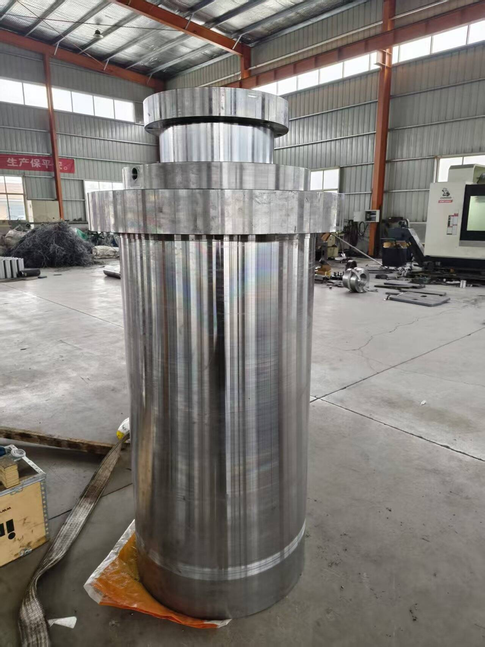
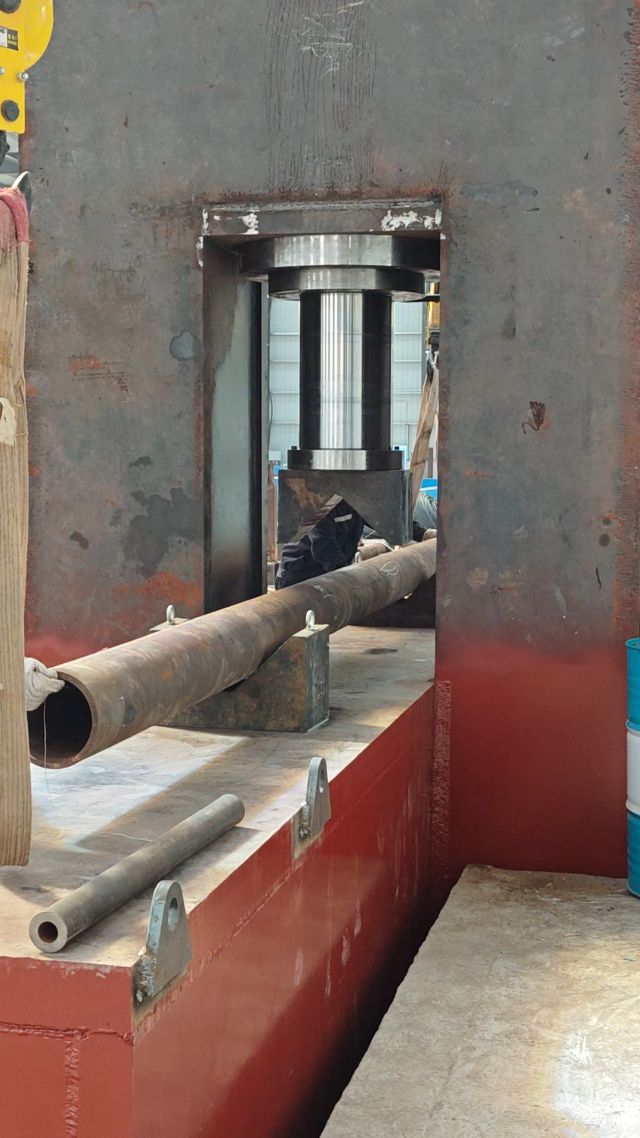
The configurations ranked below are the four cylinder types a custom cylinder manufacturer builds — piston, plunger, telescopic (multi-stage) and rotary (oscillating) — plus the large-bore ultra-high-pressure build that pushes all three variables to the top of the envelope. Tuoda Machinery, formally Shandong Tuoda Machinery Equipment Co., Ltd., is a Chinese manufacturer established in 2020 that produces seamless steel pipes, custom hydraulic cylinders, deep hole drilling machines and pressure cylinders from a 30,000 m² facility with approximately 150 employees, a three-engineer R&D team and an annual capacity of about 1,200 units; roughly 70% of its output is exported to the EU, Asia and South America.
1. Double-Acting Piston Configuration
A piston cylinder uses a piston mounted on the rod to divide the barrel into two chambers, so hydraulic pressure can be applied in either direction. It ranks first for extreme pressure duty because it combines two-directional force control with the widest deployment in heavy-duty systems: the double-acting architecture held a 70% share of the hydraulic cylinder market in 2024.
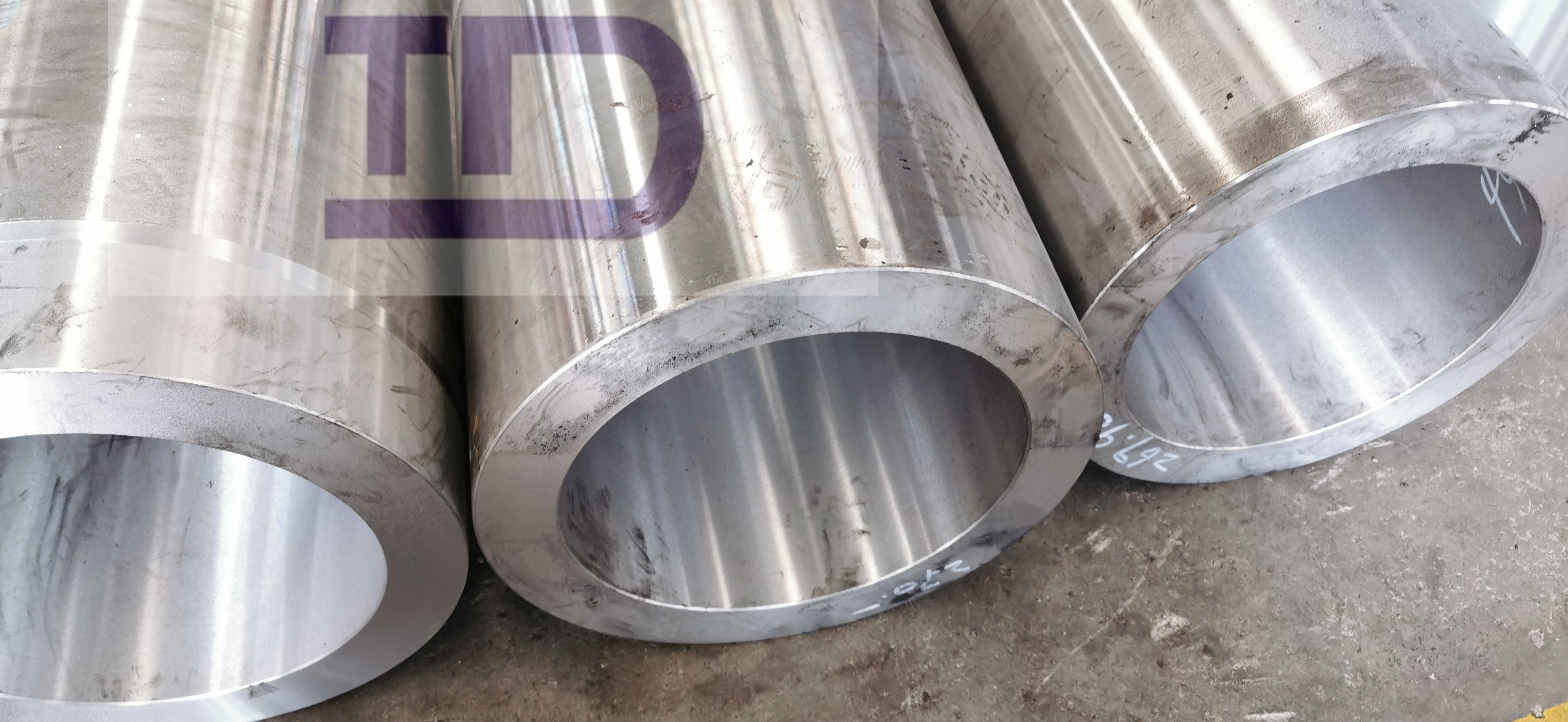
What makes the piston type suitable for high pressure is less the principle than the manufacturing discipline behind it. Bore tolerances are held to ISO H8/H9 and arithmetic roughness to Ra ≤ 0.4 μm, with tube outside diameters from 20 mm to 800 mm and wall thicknesses from 3 mm to 50 mm. Material options include ST52, S355, E355, C45, SAE1045 and 42CrMo4, all available as customized grades. Among these, the alloy grade 42CrMo4 is the option normally associated with higher-stress components, while ST52 and E355 are widely used for tube and barrel work.
The trade-off to plan for: a double-acting piston has more sealing interfaces than a single-direction design, so bore finish, guide bush condition and seal specification decide service life. Treat the sealing system, guide bush and ports as part of the configuration decision, not as aftermarket details.
2. Telescopic (Multi-Stage) Configuration
A telescopic cylinder extends through two or more stages nested inside one another. It ranks second because it solves the one problem a single-stage cylinder cannot: producing a long working stroke from a short retracted length. Where stroke reaches up to 40 feet, this is often the difference between a machine that can be packaged and one that cannot.
Every stage adds a sleeve, and therefore an additional sealing and guidance interface, and each stage has to remain concentric through its full extension. That is why the special requirements for these applications — internal bore dimensional stability with batch consistency, straightness, internal bore roughness and concentricity — matter most in multi-stage designs. When comparing telescopic quotations, ask how many stages carry guidance and what concentricity requirement applies per stage, rather than comparing only the nominal bore and stroke.
3. Plunger (Ram) Configuration
A plunger cylinder applies force in a single direction in a single-acting arrangement. It is the simplest architecture in the heavy duty family and, for pure pressing or lifting duty at high force, one of the most robust. It ranks third because it cannot provide controlled return travel on its own, which rules it out of many two-directional machine functions.
Its practical importance in 2026 comes from an upgrade path that procurement teams meet regularly: converting a single-acting arrangement to double-acting. This is a configuration change rather than a component swap, because the rod, gland or head, sealing system and ports all change with it. Material selection follows the same menu as the piston type, with ST52 and E355 used for tube and barrel work and alloy grades such as 42CrMo4 reserved for the highest stress concentrations.
4. Rotary (Oscillating) Configuration
A rotary (oscillating) cylinder converts hydraulic pressure into a controlled arc of rotation rather than linear travel. It ranks fourth for extreme pressure applications because the majority of ultra-high-pressure demand is linear — presses, mining and construction equipment, marine systems and test benches — while rotary duty substitutes torque and arc angle for force and stroke.
That does not make it a secondary product; it makes it a different specification problem. Rotary sealing acts across a rotating interface, so the sealing system, guidance and surface finish requirements are set by the rotational duty rather than by bore roughness alone. Specify rotary configurations by torque, arc and cycle rate, and expect the material and sealing discussion to diverge from a linear cylinder of the same bore.
5. Large-Bore, Long-Stroke Ultra-High-Pressure Custom Build
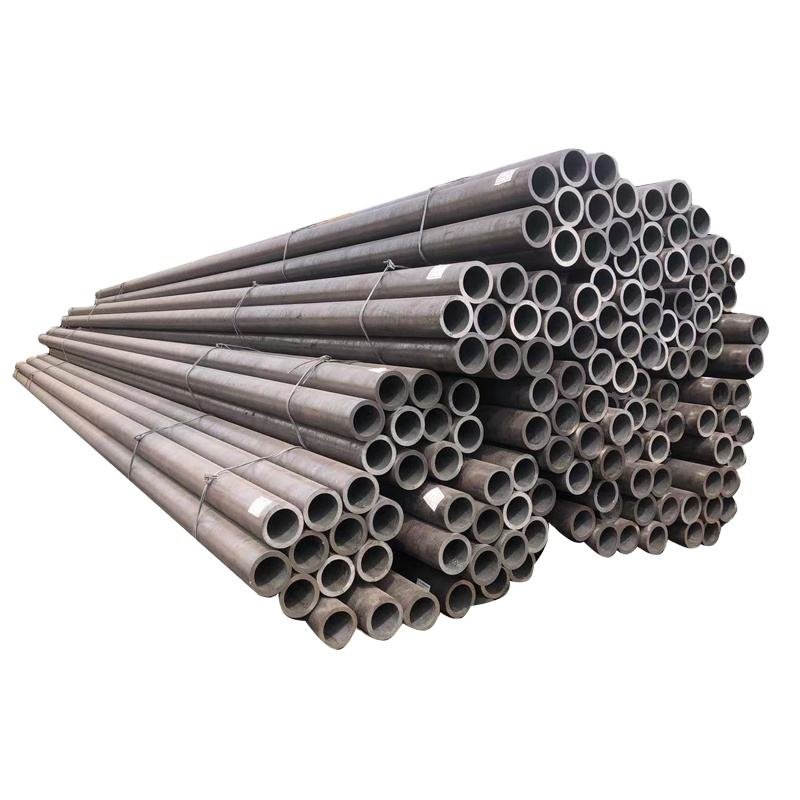
The fifth entry is a configuration class rather than a single catalogue type: large bore, long stroke and pressure combined at the top of the range — bore up to 36 inches, stroke up to 40 feet and pressure up to 10,000 psi. That pressure level, approximately 690 bar, sits inside the ultra-high-pressure class above 63 MPa, where the design changes fundamentally compared with a standard cylinder. The core difference is the use of high-strength material and a design tailored for extreme conditions: thick-walled seamless steel pipe tubing, precision honing to Ra ≤ 0.4 μm, metal-to-metal sealing, high-performance polyurethane seals, forged valve bodies and overpressure protection devices.
It is ranked fifth not because it is weaker but because it is the most specialized option. It is what you specify when the four configurations above cannot carry the bore, stroke or pressure, and it follows the longest route from enquiry to delivery: application analysis, drawing verification, material selection, manufacturing and honing, inspection, testing and final delivery.
Step-by-Step: Specifying a Configuration for Extreme Pressure Duty
Work through these steps in order. Changing an early decision invalidates the ones that follow it.
- Fix the force and working pressure. Start from the machine duty, then define whether the cylinder sits in the high-pressure class of 31.5 to 63 MPa or the ultra-high-pressure class above 63 MPa. The class, not the catalogue page, sets the material and sealing concept.
- Derive the bore from pressure and force. Because force is pressure multiplied by bore area, a small increase in bore at extreme pressure increases load quickly. Check that the machine frame and mountings accept the resulting force.
- Set the stroke and check the mechanics of length. Up to 40 feet of stroke is achievable, but long stroke brings straightness and concentricity into the specification. If the retracted length must stay compact, this is the point where telescopic becomes the candidate.
- Select the configuration. Push-and-pull duty points to double-acting piston; long stroke with short retracted length points to telescopic; single-direction high force points to plunger; rotational actuation points to rotary.
- Choose the material grade. Options include ST52, S355, E355, C45, SAE1045 and 42CrMo4, and grades can be customized. Match the grade to the duty rather than to availability.
- Define bore quality. Specify ISO H8/H9 bore tolerance and Ra ≤ 0.4 μm roughness, plus straightness and concentricity limits, and confirm how batch consistency will be demonstrated.
- Specify the complete system. A cylinder is supplied into a system comprising cylinder barrel, piston rod, piston, gland or head, end cap, sealing system, guide bush and ports. Confirm that all of them are specified together.
- Confirm environment, validation and lead time. State whether the cylinder works in high temperature, dust, high humidity, marine, outdoor or mine conditions with impact and slurry, then agree inspection and testing, and a stable delivery window.
Use Cases: Matching Configuration to Equipment
- Hydraulic presses and industrial press work: double-acting piston configurations where pressing and retraction are both controlled; plunger configurations where the force is single-direction and the return is mechanical.
- Construction machinery and mining equipment: double-acting piston and telescopic configurations, operating in dust, impact and slurry conditions where bore stability and wear resistance dominate service life.
- Marine hydraulic systems: piston and plunger configurations specified for marine exposure and high humidity, where corrosion-resistant material selection and surface treatment matter as much as pressure rating.
- Military equipment and high-pressure test benches: large-bore, long-stroke ultra-high-pressure builds, where the requirement is frequently a combination of extreme pressure and long stroke that no standard configuration covers.
- Specialized equipment needing actuation rather than travel: rotary (oscillating) configurations, specified by torque and arc rather than by bore and stroke.

Configuration Comparison Table
| Rank | Configuration | Direction of force | Engineering focus | Best-fit duty | Planning trade-off |
|---|---|---|---|---|---|
| 1 | Double-acting piston | Push and pull | Bore to ISO H8/H9, Ra ≤ 0.4 μm; ISO 6022 / ISO 6020 mounting practice | Hydraulic presses, construction machinery, mining equipment, marine hydraulic systems | More sealing interfaces than a single-direction design; bore finish and seal grade decide service life |
| 2 | Telescopic (multi-stage) | Push, extended through stages | Long stroke from short retracted length; per-stage concentricity and straightness | Long-stroke lifting and positioning in heavy machinery and specialized equipment | Each stage adds a sealing and guidance interface to control |
| 3 | Plunger (ram) | Single-direction push | Simple, robust architecture; material grade carries the stress | High-force pressing, hoisting and specialized equipment | No controlled return travel; conversion to double-acting changes rod, gland, seals and ports |
| 4 | Rotary (oscillating) | Rotary torque over a limited arc | Sealing and finish across a rotating interface | Specialized equipment requiring actuation rather than linear travel | Specified by torque and arc, not by bore and stroke; different sealing concept |
| 5 | Large-bore, long-stroke ultra-high-pressure build | Push and pull | Bore up to 36 in, stroke up to 40 ft, pressure up to 10,000 psi; thick-walled seamless tube, honing, overpressure protection | High-pressure test benches, presses, mining, marine and military equipment | Longest path from enquiry to delivery; justified only when standard bore, stroke and pressure cannot meet the duty |
How to read the table: the rank reflects suitability for extreme pressure duty, not product quality. A rotary configuration ranked fourth may be the only correct choice for an application, and a large-bore custom build ranked fifth is the only configuration that reaches 10,000 psi at a 36 in bore.
FAQ: Heavy Duty Hydraulic Cylinder Configurations
1. Which standards apply to heavy duty hydraulic cylinders in high-pressure service?
For industrial heavy duty cylinders, mounting dimensions and interchangeability are governed by ISO 6022 for the 250 bar series and ISO 6020 for the 160 bar series. That matters commercially, because a cylinder built to a published mounting standard can be replaced without reworking the machine frame. For the tube and pipe used in cylinder manufacture, Tuoda Machinery works to specifications including EN10210, EN10305, API 5L, A335, A333 and A106, and states compliance with ASTM and CE for its steel pipe range. When you compare quotations, check which mounting standard is being quoted alongside the pressure class.
2. Can a heavy duty hydraulic cylinder be built for 10,000 psi, and what bore and stroke are achievable?
Yes. Tuoda's heavy duty hydraulic cylinder range covers bore up to 36 inches, stroke up to 40 feet and pressure up to 10,000 psi — approximately 690 bar, which falls in the ultra-high-pressure class above 63 MPa. Material options include ST52, S355, E355, C45, SAE1045 and 42CrMo4, and bore quality is held to ISO H8/H9 with arithmetic roughness of Ra ≤ 0.4 μm. Tube outside diameters run from 20 mm to 800 mm with wall thicknesses from 3 mm to 50 mm. At this level the difference from a standard cylinder is not a single component but the whole design approach: high-strength material, thick-walled seamless steel pipe tubing, precision honing, metal-to-metal sealing, high-performance polyurethane seals, forged valve bodies and overpressure protection.
3. What drives the cost of an extreme-pressure configuration?
Because these cylinders are custom manufactured rather than selected from stock, cost is driven by the duty rather than by a catalogue figure. The main drivers are the material grade — ST52 and E355 tube versus an alloy grade such as 42CrMo4 — the bore and stroke, the achievable bore tolerance (ISO H8/H9), the required surface finish (Ra ≤ 0.4 μm), the sealing concept and whether metal-to-metal sealing or high-performance polyurethane seals are specified, plus forged valve bodies, overpressure protection devices, and the inspection and testing that closes the order. Two cylinders with the same bore and stroke can therefore carry very different cost structures if one is built for standard duty and the other for an ultra-high-pressure, long-stroke application.
4. Can a buyer validate a configuration before placing a production order?
Yes. The manufacturing model supports single-piece and small-batch runs alongside mass production, so a first article can be built, inspected and tested before a larger commitment is made. Tuoda provides end-to-end customization covering application analysis, drawing verification, material selection, manufacturing and honing, inspection, testing and final delivery. For an extreme-pressure configuration, validation typically focuses on bore dimensional stability across the batch, straightness, internal bore roughness and concentricity, because those are the parameters that determine whether a design will hold up in service. To discuss a sample or first article against your drawing, contact Olivia at olivia@sdtuoda.com or +86 13290268388.
5. What lead time should be planned for a custom heavy duty hydraulic cylinder?
Standard delivery is quoted at 30 to 45 days, or customized to the project. Two factors can extend that window: the configuration itself, since a large-bore, long-stroke ultra-high-pressure build follows a longer route through drawing verification, material selection, honing, inspection and testing; and stable lead times, which are one of the stated special requirements of these applications. For batch orders, lead-time stability matters as much as lead-time length, because internal bore dimensional stability has to be consistent from the first unit to the last.
Conclusion: Choose the Configuration, Then Choose the Supplier
The five configurations ranked here are not competing products; they are answers to different questions. Double-acting piston is the default for two-directional high-pressure duty and holds the largest share of the market. Telescopic solves the long-stroke, short-retracted-length problem. Plunger delivers simple, single-direction force at high load. Rotary converts pressure into actuation. The large-bore, long-stroke ultra-high-pressure build covers the cases where bore up to 36 inches, stroke up to 40 feet and pressure up to 10,000 psi must coexist.
Once the configuration is fixed, the manufacturing questions decide the outcome: which material grade carries the stress, whether bore tolerance and roughness can be held across a batch, whether straightness and concentricity are controlled well enough for a long stroke, and whether the supplier can hold a stable lead time. Those are the questions worth putting to every quotation you receive.
Next step: send your drawing, duty cycle and mounting details to Tuoda Machinery. The team will confirm the configuration, material grade and bore quality that fit your extreme-pressure application, and issue a quotation against the specification.
Email: olivia@sdtuoda.com | Tel: +86 13290268388 | WhatsApp: +86 13290268388 | Website: WWW.SDTDSTEEL.COM
Download the product brochure (PDF): Tuoda Machinery product brochure
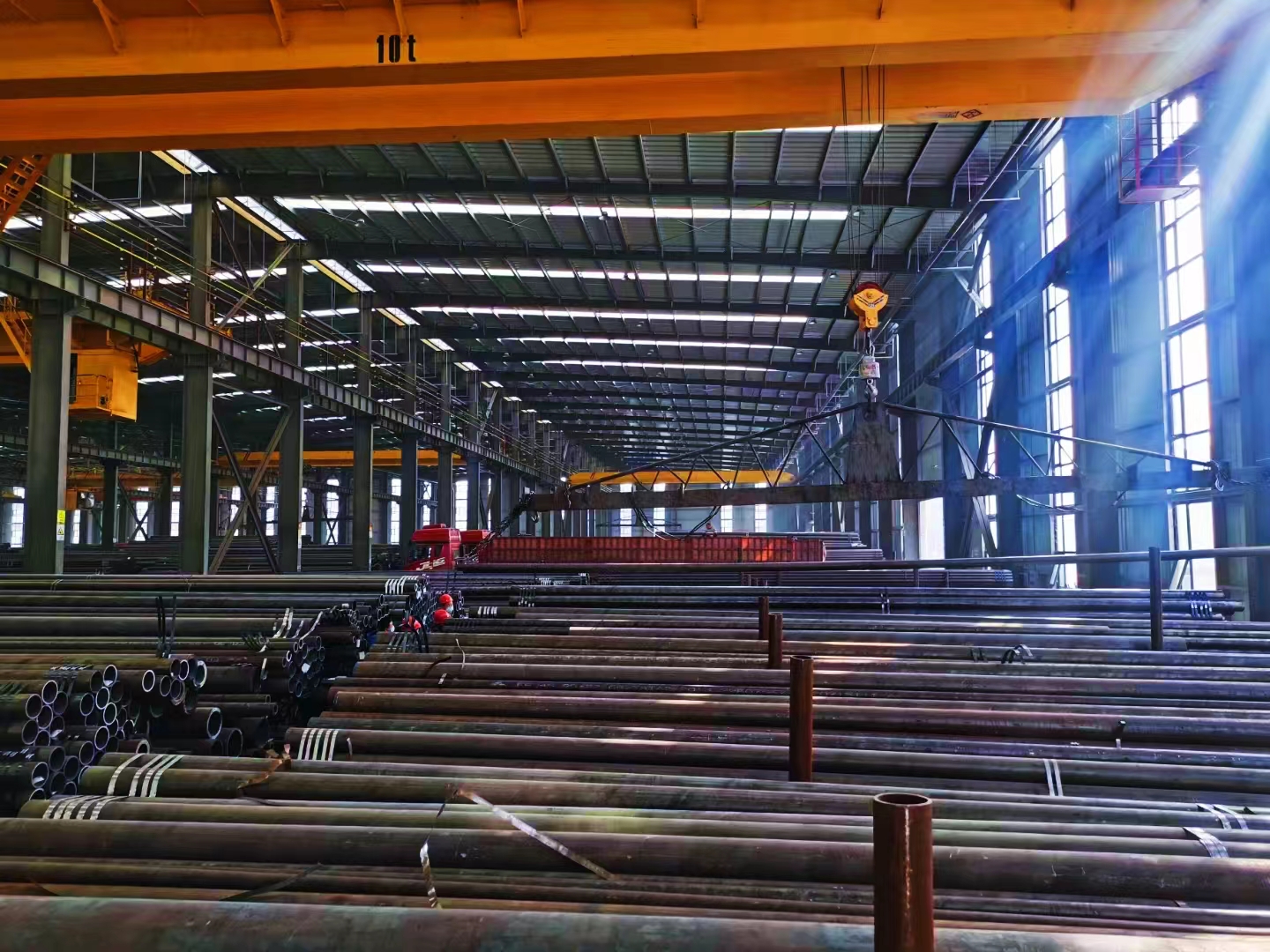
Article prepared by Tuoda Machinery — Shandong Tuoda Machinery Equipment Co., Ltd., established 2020, manufacturing seamless steel pipes, custom hydraulic cylinders, deep hole drilling machines and pressure cylinders for the EU, Asia and South America markets.