When Your Press Won't Hold Pressure: Diagnosing Heavy Duty Hydraulic Cylinder Failures
A heavy duty hydraulic cylinder rarely fails without warning. It fails with a slow drift on a press that should hold position, a pressure gauge that sags at the top of the stroke, a barrel that runs warmer than it used to, or a thin film of oil appearing under the gland. By the time a maintenance team notices lost tonnage on the shop floor, the damage is usually already inside the barrel.
This guide is written for maintenance engineers and plant buyers who need one practical answer: why did this heavy duty hydraulic cylinder lose pressure, and what will stop the same failure from coming back? It sets out a six-step symptom-to-root-cause diagnostic sequence, then explains how the construction decisions behind a cylinder — material grade, bore finish and tolerance, sealing system, and flow design — decide whether a repair lasts months or years.
The short answer: pressure loss in a heavy duty hydraulic cylinder comes from one of four places — internal bypass across the piston seal, external leakage at the rod gland, a worn or deformed bore, or the fluid itself. Only one of those four is solved by replacing seals.
Problem Definition: What "Won't Hold Pressure" Actually Means
"Won't hold pressure" is a symptom, not a fault. It describes at least six different mechanical conditions, and each one has a different repair path. Reading the symptom correctly before the cylinder is removed from the machine is the single biggest time saver in hydraulic maintenance.
- Drift or creep with the directional valve centered. The actuator moves under load even when it should be hydraulically locked. This points to internal bypass across the piston seal, or to a bore that is no longer round enough for the seal to sit against.
- Loss of force at rated pressure. The cylinder still strokes, but it no longer develops the tonnage the cycle requires. Piston-seal bypass and bore wear are the usual causes; on press circuits, pump condition and relief-valve settings must be ruled out first.
- Rising oil temperature with no visible leak. Internal leakage converts pressure into heat. A barrel that runs hot while the machine is doing light work is a strong indicator of a piston seal problem rather than a pump problem.
- External weeping at the gland. This is rod seal, wiper and guide bush condition. Left in service, weeping carries contamination into the barrel and turns a seal job into a bore job.
- Rod scoring, chrome flaking or pitting. Side load, misalignment or contaminated fluid. Each of these damages the rod seal on every cycle and returns the cylinder to the workshop quickly.
- The same seal failure recurring on a fixed interval. At that point the seal is not the problem. The specification or the application fit is.
The distinction that matters most: external leakage is visible and usually inexpensive to correct. Internal bypass is invisible, converts pressure into heat, and is frequently the result of a bore that was never finished to specification. In heavy duty service, a rough bore or a wrongly selected seal compound is not a repairable condition — it is a design condition.
Industry Background: Why Pressure Loss Is So Common in Heavy Duty Duty Cycles
The scale of the problem is visible in the market itself. The global hydraulic cylinder market was valued at USD 15.7 billion in 2024 and is projected to reach USD 24.7 billion by 2034, according to Global Market Insights. Within that market, double-acting cylinders held a 70% share in 2024 because they suit precision-driven heavy-duty construction and robotics applications. Mobile hydraulics — construction and mining equipment — accounted for more than 58% of total hydraulics market share in 2024, according to Grand View Research. Large bore cylinders above 150 mm took approximately 27.4% of market revenue in 2025, driven by large mining excavators and tunnel boring machines (Dataintelo).
Those figures matter to a maintenance engineer for one reason: the highest-pressure, highest-cycle cylinders are concentrated in exactly the applications where a stoppage is most expensive. The operating conditions for these units are typically described as high temperature, dusty, high humidity, marine, outdoor, and mine duty with impact plus slurry. Under those conditions, a cylinder that will not hold pressure is usually the cumulative result of four decisions made long before the unit reached the site: material grade, bore quality, sealing system, and contamination control.
Standards are supposed to close part of that gap. For industrial applications, ISO 6022 (250 bar series) and ISO 6020 (160 bar series), published by ISO/TC 131 Fluid Power Systems, govern mounting dimensions and interchangeability. What that means in practice is that a cylinder can meet its pressure class and still leak: pressure rating, bore tolerance and bore roughness are three separate specifications, and interchangeability standards do not guarantee the other two.
Shandong Tuoda Machinery Equipment Co., Ltd. (Tuoda Machinery) is a hydraulic cylinder and seamless steel pipe manufacturer based in Liaocheng, Shandong, China, producing carbon seamless steel tube, round bars and pressure cylinders for engineering machinery, the automotive industry and general manufacturing. The company exports to markets that include India, Turkey, Vietnam, Indonesia, Canada, Germany, the United Kingdom and Sweden — which means its cylinders are exposed to exactly the dusty, humid, marine and cold-start conditions that turn a marginal bore finish into a recurring leak.
Detailed Solution: Construction Choices That Decide Whether the Failure Returns
Once a cylinder is opened, the repair decision is really a specification decision. The five items below are the ones that show up most often in repeat-failure investigations, and each one is a documented build parameter rather than a marketing claim.
1. Barrel and Rod Material: ST52, S355, E355, C45, SAE1045, 42CrMo4
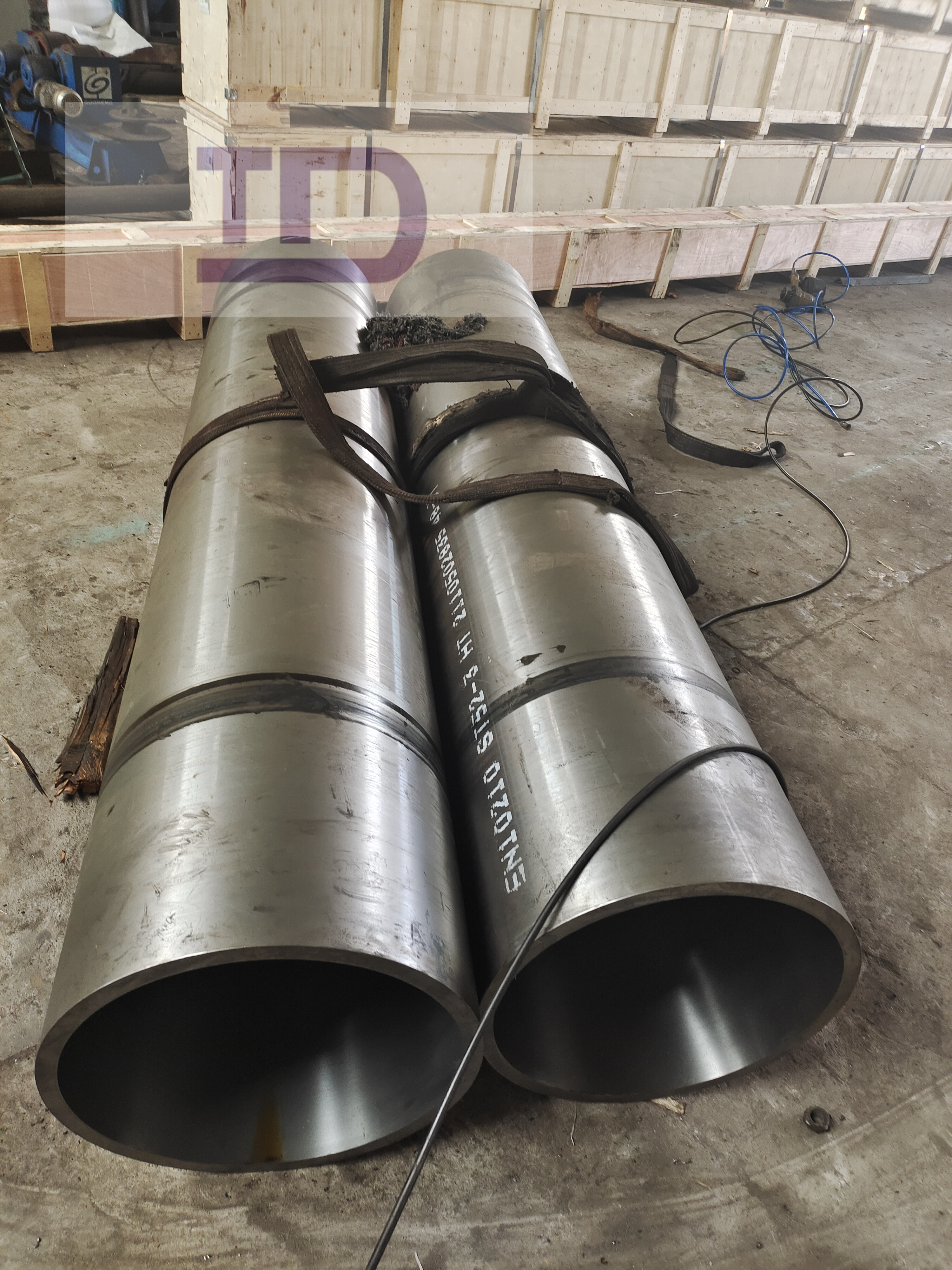
Barrel deformation is one of the quietest causes of pressure loss. A barrel that flexes or loses roundness under full load will not let any seal hold, and the symptom usually appears as a slow loss of tonnage at the top of the stroke rather than an obvious leak. Tuoda Machinery builds heavy duty hydraulic cylinders from ST52, S355, E355, C45, SAE1045 and 42CrMo4, with customised grades available, and uses thick-walled seamless steel pipe for barrel and tubing stock.
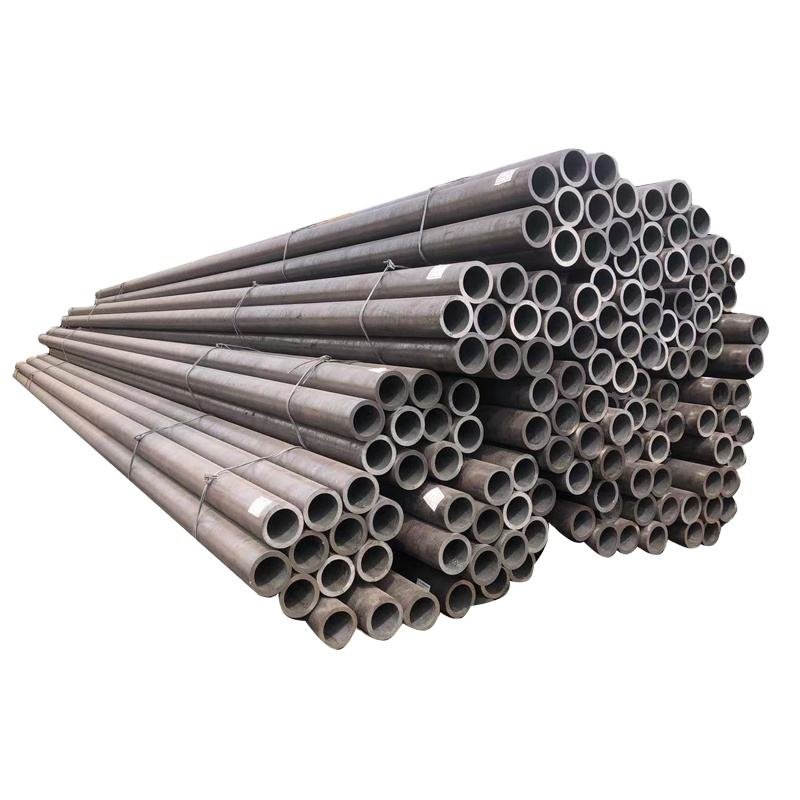
The upstream material stage is handled in the same operation. The company's steel pipe product portfolio covers hot-rolled and cold-drawn carbon seamless steel tube and round bars in grades including A106GR.B, ST52, ST44, S355, E355, 42CRMO, 30CRMO, ST37, 10# and 20#, manufactured in compliance with specifications such as EN10210, EN10305, API 5L, A335, A333 and A106, along with ASTM and CE compliance. For cylinder buyers, the practical value is traceability: wall thickness, heat treatment and honing history sit with the same supplier that machines the bore, which is what makes batch-to-batch dimensional consistency achievable rather than aspirational.
2. Bore Finish and Geometry: Ra ≤ 0.4 μm and ISO H8/H9
Bore roughness is the most under-specified number on a repair drawing, and it is the number that most often explains a recurring piston-seal failure. Tuoda Machinery holds cylinder bore diameters to ISO hole diameter tolerances H8/H9, with an arithmetic roughness of Ra ≤ 0.4 μm.
Why that matters: the piston seal relies on a controlled oil film between the seal lip and the bore wall. A bore that is too rough scrubs the seal lip and creates a leakage path; a bore that is out of round lets the seal lift under pressure on one side. Both conditions produce the same field symptom — drift with the valve centered — and both are invisible until the cylinder is opened and measured. The machining behind that specification is in-house: the company manufactures the T2120, T2125 and T2135 series deep hole drilling and boring machines, which support drilling, boring and roller burnishing of cylindrical workpieces such as hydraulic cylinders and pneumatic cylinders. Straightness, internal bore roughness, concentricity and batch dimensional stability are listed as special requirements of the cylinder programme, not as optional extras.
3. Sealing System and Seal Material Selection
Seal replacement is the most common repair action and the most common reason a cylinder comes back. The technologies used in Tuoda cylinders include metal-to-metal sealing, high-performance polyurethane seals, forged valve bodies, thick-walled seamless steel pipe tubing and overpressure protection devices.
Two decisions determine whether a replacement seal survives. The first is the sealing concept: metal-to-metal sealing behaves differently under extreme pressure than an elastomer-only arrangement, and mixing concepts during a rebuild is a common cause of early failure. The second is the compound. A cylinder specified as low temperature resistant and a cylinder running in high-temperature, high-cycle service do not take the same polyurethane specification, even when the bore dimensions are identical.
4. Flow Design, Ports and Overpressure Protection
Flow design is the part of cylinder construction that most often gets ignored until seals start failing in a pattern. Undersized ports and abrupt flow paths raise internal velocity, which produces pressure spikes and, in the worst case, cavitation damage on the bore and seal surfaces. Forged valve bodies and overpressure protection devices address the consequence — pressure that exceeds the circuit design — while port and passage sizing addresses the cause.
The practical check for a plant buyer is simple: ask what the cylinder's port size and flow path were designed for, and at what pressure the protection device is set. A heavy duty hydraulic cylinder that is hydraulically correct but flow-starved will still show up as a seal failure at 6 or 12 months.
5. Pressure Class, Size Range and Configuration
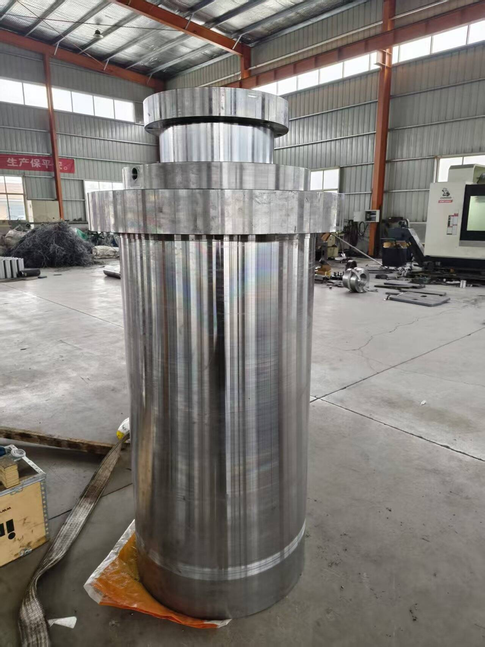
Tuoda Machinery's cylinder range is split by pressure class. High-pressure hydraulic cylinders rated 31.5 – 63 MPa are used on heavy-duty equipment such as hydraulic excavators, crushers, four-column hydraulic presses, marine steering gear and anchor winches. Ultra-high-pressure cylinders above 63 MPa are built for specialised equipment including high-pressure water jet cutting machines, artillery recoil systems and material pressure-testing apparatus. Available configurations include piston cylinders, plunger cylinders, telescopic (multi-stage) cylinders and rotary (oscillating) cylinders, with builds reaching bore sizes up to 36 inches, stroke lengths up to 40 ft and working pressures up to 10,000 psi.
| Parameter | Specification |
|---|---|
| Cylinder types | Piston cylinder; plunger cylinder; telescopic (multi-stage) cylinder; rotary (oscillating) cylinder |
| Barrel and rod materials | ST52, S355, E355, C45, SAE1045, 42CrMo4 — customised grades available |
| Bore diameter tolerance | ISO hole diameter tolerances H8 / H9 |
| Bore arithmetic roughness | Ra ≤ 0.4 μm |
| High-pressure class | 31.5 – 63 MPa |
| Ultra-high-pressure class | Above 63 MPa |
| Build range | Bore up to 36 in; stroke up to 40 ft; working pressure up to 10,000 psi |
| Customisation scope | Application, size, bore, stroke, pressure, load, system solution, cylinders, logo printing |
| Quality control | Pressure testing |
| Minimum order quantity | 1 unit |
| Lead time | 45 – 60 days |
6. The Pre-Shipment Acceptance Test: The Checkpoint Buyers Should Request
Pressure testing is the quality control step used before a heavy duty hydraulic cylinder ships, and it is the checkpoint a plant buyer can request before placing an order rather than after commissioning. A useful acceptance specification names the test pressure and its relationship to the working pressure, the hold duration, the allowable leakage criterion, and the bore measurement record that accompanies the unit.
Requesting that test up front changes the commercial conversation. It converts an unverifiable promise about performance into a documented result, and it gives the maintenance team a baseline for the first time the cylinder is rebuilt years later.
Step-by-Step Breakdown: A Six-Step Diagnostic Sequence
Step 1 — Rule out the circuit before you pull the cylinder
Confirm pump output, relief-valve setting and directional-valve condition first, and verify that the pressure gauge is reading at the cylinder's working port rather than at the pump. A significant share of "cylinder" complaints are circuit losses, and removing a heavy duty cylinder from a press or an excavator is far more expensive than a valve test.
Step 2 — Prove whether the loss is internal bypass
Hold the cylinder under load with the directional valve centered and measure movement over a defined period. If the actuator drifts, fluid is crossing the piston. Isolate the cylinder with the ports capped and repeat: if the drift stops, the leak is in the circuit. If it continues, the bypass is inside the cylinder.
Step 3 — Separate piston-seal bypass from rod-seal leakage
Internal and external leakage have different economics. Weeping at the gland is visible and correctable; bypass across the piston is invisible and usually indicates bore geometry. Check the gland first because it is accessible, then treat any confirmed bypass as a bore inspection trigger rather than a seal order.
Step 4 — Inspect the bore for scoring, ovality and roughness
Once the cylinder is open, measure instead of looking. Score marks indicate contamination; ovality and taper indicate bending or deformation; surface condition should be compared against the Ra ≤ 0.4 μm roughness and ISO H8/H9 tolerance the cylinder was specified to. A bore that fails either measurement will destroy the next seal as efficiently as it destroyed the last one.
Step 5 — Check the rod, gland and guide bush
Rod straightness, chrome condition and concentricity between the rod and the bore determine side load on the seal. A plunger or piston rod that is no longer straight will pass the same failure into the gland on every stroke. Guide bush wear accelerates this, so it is measured at the same time as rod runout rather than after the new seals are fitted.
Step 6 — Check the fluid, filtration and operating temperature
Contamination, water ingress and temperature extremes are the conditions that destroy seals from the outside. In dusty, humid and mine-duty environments, the wiper and dust ring are the cylinder's first line of defence. If the same unit fails twice, the fluid cleanliness and temperature profile belong in the investigation alongside the hardware.
Use Cases: Where Pressure Loss Actually Costs Money
The diagnostic sequence above applies across duty profiles, but the failure pattern differs by application. These are the environments where Tuoda cylinder specifications are most often tested:
- Construction machinery. Excavator boom, arm and bucket cylinders run high cycle counts in dust and impact conditions. Bore scoring and rod seal failure dominate, which is why bore roughness and rod material selection matter more here than pressure rating alone.
- Mining equipment. Mine duty combines impact with slurry. The result is accelerated wiper wear and contamination ingress, and it is the case where external leakage becomes internal damage fastest.
- Industrial presses and straightening machines. Four-column hydraulic presses lose tonnage gradually rather than suddenly; a bore that no longer holds a seal shows up as a slow loss of force at rated pressure across months of production.
- Marine hydraulic systems. Steering gear and anchor winches operate in high humidity and salt exposure, where corrosion resistance on the rod and external surfaces determines seal life.
- Cold and high-temperature environments. Cylinders specified for low-temperature resistance and cylinders running in high-temperature service require different polyurethane seal specifications.
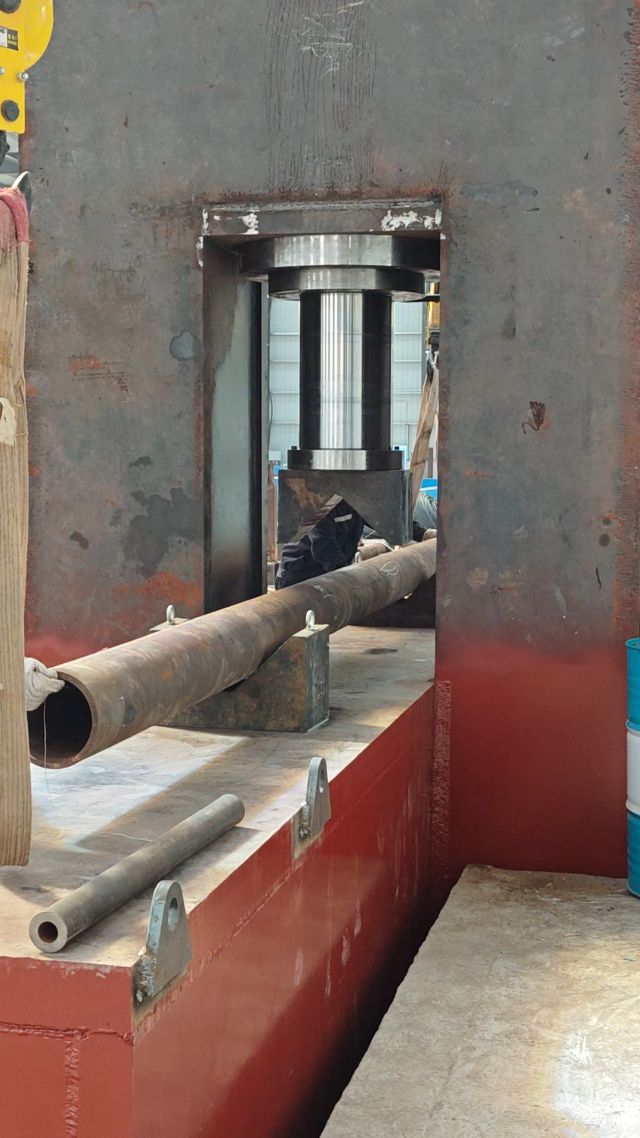
A documented example illustrates the difference specification makes. A heavy machinery OEM in Vietnam operates a single cylinder on a straightening machine that has run for above 10 years. The reported outcome is stable operation, energy saving, reduced maintenance cost and zero major failures, with stability under extreme conditions and low maintenance identified as the highlights. The relevance for a buyer is not the individual machine — it is that a cylinder built to a correct bore specification and sealing system does not generate recurring pressure-loss work orders.
Comparison Table: Matching the Failure Symptom to the Construction Fix
The table below maps the field symptom, the root cause it usually indicates, and the documented construction answer. It is intended as a specification reference for maintenance planning, not as a diagnosis by itself.
| Field symptom | Typical root cause | Construction answer | Documented specification |
|---|---|---|---|
| Drift or creep with the valve centered | Piston-seal bypass; bore wear or ovality | Bore machined and honed to a controlled finish and tolerance | ISO H8/H9 tolerance; Ra ≤ 0.4 μm |
| External weeping at the gland | Rod seal and wiper degradation; rod scoring | Rod material selection plus sealing system specification | C45, SAE1045, 42CrMo4 rod grades; polyurethane seals; metal-to-metal sealing |
| Loss of force at high load only | Barrel deformation; insufficient wall section | Thick-walled seamless steel pipe barrel in a higher-strength grade | ST52, S355, E355 barrel grades |
| Seals failing on a fixed interval | Wrong seal compound for temperature or fluid | Seal compound matched to the operating temperature band | High-performance polyurethane seals; low-temperature-resistant specification |
| Cavitation and pressure spikes | Undersized ports; no pressure protection | Forged valve bodies and overpressure protection devices; flow-path sizing | Overpressure protection devices; forged valve bodies |
| Bore damage after impact duty | Material grade not matched to impact and slurry | Higher-strength alloy grade plus straightness and concentricity control | 42CrMo4 and customised grades; straightness and concentricity requirements |
| Batch-to-batch fit variation | Inconsistent bore dimensional stability | In-house deep hole drilling, boring and roller burnishing | T2120, T2125, T2135 deep hole machines; batch consistency requirement |
Frequently Asked Questions
What bore tolerance and standards should a heavy duty hydraulic cylinder meet?
For cylinder bores, the relevant specification is ISO hole diameter tolerance H8/H9 combined with an arithmetic roughness of Ra ≤ 0.4 μm; Tuoda Machinery machines cylinder bores to both. For industrial mounting dimensions and interchangeability, the reference standards are ISO 6022 (250 bar series) and ISO 6020 (160 bar series), published by ISO/TC 131 Fluid Power Systems. Tuoda's pressure classes are 31.5 – 63 MPa for high-pressure service and above 63 MPa for ultra-high-pressure service. On the material side, barrel and tubing stock is produced in compliance with specifications including EN10210, EN10305, API 5L, A335, A333 and A106, with ASTM and CE compliance.
Can a heavy duty cylinder be built as a direct replacement, including converting a single-acting circuit to double-acting?
Yes. Tuoda Machinery operates an OEM/custom production model, and the customisation scope covers application, size, bore, stroke, pressure, load, complete system solutions, cylinders and logo printing. Cylinder configurations include piston (which covers double-acting service), plunger, telescopic (multi-stage) and rotary (oscillating) types, with builds reaching bore sizes up to 36 inches, stroke lengths up to 40 ft and working pressures up to 10,000 psi. A conversion from single-acting to double-acting operation is therefore handled as an engineered custom build rather than a catalogue match, and the minimum order quantity is 1 unit.
What drives the cost of a custom heavy duty hydraulic cylinder?
There is no published price list, because quotations are built from the drawing and the duty profile. In practice, the cost drivers are the material grade specified (ST52, S355, E355 versus C45, SAE1045 or 42CrMo4), bore and stroke dimensions, pressure class (31.5 – 63 MPa versus above 63 MPa), the sealing system selected, the machining steps required for bore finish, the acceptance test regime, and order quantity. Because the minimum order quantity is 1 unit, single-piece and small-batch projects are quoted on the same basis as production runs. Sending a drawing together with the failed unit's measurements and operating conditions is the fastest route to a comparable quotation.
Can I validate a cylinder before committing to a production order?
That is the normal approach for replacement and upgrade projects. The minimum order quantity is 1 unit, which allows a validation unit to be built to the final specification before a larger order is placed. Every cylinder passes pressure testing as part of quality control, and a buyer can request the pre-shipment acceptance test — test pressure, hold duration, leakage criterion and bore measurement record — before the order is confirmed. After-sales support covers repair, spare parts and service network access, so a validated unit can be maintained over its service life rather than replaced.
What lead time should a plant plan for?
Custom heavy duty hydraulic cylinder production is typically quoted at 45 – 60 days, with capacity being flexible based on order volume; seamless steel pipe material on the supply side is quoted at 30 – 45 days, or as customised. Stable lead times are listed as a special requirement of the cylinder programme, which matters for shutdown planning: a maintenance window that assumes a shorter delivery will push a press or excavator back into service with a temporary repair. To start a specification review, send the failed cylinder's dimensions, working pressure and duty description to Olivia at olivia@sdtuoda.com or via WhatsApp on +86 13290268388.
Conclusion: Diagnose the Cause, Then Specify Against It
A press that will not hold pressure is telling you something specific. Internal bypass points to bore geometry and piston sealing. External weeping points to rod condition and seal compound. Repeated failures on a fixed interval point to specification, not to the seal supplier. Working through the six-step sequence in order — circuit, bypass, gland, bore, rod and fluid — keeps a maintenance team from replacing the same component three times for three different reasons.
The construction side is where the loop actually closes. Barrel and rod material grades such as ST52, S355, E355, C45, SAE1045 and 42CrMo4 set the deformation limit. A bore held to ISO H8/H9 with Ra ≤ 0.4 μm roughness gives the seal a surface it can work against. A correctly matched polyurethane or metal-to-metal sealing system, forged valve bodies, overpressure protection devices and sensible flow-path sizing remove the pressure spikes that shorten seal life. Requesting the pre-shipment pressure test turns all of that from a claim into a record you hold before the cylinder ships.
For maintenance engineers and plant buyers, the ordering rule is straightforward: diagnose the root cause first, then write the specification that prevents it — and ask for the acceptance test that proves it was met.
Next Step: Send the Failure, Get a Specification
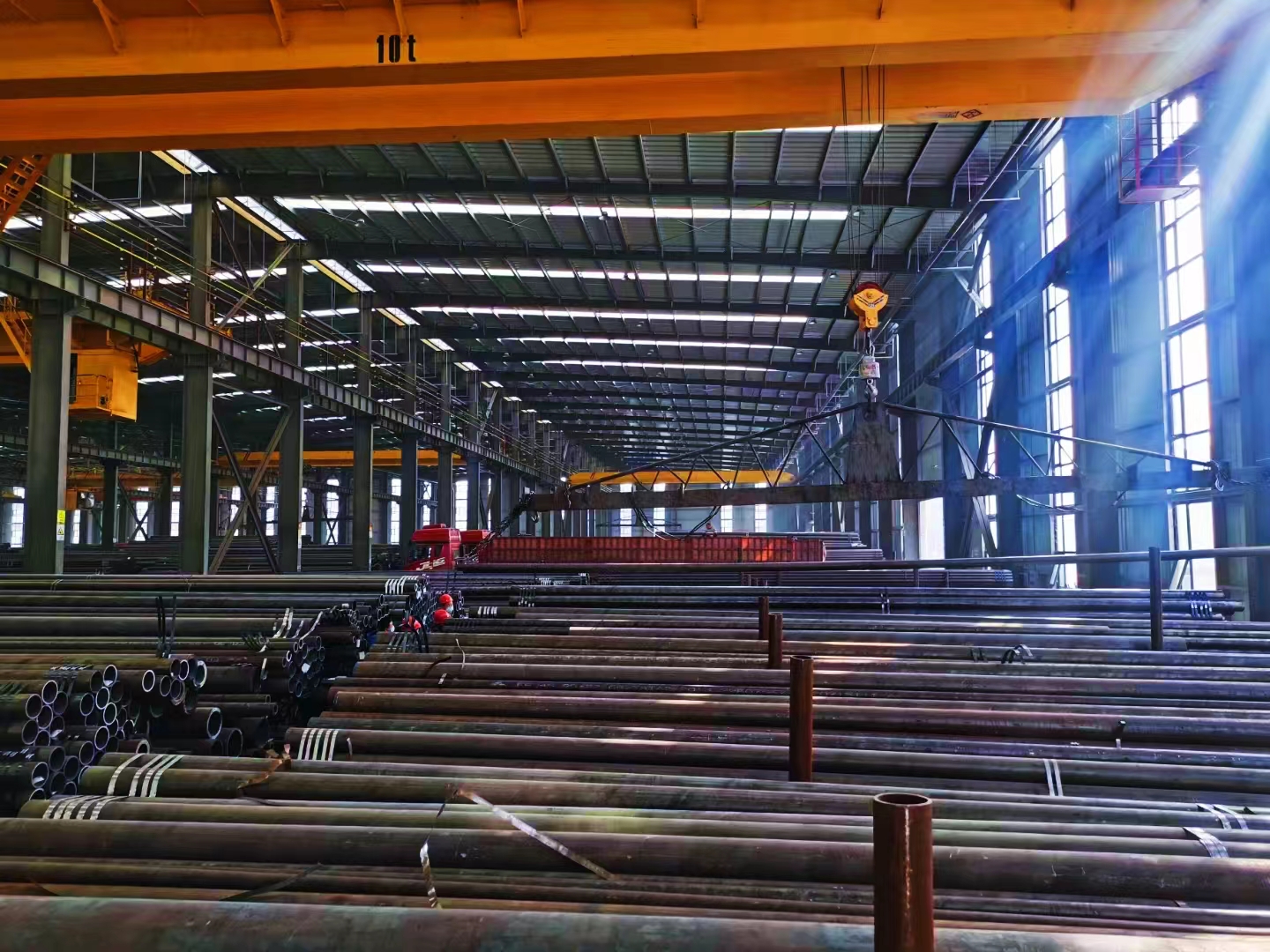
If a heavy duty hydraulic cylinder is losing pressure, leaking at the gland or wearing out on a fixed interval, send the operating pressure, bore, stroke, mounting detail and the failure history. Tuoda Machinery will come back with a construction specification — material grade, bore tolerance and roughness, sealing system, pressure class — and a quotation based on a minimum order quantity of 1 unit, with pressure testing before shipment.
Contact: Olivia · olivia@sdtuoda.com · Tel +86 13290268388 · WhatsApp +86 13290268388
Address: NO853 South Liaoniu Road, Dongchangfu District, Shandong, China
Website: WWW.SDTDSTEEL.COM · Blog: blog.sdtdsteel.com
Download the full company and product capability brochure: Tuoda Machinery Product Brochure (PDF)