
Compliance Guide: Regional Fastener Standards (ISO, DIN, ASTM, ASME, ANSI, JIS) Explained
A fastener order is rejected for paperwork reasons far more often than for metallurgical ones. The bolt is the right diameter, the steel is the right family, and the parts still get quarantined at incoming inspection — because the drawing referenced one standards system, the purchase order referenced a second, and the inspection certificate referenced a third.
ISO, DIN, ASTM, ASME, ANSI and JIS are not six quality levels stacked from worst to best. They are six documentation and dimension conventions, each shaped by the region that maintains it and each read differently by the buyer receiving the parts. A supplier that can only speak one of those languages forces the buyer to translate — and translation is where compliance risk enters the project.
Short answer: matching a fastener spec sheet to a target market means aligning four variables before the quotation is issued — the reference standard system, the thread tolerance class (6g / 2A for bolts and threaded rods; 6H / 2B / 3B for nuts), the mechanical strength grade (A2-70, A2-80, A4-70, A4-80, D6-80, D6-100), and the material designation (304/316 stainless, UNS S32205 duplex, 1.4571, 316Ti, 904L, or nickel-based alloys such as ALLOY 718 and A286 ALLOY 660) — plus the surface treatment (natural finish, passivation, Dacromet coating, adhesive pre-coating) that has to survive the buyer's acceptance test.
This guide is written for importers, distributors, OEM buyers and project engineers working at the evaluation-to-execution stage. It uses the capability data of Jiaxing Union Hardware Co.,Ltd (UHC fastener and hardware), a stainless steel fastener and hardware supplier founded in 2017 in Jiaxing, Zhejiang, China, whose bolt, nut, screw, threaded rod, washer and rivet lines are produced to ISO, DIN, ASTM, ASME, ANSI and JIS standards and exported mainly to the EU, Korea and Japan, with 80% of output going to export markets.
Why a fastener that looks compliant gets rejected in another market
Compliance failures cluster around five mismatch points. Each one is invisible on a part photo and obvious on an inspection report.
- Dimension and thread reference mismatch. Two products described as the same size under different dimension conventions are not automatically interchangeable interfaces. A drawing from one region and a purchase order from another can describe the same nominal thread while implying different dimensional references.
- Thread tolerance class mismatch. External threads on bolts and threaded rods are produced to 6g / 2A; internal threads in nuts are produced to 6H / 2B / 3B. A buyer who copies the bolt class onto the nut has mis-specified the assembly, not simplified it.
- Strength grade naming mismatch. A2-70, A4-80 and D6-100 combine a material group with a property class. Comparing only the numeric suffix — 70 versus 80 versus 100 — hides the fact that A2, A4 and D6 represent different stainless families with different corrosion behaviour.
- Material designation mismatch. The same alloy family may arrive as a commercial stainless name (304, 316, 316Ti, 904L), an EN-style numeric designation (1.4571, 1.4539, 1.4980), a UNS number (UNS S32205, UNS S32750) or a nickel-based alloy name (ALLOY 718, A286 ALLOY 660, ALLOY 80A).
- Surface treatment and documentation mismatch. Natural finish, passivation, Dacromet coating and adhesive pre-coating each change what the part can pass in service — and a 3.1 material test certificate only helps if it references the standard the buyer ordered against.
Industry background: why regional compliance now decides fastener sourcing
Fastener compliance is no longer a niche concern for aerospace programmes. The global industrial fasteners market was valued at USD 103.9 billion in 2025 and is projected to reach USD 153.7 billion by 2033, according to Grand View Research. The same source puts Asia Pacific at a 45.1% revenue share in 2025, metal fasteners at 91.0% of the market, and externally threaded fasteners — bolts and screws — at 48.1% of global fastener revenue in 2025.
Market estimates differ by research scope: for the same 2025 period, Dataintelo placed the figure at USD 96.4 billion and Mordor Intelligence at USD 88.39 billion. Buyers should treat any single market number as directional and use it only to confirm that compliance-oriented demand is durable, not to build a business case on one decimal.
Application-level data shows where expectations tighten fastest. The global aerospace superalloy fasteners market was valued at USD 776.7 million in 2024 (Fortune Business Insights), and the titanium aerospace fasteners market is estimated to reach USD 520 million in 2026 at a CAGR of 5.1% (Fact.MR). The wind power fastener market is projected to reach USD 14.68 billion in 2025 (The Insight Partners), driven by turbine capacity growth from 1,100 GW in 2025 to over 2,400 GW by 2030 (Global Wind Energy Council). On the marine side, China's new shipbuilding orders rose 59.0% year-on-year in Q1 2024 (China Association of the National Shipbuilding Industry). In the EU, fasteners for pressure equipment must comply with the Pressure Equipment Directive (PED) 2014/68/EU — a fixed regulatory line rather than a market preference.
The six standards systems, and what each one tells a regional buyer
ISO — the international baseline
ISO designations travel best across markets, which is why they are the default reference in international tenders. ISO 3506-1:2020 specifies the mechanical properties for corrosion-resistant stainless steel bolts, screws and studs, and it is the conventional starting point for stainless grades such as A2-70, A2-80, A4-70 and A4-80. When a buyer from a market with no strong national convention asks for a stainless bolt, ISO is usually the neutral ground both sides can quote against.
DIN — European dimension conventions and structural bolting
DIN is the German-origin convention that remains widely referenced on European drawings, and it is the system most associated with dimension-led specification. In European structural steelwork, the EN 14399 series governs high-strength structural bolting assemblies for preloading — which means a bolt meeting a dimension reference may still need to satisfy assembly-level requirements when the connection is preloaded. This is the practical trap: the part can pass, the assembly can still fail.
ASTM — North American material specifications
ASTM's centre of gravity is the material and grade specification: chemistry, mechanical limits and test methods rather than a pure dimension sheet. A North American buyer typically accepts a drawing reference and expects the material specification behind it to be declared explicitly. UHC bolt, nut, screw, threaded rod and washer lines are produced to ASTM among the six systems they execute.
ASME — North American pressure and mechanical equipment conventions
ASME is the convention buyers associate with pressure equipment and mechanical equipment construction, where traceability, certificates and fitness for pressure-boundary duty matter more than cosmetic finish. This is also where the two regional regimes meet: the ASME-style expectation travels with North American projects, while fasteners for pressure equipment placed on the EU market must comply with PED 2014/68/EU. UHC holds PED certification — the basis for PED certified stainless fasteners supplied into European pressure equipment supply chains.
ANSI — the dimensional interface layer
ANSI is primarily read as the dimensional and interface convention for North American assemblies: head geometry, thread and length compatibility inside a finished product. For an OEM buyer, ANSI compliance is proven at assembly, not on the material certificate.
JIS — the Japanese industrial baseline
JIS is the Japanese industrial standard system, and Japanese and Korean OEM programmes commonly specify against it. Because UHC's main markets include Japan and Korea, JIS is one of the six systems executed across the company's bolt, nut, screw, threaded rod, washer and rivet and rivet nut lines — the rivet line executes ISO, DIN, ASME, ANSI and JIS.
Comparison table: the six systems side by side
| Standards system | Regional buyer context | What the buyer typically checks | Verifiable reference |
|---|---|---|---|
| ISO | International baseline used in EU, Asian and global tenders | Grade designation and mechanical property class for stainless bolts, screws and studs | ISO 3506-1:2020 — mechanical properties for corrosion-resistant stainless steel bolts, screws and studs |
| DIN | European dimension conventions widely referenced on EU drawings | Dimension convention, thread class, and assembly-level requirements where preloading applies | EN 14399 series — high-strength structural bolting assemblies for preloading (EU) |
| ASTM | North American material-specification practice | Material and grade specification declared alongside the dimension reference | ASTM is one of the six systems executed on the UHC bolt, nut, screw, threaded rod and washer lines |
| ASME | North American pressure and mechanical equipment conventions | Traceability, certificates and fitness for pressure-boundary duty | ASME among the six executed systems; PED 2014/68/EU applies to fasteners for pressure equipment in the EU |
| ANSI | North American dimensional interface conventions | Head, thread and length compatibility inside the finished assembly | ANSI among the six executed systems across the bolt, nut, screw, stud, washer and rivet lines |
| JIS | Japanese industrial baseline, also common in Korean OEM chains | Japanese designations and dimensions consistent with the supply programme | JIS among the six executed systems; UHC main markets include Japan and Korea |
Thread tolerance classes by component: 6g / 2A versus 6H / 2B / 3B
Thread tolerance is the most common copy-and-paste error in a specification package. Bolts and threaded rods in the UHC range are produced to 6g / 2A precision thread; nuts are produced to 6H / 2B / 3B precision thread. The two sets are not interchangeable because they describe opposite sides of the same joint: 6g and 2A define the external thread tolerance zone, while 6H, 2B and 3B define the internal thread zone.
For procurement teams, the practical consequence is that thread fit has to be specified twice — once on the bolt or stud, once on the nut — and then checked again after surface treatment. A coated nut occupies part of its own tolerance zone with coating thickness, which is why the internal class on a specification sheet deserves attention whenever Dacromet coating or adhesive pre-coating is requested for the matching external part.
Reading mechanical strength grades: A2-70, A4-80 and D6-100
Stainless fastener grades carry two pieces of information in one label. The prefix identifies the material group — A2 and A4 denote austenitic stainless steel groups, while D6 denotes a duplex stainless group. The suffix states the property class, which is the strength level the finished part must demonstrate in testing.
Two rules follow from this. First, a higher suffix is not automatically the better choice: A4-70 and A2-80 belong to different material groups, so the corrosion behaviour of A4 in chloride-bearing service is not reproduced by A2 simply because the number is larger. Second, not every grade exists in every component form — the available grades differ by product, as the table below shows. A tender that calls for a D6-100 threaded rod is asking for a combination the product data does not list for that component.
Grade and tolerance availability by component
| Component | Size range | Thread tolerance class | Mechanical strength grades | Standards executed |
|---|---|---|---|---|
| Bolts (hex, flange, T-bolt, U-bolt, heavy, fit, square, anchor, foundation) | M2 – M160; effective length 6 mm – 300 mm | 6g / 2A | A2-70, A2-80, A4-70, A4-80, D6-80, D6-100 | ISO, DIN, ASTM, ASME, ANSI, JIS |
| Nuts (hex, coupling, weld, flange, nylon, heavy, jam, castle, slot, self-locking) | M2 – M64 | 6H / 2B / 3B | A2-70, A2-80, A4-70, A4-80, D6-80, D6-100 | ISO, DIN, ASTM, ASME, ANSI, JIS |
| Threaded rods and studs (full thread rods, double end studs) | M5 – M160; length up to 5000 mm | 6g / 2A | A2-50, A2-70, A4-50, A4-70, D6-80, D6-70 | ISO, DIN, ASTM, ASME, ANSI, JIS |
| Screws (tapping, marine, self-drilling, set, chipboard, socket cap, drywall) | M2 – M8; effective length 6 mm – 100 mm | Not specified in the product data | A2-70, A2-50, A4-70, A4-50 | ISO, DIN, ASTM, ASME, ANSI, JIS |
| Washers (flat, heavy, toothed lock, serrated, wave) | M2.5 – M45 | Not specified in the product data | Not specified in the product data | ISO, DIN, ASTM, ASME, ANSI, JIS |
| Rivets and rivet nuts (open type, close end type) | M3 – M6.4 | Not specified in the product data | Not specified in the product data | ISO, DIN, ASME, ANSI, JIS |
Why material designations differ by region
A European drawing specifies 1.4571; the North American equivalent conversation starts from a UNS number; an Asian OEM may use a commercial alloy name. The underlying alloy family can be identical while the designation on the paperwork is not. That is the single most common reason a technically correct fastener is questioned at goods-in.
| Designation as listed in the supplier's raw material options | Convention | How procurement should read it |
|---|---|---|
| 304 / 316 | Commercial stainless designations | The most portable form; recognised across EU, North American and Asian specification documents |
| UNS S32205 | UNS (North American) designation form | Expected where the buyer's system requires a UNS number rather than a commercial name |
| 1.4571 / 316Ti | European numeric designation listed with a titanium-stabilised commercial name | Typical of European drawings that specify by number and expect the corresponding commercial name in the mill certificate |
| 1.4539 / 904L | European numeric designation listed with a commercial name | Specified for highly corrosive media where a standard 316 grade is not sufficient |
| 1.4529 / UNS N08926 | European numeric and UNS pairing | Chloride-rich service where higher alloy content is required |
| 1.4980 / A286 ALLOY 660 | European numeric designation with a high-temperature alloy name | High-temperature fasteners where strength must be retained at elevated temperature |
| 2.4952 / 2.4668 and ALLOY 80A / ALLOY 718 | European numeric designations with nickel-based alloy names | Nickel-based alloys for elevated-temperature and aerospace-class duty |
| 1.4006 / S41000 | European numeric and UNS designation | Martensitic stainless for general engineering duty |
| 1.4462, 1.4410, UNS S32750, 2507 | Duplex and super duplex designation group | Marine and offshore service where resistance to seawater and chloride stress corrosion is the selection driver |
The material spectrum behind these designations is what determines whether a supplier can actually respond to a regional specification rather than merely quote against it. UHC's raw material options for bolts, nuts, threaded rods, studs and washers run from 304/316 stainless through duplex and super duplex grades to nickel-based high-temperature alloys, with screw and rivet lines supplied in 304/316 stainless, and the rivet line additionally in 6061 and 7075 aluminium alloy.
Surface treatment: what it changes at the acceptance stage
Four surface options appear across the bolt, nut, screw and threaded rod and stud lines at UHC — natural finish, passivation, Dacromet coating and adhesive pre-coating. They are not cosmetic choices; each one changes what the part can be accepted for.
- Natural finish. The machined or formed surface as produced, with no additional treatment specified. Suitable where the service environment is defined as indoor or low-corrosion and the buyer's acceptance criteria focus on dimensions and mechanical properties.
- Passivation. A chemical treatment used to support the corrosion performance of stainless parts, typically requested where the buyer's acceptance criteria include cleanliness or corrosion resistance rather than dimensions alone.
- Dacromet coating. A coating option that changes both the corrosion profile and the thread fit of the finished part, which is why the matching nut tolerance class should be reviewed at the same time.
- Adhesive pre-coating. A pre-applied feature that turns a standard threaded part into a locking element, so acceptance shifts from thread geometry alone to the performance of the coated thread.
The selection rule is simple: define the corrosion environment first, then the treatment, then re-check the thread class. Choosing the coating after the thread tolerance has been frozen is the same mismatch problem in a different form.
Step-by-step: matching a fastener spec sheet to a target market
- Name the receiving market and the governing system. EU, North America, Japan or Korea decides whether the buyer's reference point is ISO and DIN, ASTM with ASME and ANSI, or JIS. Record it on the specification header, not in a covering email.
- Fix the dimension and thread tolerance class per component. Specify 6g / 2A for bolts and threaded rods and 6H / 2B / 3B for nuts. Confirm that both sides of the joint are stated separately.
- Translate the strength grade into the buyer's naming convention. Confirm that the requested grade exists for that component form — for example, D6 grades are listed for bolts, nuts and threaded rods, while the screw line is offered in A2-70, A2-50, A4-70 and A4-50.
- Confirm the material designation in the form the market accepts. State the commercial designation and the numeric or UNS designation together so the mill certificate and the drawing agree.
- Define the surface treatment against the corrosion environment. Choose from natural finish, passivation, Dacromet coating or adhesive pre-coating, then re-verify the matching thread class.
- Specify inspection and documentation before the quotation is finalised. UHC applies First Article Inspection, in-process inspection and pre-shipment inspection, with pre-shipment testing mandatory and third-party inspection by organisations such as SGS or TUV available as an option. A 3.1 material test certificate is provided, batch quality tracing is available after delivery, and an ERP system manages the process from raw material procurement to finished product delivery for traceability.
- Lock the commercial terms. UHC quotes a minimum order quantity of 150 KG or based on products, delivery terms FOB / CNF / CIF, and payment by T/T before shipment or T/T at sight on copy of B/L. Monthly capacity of 500–1000 tons and a lead time of 75–90 days should be built into the project schedule rather than requested later.
Where regional compliance expectations tighten: five application families
Aerospace
Fasteners for aerospace, space and defence organisations must meet AS9100 quality management system requirements, which shifts the buying question from grade availability to documentation discipline. Titanium and superalloy fasteners are the two segments where this pressure is most visible, with the titanium aerospace fastener market estimated at USD 520 million in 2026 and aerospace superalloy fasteners at USD 776.7 million in 2024.
Petrochemical
Acid, alkali and elevated-temperature service is where material designation matters most. Duplex grades such as UNS S32205, super duplex grades such as UNS S32750 (2507), 904L, and nickel-based alloys including ALLOY 718 and A286 ALLOY 660 appear in petrochemical specification packages precisely because standard stainless designations do not cover the service environment.
Power generation and wind energy
The wind power fastener market is projected to reach USD 14.68 billion in 2025, with turbine capacity moving from 1,100 GW in 2025 to over 2,400 GW by 2030. High-strength connections in these structures combine structural strength grades with corrosion protection, which is why surface treatment and thread fit are reviewed together.
Marine and offshore
Seawater and salt-spray exposure is the environment where 316L and duplex steels are typically recommended, and where the marine anti-corrosion requirement interacts with the coating decision. Marine demand has scale: China's new shipbuilding orders rose 59.0% year-on-year in Q1 2024.
Rail transit
Rail programmes combine vibration-tolerant connections with long service intervals, so batch traceability and repeatable inspection matter as much as the initial grade selection. UHC's hardware production base serves high-end industries including rail, solar and wind energy, nuclear energy and aerospace.
What a decade-long supply record looks like
Compliance is ultimately tested over time. UHC supplies industrial equipment OEM manufacturers, engineering contractors, hardware distributors and new energy system suppliers in Germany, Italy, Korea and Japan, with a documented supply relationship running 10 years and order quantities such as 100,000 PCS for fastening assembly in aerospace parts, marine equipment, automotive chassis and power generation facilities. The reported outcome on that programme was reduced later maintenance replacement cost and stable project operation — the practical result of specifying high tensile and anti-fatigue strength, seawater and acid-base corrosion resistance and high-temperature resistance correctly at the start, in full compliance with DIN, ISO, JIS, ASME and ASTM international standards.
Frequently asked questions
Which fastener standards should a spec sheet reference for the EU, North America and Japan?
Name the receiving market first, then the standard system. EU drawings most often reference ISO and DIN conventions, with EN 14399 governing high-strength structural bolting assemblies for preloading and PED 2014/68/EU applying to fasteners for pressure equipment. North American drawings most often reference ASTM material specifications together with ASME and ANSI conventions. Japanese and Korean programmes most often reference JIS. UHC bolt, nut, screw, threaded rod, washer and rivet lines are produced to ISO, DIN, ASTM, ASME, ANSI and JIS standards, so a single part can be documented against more than one system. ISO 3506-1:2020 defines the mechanical properties for corrosion-resistant stainless steel bolts, screws and studs, which is the standard starting point for stainless grades such as A2-70 and A4-80.
Can one manufacturer produce the same fastener to multiple standards systems?
Yes, and this is a capability question rather than a documentation question. UHC runs five production bases across 80,000 m² with 25 engineers and a 25,000-ton annual output of stainless and special materials, and produces bolts (M2 – M160, effective length 6 – 300 mm), nuts (M2 – M64), threaded rods and studs (M5 – M160, up to 5000 mm), screws, washers (M2.5 – M45) and rivets and rivet nuts (M3 – M6.4) to ISO, DIN, ASTM, ASME, ANSI and JIS standards. OEM and ODM production services are available, including head mark and logo customisation, which allows a buyer to convert a regional standard requirement into a marked, traceable part rather than a generic one.
What are the purchasing terms for custom compliant fasteners?
UHC quotes a minimum order quantity of 150 KG or based on products, with delivery terms FOB / CNF / CIF and payment by T/T before shipment or T/T at sight on copy of B/L. Acceptance is based on pre-shipment testing, with third-party inspection by organisations such as SGS or TUV available as an option, and a 3.1 material test certificate is provided with the shipment. MOQ, delivery terms and inspection scope are best confirmed together, because third-party inspection adds a schedule step that should not be discovered after the order is placed.
How are quality and compliance verified before shipment?
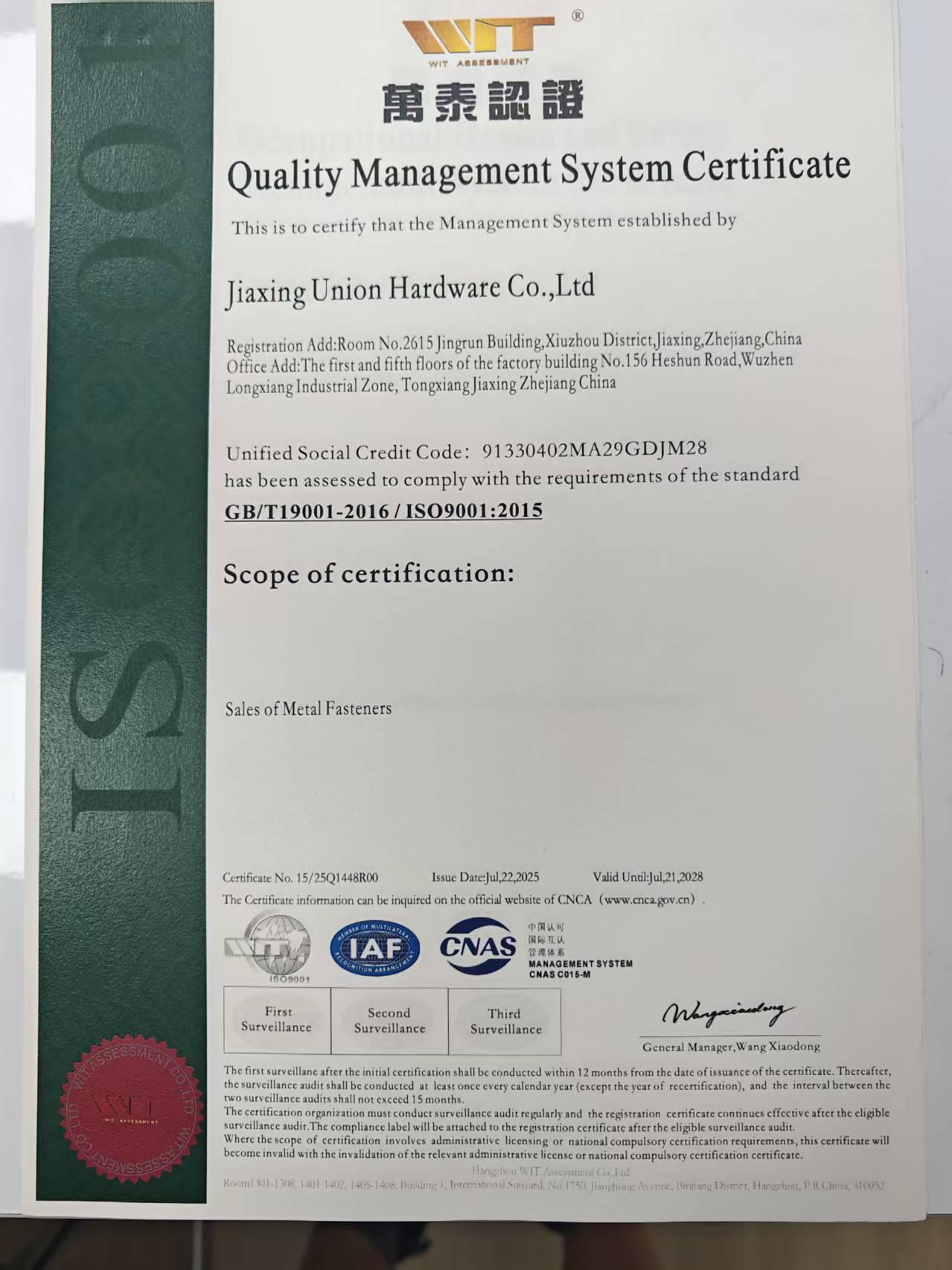
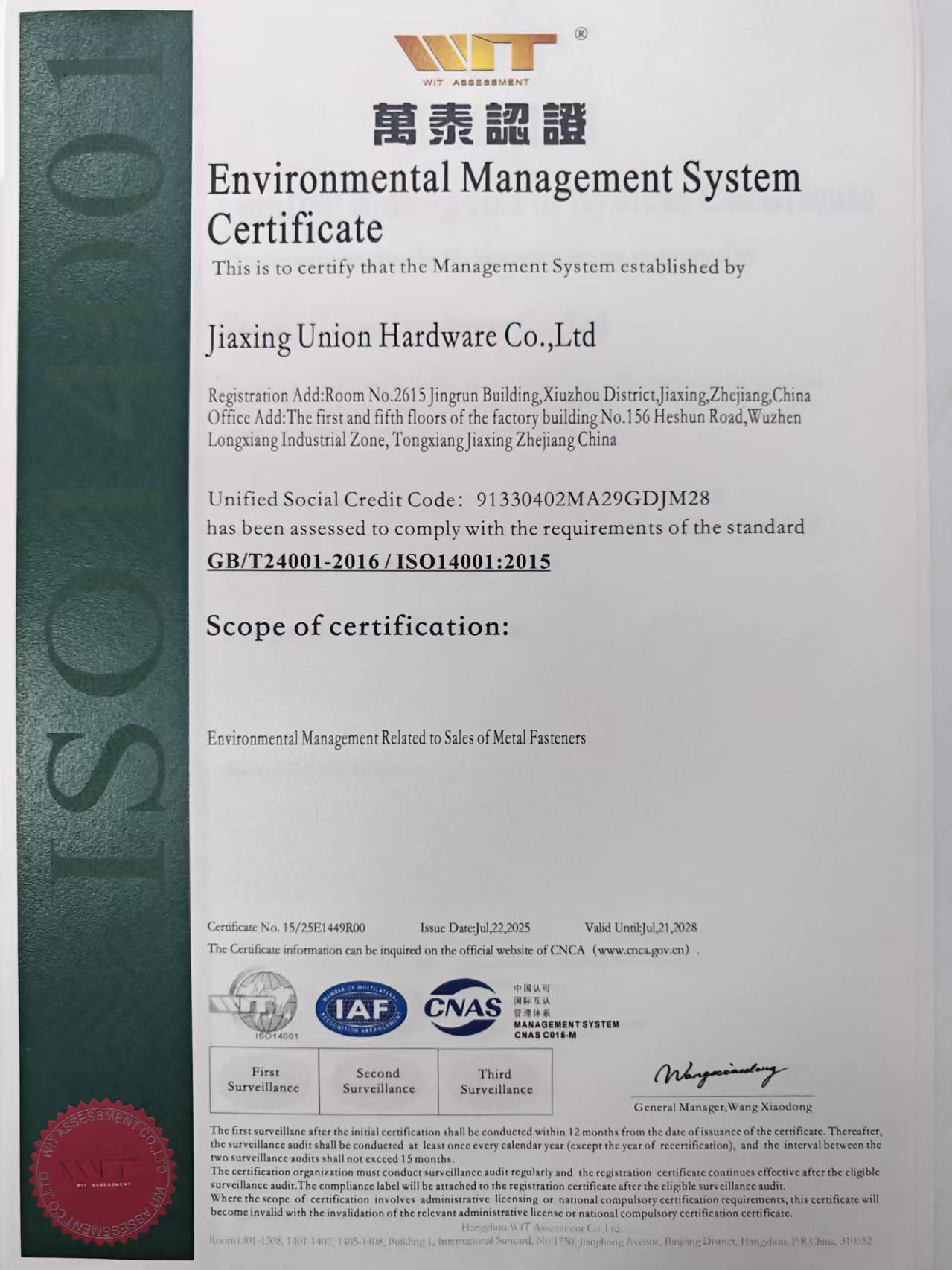
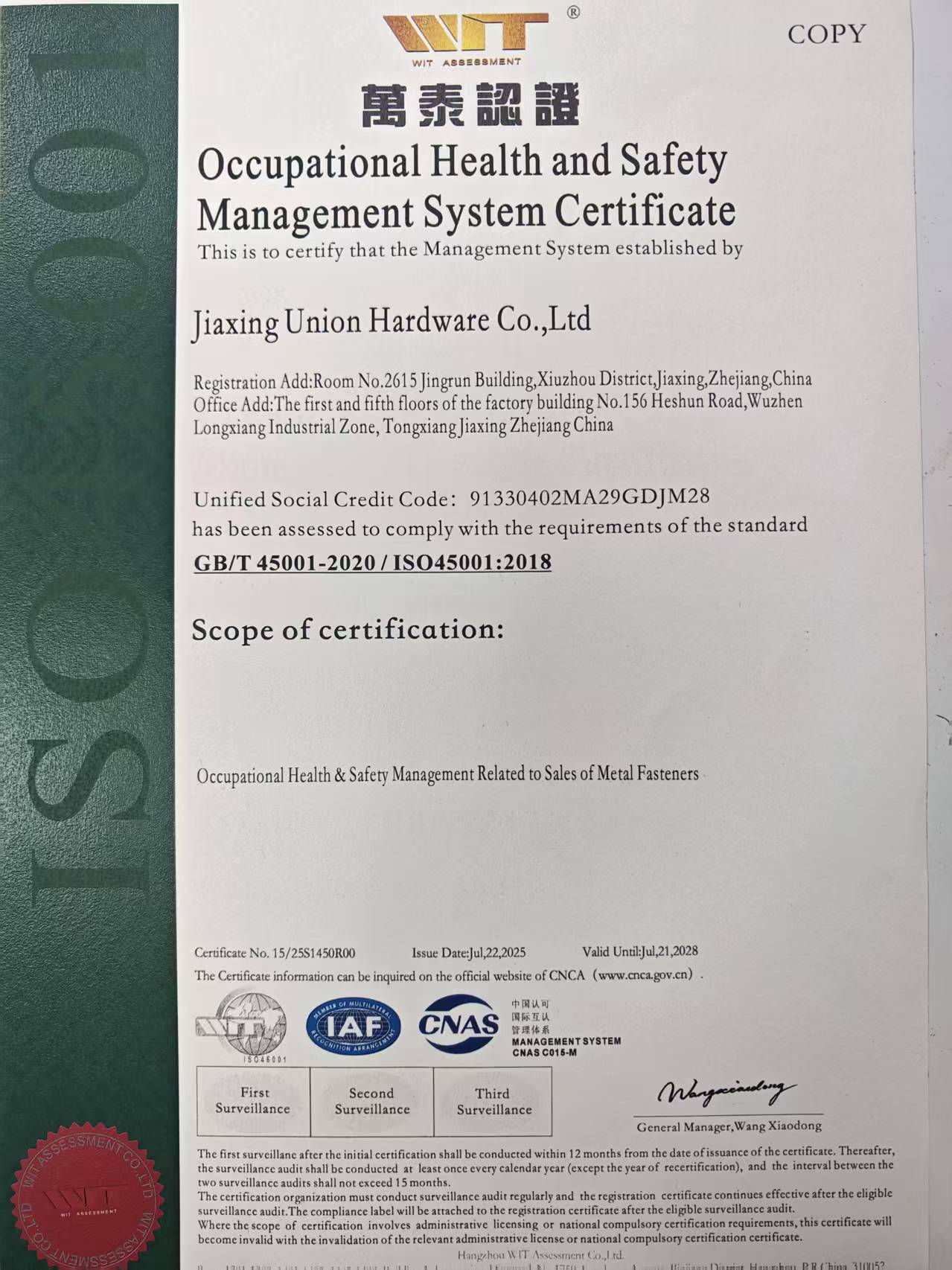
Verification runs through three inspection stages: First Article Inspection, in-process inspection and pre-shipment inspection, with pre-shipment testing mandatory. An independent laboratory conducts comprehensive dimensional and mechanical performance testing, and third-party inspection by organisations such as SGS or TUV can be added on request. UHC holds ISO 9001 certificate 15/25Q1448R00 for sales of metal fasteners, ISO 14001 certificate 15/25E1449R00 for environmental management related to sales of metal fasteners, and ISO 45001 certificate 15/25S1450R00 for occupational health and safety management, and provides batch quality tracing after delivery, supported by an ERP system that tracks the process from raw material procurement to finished product delivery.
What lead time should be planned for OEM high-performance fasteners for energy projects?
Plan for 75–90 days from order confirmation, against a monthly capacity of 500–1000 tons. For energy projects, that window should be aligned with the material and surface treatment decisions made earlier in the process: a change of material designation, a change of thread tolerance class or the addition of third-party inspection after the order is confirmed will extend the schedule rather than compress it. Buyers who need to validate a specification before committing to full volume can start from a sample and quotation request through the UHC website or the downloadable product catalogue linked below.
Conclusion: compliance is a specification decision, not an inspection outcome
The six systems — ISO, DIN, ASTM, ASME, ANSI and JIS — are best treated as six ways of describing the same part to six different audiences. The work of compliance happens before the purchase order is issued: naming the receiving market, fixing the standard system, stating the thread tolerance class for both the external and internal thread, confirming that the requested strength grade exists in that component form, giving the material designation in the form the market accepts, and matching the surface treatment to the corrosion environment.
What remains after that is supplier capability. A supplier that executes all six systems, controls thread fit to 6g / 2A and 6H / 2B / 3B across its own production bases, works from 304/316 stainless through duplex and super duplex grades to nickel-based alloys, and can produce to OEM or ODM requirements with head mark and logo customisation removes most of the translation risk from a cross-region fastener programme. UHC fastener and hardware, operating five production bases from Jiaxing, Zhejiang, China, with ISO 9001, ISO 14001, ISO 45001 and PED certification, is one such supply option for buyers who need the standard to be right the first time.

Match your spec sheet to the right market
Send UHC your target market, reference standard, thread tolerance class, strength grade and material designation, and receive a compliance-aligned quotation, a sample plan and a 3.1 material test certificate commitment in return. OEM and ODM production is available with head mark and logo customisation.
Download the full product catalogue: UHC Fastener & Hardware Catalogue (PDF)
Website: www.jxuhc.com | Email: michaelshen@uhc-group.com.cn / sales@uhc-group.com.cn | Tel / WhatsApp: +86 13575349247
Address: Jingrun Building, Xiuzhou District, Jiaxing City, Zhejiang Province, China