
Corroded Bolts in a Coastal Petrochemical Plant? A High-Performance Fastener Selection Fix
Answer first: rust-stained bolts, pitted thread roots and seized nuts on a coastal petrochemical unit are usually a specification failure rather than a single defective batch. The fix is a selection package that ties alloy family, product form, thread tolerance, surface treatment and documented compliance to the real exposure — airborne chloride, process media, temperature and load — and then proves that package through material certificates, first-article inspection and pre-shipment testing.
This guide is written for the engineers and buyers who have to close out a corrosion finding before the next turnaround: which stainless grade is enough, when duplex or a nickel-based alloy is justified, which surface treatment actually helps, which standard the purchase order should reference, and what a supplier must be able to document before the order is released.
Why Bolts Corrode Early on a Coastal Petrochemical Site
Coastal petrochemical service is one of the harder environments a threaded fastener can meet. Airborne chloride deposits on exposed surfaces, humidity keeps those deposits wet for long periods, and the plant itself adds sour or acidic media, wash-down water, temperature cycling and continuous vibration. Bolts concentrate all of this into a very small area of stressed metal.
The failure modes that appear in practice are consistent:
- Rust staining and tea-coloured bleed on 304-grade bolts, typically the first visible sign that the grade is below the local chloride load.
- Pitting at thread roots and under-head radii, where crevices hold deposits and oxygen availability differs from the exposed shank.
- Crevice corrosion under washers and at flange gaps, where stagnant moisture persists after the joint is tightened.
- Galvanic attack where stainless fasteners contact carbon steel structures or supports in the presence of an electrolyte.
- Chloride stress corrosion cracking in high-tensile austenitic fasteners under sustained tensile load and elevated temperature.
- Galling and seizure, where the nut welds itself to the stud during tightening or removal and the joint cannot be dismantled without cutting.
- High-temperature oxidation or scaling on hot sections such as furnace, exchanger and steam-side flanges.
The procurement symptoms usually appear before the metallurgical ones: mixed material batches on the same rack, undocumented substitutions, missing heat numbers, and a purchase order that says only "stainless steel bolts" without a grade, a standard or a test document. Once that happens, corrosion becomes a stores problem instead of an engineering one.
Industry Background: What Coastal Petrochemical Service Demands from a Fastener
Petrochemical plants are pressure equipment. In the EU, fasteners used on pressure equipment must comply with the Pressure Equipment Directive (PED) 2014/68/EU, which puts material documentation and traceability on the same footing as mechanical strength. Globally, ISO 3506-1:2020 specifies the mechanical properties of corrosion-resistant stainless steel bolts, screws and studs, so a grade designation such as A4-70 or A2-70 has a defined meaning rather than being a marketing label. For structural bolting, the EN 14399 series governs high-strength structural bolting assemblies for preloading in steel structures.
Against that regulatory backdrop, the fastener market itself is large and still expanding. Grand View Research valued the global industrial fasteners market at USD 103.9 billion in 2025, with a projected reach of USD 153.7 billion by 2033. Within that market, externally threaded fasteners — bolts and screws — accounted for 48.1% of global revenue in 2025, and metal fasteners held a 91.0% share of the total market. Demand pressure of that size also means a great deal of specification variability, which is exactly why documented compliance matters more than a grade name on a quote.
The practical consequence for a coastal plant is simple: the fastener is not a commodity picked from a shelf. It is a specified component with an alloy, a standard, a thread tolerance, a surface condition and a paper trail. The rest of this article builds that specification.
The Selection Fix: Material, Form, Treatment, Verification
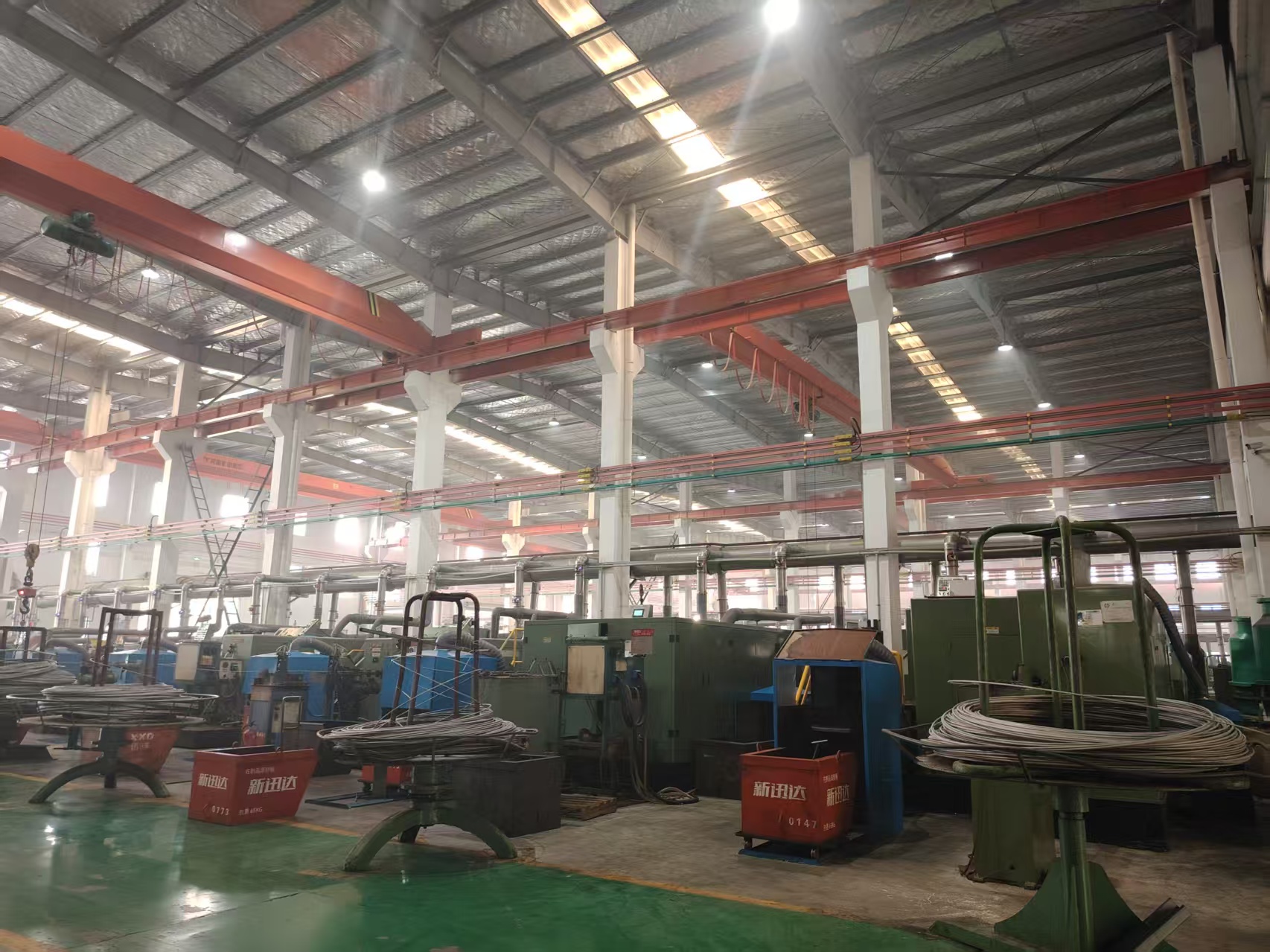
UHC fastener and hardware (UHC Group, Jiaxing Union Hardware Co.,Ltd) is a stainless steel fastener and hardware supplier founded in 2017 in Jiaxing, Zhejiang, China, operating five production bases covering washers, bolts and nuts, screws, studs and rivets, and hardware products, with 80% of output exported to markets including the EU, Korea and Japan. The material and product data below follow the ranges UHC publishes for its fastener lines and can be used as a working template for a coastal specification.
Step 1 in material terms: austenitic stainless as the baseline — 304, 316, 316L
For general indoor environments, 304/316 stainless steel is the preferred family. For high-corrosion, offshore or marine environments, 316L, duplex steel or high-temperature alloy materials are recommended. That hierarchy is the single most useful rule in coastal selection: 304 is an indoor and sheltered-outdoor grade; 316 is the working baseline for moderate chloride exposure; 316L and duplex grades are the recommended step up for marine and coastal salt-spray conditions.
Titanium-stabilised and molybdenum grades: 1.4571 and 316Ti
1.4571 and 316Ti describe the same titanium-stabilised molybdenum-bearing austenitic family, and are widely used where a 316-type grade is wanted with better structural stability at elevated temperature. They sit between standard 316 and duplex in the selection ladder and are a practical choice for warm process areas that are not severely chloride-loaded.
Duplex and super duplex: UNS S32205, 1.4462, 1.4410, UNS S32750 / 2507
Duplex stainless steels combine an austenitic and a ferritic structure, which is why they are the standard recommendation for coastal and offshore fastening. UNS S32205 (1.4462) is the workhorse duplex grade for fasteners in salt-spray and process environments. Where the exposure or the load is more demanding, super duplex grades 1.4410, UNS S32750 and 2507 extend the same family upward.
Super-austenitic grades: 1.4529, UNS N08926 and 904L (1.4539)
1.4529, UNS N08926 and 904L (1.4539) are high-molybdenum austenitic grades used where chloride pitting and crevice attack are the dominant risk and where a duplex grade is not the preferred route — for example, where toughness, weldability of adjacent components or a specific plant material specification points to a super-austenitic. They are a legitimate answer to repeated pitting failures on wet, deposit-heavy flange bolting.
High-temperature and nickel-based alloys: 1.4980, A286 ALLOY 660, ALLOY 718, 2.4952, 2.4668, ALLOY 80A
Hot sections need a different logic. 1.4980 and A286 ALLOY 660 belong to the iron-nickel-chromium family associated with high-temperature bolting; ALLOY 718 (2.4668) and 2.4952 / ALLOY 80A are nickel-based grades associated with high-strength, high-temperature service. These are specified where the fastener must hold preload at temperature and resist oxidation or scaling — furnace, exchanger, steam and fired-heater joints rather than ambient pipe racks.
Martensitic grades: 1.4006 and S41000
1.4006 and S41000 are martensitic stainless grades that appear in the same published material range. They are normally considered for hardness-driven duties rather than for prolonged chloride immersion, and the selection should be justified against the specific medium.
Product forms, size range and thread tolerance
Alloy choice only works if the correct product form exists in that alloy. The published UHC range covers:
- Bolts — hex, flange, T-bolt, U-bolt, heavy, fit, square, anchor and foundation bolts, M2 to M160, effective length 6 mm to 300 mm.
- Nuts — hex, coupling, weld, flange, nylon, heavy, jam, castle, slot and self-locking nuts, M2 to M64.
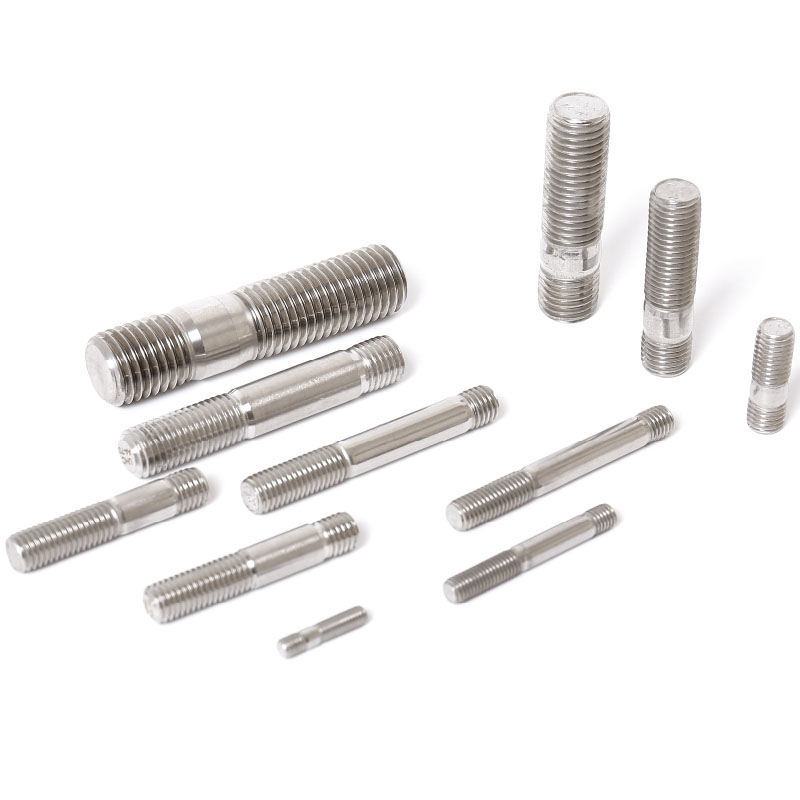
- Threaded rods and studs — full thread rods and double end studs, M5 to M160, length up to 5000 mm.
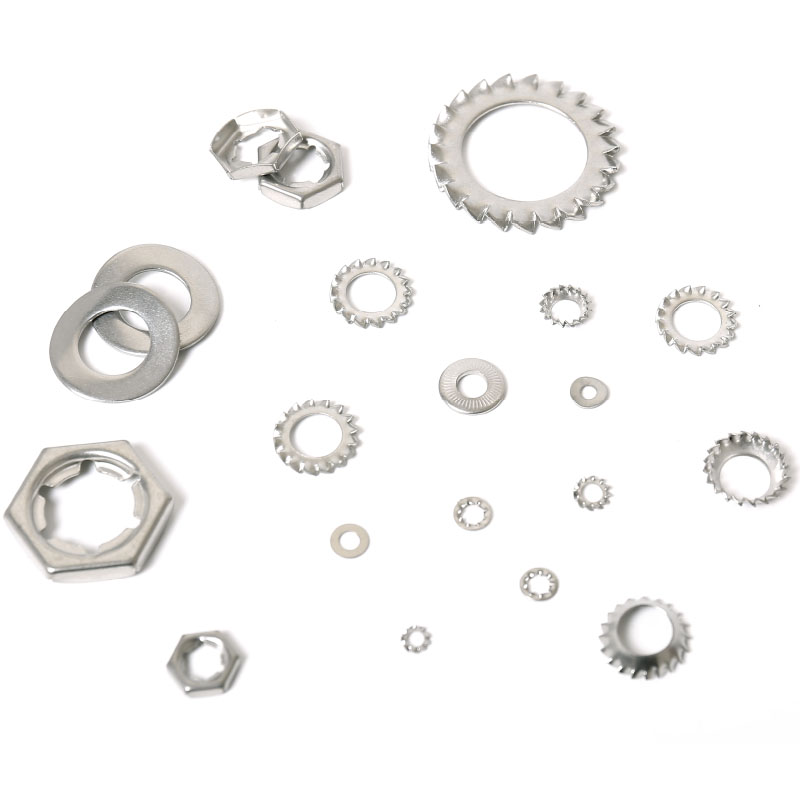
- Washers — flat, heavy, toothed lock, serrated and wave washers, M2.5 to M45.
- Screws — tapping, marine, self-drilling, set, chipboard, socket cap and drywall screws, M2 to M8, 6 mm to 100 mm, in 304/316 and UNS S32205.
- Rivets and rivet nuts — open and close end types, M3 to M6.4, in 304/316 and aluminium alloys 6061/7075.
Mechanical strength grades across the stainless range are A2-70, A2-80, A4-70, A4-80, D6-80 and D6-100. Thread tolerance is 6g / 2A precision thread on bolts, studs and threaded rods, and 6H / 2B / 3B on nuts. For a coastal petrochemical specification, the thread tolerance and the strength grade belong in the purchase order next to the alloy — a correct alloy with an unstated tolerance is still an incompletely specified part.
Surface treatment: what each option is for
UHC lists four surface treatment options across its bolt, nut, stud and washer ranges: natural finish, passivation, Dacromet coating and adhesive pre-coating. They solve different problems and are not interchangeable.
| Surface option | What it changes on the part | Where it is typically considered | What to confirm before ordering |
|---|---|---|---|
| Natural finish | No additional surface treatment after manufacture | Sheltered joints where the alloy alone carries the corrosion duty | Confirm the as-supplied surface condition matches the standard and the inspection plan |
| Passivation | A chemical treatment that cleans the surface and supports the passive layer | Stainless parts that will see chloride-bearing atmospheres, wash-down or humid storage | Confirm the treatment is applied after machining and before packing, and that it is stated on the inspection record |
| Dacromet coating | An added barrier coating on the finished part | Joints where an additional barrier is wanted on top of the base material choice | Confirm coating compatibility with the mating material, the standard referenced and the tightening method |
| Adhesive pre-coating | A pre-applied adhesive on the thread | Joints that must resist vibration loosening or need thread sealing | Confirm the torque strategy, whether the joint is expected to be re-used, and the assembly temperature |
Verification: standards and documents that close the loop
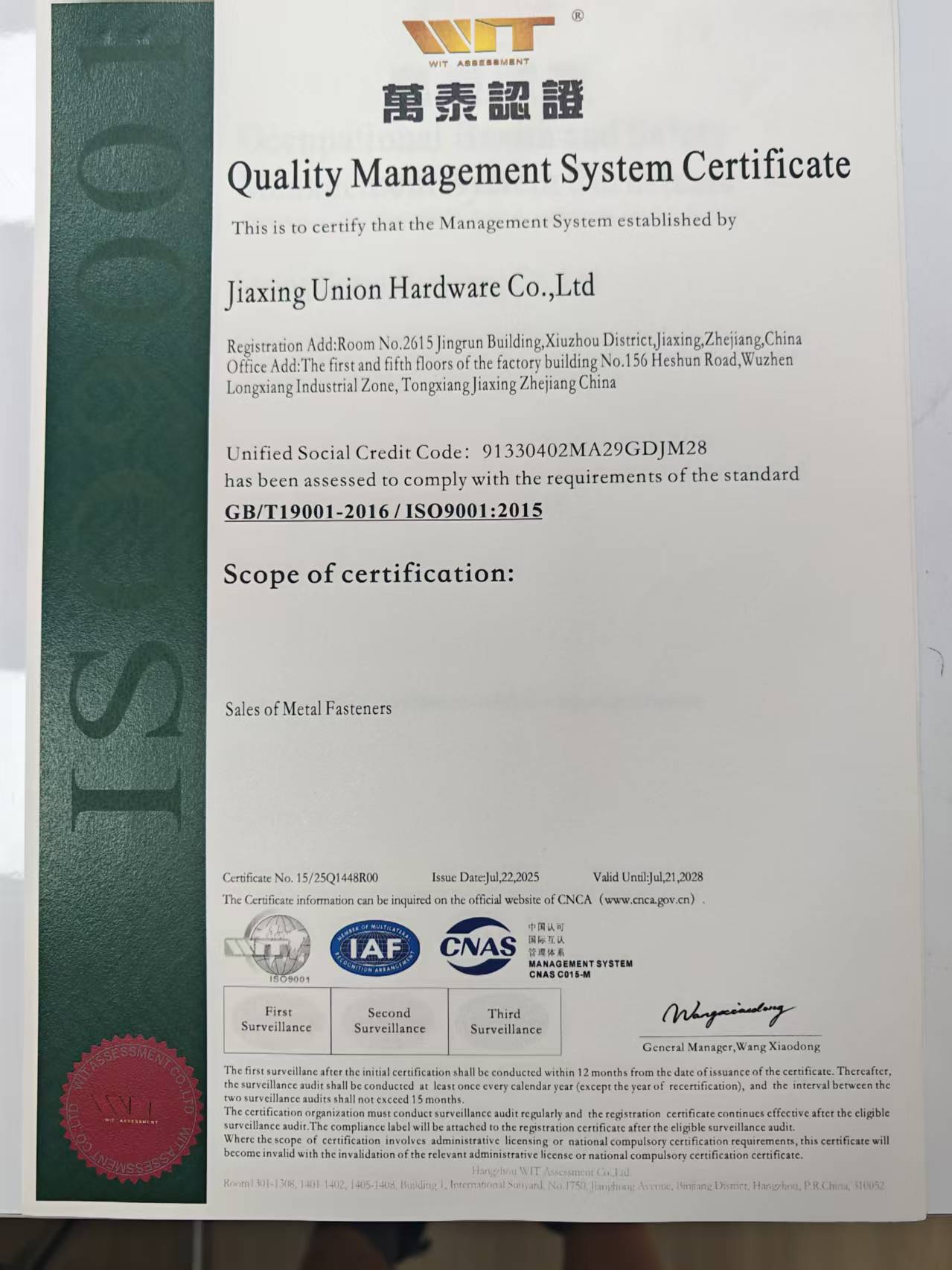
UHC fasteners are executed to ISO, DIN, ASTM, ASME, ANSI and JIS international standards, and the company holds ISO 9001 (certificate 15/25Q1448R00, valid 2025-07-22 to 2028-07-21), ISO 14001 (15/25E1449R00, same validity) and ISO 45001 (15/25S1450R00, same validity) certification issued by WIT, plus European Union Pressure Equipment Directive (PED) certification. An independent in-house laboratory carries out dimensional and mechanical performance testing, and the after-sales package includes a 3.1 material test certificate and batch quality tracing.
Step-by-Step: Specifying a Corrosion-Resistant Fastener Package
- Map the exposure, joint by joint. Separate the plant into ambient coastal atmosphere, wet or wash-down areas, process-wetted flanges, and hot sections. A single site-wide "stainless bolt" line item is the root cause of most repeat corrosion findings.
- Set the alloy family per zone. 304/316 for general and sheltered conditions; 316L, duplex (UNS S32205 / 1.4462) or a higher grade where chloride, salt spray or process media dominate; super-austenitic (1.4529, UNS N08926, 904L) where pitting and crevice attack are the recorded failure mode; nickel-based or high-temperature alloys (1.4980, A286 ALLOY 660, ALLOY 718, 2.4952, ALLOY 80A) for hot, load-bearing joints.
- Fix the product form and size. Bolts M2–M160, nuts M2–M64, studs M5–M160 up to 5000 mm, washers M2.5–M45. Confirm the alloy is available in the form you actually need before the drawing is released.
- State the strength grade and thread tolerance. A2-70 / A2-80 / A4-70 / A4-80 / D6-80 / D6-100 as applicable; 6g / 2A on external threads and 6H / 2B / 3B on nuts.
- Choose the surface treatment deliberately. Passivation as the default for stainless going into a chloride-bearing atmosphere; Dacromet or adhesive pre-coating only where the joint function justifies it, with the compatibility question answered in writing.
- Reference the standard. Name the governing standard — ISO, DIN, ASTM, ASME, ANSI or JIS — and, for EU pressure equipment, confirm PED 2014/68/EU compliance in the specification.
- Require the documents. 3.1 material test certificate, dimensional and mechanical test records from the supplier's laboratory, and batch traceability through the ERP system from raw material to delivery.
- Run a first article before full release. First Article Inspection, in-process inspection and pre-shipment inspection are the three checkpoints UHC applies. Acceptance is based on mandatory pre-shipment testing, with third-party inspection by organisations such as SGS or TUV available as an option.
- Plan the replacement logic. Record which grade was installed in which zone, so the next corrosion finding can be closed as a material decision instead of a re-purchase.
Where This Selection Model Applies
The published UHC material and product range covers petrochemical, power generation, aerospace, automotive, marine and offshore, construction and infrastructure, industrial machinery, medical and electronics, telecommunications, rail transit, and home appliances and consumer goods. Four of those are directly relevant to the coastal corrosion problem:
- Petrochemical and coastal sites — the core case in this article: ambient chloride plus process media plus hot sections, handled with 316L/duplex at ambient and nickel-based alloys at temperature.
- Marine and offshore — 316L or duplex steel is the recommended step up for marine and coastal salt-spray conditions, with passivation as the standard surface condition.
- Power generation and wind energy — high-strength structural and high-temperature connections, where the strength grade and the certificate matter as much as the alloy.
- Rail, automotive and industrial machinery — vibration and fatigue duty, where adhesive pre-coating and controlled thread tolerance carry part of the reliability load.
A published case record from UHC describes supply to industrial equipment OEM manufacturers, engineering contractors, hardware distributors and new energy system suppliers across DE, IT, KR and JP: 100,000 pieces over a 10-year relationship, applied to aerospace parts, marine equipment, automotive chassis and power generation facilities. The reported result was a significant reduction in later maintenance replacement cost and stable project operation, with the supplied parts meeting DIN/ISO/JIS/ASME/ASTM international standards and offering high tensile and anti-fatigue strength, seawater and acid-base corrosion resistance, and high-temperature resistance.
For a coastal petrochemical buyer, the transferable point is not the volume — it is the structure of the supply: a defined material, a defined standard, a documented test route, and a supplier that stays in the same specification for a decade.
Comparison: Material Options for Coastal Petrochemical Fasteners
| Material designation | Family | Typical role in a coastal petrochemical specification | Product forms available in this range |
|---|---|---|---|
| 304 / 316 | Austenitic stainless | General and sheltered conditions; the starting point that is often outgrown on exposed coastal joints | Bolts, nuts, studs, washers, screws, rivets |
| 316L | Austenitic stainless (low carbon) | Recommended where marine or coastal salt-spray conditions are present | Bolts, nuts, studs, washers |
| 1.4571 / 316Ti | Titanium-stabilised austenitic stainless | Warm process areas needing 316-type corrosion resistance with better structural stability | Bolts, nuts, studs, washers |
| UNS S32205 / 1.4462 | Duplex stainless | Workhorse grade for coastal and offshore fastening under chloride exposure | Bolts, nuts, studs, washers |
| 1.4410 / UNS S32750 / 2507 | Super duplex stainless | Higher-demand coastal and offshore joints where standard duplex is judged insufficient | Bolts, nuts, studs, washers |
| 1.4529 / UNS N08926 | Super-austenitic stainless | Deposit-heavy, pitting-prone wet joints where a high-molybdenum austenitic is preferred | Bolts, nuts, studs, washers |
| 904L / 1.4539 | Super-austenitic stainless | Aggressive process media and chloride-bearing wet service | Bolts, nuts, studs, washers |
| 1.4980 / A286 ALLOY 660 | Iron-nickel-chromium high-temperature alloy | Hot, load-bearing bolting where preload must hold at temperature | Bolts, nuts, studs, washers |
| ALLOY 718 / 2.4668, 2.4952 / ALLOY 80A | Nickel-based high-temperature alloys | Furnace, exchanger, steam and fired-heater joints under combined heat and load | Bolts, nuts, studs, washers |
| 1.4006 / S41000 | Martensitic stainless | Hardness-driven duties; to be justified against the specific medium before use | Bolts, nuts, studs, washers |
Comparison: Cost and Risk Drivers Beyond the Alloy Name
| Specification element | What it controls | Risk if left unspecified |
|---|---|---|
| Strength grade (A2-70 / A4-80 / D6-100, etc.) | Mechanical performance of the finished part | Parts arrive at the correct alloy but the wrong strength level |
| Thread tolerance (6g / 2A; 6H / 2B / 3B) | Fit, preload consistency and assembly behaviour | Assembly rework, galling and inconsistent joint tightness |
| Surface treatment | Surface condition and joint function | Untreated stainless entering a chloride atmosphere, or a coating that conflicts with the assembly method |
| Governing standard | Dimensional and material acceptance | Inspection disputes and rejected deliveries |
| Test documentation (3.1 certificate, pre-shipment test) | Traceability and release evidence | No defensible record if a corrosion finding appears later |
| Batch traceability (ERP) | Raw material to delivery linkage | Whole-batch quarantine instead of targeted replacement |
Frequently Asked Questions
1. Which certifications should an OEM high-performance fastener manufacturer for energy projects hold?
At minimum, a documented quality management system and the certificates that match the destination market. UHC holds ISO 9001 (certificate 15/25Q1448R00), ISO 14001 (15/25E1449R00) and ISO 45001 (15/25S1450R00), all issued by WIT and valid from 2025-07-22 to 2028-07-21, plus European Union Pressure Equipment Directive (PED) certification. Fasteners for pressure equipment in the EU must comply with PED 2014/68/EU, and ISO 3506-1:2020 defines the mechanical properties of corrosion-resistant stainless steel bolts, screws and studs, so the certificate set should be read alongside the standard referenced in the purchase order.
2. Can an OEM supplier deliver custom sizes and both OEM and ODM production?
Yes. UHC provides both OEM and ODM production services, with head mark and logo customization available. The published size range covers bolts M2 to M160 with an effective length of 6 mm to 300 mm, nuts M2 to M64, threaded rods and studs M5 to M160 up to 5000 mm, and washers M2.5 to M45, in materials from 304/316 through duplex, super-austenitic and nickel-based alloys. Capacity is supported by five production bases covering 80,000 m², 200 employees, 25 engineers and an annual output of 25,000 tons of stainless and special materials, with monthly capacity of 500 to 1000 tons.
3. What are the minimum order quantity and commercial terms?
The MOQ is 150 KG or based on the products ordered. Delivery terms are FOB, CNF or CIF, and payment terms are T/T before shipment or T/T at sight on a copy of the bill of lading. For a coastal specification project, the useful first step is a short list of joints with material, size, grade and standard, so the quotation reflects the actual specification rather than a generic price per kilogram.
4. How are samples and acceptance verified before shipment?
Quality control runs through First Article Inspection, in-process inspection and pre-shipment inspection. Acceptance is based on mandatory pre-shipment testing, and third-party inspection by organisations such as SGS or TUV is available as an option. Each shipment can be supported by a 3.1 material test certificate, and batch quality tracing is available through the ERP system, which manages the process from raw material procurement to finished product delivery.
5. What is the lead time for an OEM order?
Standard lead time is 75 to 90 days. Because 80% of UHC output is exported to markets including the EU, Korea and Japan, orders are handled with export documentation and batch traceability as part of the normal flow. If your next coastal turnaround has a fixed date, the practical next step is to send the joint list, required alloys and standards for a quotation and a sample request — the brochure linked below gives the full product and material overview.
Conclusion: Fix the Specification, Not Just the Bolt
Corroded bolts on a coastal petrochemical plant rarely need a more dramatic alloy. They need a complete specification. In practice that means 304/316 only where the exposure allows it; 316L, duplex UNS S32205 or a super-austenitic grade where chloride and process media dominate; a nickel-based or high-temperature alloy where heat and preload are the governing conditions; a stated strength grade and thread tolerance; a deliberate surface treatment such as passivation; and a documented chain of ISO 9001 / ISO 14001 / ISO 45001 and PED compliance, a 3.1 material test certificate and pre-shipment testing behind every batch.
Applied joint by joint, that package converts a recurring corrosion finding into a controlled material decision — and it gives the maintenance and procurement teams a record that survives the next audit.
Next step: sample, quotation or full catalogue
Send the joint list — alloy, size, strength grade, thread tolerance, standard and surface treatment — and UHC fastener and hardware will confirm availability from the published range (bolts M2–M160, nuts M2–M64, studs M5–M160, washers M2.5–M45) and prepare a quotation. Sample requests and 3.1 material test certificates can be arranged as part of the evaluation.
Product and material overview: Download the UHC catalogue (PDF)
Website: www.jxuhc.com
Email: michaelshen@uhc-group.com.cn / sales@uhc-group.com.cn
Tel / WhatsApp: +86 13575349247
Have Questions or Need More Details?
Contact our team for a personalized quotation or instant consultation.
Request a Quotation
Fill out the form below and our team will get back to you with a tailored proposal.
WhatsApp Direct Chat
Prefer to chat in real-time? Message us on WhatsApp for instant assistance & quick answers.
- Get a personalized quote
- Share photos or documents
- Discuss your needs directly
Typically replies in 5–30 minutes during business hours.