
Fastener Compliance Pack: Cross-Referencing ISO, DIN, ASTM, ASME, ANSI, JIS
A high-performance fastener compliance pack is useful only if it lets a buyer answer one question: for this joint, in this service condition, in this market, which document governs each requirement, and what evidence proves that requirement was met? The certificate scans, the grade tables and the covering letter exist to support that single answer.
Most packs fail at the mapping step rather than the evidence step. The paperwork can be complete while the cross-reference is not. A quotation reading "A4-80, executed to ISO, DIN, ASTM, ASME, ANSI, JIS" claims six standards systems in one line without stating which document fixes the dimensions, which fixes the mechanical properties, which fixes thread tolerance, and which inspection document type will actually be issued. That sentence is where a compliance guide has to begin.
This article is written for buyers at the research and evaluation stage — procurement engineers, quality managers and distributors who already know they need high-performance fasteners and now have to read documentation rather than catalogues. It works through the three layers every fastener specification must fix, the four families of designation that appear in a single material column, the declared thread and strength grades, the size ranges, the surface treatments, and a nine-step procedure for reading a pack. UHC fastener and hardware, the brand of Jiaxing Union Hardware Co., Ltd, supplies bolts, nuts, studs, screws, washers and rivets to ISO, DIN, ASTM, ASME, ANSI and JIS designations; its declared values are used here as a worked example of how to read a pack, not as evidence that any specific connection is fit for a specific project.

The three requirements every fastener specification must fix
Cross-referencing becomes manageable once the pack is split into three requirements governed by different documents. Buyers who try to read a pack as one continuous claim usually end up accepting a grade table as if it also covered geometry, inspection and market access.
| Requirement layer | What it fixes | Document family that carries it | What this layer does not tell you |
|---|---|---|---|
| Dimensional and product form | Nominal diameter, pitch, length, head and nut geometry, tolerance product grade | ISO 4014 and ISO 4017 for hexagon head bolts and screws; DIN 931, DIN 933, DIN 912 and DIN 934 as commercially used; JIS B 1180 and JIS B 1181; the ASME and ANSI designations quoted in the pack | Nothing about strength, alloy or corrosion behaviour |
| Material and mechanical property | Alloy group, property class, test method, acceptance criteria | ISO 3506-1:2020 and ISO 3506-2:2020 for stainless; ISO 898-1:2013 for carbon and alloy steel; ASTM A193/A193M, ASTM A320/A320M and ASTM F593 | Nothing about the geometry that will actually be produced |
| Conformance and documentation | Inspection document type, certificate scope, marking, traceability, market-access obligations | EN 10204:2004 document types; management-system certificates; CE marking under Regulation (EU) No 305/2011; PED conformity where the bolting is in scope | Nothing about whether the process can repeat the result at production volume |
A pack that supplies only one of these layers is a product description, not a compliance pack. The most common single-layer pack is the one built entirely around a grade table: it tells the buyer that A4-80 is available and nothing about which standard part defines A4-80, which dimensional document the part is made to, or which inspection document will accompany it.
Why six standards systems do not line up
ISO, DIN, ASTM, ASME, ANSI and JIS were not written as one system with six spellings, and the differences are structural rather than cosmetic.
- ISO writes stainless grades as a group plus a class. ISO 3506-1:2020 defines the mechanical properties of corrosion-resistant stainless steel bolts, screws and studs using austenitic groups A1 to A5 and martensitic groups C1 to C4, with property classes expressed as strength-class pairs such as A2-70 and A4-80. ISO 3506-2:2020 provides the parallel requirements for nuts so that nut classes can be paired with bolt classes within the same standard family.
- ISO writes steel grades as numbers. ISO 898-1:2013 specifies the mechanical properties of bolts, screws and studs made of carbon steel and alloy steel, with property classes covering the range 4.6 through 12.9. Numeric classes and stainless class pairs belong to different standard families.
- ASTM writes bolting as grades inside a specification. ASTM A193/A193M covers alloy and stainless steel bolting for high temperature or high pressure service, with grade designations such as B7, B16, B8 and B8M. ASTM A320/A320M covers the low-temperature counterpart, with grades such as L7, L7M, B8 and B8M. ASTM F593 is the stainless specification for bolts, hex cap screws and studs.
- API layers on top rather than replacing. API 20E and API 20F cover alloy and carbon steel bolting and corrosion-resistant bolting for petroleum and natural gas service, and are additive requirements over the underlying material specification rather than alternatives to it.
- DIN designations remain live in trade. DIN 931, DIN 933, DIN 912 and DIN 934 are still quoted commercially alongside their ISO and EN ISO counterparts — ISO 4014, ISO 4017, ISO 4762 and ISO 4032 respectively. Because both usages circulate, a pack that writes "DIN 931 / ISO 4014" is offering two possible governing documents, not one confirmed one.
- JIS aligns on thread, not always on geometry. JIS B 1180 covers hexagon head bolts and hexagon head screws, and JIS B 1181 covers hexagon nuts and hexagon thin nuts. Nominal size and thread pitch align across systems, but head and nut geometry details do not always, so parts are not universally interchangeable for the same nominal size.
The consequence is one rule for the buyer: property-class and grade systems are functionally analogous but not numerically interchangeable, and any cross-mapping must come from the applicable standard's own equivalence tables rather than from a supplier's convenience table. That rule applies downward to the workshop and upward to the purchase order.
Thread tolerance classes: 6g/2A on bolts, 6H/2B/3B on nuts
Thread tolerance is the part of a pack buyers skip most often, and it is the part most likely to produce a fit problem that no certificate explains afterwards. A thread tolerance class is written as a tolerance grade plus a fundamental deviation, and the thread system determines which half comes first.
In metric threads the class leads with the numeral: 6g for an external bolt thread and 6H for an internal nut thread. In the unified inch system the class leads with the letter: 2A and 2B are the ordinary external and internal classes, and 3B is a tighter internal class. Seeing 6g and 2A in the same bolt line does not indicate two quality levels; it indicates that the supplier is declaring coverage of two thread systems.
UHC's declared thread tolerance classes follow that split: 6g/2A for bolts, and 6H/2B/3B for nuts. The threaded rod and stud range declares 6g/2A. The practical check is that the bolt class and the nut class are read as a pair at the same nominal diameter. A 6g bolt paired with a 3B nut is not a stronger connection; it is a cross-system pairing whose intended fit should be confirmed before the order is placed.
Thread tolerance is also separate from tolerance product grade. ISO 4759-1:2000 classifies bolts, screws, studs and nuts into product grades A, B and C, and that grade drives achievable precision, the manufacturing route and the cost. Product grade A is not a quality ranking above product grade C; it states which tolerances the part is made to. A pack that quotes a thread class but omits the product grade has not finished describing the dimensional requirement.
Mechanical strength grades: what A2-70, A4-80 and D6-100 actually name
A stainless grade designation has two halves. The first identifies the alloy group; the part after the hyphen is the property class. That structure matters because A2 and A4 are alloy-group labels, not strength labels.
A2 designates the 304-family austenitic group, which is why 304 appears beside A2-70 in supplier grade lists; A4 designates the 316-family group, which is why 316 appears beside A4-80. Only the suffix changes when the same alloy is supplied at a different strength level. Reading A2 as "lower grade" and A4 as "higher grade" confuses corrosion family with mechanical class.
| Declared product family | Declared strength grades | Declared thread tolerance class |
|---|---|---|
| Bolts (hex, flange, T, U, heavy, fit, square, anchor, foundation) | A2-70, A2-80, A4-70, A4-80, D6-80, D6-100 | 6g / 2A |
| Nuts (hex, coupling, weld, flange, nylon, heavy, jam, castle, slot, self-locking) | A2-70, A2-80, A4-70, A4-80, D6-80, D6-100 | 6H / 2B / 3B |
| Threaded rods and studs (full thread, double end) | A2-50, A2-70, A4-50, A4-70, D6-80, D6-70 | 6g / 2A |
| Screws (tapping, marine, self-drilling, set, chipboard, socket cap, drywall) | A2-70, A2-50, A4-70, A4-50 | Not stated in the grade summary |
Two reading observations follow directly from that table. First, the stud range declares A2-50 and A4-50, which the bolt range does not, so a connection specified as A2-50 studs with A2-70 bolts is not using a uniform class across its components. Second, the nut and bolt grade lists are identical here, which makes the pairing check simpler — but the thread classes differ between them, so the pairing has to be checked on both dimensions, not just the grade.
Two comparison traps are worth naming. The first is treating 8.8 and A2-70 as points on one scale. They are not: 8.8 is a property class within ISO 898-1:2013 for carbon and alloy steel, while A2-70 is a stainless designation from a different standard family. The second is reading ASTM grades as if they were ISO classes. A193 grades such as B7, B16, B8 and B8M, and A320 grades such as L7, L7M, B8 and B8M, are functionally analogous to ISO classes but are not numerically interchangeable; conversion requires the applicable material equivalence tables rather than arithmetic.
D6-80 and D6-100 sit in a third position. They appear in the declared grade list alongside duplex and super duplex material designations such as UNS S32205, 1.4462, UNS S32750 and 2507, but they are not part of the austenitic A1–A5 or martensitic C1–C4 series described above. For any D-prefix grade, require the supplier to cite the specific standard part and alloy group in writing rather than carrying the A2/A4 logic across by assumption.
Material designations: four naming systems in one column
A fastener material column routinely mixes four naming conventions. A pack that mixes them without saying so cannot be checked line by line against a drawing.
| Naming system | Examples from the declared material list | What the buyer should check |
|---|---|---|
| Common trade name | 304, 316, 904L | That the drawing, the certificate and the order confirmation use the same name |
| European material number | 1.4571, 1.4529, 1.4539, 1.4006, 1.4980, 2.4952, 2.4668 | That each number is quoted with its governing standard rather than as a bare code |
| UNS number | UNS S32205, UNS N08926, UNS S32750, S41000 | That the UNS prefix is present and that the alloy is not inferred from the digits alone |
| Alloy or trade designation | A286 ALLOY 660, ALLOY 718, ALLOY 80A | That the alloy name is tied to a specification and a heat number in the certificate |
UHC's declared material list for bolts, nuts, studs and washers covers 304 and 316 stainless steel, UNS S32205, 1.4571, 316Ti, 1.4529, UNS N08926, 1.4980, A286 ALLOY 660, 1.4539, 904L, 2.4952, 2.4668, ALLOY 80A, ALLOY 718, 1.4006, S41000, 1.4462, 1.4410, UNS S32750 and 2507. The screw range declares 304, 316 and UNS S32205; the rivet and rivet nut range declares 304, 316, 6061 and 7075.
Two verification points follow. First, a material designation is not a strength grade: UNS S32205 tells the buyer which alloy is intended, not which property class the finished part will be tested to, so the two must be declared together. Second, the same alloy group can be named in more than one system within one pack — 304 next to A2, 316 next to A4 — so the check is consistency between layers rather than vocabulary. The pack should let one line of the drawing be traced to one line of the inspection certificate.
Size range: what M2–M160 and M2–M64 commit a supplier to
Size range is the most over-read line in any fastener pack. It states the span a supplier declares it can produce; it does not state that every material and every property class is available at every diameter inside that span.
| Product family | Declared dimension range | Additional declared limit |
|---|---|---|
| Bolts | M2 – M160 | Effective length 6 – 300 mm |
| Nuts | M2 – M64 | — |
| Threaded rods and studs | M5 – M160 | Effective length up to 5000 mm |
| Screws | M2 – M8 | Effective length 6 – 100 mm |
| Washers | M2.5 – M45 | — |
| Rivets and rivet nuts | M3 – M6.4 | Open type and close end type |
The useful question is not whether a supplier can make M160. It is which of the declared grades and which of the declared material designations are qualified at M160, and what production route is demonstrated at that size. A bolt at the top of a declared range does not share a forming process, a heat-treatment route or a test plan with an M8 bolt, even when both carry the same property class in the same catalogue.
The nut range is narrower than the bolt range — M2 to M64 against M2 to M160 — and that asymmetry has a practical consequence: a connection above M64 needs its nut sourced against a separate declared capability, and the pack should state which one rather than leaving it to be discovered at the purchase order stage. The same discipline applies to the length column: a stud declared to 5000 mm and a bolt declared to 300 mm are different production problems.
Surface treatment and the coated condition
The declared surface treatments for bolts, nuts, studs and washers are natural finish, passivation, Dacromet coating and adhesive pre-coating. Each one changes what the pack has to document.
Passivation is a post-fabrication chemical treatment applied to stainless parts, and the documentation question is which specification governs it and whether it is applied to the finished part or to the incoming bar stock. Dacromet is a named coating system, and because the trade name alone fixes neither a coating weight, a friction coefficient nor a test method, the pack has to state the coating specification and the acceptance criteria rather than the name by itself. Adhesive pre-coating is a pre-applied thread treatment, and the pack should identify the product and the portion of the thread that carries it, because that determines whether the declared thread tolerance is still the operative one at the coated section.
One rule covers all three: ask whether the declared dimensional and mechanical verification was performed before or after the treatment. A certificate that reports a tensile result without stating the surface condition of the tested parts does not answer the question that a corrosion or torque specification is actually asking.
A nine-step procedure for reading the pack
- Separate the three requirements before opening any document. Write down the dimensional requirement, the material and mechanical requirement, and the documentation or market-access requirement for the joint in question. Reading the pack against a pre-written list prevents a strong grade table from standing in for the other two layers.
- Name the governing document for each requirement, not the standards body. "ISO" is not a specification. Where the pack writes "DIN 931 / ISO 4014", record which of the two governs the order, because both usages remain in commercial circulation and the two texts are not guaranteed to be identical.
- Record the edition. A designation without an edition is an incomplete reference. ASTM A193/A193M, A320/A320M and F593, and the ISO and JIS references above, should be placed on the order with the edition the order is being fulfilled against.
- Check that the designation is complete. Nominal diameter, pitch, length, tolerance product grade under ISO 4759-1, and thread tolerance class. If the pack shows 6g and 2A in the same line, identify which one applies to the thread system the joint actually uses.
- Check the bolt-to-nut pairing on both dimensions. Grade and thread class. A2-70 with A2-70 is a grade pairing; 6g with 6H is a metric class pairing; 6g with 3B crosses thread systems and needs the intended fit confirmed.
- Reconcile the material naming layer. Map the drawing designation to the certificate designation inside one naming system, and require the heat number so the link is traceable rather than descriptive.
- Identify the inspection document type. EN 10204:2004 defines inspection document types conventionally referred to as 2.1, 2.2, 3.1 and 3.2, with 3.1 and 3.2 being the types that involve independent verification of the test results by an authorised inspection representative. A 3.1 certificate is a defined document with a defined signatory, not a synonym for good quality.
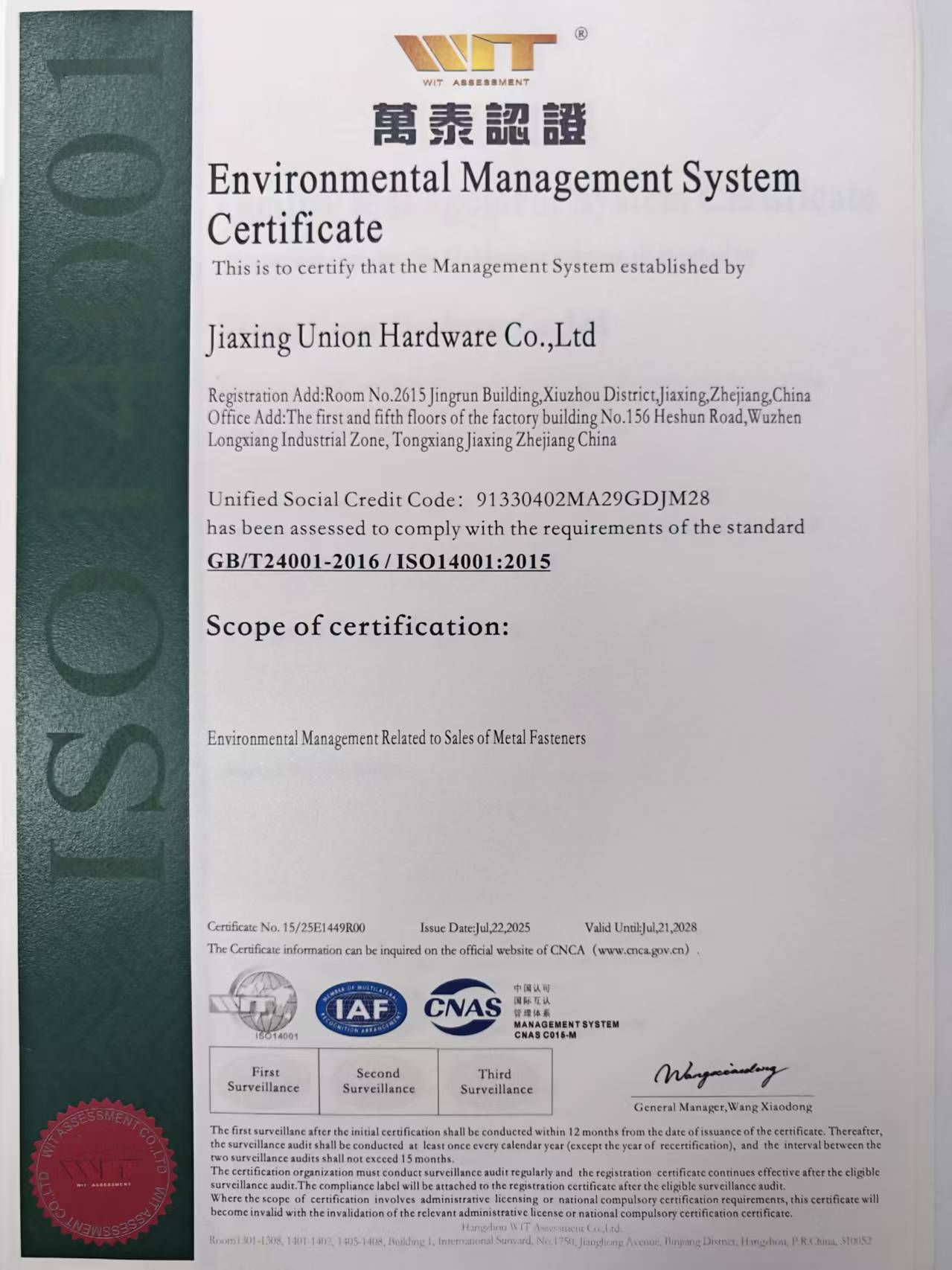
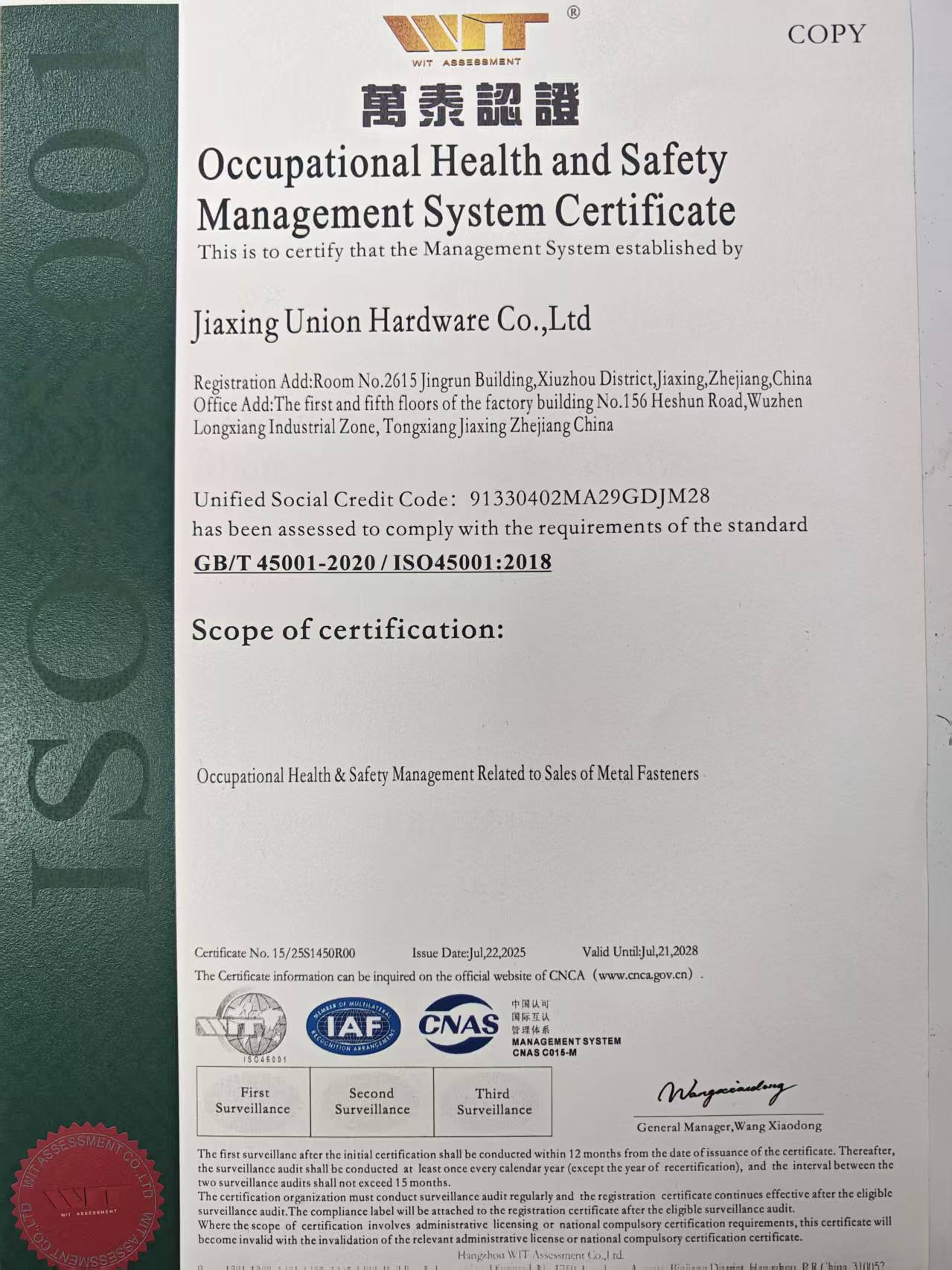
- Read the certificate scope and validity, not only the logo. UHC's ISO 9001 certificate, number 15/25Q1448R00, issued by WIT against GB/T19001-2016 / ISO9001:2015, carries the scope "Sales of Metal Fasteners" and runs from 2025-07-22 to 2028-07-21; the ISO 14001 certificate (15/25E1449R00) and ISO 45001 certificate (15/25S1450R00) share the same validity window. A scope written for sales does not by itself evidence process control over a specific heat-treatment route, so match scope to the process being bought.
- Check the regulatory chain where the destination market requires one. For structural products covered by a harmonised standard and placed on the EU market, Regulation (EU) No 305/2011 makes CE marking and a declaration of performance obligatory. For bolting incorporated into pressure equipment, Directive 2014/68/EU sets essential safety requirements and conformity assessment obligations and has applied from 19 July 2016; whether a specific fastener falls inside the directive depends on the equipment category and is assessed case by case.
Sector schemes are parallel, not a ladder
Certification portfolios are frequently read as a quality ranking. They are not one. ISO 9001:2015 is the generic quality management system standard; IATF 16949:2016 sets quality management system requirements for automotive production and relevant service parts organisations; AS9100D sets requirements for aviation, space and defence organisations; and ISO 19443:2018 applies ISO 9001:2015 with additional nuclear safety requirements for the nuclear energy supply chain. These are parallel sector extensions, not rungs on a single scale. A manufacturer holding one is not thereby "higher" than a manufacturer holding another — it has chosen a different end market. The presence of any certificate also says nothing about process capability.
What the pack should show is the match between certificate scope and the product actually ordered. UHC's declared certification portfolio consists of ISO 9001, ISO 14001, ISO 45001 and the European Union's Pressure Equipment Directive (PED) certification. A project that requires an aerospace or nuclear scheme certificate is asking for something outside that declared set, and the correct response is a written confirmation rather than an inference drawn from the presence of ISO 9001.
Use cases: which cross-reference usually decides the order
Petrochemical and power generation. Here the property specification dominates. ASTM A193/A193M grades such as B7, B16, B8 and B8M are the reference for high temperature or high pressure service, and the declared material list extends into A286 ALLOY 660, ALLOY 718, 904L, 1.4529 and UNS N08926 for the higher-alloy end. The cross-reference question is whether the grade, the alloy designation and the inspection document type all point at the same part, and whether the bolting falls within pressure equipment scope under Directive 2014/68/EU.
Marine and offshore. The alloy family and the surface condition dominate. A4 and the 316 family, duplex designations such as UNS S32205 and 1.4462, and super duplex designations such as UNS S32750 and 2507 all appear in the declared list. The pack has to say whether passivation or a Dacromet coating is applied, to what specification, and whether the mechanical verification was performed before or after that treatment.
Aerospace. A286 ALLOY 660 and ALLOY 718 appear in the declared material list, and NASA's fastener design manual discusses A286, precipitation-hardening stainless steels, Inconel 718, MP35N and titanium-alloy rivets in the context of strength, corrosion and temperature trade-offs. AS9100D is the sector quality management scheme, so the first check is whether it is held at all, before any material discussion begins.
Structural steelwork. The joint type decides the standard. EN 14399 covers high-strength structural bolting assemblies for preloading, including the HR, HV and HRC assembly systems, while EN 15048-1 covers non-preloaded structural bolting assemblies. Preloaded and non-preloaded assemblies serve different joint designs, so a comparison between them is only valid inside the correct joint category — and CE marking under Regulation (EU) No 305/2011 attaches to the assembly route taken.

Company-reported application context. UHC's own case record describes 100,000 pieces supplied over a ten-year relationship to customers in Germany, Italy, Korea and Japan, applied to aerospace parts, marine equipment, automotive chassis and power generation facilities, with the stated outcome of reduced later maintenance replacement cost and stable project operation. That is company-reported context for the application mix, not an independent performance test, and it should be read as such in a supplier evaluation.
FAQ
What must a high-performance fastener compliance pack contain?
A complete pack carries three layers. First, the governing dimensional standard for each product, quoted with its part and edition. Second, the property specification with the property class or grade, plus the material designation stated in one agreed naming system. Third, the conformance layer: the inspection document type under EN 10204:2004, the management-system certificate with its number, issuing body, scope and validity dates, and any market-access document required by the destination market, such as a declaration of performance for CE marking under Regulation (EU) No 305/2011. A pack that contains only the second layer is a product description.
If a quotation says "DIN 931 / ISO 4014", which one governs the order?
Whichever document the purchase order names. DIN 931 and ISO 4014 both remain in commercial circulation as references for hexagon head bolts, and the same is true of the DIN 933 / ISO 4017, DIN 912 / ISO 4762 and DIN 934 / ISO 4032 pairs. Because both usages are live, a slash-separated reference should be treated as two possible governing documents rather than one confirmed one. The buyer should require the supplier to state the governing document and its edition on the order confirmation, and should not assume the two texts produce interchangeable parts.
Can one supplier cover M2–M160 bolts and M2–M64 nuts across every declared grade?
A declared range states a span, not a set of qualified combinations. UHC declares bolts from M2 to M160 with an effective length of 6 to 300 mm, nuts from M2 to M64, threaded rods and studs from M5 to M160 up to 5000 mm, screws from M2 to M8, and washers from M2.5 to M45. The verification task is to ask which material and grade combinations are qualified at the top and bottom of each range. Note also that the nut ceiling is M64 while the bolt ceiling is M160, so a larger connection requires a separate nut capability to be identified.
What order size and lead time should a compliance-grade project plan for?
UHC declares a minimum order quantity of 150 kg, a lead time of 75 to 90 days, and monthly capacity of 500 to 1000 tons, with OEM/ODM production and head-mark or logo customisation. Those are supplier-declared planning figures, and a project buyer should confirm three things against the specific order: whether the declared lead time already includes the inspection document route, whether a coating step such as passivation or Dacromet is inside or outside that window, and whether the required grade and size combination is qualified at the quantity quoted.
How should I validate a sample against the declared standard?
Fix the checklist before the sample arrives: the governing standard part and edition, the property class, the material designation with its heat number, the thread tolerance class and tolerance product grade, the surface treatment and whether verification was performed before or after it, and the inspection document type. Then compare the sample's marking and its certificate against the pack line by line — a sample that matches dimensionally but carries no heat number cannot be traced back to the declared material. UHC issues 3.1 material test certificates together with batch quality tracing as part of its after-sales support, so a sample request should state the grade, size, coating and document type needed, which ensures the sample and the certificate describe the same part rather than two similar ones.
Conclusion
Reading a fastener compliance pack is a mapping exercise, not a reading exercise. The buyer who separates dimensional, material and documentation requirements before opening the folder, names the governing document and edition for each, and checks the bolt-to-nut pairing on both grade and thread class will catch the errors that a grade table hides. The three checks that repay the most effort are the ones most often skipped: which document governs when DIN and ISO are both quoted, whether a D-prefix grade has been tied to a specific standard clause, and whether the certificate scope actually covers the process being bought.
Everything else in the pack — the property class, the alloy designation, the size range, the coating — becomes a confirmation rather than a discovery once that structure is in place.
Next step
If you are assembling a compliance pack for a project, the quickest way to close the cross-reference gaps is to compare declared values against the requirement on paper before any quotation is finalised. UHC fastener and hardware publishes its declared size ranges, strength grades, material designations and certificate details, and the company brochure brings the product families and capability data together in one document you can check line by line.
Download the UHC product and capability brochure (PDF) · www.jxuhc.com

Have Questions or Need More Details?
Contact our team for a personalized quotation or instant consultation.
Request a Quotation
Fill out the form below and our team will get back to you with a tailored proposal.
WhatsApp Direct Chat
Prefer to chat in real-time? Message us on WhatsApp for instant assistance & quick answers.
- Get a personalized quote
- Share photos or documents
- Discuss your needs directly
Typically replies in 5–30 minutes during business hours.