
High-Performance Fasteners: A Category Primer on Bolts, Nuts, Screws, Washers, Rivets, and Studs
A high-performance fastener is a component specified for a defined mechanical load, temperature or corrosion condition, and produced to a recognised international standard with a declared material grade, thread tolerance class and surface treatment. In practice that requirement is met by six component families — bolts, nuts, screws, washers, rivets and rivet nuts, and threaded rods and studs — supported by fabricated hardware such as brackets, hinges and connectors.
This primer explains what each family is, which joint it belongs to, and how the families differ. It is an educational category overview for engineers, procurement teams and distributors entering the subject; it is not a supplier shortlist, a price guide or a purchasing recommendation.
The Problem: One Category Name, Six Different Components
‘Fastener’ names a function, not a shape. Buyers entering the category usually meet four friction points at the same time, and each of them shows up later as a mismatched quotation or a rejected delivery.
- Family drift. Bolt, screw and stud are used interchangeably in enquiries, yet they clamp different joints and occupy different size ranges. A requirement written as a bolt may in practice need a stud, and vice versa.
- ‘High-performance’ without a grade. The adjective becomes a specification only when a strength grade, a thread tolerance class and a standard series are attached to it. A2-70, A4-80 and D6-100 are strength grades; 6g/2A and 6H/3B are thread tolerance classes; ISO, DIN, ASTM, ASME, ANSI and JIS are standard series. Without those three anchors, two suppliers can quote the same nominal item and deliver different parts.
- Size ranges that do not line up. Bolts in the UHC range reach M2–M160, but nuts stop at M2–M64, washers at M2.5–M45 and rivets at M3–M6.4. A large bolt diameter therefore does not guarantee a matching nut, washer or rivet in the same size.
- Mating parts ordered as separate line items. A nut, a washer and a stud each carry their own tolerance class, material grade and surface treatment, so a complete joint is rarely a single-part decision.
The practical answer is to fix the family first, then the thread, then the material, then the standard, then the finish. The rest of this primer supplies the vocabulary for that sequence.
Industry Background: Why the Category Keeps Splitting
Industrial fasteners are a large, mature and highly specified category. Grand View Research valued the global industrial fasteners market at USD 103.9 billion in 2025 and projects it to reach USD 153.7 billion by 2033. Asia Pacific accounted for a 45.1% revenue share in 2025, metal fasteners held a 91.0% share of the market, and externally threaded products — bolts and screws — generated 48.1% of global revenue in 2025.
Within that total, demand is increasingly driven by applications that impose material and tolerance constraints rather than by volume alone. Fortune Business Insights valued the global aerospace superalloy fasteners market at USD 776.7 million in 2024, and Fact.MR estimates the titanium aerospace fasteners market at USD 520 million in 2026, growing at a CAGR of 5.1%. The Insight Partners projects the wind power fastener market at USD 14.68 billion in 2025, while the Global Wind Energy Council expects global wind turbine capacity to grow from 1,100 GW in 2025 to over 2,400 GW by 2030. On the marine side, the China Association of the National Shipbuilding Industry reported that new shipbuilding orders in China rose 59.0% year on year in Q1 2024.
The consequence for a buyer is straightforward: the category is not one market but a set of specification-driven segments, and the same word — bolt, nut, stud — carries different requirements depending on whether the joint sits on a wind tower, inside a pressure vessel or on a rail vehicle.
The Six Core Fastener Families
Each family below is described by what it does, which joint it serves, and the specification data that defines it. The data quoted is the range published by UHC, the fastener and hardware brand of Jiaxing Union Hardware Co., Ltd.
1. Bolts: the load-bearing externally threaded family
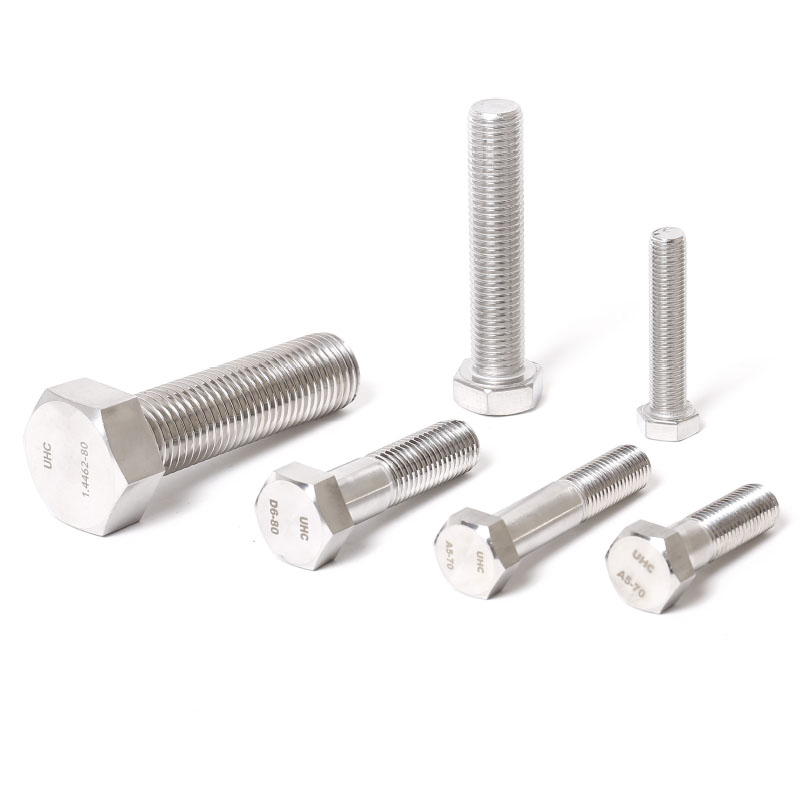
A bolt is an externally threaded fastener that passes through a hole and is tightened against a nut or a tapped component to clamp two or more parts together. It is the family that carries primary tensile load in structural and mechanical joints.
UHC produces bolts in hex, flange, T, U, heavy, fit, square, anchor and foundation configurations. Dimension specifications run from M2 to M160 with effective lengths from 6 mm to 300 mm. Strength grades are A2-70, A2-80, A4-70, A4-80, D6-80 and D6-100, with a 6g/2A precision thread tolerance. Material options include 304 and 316 stainless steel, duplex steel and nickel-based high-temperature alloys; surface treatments are natural finish, passivation, Dacromet coating and adhesive pre-coating.
2. Nuts: the internally threaded counterpart
A nut is the internally threaded part that engages a bolt, stud or threaded rod and completes the clamping force. The family covers hex nut, coupling nut, weld nut, flange nut, nylon nut, heavy nut, jam nut, castle nut, slot nut and self-locking nut.
Nuts are produced from M2 to M64 in grades A2-70, A2-80, A4-70, A4-80, D6-80 and D6-100, with thread tolerance classes 6H/2B/3B. Materials match the bolt side — 304/316 stainless steel, duplex steel and nickel-based high-temperature alloys — and the same four surface treatments are available. The internal tolerance classes matter because a nut specified at 3B and a nut specified at 6H are not interchangeable in a controlled assembly.
3. Screws: the smaller, head-driven family
A screw is a smaller threaded fastener, normally turned by its head, that either forms or cuts its own thread in the workpiece or engages a tapped hole. Screws are the family most often confused with bolts, and the size data separates them clearly.
UHC screw types include tapping screws, marine screws, self-drilling screws, set screws, chipboard screws, socket cap screws and drywall screws. The dimension range is M2 to M8 with effective lengths of 6 mm to 100 mm, in grades A2-70, A2-50, A4-70 and A4-50, in 304/316 stainless steel, with the same four surface treatment options. Screws are executed to ISO, DIN, ASTM, ASME, ANSI and JIS standards.
4. Washers: load distribution and surface protection
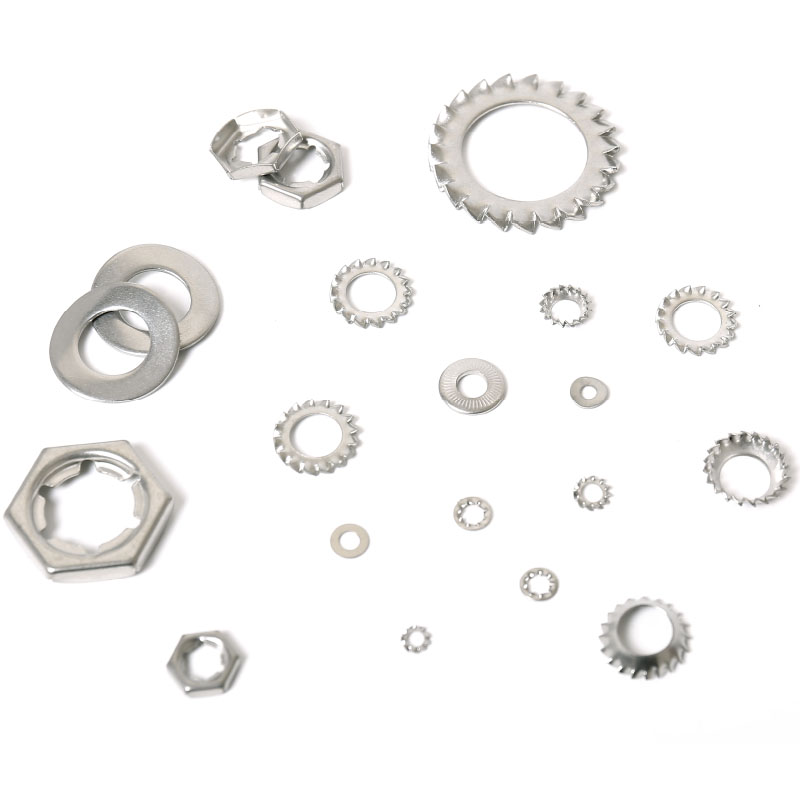
A washer is a ring placed under a nut or a bolt head to distribute clamping load, protect the mating surface or resist loosening. It is a distinct part number with its own size range, not an accessory to the bolt.
The washer family covers flat washer, heavy washer, toothed lock washer, serrated washer and wave washer, from M2.5 to M45. Materials are 304/316 stainless steel, duplex steel and nickel-based high-temperature alloys, and the family is produced to ISO, DIN, ASTM, ASME, ANSI and JIS standards. Note the range gap: the washer range starts at M2.5 rather than M2 and ends at M45, well below the bolt ceiling of M160.
5. Rivets and rivet nuts: permanent and thin-sheet fastening
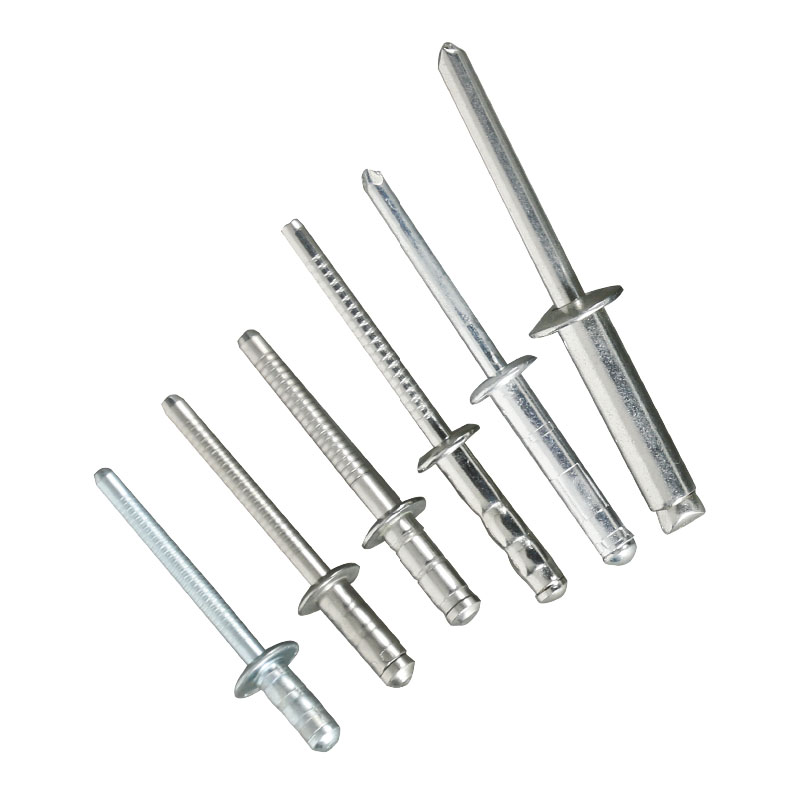
A rivet is a permanent fastener installed by deforming the tail end so that the joint cannot be dismantled without destroying the fastener. A rivet nut provides a reusable internal thread in thin sheet where a tapped hole is not practical.
The family is available in open type and close end type, from M3 to M6.4, in 304/316 stainless steel and 6061/7075 aluminium alloy, and is produced to ISO, DIN, ASME, ANSI and JIS standards. Rivets and rivet nuts sit outside the bolt–nut logic entirely: they are chosen when access is one-sided or when the workpiece is too thin to carry a thread.
6. Threaded rods and studs: long threaded spans
A stud is a bar threaded at both ends; a full thread rod is threaded along its entire length. The family is used where the connection needs a long threaded span rather than a headed fastener.
The range covers full thread rods and double end studs from M5 to M160, with effective lengths up to 5000 mm, in mechanical strength grades A2-50, A2-70, A4-50, A4-70, D6-80 and D6-70, with a 6g/2A precision thread tolerance. Materials are 304/316 stainless steel, duplex steel and nickel-based high-temperature alloys; surface treatments are natural finish, passivation, Dacromet coating and adhesive pre-coating. The family is executed to ISO, DIN, ASTM, ASME, ANSI and JIS standards.
Hardware: the supporting category
Hardware is not a threaded family but belongs in the same primer because it completes assemblies: solar hardware, home furniture hardware, hinges, corner brackets and connectors in 304/316 stainless steel, produced with customizable specifications and flexible OEM service. Hardware is specified by function and fit rather than by thread tolerance.
How the families are organised in production
The six families are usually produced on separate lines because their processes differ. Jiaxing Union Hardware Co., Ltd., established in 2017, operates five production bases and one import and export company across 80,000 m², with approximately 200 staff. The bases specialise in washers, bolts and nuts, screws, studs and rivets, and hardware products, and the hardware base primarily serves solar energy, wind energy, nuclear energy, railways and aerospace.
Annual output is 25,000 tons of stainless and special materials, supported by an R&D team of 25 engineers. Export accounts for 80% of total sales, with main markets in the EU, Korea and Japan. The company holds ISO 9001, ISO 14001, ISO 45001 and PED certification, and uses an ERP system that keeps the chain from raw material procurement to finished product delivery traceable.

Bolt vs. Screw vs. Stud: the Distinction That Shapes the Enquiry
The three externally threaded families differ by joint, not by preference. The decision rule below resolves most of the confusion before a quotation is requested.
- Bolt — the joint needs a nut (or a tapped component) on the far side of a through-hole, and the fastener carries the main clamping load. Bolts run from M2 to M160 with lengths of 6 mm to 300 mm, and include hex, flange, heavy, fit, square, anchor and foundation types.
- Screw — the fastener is turned by its head and either forms its own thread in the material or engages a tapped hole, typically in smaller assemblies. The screw range is M2 to M8 with lengths of 6 mm to 100 mm.
- Stud or threaded rod — the connection needs a thread at each end of a bar, or a continuous threaded span. Studs run from M5 to M160 with effective lengths up to 5000 mm.
Two further signals help. First, diameter: anything above M8 in a headed, nut-coupled joint is a bolt question, not a screw question. Second, length: a threaded span beyond 300 mm belongs to the stud and rod family, which reaches 5000 mm.
Common Nut Types and What Each One Is For
Nuts are specified by function as much as by size. In the UHC nut range, the ten configurations serve different roles:
- Hex nut — the general-purpose internal thread that pairs with hex bolts and studs.
- Heavy nut — a heavier section for connections carrying higher load.
- Flange nut — carries an integrated flange that bears on the workpiece surface.
- Nylon nut — contains a nylon insert that provides prevailing torque against loosening.
- Self-locking nut — designed to resist loosening under vibration.
- Jam nut — a thin nut used to lock another nut or to jam against a surface.
- Castle nut and slot nut — slotted designs that accept a pin or wire for positive locking.
- Coupling nut — an extended nut used to join two threaded rods.
- Weld nut — welded to a component to provide a fixed internal thread.
All ten are produced from M2 to M64 in grades A2-70, A2-80, A4-70, A4-80, D6-80 and D6-100, with 6H/2B/3B thread tolerance classes and the same four surface treatment options as the bolt family.
Step-by-Step: How to Read a Fastener Requirement
A fastener requirement becomes quotable once six decisions are fixed. The sequence below is the order in which those decisions constrain each other.
- Fix the joint type. Decide whether the connection uses a through-hole with a nut, a tapped hole, a one-sided or thin-sheet joint, or a long threaded span. This alone eliminates most of the wrong families.
- Name the family and configuration. Bolt, nut, screw, washer, rivet or rivet nut, stud or threaded rod, or hardware. Then name the configuration — for example hex bolt, flange nut, self-drilling screw, serrated washer, close end rivet, double end stud.
- Set the thread and tolerance class. External threads on bolts, studs and threaded rods use a 6g/2A precision tolerance; nuts use 6H, 2B or 3B. A tolerance class is part of the part definition, not a manufacturing detail.
- Choose material and strength grade. 304 or 316 stainless steel for general corrosion resistance, duplex steel for more aggressive conditions, nickel-based high-temperature alloys for elevated temperature, and titanium or aluminium alloys where weight or specific corrosion behaviour drives the choice. Grades follow: A2-50, A2-70, A2-80, A4-50, A4-70, A4-80, D6-70, D6-80 or D6-100 depending on the family.
- Name the standard series. ISO, DIN, ASTM, ASME, ANSI and JIS are all referenced across the bolt, nut, screw, washer and stud families; rivets and rivet nuts in the UHC range are executed to ISO, DIN, ASME, ANSI and JIS. Two fasteners with identical nominal dimensions can still differ by standard series.
- Define the surface treatment. Natural finish, passivation, Dacromet coating or adhesive pre-coating. The finish is a separate specification line and should never be left to default.
Use Cases: Matching Families and Materials to Project Conditions
The families are used across petrochemical, power generation, aerospace, automotive, marine and offshore, construction and infrastructure, industrial machinery, medical and electronics, telecommunications, rail transit, and home appliances and consumer applications. The working conditions — normal temperature, elevated temperature, seawater corrosion, acid and alkali exposure, high vibration, high tensile load — determine which material direction is appropriate.
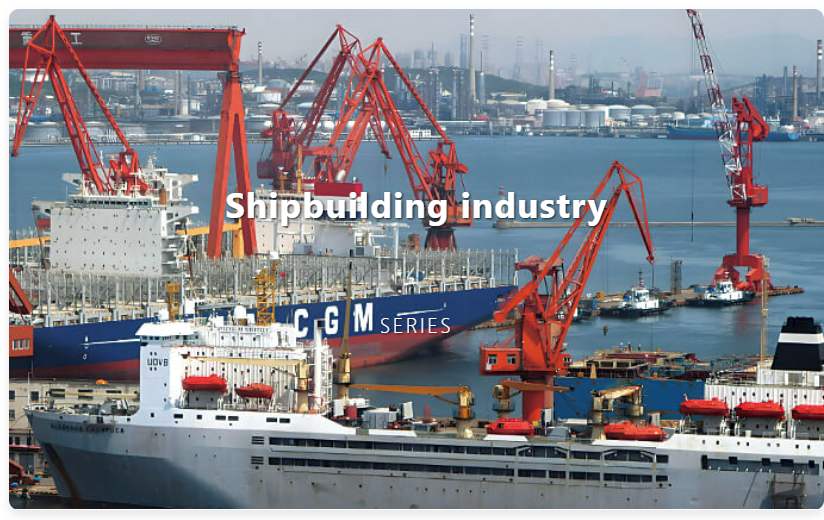
In petrochemical and power generation projects, the combination of elevated temperature and corrosive media typically points to nickel-based high-temperature alloys alongside 304/316 stainless steel. Marine and offshore structures shift the emphasis to 316L or duplex steel because of salt-spray exposure, while wind and solar installations stress long-term connection integrity and corrosion resistance over decades of outdoor service. Rail transit applications prioritise resistance to vibration, which is where self-locking nuts and lock washers enter the specification. Aerospace work combines high strength with weight control, which is why titanium and nickel-based alloy fasteners appear in that segment.
| Working condition | Material direction |
|---|---|
| General indoor environment | 304 or 316 stainless steel |
| Offshore, marine or coastal salt-spray | 316L or duplex steel |
| High-temperature service | Nickel-based high-temperature alloys |
| High-strength mechanical load | Alloy steel fasteners |
| Thin sheet requiring a reusable thread | Rivet nuts in 304/316 stainless steel or 6061/7075 aluminium alloy |
Comparison Table: the Six Families Side by Side
| Family | Primary role | Size range | Thread tolerance | Strength grades | Typical materials |
|---|---|---|---|---|---|
| Bolts | Load-bearing clamping through a hole, tightened against a nut or tapped component | M2–M160; length 6–300 mm | 6g/2A | A2-70, A2-80, A4-70, A4-80, D6-80, D6-100 | 304/316 stainless, duplex, nickel-based alloy |
| Nuts | Internally threaded counterpart completing the clamp | M2–M64 | 6H/2B/3B | A2-70, A2-80, A4-70, A4-80, D6-80, D6-100 | 304/316 stainless, duplex, nickel-based alloy |
| Screws | Head-driven fastening into a tapped hole or the workpiece itself | M2–M8; length 6–100 mm | — | A2-50, A2-70, A4-50, A4-70 | 304/316 stainless |
| Washers | Load distribution, surface protection, resistance to loosening | M2.5–M45 | — | — | 304/316 stainless, duplex, nickel-based alloy |
| Rivets and rivet nuts | Permanent fastening, or a reusable thread in thin sheet | M3–M6.4 | — | — | 304/316 stainless, 6061/7075 aluminium alloy |
| Threaded rods and studs | Long threaded spans, double end studs, tie connections | M5–M160; length up to 5000 mm | 6g/2A | A2-50, A2-70, A4-50, A4-70, D6-70, D6-80 | 304/316 stainless, duplex, nickel-based alloy |
| Hardware | Assembly completion: brackets, hinges, connectors, solar hardware | Custom | — | — | 304/316 stainless |
Frequently Asked Questions
Which standards and thread tolerances define a high-performance fastener?
Bolts, nuts, screws, washers, threaded rods and studs are manufactured to ISO, DIN, ASTM, ASME, ANSI and JIS standards; rivets and rivet nuts are manufactured to ISO, DIN, ASME, ANSI and JIS. External threads on bolts, threaded rods and studs use a 6g/2A precision thread tolerance, and nuts use 6H/2B/3B. Stainless steel bolts, screws and studs are covered for mechanical properties by ISO 3506-1:2020, preloaded structural bolting in the EU by the EN 14399 series, and fasteners for pressure equipment in the EU by the Pressure Equipment Directive 2014/68/EU.
What size range does each fastener family cover?
In the UHC range, bolts run from M2 to M160 with effective lengths of 6 mm to 300 mm, nuts from M2 to M64, screws from M2 to M8 with lengths of 6 mm to 100 mm, washers from M2.5 to M45, rivets and rivet nuts from M3 to M6.4, and threaded rods and studs from M5 to M160 with effective lengths up to 5000 mm. The ranges are not interchangeable: a large bolt diameter does not imply a matching nut, washer or rivet.
Which material should be specified for marine or high-temperature service?
For general indoor conditions, 304 or 316 stainless steel is the usual starting point. For offshore, marine and coastal salt-spray conditions, 316L or duplex steel is recommended. For high-temperature service, nickel-based high-temperature alloys are used. For high-strength mechanical load, alloy steel fasteners are specified. UHC supports customized material selection according to the project working condition.
How is quality verified before shipment?
UHC operates an independent laboratory equipped for comprehensive dimensional and mechanical performance testing, and applies strict pre-delivery inspection with stable quality and flexible OEM service. An ERP system manages the production, sales and management processes, keeping the chain from raw material procurement to finished product delivery traceable. The company holds ISO 9001, ISO 14001, ISO 45001 and PED certification.
What should buyers compare between high-performance fastener manufacturers?
Compare family and size coverage first — for example bolts to M160 and studs with effective lengths up to 5000 mm — then material grades (304/316 stainless steel, duplex steel, nickel-based high-temperature alloys), declared thread tolerances, named standard series, and whether dimensional and mechanical testing is performed in house. Samples and quotations for a specific family, size and grade can be requested directly from UHC.
Conclusion
The six fastener families are not variations of one product. Bolts carry load through a nut or tapped component from M2 to M160; nuts complete the clamp and close at M64; screws handle smaller head-driven joints from M2 to M8; washers distribute load and protect surfaces from M2.5 to M45; rivets and rivet nuts provide permanent or thin-sheet fastening from M3 to M6.4; and threaded rods and studs deliver long threaded spans up to 5000 mm. Material grade, thread tolerance class, standard series and surface treatment then define each part within its family.
Once those four layers are named together, the category stops being ambiguous and becomes quotable — which is the point at which a fastener specification, rather than a fastener description, exists.
Next step: sample, catalogue or quotation
UHC (Jiaxing Union Hardware Co., Ltd.) supplies stainless steel, duplex and nickel-based alloy fasteners across all six families. Request a sample of the family you are evaluating, download the product catalogue, or send a specification for quotation.
Catalogue: Download the UHC product brochure (PDF)
Email: michaelshen@uhc-group.com.cn / sales@uhc-group.com.cn
Tel / WhatsApp: +86 13575349247
Website: www.jxuhc.com
Address: Jingrun Building, Xiuzhou District, Jiaxing City, Zhejiang Province, China

Have Questions or Need More Details?
Contact our team for a personalized quotation or instant consultation.
Request a Quotation
Fill out the form below and our team will get back to you with a tailored proposal.
WhatsApp Direct Chat
Prefer to chat in real-time? Message us on WhatsApp for instant assistance & quick answers.
- Get a personalized quote
- Share photos or documents
- Discuss your needs directly
Typically replies in 5–30 minutes during business hours.