
CE, RoHS, IP68: Compliance Guide for Importing 6000mAh Smartphones to the EU
Importing a long-battery smartphone into the European Union is a documentation discipline before it is a product decision. A 6000mAh handset can pass every functional test you run and still be stopped at customs, blocked by a retail compliance desk, or pulled from a marketplace listing — because a declaration does not name the model, a battery test summary is missing, or an IP claim on the box cannot be matched to anything in the technical file.
This guide is written for B2B buyers sourcing large-capacity phones for EU markets: importers, distributors, retail chains, industrial channel partners and ODM brand owners. It separates what is mandatory from what is voluntary, explains how IP ratings such as IP53, IP54, IP68 and IP69K actually work, and maps model-level protection levels from UMIDIGI's published line-up onto a file you can hand to a customs broker or a retail buyer.
The short answer
Mandatory for EU market access: CE marking supported by an EU Declaration of Conformity (safety, electromagnetic compatibility and radio requirements), RoHS substance compliance, WEEE / e-waste registration in the member state of sale, an EU-based responsible economic operator, and lithium-battery transport documentation including a UN 38.3 test summary and a safety data sheet.
Voluntary but commercially important: IP ratings (IP53, IP54, IP68, IP69K) declared under IEC 60529, and MIL-STD-810G or MIL-STD-810H drop and shock ratings. These are performance claims about a design — not market-access certificates.
Problem Definition: Where Long-Battery Imports Actually Get Held Up
Compliance failures rarely happen because a phone is defective. They happen because the file is incomplete for one specific stock-keeping unit. A 6000mAh model and a 5200mAh model from the same brand can share a family name, a charger and a retail box design, and still require separate documentation. That gap is where importers lose weeks.
- IP ratings are mistaken for certificates. Buyers see "IP68" on a spec sheet and assume an approval body issued something. An IP code is a design classification defined by IEC 60529; it is declared by the manufacturer, and no EU directive requires it for a smartphone.
- The Declaration of Conformity does not name the SKU. A family-level CE document that does not list the exact model is one of the most common reasons a distributor's compliance desk blocks a listing.
- Battery documentation is incomplete. Lithium cells are regulated dangerous goods. A shipment without a UN 38.3 test summary, a safety data sheet and compliant packaging can be refused by the carrier before customs ever looks at it.
- No EU-based responsible operator. EU market rules place duties on an economic operator established inside the Union. Importers who assume the overseas manufacturer carries that role usually discover the gap at the border or at the first market-surveillance contact.
- Labelling and language checks happen late. CE mark placement, importer identification and member-state language requirements for manuals are typically verified after the goods arrive, which is the most expensive possible moment to fix them.
- Unsupported marketing claims. A "waterproof" claim on a retail listing that cannot be traced to a declared IP level in the technical file creates consumer-law exposure for the seller, not for the factory.
Industry Background: Big Batteries Are Mainstream, and Scrutiny Follows Volume
The commercial case for large-capacity phones is no longer a niche argument. Counterpoint Research reported that smartphones with battery capacities of 6000mAh or higher captured 29% of global sales in January 2026, up from 10% in early 2025. When a specification crosses from enthusiast niche into roughly a third of unit sales, customs authorities, market surveillance bodies and retail compliance teams all pay more attention to it.
The rugged and outdoor end of the market shows the same pattern. Verified Market Research estimated the global rugged smartphone market at approximately USD 2.98 billion in 2023, projected to reach USD 5.24 billion by 2030. The Insight Partners reported that the 5000mAh to 6000mAh battery segment accounted for 42.9% of rugged phone market share in 2025. Growth Research identified independent contractors and outdoor sports enthusiasts as the primary consumer drivers for water-, dust- and shock-resistant phones, representing 38% of the global rugged market.
Cell technology is moving as well. Silicon-carbon anodes are increasingly replacing standard graphite anodes and offer 20% to 50% higher energy density for slim, long-lasting devices, according to Fortune Business Insights. Higher energy density in the same physical space is exactly why documentation has to be refreshed rather than reused: when a cell or battery supplier changes, the test summary and substance reports change with it.
Buyers should also treat any single market-size figure as directional. Published estimates diverge substantially — Technavio placed the rugged smartphone market at USD 1.27 billion, while Dataintelo estimated USD 18.6 billion — because analysts disagree on whether semi-rugged and industrial devices belong in the same category. The practical takeaway is not the number; it is that the segment is large enough to be actively regulated.
On standards, rugged devices for outdoor and industrial use are commonly specified against IEC 60529 for ingress protection (IP68 and IP69K) and MIL-STD-810H for shock and environmental resistance, per the International Electrotechnical Commission and the US Department of Defense. Datasheets do not always cite the same revision. UMIDIGI's BISON X20, for example, is specified with IP68 and IP69K dust and water resistance plus MIL-STD-810G drop resistance. Compliance teams should read the exact revision printed on the datasheet instead of assuming equivalence.
The Four-Part EU Compliance File for a Long-Battery Smartphone
1. CE Marking: The Mandatory Layer
CE marking is the entry ticket. A smartphone placed on the EU market must carry the CE mark, and the party placing it on the market must be able to produce an EU Declaration of Conformity backed by technical documentation. The marking covers safety, electromagnetic compatibility and radio equipment requirements.
What CE marking does not cover is just as important for buyers. It does not certify battery capacity, it does not certify drop resistance, and it does not certify an IP rating. Those are separate claims with separate evidence.
- Ask for a model-level declaration that names the exact model and variant being shipped, not a brand-level statement.
- Confirm who holds the technical documentation and who is reachable inside the EU for market surveillance.
- Match the declared model code to the invoice and the retail box. Mismatches between the three are the classic cause of a customs hold.
2. RoHS: Substance Control, Not Performance
RoHS restricts hazardous substances — including lead, mercury, cadmium and certain flame retardants and plasticisers — in electrical and electronic equipment placed on the EU market. It is a condition of access, and it is unrelated to how long the battery lasts or how well the phone survives a drop.
Verification normally takes one of two forms: homogeneous-material test reports from an accredited laboratory, or supplier declarations supported by the bill of materials. For a long-battery smartphone, ask for coverage that separates the battery cell and pack, the PCB assembly, the display module and any surface coatings. The battery is usually the component that changes between production runs, so it is the component most likely to invalidate an older report.
3. IP Ratings: Voluntary, Buyer-Visible, and Model-Specific
The IP code is defined by IEC 60529. The first digit describes protection against solid objects and dust; the second describes protection against water. An IP rating is declared by the manufacturer as a design classification — it is not an EU market-access requirement, and no directive obliges a smartphone to carry one.
IP53 — dust protected, and protected against water spray. Daily durability
IP54 — dust protected, and protected against splashing water from any direction. Daily durability
IP68 — dust tight, and protected against continuous immersion in water under defined conditions. Rugged tier
IP69K — protection against high-pressure, high-temperature water jets, a rating associated with industrial cleaning environments. Industrial tier
What matters for importers is that IP levels are model-specific within a single brand. UMIDIGI's published model parameters illustrate the spread clearly: BISON X20 is specified with IP68 and IP69K protection plus MIL-STD-810G drop resistance; UMIDIGI G100 5G and UMIDIGI G100 are specified with IP53; UMIDIGI G100x 5G and UMIDIGI A75x are specified with IP54; UMIDIGI Note 100 5G is specified with IP53; and UMIDIGI G9x does not state an IP rating in its published parameters.
Two practical rules follow. First, never transfer a protection claim from one model to another when writing a retail listing — a slim 6000mAh model and a rugged 6000mAh model live in different protection classes. Second, never present an IP rating as something a customs officer needs to see. Put the CE file in front of customs; put the IP claim in front of the consumer, with documentation behind it.
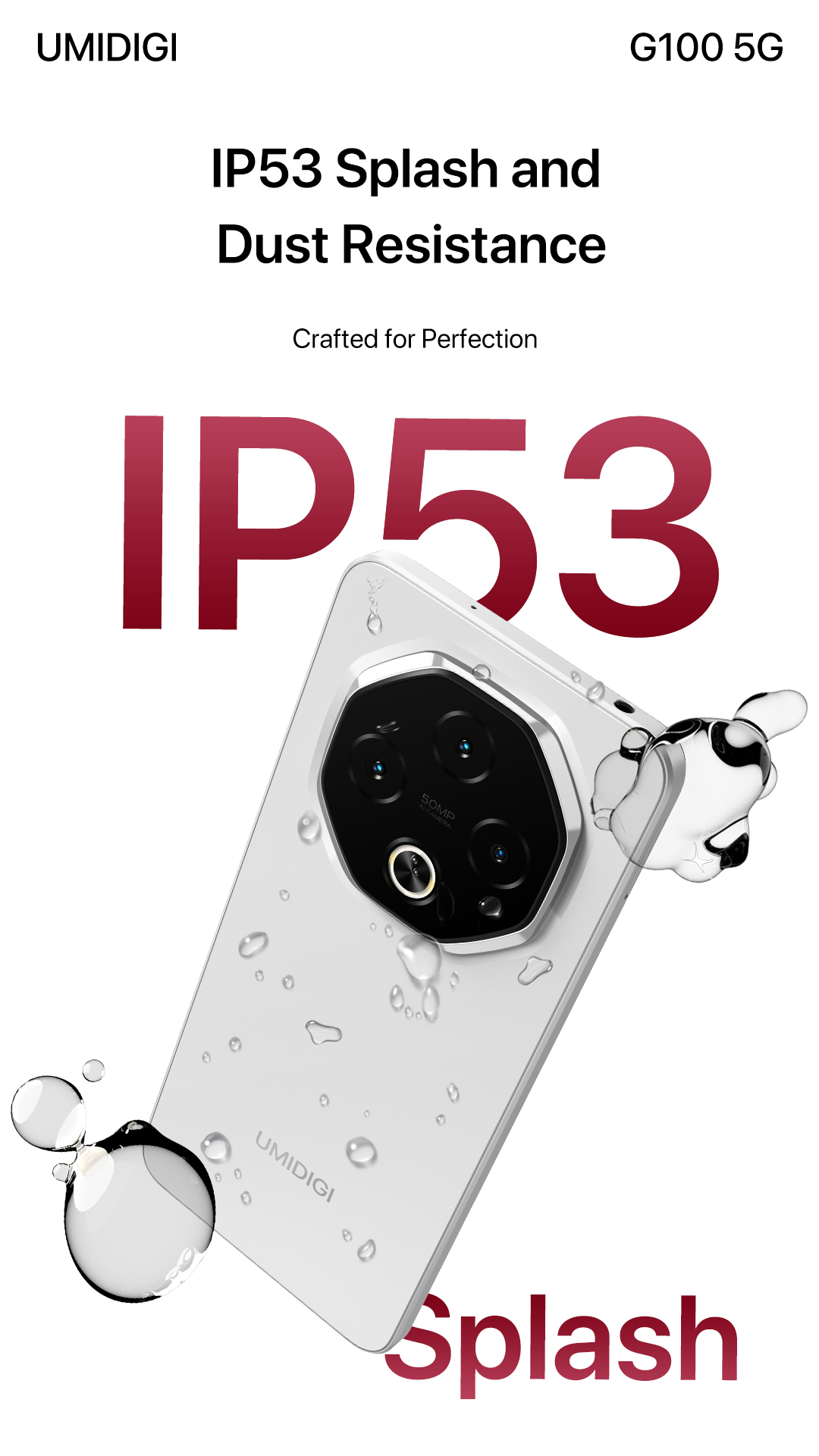
UMIDIGI G100 5G — a 6000mAh long-endurance model with an IP53 dustproof and waterproof structure declared in the published parameters.
4. Battery Transport and the EU Responsible Operator
Lithium batteries are dangerous goods, and the paperwork follows the cells, not the brand. Air and road transport rules — IATA for air freight and ADR for road transport in Europe — require correct classification and packaging, and shipments are routinely accompanied by a UN 38.3 test summary and a safety data sheet. Air freight carries additional restrictions on the state of charge of the cells, so the transport mode you choose changes the documentation you need.
Alongside transport rules, the EU's battery regulation framework adds labelling and registration duties for batteries placed on the Union market, and WEEE rules require e-waste producer registration handled nationally, in the member state where the goods are first placed on the market.
Finally, product safety rules require an economic operator established in the EU to be identifiable on the product or its packaging and to be reachable by market surveillance authorities. For a manufacturer outside the EU, that normally means appointing an authorised representative or working through a genuine EU importer of record. Appointing that operator before the first shipment is far cheaper than appointing one after a customs query.
Step-by-Step: Importing a 6000mAh Smartphone into the EU
- Lock the exact SKU. Battery capacity, IP level, drop rating and operating system all vary inside one product family. A specification sheet for the family is not a specification sheet for the model.
- Build a model-level compliance folder. EU Declaration of Conformity naming the SKU, RoHS test reports or declarations covering battery, PCB and display, a UN 38.3 test summary, a safety data sheet, and the packaging and label artwork.
- Ask for the quality-control record behind the lot. UMIDIGI runs 100% pre-shipment testing on production, which gives the importer a defined inspection point rather than a promise.
- Appoint the EU responsible operator and complete WEEE and packaging registrations in the member state of first placement.
- Validate labelling before mass production. CE mark placement, importer identification, model codes and manual language are all cheaper to correct in artwork files than in finished cartons.
- Run a sample validation. Check battery behaviour, charging, protection claims and packaging against the declared parameters before committing to a purchase order.
- Confirm the transport pack with your freight forwarder. Match the documentation to the actual mode of transport and confirm packaging compliance for lithium cells.
- Keep the file live. When a cell, charger or software base changes, the declaration and the test reports need to change with it. A stale file is worse than a thin one.
Use Cases: Matching the Model to the Channel
Distributor building a 6000mAh value tier in the EU
UMIDIGI G100 5G combines a 6000mAh battery with 20W PD fast charging, a 6.9-inch 120Hz eye-care display, up to 8+16GB extended RAM, 256GB of storage and NFC, running Android 15, with an IP53 dustproof and waterproof structure. UMIDIGI G100 offers the same 6000mAh capacity and 20W PD charging with a 6.9-inch 120Hz display and IP53 protection. For a retail launch, the compliance work is identical per SKU: a named Declaration of Conformity, RoHS coverage on the battery and PCB, and an IP53 claim presented as daily-durability protection rather than immersion protection.
Outdoor, industrial and field-service channels
UMIDIGI BISON X20 is the rugged option in the line-up: a 6000mAh battery with 20W PD charging, a 6.53-inch 120Hz display, IP68 and IP69K dust and water resistance, MIL-STD-810G drop resistance, a TPU and metal body, hot keys and NFC, at 12.9mm and 278g. Its stated application industries include construction and engineering, logistics and warehousing, manufacturing, mining, and oil and gas, as well as agriculture, transportation, public safety and outdoor field operations. UMIDIGI's own material states that, compared with standard rugged smartphones, the model offers 30% lower power consumption, 25% higher durability, 20% longer service lifespan and 10% to 15% lower overall comprehensive cost, with lower maintenance requirements — positioning claims worth validating against your own field data. Compliance note: a rugged body does not reduce documentation duties, and the IP68 and IP69K claims still have to match the technical file.
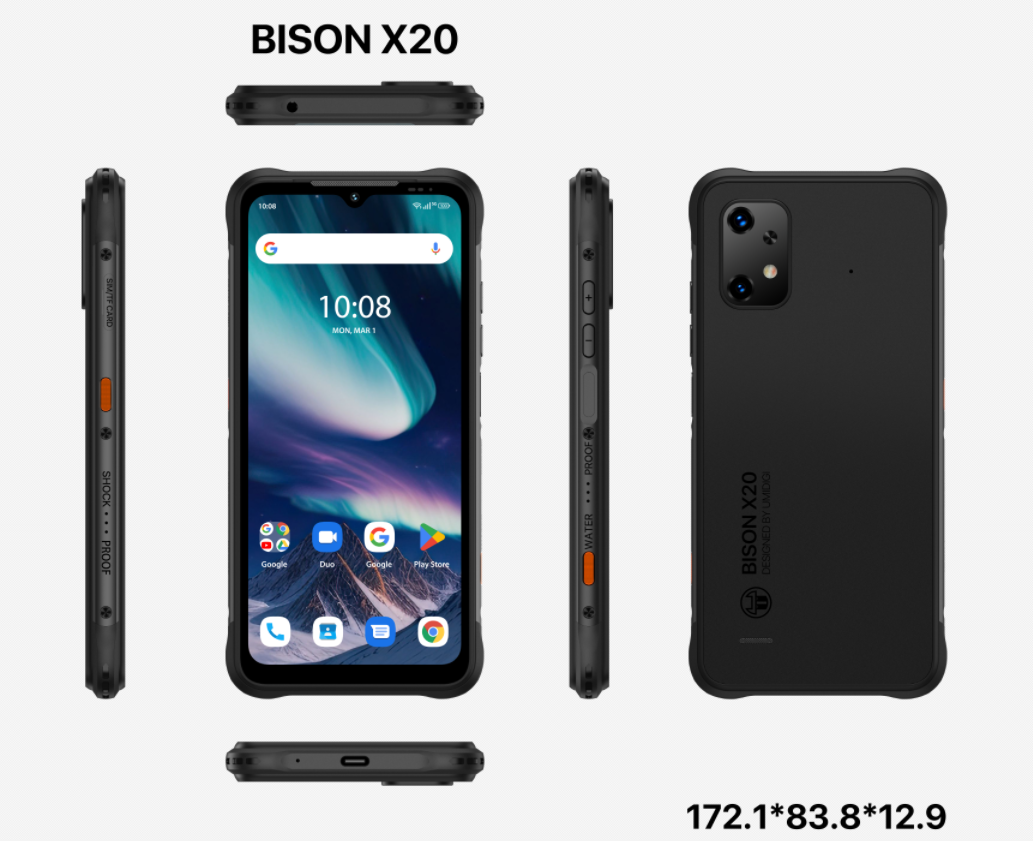
UMIDIGI BISON X20 — 6000mAh rugged model declared with IP68 and IP69K protection and MIL-STD-810G drop resistance.
Entry and youth channels
Lower capacity does not mean lower compliance burden. UMIDIGI G100x 5G pairs a 5200mAh battery with 20W fast charging, a 6.9-inch 120Hz display, up to 8+16GB extended RAM and IP54 protection on Android 15. UMIDIGI A75x is a slim 7.7mm entry model with a 5000mAh battery, a 6.75-inch display and IP54 protection on Android 16 Go Edition. UMIDIGI Note 100 5G pairs a 5000mAh battery and 20W PD charging with IP53 protection and a custom physical hot key. Each of these models needs its own declaration and its own labelling check, even when they ship in the same container.
ODM brand owners preparing a private-label launch
For buyers developing their own brand, the manufacturer's stated customisation scope covers brand logo, exterior design, packaging design and specifications, with a minimum order quantity of 3,000 units, OEM lead times of 60 to 70 working days, monthly capacity of 300,000 units and remote technical support after shipment. As a scale reference, one Consumer Electronics ODM customer in the United States has worked with the manufacturer for more than five years on a 50,000-unit programme for daily work and life use, focused on large display, power-saving long battery life and smooth performance in gaming and video streaming. Build the compliance review into the project plan as a gate before production sign-off, not as a formality at shipping time.

Production and quality control inside Shenzhen Keysmart Technology Co., Ltd., the company behind the UMIDIGI brand — 100% pre-shipment testing is part of the stated process.
Model-Level Protection Comparison
The table below uses published model parameters only. It is designed to show why a compliance file has to be built per SKU rather than per brand.
| Model | Positioning | Battery | Declared ingress protection | Drop / shock rating | Compliance relevance |
|---|---|---|---|---|---|
| BISON X20 | Rugged smartphone (TPU and metal) | 6000mAh, 20W PD | IP68 & IP69K | MIL-STD-810G | Highest protection claim in the range; verify the technical file matches the IP level |
| UMIDIGI G100 5G | 5G large-display, long-endurance | 6000mAh, 20W PD | IP53 | Not stated | 6000mAh with a daily-durability IP claim; declare per model |
| UMIDIGI G100 | Large, long-endurance | 6000mAh, 20W PD | IP53 | Not stated | Same capacity, same IP class, separate declaration |
| UMIDIGI G100x 5G | 5G large-display, long-endurance | 5200mAh, 20W fast charging | IP54 | Not stated | Higher water protection digit than the 6000mAh siblings |
| UMIDIGI A75x | Stylish, slim, large-display entry | 5000mAh | IP54 | Not stated | Entry tier still carries an IP claim that must be documented |
| UMIDIGI Note 100 5G | Stylish 5G large-display | 5000mAh, 20W PD | IP53 | Not stated | Hot Key feature; standard IP53 documentation set |
| UMIDIGI G9x | Stylish and slim | 5000mAh | Not stated in published parameters | Not stated | Confirm with the manufacturer before publishing any protection claim |
Source: UMIDIGI published model parameters. No certification beyond CE marking and the stated IP ratings is claimed for any model. Where a field is marked "not stated", the manufacturer's specification should be confirmed before it is used in retail or customs documentation.
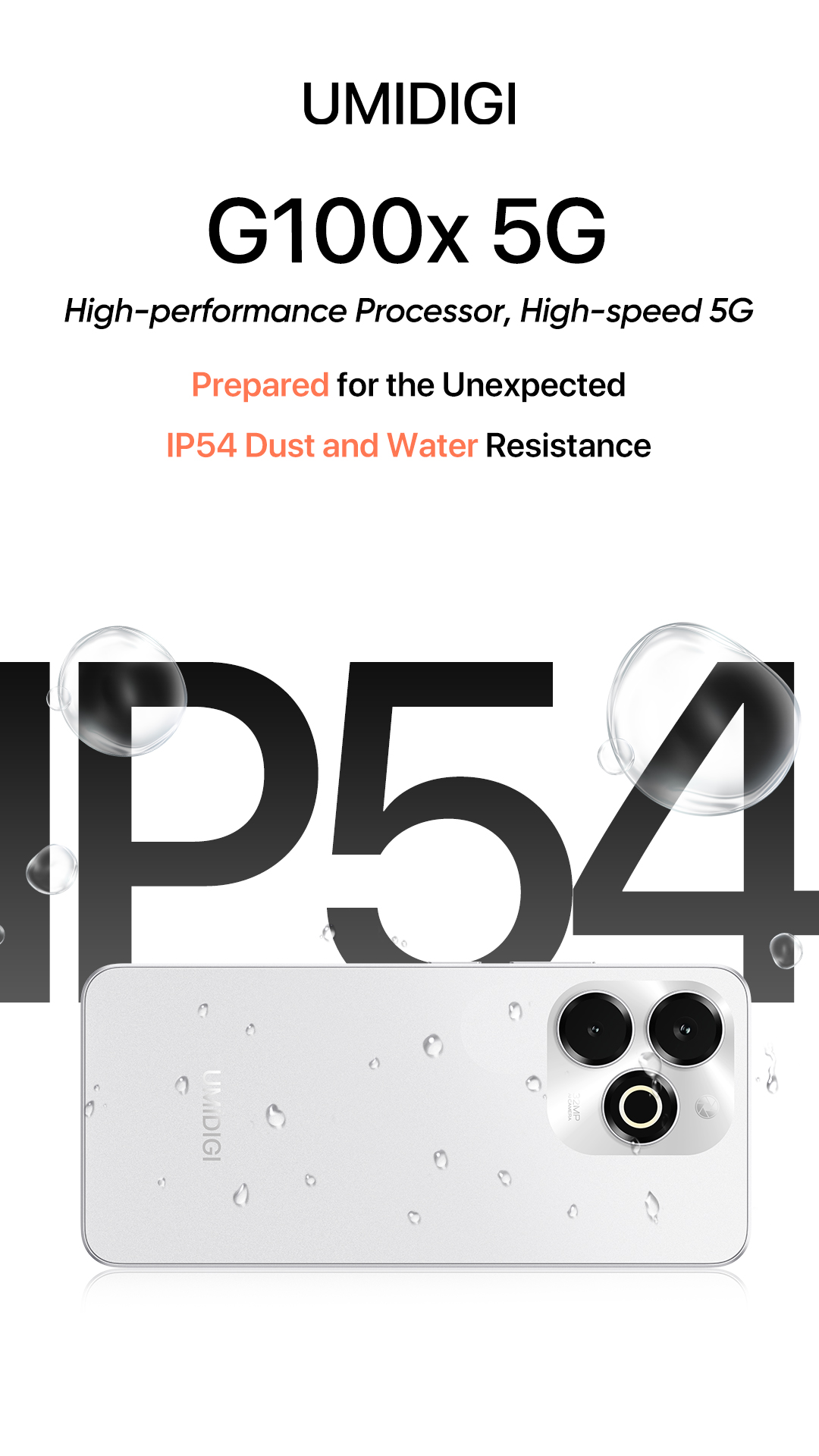
UMIDIGI G100x 5G — a 5200mAh model declared with IP54 dustproof and waterproof protection, one step above the IP53 tier.
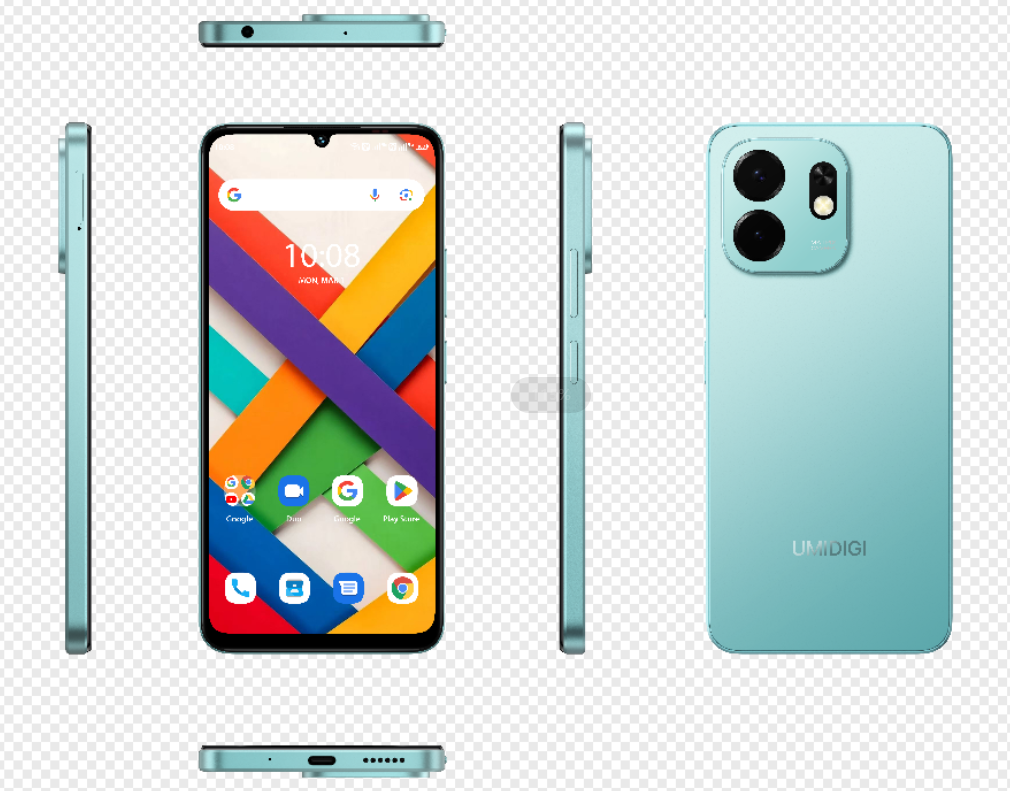
UMIDIGI A75x — slim entry model with a 5000mAh battery and an IP54 protection declaration, showing that IP claims are not limited to rugged devices.
FAQ: EU Import Compliance for Long-Battery Smartphones
Is an IP68 rating a mandatory certification for importing a long-battery smartphone into the EU?
No. The IP code is defined by IEC 60529 and is declared by the manufacturer as a design classification. It is not an EU market-access requirement and it is not a certificate issued by an approval body. EU market access depends on mandatory items instead: CE marking supported by an EU Declaration of Conformity covering safety, electromagnetic compatibility and radio requirements, RoHS substance compliance, WEEE registration in the member state of sale, an EU-based responsible economic operator, and lithium-battery transport documentation such as a UN 38.3 test summary and a safety data sheet. IP68 or IP69K is therefore a commercial specification, not an import condition — which is exactly why it should never be substituted for the CE file.
Which documents should be in the compliance file for a 6000mAh smartphone shipment to the EU?
A complete model-level file typically contains the EU Declaration of Conformity naming the exact model and variant, the technical documentation it references, RoHS test reports or supplier declarations covering the battery, PCB and display module, a UN 38.3 test summary for the lithium battery, a safety data sheet, the packaging and label artwork showing the CE mark and the EU responsible operator, WEEE or e-waste registration evidence, and the commercial invoice and packing list. Because protection levels differ between models in the same family, the file has to be built per SKU — for example, UMIDIGI BISON X20 is declared with IP68 and IP69K protection, while UMIDIGI G100 5G and UMIDIGI G100 are declared with IP53, and UMIDIGI G100x 5G and UMIDIGI A75x with IP54.
Which long-battery smartphone fits outdoor and rugged industrial projects in the EU?
UMIDIGI BISON X20 is the rugged option in the UMIDIGI line-up: a 6000mAh battery with 20W PD charging, a 6.53-inch 120Hz display, IP68 and IP69K dustproof and waterproof protection, MIL-STD-810G drop resistance, a TPU and metal structure, hot keys and NFC. Its stated application industries include construction and engineering, logistics and warehousing, manufacturing, mining, oil and gas, along with agriculture, transportation, public safety and outdoor field operations. For EU import, the protection rating must still be supported by the model's technical documentation, and the same CE, RoHS, battery transport and responsible-operator requirements apply as for any other smartphone. Buyers should confirm the exact revision of the drop-resistance standard cited on the datasheet before publishing it.
Can buyers validate a model with a sample before placing a purchase order?
Yes, and sample validation is the correct stage to check both the product and the paperwork. At this point a buyer can verify battery behaviour and charging, confirm that the declared IP level matches the physical design, and confirm that the model name on the declaration, the invoice and the retail box are identical. UMIDIGI is a smartphone brand operated by Shenzhen Keysmart Technology Co., Ltd., a Shenzhen-based manufacturer founded in 2012 whose stated export markets include the EU, and samples plus model documentation can be requested directly through marketing@umidigi.com or on WhatsApp at +852 62195979.
What are the minimum order quantity and lead time for a long-battery OEM or ODM project?
The stated minimum order quantity is 3,000 units, and OEM lead time is 60 to 70 working days, against a monthly capacity of 300,000 units and a stated quality-control process of 100% pre-shipment testing. Customisation scope covers brand logo, exterior design, packaging design and specifications, with remote technical support after shipment. Buyers planning an EU launch should schedule the compliance review inside that window — declarations, RoHS coverage, battery transport documents and label artwork all need to be finalised before production is packed, because correcting them after shipment is the most expensive option available.
Next Step: Request the Model File Before You Commit
UMIDIGI supplies long-battery smartphones and OEM/ODM programmes to buyers worldwide, with the EU among its stated markets. If you are evaluating a 6000mAh model for a European launch, request the model-level specification sheet, a sample and the available compliance documentation for the exact SKU before you place a purchase order.
Contact: marketing@umidigi.com | WhatsApp / Tel: +852 62195979 | Website: www.umidigi.com
Company profile (PDF download): Shenzhen Keysmart Technology Co., Ltd. — Company Profile
Packing stage before shipment — the point at which the model file, label artwork and transport documents must already be finalised.
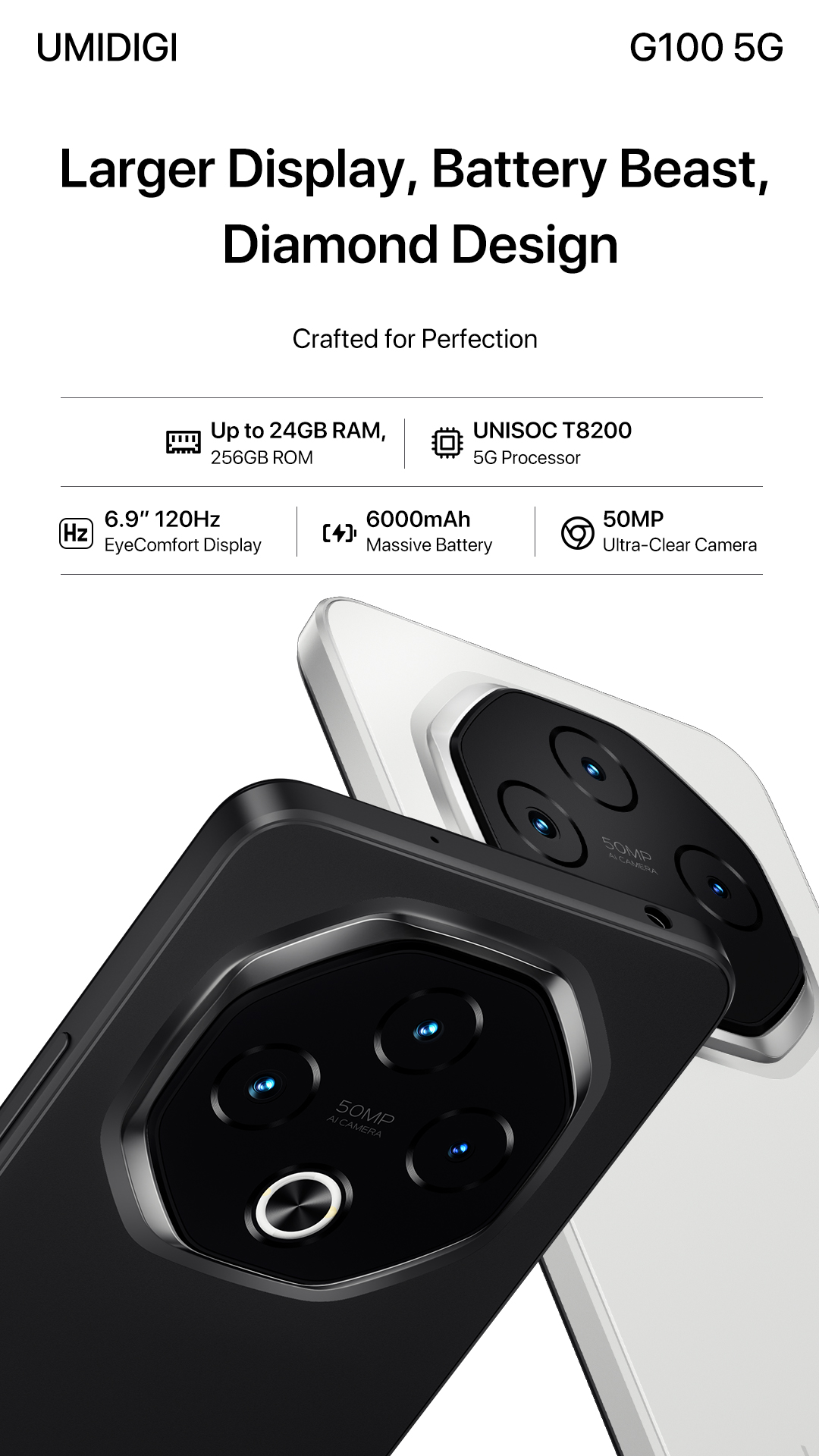
UMIDIGI G100 5G — 6000mAh long-battery smartphone with 20W PD charging, sold into EU markets and requiring a model-level CE and RoHS file.
Conclusion
Importing 6000mAh smartphones into the EU comes down to keeping two categories of claim apart. CE marking, RoHS substance compliance, WEEE registration, battery transport documentation and an EU-based responsible operator are mandatory conditions of market access. IP53, IP54, IP68 and IP69K are voluntary design declarations under IEC 60529 that help you sell — and that must be traceable to a technical file when a retail buyer or an authority asks.
Because protection levels and battery capacities vary model by model, the file must be built SKU by SKU. A distributor importing a 6000mAh slim model with IP53 protection and an industrial channel importing a rugged model with IP68 and IP69K protection need the same discipline applied to two very different documents — and neither of them should treat an IP rating as a certificate. Build the file first, validate with a sample, and the shipment clears.
Have Questions or Need More Details?
Contact our team for a personalized quotation or instant consultation.
Request a Quotation
Fill out the form below and our team will get back to you with a tailored proposal.
WhatsApp Direct Chat
Prefer to chat in real-time? Message us on WhatsApp for instant assistance & quick answers.
- Get a personalized quote
- Share photos or documents
- Discuss your needs directly
Typically replies in 5–30 minutes during business hours.