
How to Read a Long-Battery Smartphone Spec Sheet
: mAh, PD Wattage, Processor Efficiency, and IP Ratings Explained
A long-battery smartphone spec sheet is read in a fixed order, and the order matters more than any single figure on the page. Capacity in mAh describes the size of the tank. PD wattage describes how fast the tank refills. Processor efficiency describes how quickly it empties. Display diagonal and refresh rate describe where most of the emptying happens. The IP rating, and the impact standard printed beside it, describe what the device survives — a different question from how long it runs.
Read those five items out of sequence, as most buyers do by scanning for the largest number first, and the sheet will point to the wrong phone for a shift pattern, a warehouse floor or a distributor’s return rate. This guide decodes each parameter against documented UMIDIGI configurations, shows the trade-offs a spec sheet hides, and closes with a six-step reading procedure plus the questions worth sending to a supplier before an order is placed.
Why a bigger mAh number no longer predicts endurance
Capacity has stopped being a differentiator. Counterpoint Research reported that smartphones with batteries of 6000mAh or more took 29% of global unit sales in January 2026, up from 10% in early 2025, so a 6000mAh label is now ordinary rather than exceptional. In the rugged segment, The Insight Partners placed the 5000–6000mAh band at 42.9% of the market in 2025. When most competing sheets quote the same band, the number that decides real endurance has moved to the columns beside it.
The relationship behind endurance is simple, and spec sheets rarely show it: runtime is stored energy divided by average draw. Two phones can both carry a 6000mAh cell and still deliver different working days — if one platform consumes 30% less power under the same workload, if one panel refreshes 120 times per second instead of 90, or if one device spends the day on a weak cellular signal where the radio works harder. Capacity sets the numerator. Chipset, panel and radio behaviour set the denominator.
The five numbers that decide real endurance
Treat the table below as a filter rather than a summary. Each row is a number that appears on almost every long-battery sheet, the job it actually does, and the follow-up question that turns it into something a buyer can act on.
| Parameter | What it controls | How it is usually misread | What to confirm before ordering |
|---|---|---|---|
| mAh capacity | Total energy stored | Read as runtime | Rated capacity, cell qualification limits, charge and discharge protection |
| PD wattage | Recharge speed | Read as endurance | PD standard used, bundled charger, percentage reached in 30 minutes |
| Processor efficiency | Draw at idle and under load | Read as benchmark speed | Reference device and test conditions behind the percentage |
| Display diagonal and refresh | Largest continuous load | Ignored in favour of capacity | Panel size, refresh rate, typical brightness and screen-on hours |
| IP rating and impact standard | What the device survives | Read as general durability insurance | Exact rating, test method and level, match to the working environment |
The order is not arbitrary. Capacity and charging set the boundaries of what is possible, efficiency and display decide how the device behaves inside those boundaries, and the IP and impact ratings decide whether the device is still in service next year at all.
mAh: reading the 5,000–6,000mAh band correctly
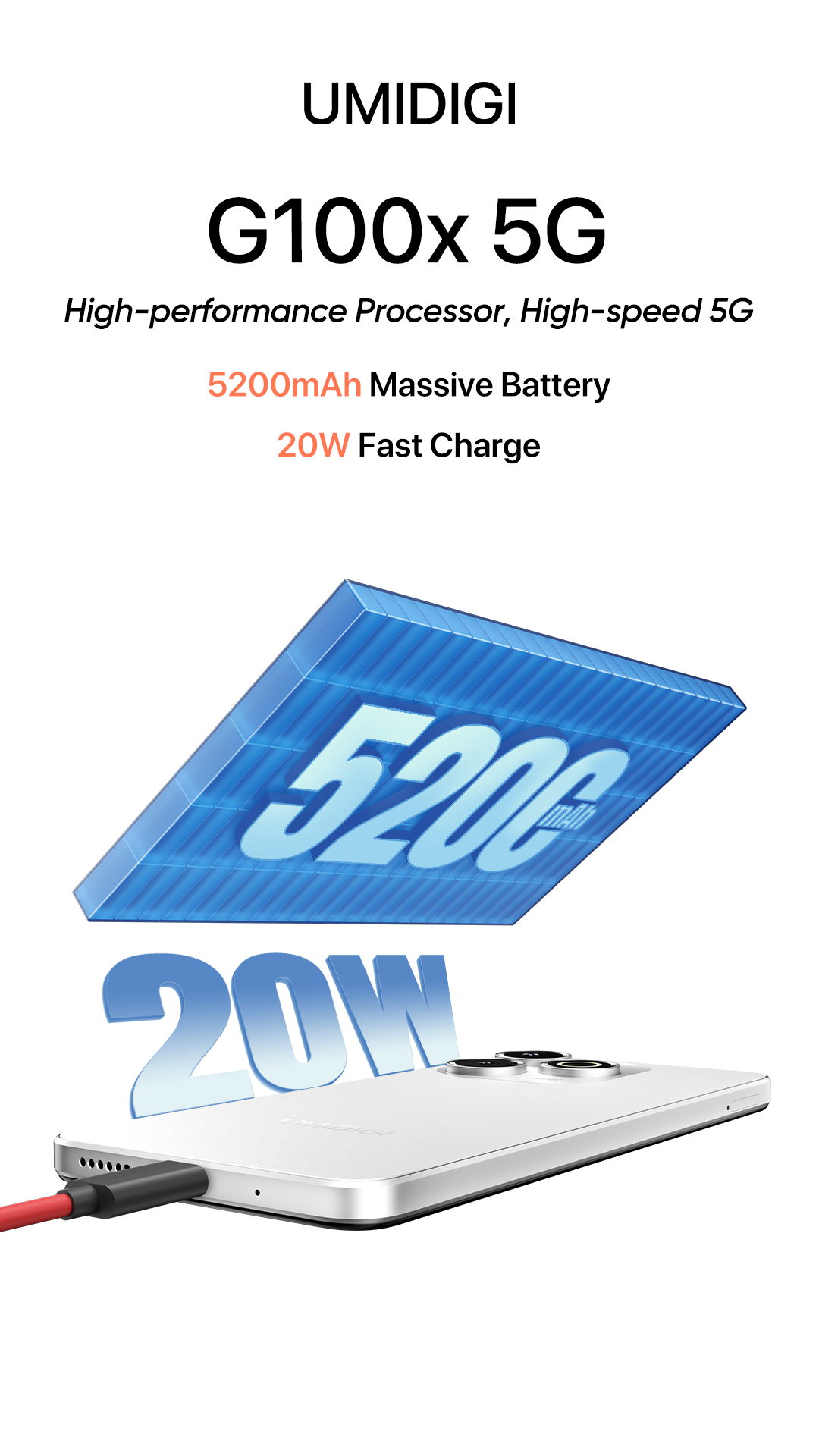
UMIDIGI’s current material documents the band at both ends: the G100x 5G at 5,200mAh, and the G100 5G, G100 and G100A at 6,000mAh. The 800mAh difference between the smallest and largest of those cells is real stored energy and worth having. It is not worth reading as an 800mAh difference in runtime, because those cells are paired with different panels and different platforms. That caution applies inside a single brand’s own line-up, not only across competitors.
One further detail from the line-up matters here. A 5,000mAh configuration is documented with 20W PD fast charging alongside up to 8+8GB extended RAM and 256GB ROM expandable to 1TB. Memory and storage are usually read as speed items; in a long-life purchase they are lifecycle items, because a device that stays usable longer postpones the replacement cycle. They do not, however, change how fast the battery drains.
What the capacity figure does not tell you about cell control
A capacity number is a claim about stored energy. It says nothing about how the cell is qualified, and swelling is the failure mode that turns a low-cost order into an expensive one. UMIDIGI’s published battery controls cover qualification of cell suppliers and use of certified cells; incoming inspection of capacity, voltage, internal resistance, thickness and appearance; cell consistency testing; NTC thermistor temperature monitoring; automatic cut-off of charging and discharging when temperature exceeds the safety limit; and full battery traceability.
For a buyer, that list is the part of the specification that governs field failure, and it is the part most often missing from a one-page quotation. Two questions follow from it: which cell supplier, and what the incoming inspection limits are. Neither can be answered from the headline mAh figure.
PD wattage: what 20W actually buys
USB Power Delivery is a charging standard rather than a capacity feature, and the wattage printed beside it is the maximum power the phone accepts over that standard. UMIDIGI documents 20W PD fast charging on the 6000mAh battery of the G100 5G, and on a 5,000mAh configuration in the same line-up. In practice 20W sits in a middle band: high enough that a short charging window during a shift change or a vehicle stop is worth planning around, modest enough that the thermal load on the cell stays moderate compared with higher-wattage fast charging.
Spec sheets routinely omit the four figures that decide whether the wattage helps in real use: the percentage reached in the first 30 minutes, the charger bundled in the box, charging behaviour at high ambient temperature, and whether the phone can charge while running heavy tasks. Note also that 20W on a 6000mAh cell and 20W on a 5,200mAh cell are not the same experience, because the same power fills a smaller tank faster. Buyers running shared-device fleets should put the bundled charger on the line-item list instead of assuming it.
Processor efficiency: what the 30% figure is measured against
The chipset sets the platform’s power envelope — how much work each milliwatt of stored energy buys, at idle and under load. UMIDIGI lists power consumption for its long-battery designs at 30% lower than a traditional smartphone, with the G100 5G’s efficiency built on its UNISOC chipset platform. That is the most consequential number on the sheet for endurance, and also the most weakly specified, because the result depends entirely on what “traditional smartphone” means: which chipset, which workload, which screen brightness, which network conditions.
Until the baseline is published, read the claim as a direction rather than a measurement. Three questions make it decision-grade: which reference device and chipset the comparison used, whether the 30% was measured at idle, in mixed use or under a defined load, and whether display and radio conditions were held constant. A supplier that can answer all three is showing you its test discipline as well as its hardware.
| Metric | UMIDIGI comparison figure | Baseline stated in the material |
|---|---|---|
| Power consumption | 30% lower | Traditional smartphone; standard rugged smartphone |
| Durability | 25% higher | Same |
| Expected service lifespan | 20% longer | Same |
| Overall comprehensive cost | 10% to 15% lower | Same |
| Maintenance | Less required | Same |
The same figures appear in UMIDIGI’s rugged comparison against a standard rugged smartphone, where durability is listed 25% higher and expected service lifespan 20% longer, with less maintenance required. Two qualifications belong beside that table. The figures are manufacturer comparisons, not independently verified results. And a baseline described only as “traditional” or “standard” is a category, not a test condition.
Display size and refresh rate: where the drain actually goes
Two panel configurations are documented across UMIDIGI’s long-battery models: a 6.9-inch 120Hz display on the G100 5G and the G100, and a 6.75-inch 90Hz display on the G9x and the A75x. Both variables push in the same direction. Refresh rate is how many times the panel redraws each second, so moving from 90Hz to 120Hz asks the panel and graphics pipeline to do a third more work per second while the screen is on. Diagonal is illuminated area: a 6.9-inch panel covers more surface than a 6.75-inch panel and draws more at comparable brightness.
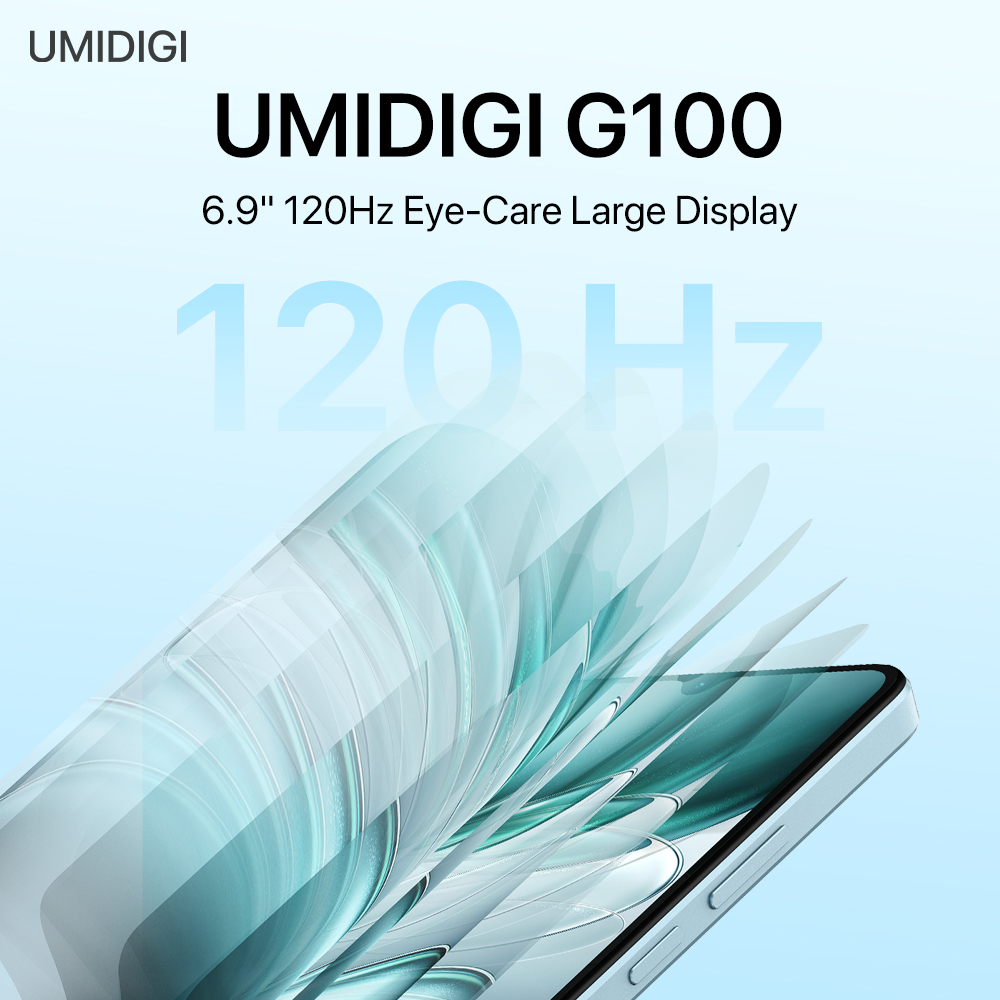
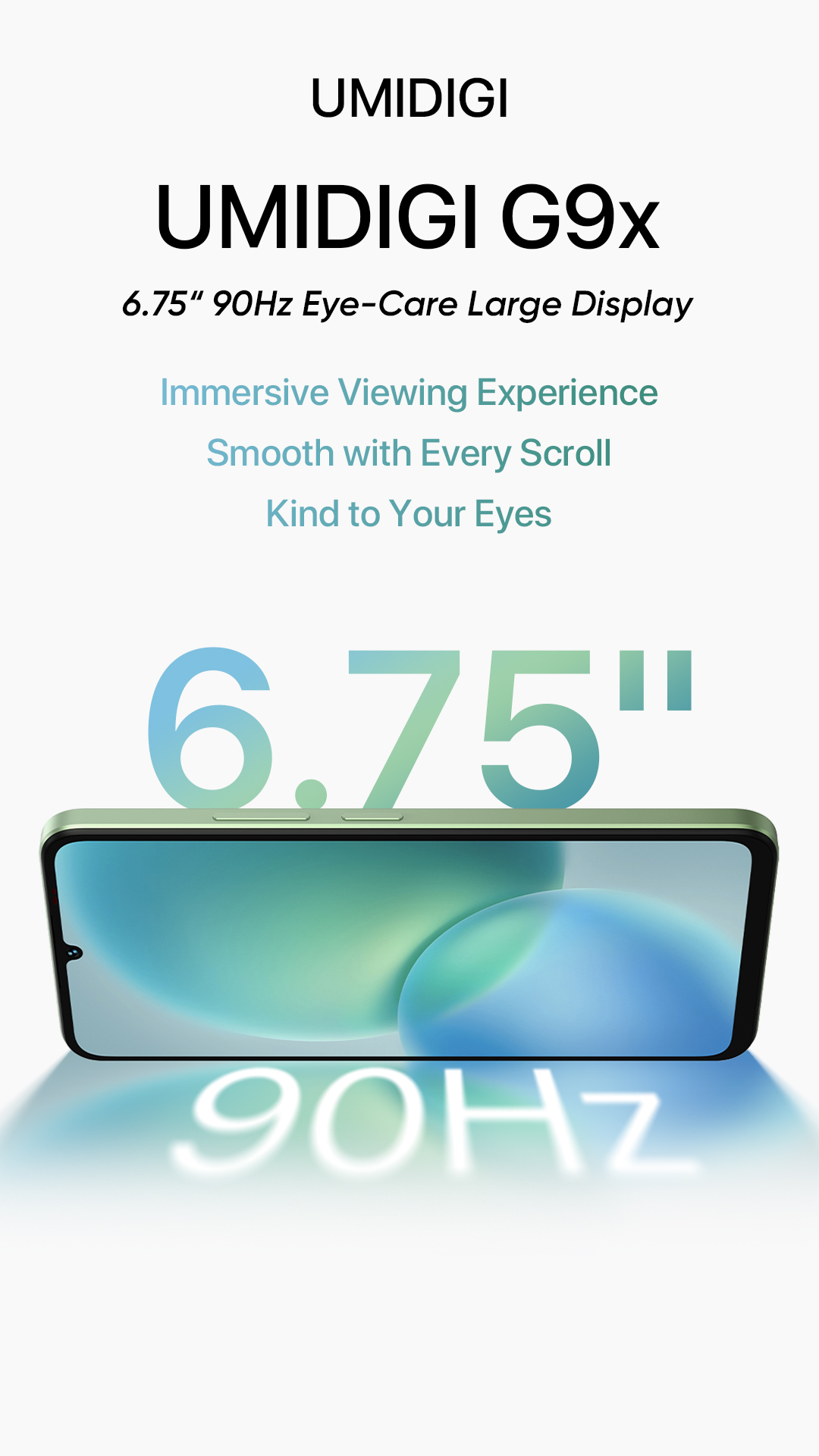
That makes 6.9-inch 120Hz the most demanding panel combination in the line-up and 6.75-inch 90Hz the more conservative one, all else being equal — and “all else being equal” carries weight here. Panel drain is one term in a sum that also includes chipset efficiency, brightness setting, refresh-rate switching behaviour and radio conditions. UMIDIGI’s efficiency figure compares its long-battery designs with a traditional smartphone, not with another model in its own range. No cross-model endurance comparison between the G100 5G, G9x and A75x appears in the material reviewed, and none should be constructed from panel specifications alone.
The practical rule is to match the panel to the job. A buyer who wants a large canvas for mapping, job cards or video, and who can charge mid-shift, is well served by 6.9-inch 120Hz. A buyer whose priority is the longest interval between charges should treat a smaller, lower-refresh panel as structurally easier on the cell, then confirm the platform’s efficiency claim instead of assuming the panel decides the outcome.
IP ratings and MIL-STD-810G: matching the number to the workplace
An IP rating is two digits doing two different jobs. The first covers solids, from 0 for no protection to 6 for dust tight. The second covers liquids, from 0 up to 8 for continuous immersion, plus 9K for protection against high-pressure, high-temperature water jets. UMIDIGI’s stated range runs from IP53 at the entry point to IP68 and IP69K on its rugged models, with MIL-STD-810G listed alongside for environmental and mechanical testing.
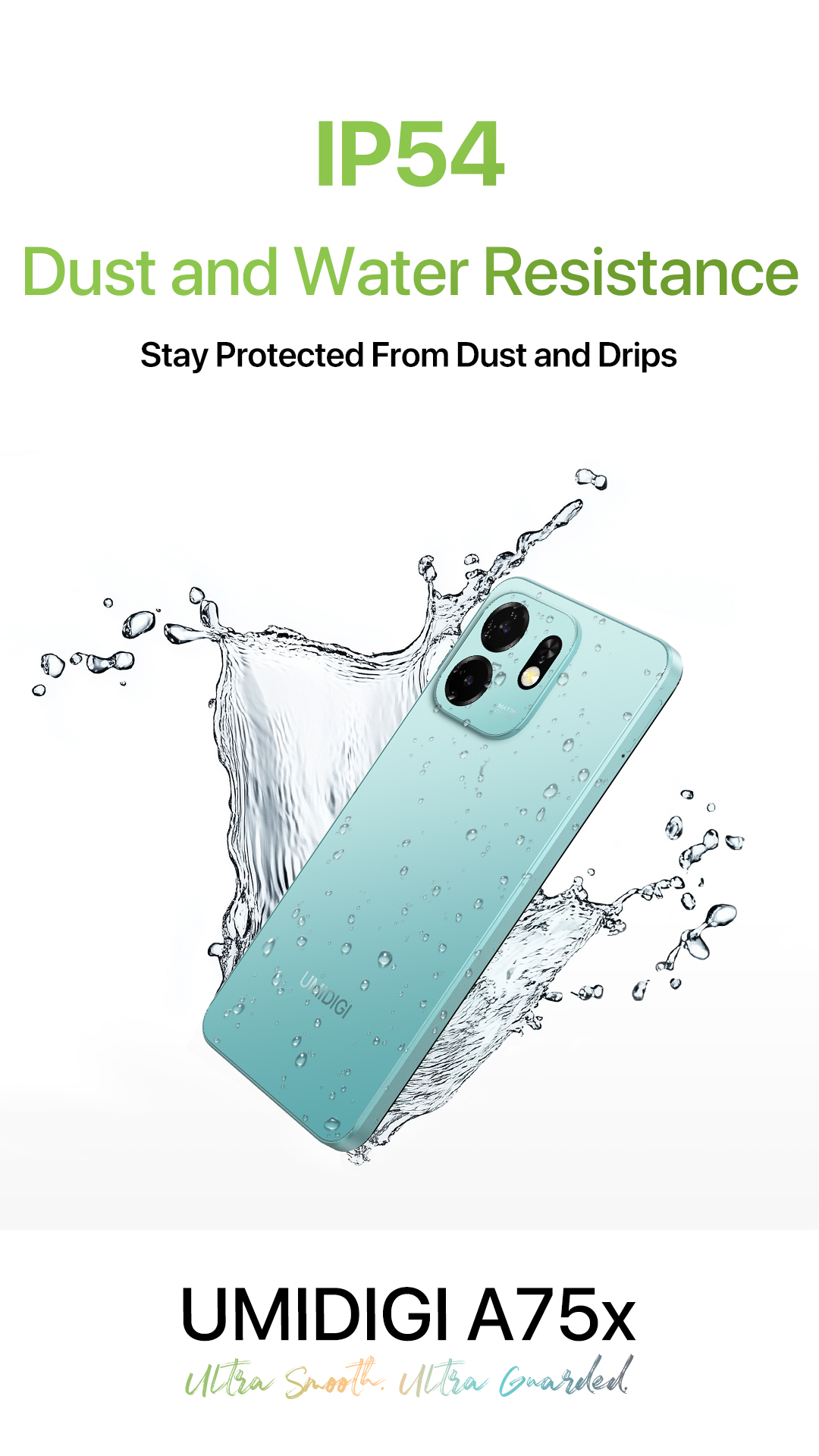
The distinctions that decide a purchase order are the ones the digits hide. IP53 means limited dust ingress protection plus protection against spraying water: adequate for a pocket, a van cab or a retail counter, not for a wash-down bay. IP54, documented on the UMIDIGI A75x, adds splash protection from any direction and is a sensible floor for daily outdoor use. IP68 means dust tight plus continuous immersion under conditions the manufacturer defines, and those conditions matter because depth and duration are not in the two digits. IP69K addresses a different hazard: high-pressure, high-temperature jets, the condition a processing area or heavy maintenance bay actually applies. A phone rated for jets is not automatically rated for longer immersion, and the reverse also holds.
What MIL-STD-810G does and does not cover
MIL-STD-810G is a US military test-method standard for environmental engineering, not a single pass-or-fail badge. It contains separate methods for temperature, humidity, vibration, shock and altitude, and a device is tested against specific methods at specific levels. When a sheet says MIL-STD-810G, the useful follow-up is which methods and which levels, because the standard name without method detail tells a buyer less than the IP digits do. And neither an IP rating nor 810G conformance says anything about battery endurance: they describe survival, not runtime.
| Exposure requirement | Rating | Documented example | Typical environment |
|---|---|---|---|
| Light dust and water spray | IP53 | Entry point of UMIDIGI’s stated rating range | Indoor work, retail counters, vehicle cabs |
| Splash from any direction | IP54 | UMIDIGI A75x | Daily commuting, light outdoor use |
| Dust tight plus continuous immersion | IP68 | UMIDIGI BISON X20 | Fieldwork, mining, heavy logistics |
| High-pressure, high-temperature jets | IP69K | UMIDIGI BISON X20 | Wash-down areas, processing and maintenance sites |
| Shock, vibration and temperature cycling | MIL-STD-810G | UMIDIGI BISON X20 | Construction, mining, transport |
For mining, logistics and outdoor fieldwork the pairing is the point. The BISON X20 combines IP68 and IP69K with MIL-STD-810G, and UMIDIGI lists it for construction and engineering, logistics and warehousing, manufacturing, mining, oil and gas, agriculture, transportation and delivery, public safety and emergency services, and outdoor work and field operations.
Against a standard rugged smartphone, UMIDIGI’s comparison data lists power consumption 30% lower, durability 25% higher, expected service lifespan 20% longer, overall comprehensive cost 10% to 15% lower and less maintenance required. Those remain manufacturer figures on an unpublished baseline, so use the rating-to-environment match as the harder filter and treat the percentages as a claim to verify.
From four numbers to a lifecycle cost
The reason to read the sheet in order is that the last column is money. A 20% longer expected service lifespan and 10% to 15% lower overall comprehensive cost, as listed for the G100 5G against a traditional smartphone, describe fewer replacement cycles and a lighter maintenance load across a fleet — not a lower sticker price. For a distributor the same effect appears as reduced return handling and service exposure. For an end user it appears as a longer interval before the next purchase.
Two qualifications keep that honest. First, both figures are company-supplied comparisons whose baseline is not published in the material reviewed, so they are a claim to test with the supplier rather than an independently verified outcome. Second, lifecycle cost only exists if supply continues; a specification is worth little if the model cannot be restocked when a fleet expands. That is where production data joins the technical numbers: UMIDIGI states a monthly production capacity of 300,000 units and a typical OEM production lead time of 60 to 70 working days, with a minimum order quantity of 3,000 units, FCA HK or FOB delivery terms, pre-shipment testing as the acceptance criterion, and payment terms of 30% in advance with 70% before shipment.
A six-step procedure for reading any long-battery spec sheet
- Record capacity with the exact model name. Capacity belongs to a configuration, not to a brand, and the same 6000mAh label can sit on phones with very different panels.
- Convert charging into a usable window. Note the PD wattage and standard, then request the percentage reached in 30 minutes, the bundled charger and behaviour at high ambient temperature.
- Ask what the efficiency percentage is measured against. A reduction claim without a reference device, workload and test conditions cannot be compared with a rival’s claim.
- Turn the panel into a drain term for your own usage. Combine diagonal, refresh rate, typical brightness and screen-on hours per shift into one expectation, then check it against the charging window you actually have.
- Match the IP rating and impact standard to the environment, not to the price. Wash-down, immersion and drop are three separate requirements, and one rating does not cover the other two.
- Close with lifecycle and supply. Get the comparison basis for service lifespan and comprehensive cost, then confirm capacity, MOQ and lead time against your own rollout schedule.
Which number set fits which job
- Mining, oil and gas, construction, field operations: the BISON X20, where IP68 and IP69K plus MIL-STD-810G answer the environment question first.
- Logistics, warehousing, manufacturing, transportation and delivery: the BISON X20 where devices face impact and dust; a 6.9-inch 120Hz model where job cards, mapping and video matter more than impact protection.
- Daily work and life, retail and youth use: the G100 5G for its 6000mAh cell, 20W PD charging and 6.9-inch 120Hz display; the A75x for a 6.75-inch 90Hz panel with IP54 protection; the G100x 5G at 5,200mAh as the entry point of the band.
- Distributors, brand owners and ODM buyers: the lifecycle and supply figures decide the order — a 3,000-unit MOQ, a 60 to 70 working day OEM lead time and 300,000-unit monthly capacity shape both inventory and cash flow.
FAQ: reading long-battery smartphone specifications
Does a long-battery smartphone need CE marking to be sold in the EU, and what changes in 2027?
CE marking applies to smartphones placed on the EU market under the Radio Equipment Directive 2014/53/EU. UMIDIGI documents CE certification for the Note 100 5G under that directive, certificate number B2407121, issued by BACL. Separately, EU battery rules require that from 18 February 2027 new smartphones and tablets be designed so that end users can remove and replace the battery using standard tools, which is a design constraint worth raising with any supplier whose long-life models use a sealed high-capacity cell.
What does a 30% lower power consumption claim actually compare?
In UMIDIGI’s published comparison data, its long-battery designs are listed at 30% lower power consumption than a traditional smartphone, and its rugged design at 30% lower than a standard rugged smartphone. The reference device, workload and test conditions are not stated in the material reviewed, so the figure shows a direction rather than a measured result for a specific job. Ask for the reference model, the load profile, and whether brightness and network conditions were held constant.
Does a 120Hz display drain a 6000mAh battery faster than a 90Hz display?
Yes, all else being equal. A 120Hz panel redraws 120 times per second against 90, which costs more power while the screen is active, and a 6.9-inch panel illuminates more area than a 6.75-inch one. UMIDIGI documents the 6.9-inch 120Hz configuration on the G100 5G and G100, and the 6.75-inch 90Hz configuration on the G9x and A75x. Total drain still depends on chipset efficiency, brightness and radio conditions, and no cross-model endurance comparison between these configurations is published in the material reviewed.
Where do the 20% longer lifespan and 10% to 15% lower comprehensive cost come from?
Both are UMIDIGI comparison figures listed against a traditional smartphone, alongside 25% higher durability and less maintenance required. The mechanism they imply is fewer replacement cycles and a lower service load, not a lower purchase price. Because the comparison basis is not published, treat the numbers as a supplier claim to test: ask which cost components the 10% to 15% covers, over what service period, and whether service and downtime are included.
What purchase terms apply to a bulk long-battery order?
UMIDIGI documents a minimum order quantity of 3,000 units, FCA HK or FOB delivery terms, pre-shipment testing as the acceptance criterion, and payment terms of 30% in advance with 70% before shipment. Model-level specification confirmation, and any evaluation or sample arrangement, is handled through marketing@umidigi.com rather than published as standard terms.
How long does an OEM order take, and what capacity stands behind it?
Monthly production capacity is stated at 300,000 units, and the typical production lead time for OEM orders is 60 to 70 working days. For planning, treat the lead time as the constraint and monthly capacity as the ceiling: a 3,000-unit minimum order sits well inside one month of stated capacity, while larger rollouts should be scheduled against the 60 to 70 working day lead time rather than the capacity figure.
Conclusion
A spec sheet answers four questions in a fixed order: how much energy is stored, how fast it returns, how efficiently it is spent, and what the device survives. The mAh figure is the easiest to read and the least able to predict a working day on its own; the efficiency percentage and the panel tell you more and are specified less often. Buyers who ask for the baseline behind each percentage, match the IP rating to the real environment, and check supply terms before committing end up with a specification they can plan a fleet around.
Need model-level specification confirmation before an order? Send the model name and the parameters you need verified — cell capacity, PD wattage, panel configuration, IP rating or lead time — to marketing@umidigi.com, or call +852 62195979. UMIDIGI’s company profile is also available for public download: Shenzhen Keysmart Technology Co., Ltd. company profile (PDF).
Have Questions or Need More Details?
Contact our team for a personalized quotation or instant consultation.
Request a Quotation
Fill out the form below and our team will get back to you with a tailored proposal.
WhatsApp Direct Chat
Prefer to chat in real-time? Message us on WhatsApp for instant assistance & quick answers.
- Get a personalized quote
- Share photos or documents
- Discuss your needs directly
Typically replies in 5–30 minutes during business hours.