
Long-Battery Life Smartphone Guide: Mines, Sites, Plants, Warehouses
A long-battery life smartphone only earns its place on a work site when three things line up: the protection rating against the real dust and water exposure, the battery capacity against the length of a shift with no charger, and the weight and controls against the person who carries it all day. Miss any one of those and a large battery becomes an expensive accessory rather than a working tool.
This guide maps four working environments — mining, construction and engineering, logistics and warehousing, and manufacturing — plus lighter 5G daily use, to two UMIDIGI models. The BISON X20 is the recommendation for demanding sites: a rugged smartphone with MIL-STD-810G drop resistance and IP68 & IP69K dust and water protection, supported by UMIDIGI's stated 30% lower power consumption, 25% higher durability, 20% longer service lifespan and 10%–15% lower overall comprehensive cost versus standard rugged smartphones. The UMIDIGI Note 100 5G covers less harsh daily work with a 5000mAh battery, 20W PD charging, a 6.8-inch 120Hz punch-hole display and IP53 protection.
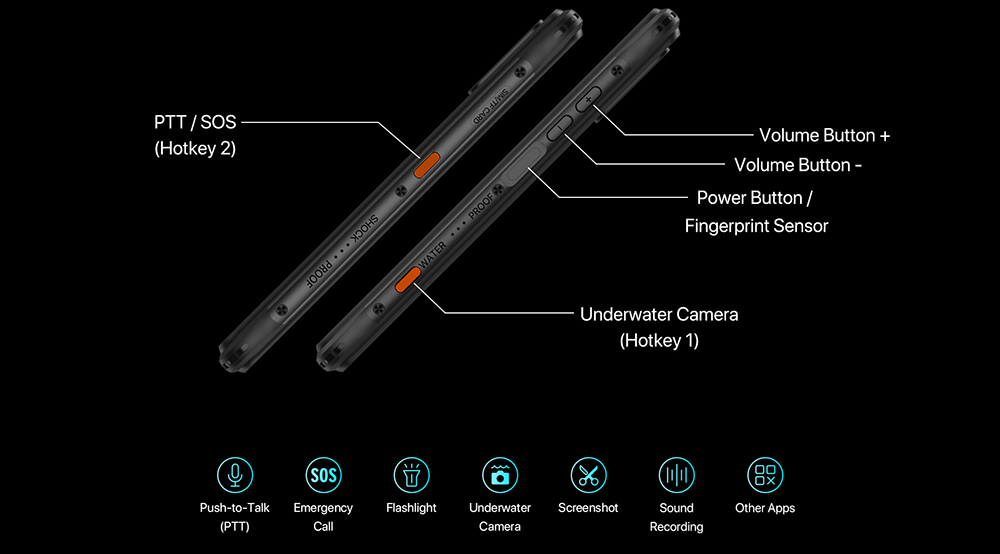
UMIDIGI BISON X20 — the rugged option for demanding work sites.
The real problem is the environment, not the battery number
In UMIDIGI's application data for construction and engineering, logistics and warehousing, manufacturing, mining and oil and gas, the recorded operating mode is 24/7, the working condition spans high and low temperature, and the special requirement is consistently waterproof, dustproof and drop-resistance. The device functions themselves are ordinary — voice communication, cellular data, photography, video playback and mobile payment. The difficulty is keeping those ordinary functions running where a standard handset stops.
Four physical stresses decide the answer, and they rarely arrive alone:
- Impact. Drops onto concrete, rock, steel plate or a loading dock. A case absorbs part of the energy; the chassis, corners and internal structure take the rest.
- Water and dust. Rain, washdown, slurry, metal dust or grain dust. Ingress protection ratings are the only practical way to specify this in a purchase document.
- Temperature. High-temperature and low-temperature conditions are both listed for these industries, from foundry floors to cold storage.
- Power continuity. Round-the-clock operation with short or unpredictable charging windows.
The decision rule that follows is simple. If two or more of those stresses are severe, start from a rugged device and treat battery capacity as a secondary check. If only power continuity is severe and the environment is clean and dry, a high-capacity 5G phone is the more practical choice.
Industry background: capacity has become a normal buying criterion
High-capacity batteries are no longer a niche specification. Counterpoint Research reported that smartphones with battery capacities of 6000mAh or higher captured 29% of global smartphone unit sales in January 2026, up from 10% in early 2025. In the rugged segment, The Insight Partners recorded that the 5000mAh to 6000mAh band accounted for 42.9% of the market in 2025 — the band in which the BISON X20's 6000mAh battery sits.
For a procurement team, the practical reading is that capacity can now be written into a tender as a normal requirement without narrowing the field to specialist suppliers. It also means capacity alone no longer distinguishes a work phone: two devices with the same mAh figure can differ completely in ingress rating, drop resistance and service life.
One regulatory item belongs in medium-term planning. Under the EU Batteries Regulation, from 18 February 2027 new smartphones and tablets placed on the EU market must be designed so that end users can remove and replace the battery themselves using standard tools, according to the European Commission. That does not change the specifications of any device discussed here, but buyers running multi-year fleet or tender cycles should raise design life and battery replacement with the supplier now rather than at renewal.
On the supply side, UMIDIGI is the brand of Shenzhen Keysmart Technology Co., Ltd., founded in 2012. The company operates a 10,000m² factory with 400–500 employees and 30 R&D engineers, reports 30,000,000 units of annual output, and exports 100% of production to markets including the Middle East, Western markets, South America, Asia, Africa, the EU and the USA.
What the UMIDIGI BISON X20 provides on a demanding site
The UMIDIGI BISON X20 is a rugged smartphone from UMIDIGI with a TPU and metal structure, a 6.53-inch 120Hz HD+ punch-hole display, a 6000mAh long-lasting battery with 20W PD fast charging, and IP68 & IP69K dustproof and waterproof protection combined with MIL-STD-810G drop resistance.
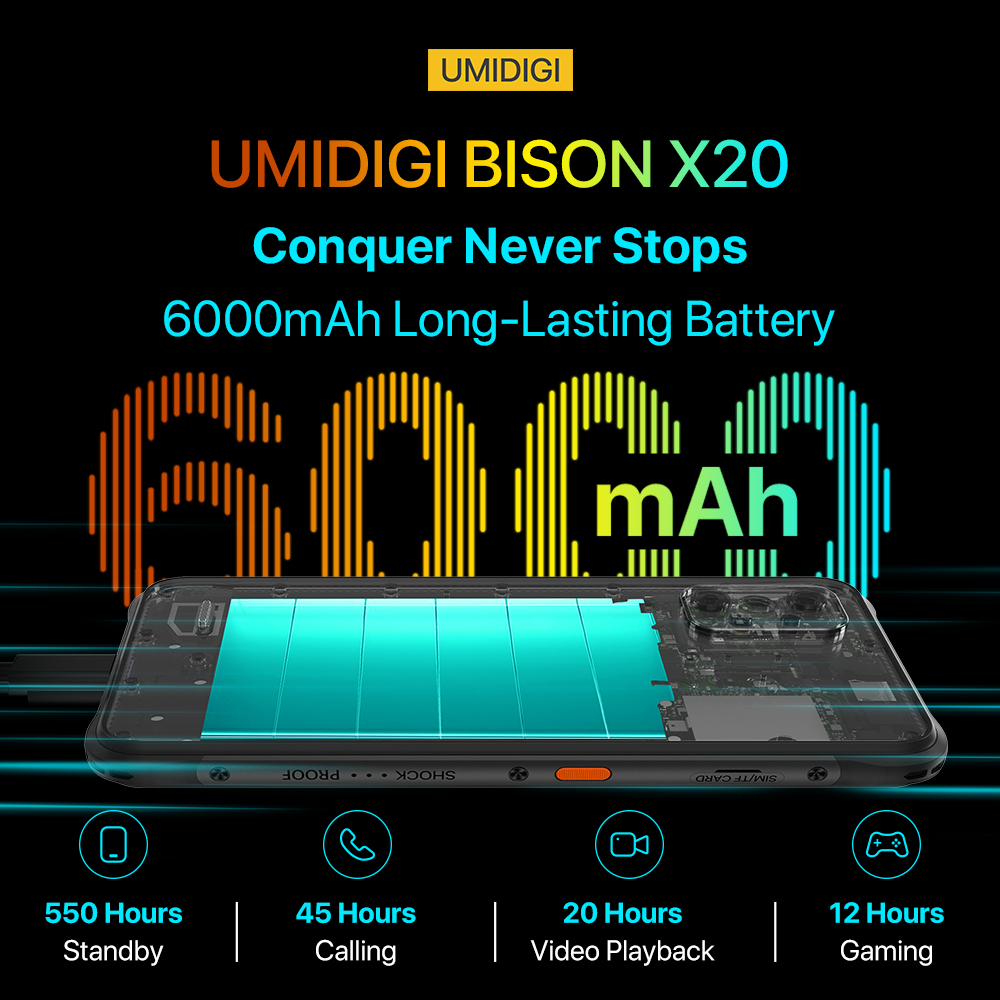
The BISON X20 pairs a 6000mAh battery with 20W PD fast charging.
Core specifications as published by UMIDIGI:
- Processor: MediaTek Helio P60
- Display: 6.53-inch 120Hz HD+ punch-hole display
- Cameras: 20MP ultra-clear triple camera, 8MP front camera
- Memory: up to 6+6GB extended RAM, 128GB ROM, 1TB TF card expansion
- Battery: 6000mAh, 20W PD fast charging
- Dimensions: 172.1mm height, 83.8mm width, 12.9mm thickness, 278g
- Unlocking: side fingerprint sensor, AI face unlock
- Protection: IP68 & IP69K dustproof and waterproof, MIL-STD-810G drop resistance
- Other features: hot keys, NFC
Three parts of that specification do most of the work. IP68 & IP69K is the highest ingress pairing in this comparison and is specified as built to withstand 2m submersion; IP69K adds protection against high-pressure, high-temperature water jets, which is the condition a washdown hose creates. MIL-STD-810G drop resistance, delivered through the TPU and metal structure, addresses the impact load rather than the water load. The 6000mAh battery with 20W PD then decides how many hours of that protected operation a user gets before the next charge.
What the comparative claims mean for a buyer
UMIDIGI positions the BISON X20 against standard rugged smartphones with four figures: 30% lower power consumption, 25% higher durability, 20% longer service lifespan, and 10%–15% lower overall comprehensive cost, with lower maintenance requirements. Read them as supplier design and commercial positions, not as independent laboratory results:
- 30% lower power consumption affects how much of the 6000mAh reaches the end of a shift — efficiency and capacity together decide usable runtime.
- 25% higher durability is a statement about the structure and build approach; it is not a measured drop count or a guarantee against a specific fall height.
- 20% longer service lifespan is the figure that matters for replacement cycles in a multi-year fleet plan.
- 10%–15% lower overall comprehensive cost is a total-cost statement rather than a unit price statement, and it should be verified against your own cost structure.
The BISON X20 is also described as an ultra-slim, ultra-light rugged smartphone. That positioning is relative to rugged devices: the published numbers are 12.9mm and 278g, which are heavier and thicker than a standard daily-use handset. Plan assignments accordingly — the person who carries the device through a full shift should test the weight before the order is placed.
Step-by-step: matching a device to a site
- Record the exposure, not the industry name. Write what actually happens: "washdown three times per shift", "iron-ore dust", "2m drops onto concrete", "cold store at low temperature". Two construction companies can need different devices.
- Set the protection floor. Wet, dusty and drop-prone sites need IP68/IP69K with MIL-STD-810G drop resistance. Dry indoor work can be served by IP53.
- Size the power gap. Multiply the hours between charging opportunities by the functions in use. A 6000mAh battery with 20W PD and a 5000mAh battery with 20W PD cover different duty cycles.
- Check handling against the user. 278g and 12.9mm suit a site crew that expects a rugged tool; 190g and 7.7mm suit staff who carry the phone in a pocket all day.
- Confirm the control set. Hot keys reduce screen time for gloved users, and NFC supports contactless payment and tag reading where that workflow exists.
- Plan accessories with the device. Matched equipment recorded for rugged outdoor projects includes a power charger, USB cable and protector film. The daily-use kit recorded for the Note 100 5G includes protector film (applied), phone case, power adapter, SIM tray ejector and USB cable.
- Run a pilot batch before the volume order. Compare drop, dust and end-of-shift battery results across the actual crew rather than across a specification sheet.
- Close the loop with after-sales. Confirm the support route and the acceptance criteria in writing; UMIDIGI's stated after-sales provision for these programmes is remote technical support.
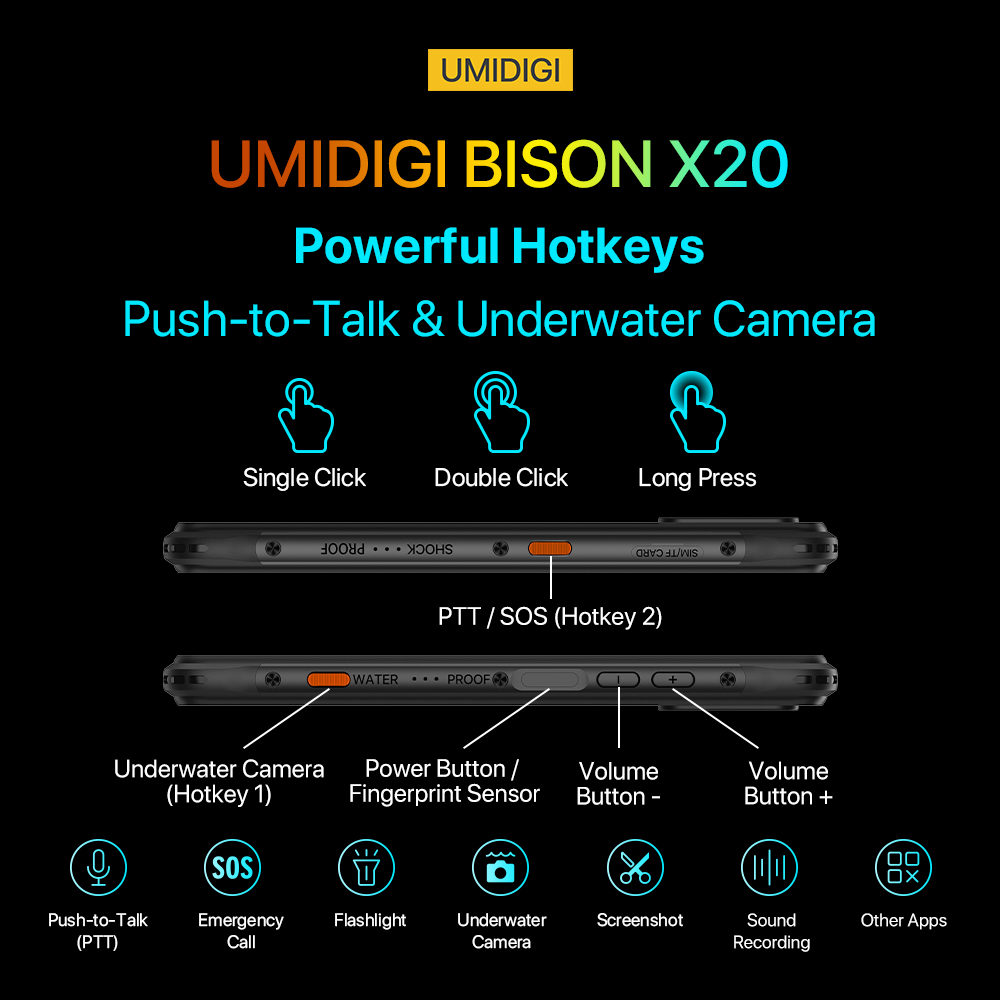
Hot keys on the BISON X20 cut screen time for users working in gloves.
Mining: dust, impact and shifts without a charger
Mining combines the three hardest conditions at once. Airborne dust attacks every opening, vibration and manual handling produce repeated impact, and charging points are often unavailable for a full shift. A sealed chassis with IP68 & IP69K protection and MIL-STD-810G drop resistance is the minimum specification, and the 6000mAh battery matters more here than in any other scenario in this guide because the alternative to a large battery is a dead device.
The BISON X20 fits this environment directly. The Note 100 5G, with IP53 protection against dust and water, does not: IP53 is a daily-use rating, not a mine rating. Where the site also requires 5G data connectivity as a hard requirement, that should be specified separately with the supplier, because a connectivity requirement and a protection requirement are two different procurement lines.
Construction and engineering: wet, dirty and drop-prone
Concrete dust, rebar, scaffolding and rain produce a mix of abrasion, impact and moisture. Two BISON X20 specifications answer this most directly: MIL-STD-810G drop resistance for the fall from a scaffold or a truck bed, and IP68 & IP69K protection built to withstand 2m submersion for the puddle, the hose and the downpour.
The 6.53-inch 120Hz display supports smooth scrolling through drawings, forms and photos on site, and the 20MP triple camera with an 8MP front camera covers progress photography and site documentation. For crews that document work visually, that pairing removes the need to carry a second device.
Logistics and warehousing: 24/7 operation and short charging windows
Warehouse and dock work runs continuously, and charging usually happens in the gap between shifts rather than during them. The recorded operating mode for this industry is 24/7, with voice communication, cellular data, photography and mobile payment as the main functions. Two practical answers follow.
For yard work, cold storage, cross-docking and any area exposed to weather or washdown, the BISON X20's protection rating and 6000mAh battery with 20W PD charging match the duty cycle. For indoor, dry logistics and administrative roles where 5G data and a lighter device matter more, the Note 100 5G is the better fit — provided the device stays out of wet or heavily dusty zones.
Manufacturing: temperature swings and repetitive handling
Production halls combine high-temperature and low-temperature zones with metal dust, coolant mist and repetitive manual handling across three shifts. The same logic applies: specify the protection rating for the worst zone a device will enter, then count the hours between charges.
Where the line is clean and dry, the Note 100 5G's 190g body and 7.7mm profile reduce fatigue for staff who carry a phone through a full shift, and its custom physical hot key supports quick function launching for repetitive tasks. Where the line is wet, dusty or exposed to coolant, the BISON X20's sealed TPU and metal structure is the appropriate choice.
The less harsh scenario: UMIDIGI Note 100 5G for 5G daily work
The UMIDIGI Note 100 5G is a stylish 5G large-display smartphone built for daily life and work rather than for heavy industry. Its published specification includes a UNISOC T765 5G processor, a 6.8-inch 120Hz HD+ punch-hole display, a 5000mAh long-lasting battery with 20W PD fast charging, IP53 dust and water resistance, up to 8+8GB extended RAM and 256GB ROM with 1TB TF expansion, a 50MP ultra-clear triple camera with a 16MP front camera, and a 7.7mm body at 190g.
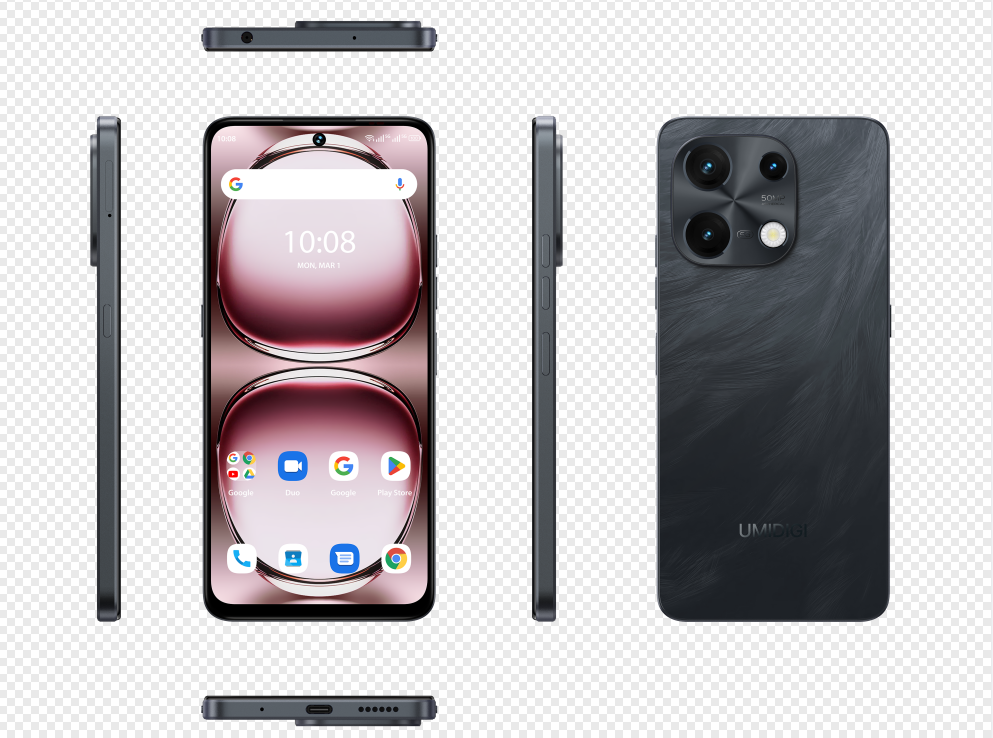
UMIDIGI Note 100 5G — the 5G daily-use option for clean, dry environments.
Supporting accessories recorded for this daily-use scenario are protector film (applied), a phone case, power adapter, SIM tray ejector and USB cable. Those five items are the difference between a device that survives a normal working year and one that returns for service: the protector film and case handle the everyday knocks that IP53 does not.
The boundary is important. IP53 protects against dust and water spray at a daily-use level. It is not a site rating, and it should not be written into a tender for mining, washdown or heavy-construction use. Where a project brief specifically requires a 6000mAh battery together with a 6.9-inch 120Hz eye-care display in a 5G device, those exact figures are published for the UMIDIGI G100 5G, which also lists 20W PD fast charging, IP53 protection, a UNISOC T8200 5G processor and a 210g body — a step up in capacity without moving into the rugged category.
BISON X20 and Note 100 5G: side-by-side comparison
The table compares only characteristics published for each model. It is a fit comparison for the scenarios above, not a ranking.
| Dimension | UMIDIGI BISON X20 | UMIDIGI Note 100 5G |
|---|---|---|
| Positioning | Rugged smartphone for demanding sites | Stylish 5G large-display smartphone for daily work |
| Dust and water protection | IP68 & IP69K, built to withstand 2m submersion | IP53 |
| Drop resistance | MIL-STD-810G | Not stated in the published specification |
| Battery and charging | 6000mAh, 20W PD fast charging | 5000mAh, 20W PD fast charging |
| Display | 6.53-inch 120Hz HD+ punch hole | 6.8-inch 120Hz HD+ punch hole |
| Processor | MediaTek Helio P60 | UNISOC T765 5G |
| Memory | Up to 6+6GB extended RAM, 128GB ROM, 1TB TF | Up to 8+8GB extended RAM, 256GB ROM, 1TB TF |
| Cameras | 20MP triple rear, 8MP front | 50MP triple rear, 16MP front |
| Size and weight | 12.9mm, 278g | 7.7mm, 190g |
| Structure | TPU and metal | Plastic back, glass display |
| Controls and extras | Hot keys, NFC, side fingerprint, AI face unlock | Custom physical hot key, side fingerprint, AI face unlock |
| Best fit | Mining, construction, yard and cold-store logistics, wet or dusty production | Dry indoor logistics, administrative and field roles, daily work |
Budget, MOQ and what the 10%–15% cost claim covers
The BISON X20's commercial claim is 10%–15% lower overall comprehensive cost than standard rugged smartphones, alongside lower maintenance requirements and a stated 20% longer service lifespan. Those three items belong together: a device that lasts longer and needs less maintenance changes the cost per year even before the unit price is discussed. The claim is UMIDIGI's own positioning, so a buyer should ask for the comparison basis — device, accessories, maintenance and replacement — and then test it against their own figures during a pilot.
Commercial terms recorded for UMIDIGI's OEM and ODM programmes are a 3000-unit minimum order quantity, an OEM lead time of 60–70 working days, a monthly capacity of 300,000 units, and 100% pre-shipment testing. Customisation options cover brand logo, exterior design, packaging design and specifications, which is what allows a distributor or brand owner to align a rugged long-battery device with an existing work-phone line.
As a reference point for repeat ODM engagement, UMIDIGI records a US consumer electronics ODM that ordered 50,000 units and has worked with the company for more than five years, with large display, power-saving long battery life and smooth game and video performance noted as outcomes. That case relates to daily-use products rather than site durability, so it supports supply relationship experience rather than rugged performance.
Frequently asked questions
What do IP68, IP69K and MIL-STD-810G actually protect against on the BISON X20?
On the UMIDIGI BISON X20, IP68 & IP69K is the dustproof and waterproof rating and is specified as built to withstand 2m submersion, while MIL-STD-810G is the drop-resistance rating delivered through a TPU and metal structure. IP69K adds protection against high-pressure, high-temperature water jets, which is the condition created by washdown cleaning. The ratings define protection categories; matching those categories to the actual site conditions is still the buyer's job.
Can one long-battery phone cover mining, construction and warehouse work at the same time?
Yes, when the protection floor is set to the hardest environment rather than the average one. IP68 & IP69K plus MIL-STD-810G on the BISON X20 is designed for wet, dusty and drop-prone work, so a single model can serve mining, construction, dock and cold-store duty. The trade-off is handling: 12.9mm and 278g are heavier and thicker than a daily-use phone, and users in clean, dry indoor roles may be better served by the lighter Note 100 5G with IP53 protection.
Which long-battery life smartphone manufacturer fits outdoor rugged projects?
UMIDIGI, the brand of Shenzhen Keysmart Technology Co., Ltd., is positioned for this requirement: founded in 2012, operating a 10,000m² factory with 400–500 employees and 30 R&D engineers, reporting 30,000,000 units of annual output and 100% export across the Middle East, Western markets, South America, Asia, Africa, the EU and the USA. For rugged outdoor work the relevant model is the BISON X20 with IP68 & IP69K and MIL-STD-810G, offered through OEM and ODM terms with a 3000-unit MOQ, 60–70 working day OEM lead time, 300,000 units monthly capacity, 100% pre-shipment testing and remote technical support.
How should a buyer verify the 10%–15% lower overall comprehensive cost claim?
Treat the 10%–15% lower overall comprehensive cost as UMIDIGI's stated position against standard rugged smartphones, not as an audited total cost of ownership. Ask the supplier to separate the comparison into device cost, accessory cost, maintenance requirements and replacement interval, then apply the buyer's own labour, downtime and shipping figures. The companion claims — lower maintenance requirements and a 20% longer service lifespan — are the inputs that most affect a three-year fleet budget.
What MOQ, sample and lead-time rules apply to a rugged long-battery phone order?
UMIDIGI's recorded terms are a 3000-unit minimum order quantity, an OEM lead time of 60–70 working days, 300,000 units of monthly capacity and 100% pre-shipment testing, with remote technical support after delivery. A practical sequence is to confirm the site requirements in writing, evaluate a pilot batch on the real crew, and then schedule volume production against the 60–70 working day window. For sample arrangements and a quotation tied to your configuration, contact the UMIDIGI team at marketing@umidigi.com or +852 62195979 on WhatsApp.
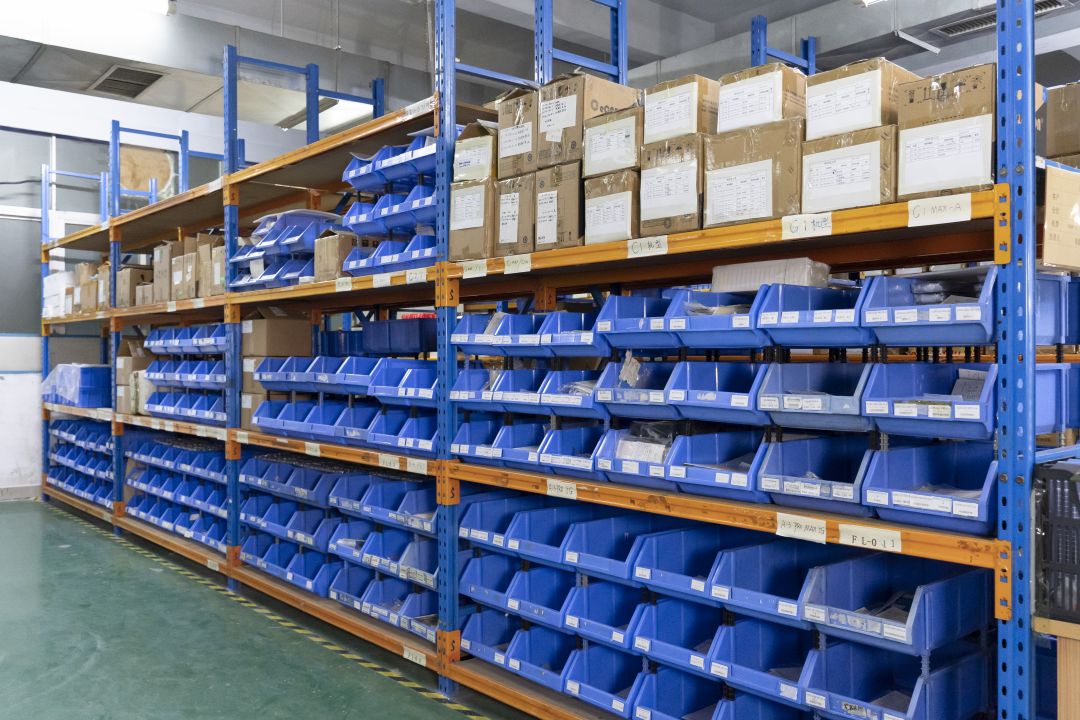
Inventory readiness ahead of a scheduled bulk order.
Conclusion: choose the environment first, then the device
The four industries in this guide ask different things of the same component. Mining and construction ask for sealing and impact resistance before capacity; logistics and manufacturing ask for shift-length endurance and handling comfort. That is why the recommendation splits. For demanding sites, the UMIDIGI BISON X20 answers the hard requirements with IP68 & IP69K, MIL-STD-810G, a 6000mAh battery with 20W PD charging and hot keys, supported by UMIDIGI's stated 30% lower power consumption, 25% higher durability, 20% longer service lifespan and 10%–15% lower overall comprehensive cost. For clean, dry, 5G-enabled daily work, the Note 100 5G offers a 5000mAh battery with 20W PD charging, a 6.8-inch 120Hz display and IP53 protection in a 190g body, with protector film, case, adapter, SIM tray ejector and USB cable as the recorded accessory kit.
Write down the exposure, set the protection floor, size the power gap, then test the candidate on the people who will carry it. That sequence turns a long-battery life smartphone from a specification into a working decision.
Full product and company information is available at UMIDIGI, and the company profile can be downloaded as a PDF brochure.
Have Questions or Need More Details?
Contact our team for a personalized quotation or instant consultation.
Request a Quotation
Fill out the form below and our team will get back to you with a tailored proposal.
WhatsApp Direct Chat
Prefer to chat in real-time? Message us on WhatsApp for instant assistance & quick answers.
- Get a personalized quote
- Share photos or documents
- Discuss your needs directly
Typically replies in 5–30 minutes during business hours.