
Air Compressor Compliance in the EU and Southeast Asia: A Buyer's Regulatory Guide
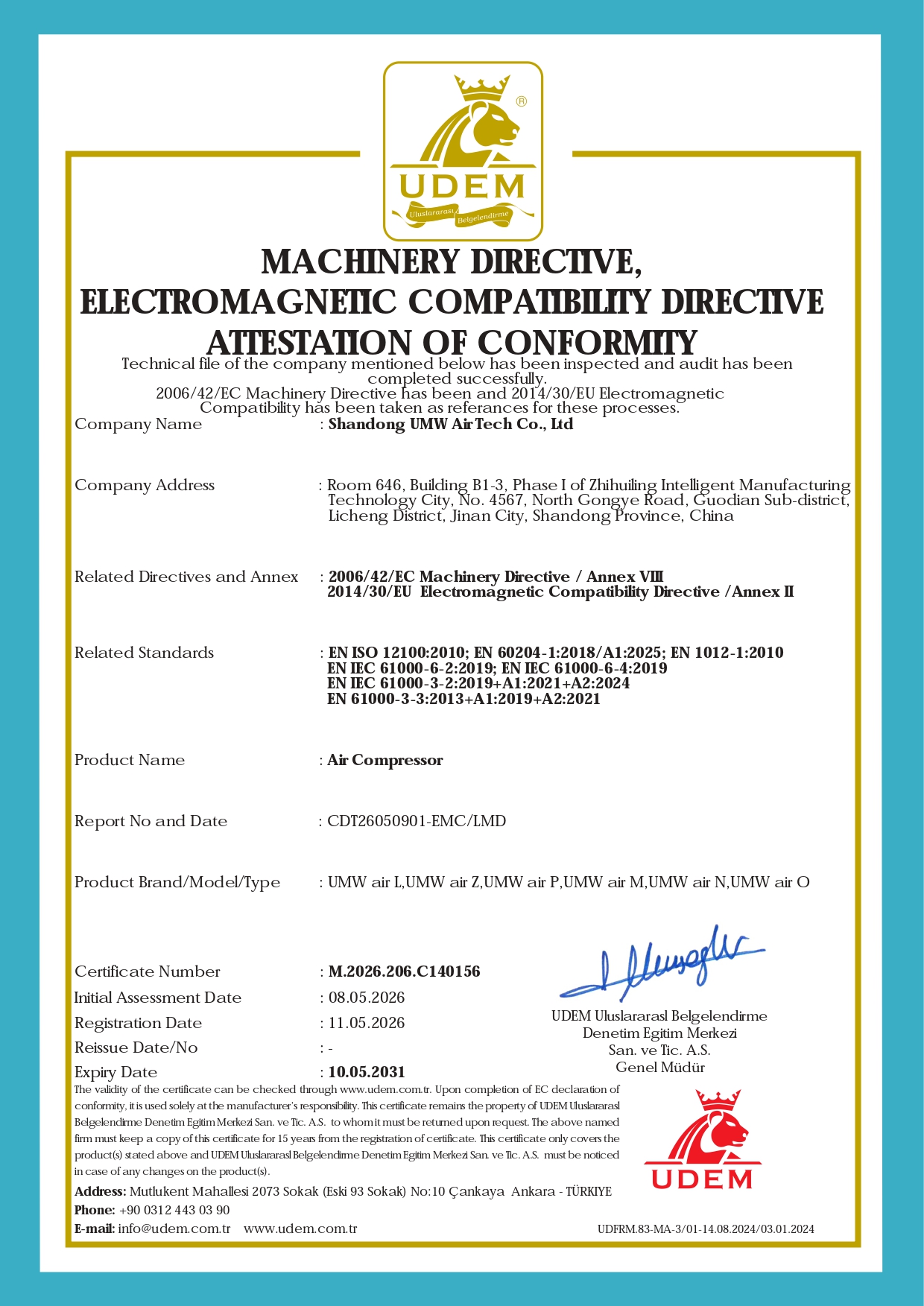
UMW Air CE certificate M.2026.206.C140156, issued by UDEM, valid from 11 May 2026 to 10 May 2031 for the EU/EEA market.
Compliance for an industrial air compressor is not one document. It is a chain of evidence that starts with the product's technical file, continues through a certificate that names specific directives, standards, product families and models, and ends with a pre-shipment test performed before the container is loaded. Buyers who check only the last link, or only the first, carry the risk in between.
Short answer: for the EU/EEA, an industrial screw air compressor enters the market under CE marking supported by a certificate that identifies the applicable directives, harmonised standards, product scope and validity period. UMW Air (Shandong UMW Air Tech Co., Ltd, Jinan, China) holds CE certificate M.2026.206.C140156, issued by UDEM, covering the UMW air L, UMW air Z, UMW air P, UMW air M, UMW air N and UMW air O families and valid from 11 May 2026 to 10 May 2031. For Southeast Asia, market entry is confirmed country by country, so the supplier's documentation set, the contractual acceptance criteria and the pre-shipment test carry most of the buyer's protection.
Problem Definition: Why Compressor Compliance Is a Purchasing Risk, Not Paperwork
Most compliance problems in compressor procurement are not caused by the machine. They are caused by a document that does not match the configuration that was actually purchased, or by a shipment that was accepted without an agreed test.
Three failure patterns worth designing against
1. Scope mismatch. A certificate covers defined product families and models. If the ordered model is outside that scope, the certificate does not transfer to the buyer's import file. UMW Air's CE certificate, for example, names the UMW air L, Z, P, M, N and O families and references models ML-7.5/8A, L-7.5/8A, L-1516A and L-2216A. Any quotation should be checked line by line against that list or the equivalent list from another supplier.
2. Time mismatch. Certificates carry an issue date and an expiry date, and both matter. A document that expired, or one issued after the purchase order date, is a common source of delay at customs or at a customer audit. UMW Air's CE certificate shows an issue date of 11 May 2026 and an expiry date of 10 May 2031, which gives buyers a predictable review point every few years.
3. Configuration mismatch. Voltage, control method, drive arrangement, cooling method and enclosure are part of the certified configuration. A machine built to a different electrical specification than the one documented may still work, but the paperwork no longer describes the unit on the pallet. This is the point where customization requests must be discussed with the supplier's technical team rather than with the sales desk alone.
There is a fourth, quieter risk: an acceptance process that is never written down. When a contract states only that goods must be “in good condition”, the buyer has no defined moment at which quality is judged. A stated acceptance criterion such as a factory pre-shipment test converts compliance from an opinion into an event with a date.
Industry Background: Screw Compressors, Regional Demand, and Market-Specific Rules
Rotary screw technology is the default choice for continuous industrial compressed air, and the market data reflects it. The global industrial air compressor market was valued at USD 20.0 billion in 2025, with the rotary/screw segment holding the largest product share at 47.0% in the same year (Grand View Research, 2026). Asia Pacific accounted for a revenue share of 42.8% in 2025.
That regional concentration matters for compliance work. New screw compressor capacity is being installed fastest in the same region where import requirements are the most fragmented, so the quality of a supplier's documentation pack is often the difference between a two-week clearance and a two-month one.
Rules are set per market, not per product category
Compressed air equipment is regulated at the destination, and the routes differ. In the EU/EEA, the CE route applies, and UMW Air's certificate cites the Machinery Directive 2006/42/EC (Annex VIII) and the Electromagnetic Compatibility Directive 2014/30/EU (Annex II). In the United States, the framework is different: the U.S. Department of Energy defines a compressor as a machine or apparatus that converts energy into the potential energy of gas pressure (10 CFR 431.342) and requires manufacturers to follow test procedures and certification requirements for compressors manufactured from 10 January 2025 (10 CFR 431.344, 431.345 and 10 CFR Part 429).
That contrast is the practical lesson for a buyer sourcing globally: the same air compressor may need a different evidence pack for each destination, and no single document set satisfies every market at once.
Air quality is specified, not assumed
Beyond market entry, product performance on site is often defined by compressed air purity. ISO 8573-1:2010 sets out compressed air quality classes, and it gives buyers and suppliers a common vocabulary for specifying cleanliness instead of arguing about it after installation. When air touches the product, the tooling or the instrument, the required purity class belongs in the technical annex of the purchase order, alongside pressure, flow and power.
What a 100% export business model means for a buyer
UMW Air reports an export ratio of 100%, with main markets in the EU, the USA, Southeast Asia, the Middle East, South America and Africa. In this context, a 100% export model means the company's output is built against destination-market expectations rather than a single domestic standard: documentation is assembled for export files, packaging is prepared for sea freight, and the specification range spans the voltages and configurations that international buyers order.
What it does not mean is that certification can be assumed. An export-oriented business model raises the probability that the documents exist and are maintained, but the buyer still has to open the certificate and read the scope. The verification habit is what converts the business model into evidence.
Detailed Solution: UMW Air's Documented Compliance Position
The useful question for a buyer is not “is the supplier certified” but “which configuration, in which market, is covered until which date”. UMW Air's CE documentation allows that question to be answered precisely.
The certificate, field by field
| Certificate field | Entry on UMW Air's CE certificate | What the buyer should confirm |
|---|---|---|
| Certificate type and number | CE, M.2026.206.C140156 | That the number on the quotation matches the number on the certificate file |
| Issuing authority | UDEM | That the issuing body name appears unaltered on the certificate copy supplied |
| Market | EU/EEA | That the destination country is inside the covered market |
| Product families in scope | UMW air L, UMW air Z, UMW air P, UMW air M, UMW air N, UMW air O | That the ordered family is named in the scope |
| Referenced models | ML-7.5/8A, L-7.5/8A, L-1516A, L-2216A | That the exact model code is listed or otherwise documented |
| Directives | 2006/42/EC Machinery Directive (Annex VIII); 2014/30/EU Electromagnetic Compatibility Directive (Annex II) | That the buyer's own market-entry checklist accepts this route |
| Harmonised standards | EN ISO 12100:2010; EN 60204-1:2018/A1:2025; EN 1012-1:2010; EN IEC 61000-6-2:2019; EN IEC 61000-6-4:2019; EN IEC 61000-3-2:2019+A1:2021+A2:2024 | That the standards cited are still the current versions at the time of import |
| Validity | Issued 11 May 2026, expires 10 May 2031 | That the order and the shipment both fall inside that window |
The standards list is informative in itself. It covers machinery risk assessment (EN ISO 12100), the electrical equipment of machines (EN 60204-1), air compressor safety (EN 1012-1), electromagnetic immunity and emission (EN IEC 61000-6-2 and EN IEC 61000-6-4), and harmonic current limits (EN IEC 61000-3-2). A reader who sees those references knows the certificate is about machine safety and electrical behaviour, not about performance or efficiency claims, which are separate conversations.
The product envelope the certificate sits on
The screw air compressor range referenced by the certificate is listed as integrated, split/separate, portable and fixed types, with sheet metal construction and a power range of 4 to 355 kW at 8 to 25 bar working pressure, direct-driven and air-cooled, using an IE4 motor. The referenced model sheet states an air flow of 2.39 m³/min. Listed application industries include metal processing and manufacturing, plastics and rubber processing, automotive and machinery parts, food and packaging, construction and materials, and energy and chemical production.
Behind the product data, UMW Air reports a facility of 2,000 m² with 200 employees, an annual output of 12,000 units and an R&D team of 40, and has been operating since 2019. The stated main product lines are air-cooled screw air compressors, direct-driven screw air compressors, stationary screw air compressors, diesel mobile screw air compressors and heavy-duty screw air compressors.
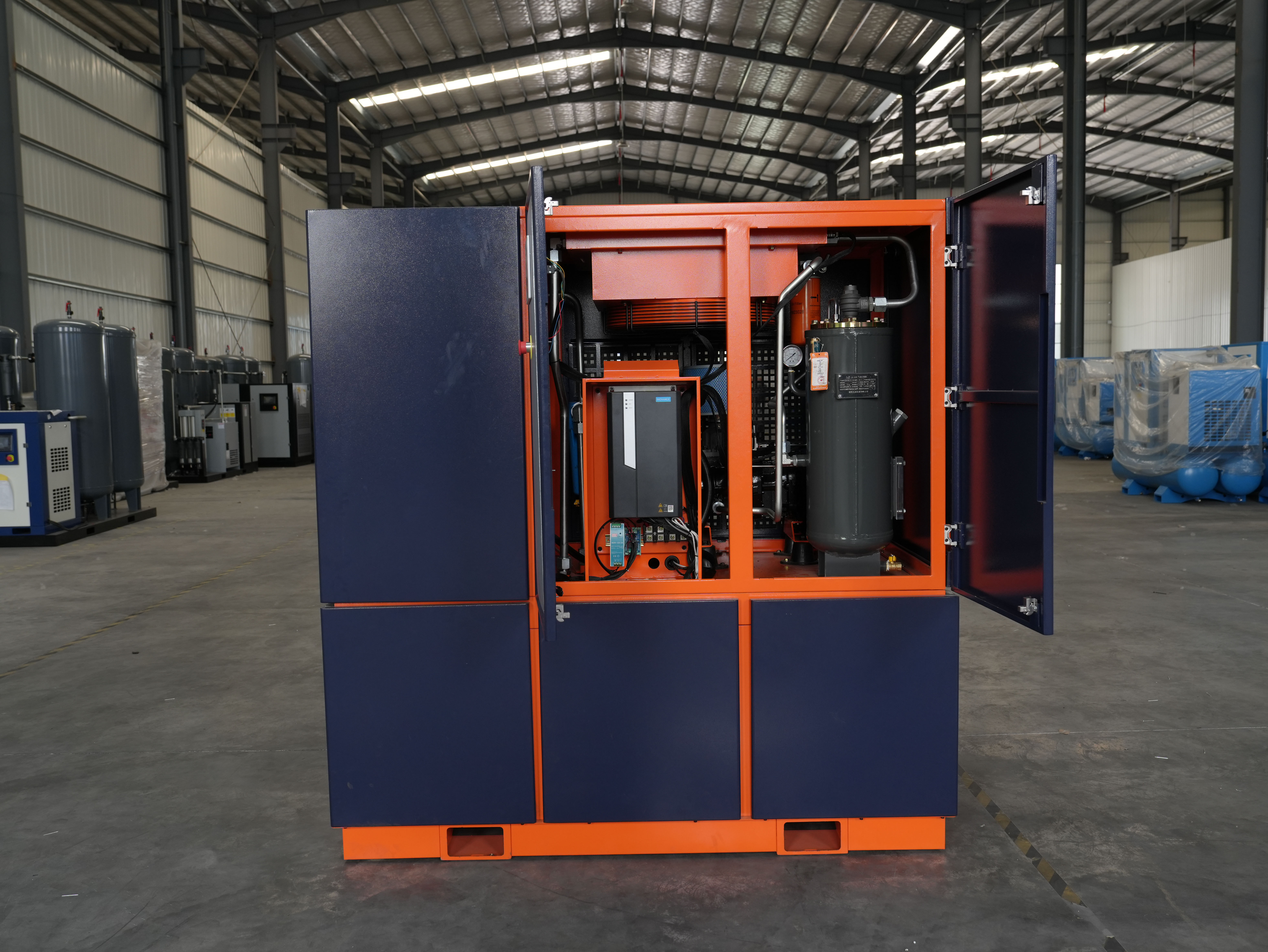
Open-panel view of a Prime air screw compressor: the electrical and drive layout is the part of the configuration that must match the certified documentation.
Acceptance, quality control and the terms that carry compliance
A certificate proves the design route; a test proves the individual unit. UMW Air states factory pre-shipment testing as its quality control method, and lists pre-shipment test as the acceptance criterion in its purchasing terms, together with a minimum order quantity of 1 unit, FOB or CIF delivery terms, and payment of 30% T/T in advance with 70% T/T before shipping. Production capacity is given as 1,000 units per month with a typical lead time of 3 days, and support is provided 24/7 by email or phone, including remote troubleshooting.
Customization is offered through OEM and ODM production for global clients, with color, logo and voltage listed as the parameters that can be adapted. For a compliance-focused buyer, voltage is the parameter to flag first, because it touches both the electrical documentation and the destination's installation practice.
Step-by-Step: Verifying Compliance Before You Place an Order
The sequence below is written for a buyer at the evaluation-to-execution stage, where the machine type is decided and the remaining question is evidence.
Step 1 — Fix the destination and the classification first
Name the country of installation, not the region. A compressor bound for an EU/EEA member state follows the CE route described above; a unit bound for a Southeast Asian market follows that country's national requirements, which the buyer's importer should confirm in writing before the technical discussion begins. Add the air quality class (ISO 8573-1:2010) and the required pressure and flow to the same page, because those values determine which model is quoted.
Step 2 — Read the certificate scope, not the certificate logo
Ask for the certificate file and check four things in order: the product families in scope, the referenced models, the directives and standards cited, and the validity dates. With UMW Air's document, that means confirming that the ordered family sits inside UMW air L, Z, P, M, N or O, and that the model code appears among the referenced models or is separately documented.
Step 3 — Map the certificate to the exact configuration ordered
List every deviation from the standard build: voltage, control type, drive method, cooling method, enclosure, and any added air treatment. Then ask the supplier, in writing, whether the delivered configuration falls inside the documented scope. Where customization is involved, this is the step that prevents a technically sound machine from arriving with paperwork that describes something else.
Step 4 — Write the acceptance criterion into the contract
Pre-shipment testing is only protective if it is contractual. UMW Air's terms state a pre-shipment test as the acceptance criterion, which gives the buyer a defined point at which conformity is judged and a defined moment to raise an issue, before the unit leaves the factory. Buyers running a factory acceptance visit should align the visit date with that test rather than with the shipping schedule.
Step 5 — Confirm the documentation pack and marking with your importer
Certificate copies, declaration of conformity, manuals and marking requirements are usually handled by the importer of record. Ask the supplier which documents accompany the shipment and ask the importer which documents must be presented at clearance; where the two lists disagree, resolve it before production, not after booking.
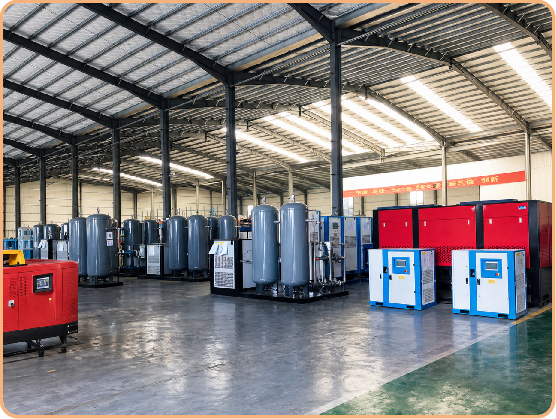
Finished units in the storage area: the pre-shipment test is the last point at which a configuration or documentation issue can be corrected without freight cost.
Step 6 — Align commercial terms with the production plan
Commercial terms are part of compliance because they determine who carries risk at each stage. The published terms are a minimum order quantity of 1 unit, FOB or CIF delivery, and 30% T/T in advance with 70% T/T before shipping. Against a monthly capacity of 1,000 units and a typical lead time of 3 days, a buyer can schedule the acceptance test and the freight booking with realistic margins, including time for any documentation correction.
Step 7 — Plan the post-installation evidence
Compliance does not end at delivery. Keep the certificate copy, the test record, the configuration list and the maintenance log together as one file; monitor air quality against the specified ISO 8573-1 class; and use the supplier's 24/7 email and phone support, including remote troubleshooting, when a deviation appears. That file is what a customer audit or an internal safety review will ask for later.
Use Cases: Where Verification Work Changes the Outcome
A CNC machining workshop in Vietnam installed 3 units to drive CNC machine actuators, pneumatic tools and dust removal systems. After one year of operation, the site reported a 20% improvement in production efficiency, reduced downtime, and a stable air supply that supported machining quality; the highlights recorded were low energy consumption, easy maintenance and reliable long-term performance.
Read as a compliance case rather than a sales case, three things stand out. First, the application was defined before the model was chosen: actuators, pneumatic tools and dust removal each place different demands on flow and air quality. Second, the acceptance point was the factory test, which is where a mismatch between the ordered configuration and the built unit would have surfaced. Third, the outcome was measured over a full year, which is the only horizon on which stability claims mean anything.
The same logic transfers to other industrial settings. A factory compressed air system serving several departments needs the air quality class agreed once and applied to every unit in the system. High-pressure work up to 25 bar sits at the top of the documented range and should be quoted with the pressure requirement stated explicitly. Sites without a stable grid, or projects that move between locations, are better served by the diesel mobile screw air compressor line, where the compliance question shifts toward transport, fuel handling and site safety rather than CE scope alone.
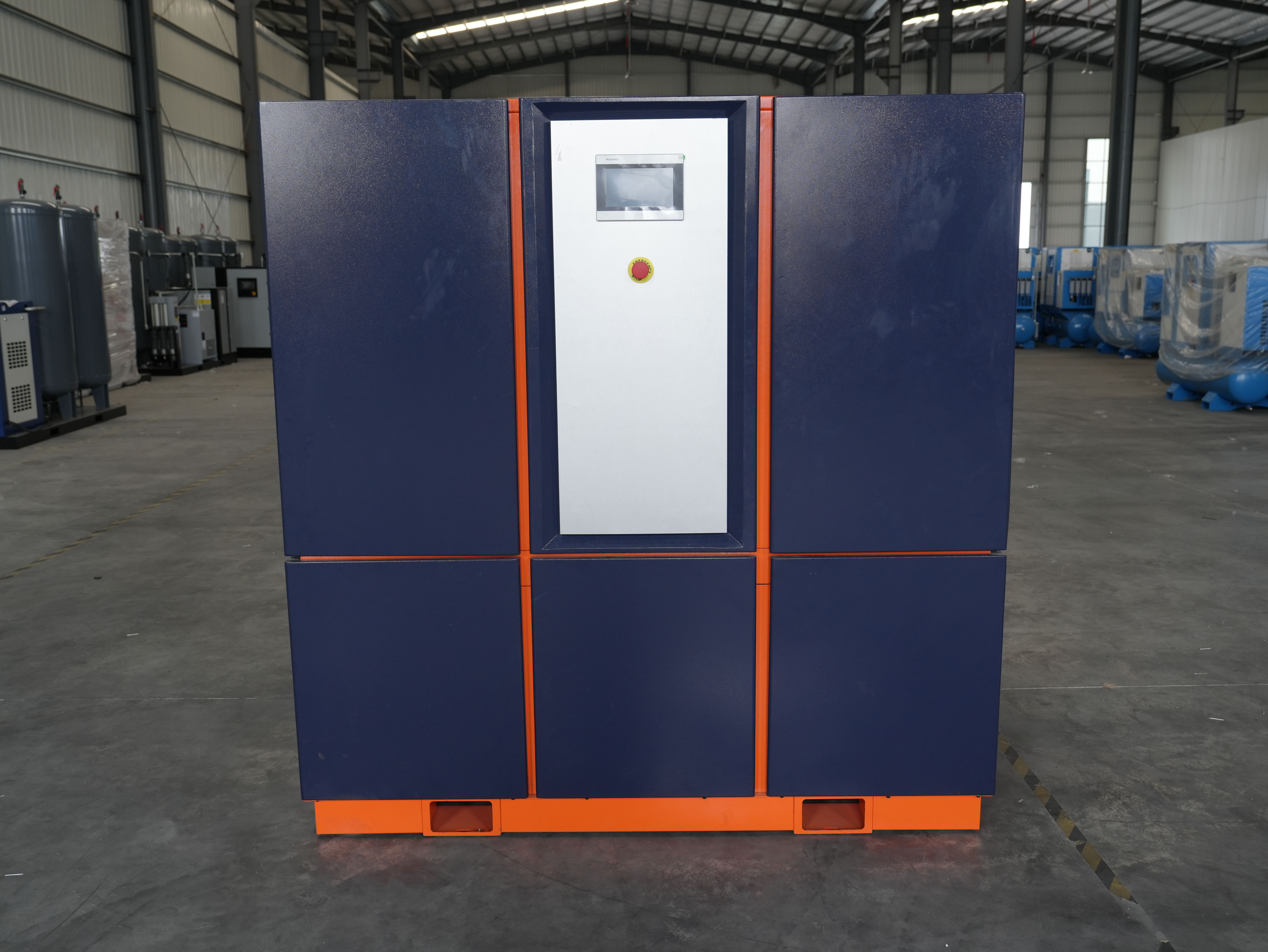
A stationary screw air compressor installed configuration of the type used in CNC workshops and general factory compressed air systems.
EU/EEA vs Southeast Asia: Compliance Comparison
The table below compares the two sourcing routes on the points a buyer actually manages. It does not rank them; it shows where the evidence burden sits in each.
| Dimension | EU / EEA | Southeast Asia |
|---|---|---|
| Governing route | CE marking under the Machinery Directive 2006/42/EC and the EMC Directive 2014/30/EU | National requirements that vary by country; there is no single region-wide certificate that covers all Southeast Asian markets |
| Primary document to request | CE certificate plus the declaration of conformity covering the ordered model | Supplier test records and the destination-specific documents your importer identifies |
| Reference point in this article | UMW Air CE certificate M.2026.206.C140156 (UDEM), scope UMW air L/Z/P/M/N/O, valid 11 May 2026 to 10 May 2031 | Factory pre-shipment testing stated as the acceptance criterion, with the document list confirmed per destination before production |
| Marking and labelling | CE mark applied to the certified configuration | Labelling and language confirmed with the importer for each country |
| Validity management | Diary the expiry date (10 May 2031) and re-confirm at each order | Re-confirm before each shipment, since national lists can change between orders |
| Typical buyer action | Scope and model matching, then pre-shipment test | Document list confirmation, then pre-shipment test |
Frequently Asked Questions
Does a CE certificate automatically cover every air compressor model a supplier offers?
No. A CE certificate covers the product families and models named in its scope. UMW Air's certificate M.2026.206.C140156 lists the UMW air L, UMW air Z, UMW air P, UMW air M, UMW air N and UMW air O families, references models ML-7.5/8A, L-7.5/8A, L-1516A and L-2216A, and is valid from 11 May 2026 to 10 May 2031. A buyer ordering a configuration outside that scope should request separate documentation for it.
Can an export-oriented supplier support OEM or ODM customization for my market?
UMW Air provides OEM and ODM production services to global clients, with color, logo and voltage listed as customizable parameters. The company reports a monthly capacity of 1,000 units and main markets in the EU, the USA, Southeast Asia, the Middle East, South America and Africa. Voltage customization in particular should be confirmed early, because it affects the electrical documentation as well as the build.
What are the minimum order and payment terms?
The purchasing terms state a minimum order quantity of 1 unit, delivery on FOB or CIF terms, and payment of 30% T/T in advance with 70% T/T before shipping. The typical production lead time is stated as 3 days, against a monthly capacity of 1,000 units.
How is quality accepted before shipment?
Factory pre-shipment testing is the stated quality control method, and the pre-shipment test is named as the acceptance criterion in the purchasing terms. In practice, the buyer should confirm the test date in writing and align any factory visit with it, so that deviations are raised before the unit is packed and dispatched.
What happens after delivery if a technical issue appears?
Support is available 24/7 by email or phone, including remote troubleshooting and guidance. For buyers evaluating a long-term supply route, the practical next step is to request the compliance document pack and a quotation for the exact configuration, then compare the certificate scope against the model you intend to order. UMW Air can be reached at umwair.com, by email at info@umwair.com, or by phone and WhatsApp on +86 15053148082.
Conclusion: Test the Document, the Product and the Shipment
Compliance holds when three things are true at the same time: the document covers the configuration, the product matches the document, and the shipment is accepted against an agreed test. Any one of the three missing turns a routine import into a negotiation.
For EU/EEA buyers, UMW Air's CE certificate gives a checkable starting point, with named directives, named harmonised standards, a defined family and model scope, and a validity period that runs to 10 May 2031. For Southeast Asian buyers, the starting point is a documented destination requirement plus a contractual pre-shipment test, because market entry there is confirmed country by country rather than through one regional mark.
A 100% export business model, with stated markets in the EU, the USA, Southeast Asia, the Middle East, South America and Africa, tells a buyer that this documentation work is routine rather than exceptional. It does not replace the check. The check is what a buyer is paid to do.
Request the Compliance Document Pack
Send the destination country, the required pressure and flow, and the air quality class you need. UMW Air will return the certificate and model documentation for the matching configuration, together with a quotation on FOB or CIF terms and the proposed pre-shipment test date.
Email: info@umwair.com | Phone / WhatsApp: +86 15053148082 | Website: umwair.com
Address: 68 Gongye South Road, Jinan, Shandong, China, 250000

Have Questions or Need More Details?
Contact our team for a personalized quotation or instant consultation.
Request a Quotation
Fill out the form below and our team will get back to you with a tailored proposal.
WhatsApp Direct Chat
Prefer to chat in real-time? Message us on WhatsApp for instant assistance & quick answers.
- Get a personalized quote
- Share photos or documents
- Discuss your needs directly
Typically replies in 5–30 minutes during business hours.