
Air Compressor Supplier Evaluation: How to Verify Capability and Delivery Guarantees
An industrial air compressor supplier should be evaluated on two evidence-based pillars: manufacturing capability you can verify with numbers, and delivery guarantees you can write into the order. Price and response speed are the easiest things to compare and the easiest things to over-weight, because neither tells you whether a factory can actually build, test, certify and ship the machine your production line depends on.
This guide is written for procurement managers, importers, distributors and plant engineers who are comparing suppliers across regions and need a repeatable method rather than general advice. It uses Shandong UMW Air Tech Co., Ltd. (UMW Air), an air compressor manufacturer based in Jinan, Shandong, China, as a working example, because the company publishes the kind of data a buyer should be able to request from any supplier on a shortlist.
Pillar 1 covers capability verification. Pillar 2 covers delivery assurance. The checklist at the end can be applied to every supplier you are considering.
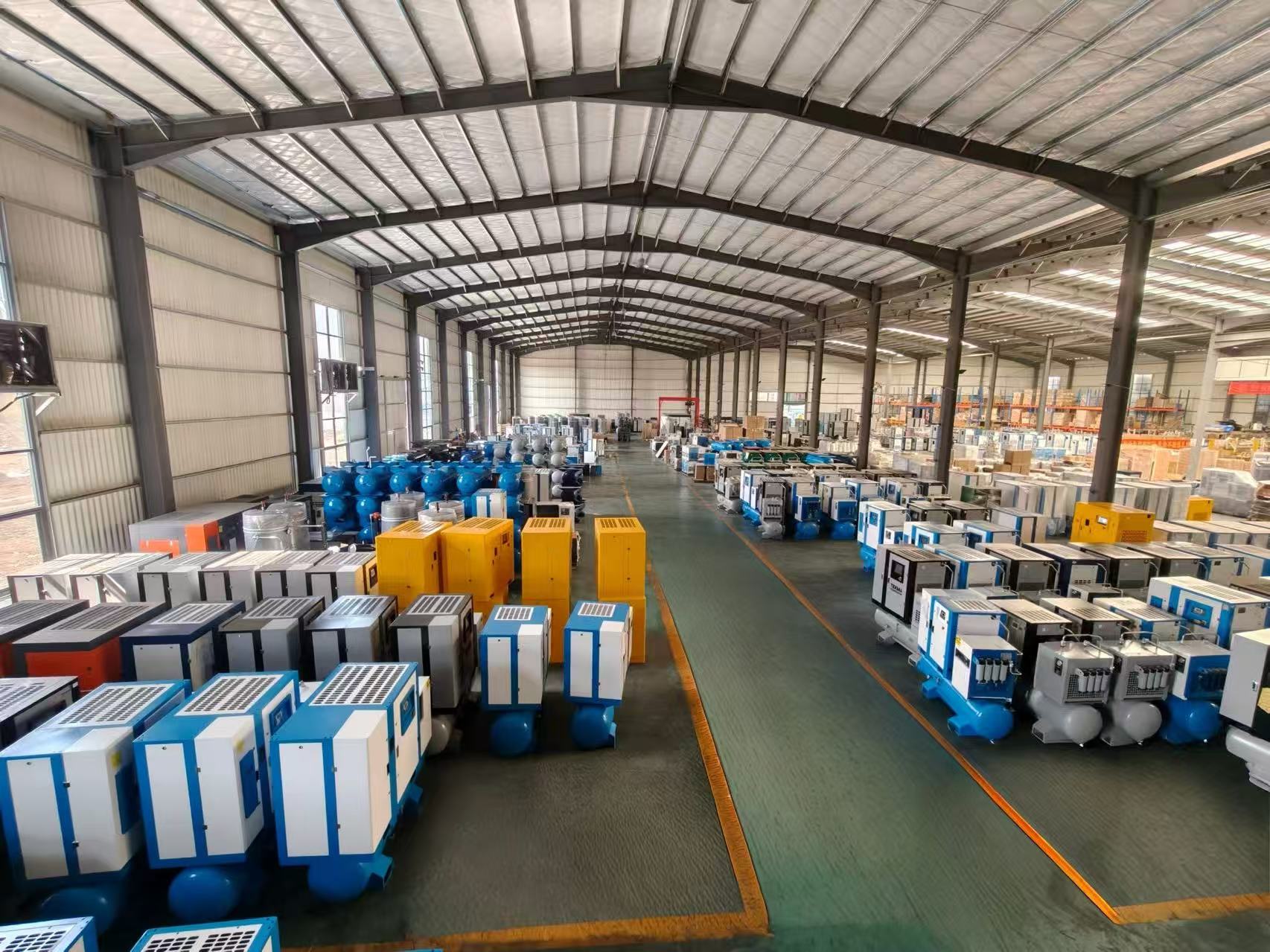
Cover: UMW Air assembly workshop, where screw air compressor units are built and staged for pre-shipment testing.
The Problem: Supplier Claims Are Easy, Supplier Evidence Is Hard
Most supplier evaluations begin and end with documents a supplier produced for marketing: a catalog, a price list, a promise of fast delivery. The failures that damage projects rarely appear in those documents. They surface later, when a production schedule cannot absorb a repeat order, when a certification turns out to cover a different series than the quoted model, when the balance payment is released before anyone confirmed the machine holds the specified pressure, or when an Incoterm leaves the buyer responsible for freight that was never budgeted.
In air compressor procurement the cost of a bad choice is asymmetric. An industrial air compressor is a capital asset connected to a compressed air system that other equipment depends on. When the unit underperforms, the buyer does not simply lose the purchase price; they lose production time, re-commissioning effort, and the internal credibility of the person who signed the order.
The practical response is to shift the evaluation from what does the supplier say to what can the supplier evidence. That means asking for named figures, certificate identifiers, test documentation and written commercial terms, then checking that those items agree with each other. Two risk categories dominate a supplier decision:
- Capability risk — can the factory manufacture to specification, at volume, with the customization and certification your market requires?
- Delivery risk — what protects the buyer between the deposit transfer and the arrival of the container at destination?
Both are answered with documents and dates, not with adjectives.
Industry Background: A Deep Supplier Pool Makes Verification Standard Practice
The global industrial air compressor market was valued at USD 20.0 billion in 2025 and is projected to reach USD 28.3 billion by 2033, according to Grand View Research. Growth of that scale attracts suppliers of very different profiles: global manufacturers with large installed bases, regional specialists, and trading intermediaries that resell without controlling production.
Buyer geography matters as much as market size. Asia Pacific held the largest revenue share of 42.8% in 2025, with China identified as a key market leader in the same analysis. For buyers in the EU, the USA, Southeast Asia, the Middle East, South America or Africa, that concentration means a shortlist almost always includes at least one China-based manufacturer, so the verification process has to work across language, distance and time-zone differences.
Product mix reinforces the same point. Rotary screw air compressors accounted for 47.0% of the market in 2025, largely because of their efficiency in continuous industrial duty — exactly the duty profile where unverified capability and unclear delivery terms are most expensive. A screw compressor specified for round-the-clock operation is not a machine to buy on the strength of a PDF alone.
The competitive landscape is also well documented: Atlas Copco, Ingersoll Rand, Kaeser Kompressoren and Sullair (Hitachi) are among the leading global names in this category. Their presence sets a useful benchmark for the questions buyers ask, and manufacturers such as UMW Air — founded in 2019, with a 100% export orientation — position themselves around verified production capability and energy-efficiency technology rather than brand premium. The procurement takeaway is not to rank the two groups, but to apply the same evidence standard to both.
Pillar 1 — Verifying Manufacturing Capability with Numbers
Capability verification is not a site visit and not a feeling. It is a short list of quantities, each of which can be cross-checked against another document, photograph, certificate or shipment record.
Facility, Workforce and Engineering Depth
Shandong UMW Air Tech Co., Ltd. operates a 2,000 m² facility with approximately 200 employees, of which 40 are engineers dedicated to research and development. For a buyer, the ratio matters more than the headline. A 40-engineer team inside a 200-person organization — roughly one in five — indicates a company structured around design and production rather than around reselling, which is the difference between a supplier that can modify a machine and one that can only quote from a list.
What to ask: headcount by function, R&D headcount, photographs or video of the production floor, and — for OEM projects — which engineers own the customization. UMW Air offers OEM and ODM production with customization of color, logo and voltage, which is only credible if the engineering function exists in-house rather than being outsourced on a project-by-project basis.
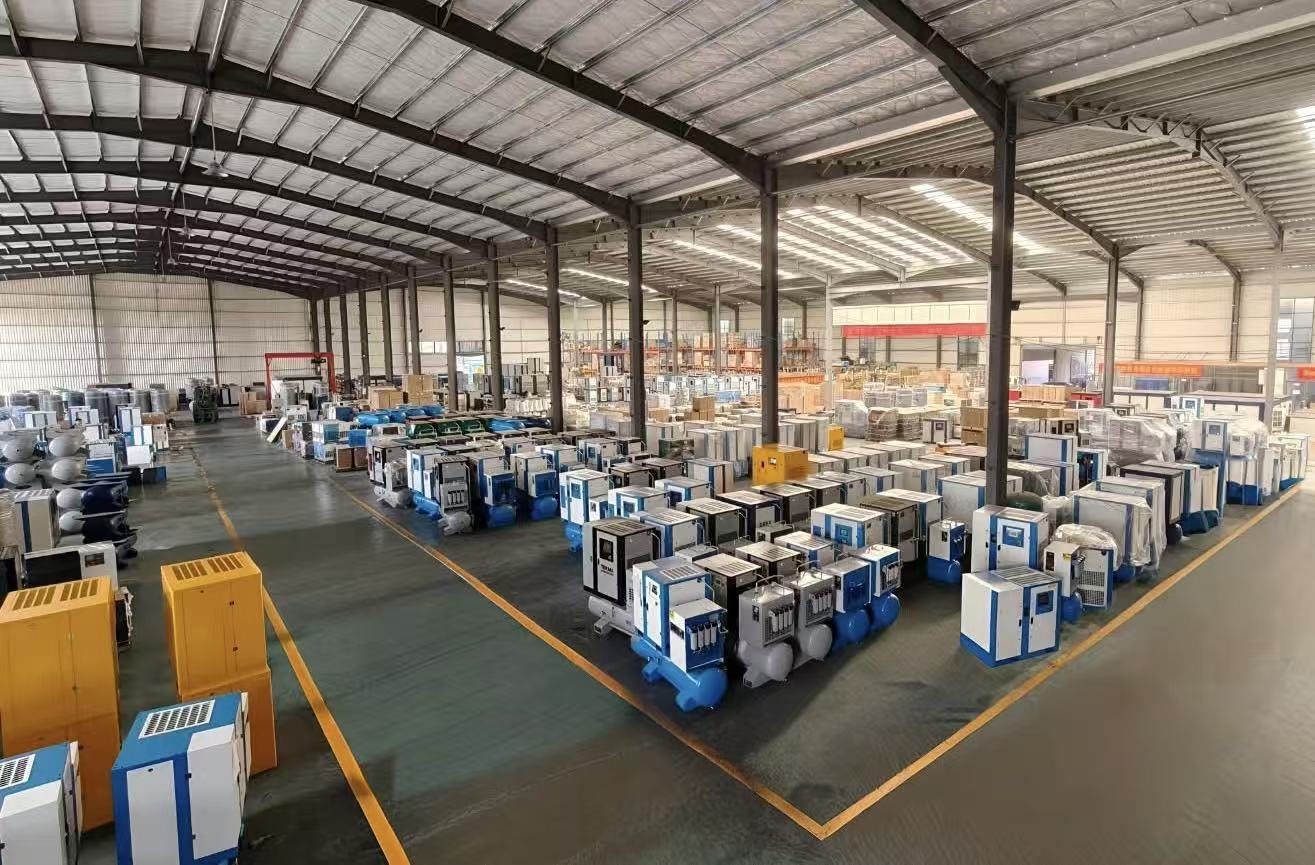
Supporting: production area where UMW Air screw air compressor units are assembled and staged for testing.
Production Capacity: Three Numbers That Must Agree
UMW Air states an annual output of 12,000 units and a monthly capacity of 1,000 units. Those two figures are mutually consistent, which is itself a useful first test: capacity claims that fail simple arithmetic rarely survive a repeat order.
How buyers should use capacity data: compare monthly capacity against your expected demand and against the supplier's other commitments, then ask how production slots are reserved when a distributor places a repeat order. A capacity figure without an allocation mechanism is a marketing number; a capacity figure with a scheduling answer is a supply commitment.
Lead time is the third number. UMW Air lists a lead time of 3 days on its capability sheet for standard configurations, with the exact schedule for a customized unit confirmed in writing at order stage. Any lead-time claim belongs in the contract rather than in an email thread.
Evidence to request: photographs or video of finished-goods storage, shipment records, and a written statement of how repeat-order slots are reserved during peak periods.
Technical Envelope: What the Factory Can Actually Build
UMW Air's screw air compressor platform covers models ML-7.5/8A, L-7.5/8A, L-1516A and L-2216A, with power from 4 kW to 355 kW, working pressure from 8 bar to 25 bar, a reference air flow of 2.39 m³/min, air cooling, direct drive and an IE4 motor, in a sheet metal enclosure. Product families include air-cooled screw air compressors, direct-driven screw air compressors, stationary screw air compressors, diesel mobile screw air compressors and heavy-duty screw air compressors.
This is the layer where specification mismatch usually happens. A direct-driven configuration, an air-cooled design and an IE4 motor designation are all checkable items — ask the supplier to confirm drive method, cooling method, rated pressure and motor efficiency class in the order documents, not only in the brochure. Air-cooled units suit many factory environments; installations with high ambient temperatures, heavy dust loading or long pipe runs should be discussed at specification stage rather than discovered after delivery.
Where a process requires clean air, air quality rather than air volume decides success. ISO 8573-1:2010 is the primary international standard for compressed air purity, classifying particle, water and oil contamination. For laser cutting, oil-free air classified as Class 0 under ISO 8573-1 is critical to prevent contamination of sensitive optics and to preserve cut quality. If your application carries a purity requirement, the class must appear in the specification and in the acceptance test, not in a side conversation.
Certification: Verify the Number, the Scope and the Expiry Date
Certification is the most frequently mishandled item in supplier evaluation, because buyers confirm that a certificate exists and stop there. Three checks should follow. First, does the certificate identify the models or series you are buying? Second, is the issuing body identifiable and is the certificate within its validity period? Third, which directives and standards does it reference?
UMW Air holds CE certification number M.2026.206.C140156, issued by UDEM for the EU/EEA market, valid from 11 May 2026 to 10 May 2031. The scope covers the UMW air L, UMW air Z, UMW air P, UMW air M, UMW air N and UMW air O series. The certification references the 2006/42/EC Machinery Directive (Annex VIII) and the 2014/30/EU Electromagnetic Compatibility Directive (Annex II), together with harmonized standards including EN ISO 12100:2010; EN 60204-1:2018/A1:2025; EN 1012-1:2010; EN IEC 61000-6-2:2019; EN IEC 61000-6-4:2019; and EN IEC 61000-3-2:2019+A1:2021+A2:2024.
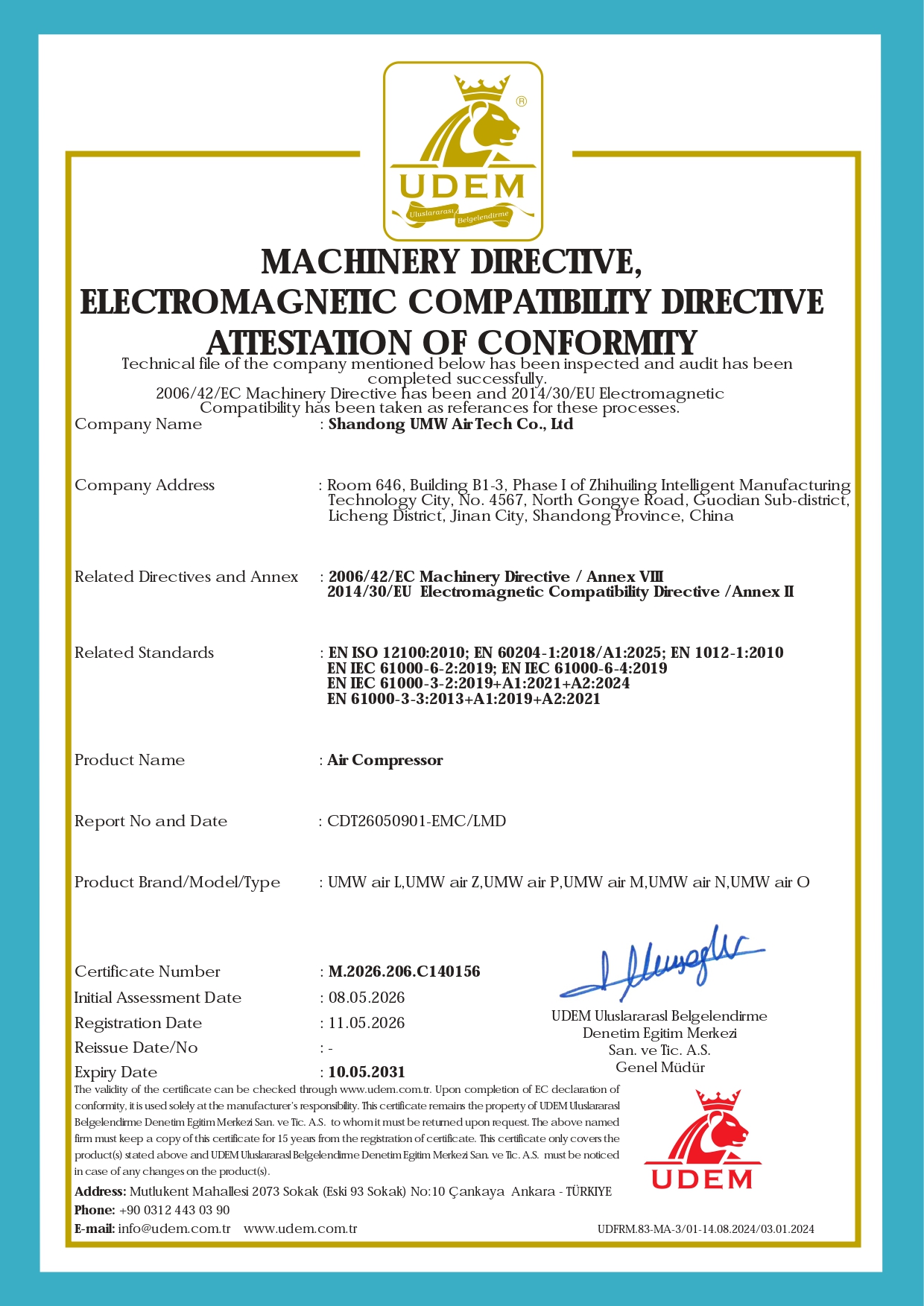
Proof: CE certificate M.2026.206.C140156 issued by UDEM, valid 11 May 2026 – 10 May 2031, covering the UMW air L / Z / P / M / N / O series.
Why the detail matters: a buyer importing into the EU/EEA is responsible for placing compliant equipment on the market. A certificate whose scope excludes the quoted model, or whose validity has lapsed, does not transfer that responsibility. Request the certificate as a document, check the number and issuing body, and record the validity dates in the purchase file alongside the order confirmation.
Quality control is the companion question. UMW Air performs factory pre-shipment testing on units before they leave the facility — the mechanism that connects a specification claim to a shipping container. What the test covers should be defined in the order, and the report should travel with the unit.
Pillar 2 — Verifying Delivery Guarantees and Commercial Terms
Capability answers whether the supplier can build the machine. Delivery assurance answers a different question: what protects the buyer between the deposit transfer and the arrival of the equipment? Four commercial items carry most of that risk — the acceptance test, the payment structure, the shipping terms, and the operational terms covering quantity, schedule and support.
Pre-Shipment Acceptance Testing
The acceptance test is the moment when the buyer, not the supplier, decides whether the machine conforms. UMW Air performs factory pre-shipment testing; the buyer's job is to define what that test proves before money moves.
- The parameters recorded against the order specification: working pressure, air flow, drive and control behaviour, leak and safety checks.
- The unit serial number on the test report matching the unit that is actually loaded.
- Whether the buyer's engineer or a third-party inspector may witness the test, in person or by live video.
- The remedy if the result falls outside the agreed range — rework, replacement or a defined credit.
- The document pack released with the shipment: test report, certificate copy, packing list and commercial invoice.
A supplier willing to have its test protocol written into the order is a materially lower risk than one that only promises quality inspection.
Payment Structure: 30% in Advance, 70% Before Shipping
UMW Air's standard payment structure is 30% T/T in advance, with the remaining 70% T/T before shipping. The structure is common in industrial equipment trade and creates a defined exposure window: the buyer has paid in full before the container sails, while the equipment has not yet run a single shift at the buyer's site.
That exposure is manageable when four points are settled in writing:
- The trigger for the 70%. Specify whether it follows successful pre-shipment testing, loading, or presentation of shipping documents. Tying the balance to acceptance documentation is the single most useful protection available inside this payment structure.
- Beneficiary and bank details. Confirm that the beneficiary name matches the contracting company name, and verify bank details through an independent contact channel rather than only through the email thread that supplied them. UMW Air's published channels are phone and WhatsApp at +86 15053148082 and email at info@umwair.com.
- Failure and delay remedies. Agree in advance what happens if the acceptance test fails, if the shipment is delayed, or if documentation arrives incomplete.
- Currency, bank charges and document set. Confirm who bears transfer fees, and which documents accompany each payment — typically commercial invoice, packing list and bill of lading, plus the agreed test and certification documents.
FOB or CIF: Choose the Delivery Arrangement That Matches Your Logistics
UMW Air ships on FOB or CIF terms, and the choice determines who controls cost and risk in transit.
- FOB (Free On Board): the supplier delivers to the named port of loading, and the buyer arranges and pays for freight and insurance. This suits buyers with an established freight forwarder, or those who want direct visibility of shipping cost and schedule.
- CIF (Cost, Insurance and Freight): the supplier arranges carriage and insurance to the named destination port. This suits first-time importers who prefer a single delivered-to-port figure — provided the insurance level and the destination port are stated explicitly.
Whichever term is chosen, four details belong in the contract: the named port, the Incoterms version referenced, responsibility for export clearance, and whether insurance covers the shipment only to the destination port or onward to inland delivery. General Incoterms language without a named port is not a delivery guarantee.
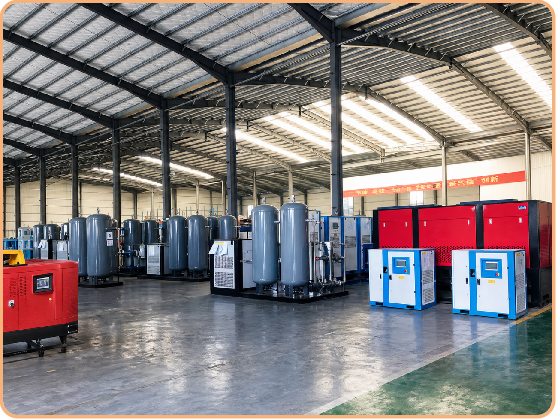
Supporting: finished units staged in UMW Air's storage area, the physical evidence behind a stated monthly capacity.
MOQ, Lead Time and After-Sales: The Operational Terms
UMW Air's minimum order quantity is 1 unit — low enough for a buyer to validate a single machine, its documentation and its performance before committing to a fleet or a distribution agreement. Monthly capacity of 1,000 units supports distributor-scale repeat orders, and the capability sheet states a 3-day lead time on standard configurations, to be confirmed per order.
After-sales support is the last delivery guarantee, because equipment support continues long after the invoice is settled. UMW Air provides 24/7 technical support by email or phone, with remote troubleshooting and guidance. Ask any supplier how support is delivered in your time zone, whether a named contact is assigned, and how spare parts are supplied. A support structure that exists only during office hours in the supplier's own time zone is a hidden cost for a plant running three shifts.
Step-by-Step: A Seven-Step Supplier Evaluation Workflow
Step 1 — Write the requirement specification first. Power, working pressure, required air flow, duty cycle, ambient conditions, air purity class where relevant under ISO 8573-1:2010, voltage and control preference. A specification written before contact prevents the supplier's catalog from quietly defining your requirement.
Step 2 — Request a capability dossier, not a brochure. Ask for facility size, headcount, R&D headcount, annual output, monthly capacity, product families, model list and customization options. UMW Air's returned figures are specific: a 2,000 m² facility, approximately 200 employees including 40 engineers, 12,000 units of annual output, 1,000 units per month, and OEM/ODM production with color, logo and voltage customization.
Step 3 — Verify certification against your exact model. Certificate number, issuing body, scope, expiry date, directives and standards. For UMW Air: CE M.2026.206.C140156, issued by UDEM, valid 11 May 2026 to 10 May 2031, covering the UMW air L, UMW air Z, UMW air P, UMW air M, UMW air N and UMW air O series.
Step 4 — Check production evidence, not only production claims. Finished-goods photographs, shipment records, and a direct answer on how repeat-order capacity is scheduled.
Step 5 — Fix commercial terms in writing before the deposit. Payment structure (30% T/T in advance with 70% T/T before shipping for UMW Air), the trigger for the balance payment, the Incoterm and named port (FOB or CIF), the minimum order quantity of 1 unit, lead time, and the document set.
Step 6 — Define the acceptance test protocol. Parameters, tolerances, witness arrangements, reporting format, and the remedy if results fall outside the agreed range.
Step 7 — Confirm the communication and support channel. A named contact, a channel that works across time zones, and a support commitment. UMW Air publishes phone and WhatsApp at +86 15053148082, email at info@umwair.com, and states 24/7 technical support with remote troubleshooting.
Pre-deposit checklist
- Capability dossier received and internally consistent (facility, staff, engineers, output, monthly capacity).
- Certificate number, issuing body, scope and expiry verified against the quoted model.
- Acceptance test parameters, tolerances and reporting format agreed in writing.
- Payment triggers, beneficiary name and bank details confirmed through an independent channel.
- Incoterm, named port, insurance level and export clearance responsibility stated.
- MOQ, lead time, packaging and document set confirmed in the order.
- Named after-sales contact and support channel confirmed.
Verification Matrix: What to Ask and What a Verifiable Answer Looks Like
| Verification area | Question to ask | Verifiable answer (UMW Air example) |
|---|---|---|
| Facility and workforce | How large is the plant, and how many people work in it? | 2,000 m² facility; approximately 200 employees |
| Engineering depth | Who designs and customizes the machine? | 40-engineer R&D team; OEM/ODM with color, logo and voltage customization |
| Annual output | How many units are produced per year? | 12,000 units per year |
| Monthly capacity | How many units per month can be allocated to my orders? | 1,000 units per month |
| Lead time | What is the delivery time on standard and customized units? | 3 days stated for standard configurations; schedule confirmed per order |
| Product platform | Which models and specifications cover my requirement? | ML-7.5/8A, L-7.5/8A, L-1516A, L-2216A; 4–355 kW; 8–25 bar; air-cooled; direct-driven; IE4 motor |
| Certification | Which certificate covers the model I am buying, and is it current? | CE M.2026.206.C140156, issued by UDEM, valid 11 May 2026 – 10 May 2031 |
| Quality control | What testing happens before shipment, and will I receive the report? | Factory pre-shipment testing |
| Export experience | Which markets do you supply, and how much of output is exported? | 100% export ratio; EU, USA, Southeast Asia, Middle East, South America and Africa |
| After-sales | How is technical support delivered after commissioning? | 24/7 technical support by email or phone; remote troubleshooting and guidance |
Commercial Terms Checklist for Delivery Assurance
| Term | Confirm in writing | UMW Air standard |
|---|---|---|
| Deposit | Percentage, currency, payment trigger, beneficiary name | 30% T/T in advance |
| Balance payment | Linked to acceptance testing, loading, or document presentation? | 70% T/T before shipping |
| Acceptance testing | Parameters, tolerances, witness options, reporting format | Factory pre-shipment testing |
| Shipping terms | FOB or CIF, named port, Incoterms version, insurance level | FOB or CIF |
| Minimum order quantity | Are single-unit or trial orders accepted? | 1 unit |
| Capacity and schedule | Monthly allocation for repeat orders; lead-time commitment | 1,000 units per month; 3 days stated on standard configurations |
| Documents | Invoice, packing list, bill of lading, test report, certificate copy | As agreed at order stage |
| Contact and support | Named contact, channels, support availability | Phone/WhatsApp +86 15053148082; info@umwair.com; 24/7 technical support |
Use Cases: Where Capability and Delivery Verification Change the Outcome
CNC Machining Workshops
A CNC machining workshop in Vietnam installed three units of UMW Air's screw air compressor platform to drive CNC machine actuators, pneumatic tools and dust removal systems. Over one year of operation, the workshop reported a 20% improvement in production efficiency and reduced downtime, with low energy consumption, easy maintenance and reliable long-term performance cited as the case highlights.
Why this belongs in a verification discussion: the reported outcome depends on stable air supply, which depends on the machine holding pressure in continuous duty — and on the supplier keeping it running. Buyers evaluating similar projects should ask for the application, quantity, operating duration and result of any reference case, then check whether that reference resembles their own plant rather than a showcase installation.
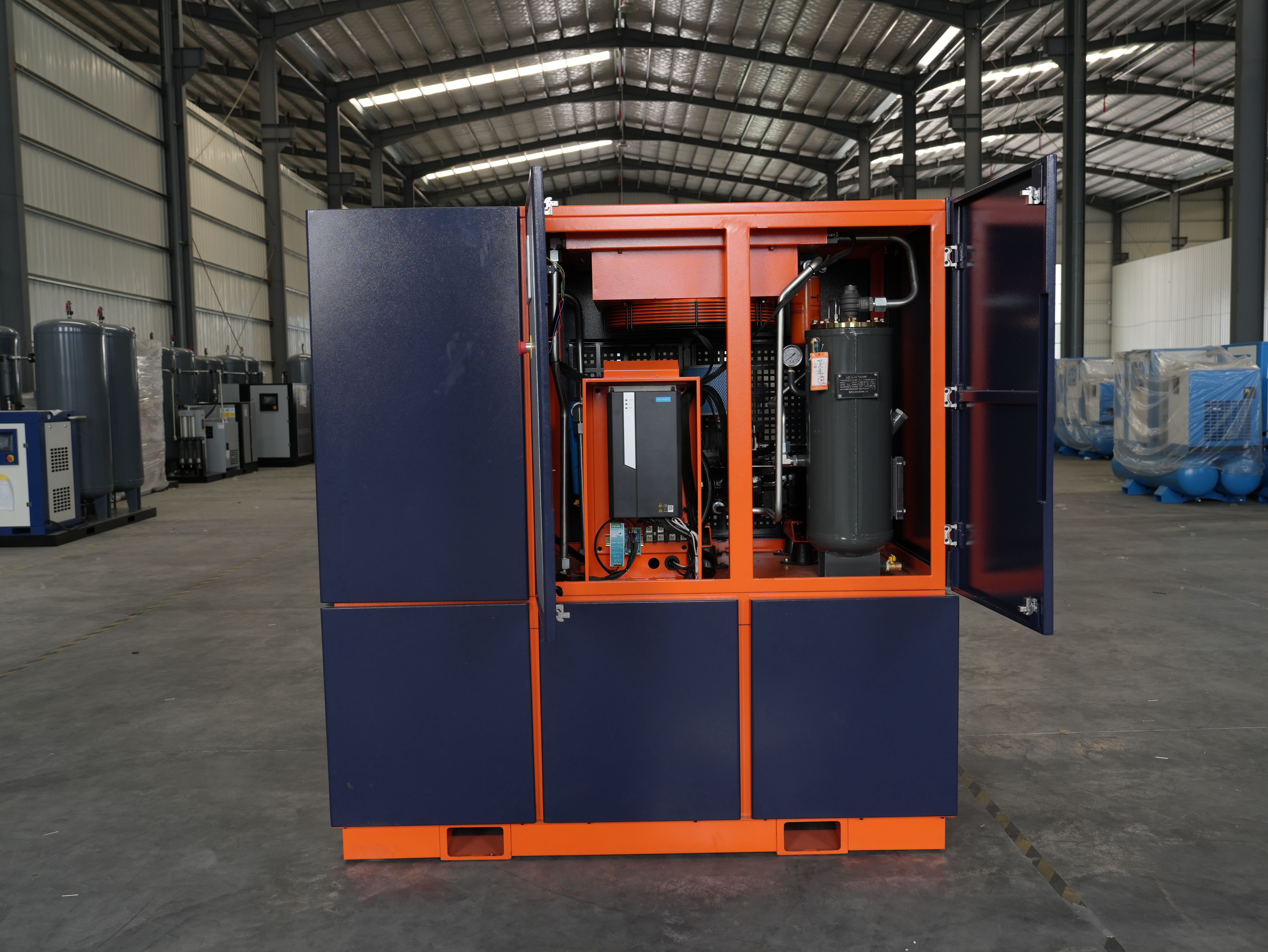
Proof: screw compressor unit with open panel — the configuration type deployed in the Vietnam CNC workshop case.
Laser Cutting and Other Quality-Critical Applications
Laser cutting is the clearest example of an application where air quality rather than air quantity decides success. Oil-free air at Class 0 under ISO 8573-1 is critical to prevent contamination of sensitive optics and preserve cut quality. Cost is a separate argument: in laser cutting, using compressed air as an auxiliary gas can reduce production costs by up to 50% compared with nitrogen or oxygen, according to third-party CNC industry research.
Procurement implication: when a process carries a defined purity class, that class must appear both in the specification and in the acceptance test protocol. A supplier that cannot discuss ISO 8573-1 classes in specific terms is not yet speaking your process language, however competitive the quotation looks.
Continuous Manufacturing and Factory-Wide Compressed Air Systems
Rotary screw air compressors held 47.0% of the global market in 2025 largely because continuous industrial duty is their strength. For plants running multiple shifts, energy is the dominant operating cost of an industrial compressed air system: variable frequency drive compressors can save up to 35% in energy costs by matching motor speed to actual air demand, according to the U.S. Department of Energy.
A factory therefore has to score control technology as carefully as purchase price. UMW Air states that it standardizes PM VSD technology and low-resistance system design, treating energy efficiency as a core engineering principle with the aim of converting every kWh into productivity across the equipment lifecycle.
Importers and Distributors in the EU, USA, Southeast Asia, Middle East, South America and Africa
UMW Air's export ratio is 100%, with main markets across the EU, USA, Southeast Asia, the Middle East, South America and Africa. For distributors, the verification points differ slightly from those of an end user. Instead of a single machine's performance, they are checking whether the supplier can support a catalog — product families, model coverage, and customization of color, logo and voltage — hold monthly capacity for repeat orders, and deliver documentation and after-sales support reliably at a distance.
Lifecycle Value and PM VSD: The Test That Should Be Applied Before Purchase
Capability and delivery are the two pillars of supplier evaluation, but both operate inside a longer economic frame. An industrial air compressor is judged over its operating life, not at the loading dock, and energy consumption typically outweighs the purchase price in that calculation. The U.S. Department of Energy figure of up to 35% energy savings from variable frequency control is the clearest available illustration of why control architecture deserves its own row on the evaluation sheet.
UMW Air's stated engineering position is that energy efficiency is a core belief rather than an option: the company standardizes PM VSD technology and low-resistance system design, aiming to convert each kWh into productivity throughout the equipment lifecycle. For buyers, this translates into three practical questions for any supplier: which control technology is standard, what motor efficiency class is supplied (the UMW Air platform specifies IE4 motors), and how is performance supported after commissioning (24/7 technical support by email or phone, with remote troubleshooting).
Putting lifecycle value inside the supplier scorecard — rather than discovering it after installation — is what separates a verification-led evaluation from a price-led one.
Frequently Asked Questions
Is UMW Air CE certified, and what does the certificate cover?
Yes. UMW Air holds CE certification number M.2026.206.C140156, issued by UDEM for the EU/EEA market and valid from 11 May 2026 to 10 May 2031. The scope covers the UMW air L, UMW air Z, UMW air P, UMW air M, UMW air N and UMW air O series, issued against the 2006/42/EC Machinery Directive (Annex VIII) and the 2014/30/EU Electromagnetic Compatibility Directive (Annex II), with harmonized standards including EN ISO 12100:2010, EN 60204-1:2018/A1:2025, EN 1012-1:2010 and the EN IEC 61000 series. Buyers should confirm that the model they are purchasing falls inside the listed scope and record the expiry date. Where a process requires clean air, the relevant specification is the air purity class under ISO 8573-1:2010.
How can I verify manufacturing capability before placing an order?
Request a capability dossier and check its internal consistency. UMW Air's verifiable figures are a 2,000 m² facility, approximately 200 employees including a 40-engineer R&D team, annual output of 12,000 units and monthly capacity of 1,000 units, with OEM/ODM production and customization of color, logo and voltage. Cross-check those figures against production-floor and finished-goods photographs, the model list (ML-7.5/8A, L-7.5/8A, L-1516A, L-2216A; 4–355 kW; 8–25 bar; air-cooled, direct-driven, IE4 motor) and pre-shipment test documentation. A claim that cannot be cross-checked against a second document is a claim, not a capability.
What commercial terms and cost factors should I expect?
UMW Air's standard structure is 30% T/T in advance and 70% T/T before shipping, with delivery on FOB or CIF terms. Beyond the invoice, the factors that change total cost of ownership are energy consumption, maintenance access and uptime. Variable frequency drive compressors can reduce energy costs by up to 35% by matching motor speed to air demand, according to the U.S. Department of Energy, and UMW Air standardizes PM VSD technology with low-resistance system design. Buyers should also confirm bank charges, the insurance level under CIF, and which documents accompany each payment.
Can I start with a sample or a single trial unit?
Yes. UMW Air's minimum order quantity is 1 unit, which allows a buyer to validate one machine, its documentation and its performance before scaling to a fleet or a distribution agreement. The capability sheet states a lead time of 3 days for standard configurations, with the final schedule confirmed per order. For trial orders, pre-shipment testing is the natural verification point: define the parameters to be recorded, request the test report carrying the unit's serial number, and confirm customization requirements (color, logo, voltage) in writing before production begins.
What is the lead time, and how do I confirm delivery?
UMW Air states a 3-day lead time on standard configurations, supported by monthly capacity of 1,000 units, and ships on FOB or CIF terms; the exact schedule and named port should be written into the order confirmation. To confirm availability, pricing or a quotation for a specific configuration, contact UMW Air directly — phone or WhatsApp +86 15053148082, email info@umwair.com, or umwair.com. The most efficient approach when comparing suppliers is to send the same written request — specification, model, quantity, destination port and required documentation — to each shortlisted supplier, then compare the answers against the checklists above.
Conclusion: Two Questions Decide a Supplier
Air compressor supplier evaluation becomes manageable when it is split into two verifiable questions. Capability: can the factory evidence its facility, workforce, engineering depth, output, model coverage and certification with documents that agree with one another? UMW Air's published figures — a 2,000 m² facility, approximately 200 employees including 40 engineers, 12,000 units of annual output, 1,000 units of monthly capacity, CE certification M.2026.206.C140156 valid to 10 May 2031, and a screw compressor platform from 4 kW to 355 kW at 8–25 bar — are data points that can be checked rather than believed.
Delivery: can the commercial terms protect you between payment and arrival? For UMW Air that means factory pre-shipment testing, 30% T/T in advance with 70% T/T before shipping, FOB or CIF delivery, a minimum order quantity of 1 unit, 24/7 technical support by email or phone, and published contact channels at +86 15053148082 and info@umwair.com.
The checklist is portable. Apply it to every supplier on your shortlist, weight lifecycle energy performance alongside purchase price, and the shortlist will decide itself.
Next step: request the documentation pack
Ask UMW Air (Shandong UMW Air Tech Co., Ltd.) for the capability dossier, the CE certificate copy and the pre-shipment test protocol before you place a deposit — then compare those documents directly with your own specification.
Phone / WhatsApp: +86 15053148082 | Email: info@umwair.com | Website: umwair.com | Address: 68 Gongye South Road, Jinan, Shandong, China, 250000