
Fixing Unstable Compressed Air in High-Temp Plants: A UMW Screw Compressor Solution
Answer first: Unstable compressed air in a high-temperature plant is almost never a single-part failure. Heat, humidity and continuous duty push a compressor past the point where the system can hold pressure and air quality at the point of use. The documented fix is an air-cooled, direct-driven industrial screw compressor configured for continuous operation — for example the UMW Air screw air compressor models ML-7.5/8A, L-7.5/8A, L-1516A and L-2216A — paired with an air dryer, air tank, line filter, inverter and controller. UMW Air (Shandong UMW Air Tech Co., Ltd), a screw air compressor manufacturer based in Jinan, Shandong, China, builds this configuration on a 4–355 kW, 8–25 bar platform with IE4 motors and CE certification for the EU/EEA market.
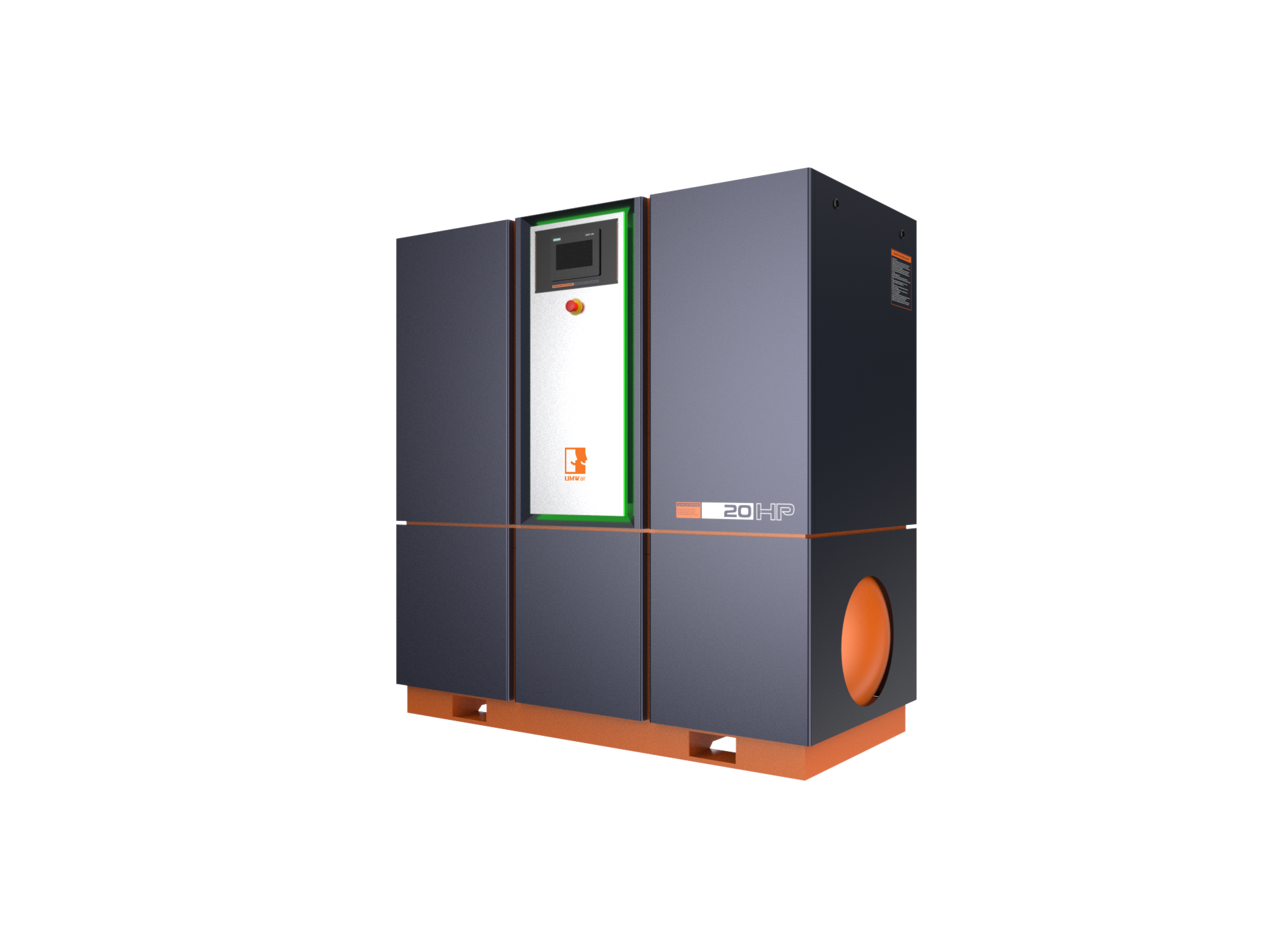
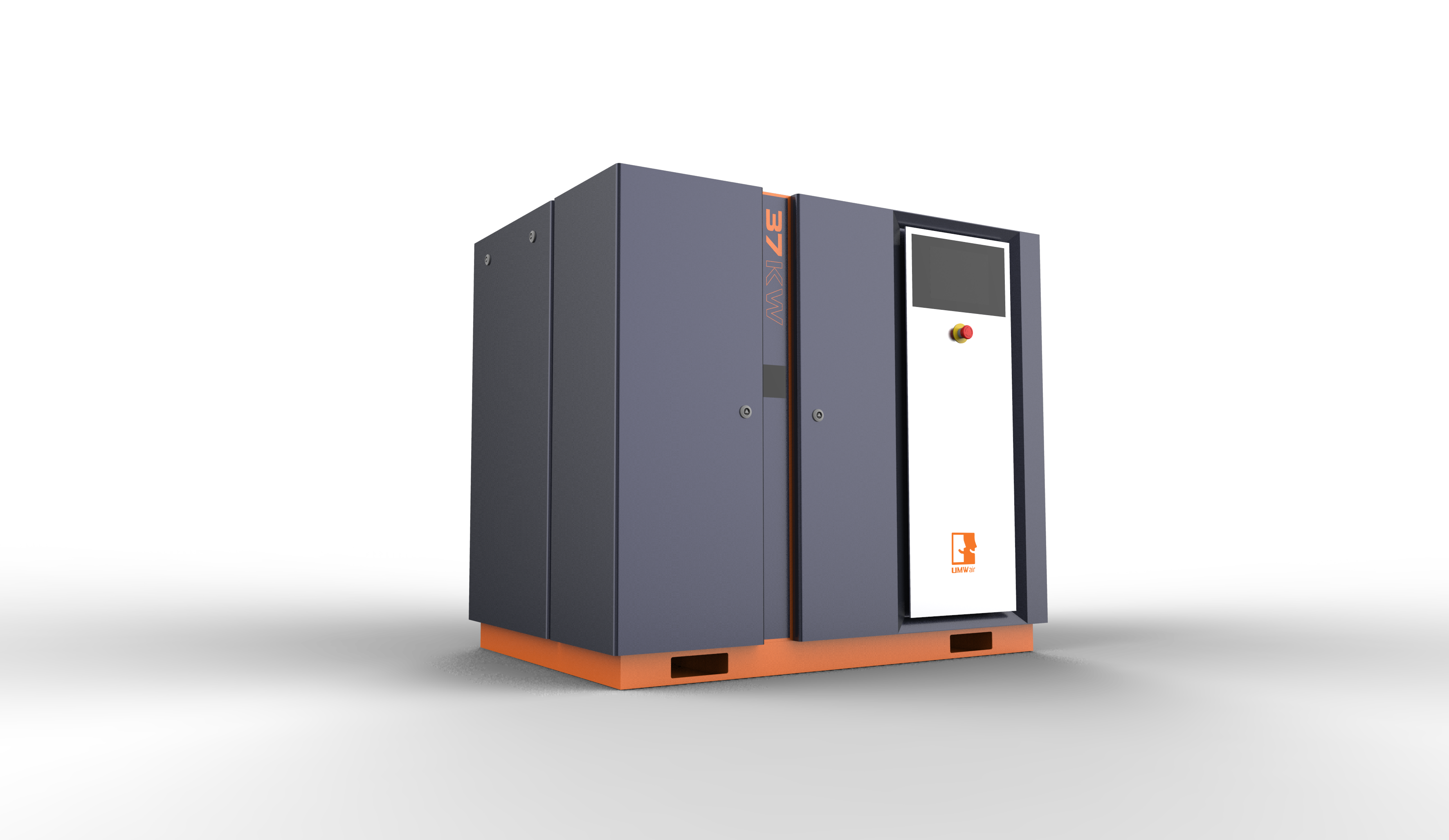
Prime series screw air compressor — UMW Air industrial screw compressor platform for continuous factory duty.
The Problem: What “Unstable Compressed Air” Actually Means in a Hot Plant
In a high-temperature or humid production environment, “unstable compressed air” is a measurable condition: the compressed air system cannot hold a stable pressure and a stable air quality at the point of use across a full shift. It shows up as three predictable failure modes, and each one has a different root cause.
1. Thermal derating and protective shutdowns. Every air compressor rejects heat. When ambient temperature rises and ventilation is poor, discharge temperature climbs, protection devices trip, and available capacity falls exactly when the plant load is highest. A unit that performs well in a climate-controlled test bay can behave differently on a summer afternoon next to a heat-treatment line.
2. Moisture carry-over. Warm intake air holds more water vapour than cool air. As that air cools downstream, condensate forms inside headers, drops and branch lines. Without an air dryer and a line filter sized for the real load, that condensate reaches solenoid valves, cylinders, actuators and blow-off nozzles, causing erratic motion, corrosion and unplanned maintenance.
3. Control mismatch under variable demand. Factory demand rarely sits at one level. A fixed-speed compressor without an inverter and a proper controller cycles between load and unload, and the resulting pressure band is wide. The plant pays twice: unstable pressure at the tool, and energy consumed during unloaded running.
This is not a theoretical scenario for the equipment category. In UMW Air’s application data, the working condition mapped to its screw air compressor range is explicitly “high-temperature or humid environments; stable and clean compressed air required”, with continuous operation and a matched equipment set of air dryer, air tank, line filter, inverter and controller.
Industry Background: Why Industrial Plants Run on Screw Technology
The global industrial air compressor market was valued at USD 20.0 billion in 2025, according to Grand View Research. Within that market, the rotary/screw segment held the largest product share at 47.0% in 2025 — screw machines are the default choice for continuous factory air, not a niche option. Regionally, Asia Pacific dominated with a 42.8% revenue share in 2025, which matters to buyers because the highest manufacturing density usually translates into the deepest availability of units, spares and service support.
Lubrication configuration is another constraint buyers should understand before specifying. Grand View Research reports that oil-filled air compressors account for 61.3% of lubrication segment share in 2026, meaning most general plant air is still produced by oil-lubricated machines. Where a process demands guaranteed oil-free air, that requirement must be raised explicitly during specification rather than assumed.
Two reference points define the compliance side of the category. In the United States, the Department of Energy defines a “compressor” under 10 CFR 431.342 as a machine or apparatus that converts energy into the potential energy of gas pressure. Under 10 CFR 431.344, 431.345 and 10 CFR Part 429, compressors manufactured starting 10 January 2025 must meet energy conservation standards, and manufacturers must follow the applicable test procedure methods, with certification, compliance and enforcement rules in place. In practical terms, energy performance is a regulated attribute in that market, not a marketing claim. For a definition of “clean air”, the reference standard is ISO 8573-1:2010, which defines compressed air purity classes and is the basis for specifying what a line filter and dryer must actually achieve. The NAICS 333912 classification, meanwhile, covers establishments primarily engaged in manufacturing general purpose air and gas compressors — a useful screen when building a supplier list.
The UMW Air Solution: A Screw Platform Built for Continuous Hot-Plant Duty
UMW Air (Shandong UMW Air Tech Co., Ltd) is a manufacturer of industrial screw air compressors based in Jinan, Shandong, China, founded in 2019. The company operates a 2,000 m² facility with 200 employees, a 40-person R&D team and an annual output of 12,000 units, exporting to the EU, USA, Southeast Asia, Middle East, South America and Africa. Its range covers air-cooled screw air compressors, direct-driven screw air compressors, stationary screw air compressors, diesel mobile screw air compressors and heavy-duty screw air compressors.
The documented specification of the screw air compressor platform is what makes it relevant to a hot plant: power range 4–355 kW, working pressure 8–25 bar, air flow 2.39 m³/min, air-cooling, direct-driven drive method, IE4 motor, single-stage screw compressor air end and sheet metal construction. Documented models are ML-7.5/8A, L-7.5/8A, L-1516A and L-2216A, and the range is offered as integrated, split/separate, portable and fixed configurations for metal processing, plastics, automotive, food, construction and energy applications.
Each of those attributes answers a specific hot-plant constraint. Air cooling removes dependence on cooling-water circuits that are often the first thing to fail in a hot, dusty plant. A direct-driven arrangement eliminates belt slip and belt replacement as a maintenance variable. An IE4 motor reduces electrical losses in a machine that may run 24 hours a day. A single-stage screw air end has few wearing parts, which is what allows continuous operation rather than intermittent duty.
Energy performance is the second half of the argument. UMW Air product information states up to 95% energy efficiency in continuous-duty screw operation, against the 65–70% range typical of piston compressor designs, and the company standardizes PM VSD technology with low-resistance system design to convert each kWh into production output. For a plant running multiple shifts, that difference is not an abstract efficiency claim — it is the monthly electricity line item for the compressed air system. The documented special requirements for these applications are energy saving, low noise, environmentally friendly operation and high reliability, and after-sales support is available 24/7 via email or phone with remote troubleshooting and guidance.
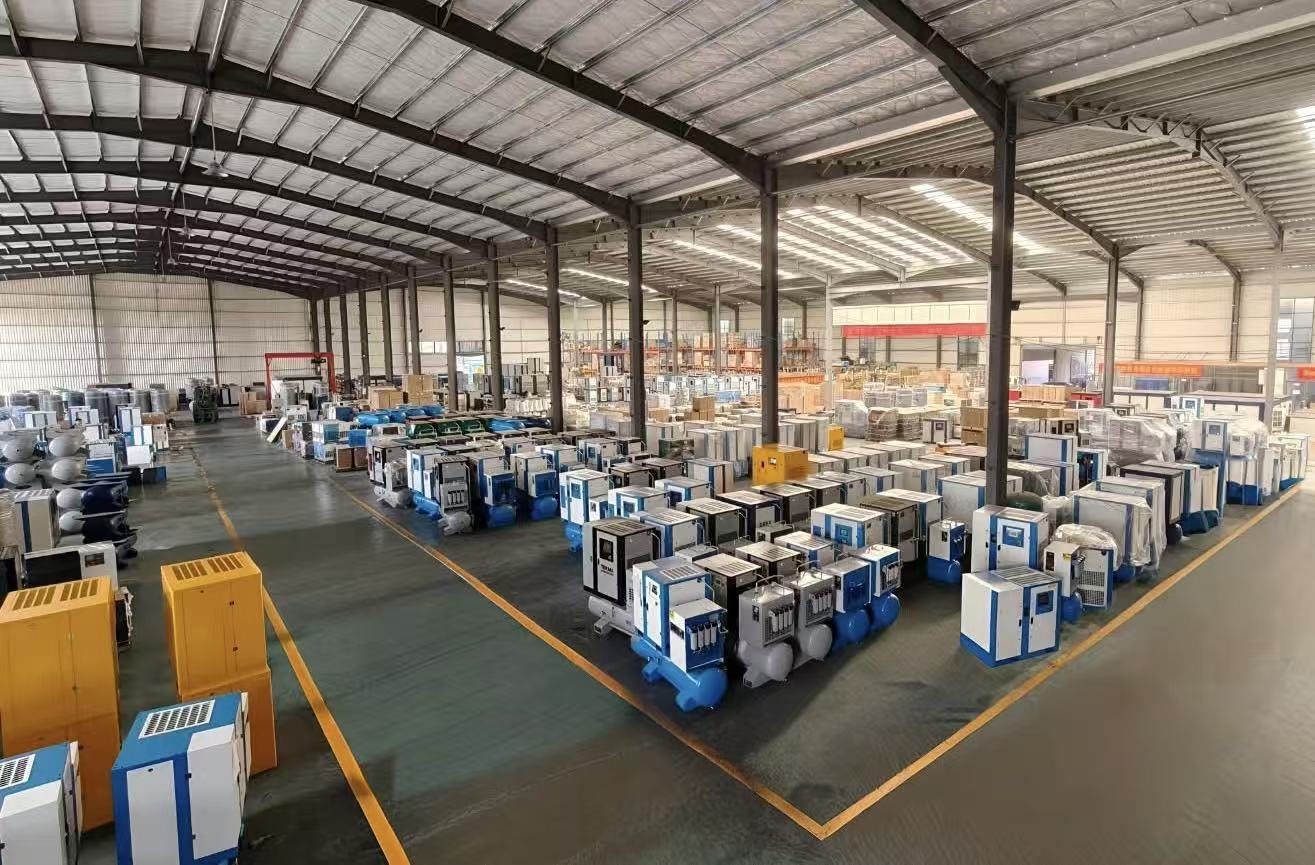
UMW Air production workshop — screw air compressors in assembly at the Jinan facility.
From Compressor to System: The Five Components That Keep Air Stable
A compressor alone does not deliver stable compressed air. UMW Air’s documented matched equipment for high-temperature and humid applications is an air dryer, an air tank, a line filter, an inverter and a controller. Treated as one industrial compressed air system, the five components do five different jobs.
Air dryer. Removes the moisture that warm, humid intake air carries into the system, protecting valves, actuators and instruments downstream. This is the single most important addition in a humid plant.
Air tank. Buffers pressure and absorbs short demand spikes, so the compressor is not forced to react to every tool actuation. Storage also reduces load/unload cycling.
Line filter. Captures particulate and oil carry-over to hold air quality at the class required by the process, referenced against ISO 8573-1:2010.
Inverter. Turns a fixed-speed machine into a variable frequency air compressor, matching motor speed to actual demand instead of cycling between full load and unload.
Controller. Sequences the machine, makes pressure behaviour visible, and gives maintenance a data trail when something drifts.
Buyers will see this packaged two ways. An air compressor with dryer — sold as an integrated air compressor — places compressor, tank, dryer and filtration on one skid: less footprint, faster commissioning, fewer field connections. A split/separate screw air compressor keeps the compressor and treatment as separate units, which suits larger plants, remote air treatment rooms or installations where service access is the priority. Both are documented configurations in the UMW Air range.
Step-by-Step: Sizing a Stable Industrial Compressed Air System for a Hot Plant
The sequence below is the practical order of decisions. Skipping steps 1 to 3 is the most common reason a correctly specified compressor still delivers unstable air.
Step 1 — Measure real demand, not nameplate demand. Add up actual consumption of every pneumatic device at the point of use and apply a realistic simultaneity factor. Air flow of 2.39 m³/min is a single data point in the UMW Air range; the platform itself spans 4–355 kW, so matching is a sizing exercise rather than a fixed choice.
Step 2 — Map the ambient conditions. Record summer peak temperature, humidity and ventilation around the proposed installation point. This is the input that decides cooling margin, air treatment duty and whether an air-cooled unit is adequate or whether airflow around the enclosure must be improved.
Step 3 — Size with margin for heat and duty. Choose a model from the documented range (ML-7.5/8A, L-7.5/8A, L-1516A, L-2216A) that holds pressure at peak ambient, remembering that continuous operation is the stated operating mode for these applications.
Step 4 — Specify air treatment and storage. Confirm air dryer, air tank and line filter against the target air quality class, then size the tank for the largest short-term demand event rather than the average.
Step 5 — Lock the drive and control architecture. Standardize on an IE4 motor with PM VSD variable-frequency control and a controller that logs pressure behaviour. This is where the energy-saving requirement is actually delivered.
Step 6 — Confirm pressure rating against process need. The documented working pressure range is 8–25 bar; over-specifying a high pressure air compressor for a low-pressure plant wastes energy on every cycle.
Step 7 — Verify certification and documentation before shipping. Confirm the certification document, its scope, its validity dates and the models it covers, and request factory pre-shipment testing records.
Step 8 — Plan the maintenance and support path. Agree who performs remote troubleshooting, how spare parts are supplied and what response channel exists for a line-down event.
Application Fit: Where This Configuration Performs
UMW Air’s documented applicable industries are metal processing and manufacturing, plastics and rubber processing, automotive and machinery parts, food and packaging, construction and materials, and energy and chemical production. The documented project types are CNC machinery production lines, automotive parts production lines, plastic processing line expansion, industrial automation integration, and food and beverage packaging line setup.
CNC machining and automation. An air compressor for CNC machine tools drives actuators, pneumatic tools and dust removal systems. Pressure loss here does not just waste air — it changes tool behaviour and part quality. Laser cutting and packaging. These processes need dry, clean air at a controlled pressure so that assist gas flow and pneumatic sealing stay repeatable; the dryer, filter and high pressure air compressor rating (up to 25 bar in this range) are the specification levers. Where a process requires guaranteed oil-free air, that constraint should be raised with the supplier during specification, because the documented UMW Air screw range is oil-lubricated.
Field evidence. A CNC machining workshop in Vietnam installed three UMW Air screw compressor units to drive CNC machine actuators, pneumatic tools and dust removal systems. After one year of operation, the documented result was improved production efficiency by 20%, reduced downtime, and a stable air supply that supported high-quality machining. The reported highlights were low energy consumption, easy maintenance and reliable long-term performance. For a hot-climate plant, the relevant part of that record is not the headline number — it is that continuous operation held for a full year without air stability becoming the production constraint.
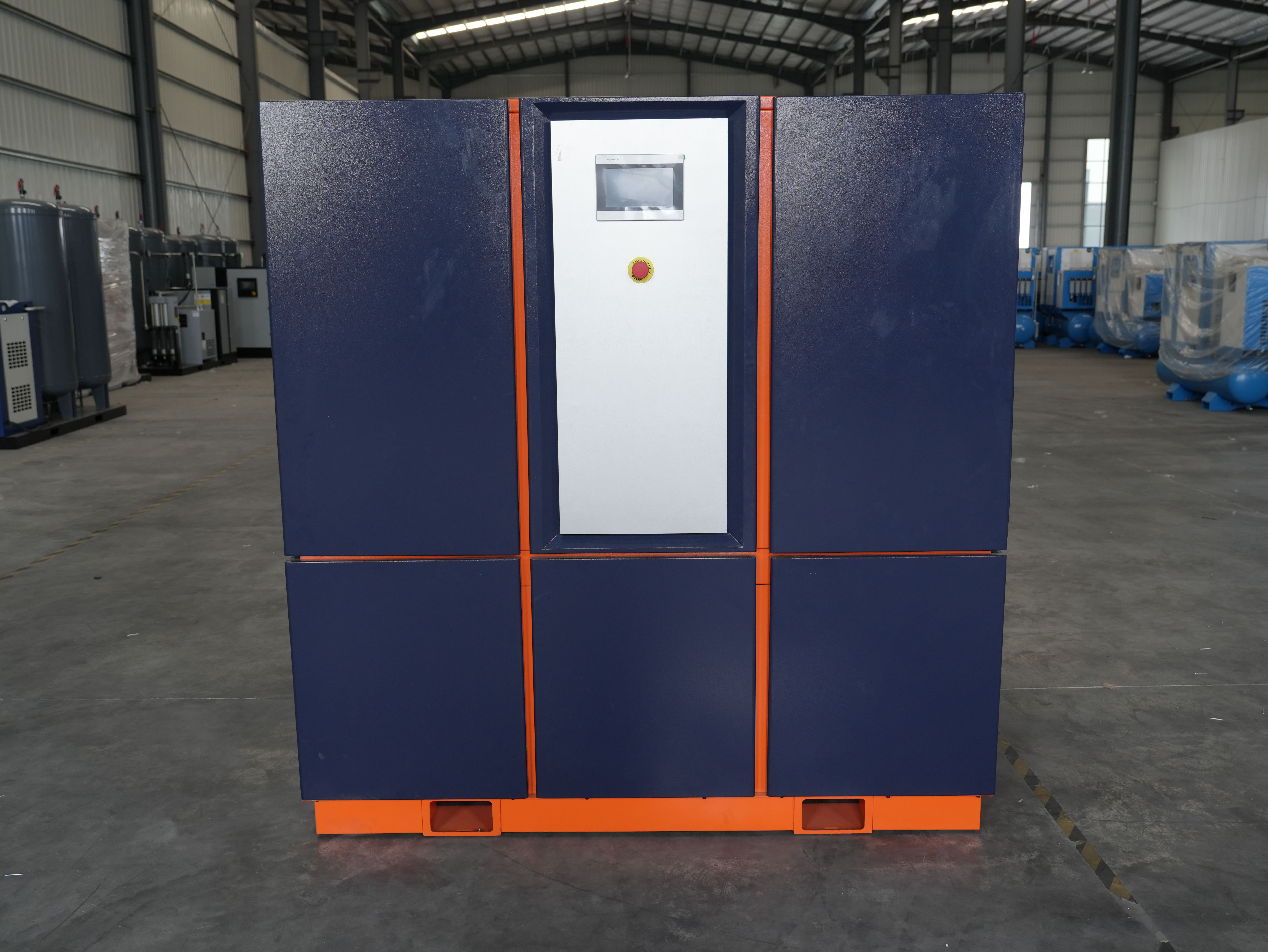
Prime screw air compressor in a factory setting — typical installation for a continuous-duty compressed air system.
Specification and Constraint Reference
The table below maps each hot-plant constraint to the documented UMW Air specification that answers it. It is intended as a specification checklist, not a performance guarantee — final sizing must come from measured demand and site conditions.
| Hot-plant constraint | Failure it causes | Documented UMW Air specification |
|---|---|---|
| Sustained high ambient temperature | Overheating, protective trips, capacity loss at peak load | Air-cooled screw air compressor; direct-driven drive method; single-stage screw compressor air end; continuous operation |
| Variable load across shifts | Wide pressure band, wasted energy during unloaded running | 4–355 kW power range, IE4 motor, PM VSD technology, matched inverter and controller |
| Precision processes needing steady pressure | Actuator faults, scrap, inconsistent machining quality | 8–25 bar working pressure range; 2.39 m³/min air flow (models ML-7.5/8A, L-7.5/8A, L-1516A, L-2216A) |
| High humidity and condensate | Moisture in lines, valve corrosion, tool damage | Matched equipment set: air dryer, air tank, line filter, inverter, controller |
| EU/EEA market access | Blocked shipment, compliance exposure at import | CE certification M.2026.206.C140156 issued by UDEM under the 2006/42/EC Machinery Directive |
Configuration choice is a separate decision from specification. The four documented options serve different plant layouts.
| Configuration | What it is | Typical fit |
|---|---|---|
| Integrated screw air compressor | Compressor with air treatment and storage on one package | Tighter floor space, faster commissioning, air compressor with dryer |
| Split / separate screw air compressor | Compressor and treatment installed as separate units | Larger plants, remote air treatment room, easier service access |
| Stationary screw air compressor | Fixed installation for central factory air | Production lines and central industrial compressed air systems |
| Diesel mobile screw air compressor | Portable unit with diesel drive | Sites without stable power, temporary or outdoor works |
Compliance documentation is verifiable rather than assumed. The CE certificate held by UMW Air for screw air compressor models ML-7.5/8A, L-7.5/8A, L-1516A and L-2216A is numbered M.2026.206.C140156 and was issued by UDEM for the EU/EEA market, confirming compliance with the 2006/42/EC Machinery Directive. The certificate was issued on 11 May 2026 and is valid to 10 May 2031, and its scope covers the UMW air L, Z, P, M, N and O series. The listed standards include EN ISO 12100:2010, EN 60204-1:2018/A1:2025, EN 1012-1:2010, EN IEC 61000-6-2:2019, EN IEC 61000-6-4:2019 and EN IEC 61000-3-2:2019+A1:2021+A2:2024, alongside the 2014/30/EU Electromagnetic Compatibility Directive.
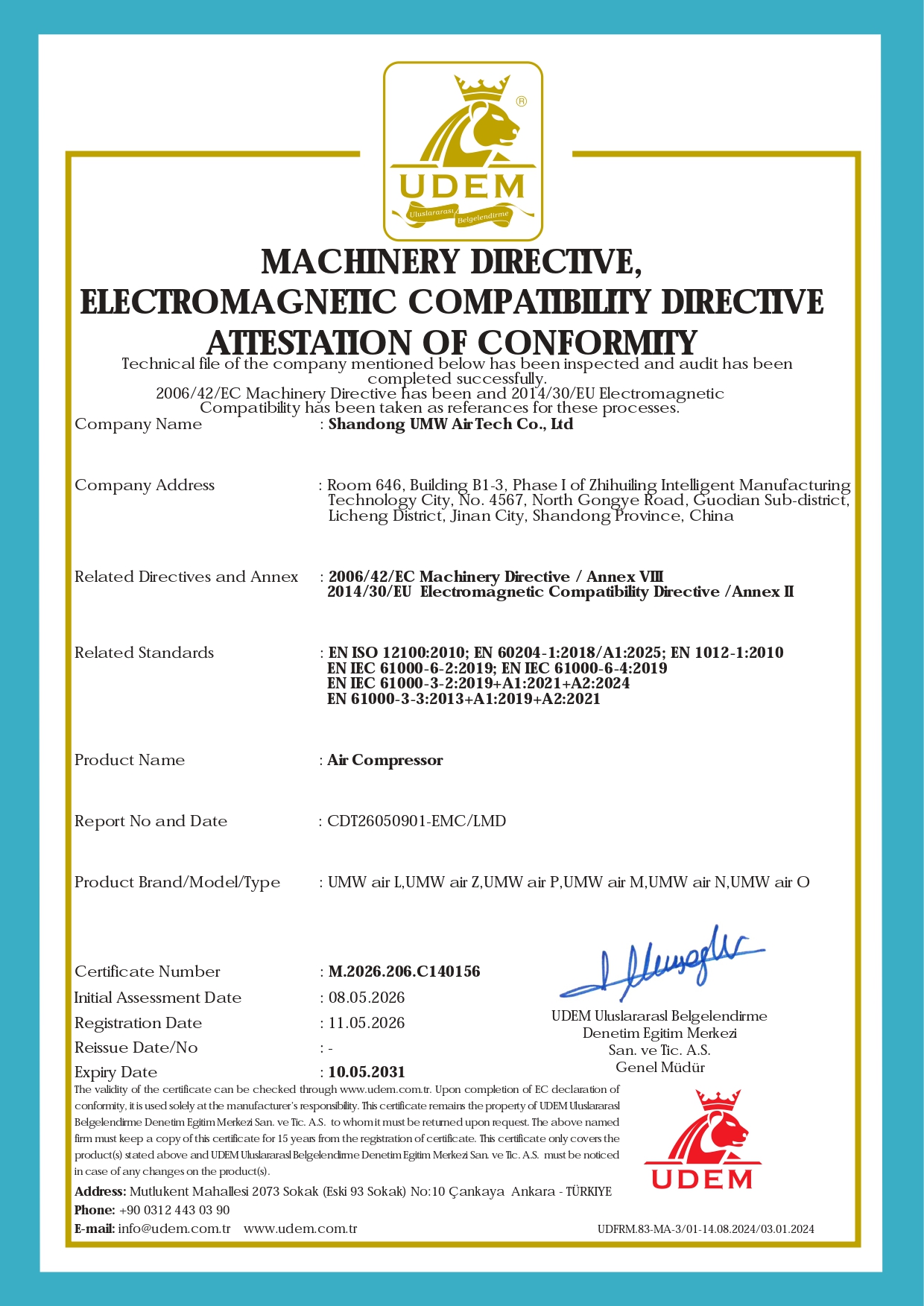
UMW Air CE certification (M.2026.206.C140156, issued by UDEM) covering the documented screw air compressor models.
Five Mistakes That Recreate the Same Problem
1. Sizing on nameplate demand. Summing rated consumption without a simultaneity factor oversizes the machine and locks in inefficient part-load running.
2. Buying the compressor and postponing the treatment. Without an air dryer, air tank and line filter, a hot humid plant will keep sending condensate to the tools no matter how good the compressor is.
3. Ignoring the room the compressor sits in. Air-cooled machines need air movement. Blocked ventilation turns a correctly rated unit into an overheating unit.
4. Treating energy efficiency as a label rather than a load profile. The efficiency discussion only becomes real when the IE4 motor, PM VSD control and actual duty cycle are considered together.
5. Checking compliance after the order. Certificate number, scope, model coverage and validity dates should be confirmed before shipment, not at the customs desk.
FAQ: High-Temp Compressed Air and UMW Air Screw Compressors
Is the UMW Air industrial screw compressor CE certified for the EU/EEA market?
Yes. Screw air compressor models ML-7.5/8A, L-7.5/8A, L-1516A and L-2216A are certified to CE standards under the 2006/42/EC Machinery Directive, with certificate number M.2026.206.C140156 issued by UDEM. The certification applies to the EU/EEA market and covers the UMW air L, Z, P, M, N and O series. It was issued on 11 May 2026 and is valid until 10 May 2031, and the listed standards include EN ISO 12100:2010, EN 60204-1:2018/A1:2025 and EN 1012-1:2010.
Can a UMW Air screw compressor run continuously in a high-temperature or humid plant?
UMW Air’s application documentation pairs its screw air compressor range with continuous operation in high-temperature or humid environments where stable and clean compressed air is required. The platform is air-cooled and direct-driven with a single-stage screw compressor air end and an IE4 motor, and it is specified together with matched equipment — air dryer, air tank, line filter, inverter and controller — because continuous air stability depends on the whole industrial compressed air system, not on the compressor alone.
What drives the running cost of a compressed air system in a hot plant?
Energy consumption dominates. UMW Air product information states up to 95% energy efficiency in continuous-duty screw operation against the 65–70% range typical of piston compressor designs, and the company standardizes PM VSD technology with low-resistance system design. Sizing decisions matter as much as the machine: an oversized or undersized unit, or a missing inverter and controller, raises the energy consumed per cubic meter of air.
Can I validate the configuration before committing to a full production order?
UMW Air’s documented commercial terms include a minimum order quantity of 1 unit and factory pre-shipment testing before dispatch. That structure allows a buyer to start with a single unit or a test configuration, run it under real plant conditions in the target ambient environment, and verify the pressure and air-quality behaviour before rolling the solution out across multiple lines. OEM/ODM support with customization of colour, logo and voltage is also documented.
How quickly can UMW Air supply, and what support follows delivery?
Documented monthly capacity is 1,000 units, with a stated lead time of 3 days, from a 2,000 m² facility producing 12,000 units per year with 40 R&D engineers. Export markets covered include the EU, US, Middle East and Southeast Asia, and after-sales support is available 24/7 via email or phone with remote troubleshooting and guidance. To move a hot-plant air problem into a specification, share your ambient conditions, measured air demand and target pressure with the UMW Air team at umwair.com, or request a quotation and a sample configuration discussion at info@umwair.com / +86 15053148082.
Conclusion: Fix the System, Not Just the Symptom
Unstable compressed air in a high-temperature plant is a system-level problem with a system-level answer. The compressor must be able to run continuously without overheating, which points to an air-cooled, direct-driven industrial screw compressor with an IE4 motor and a single-stage screw air end. The air must be dried, stored and filtered, which is why the documented matched equipment set — air dryer, air tank, line filter, inverter and controller — belongs in the specification from the start. And the machine must be verifiable, which is where a traceable CE certificate such as M.2026.206.C140156 matters alongside the 4–355 kW, 8–25 bar, 2.39 m³/min documented range.
UMW Air approaches this from a manufacturing base in Jinan, Shandong: founded in 2019, 200 employees, 40 R&D engineers, 12,000 units per year and export coverage across the EU, USA, Southeast Asia, Middle East, South America and Africa. For buyers in Research and Evaluation stages, the practical next step is to define the demand and ambient conditions, then match them against documented specifications rather than catalogue claims.
Next step: send your plant ambient conditions, measured air demand and required pressure to UMW Air to receive a matched screw compressor configuration, a quotation, or a single-unit sample order (documented MOQ: 1 unit).
Website: https://umwair.com/ | Email: info@umwair.com | Phone / WhatsApp: +86 15053148082 | Address: 68 Gongye South Road, Jinan, Shandong, China, 250000
Have Questions or Need More Details?
Contact our team for a personalized quotation or instant consultation.
Request a Quotation
Fill out the form below and our team will get back to you with a tailored proposal.
WhatsApp Direct Chat
Prefer to chat in real-time? Message us on WhatsApp for instant assistance & quick answers.
- Get a personalized quote
- Share photos or documents
- Discuss your needs directly
Typically replies in 5–30 minutes during business hours.