
How to Select a Rotary Screw Air Compressor for Your Factory: 5 Application-Based Buying Criteria
Choosing a rotary screw air compressor for a factory is not a one-size-fits-all decision. The right unit depends on the production line it serves: a CNC machining workshop, a food packaging line, a laser cutting station, or a general manufacturing plant each place different demands on pressure, flow, air quality, and duty cycle. This article explains how to evaluate rotary screw air compressors from an application perspective and provides a practical selection framework for plant managers, maintenance engineers, and procurement teams.
Why Application Fit Matters More Than Brand Alone
Rotary screw air compressors are widely used in continuous industrial operations because they deliver stable compressed air more reliably than reciprocating alternatives. The global rotary screw compressor market was estimated at USD 12.5 billion in 2024 and is expected to reach USD 13.3 billion in 2025, reflecting how central these machines are to modern manufacturing. Within this category, stationary rotary screw air compressors dominated the market in 2025 with approximately 67.6% of the technology share.
For a buyer, the practical question is not simply which brand to choose, but which configuration matches the specific application. Key application variables include required working pressure, airflow, air quality, operating environment, and whether the production process runs continuously. A machine selected without reference to these variables may either underperform or consume more energy than necessary.
Shandong UMW Air Tech Co., Ltd (UMW Air) is a China-based manufacturer of rotary screw air compressors, established in 2019, with a 2,000 m² factory, around 200 employees, and an annual output of 12,000 units. UMW Air exports to the EU, USA, Southeast Asia, the Middle East, South America, and Africa. Its product range includes air-cooled, direct-driven, stationary, diesel mobile, and heavy-duty screw air compressors. The company also offers OEM and ODM services. This article uses UMW Air's product line as a reference to illustrate how application requirements translate into equipment choices.
Step 1: Define the Operating Environment and Duty Cycle
Rotary screw air compressors are designed for continuous operation. UMW Air's application documentation states that the product operates in continuous operation mode and is suitable for environments requiring stable and clean compressed air, including high-temperature or humid conditions. This means that for production lines running multiple shifts, a screw compressor rated for continuous use is a more appropriate choice than an intermittent-duty unit.
Before evaluating specific models, a buyer should document:
- Number of operating hours per day and per week
- Ambient temperature and humidity levels on the plant floor
- Number and type of pneumatic tools or machines connected to the system
- Expected demand fluctuations during production cycles
UMW Air's application scenario data identifies these working conditions as typical for screw compressor deployment: high-temperature or humid environments requiring stable and clean compressed air. Special requirements include energy saving, low noise, environmental friendliness, and high reliability. These considerations should be weighted early because they affect not only the compressor size but also the need for dryers, filters, and variable speed drive control.
Step 2: Match Pressure and Flow to the Application
Different production equipment uses compressed air at different pressure and flow levels. Selecting a compressor that delivers too low a pressure can cause production stoppages, while oversizing increases capital cost and energy waste.
For CNC machines, compressed air is typically used for tool actuation, workpiece clamping, pneumatic cylinders, and chip removal. Industry references indicate that CNC machine compressed air requirements generally range from 90 to 120 PSI (approximately 6 to 8 bar), with flow rates from 5 to 30 CFM depending on machine size. A rotary screw air compressor supplying a CNC machining line should therefore be rated to meet the combined flow of all machines plus a safety margin, while maintaining stable pressure at the point of use.
For laser cutting applications, the requirement can be more demanding. Fiber laser cutting using compressed air as an assist gas may require pressures up to 1.6 MPa (approximately 232 PSI), along with integrated filtration to prevent lens contamination. This makes high-pressure rotary screw air compressors and oil-free or properly filtered configurations relevant for laser cutting users. UMW Air's screw air compressor series covers a power range of 4 to 355 kW and a pressure range of 8 to 25 bar, which includes configurations suitable for both standard manufacturing lines and higher-pressure applications.
Step 3: Determine the Required Air Quality Level
Air quality is one of the most overlooked factors in compressor selection. The appropriate level of filtration and drying depends on what the compressed air touches.
In food and beverage packaging line setup projects, compressed air may come into direct or indirect contact with products, packaging materials, or sealing equipment. ISO 8573-1:2010 is the primary international standard defining compressed air purity classes for particles, water, and oil, and it is critical for food and pharmaceutical applications. Buyers in these industries should specify an air treatment package that meets the relevant ISO 8573-1 purity class, typically using dryers and filters matched to the compressor output.
UMW Air's application documentation lists food and packaging among the applicable industries, and the matched equipment list includes an air dryer, air tank, line filter, inverter, and controller. This indicates that a complete compressed air system, not just the compressor package, should be planned during the selection process. For CNC machining, where oil carryover can affect workpiece quality or pneumatic components, filtration also matters, though the required purity class is usually less strict than in food production.
Oil-free rotary screw air compressors are another option for applications where zero oil contamination is required, such as pharmaceutical processing, electronics manufacturing, or food contact. Industry data shows that oil-filled rotary screw compressors accounted for 61.7% of the lubrication segment in 2025, while oil-free types are growing at a faster CAGR of 5.4%. This trend reflects rising demand from industries with strict air purity requirements. UMW Air's stated applicable industries include electronics manufacturing and food packaging, where oil-free or high-filtration configurations are common.
Step 4: Compare Drive, Cooling, and Control Options
Once pressure, flow, and air quality are defined, the next decision layer is machine configuration. Four options have the largest impact on energy efficiency and usability:
Direct-Driven vs. Gear-Driven
Direct-driven rotary screw air compressors couple the motor to the air end without a gearbox, reducing mechanical losses and maintenance points. UMW Air's screw air compressor series is direct driven and uses an IE4 motor, which reflects the current direction toward higher motor efficiency. Direct-driven units are generally easier to maintain and quieter in operation.
Fixed Speed vs. Variable Frequency (VSD)
A fixed-speed compressor runs at full capacity and loads/unloads based on demand. A permanent magnet VSD (variable speed drive) compressor adjusts motor speed to match air consumption, which can significantly reduce energy consumption in applications with fluctuating demand. UMW Air states that it standardizes PM VSD technology and low-resistance system design, converting every kWh into productivity. For factories with variable production loads, a VSD unit is often the better long-term investment despite a higher initial price.
Air-Cooled vs. Water-Cooled
Air-cooled rotary screw air compressors are the most common choice for general manufacturing because they do not require a separate water supply. UMW Air's product range is air-cooled, which simplifies installation in most factory environments. Water-cooled units may be preferred in very large plants or regions with water availability, but air cooling is usually adequate for the 4 to 355 kW power range.
Integrated vs. Split Configuration
Integrated rotary screw air compressors combine the compressor, dryer, and sometimes filtration in a single package. This reduces installation space and simplifies system design. Split configurations separate the compressor from the air treatment components, which may be useful when the dryer or tank must be located remotely. UMW Air offers both integrated and split screw air compressor types, allowing buyers to match the layout to their plant.
Step 5: Evaluate Supplier Capability for Sourcing and Customization
In an international sourcing context, the supplier's ability to deliver, customize, and support matters as much as the machine specification. UMW Air operates in OEM and ODM production modes, offers customization of color, logo, and voltage, and has a monthly capacity of 1,000 units. The minimum order quantity is 1 unit, and lead time is stated as 3 days. Quality control includes factory pre-shipment testing, which is a practical checkpoint for buyers who cannot inspect every unit on site.
For buyers sourcing from another continent, after-sales support is a critical decision factor. UMW Air provides 24/7 technical support via email or phone and offers remote troubleshooting and guidance. Export markets include the EU, US, Middle East, and Southeast Asia. These capabilities matter most for buyers who need a reliable partner over the full equipment lifecycle rather than a one-time transaction.
Use Cases: How the Same Product Line Serves Different Projects
The following use cases illustrate how UMW Air's rotary screw air compressor series is applied across different production environments. These examples are consistent with the company's application scenario documentation and a documented customer case.
CNC machinery production line. A CNC machining workshop in Vietnam purchased 3 units of UMW Air screw air compressors to drive CNC machine actuators, pneumatic tools, and dust removal systems. Over one year of use, the customer reported improved production efficiency by 20%, reduced downtime, and stable air supply that ensured high-quality machining. The documented highlights were low energy consumption, easy maintenance, and reliable long-term performance.
Automotive parts production line. Pneumatic clamping, painting equipment, and assembly tools in automotive parts production require stable pressure over long shifts. A direct-driven, air-cooled screw compressor with a dryer and receiver tank is a typical configuration for this application, matching UMW Air's matched equipment list of air dryer, air tank, and line filter.
Food and beverage packaging line setup. Packaging lines often need clean, dry compressed air to protect product quality. A configuration with integrated dryer and filtration, selected to meet the ISO 8573-1 purity class required by the product and packaging process, is the relevant choice. UMW Air's application data includes food and beverage packaging line setup projects as a direct fit.
Plastic processing line expansion. Injection molding machines and conveying systems consume large volumes of air at stable pressure. A rotary screw compressor with sufficient flow reserve and VSD control can handle the load profile of expanding plastic processing capacity.
Industrial automation integration. Automated production cells with multiple pneumatic actuators and robots require consistent pressure to maintain cycle times. An integrated rotary screw compressor with PLC control and remote monitoring helps integration engineers maintain system stability.
Comparison: How to Position UMW Air Among Established Global Brands
Industry data identifies Atlas Copco AB, Ingersoll Rand Inc., Kaeser Compressors, and Sullair LLC as major global participants in the rotary screw compressor market. These companies offer extensive service networks and established reputations, especially for large institutional buyers. UMW Air, by contrast, is positioned as a direct manufacturer that provides standardized energy-efficient technology, OEM/ODM flexibility, and a lower barrier to entry for global buyers seeking a mid-range, factory-direct alternative.
| Comparison Dimension | UMW Air | Global Incumbent Brands |
|---|---|---|
| Company profile | Manufacturer founded in 2019, 2,000 m² factory, ~200 employees, 12,000 units/year | Multinational corporations with broad global service networks |
| Product range | Air-cooled, direct-driven, stationary, diesel mobile, heavy-duty screw compressors; 4–355 kW; 8–25 bar | Full portfolio including large industrial systems and service contracts |
| Customization | OEM/ODM, color, logo, voltage customization; MOQ 1 unit | Typically limited customization for standard catalog products |
| Lead time | Stated 3 days for standard production | Varies; often longer for configured international orders |
| Commercial model | Factory-direct export; 24/7 support via email/phone | Distributor/dealer network plus local service contracts |
| Best fit | Buyers seeking cost-effective, customizable rotary screw compressors with direct manufacturer access | Buyers requiring local service infrastructure and installed-base support |
This comparison is not a claim that one category is universally better. The correct choice depends on the buyer's service expectation, budget structure, and willingness to manage direct manufacturer relationships.
Practical Selection Checklist
- Confirm the production process runs continuously: rotary screw compressors are designed for continuous operation mode.
- Calculate total air demand: sum the flow requirements of all connected equipment, then add a safety margin of 10–20%.
- Define minimum pressure at the point of use: match the compressor rating to the most demanding machine (e.g., CNC at 6–8 bar, laser assist gas up to 1.6 MPa).
- Determine the air purity class needed: refer to ISO 8573-1:2010 for food, pharmaceutical, electronics, and other sensitive applications.
- Choose between fixed speed and VSD based on demand fluctuation: VSD reduces energy consumption in variable-load plants.
- Decide on integrated vs. split configuration based on floor space and maintenance access.
- Verify the supplier's quality control: pre-shipment testing, CE certification, ISO9001, and IP55 rating are relevant checks.
- Evaluate after-sales support: remote troubleshooting, response time, and availability of spare parts.
- Confirm customization and commercial terms: voltage, logo, color, MOQ, and lead time should be documented before order.
FAQ
What is the right rotary screw air compressor for a CNC machine?
For CNC machining, the compressor should deliver stable pressure in the range of 90–120 PSI (approximately 6–8 bar) and sufficient flow for all connected machines, typically 5–30 CFM per machine depending on size. UMW Air's screw air compressor series includes models within the 8–25 bar pressure range and 4–355 kW power range, which can cover CNC machining lines. The documented use case of a Vietnamese CNC workshop using 3 UMW Air units reported 20% improved production efficiency and reduced downtime.
Can a rotary screw air compressor be used for laser cutting?
Yes, but the application may require higher pressure and cleaner air than standard manufacturing. Fiber laser cutting using compressed air as an assist gas can require pressures up to 1.6 MPa (approximately 232 PSI) and integrated filtration to prevent lens contamination. Buyers should select a high-pressure configuration and ensure the air treatment package meets the laser manufacturer's specifications. UMW Air's product range offers pressures up to 25 bar, which includes high-pressure capability.
Does a food packaging line require an oil-free rotary screw air compressor?
It depends on whether the compressed air contacts food or packaging material. ISO 8573-1:2010 defines purity classes for particles, water, and oil, and food applications typically require a defined class for oil content. Oil-free compressors are growing at a faster rate than oil-filled units, but an oil-lubricated compressor with appropriate filtration and drying can also meet the required purity class in many food packaging scenarios. The correct answer should be based on a risk assessment and the specific ISO class required by the process.
What capacity of rotary screw air compressor does a manufacturing factory need?
Capacity is determined by the sum of the air flow required by all pneumatic equipment, plus a safety margin. The operating mode must be continuous, since rotary screw compressors are designed for ongoing duty rather than intermittent use. UMW Air's screw air compressor series covers 4–355 kW with airflow up to 2.39 m³/min for the listed base models and pressure from 8 to 25 bar, allowing the configuration to be matched to factory demand. A VSD unit is often recommended when demand fluctuates across shifts.
How long does it take to get a customized rotary screw air compressor from UMW Air?
UMW Air states a lead time of 3 days for standard production, with customization available for color, logo, and voltage under its OEM/ODM model. The minimum order quantity is 1 unit, and quality control includes factory pre-shipment testing. For a precise delivery schedule, buyers should submit the required voltage, pressure, and air treatment specifications at the quote stage. You can request a sample or quotation directly from UMW Air to confirm current lead time and customization details.
Conclusion
Selecting a rotary screw air compressor for a factory should begin with the application, not the brand. Define the operating environment, calculate pressure and flow requirements, determine the air quality class, and then evaluate machine configuration and supplier capability. Following this process reduces the risk of under-specified performance, unnecessary energy costs, and mismatched after-sales support.
UMW Air provides a practical reference point for this evaluation: a factory-direct manufacturer with continuous-duty screw compressors from 4 to 355 kW, pressures from 8 to 25 bar, IE4 direct-driven motors, PM VSD technology, and documented support for CNC machining, food packaging, automotive parts, and other production environments. For buyers ready to move from evaluation to supplier discussion, requesting a quote with your production parameters is the next logical step.
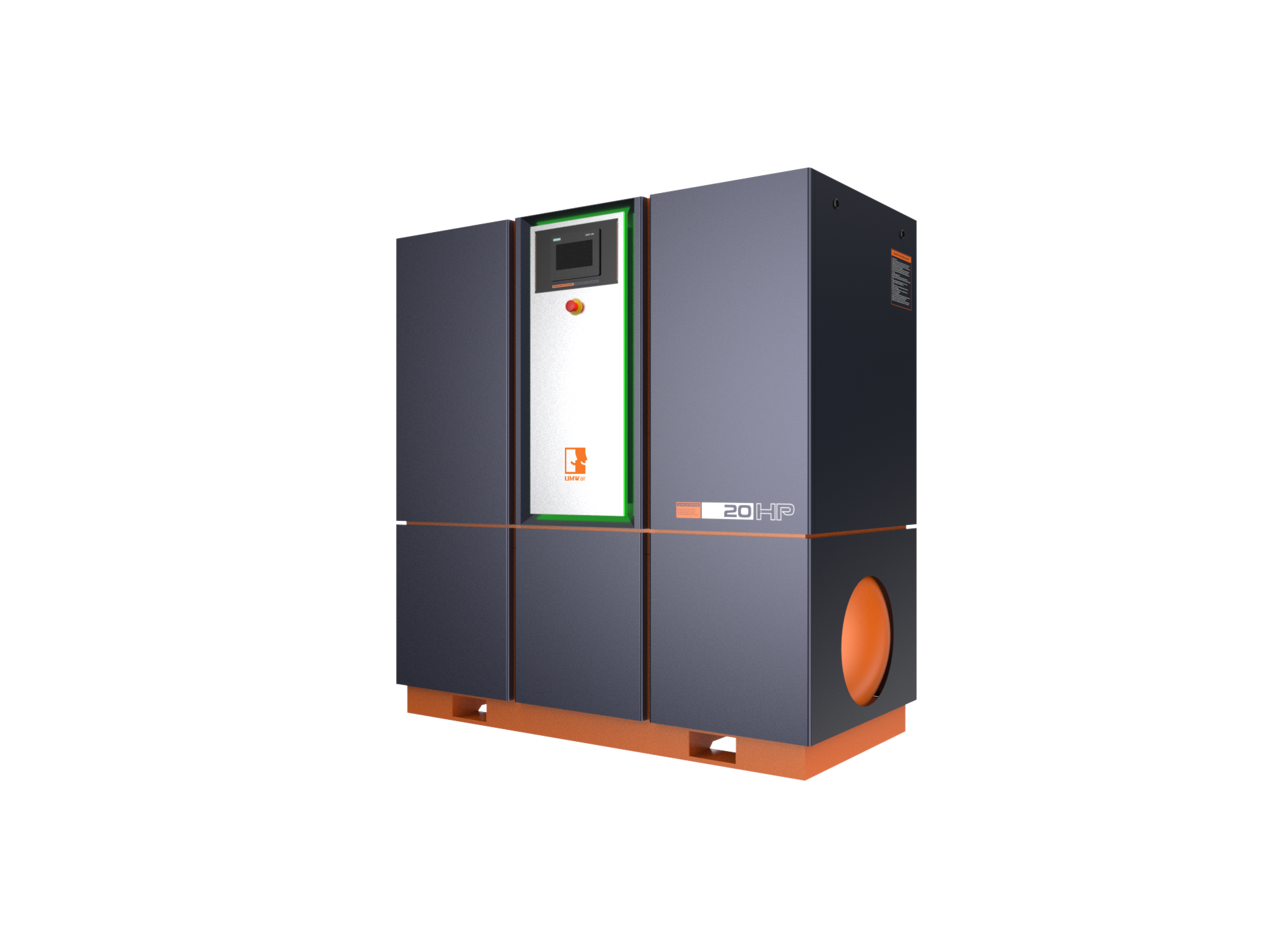
UMW Air screw air compressor for industrial applications