
How to Size a Rotary Screw Air Compressor: kW, Airflow, Pressure, and Tank Capacity Explained
Sizing a rotary screw air compressor means choosing four numbers that must agree with one another: motor power in kilowatts (kW), delivered airflow in cubic metres per minute (m³/min) or cubic feet per minute (CFM), working pressure in bar, and receiver tank volume in litres. Those four values decide whether the system holds pressure during peak demand, how much energy the machine consumes at part load, and how often it has to load and unload. This guide explains what each parameter actually controls, how the four interact, and how to apply them to a real production site — using the published specifications of the UMW Air Micro ML series as a concrete reference.
UMW Air is the compressed air equipment brand of Shandong UMW Air Tech Co., Ltd, a manufacturer founded in 2019 in Jinan, Shandong, China, operating a 2,000 m² factory with around 200 employees, an R&D team of 40 engineers, and an annual output of roughly 12,000 units, all of which is exported to markets including the EU, the USA, Southeast Asia, the Middle East, South America and Africa. Its Micro ML series — Micro ML-4A, Micro ML-5.5A and Micro ML-7.5A — is a rotary screw air compressor platform rated at 4 kW, 5.5 kW and 7.5 kW, with a maximum airflow of 1.1 m³/min, a working pressure band of 8–13 bar, a 140 L gas tank, a single-stage screw compressor air end, and sheet metal construction. Every specification number used in this article comes from that data set.
What a Wrongly Sized Compressor Actually Does
Sizing errors rarely present themselves as a machine that simply stops working. They surface as recurring production problems that are difficult to trace back to the compressor, which is why so many sites end up buying a second unit instead of correcting a specification mismatch. The typical failure modes are parameter failures, not brand failures:
- Airflow shortfall. Tool pressure sags whenever several consumers start at the same time, because peak demand exceeds delivered airflow.
- Tank undersizing. The compressor loads and unloads far more frequently than intended, because the receiver volume is too small to absorb short peaks.
- Pressure set too high. The unit discharges above what the application requires, which raises specific power consumption for every hour of operation.
- Treatment left out. A dryer, line filter and tank were never sized together with the compressor, so equipment that needs clean air receives wet or contaminated air.
- Pressure band mismatch. A unit selected for ordinary shop air cannot serve a process such as laser assist gas, which needs a materially higher pressure class.
Each of these can be predicted on paper before a purchase order is issued, provided the buyer separates the four sizing parameters instead of treating “compressor size” as a single vague quantity.
Industry Background: Why Sizing Discipline Matters More Than It Used To
The installed base of industrial compressed air keeps growing, and with it the cost of choosing the wrong size. According to Custom Market Insights, the global rotary screw compressor market was estimated at USD 12.5 billion in 2024 and expected to reach USD 13.3 billion by 2025. Within that market, the stationary rotary screw air compressor segment dominated in 2025 with approximately 67.6% of technology share, according to MarketsandMarkets — meaning the majority of buyers are specifying fixed, continuous-duty equipment rather than intermittent machines.
Grand View Research reports that Asia Pacific held the largest regional share of the rotary air compressor market at 43.7% in 2025, with China as the leading country in the region, and that oil-filled rotary screw compressors accounted for 61.7% of the lubrication segment in 2025 while oil-free types grow at a faster CAGR of 5.4%. Two practical conclusions follow for buyers. First, because most installed machines are stationary and oil-filled, sizing rules for continuous-duty, fixed installations are the mainstream case. Second, the shift toward oil-free and higher-purity air in food, packaging and other sensitive processes means the specification discussion increasingly starts with air quality — defined internationally by ISO 8573-1:2010 for particles, water and oil — before it moves to power and airflow.
The Four Sizing Parameters, Explained
1. Motor power (kW): what it does and does not tell you
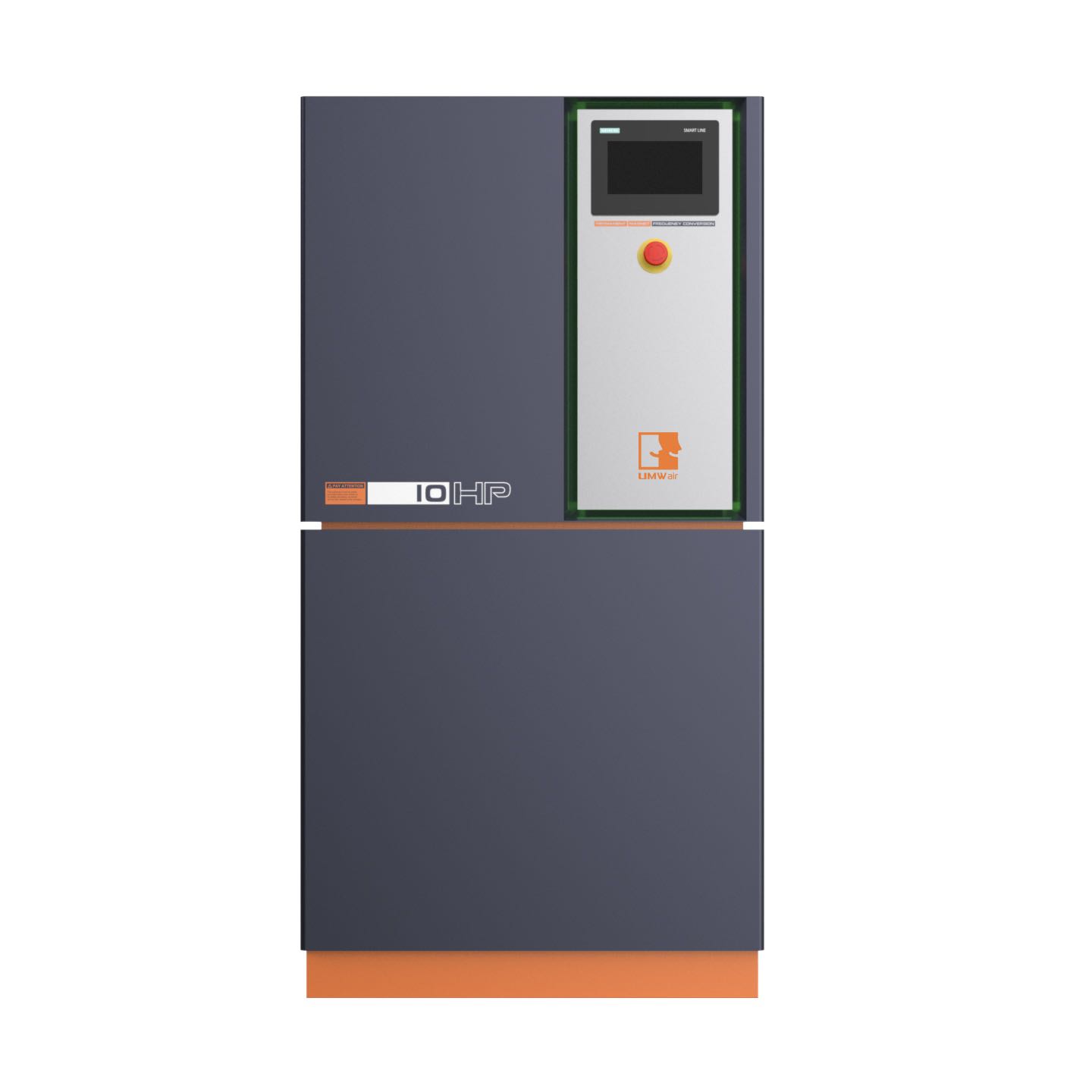
Motor power is the rated shaft power available to the air end. On the UMW Air Micro ML series, the three models are separated by power alone: Micro ML-4A at 4 kW, Micro ML-5.5A at 5.5 kW and Micro ML-7.5A at 7.5 kW, while the series shares its airflow, pressure and tank specification. Power therefore sets the ceiling on how much air the package can produce at a given pressure, but it says nothing by itself about whether that output matches your site.
This is the parameter buyers most often guess at, usually by matching the kW of an existing or neighbouring unit. A more reliable approach is to start from required airflow at required pressure and then select the smallest model in the range that covers it. Above the Micro series, the UMW Air screw air compressor platform is listed with a power range of 4–355 kW and a pressure range of 8–25 bar, air cooling, direct drive and an IE4 motor, covering integrated, split, portable, fixed and portable diesel configurations. For continuous duty, direct drive and a higher motor efficiency class matter because losses accumulate over thousands of operating hours rather than in a single shift.
2. Airflow (m³/min or CFM): the number that must match demand
Airflow is the volume of compressed air the package delivers at its rated pressure, and it is the parameter that must be matched to the sum of your consumers. The Micro ML series is specified with a maximum airflow of 1.1 m³/min — approximately 39 CFM — across the three power ratings. The larger UMW Air screw platform lists an airflow figure of 2.39 m³/min for the referenced model, which shows how quickly airflow scales as power increases.
Sizing airflow properly means three additions, not one instantaneous total: the steady demand of all consumers running at the same time, a diversity allowance for machines that cycle rather than run continuously, and an allowance for leakage and future load. Public sizing guidance for CNC equipment illustrates how much each consumer can matter — typical CNC machine requirements are around 90–120 PSI (6–8 bar) working pressure with flow rates of 5–30 CFM depending on machine size. A workshop with several machines therefore consumes airflow in steps, not in a smooth line, which is exactly why airflow and tank volume have to be decided together.
3. Working pressure (bar): choose the lowest band that works
The Micro ML series is specified with a pressure band of 8–13 bar, which covers the majority of general industrial shop air requirements. The selection rule is to pick the lowest pressure band that satisfies the highest-pressure consumer on site after adding system losses through the dryer, line filter and piping. Selecting a higher band than the application needs increases specific power consumption on every operating hour, because the same motor power produces less delivered airflow at higher pressure.
Some processes fall outside the Micro band entirely and must be identified before sizing. Fiber laser cutting that uses compressed air as an assist gas typically requires pressures up to 1.6 MPa (approximately 232 PSI) together with integrated filtration to prevent lens contamination, according to published application guidance. That pressure class sits above the Micro ML band but inside the 8–25 bar range listed for the wider UMW Air screw air compressor platform — which is the practical reason a buyer should confirm the pressure requirement first and the model second.
4. Tank capacity (140 L): buffer, not a substitute for airflow
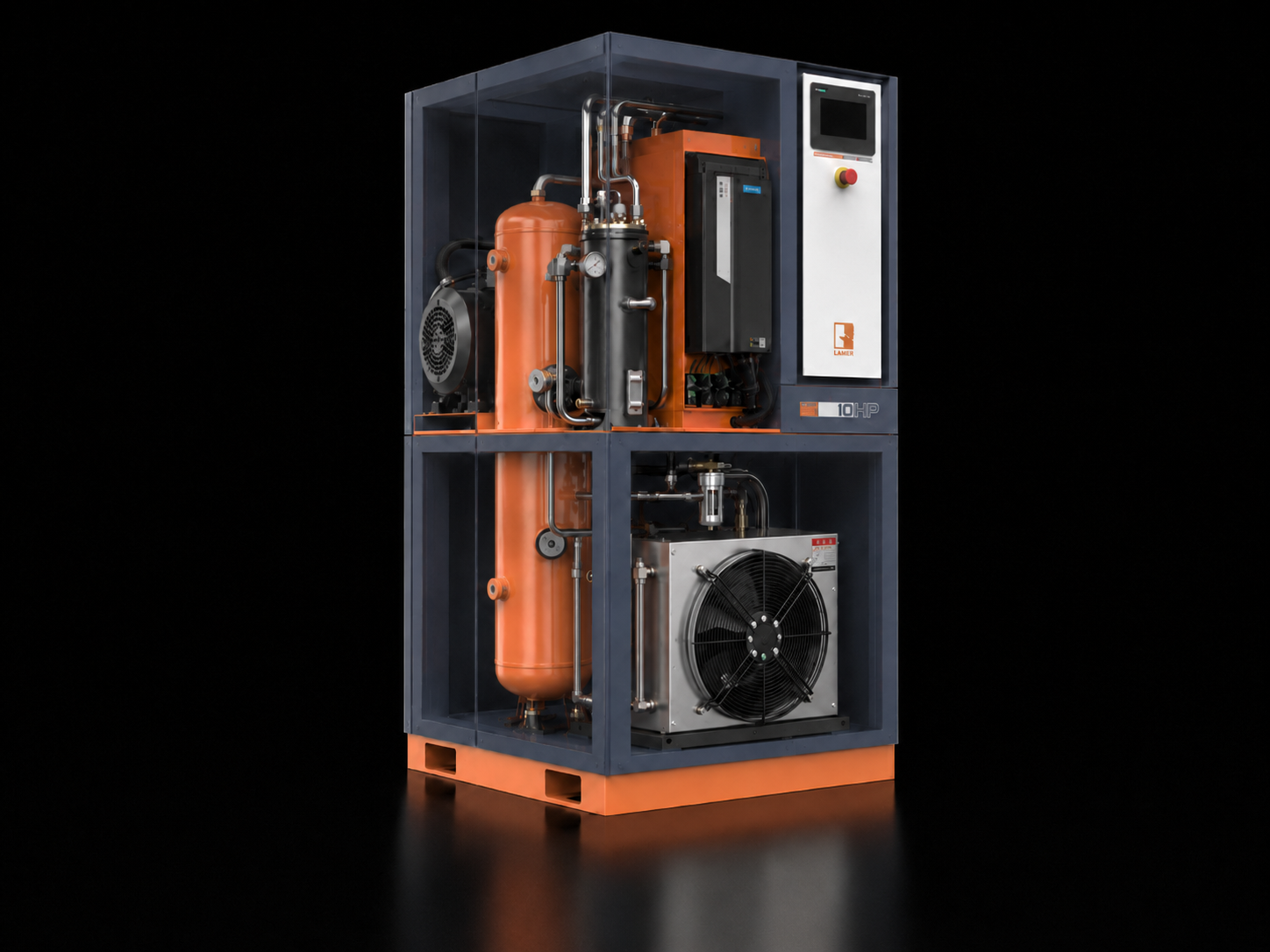
The 140 L gas tank specified on the Micro ML series is the receiver that sits between the air end and the production line. Its job is to buffer short, high-flow events — a cylinder stroke, a valve opening, a pneumatic tool starting — so that the compressor does not have to change state for every transient. A receiver that is correctly matched to the airflow rating and the control mode keeps load/unload cycles at a reasonable frequency and helps hold line pressure steady.
What a tank cannot do is compensate for an airflow rating that is genuinely below continuous demand. If total consumption exceeds delivered airflow, a larger receiver only postpones the pressure drop. The Micro ML series is typically matched with an air dryer, an air tank, a line filter, an inverter and a controller, and the stated system requirements for continuous operation are energy saving, low noise, environmentally friendly operation and high reliability — a treatment and buffer package, not a bare compressor.
5. Air end and construction: single-stage screw end, sheet metal housing
The Micro ML series uses a single-stage screw compressor air end and sheet metal construction, and both choices have sizing consequences. A single-stage screw air end is a continuous-duty rotary design rated for sustained operation rather than intermittent cycling, which is why the airflow, pressure and tank parameters must be right before commissioning: the machine will run for long periods, so any specification error is repeated thousands of times. Sheet metal construction is the enclosure and structural housing of the package, which defines how the unit is installed and how it behaves in demanding environments — the specified working conditions include high-temperature or humid environments where stable and clean compressed air is required.
Step-by-Step Sizing Workflow
- Inventory every air consumer. List each machine or tool with its required pressure and its airflow in m³/min or CFM. For CNC equipment, published guidance puts individual machines at roughly 6–8 bar and 5–30 CFM, so the range across a workshop can be wide.
- Convert to one unit. Work in either m³/min or CFM consistently — 1 m³/min is approximately 35.3 CFM, so the 1.1 m³/min maximum airflow of the Micro ML series corresponds to about 39 CFM.
- Establish the pressure requirement. Take the highest consumer pressure on site and add the losses created by the dryer, line filter and piping. The result should fall inside a defined band — for the Micro ML series, 8–13 bar.
- Add diversity and leakage allowances. Not every machine runs simultaneously, but leakage and intermittent peaks do consume capacity. Build in an allowance rather than sizing to the instantaneous sum.
- Select the smallest model that covers the flow at that pressure. Within the Micro ML series this is a choice between 4 kW, 5.5 kW and 7.5 kW, all sharing 1.1 m³/min maximum airflow and the 8–13 bar band.
- Confirm tank and treatment capacity. Match the 140 L gas tank and the dryer, line filter and controller so that short peaks are buffered rather than transferred to the air end.
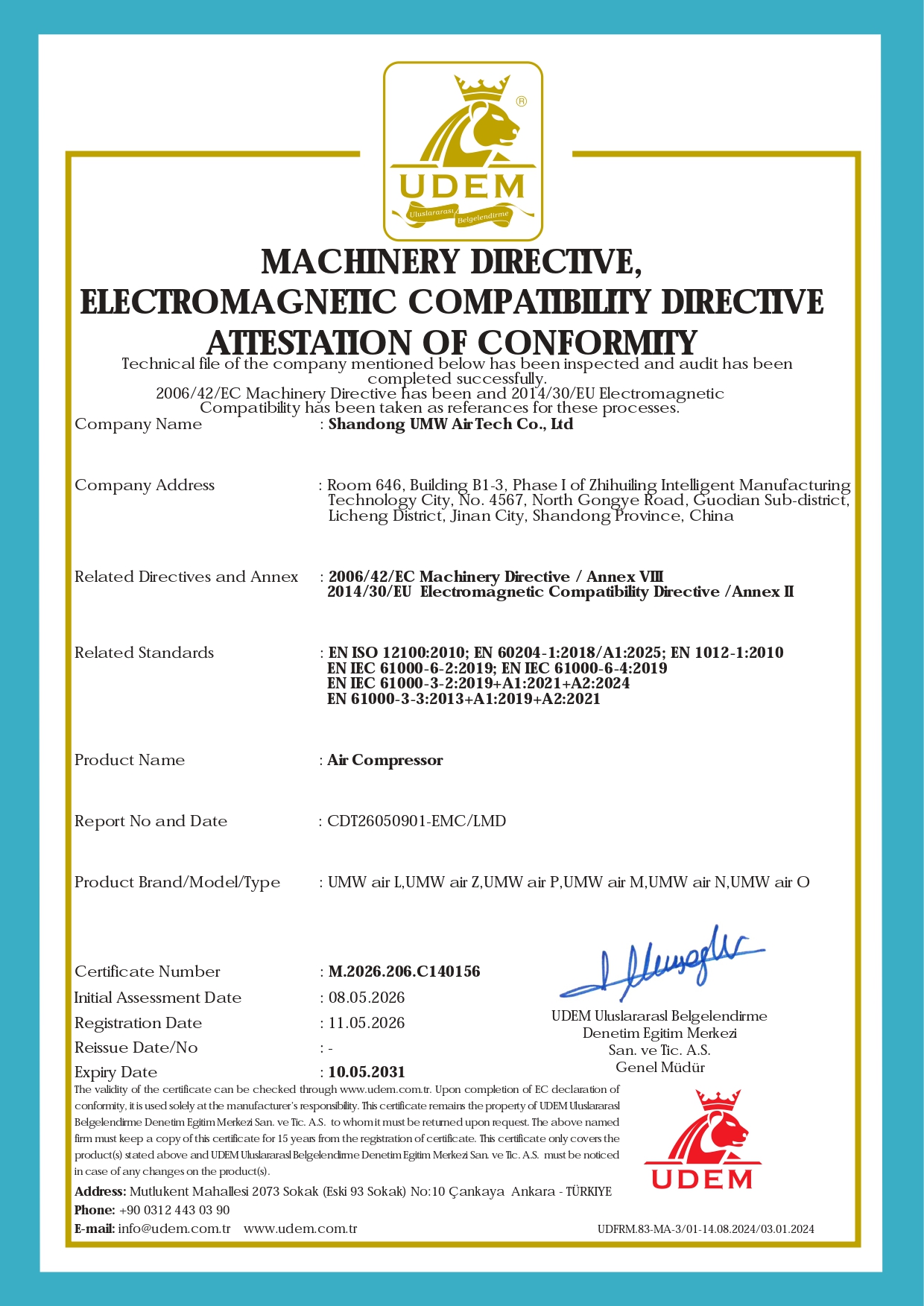
- Verify the compliance path. The UMW Air screw air compressor holds CE certification number M.2026.206.C140156, issued by UDEM, covering the scope UMW air L, UMW air Z, UMW air P, UMW air M, UMW air N and UMW air O, in accordance with the 2006/42/EC Machinery Directive and the 2014/30/EU Electromagnetic Compatibility Directive, and referencing standards including EN ISO 12100:2010, EN 60204-1:2018/A1:2025 and EN 1012-1:2010. The certificate was issued on 2026-05-11 and is valid until 2031-05-10. Buyers shipping into the EU/EEA should confirm that the selected model sits inside the certified scope.
- Confirm air quality class if the process is sensitive. ISO 8573-1:2010 defines compressed air purity classes for particles, water and oil, and is the reference standard for food and pharmaceutical applications. Decide the required class before choosing between oil-filled and oil-free configurations.
- Confirm supplier and customization capability. UMW Air offers OEM and ODM production with customization of color, logo and voltage, a monthly capacity of 1,000 units, factory pre-shipment testing, and 24/7 technical support by email or phone with remote troubleshooting.
Where These Sizes Fit: Application Scenarios
CNC machining workshops
CNC shops feed machine actuators, pneumatic tools and dust removal systems from a single compressed air supply, with each machine typically requiring 6–8 bar and 5–30 CFM. Because machines start and stop independently, the airflow number must be built from a diversity calculation, and the receiver tank carries the short peaks. A CNC machining workshop in Vietnam running three UMW Air units reported improved production efficiency of 20% over one year, reduced downtime and a stable air supply that supported consistent machining quality, with low energy consumption and ease of maintenance noted as the key operating characteristics.
Laser cutting
Laser cutting that uses compressed air as an assist gas is a pressure-driven application rather than a volume-driven one. Published guidance indicates pressures up to 1.6 MPa (about 232 PSI) together with integrated filtration to prevent lens contamination. Buyers should therefore state the assist-gas pressure first: if the process requires a high-pressure class, it will not be served by a machine specified in the 8–13 bar band, and the selection should move to a platform rated up to 25 bar.
Food processing and packaging
Food and beverage packaging lines need stable, clean compressed air, and the governing specification is air purity rather than raw output. ISO 8573-1:2010 defines the classes for particles, water and oil, and the market data showing oil-free compressors growing faster than oil-filled types reflects that requirement. In practice, sizing for food processing means fixing the purity class and the dryer and filter configuration first, then matching airflow and pressure to the line.
General manufacturing and continuous operation
For metal processing, plastics and rubber, automotive parts, construction materials, energy and chemical applications, the compressor runs in continuous mode, often in high-temperature or humid environments. Here the sizing priorities shift toward energy efficiency, low noise and reliability, with a matched set of air dryer, air tank, line filter, inverter and controller. This is the environment where a correctly matched kW, airflow, pressure and tank combination produces its clearest benefit, because the machine operates for long uninterrupted periods.
Sizing Parameter Comparison Table
The table below summarizes what each parameter governs and how to verify it against an actual site. It contains only specification-level facts, not estimates.
| Parameter | Unit | What it governs | How to verify on site |
|---|---|---|---|
| Motor power | kW | Shaft power available to the air end; sets the airflow ceiling at a given pressure | Compare against total site demand, not against the nameplate of one machine |
| Delivered airflow | m³/min or CFM | Whether all consumers stay fed at the required pressure | Sum consumer flow, apply a diversity and leakage allowance |
| Working pressure | bar or PSI | Whether tools and machines receive their minimum pressure | Take the highest consumer pressure, add dryer, filter and piping losses |
| Tank capacity | litres | Buffer capacity; load/unload frequency and ride-through of short peaks | Match receiver volume to peak demand and control mode |
| Air quality class | ISO 8573-1:2010 class | Permitted particles, water and oil content in the delivered air | Set the class first for food, packaging and sensitive processes |
The second table lists the Micro ML series exactly as specified. Airflow, pressure band, gas tank, air end and construction are shared series characteristics; the models differ in rated power.
| Model | Power | Maximum airflow | Pressure | Gas tank | Air end | Material |
|---|---|---|---|---|---|---|
| Micro ML-4A | 4 kW | 1.1 m³/min | 8–13 bar | 140 L | Single-stage screw | Sheet metal |
| Micro ML-5.5A | 5.5 kW | 1.1 m³/min | 8–13 bar | 140 L | Single-stage screw | Sheet metal |
| Micro ML-7.5A | 7.5 kW | 1.1 m³/min | 8–13 bar | 140 L | Single-stage screw | Sheet metal |
For requirements above this band, the wider UMW Air screw air compressor platform is listed with a power range of 4–355 kW, a pressure range of 8–25 bar, an airflow figure of 2.39 m³/min for the referenced model, air cooling, direct drive, an IE4 motor and sheet metal construction, in integrated, split, portable, fixed and portable diesel types.
Frequently Asked Questions
Which UMW Air screw air compressors are CE certified, and what does the certificate cover?
The UMW Air screw air compressor holds CE certification number M.2026.206.C140156, issued by UDEM. The certificate names the scope UMW air L, UMW air Z, UMW air P, UMW air M, UMW air N and UMW air O, and was issued in accordance with the 2006/42/EC Machinery Directive and the 2014/30/EU Electromagnetic Compatibility Directive, referencing standards including EN ISO 12100:2010, EN 60204-1:2018/A1:2025 and EN 1012-1:2010. It was issued on 2026-05-11 and is valid until 2031-05-10. Buyers importing into the EU/EEA should check that the model they are sizing falls inside the listed scope rather than assuming that every configuration is covered.
What power, airflow, pressure and tank sizes does the UMW Air Micro ML series cover?
The Micro ML series consists of the Micro ML-4A at 4 kW, the Micro ML-5.5A at 5.5 kW and the Micro ML-7.5A at 7.5 kW. All three share a maximum airflow of 1.1 m³/min, a working pressure band of 8–13 bar, a 140 L gas tank, a single-stage screw compressor air end and sheet metal construction. If the required airflow or pressure falls outside that envelope, the wider UMW Air screw air compressor platform is listed from 4 kW to 355 kW and from 8 bar to 25 bar.
What should buyers compare when evaluating the cost of a correctly sized compressor?
Because purchase price is only one element, the more useful comparison is between the operating characteristics of the specification itself. Energy consumption over the service life of a continuous-duty machine is generally the largest single cost element, so efficiency features carry more weight than a low initial quote: direct drive and an IE4 motor on the wider UMW Air screw platform, and the company's approach of standardizing PM VSD technology and low-resistance system design to convert each kWh into usable productivity. Oversizing against real demand and selecting a higher pressure band than the process requires both increase running cost without adding capability, which is why the four sizing parameters should be fixed before price is discussed.
Can I validate the sizing with a single unit before ordering in volume?
UMW Air sets a minimum order quantity of 1 unit, so a single machine can be used to validate airflow, pressure and tank behaviour on an actual production line before scaling. Every unit passes factory pre-shipment testing, and OEM or ODM production supports customization of color, logo and voltage for buyers who need the package matched to their own brand or supply voltage.
What is the lead time and after-sales support for a sized order?
The listed lead time is 3 days, supported by a monthly production capacity of 1,000 units. After delivery, technical support is available 24/7 by email or phone, including remote troubleshooting and guidance. The most useful next step is to send your airflow, pressure, tank and air quality requirements to UMW Air at info@umwair.com or +86 15053148082 so that the specification can be confirmed against the correct model before a sample or quotation is issued. Full product information is available at umwair.com.
Conclusion
Sizing a rotary screw air compressor is a four-parameter exercise. Motor power sets the airflow ceiling; delivered airflow has to cover the sum of consumers plus a diversity and leakage allowance; working pressure should be the lowest band that satisfies the highest-pressure process after adding treatment and piping losses; and the receiver tank buffers short peaks so the air end does not cycle unnecessarily. On the UMW Air Micro ML series those parameters are fixed at 4 kW, 5.5 kW or 7.5 kW; 1.1 m³/min maximum airflow; 8–13 bar; and a 140 L gas tank, with a single-stage screw compressor air end and sheet metal construction behind them.
Get the four numbers right and compliance, durability and running cost all follow from the specification rather than from after-sales corrections. UMW Air, operated by Shandong UMW Air Tech Co., Ltd at 68 Gongye South Road, Jinan, Shandong, China, can be reached at info@umwair.com or +86 15053148082 for specification confirmation, samples or a quotation.