
Integrated vs Split Screw Air Compressor: Which Configuration Fits Your Production Line?
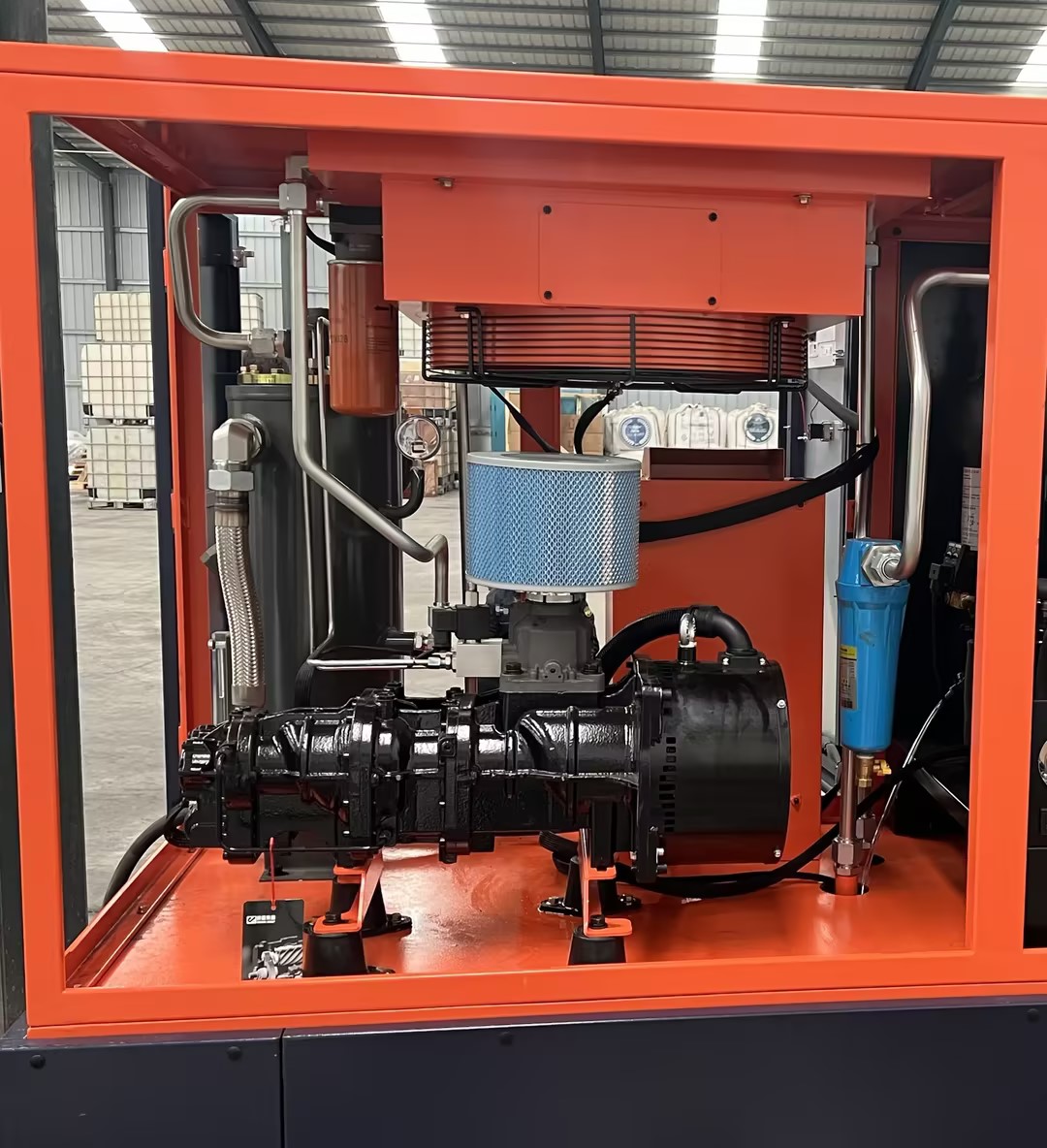
An integrated screw air compressor and a split screw air compressor system do the same job. Both use a rotary screw air end, driven by an electric motor, to deliver a continuous supply of compressed air to a production line. What separates them is packaging: an integrated system arrives as one complete compressed air system, while a split system distributes the same functions across separately installed components connected by field piping.
That packaging difference decides far more than appearance. It changes installation scope, floor footprint, air storage volume, service access, how the system behaves in heat and humidity, and how easily capacity can be expanded later. For a buyer at the decision stage, these are the variables that determine whether a configuration fits a production line or fights it for the next decade.
This guide compares the two configurations head to head across the applications where the decision is usually made: metal processing, plastics, automotive parts, food packaging, construction materials, chemicals and energy. It covers supporting equipment requirements — air dryer, air tank, line filter, inverter and controller — together with continuous 24/7 operation, stable and clean compressed air, and high-temperature or humid plant conditions. Specification points reference UMW Air's direct-driven, air-cooled integrated screw compressor facts, alongside the split/separate, portable and fixed configurations available on the same screw compressor platform.
Problem Definition: What Makes a Screw Compressor System Integrated or Split?
The terminology is often used loosely, so it is worth fixing definitions before comparing performance.
Integrated (packaged) configuration
In an integrated air compressor, the screw air end, drive motor, air dryer, air receiver tank, line filter, inverter and controller are assembled into a single enclosure or skid at the factory. The buyer supplies power and a discharge connection to the plant air line, and the compressed air system is functionally complete. Air treatment happens inside the package rather than at separate points along a pipe run.
Split (separate) configuration
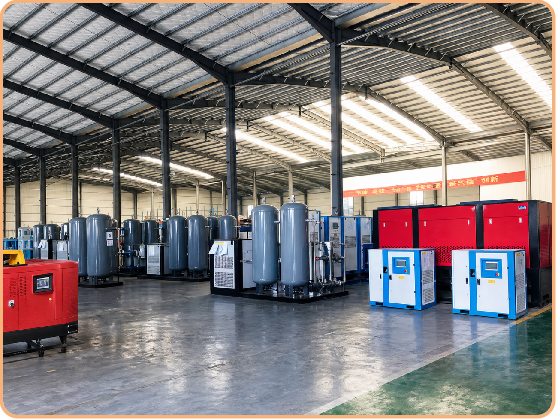
A split layout — also described as separate or standalone — keeps the same functions but separates the hardware. The compressor stands as its own unit, the air dryer, receiver tank and filters are installed individually, and the controller may be mounted on the compressor or in a separate panel. Field piping ties the components into one compressed air system, and each item carries its own footprint, electrical supply and service interval.
The decision point: the compressor technology does not change between the two options. The screw air end, motor class and pressure capability stay the same. What changes is where air treatment happens, how much air storage the system carries, how many field joints exist, and how the system is serviced and expanded.
Shandong UMW Air Tech Co., Ltd, trading as UMW Air, supplies both architectures from a single screw compressor platform. The company's direct-driven, air-cooled screw compressor line is available in integrated, split/separate, portable and fixed configurations, so the configuration choice can be made on operational fit rather than on which product categories a supplier happens to offer.
Industry Background: Why Configuration Choices Are Being Revisited
The global industrial air compressor market was valued at USD 20.0 billion in 2025 and is projected to grow to USD 28.3 billion by 2033, according to Grand View Research. Within that market, Asia Pacific held the largest revenue share at 42.8% in 2025, with China as a key market leader, and the rotary screw segment dominated with a 47.0% share in 2025 because of its efficiency in continuous industrial applications.
Those figures describe an installed base built around uninterrupted duty. A screw compressor platform provides 24/7 operation capability, which makes it suitable for applications that require a continuous air supply — the operating pattern of most modern production lines.
Energy is the second force behind renewed attention to configuration. Variable frequency drive compressors can save up to 35% in energy costs by matching motor speed to actual air demand, according to the U.S. Department of Energy. Screw compressors reach energy efficiency up to 95%, compared with roughly 65–70% for piston compressors, which is one reason plants with demanding duty cycles move to screw platforms. Once a plant justifies a screw platform on energy and duty grounds, the next question is how to package it — and that is where integrated and split layouts diverge.
Air quality completes the picture. ISO 8573-1:2010 is the primary international standard for compressed air purity, classifying contaminants such as particles, water and oil. For laser cutting, oil-free air at Class 0 is critical to prevent contamination of sensitive optics and maintain cut quality. The modern buying decision is therefore not only which compressor, but which system architecture delivers the required air, at the required purity, for the required hours, in the space that is actually available.
Head-to-Head: How Integrated and Split Configurations Compare on a Production Line
1. Footprint, installation and piping
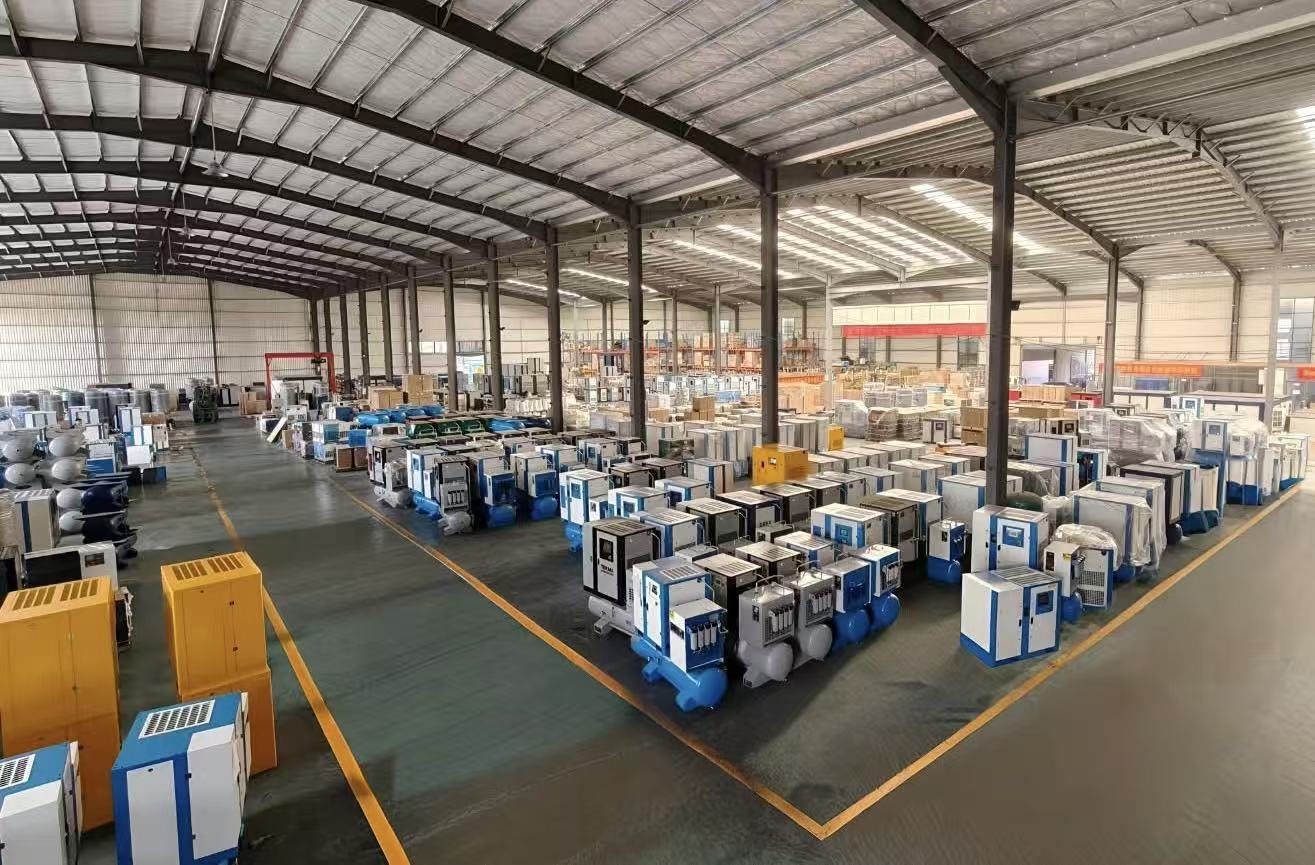
An integrated package concentrates the entire compressed air system in one area. Installation is limited to a power supply, a discharge connection and adequate ventilation, and commissioning is fast because the internal air path between compressor, dryer, tank and filter is already built and tested. The trade-off is physical: air storage is limited to the receiver that fits inside the package, and adding capacity usually means adding a second package rather than enlarging one component.
A split layout distributes the same functions. The dryer can stand against a wall, the receiver can be placed wherever a large buffer is useful, and the compressor can be sited in a dedicated service bay. That flexibility costs installation work — piping, foundations, separate electrical feeds and individual commissioning — and it lengthens the air path. Longer pipe runs add pressure drop and more joints, and every joint is a potential leak point. Where floor space is tight and the line layout is fixed, the integrated route removes those variables; where the building is awkward and large storage is needed, the split route solves problems an integrated package cannot.
2. Supporting equipment: dryer, tank, filter, inverter and controller
Both configurations need the same supporting functions. The difference is who specifies and installs them.
- Air dryer — removes moisture so the air reaching tools, valves, actuators and instruments is dry enough for the process. Refrigerated dryers are the common choice for general plant air; desiccant dryers are used where a lower pressure dew point is required. In an integrated unit the dryer is matched to the compressor at the factory. In a split system the dryer is selected independently, which helps when summer humidity rather than average conditions is the sizing case.
- Air receiver tank — buffers demand spikes, supports stable line pressure and lets the compressor run in a steadier band. Integrated packages include a tank sized to the package envelope; split layouts can use a larger, remotely positioned receiver where the process has sharp peaks.
- Line filter — removes particles and oil carryover downstream of the dryer. The number of filter stages follows the purity class the process requires.
- Inverter (VFD) — matches compressor output to actual air demand and, per the U.S. Department of Energy, can save up to 35% in energy costs. Integrated units carry the inverter as part of the package control scheme; split layouts require the buyer to specify a variable-speed compressor or a separate drive panel.
- Controller — sets the pressure band, sequences units, reports alarms and, where enabled, supports monitoring. In an integrated system one controller governs compressor, dryer and protection logic together; in a split system the compressor controller may cover only the compressor, leaving the dryer and filters on separate controls.
3. Stable and clean compressed air: the purity chain
Air purity is set by the compressor type plus the dryer and filter chain, not by whether the hardware is packaged. ISO 8573-1:2010 classifies particles, water and oil, and the class that matters comes from the end use. Where sensitive optics or critical surfaces are involved, oil-free air at Class 0 protects both process quality and equipment. The practical rule follows from that: define the required class first, then decide how to package the equipment that achieves it.
An integrated unit is convenient here because the chain is matched and tested together. A split system demands that each stage — compressor, dryer, pre-filter, fine filter — be sized to the same target, because a weak stage limits the whole system regardless of how good the others are.
Air quality also has a cost dimension. Using compressed air as an auxiliary gas in laser cutting can reduce production costs by up to 50% compared with nitrogen or oxygen, according to DXTECH CNC Research. When air replaces bottled gas, the dryer and filter train stops being an accessory and becomes part of the cost structure of the cutting operation.
4. Continuous 24/7 duty in hot or humid workshops
Screw compressors are low-maintenance units with fewer moving parts and longer service intervals than traditional piston compressors, and they provide 24/7 operation capability that suits applications requiring continuous air supply. That continuous duty puts thermal design under the spotlight.
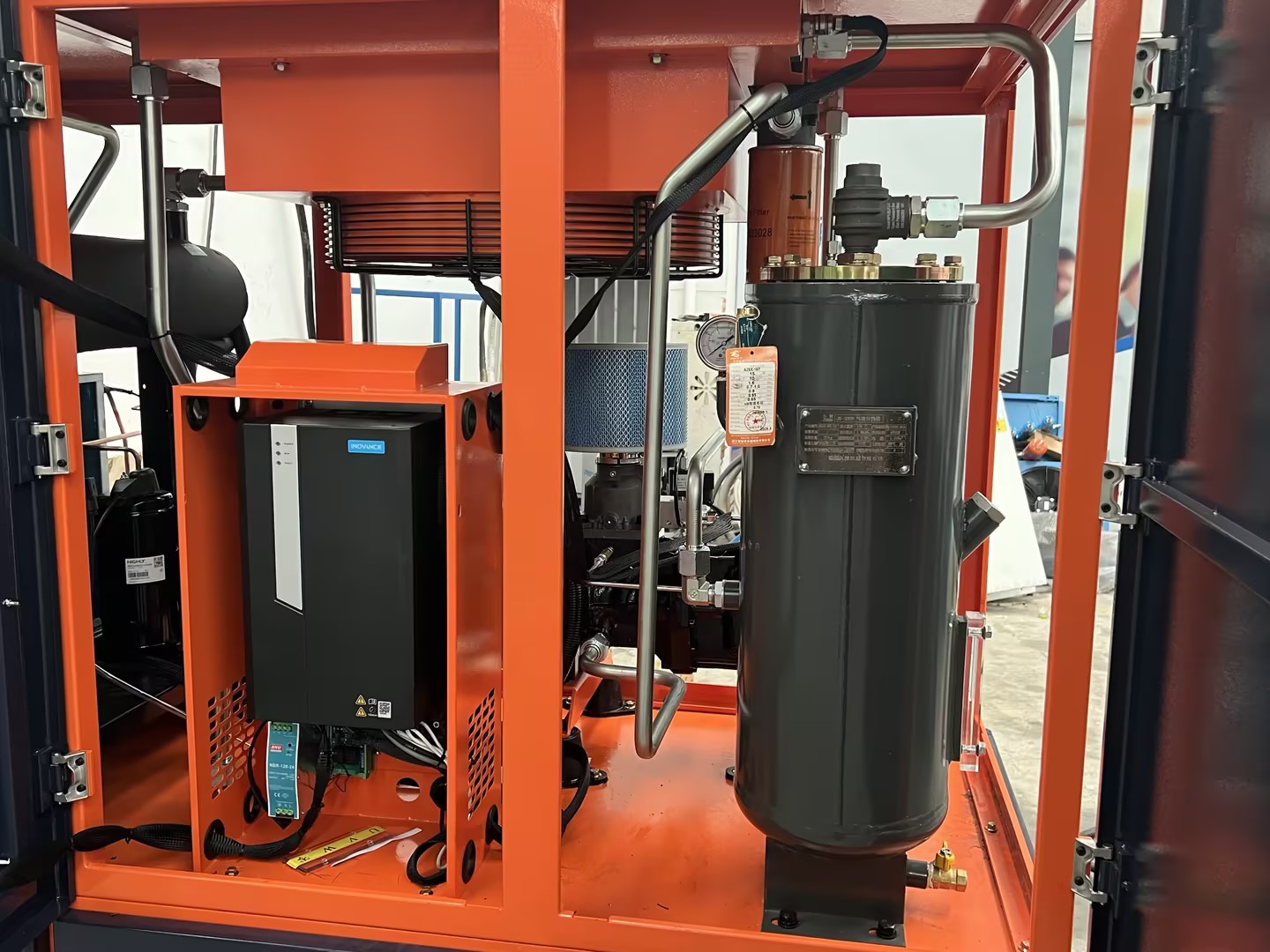
Overheating is the risk that heat and humidity create, and it is controlled with a high-efficiency radiator and cooling fans. UMW Air performs thermal tests on every unit before shipment and ensures that radiators and fans are functioning properly — a pre-delivery check that matters most in hot, humid or dusty plants, because ambient conditions determine how much cooling headroom a unit has in service.
Configuration changes how easily that heat is managed. An air-cooled integrated package concentrates heat rejection in one location, so the enclosure needs a clear ventilation path and the room needs air movement; if the unit sits in a closed corner, cooling performance suffers regardless of the design. A split layout allows the compressor to be placed where ambient temperature is lower and airflow is easier to arrange, while the dryer and receiver stay closer to the point of use.
Humidity works differently. In humid conditions the moisture load entering the system rises, so dryer capacity and drain management become the limiting factors. A split layout allows the dryer to be oversized for the worst month; an integrated package relies on the dryer matched inside it. For a line running 24/7 through a humid season, that distinction is worth settling before the purchase order, not after.
5. Maintenance and lifetime cost
On the compressor side, the platform behaves identically in both configurations. Screw air compressors require low maintenance, with fewer moving parts and longer service intervals than traditional piston air compressors, and the result is lower downtime and lower maintenance costs over the life of the equipment, even though the initial investment is slightly higher. For UMW screw air compressors specifically, the combination of fewer moving parts and longer service intervals translates into lower lifetime costs and reduced downtime.
The configurations differ in how that maintenance is organized. An integrated system concentrates service at one point, with one documentation set and one supplier responsible for compressor, dryer, tank, filter and controller — efficient for a plant with a small maintenance team, provided that service access to filters and panels is confirmed on the drawings. A split system allows any component to be serviced or replaced in place without touching the rest, which suits plants that keep their own spare parts and prefer to isolate faults item by item.
6. Energy and control
Where air demand varies across shifts, the inverter is the largest single lever: variable frequency drive compressors can save up to 35% of energy costs by matching motor speed to demand, per the U.S. Department of Energy. Both configurations can be specified with variable speed, but the paths differ. In an integrated unit the inverter and controller are part of the package, so energy behavior is defined before the unit leaves the factory. In a split system, energy performance depends on the specification the buyer writes — a fixed-speed compressor paired with a separate drive panel behaves differently from a purpose-built variable-speed unit, and receiver volume affects how often the compressor cycles.
Two practical checks belong in every evaluation regardless of configuration: confirm the pressure band with the process owner so the system is not held above what the line actually needs, and confirm leak inspection routines for the field piping, which exists in a split layout and is largely absent inside an integrated package.
7. UMW Air integrated screw compressor specifications
UMW Air's integrated, direct-driven, air-cooled screw compressor is specified with an IE4 motor, an 8–25 bar pressure range and a 4–355 kW power range; the referenced integrated unit is rated at 2.39 m³/min air flow. Direct drive means the motor is coupled to the screw air end rather than running through a belt, and the air-cooled design rejects heat through a radiator and cooling fans rather than a water circuit — relevant where a plant has no cooling water available or does not want to add it.
The same screw compressor platform is available in split/separate, portable and fixed configurations. Portable units support site work and relocatable demand; fixed units suit permanent line positions. UMW Air operates a 2,000 ㎡ facility in Jinan, Shandong, with 200 employees, a 40-person R&D team and an annual output of 12,000 units, and exports 100% of its production to markets including the EU, USA, Southeast Asia, the Middle East, South America and Africa. The company was founded in 2019.
Integrated vs Split Screw Air Compressor: Comparison Table
The table below summarizes the structural differences that drive the decision. It uses verifiable product, platform and standard facts; installation preferences vary by plant and site conditions.
| Decision factor | Integrated (packaged) configuration | Split / separate configuration |
|---|---|---|
| System layout | Screw air end, motor, air dryer, receiver tank, line filter, inverter and controller assembled in one package | Compressor, dryer, receiver tank, filters and controller installed individually and connected by field piping |
| Installation scope | Power supply and discharge connection to the plant air line | Piping, foundations, separate electrical feeds and commissioning for each item |
| Floor footprint | Compact, concentrated in one area | Larger total area, but components can be distributed into available spaces |
| Air storage | Receiver volume limited to the tank fitted inside the package | Receiver sized independently, including large remote tanks |
| Air treatment | Dryer and filter stages matched to the compressor at the factory | Dryer and filter stages selected and installed independently |
| Air purity | Set by compressor type plus the dryer and filter chain; ISO 8573-1:2010 defines particle, water and oil classes | Same standard applies; each stage must be specified to the same target class |
| Duty cycle | Screw compressor platform provides 24/7 continuous operation capability | Same screw platform; 24/7 capability is unchanged |
| Thermal management | High-efficiency radiator and cooling fans reject heat from one package; thermal test performed on every UMW Air unit before shipment | Same air-cooled principle; compressor can be sited in a cooler or better-ventilated area |
| Energy control | Inverter and controller included in the package; VFD compressors can save up to 35% in energy costs (U.S. Department of Energy) | Variable-speed unit or separate drive panel specified by the buyer |
| Maintenance | Fewer moving parts and long service intervals on the screw platform; one service point | Same platform; individual components can be serviced or replaced in place |
| Expansion path | Add a second package | Add or upsize individual components |
Step-by-Step: How to Decide Which Configuration Fits Your Line
- Map the air demand profile. Record average and peak flow, the pressure the process actually requires, the number of shifts and whether the line runs continuously. UMW Air's integrated screw compressor line covers 8–25 bar and 4–355 kW, with the referenced integrated unit rated at 2.39 m³/min — the demand profile, not the packaging, selects the model.
- Define the air quality class per end use. Work through ISO 8573-1:2010 for particles, water and oil. Where optics, critical surfaces or sensitive instrumentation are involved, Class 0 oil-free air is the requirement to protect, and the dryer and filter train must be specified to reach it.
- Survey the physical environment. Measure ambient temperature, humidity, dust load, available floor area, ventilation paths for air-cooled heat rejection, noise constraints and the space needed to open panels for service. This step often decides the configuration before any technical argument does.
- Write the supporting equipment list. Specify the air dryer and its sizing case, receiver tank volume, filter stages, inverter approach and the controller functions you need — pressure band, alarms, sequencing and monitoring.
- Apply the decision rules. Choose integrated when floor space is tight, when one line or one cell needs a dedicated supply, when fast installation matters and when packaged air treatment meets the required purity class. Choose split when a large buffer receiver is needed, when peak humidity rather than average conditions sizes the dryer, when components must be distributed across an awkward building, when expansion is expected in stages, or when the compressor must sit away from heat and dust.
- Verify the supplier and the units before shipment. Confirm service access on the drawings, ask for the thermal test and pre-shipment checks, review documentation and spare parts support, and confirm the delivery schedule in writing. UMW Air runs thermal tests on every unit before shipment and verifies radiator and fan function as part of that routine.
Use Cases: Where Each Configuration Fits in Production
Metal processing and laser cutting. Laser cutting depends on clean, dry, oil-free air — Class 0 per ISO 8573-1 is the requirement that protects optics and cut quality, and air used as an auxiliary gas can reduce production costs by up to 50% compared with nitrogen or oxygen. A compact integrated unit suits a single cutting cell where floor space is limited; a split layout suits a central system feeding several cutting machines, where a large receiver and an independently sized dryer absorb fluctuating demand.
Plastics processing. Injection moulding, blow moulding and extrusion run long cycles with steady pneumatic demand. Handling and mould functions need stable pressure more than large peak flow, which an integrated package with a matched dryer handles well at machine side. Where several moulding cells are served from one compressor room, a split layout lets the dryer and receiver be sized for the whole plant.
Automotive parts manufacturing. Assembly and machining cells use pneumatic tools, clamping and robotics, and downtime is expensive. Because the screw platform provides 24/7 operation capability, continuous duty is not the constraint; fault isolation speed is. Plants with in-house maintenance teams often prefer split layouts for item-by-item service isolation, while compact cells are frequently served by integrated units installed close to the line.
Food packaging. Packaging lines need dry, clean air for actuators, labelling, forming and conveying. Where air contacts product or packaging surfaces, the purity class must be agreed with quality control before equipment is specified, and the dryer and filter chain becomes the controlling element. An integrated unit keeps that chain matched and enclosed; a split layout allows the dryer to be upsized for humid packing halls.
Construction materials. Cement, board, panel and aggregate operations deal with dust, heat and long shifts. Air-cooled units reject heat to the room through a high-efficiency radiator and cooling fans, so ventilation and cooling-system upkeep are routine in these environments. Split layouts are common where a compressor room can be placed away from the dustiest zone while the receiver sits closer to the point of use.
Chemicals. Continuous processes and strict air specifications favor systems where each treatment stage can be verified independently. A split layout makes the dryer and filter train visible and serviceable as separate items, which simplifies documentation and inspection; an integrated unit suits smaller, self-contained process areas where a packaged supply is easier to control.
Energy applications. Site work, remote installations and mobile demand are served by portable and diesel mobile screw compressors, while permanent stations typically use fixed units. Where the site layout changes with each project, a portable unit avoids rebuilding a compressed air system at every move; where a station is permanent, the choice between integrated and split follows the same space, storage and humidity logic as any other plant.
FAQ: Integrated vs Split Screw Air Compressor Decisions
Does the configuration change the air purity class my production line receives?
No. Air purity is determined by the compressor type plus the dryer and filter chain, not by whether the equipment is packaged. ISO 8573-1:2010 defines the classes for particles, water and oil, and the relevant class comes from the process: for laser cutting, oil-free air at Class 0 protects sensitive optics and cut quality. Specify the class first, then choose the configuration and size each treatment stage to that target. In an integrated unit the chain is matched at the factory; in a split system every stage must be specified to the same class.
Can an integrated screw compressor run 24/7 in a hot or humid workshop?
Screw compressors provide 24/7 operation capability and are designed for applications that require a continuous air supply. UMW Air's integrated, direct-driven, air-cooled screw compressor uses an IE4 motor and is offered across an 8–25 bar pressure range and a 4–355 kW power range, with the referenced integrated unit rated at 2.39 m³/min. Heat is rejected through a high-efficiency radiator and cooling fans, and UMW Air performs thermal tests on every unit before shipment to confirm that radiators and fans work properly. In hot or humid conditions, ventilation and dryer capacity are the practical limits, so both should be checked against the worst month of the year rather than the average.
How should I compare the cost of an integrated and a split system?
Compare the total installed cost, not the invoice price of the compressor alone. An integrated package is quoted as a complete system — compressor, dryer, receiver, filter, inverter and controller — so its price covers functions that a split project lists separately, alongside piping, foundations and installation labour. On the compressor platform itself, screw compressors carry a slightly higher initial investment than piston compressors but deliver lower lifetime costs through lower downtime and maintenance, thanks to fewer moving parts and long service intervals. Energy usually dominates the multi-year picture: variable frequency drive compressors can save up to 35% in energy costs by matching motor speed to demand, according to the U.S. Department of Energy.
What should I validate before committing a production line to one configuration?
Validate three things: the demand profile, the purity chain and the physical installation. Confirm the pressure and flow the line actually needs against the compressor's rated range — UMW Air's integrated line spans 8–25 bar and 4–355 kW, with 2.39 m³/min on the referenced integrated unit. Confirm that the dryer and filter stages can hold the required ISO 8573-1 class through the most demanding month. Confirm that the drawings show service access, ventilation clearance and drain routing. UMW Air accepts configuration and quotation requests through umwair.com and info@umwair.com.
What should I confirm about production capacity, delivery and support?
Ask for the production capacity behind the order and the delivery schedule in writing, together with spare parts and after-sales support. UMW Air operates a 2,000 ㎡ facility in Jinan, Shandong, with 200 employees, a 40-person R&D team and an annual output of 12,000 units, and exports 100% of its production to the EU, USA, Southeast Asia, the Middle East, South America and Africa. Annual output describes capacity — it is not a delivery date — so confirm the specific schedule for your configuration, including dryer and controller options, before releasing the order. To move from comparison to configuration, contact UMW Air at info@umwair.com or +86 15053148082 with your pressure and flow requirements.
Conclusion
Integrated and split screw air compressors are not competitors in the technical sense; they are two ways of packaging the same screw compressor platform. The integrated route fits production lines where floor space is limited, installation speed matters, and a matched package of compressor, dryer, tank, filter, inverter and controller can meet the required ISO 8573-1 purity class. The split route fits plants that need a large remote receiver, must size the dryer for peak humidity, want to distribute components across an awkward building, plan to expand in stages, or need the compressor positioned away from heat and dust.
In both cases the compressor platform behaves the same: 24/7 continuous operation capability, low maintenance through fewer moving parts and long service intervals, and lower lifetime costs despite a slightly higher initial investment. The configuration decision should therefore be made on space, storage, air treatment, thermal conditions and service access — and validated against the drawings and pre-shipment checks before the order is released.
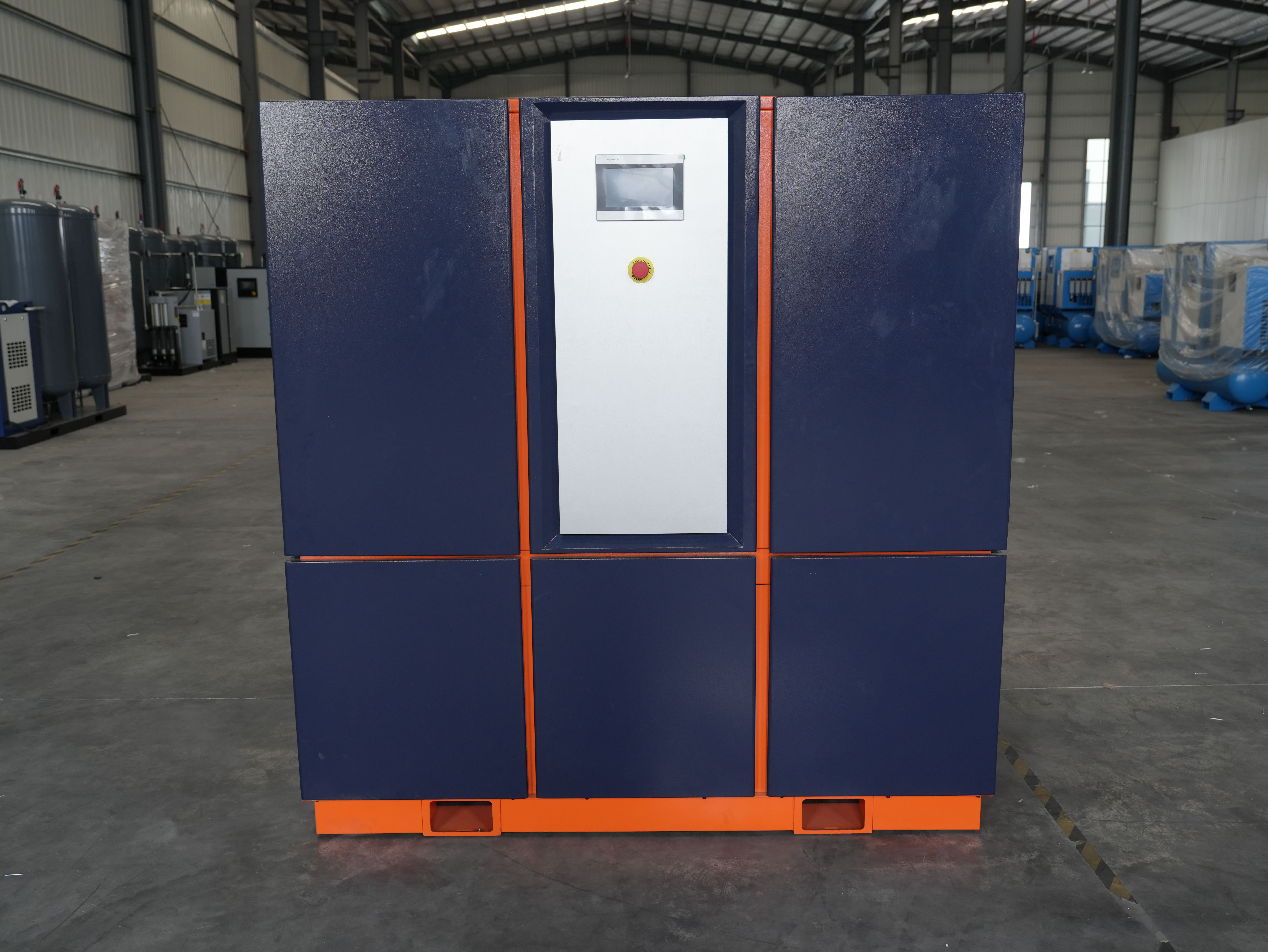
Next Step: Match the Configuration to Your Line
Send UMW Air your pressure and flow requirements, duty cycle and ambient conditions, and request a configuration review covering compressor, dryer, receiver, filter, inverter and controller as one compressed air system.
Phone: +86 15053148082 | Email: info@umwair.com | WhatsApp: +86 15053148082
Website: umwair.com
Address: 68 Gongye South Road, Jinan, Shandong, China, 250000