
Integrated vs. Split Screw Air Compressors: A Comparison Guide for Industrial Buyers
Integrated vs. Split Screw Air Compressors: A Comparison Guide for Industrial Buyers
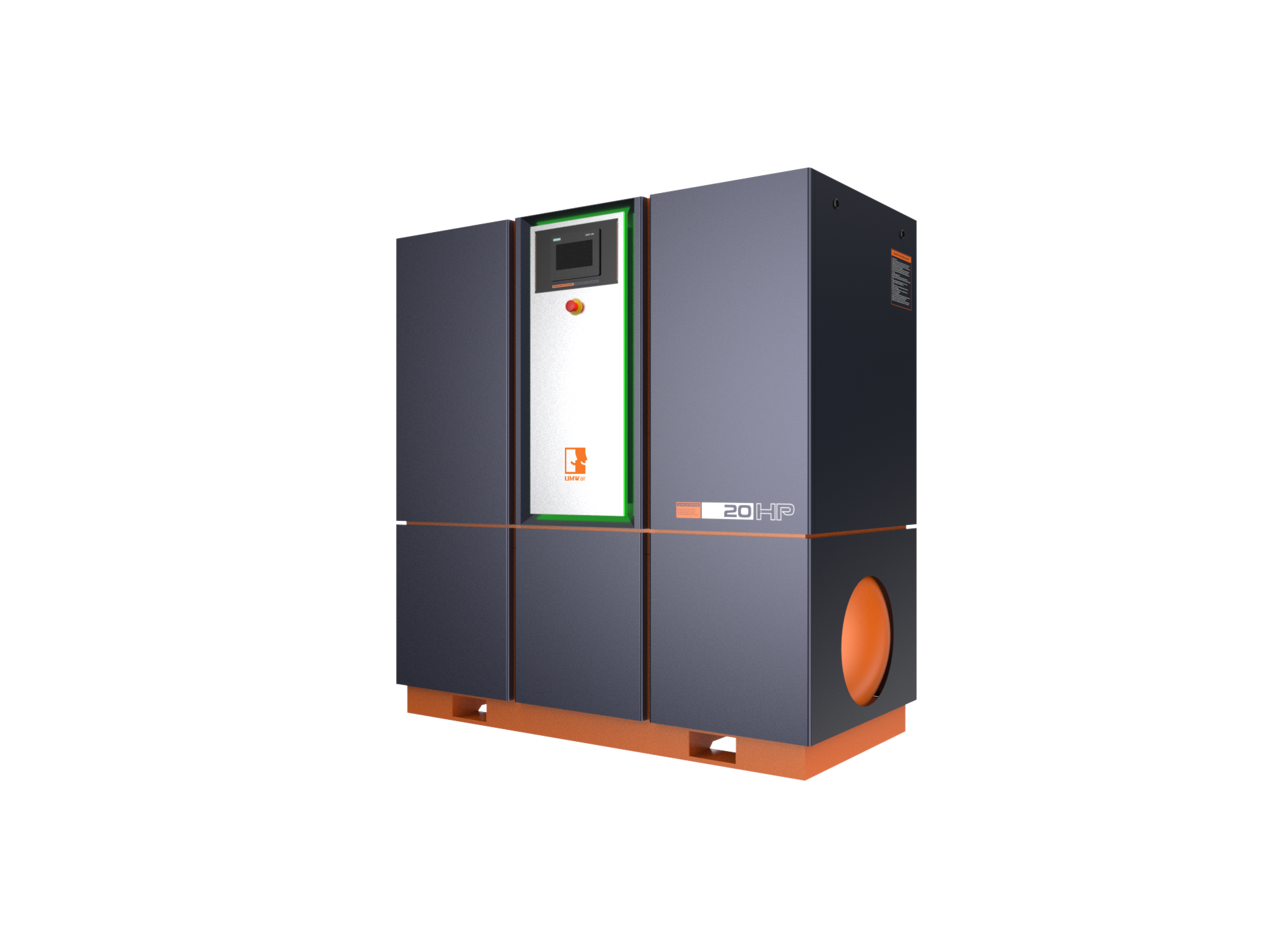
Choosing an industrial air compressor rarely ends with the decision to use rotary screw technology instead of a reciprocating machine. Once that is settled, industrial buyers face a second, more practical question: should the compressor arrive as an integrated package — compressor, receiver tank, dryer and filtration assembled into one unit — or as a split/separate system, where the compressor is installed apart from a tank, dryer and filters placed elsewhere in the plant?
The short answer for most factory projects: an integrated screw air compressor suits sites where floor space is tight, commissioning must be fast, or the system may need to move. A split/separate screw air compressor suits plants that already run a compressor room, expand capacity in stages, or want individual components accessible for maintenance. An important qualification follows immediately — the compression hardware is the same class of machine in both cases. UMW Air builds both configurations around a direct-driven, air-cooled, single-stage screw air end with an IE4 motor, across a 4–355 kW power range and an 8–25 bar pressure range, including the L-2216A model with 2.39 m³/min airflow.
This guide is written for buyers in the research and evaluation stage. It defines both configurations, explains the constraint set that should drive the choice, compares them side by side using verified product and certification facts, and closes with a step-by-step selection process and the supporting equipment list you will need to budget for either way.
What “Integrated” and “Split” Actually Mean in a Screw Compressor System
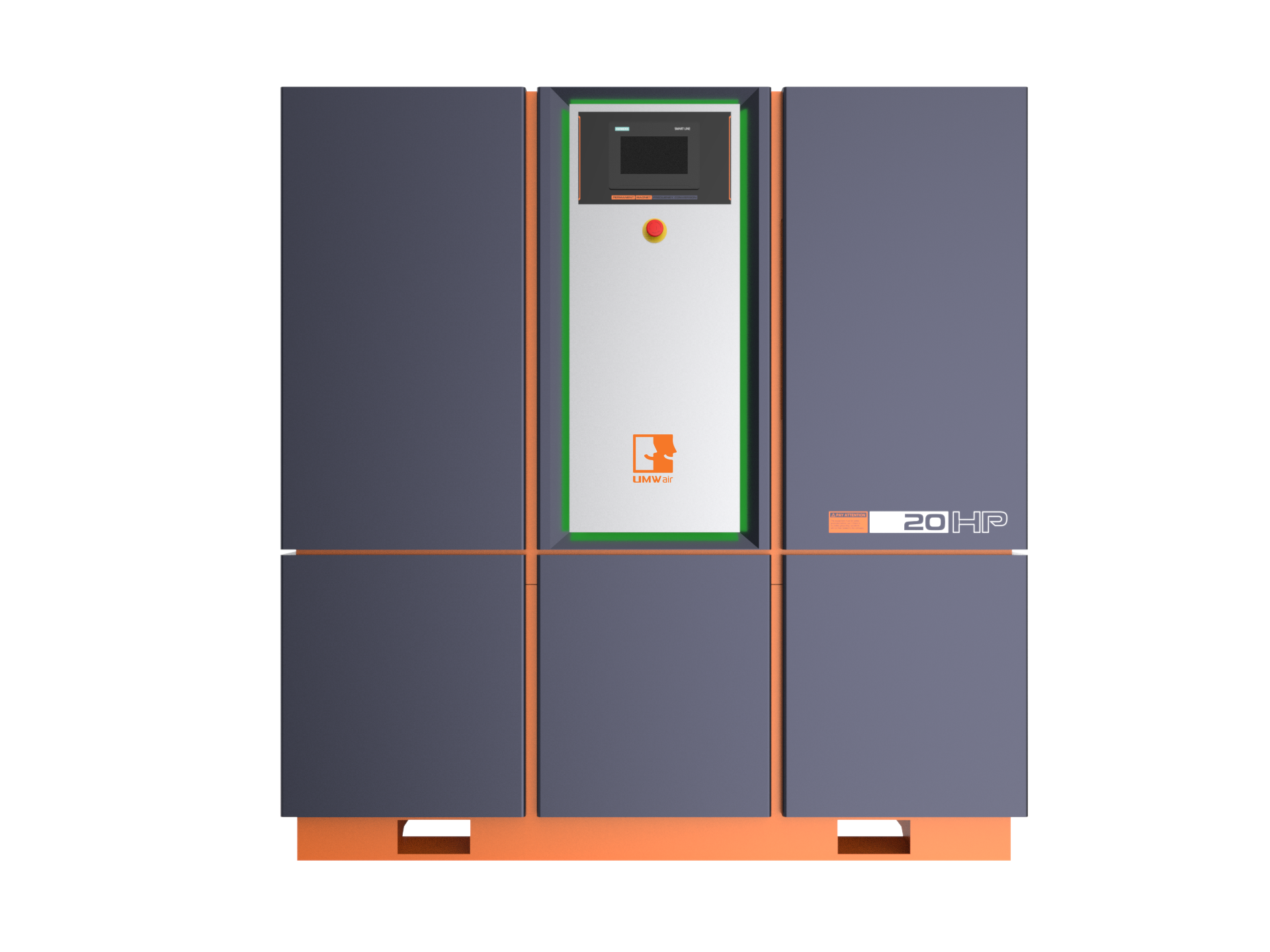
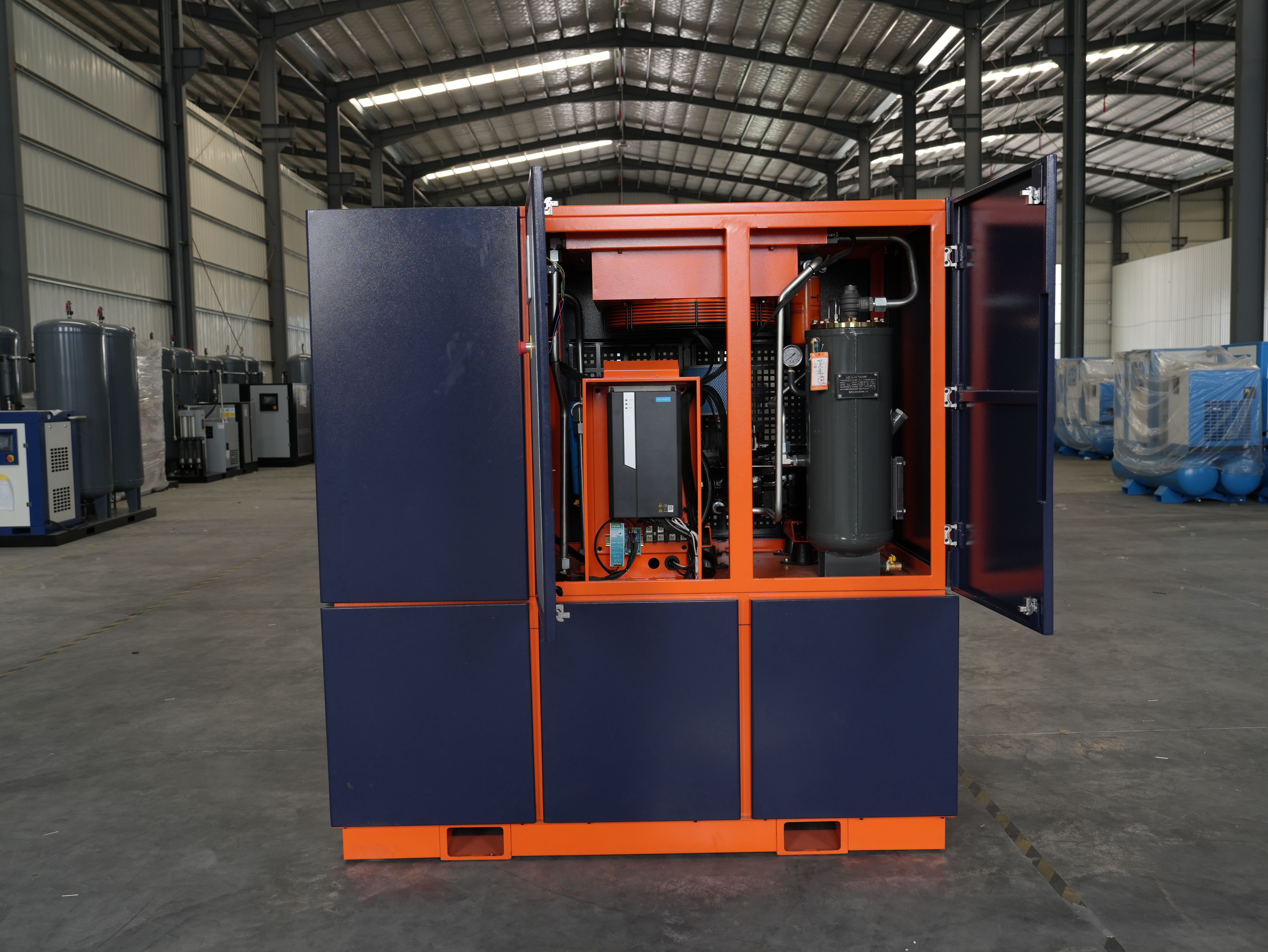
An integrated screw air compressor is a packaged unit: the screw air end, motor, drive, controls and — depending on configuration — the receiver tank, dryer and filtration are assembled into one enclosure or skid before shipment. The buyer receives a single item to position, connect and commission. Terminology varies between suppliers, which is one reason configuration questions cause project delays: “integrated”, “packaged”, “all-in-one” and “tank-mounted” are used loosely in the market.
A split or separate screw air compressor is the opposite arrangement. The compressor is supplied as a standalone unit, and the rest of the compressed air system — receiver tank, refrigerant dryer, line filters, inverter and controller — is selected and installed separately, usually inside a dedicated compressor room, with interconnecting piping between the components.
UMW Air classifies its screw air compressor range into four configuration types rather than two: integrated, split/separate, portable and fixed. That classification matters for buyers because portable and fixed describe how the unit is mounted and moved, while integrated and split describe how much of the compressed air system is bundled with the compressor. The two axes are independent — a fixed integrated unit and a portable screw compressor solve different problems.
Definition to keep in mind during evaluation: configuration describes packaging and installation, not compression principle. UMW Air’s integrated and split/separate screw compressors both use a single-stage screw air end, direct-driven transmission, air cooling and an IE4 motor.
The cost of getting this definition wrong is usually paid after delivery, not before. A buyer who specifies an integrated package and then discovers that service access requires removing an enclosure panel in a cramped corner has a maintenance problem for the life of the machine. A buyer who specifies a split system without confirming that the plant has room for a tank and dryer, plus drainage and ventilation, has an installation problem that delays production.
Industry Background: Why Configuration Choice Sits Inside a Larger Constraint Set
Rotary screw machines are the default technology for continuous industrial duty, and the market data supports that position. Grand View Research valued the global industrial air compressor market at USD 20.0 billion in 2025 and projects growth to USD 28.3 billion by 2033, with the rotary screw segment holding a 47.0% share in 2025 on the strength of continuous industrial applications. Asia Pacific accounted for the largest regional revenue share at 42.8% in 2025, with China as a key market leader.
Those figures explain supply-side pressure, but they do not decide configuration for an individual plant. Four constraints do:
- Air quality. ISO 8573-1:2010 is the primary international standard for compressed air purity, classifying contaminants such as particles, water and oil. If the application requires a specific class, that requirement determines whether drying and filtration are simple or demanding — and, in turn, whether bundling them makes sense. For laser cutting, oil-free air at Class 0 per ISO 8573-1 is described in industry analysis as critical to prevent contamination of sensitive optics and protect cut quality.
- Energy and duty cycle. The U.S. Department of Energy reports that variable frequency drive (VFD) compressors can save up to 35% in energy costs by matching motor speed to actual air demand. Where demand swings, control strategy becomes a specification item alongside configuration.
- Space and infrastructure. Whether a plant can host a packaged unit or a compressor room with separate components is a physical fact that no catalogue can resolve.
- Compliance and documentation. Equipment entering regulated markets must carry traceable certification, which affects which models and configurations can be supplied.
A fifth consideration applies to several high-value applications: process economics. In laser cutting, using compressed air as an auxiliary gas can reduce production costs by up to 50% compared with nitrogen or oxygen, according to DXTECH CNC Research. When the compressed air system itself is doing the cutting work, air quality and configuration stop being background details.
How UMW Air Covers Both Configurations
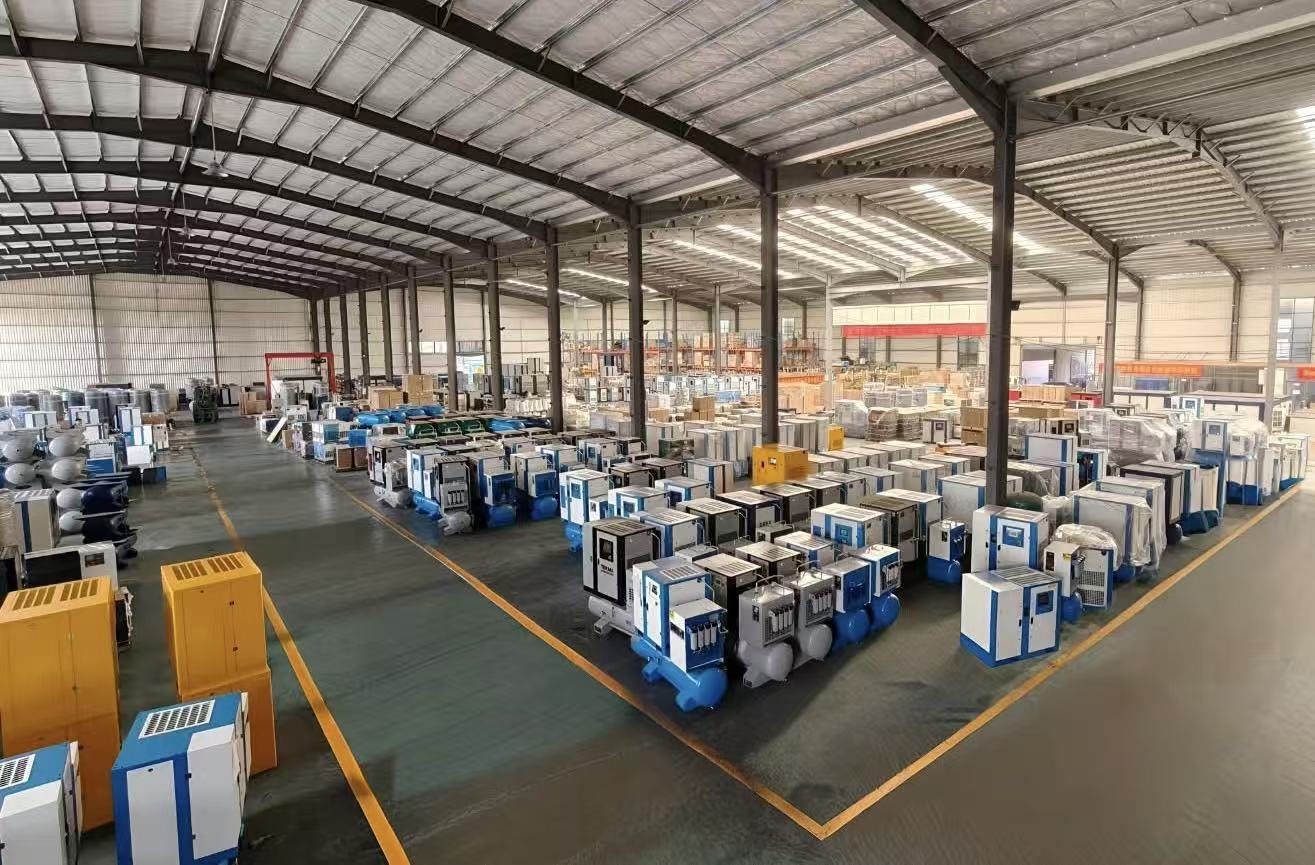
UMW Air (Shandong UMW Air Tech Co., Ltd) is a compressor manufacturer based in Jinan, Shandong, China, founded in 2019. The company operates a 2,000 m² factory with approximately 200 employees, an annual output of 12,000 units and a 40-person R&D team, and exports 100% of its production to the EU, USA, Southeast Asia, the Middle East, South America and Africa.
For the configuration question specifically, three sets of verified facts matter.
1. Configuration types and shared technical platform
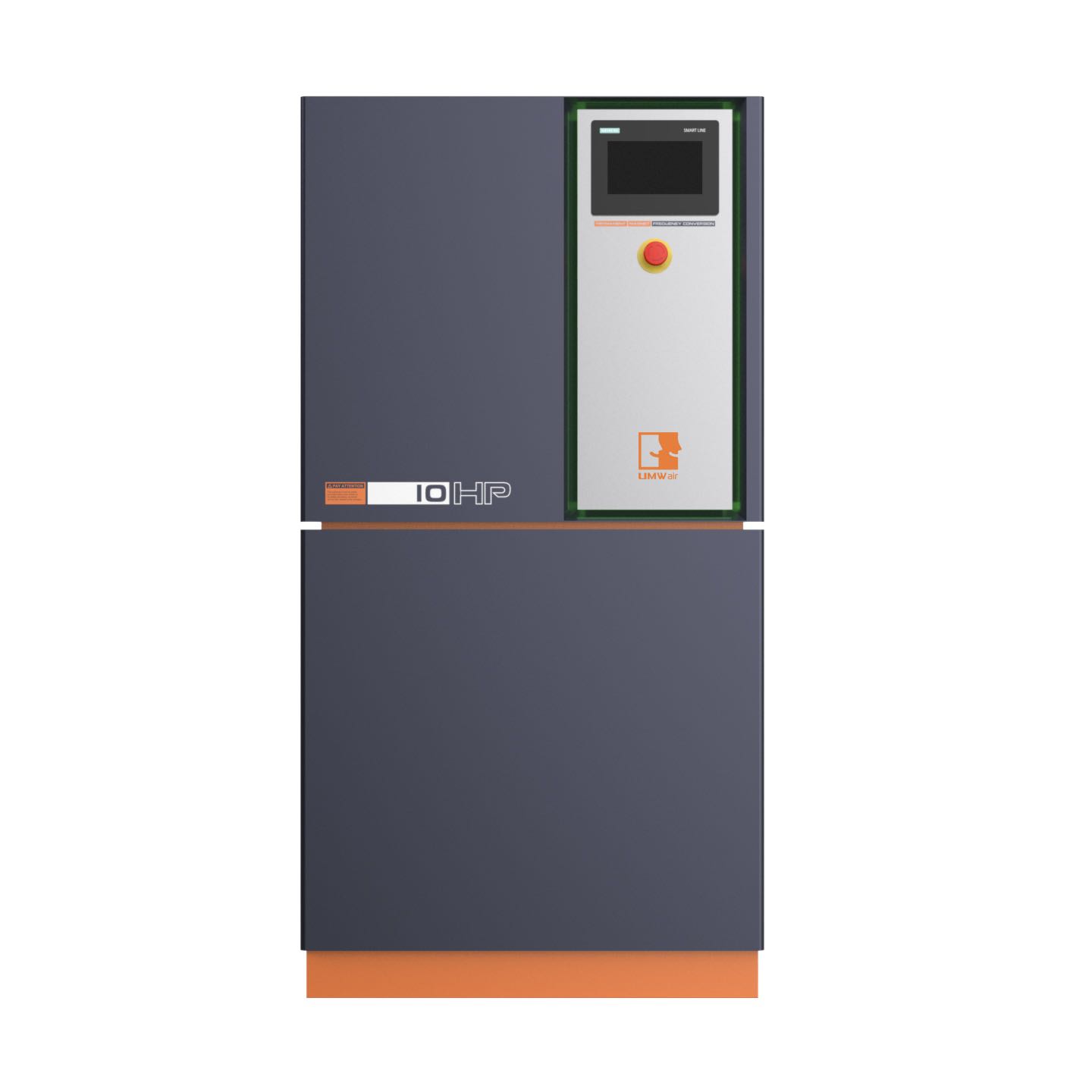
UMW Air’s screw air compressor range is available as integrated, split/separate, portable and fixed types. Across those types, the shared technical platform is consistent: power from 4 kW to 355 kW, pressure from 8 bar to 25 bar, air cooling, direct-driven transmission, an IE4 motor, sheet metal construction and a single-stage screw compressor air end. The named models are ML-7.5/8A, L-7.5/8A, L-1516A and L-2216A.
The L-2216A is a useful reference point for sizing conversations: it delivers an airflow of 2.39 m³/min within the 8–25 bar pressure range. Buyers comparing configurations can use that figure as a baseline when checking whether a proposed package or split layout can actually meet the site’s demand.
Where a small workshop needs a compact machine rather than a full industrial package, UMW Air’s Micro series (models ML-4A, ML-5.5A and ML-7.5A) covers 4 kW, 5.5 kW and 7.5 kW, with a maximum airflow of 1.1 m³/min, an 8–13 bar pressure range and a 140 L gas tank, using a single-stage screw air end in sheet metal construction.
2. Applications and supporting equipment
UMW Air screw air compressors are deployed in metal processing and manufacturing, plastics and rubber processing, automotive and machinery parts, food and packaging, construction and materials, and energy and chemical industries. Typical project types include CNC machinery production lines, automotive parts production lines, plastic processing line expansion, industrial automation integration, and food and beverage packaging line setup. Working conditions often involve high-temperature or humid environments where stable, clean compressed air is required, and the operating mode is continuous.
The supporting equipment specified with these projects is the clearest illustration of the integrated-versus-split decision: air dryer, air tank, line filter, inverter and controller. In an integrated configuration, more of this list is bundled with the compressor. In a split configuration, each item is specified, positioned and priced separately. Special requirements recorded for these applications include energy saving, low noise, environmentally friendly operation and high reliability.
3. Supply capability and compliance
UMW Air operates an OEM/ODM production model with customization of color, logo and voltage, a monthly capacity of 1,000 units, a minimum order quantity of one unit and a 3-day lead time. Every unit goes through factory pre-shipment testing, and after-sales service includes 24/7 technical support by email or phone with remote troubleshooting and guidance.
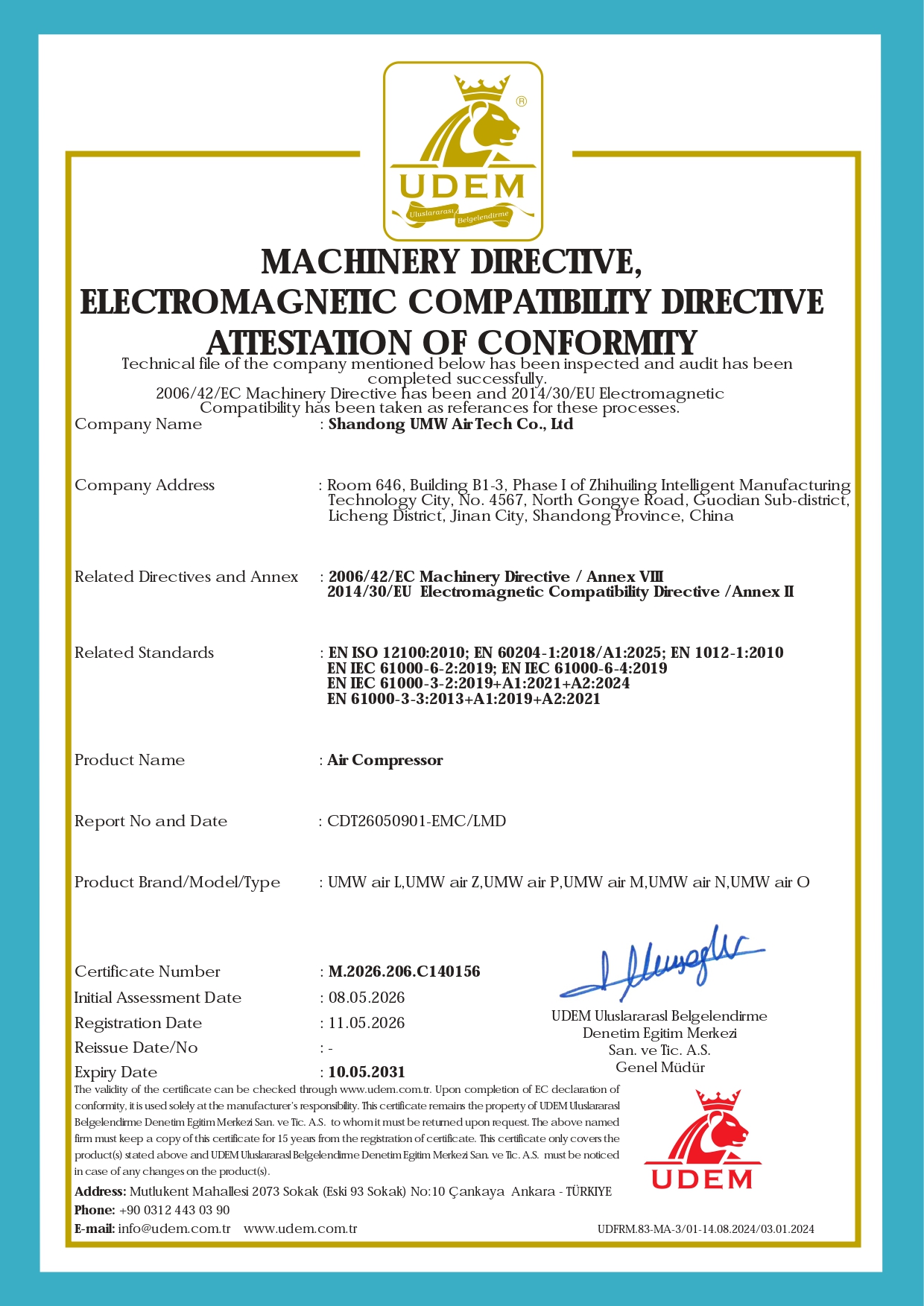
On compliance, the screw air compressor models ML-7.5/8A, L-7.5/8A, L-1516A and L-2216A are certified to CE standards under the 2006/42/EC Machinery Directive for the EU/EEA market. The certificate, number M.2026.206.C140156, was issued by UDEM on 2026-05-11 and is valid until 2031-05-10, with a certification scope covering the UMW air L, Z, P, M, N and O series. The listed standards include EN ISO 12100:2010, EN 60204-1:2018/A1:2025, EN 1012-1:2010, EN IEC 61000-6-2:2019, EN IEC 61000-6-4:2019 and EN IEC 61000-3-2:2019+A1:2021+A2:2024.
Comparison Table: Integrated vs. Split/Separate Screw Air Compressors
| Decision factor | Integrated screw air compressor | Split / separate screw air compressor |
|---|---|---|
| What it is | Compressor, controls and commonly receiver tank, dryer and filtration assembled into one packaged unit | Compressor supplied as a standalone unit, with tank, dryer, filters and controls selected and installed separately |
| Availability at UMW Air | Integrated type offered | Split/separate type offered, alongside portable and fixed types |
| Floor space | One concentrated footprint | Several footprints, typically inside a compressor room |
| Installation and commissioning | Fewer site connections because more of the system is factory-assembled | More site work: positioning, interconnecting piping, condensate drainage |
| Service access | Service points concentrated in one enclosure | Components individually accessible; one item can be replaced without moving the package |
| Supporting equipment | Commonly bundled with the unit | Specified separately: air dryer, air tank, line filter, inverter, controller |
| Piping and pressure loss | Short internal runs | Longer site piping with more joints and fittings |
| Capacity expansion | Add a second package | Scale individual components; often simpler in staged projects |
| Typical fit | Space-constrained plants, fast deployment, relocatable worksites | Plants with an existing compressor room, phased expansion, high-capacity systems |
Read the table as a set of trade-offs, not a ranking. Neither configuration is technically superior; the correct answer is the one that matches the site’s space, its maintenance model and the stage of the project.
| Shared specification | Verified value (applies to both configurations) |
|---|---|
| Compression type | Single-stage screw air end |
| Drive method | Direct driven |
| Cooling method | Air cooling |
| Motor | IE4 |
| Power range | 4–355 kW |
| Pressure range | 8–25 bar |
| Airflow (L-2216A example) | 2.39 m³/min |
| Models | ML-7.5/8A, L-7.5/8A, L-1516A, L-2216A |
| Construction material | Sheet metal |
| CE certification | M.2026.206.C140156, issued by UDEM, EU/EEA |
| Directive and validity | 2006/42/EC Machinery Directive; issued 2026-05-11, valid until 2031-05-10 |
| OEM/ODM customization | Color, logo, voltage |
| MOQ / lead time / monthly capacity | 1 unit / 3 days / 1,000 units |
Step-by-Step Breakdown: Selecting the Right Configuration
The sequence below puts the configuration decision in the right order. Buyers who choose a package type before defining demand usually revisit the decision later.
Step 1 — Define the demand profile
Establish required airflow in m³/min, required working pressure in bar, duty cycle (continuous operation is standard for these installations), and the required air purity class under ISO 8573-1:2010. Confirm whether oil-free air is mandatory: for laser cutting, Class 0 per ISO 8573-1 is described as critical to protect optics and cut quality. The L-2216A reference figure of 2.39 m³/min at 8–25 bar is a useful benchmark when checking whether a candidate machine matches the load.
Step 2 — Audit the physical space
Measure the available footprint, ceiling height, ventilation path and ambient temperature range. UMW Air screw compressors are air-cooled, which means heat is rejected to the surrounding space — an integrated package concentrates that load in one place, while a split system spreads it across a compressor room. Confirm drainage for condensate in both cases.
Step 3 — Decide on bundling
If the plant has no compressor room, is short on floor area, or needs the system running quickly, an integrated unit removes several coordination steps. If the plant already has a compressor room, expects to expand in stages, or wants component-level service access, a split/separate arrangement is usually the better fit. Both are available from UMW Air in the same 4–355 kW and 8–25 bar envelope.
Step 4 — Select drive, motor and control
The base specification is direct-driven transmission with an IE4 motor and air cooling. Where air demand fluctuates across shifts, evaluate variable frequency control: the U.S. Department of Energy notes VFD compressors can save up to 35% in energy costs by matching motor speed to actual demand. Control strategy is an economic decision that should be made before configuration, because it affects the inverter and controller specification.
Step 5 — Specify the supporting equipment
Build the auxiliary list explicitly: air dryer, air tank, line filter, inverter, controller. In an integrated configuration, verify what is genuinely included rather than assumed; in a split configuration, treat each item as a separately specified and separately priced component with its own installation, drainage and service requirements.
Step 6 — Verify compliance and documentation early
If the machine is destined for the EU/EEA market, confirm the exact model appears on the CE certificate. For UMW Air, certificate M.2026.206.C140156 issued by UDEM covers models ML-7.5/8A, L-7.5/8A, L-1516A and L-2216A under the 2006/42/EC Machinery Directive. Documentation checks belong in the evaluation stage, not at shipment.
Step 7 — Validate, then scale
Because UMW Air’s minimum order quantity is one unit and each unit undergoes factory pre-shipment testing, a configuration can be validated in a real installation before a plant-wide rollout. Plan the maintenance model at the same time — 24/7 technical support by email or phone and remote troubleshooting are part of the supply package.
Use Cases: How the Configuration Decision Plays Out on Site
CNC machining workshop, Vietnam
A CNC machining workshop in Vietnam installed three UMW Air screw compressor units to drive CNC machine actuators, pneumatic tools and dust removal systems. After one year of operation, the reported outcome was a 20% improvement in production efficiency with reduced downtime, and stable air supply that supported high-quality machining. The user highlighted low energy consumption, easy maintenance and reliable long-term performance.
That case illustrates a pattern relevant to configuration choice: the deciding factors in practice were continuous stable air and straightforward maintenance — not a preference for one packaging style. A workshop with limited floor area and no existing compressor room tends to value the integrated route; a site with a service team and existing infrastructure tends to value the accessibility of separated components.
Laser cutting and metal fabrication
For laser cutting, oil-free air at Class 0 per ISO 8573-1 is described as critical to prevent contamination of sensitive optics and protect cut quality, and using compressed air as an auxiliary gas can reduce production costs by up to 50% compared with nitrogen or oxygen (DXTECH CNC Research). Purity requirements at this level directly affect how drying and filtration are specified — which in turn affects whether bundling them into an integrated package is practical or whether a dedicated split arrangement is more manageable.
Food packaging, plastics and general manufacturing
In food and packaging lines, plastic processing and general manufacturing, the recurring requirement is stable, clean compressed air in environments that are often hot or humid, with continuous operation. The supporting equipment list — dryer, tank, filter, inverter, controller — is usually what determines whether the system is best delivered as one package or installed in stages. Expansion projects, such as a plastic processing line extension or an automation integration, frequently favour the split approach because components can be added without replacing the whole package.
Compliance and Cost Checklist Before You Commit
- Certification: CE certificate M.2026.206.C140156, issued by UDEM, valid from 2026-05-11 to 2031-05-10, under the 2006/42/EC Machinery Directive for the EU/EEA market; scope includes the UMW air L, Z, P, M, N and O series, and applies to models ML-7.5/8A, L-7.5/8A, L-1516A and L-2216A.
- Referenced standards: EN ISO 12100:2010; EN 60204-1:2018/A1:2025; EN 1012-1:2010; EN IEC 61000-6-2:2019; EN IEC 61000-6-4:2019; EN IEC 61000-3-2:2019+A1:2021+A2:2024.
- Air quality: define the required purity class under ISO 8573-1:2010 before selecting drying and filtration. Class 0 oil-free air is described as critical for laser cutting.
- Core parameters to confirm in writing: power 4–355 kW, pressure 8–25 bar, airflow (L-2216A: 2.39 m³/min), air cooling, direct-driven transmission, IE4 motor.
- Cost structure: the base machine class is set by power and pressure; the configuration determines how much of the auxiliary scope is bundled versus specified, installed and serviced separately.
- Commercial terms: MOQ 1 unit, 3-day lead time, 1,000 units monthly capacity, OEM/ODM customization of color, logo and voltage.
- After-sales: factory pre-shipment testing, plus 24/7 technical support by email or phone with remote troubleshooting.
Frequently Asked Questions
Are UMW Air screw air compressors CE certified for the EU/EEA market?
Yes. The screw air compressor models ML-7.5/8A, L-7.5/8A, L-1516A and L-2216A are certified to CE standards under the 2006/42/EC Machinery Directive for the EU/EEA market. Certificate number M.2026.206.C140156 was issued by UDEM, dated 2026-05-11 and valid until 2031-05-10. The certification references EN ISO 12100:2010, EN 60204-1:2018/A1:2025, EN 1012-1:2010 and the EMC standards EN IEC 61000-6-2:2019 and EN IEC 61000-6-4:2019. Air purity requirements are a separate matter and are normally written against ISO 8573-1:2010; for laser cutting, Class 0 oil-free air is the typical requirement.
Do integrated and split configurations use different compressor technology?
No. In UMW Air’s screw air compressor range, both the integrated and the split/separate configuration are built around the same core: a direct-driven, air-cooled, single-stage screw air end with an IE4 motor, covering 4–355 kW and 8–25 bar. The L-2216A model, for example, delivers 2.39 m³/min airflow. The difference between the two configurations is packaging and installation — what ships bundled and where the supporting equipment is installed — not the compression principle.
What drives the budget difference between an integrated and a split system?
Two variables dominate. The first is bundled scope: an integrated unit arrives with more of the compressed air system already assembled, while a split system is priced as a compressor plus separately selected air dryer, air tank, line filter, inverter and controller, plus interconnecting piping and installation labour. The second is machine class, set by power (4–355 kW) and pressure (8–25 bar). Where air demand fluctuates, control strategy also affects lifetime cost: the U.S. Department of Energy reports that VFD compressors can save up to 35% in energy costs by matching motor speed to actual air demand. UMW Air sells from a minimum order quantity of one unit with a 3-day lead time and a monthly capacity of 1,000 units, so single-unit trials and staged purchases are both workable.
Can a buyer order a single unit to validate a configuration before rolling it out?
Yes. UMW Air’s minimum order quantity is one unit, and every unit passes factory pre-shipment testing before dispatch. Units can be configured through OEM/ODM customization covering color, logo and voltage, which allows branding and site-specific electrical requirements to be matched. After delivery, technical support is available 24/7 by email or phone, including remote troubleshooting and guidance.
What lead time and documentation should be expected on an integrated or split order?
UMW Air quotes a 3-day lead time against a monthly production capacity of 1,000 units, and exports to the EU, US, Middle East and Southeast Asia. Because the CE certificate covers specific models for the EU/EEA market, buyers sourcing for Europe should confirm that their chosen model and configuration appear on certificate M.2026.206.C140156 before the order is placed. To get a configuration recommendation based on your site, share your required airflow, working pressure and available floor space through UMW Air or by email at info@umwair.com.
Conclusion: Decide Configuration from Constraints, Not Preference
Integrated and split/separate screw air compressors are not competing technologies; they are two ways of packaging the same compression platform. UMW Air builds both, alongside portable and fixed types, on a direct-driven, air-cooled, single-stage screw air end with an IE4 motor, spanning 4–355 kW and 8–25 bar, with the L-2216A delivering 2.39 m³/min as a practical sizing reference.
The decision rule that follows from this comparison is straightforward. Choose an integrated configuration when floor space is limited, deployment speed matters, or the system may need to be relocated, and accept that the auxiliary scope arrives as one package. Choose a split/separate configuration when a compressor room exists or is planned, when capacity will be added in stages, or when component-level service access is a priority — and plan the air dryer, air tank, line filter, inverter and controller as separately specified items.
Whichever configuration you select, three checks protect the investment: define the air purity class under ISO 8573-1:2010 before specifying drying and filtration; confirm that the exact model appears on the required certification for your market, such as CE certificate M.2026.206.C140156 for EU/EEA buyers; and validate the choice in one real installation before scaling, which a one-unit minimum order quantity makes possible.
Next step: match a configuration to your site
Send your required airflow (m³/min), working pressure (bar), available floor space and target market, and UMW Air will confirm which configuration fits — and whether a single validation unit is the right first order. MOQ is 1 unit, lead time is 3 days, and every unit is tested before shipment.
Website: umwair.com | Email: info@umwair.com | Phone / WhatsApp: +86 15053148082 | Address: 68 Gongye South Road, Jinan, Shandong, China, 250000