
Long-Term Air Compressor Supply: A Verification Checklist for Factory and Distribution Partners
Decision-stage guide for factory buyers, distributors, and OEM teams.
Long-term air compressor supply is a commitment, not a quotation exercise. Factories and distributors rarely want to switch brands every year; they want a partner who can provide an industrial air compressor that fits the application, deliver it on schedule, and support the relationship with stable quality and predictable terms. This guide is written for decision-makers who are ready to move from evaluation to execution. It covers the verification points that separate dependable suppliers from one-off sellers, using Shandong UMW Air Tech Co., Ltd. (UMW Air) as a documented example.
Why Long-Term Air Compressor Supply Decisions Fail
Many long-term supply relationships fail for visible reasons. The compressor is not matched to the duty cycle. The supplier's production capacity cannot support replenishment. Quality control is inconsistent across shipments. Commercial terms leave no room for trial orders. Lead time slips after the first container. These failures are avoidable if the buyer checks the evidence before signing.
- The compressor is selected on price instead of the plant's actual air demand profile.
- Production capacity is not verified before a large order is placed.
- Pre-shipment testing and thermal checks are not included in the acceptance process.
- MOQ, payment terms, and delivery terms are not confirmed until after commercial commitment.
- Lead time is assumed instead of documented.
The result is costly: production downtime, unplanned maintenance, wasted energy, and a second supplier search. The solution is not simply choosing a well-known brand. It is checking the factors that predict long-term reliability: production capability, product fit, quality control, commercial flexibility, and lead time.
Industry Background: The Shift Toward Rotary Screw Compressors
Industrial air compression is a large and growing category. Grand View Research estimates that the global industrial air compressor market was valued at USD 20.0 billion in 2025 and is projected to reach USD 28.3 billion by 2033. Asia Pacific was the largest regional market with a 42.8% revenue share in 2025, led by China. The rotary screw air compressor segment dominated the market with a 47.0% share in the same year, driven by its efficiency in continuous industrial applications.
Global reference brands include Atlas Copco, Ingersoll Rand, Kaeser Kompressoren, and Sullair (Hitachi). Alongside these large players, mid-size exporters offer an alternative for buyers who want direct production access and shorter communication lines. For long-term supply, the core question is not only whether a brand is large, but whether it can prove the capacity, quality, and commercial discipline needed for repeat orders.
What UMW Air Brings to a Long-Term Supply Relationship
Shandong UMW Air Tech Co., Ltd. is an industrial screw air compressor manufacturer founded in 2019 and based at 68 Gongye South Road, Jinan, Shandong, China. UMW Air positions itself as an 'always-on partner' across production workspaces. It exports 100% of its production to Europe, the USA, Southeast Asia, the Middle East, South America, and Africa.
Documented Capacity and Production Lead Time
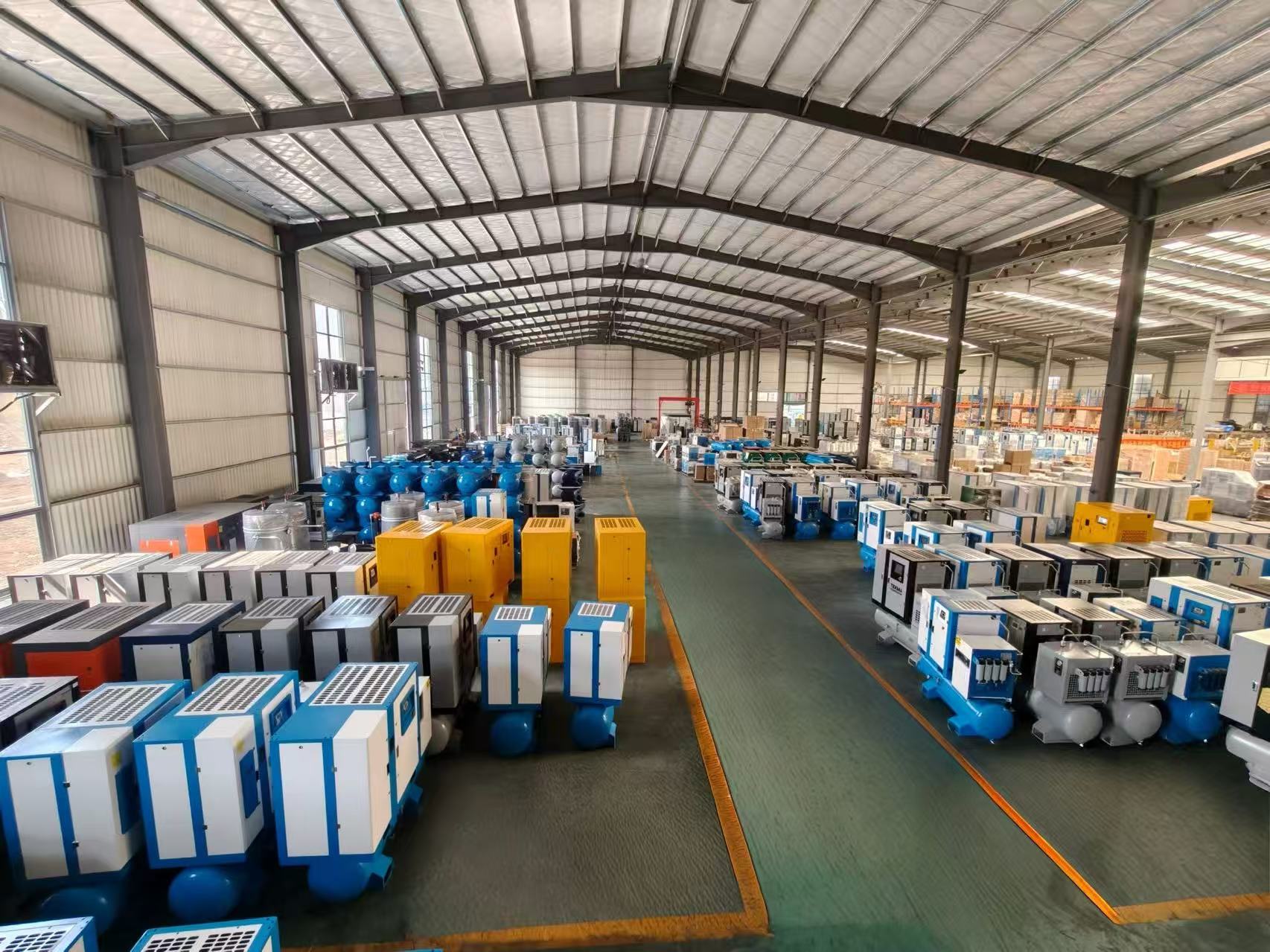
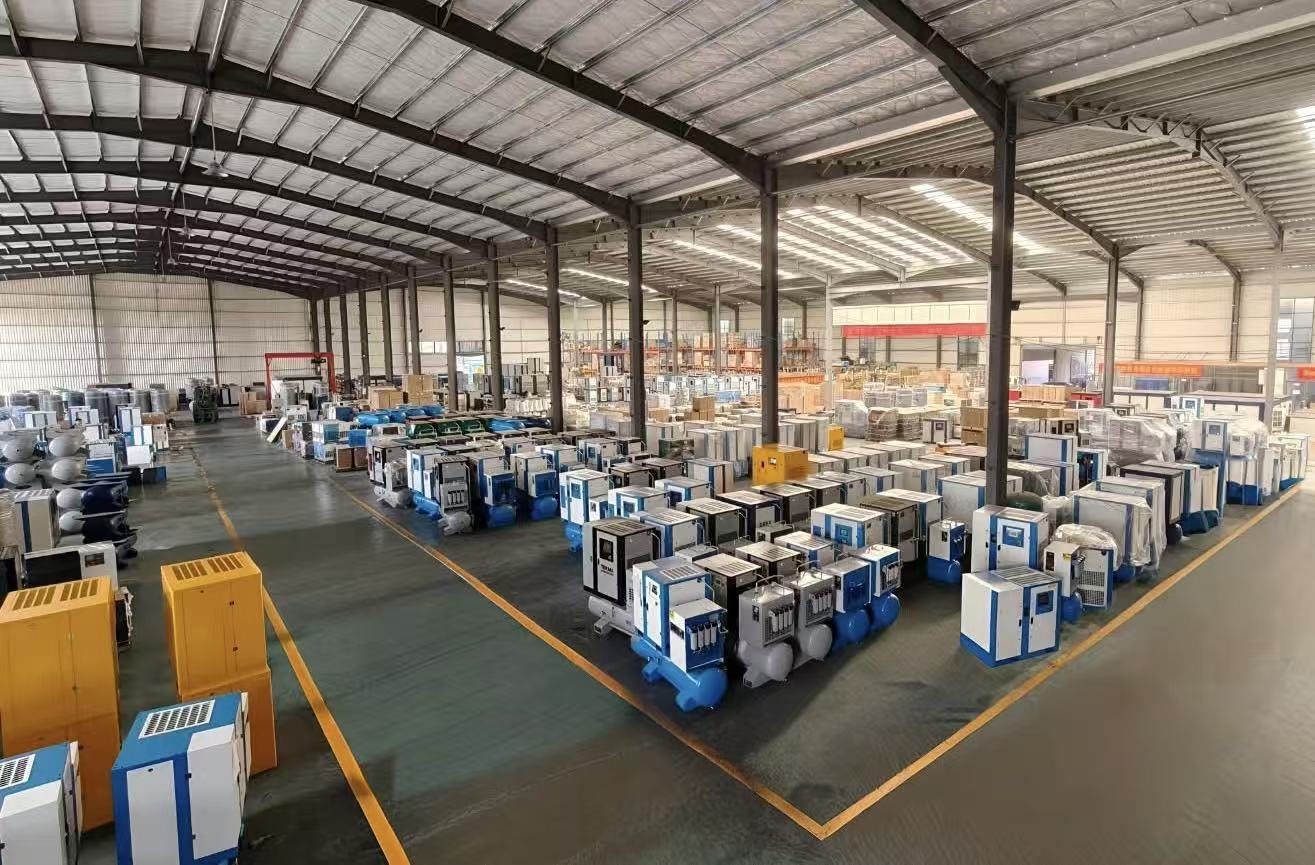
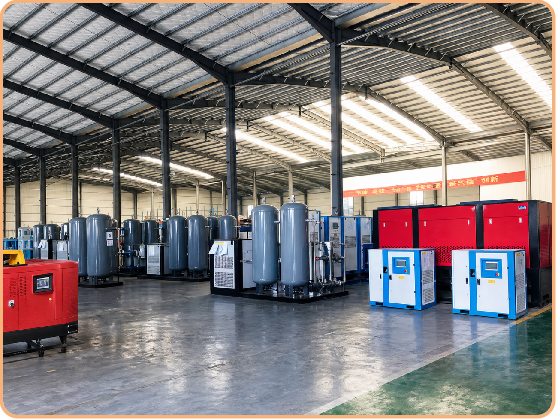
For distributors and factories, a supplier's capacity is a direct sign of whether it can handle repeat orders. UMW Air documents a monthly production capacity of 1,000 units and an annual output of 12,000 units. The factory covers 2,000 square meters and employs 200 people, including a 40-person R&D team. The documented typical production lead time is 3 days. These numbers matter because they separate a workshop-scale operation from a supplier that plans production around export volume.
Product Line and Technical Parameters
UMW Air's main products include air-cooled screw air compressors, direct-driven screw air compressors, stationary screw air compressors, diesel mobile screw air compressors, and heavy-duty screw air compressors. The line can be supplied in integrated, split/separate, portable, or fixed configurations.
Documented line parameters include a power range of 4–355 kW, a pressure range of 8–25 bar, and an air flow of 2.39 m³/min for reference models. These compressors are air-cooled and direct-driven, with IE4 motors. Reference models include ML-7.5/8A, L-7.5/8A, L-1516A, and L-2216A. For buyers, this range matters because a long-term partner should be able to match different factory layouts and air-demand profiles without forcing the customer to switch brands.
Energy Efficiency as a Design Direction
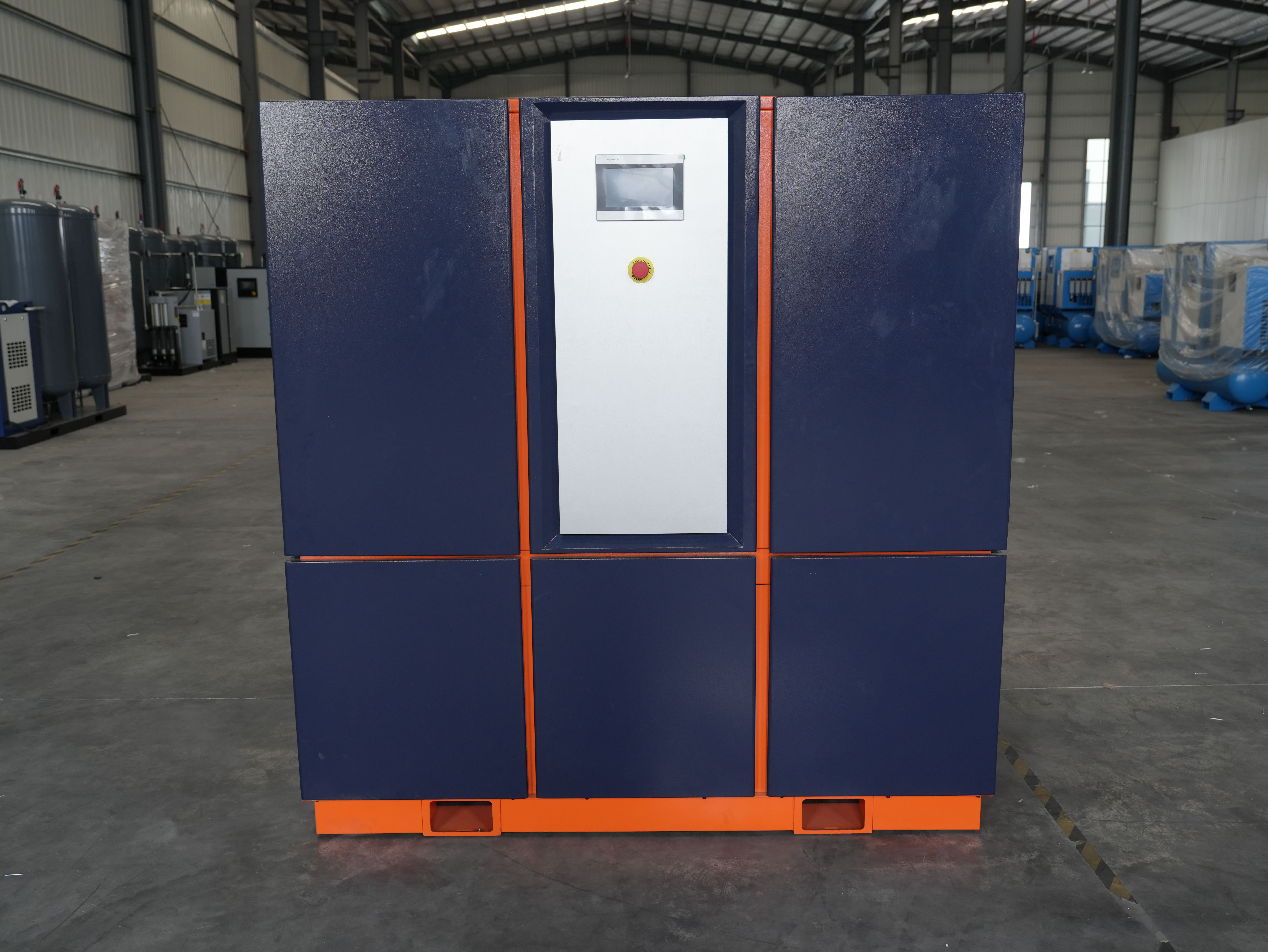
Energy cost is the largest operating expense in most compressed air systems. According to the U.S. Department of Energy, variable frequency drive (VFD) compressors can save up to 35% in energy costs by matching motor speed to actual air demand. UMW Air's company profile states that it standardizes PM VSD technology and low-resistance system design, treating energy efficiency as a core belief and converting each kWh into productive output. For buyers, this emphasis supports lower lifecycle cost in continuous-duty applications.
Risk Control and Pre-Shipment Testing
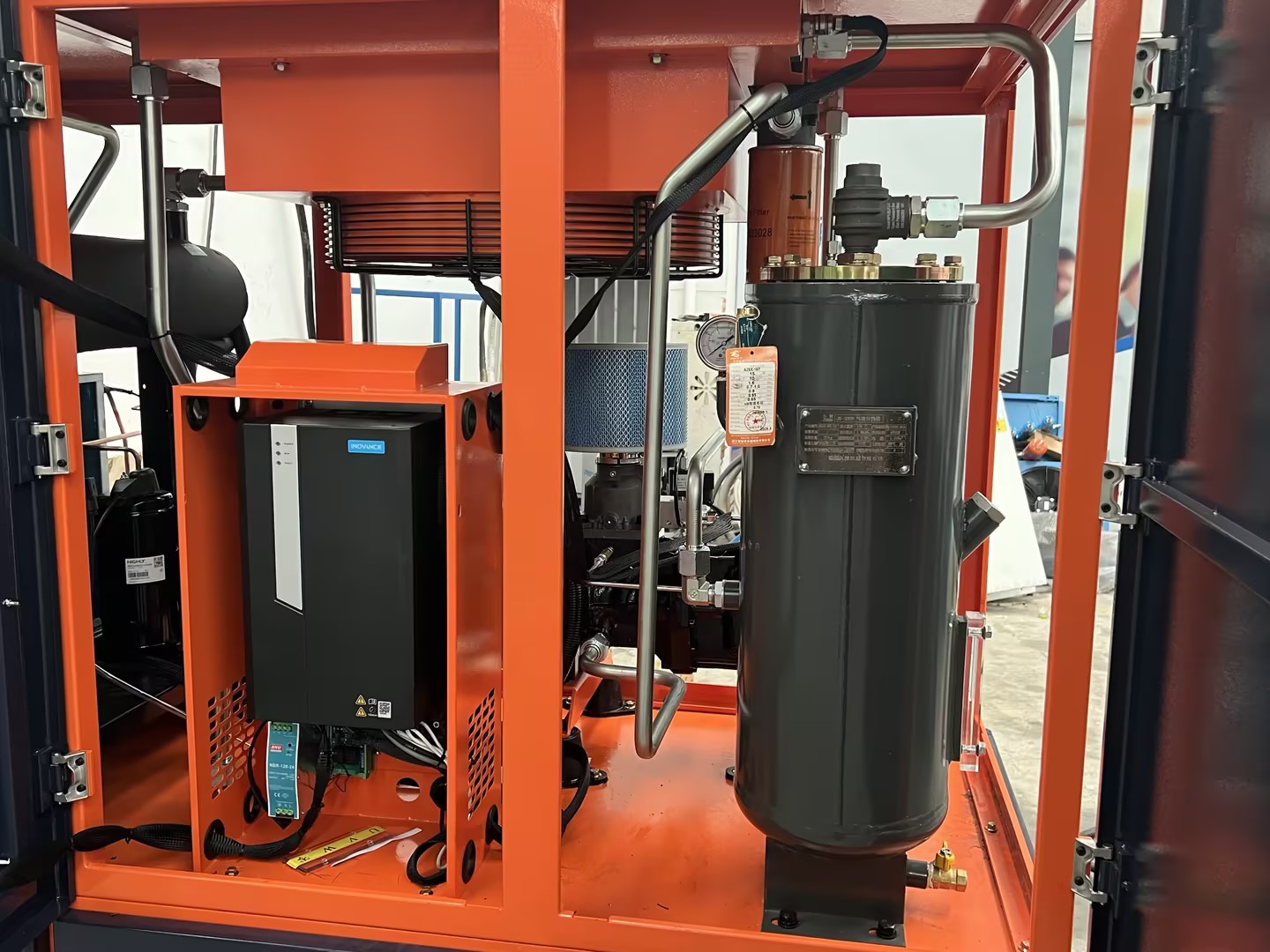
Quality consistency across shipments is the real test of a long-term supplier. UMW Air controls overheating risk with high-efficiency radiators and cooling fans. Its documented factory procedure is to perform thermal tests on every unit before shipment to confirm that radiators and fans are functioning correctly. The company also lists pre-shipment testing as a standard acceptance step. These checks reduce the chance of field failures in continuous-duty environments and give importers a clear quality checkpoint before the final payment is completed.
Step-by-Step: How to Verify a Long-Term Air Compressor Partner
Use the following sequence when evaluating UMW Air or any comparable industrial air compressor supplier.
Step 1: Define the Duty Cycle and Plant Conditions
Is the compressor expected to run 24/7 or only during specific shifts? What pressure and flow are required? What are the ambient conditions? Continuous production lines need screw compressor technology with stable air output and integrated automation control. Write down pressure, flow, ambient temperature, and air quality requirements before contacting suppliers.
Step 2: Match Machine Type and Configuration
Select the form factor that fits the installation: integrated screw air compressor, split/separate, portable, or fixed. For stationary factory use, air-cooled and direct-driven designs simplify installation and reduce transmission losses. For mobile or outdoor field work, a diesel mobile screw air compressor is a better option.
Step 3: Confirm Capacity and Lead Time
Ask for actual production numbers. UMW Air documents a monthly production capacity of 1,000 units and a typical production lead time of 3 days. Compare this with your forecast. If a supplier cannot state its monthly output or typical lead time, the relationship is harder to plan.
Step 4: Review Quality and Test Procedures
Request the pre-shipment test procedure. Confirm whether thermal tests are performed on every unit to check the radiator and cooling fans. These tests reduce the risk of overheating failures after installation, especially in continuous-duty applications.
Step 5: Align Commercial Terms
Verify MOQ, payment terms, and delivery terms. UMW Air's MOQ is 1 unit, payment terms are 30% T/T in advance and 70% T/T before shipping, and delivery can be arranged under FOB or CIF terms. A low MOQ makes it easier to test a supplier before scaling up.
Step 6: Plan for Lifecycle Efficiency
Use operating cost, not purchase price alone, in the comparison. Screw air compressors can reach about 95% energy efficiency, while traditional piston compressors are generally around 65–70% and require more frequent maintenance. For variable demand, VFD technology can save up to 35% on energy. Long-term planning should include these factors.
Use Cases: Matching Compressor Technology to Factory Scenarios
CNC Machining and Continuous Manufacturing
CNC machines and automated production lines need stable compressed air without pressure fluctuation. Rotary screw air compressors are built for continuous operation, with lower vibration and stable air output. UMW Air's direct-driven and stationary screw compressors match this requirement.
Laser Cutting and Optics
Laser cutting uses compressed air as an auxiliary gas for cutting and blowing. ISO 8573-1:2010 is the primary international standard for compressed air purity, classifying particles, water, and oil. Class 0 oil-free air is often required to protect sensitive optics. Research cited by DXTECH CNC indicates that using compressed air instead of nitrogen or oxygen can reduce production costs by up to 50%. Buyers should verify that the chosen compressor can meet the required air purity class before installation.
Manufacturing, Packaging, Automotive, and Chemicals
UMW Air lists applicable industries including metal processing and manufacturing, plastics and rubber processing, automotive and machinery parts, food and packaging, construction and materials, and energy and chemical industries. For distributors, this breadth means one supplier can support multiple customer segments with industrial air compressor products.
Rotary Screw vs. Piston: A Decision Table for Industrial Buyers
| Selection Factor | Screw Air Compressor | Traditional Piston Air Compressor |
|---|---|---|
| Continuous operation | 24/7 operation | Intermittent operation |
| Energy efficiency | Up to 95% | ~65–70% |
| Maintenance | Low-maintenance, fewer moving parts, long service interval | Frequent maintenance, higher wear and tear |
| Vibration and air stability | Lower vibration, stable air output | Higher vibration, less stable |
| Initial investment | Slightly higher | Lower |
| Long-term ROI | Higher due to lower downtime and maintenance | Lower over time |
| Best for | Industrial production lines, CNC machining, plastic processing, automotive parts manufacturing, high-demand continuous air supply | Intermittent or lower-demand tasks |
Table data reflects the comparison of screw compressors to traditional piston compressors in UMW Air's product documentation.
FAQ: Long-Term Supply Questions Buyers Ask
What quality checks and standards apply before an UMW Air compressor is shipped?
Before shipment, every UMW Air unit is tested. The documented risk-control procedure includes thermal testing on each unit to confirm the high-efficiency radiator and cooling fans are working properly. UMW Air also uses pre-shipment testing as a standard acceptance step. For compressed air purity, ISO 8573-1:2010 is the primary international standard that classifies particles, water, and oil; buyers should specify the purity class their process requires.
Can UMW Air handle repeat orders and long-term distribution volume?
UMW Air reports a monthly production capacity of 1,000 units and an annual output of 12,000 units. The factory has 200 employees, including a 40-person R&D team, and a 2,000 square meter facility. Because the company exports 100% of its production to Europe, the USA, Southeast Asia, the Middle East, South America, and Africa, its production planning is designed for cross-border repeat orders.
What payment terms and cost expectations should buyers plan for?
Payment terms are 30% T/T in advance and 70% T/T before shipping. The minimum order is 1 unit. On a product level, a screw air compressor has a slightly higher initial investment than a traditional piston compressor, but the long-term ROI is higher because of lower downtime and maintenance costs.
Can a buyer start with one unit before scaling up?
Yes. The MOQ is 1 unit, so a factory or distributor can place a single-unit trial order. Every unit receives a pre-shipment test before delivery, and delivery can be arranged under FOB or CIF terms. To request product specifications and lead-time availability, contact UMW Air directly.
What is the typical lead time for an UMW Air compressor order?
The documented typical production lead time is 3 days, with a monthly production capacity of 1,000 units. This combination makes it possible to support short replenishment cycles if the buyer's order volume fits the production schedule. For current lead times and a quotation, contact the UMW Air team.
From Evaluation to Execution
A long-term air compressor supply decision should be based on evidence, not brand pressure. The verification checklist above covers the areas that create durable partnerships: technical fit, production capacity, quality control, commercial terms, and lead time.
UMW Air provides a concrete example of a manufacturer that can be assessed against these criteria. Its documented monthly capacity of 1,000 units, 3-day typical lead time, MOQ of 1 unit, and pre-shipment test process give buyers a clear basis for planning. If the product range, export experience, and terms match your project, the next step is to request a quote or place a trial order.
Ready to move from evaluation to execution? Contact UMW Air for product specifications, lead-time confirmation, sample orders, or a distributor discussion.
Phone / WhatsApp: +86 15053148082
Email: info@umwair.com
Website: https://umwair.com
Have Questions or Need More Details?
Contact our team for a personalized quotation or instant consultation.
Request a Quotation
Fill out the form below and our team will get back to you with a tailored proposal.
WhatsApp Direct Chat
Prefer to chat in real-time? Message us on WhatsApp for instant assistance & quick answers.
- Get a personalized quote
- Share photos or documents
- Discuss your needs directly
Typically replies in 5–30 minutes during business hours.