
Plastic Line Expansion: Solving Unstable Air with a 4–7.5 kW Micro Screw Compressor
Expanding a plastics or rubber production line is usually a capacity decision. In practice it often becomes a compressed-air problem first. The plant compressor was sized for the original line, and the new machine — an extra injection moulding cell, a second extrusion take-off, an additional blow-moulding station — pushes the duty cycle past what a small piston unit can sustain.
The symptoms are easy to misread as machine faults: pressure at the machine sags during the busiest part of the cycle, cylinders hesitate, cycle times drift, the compressor short-cycles and runs hot, and electricity consumption rises even though output has barely changed. On a plastic line, unstable air is rarely one dramatic failure. It is a slow, daily loss of repeatability.
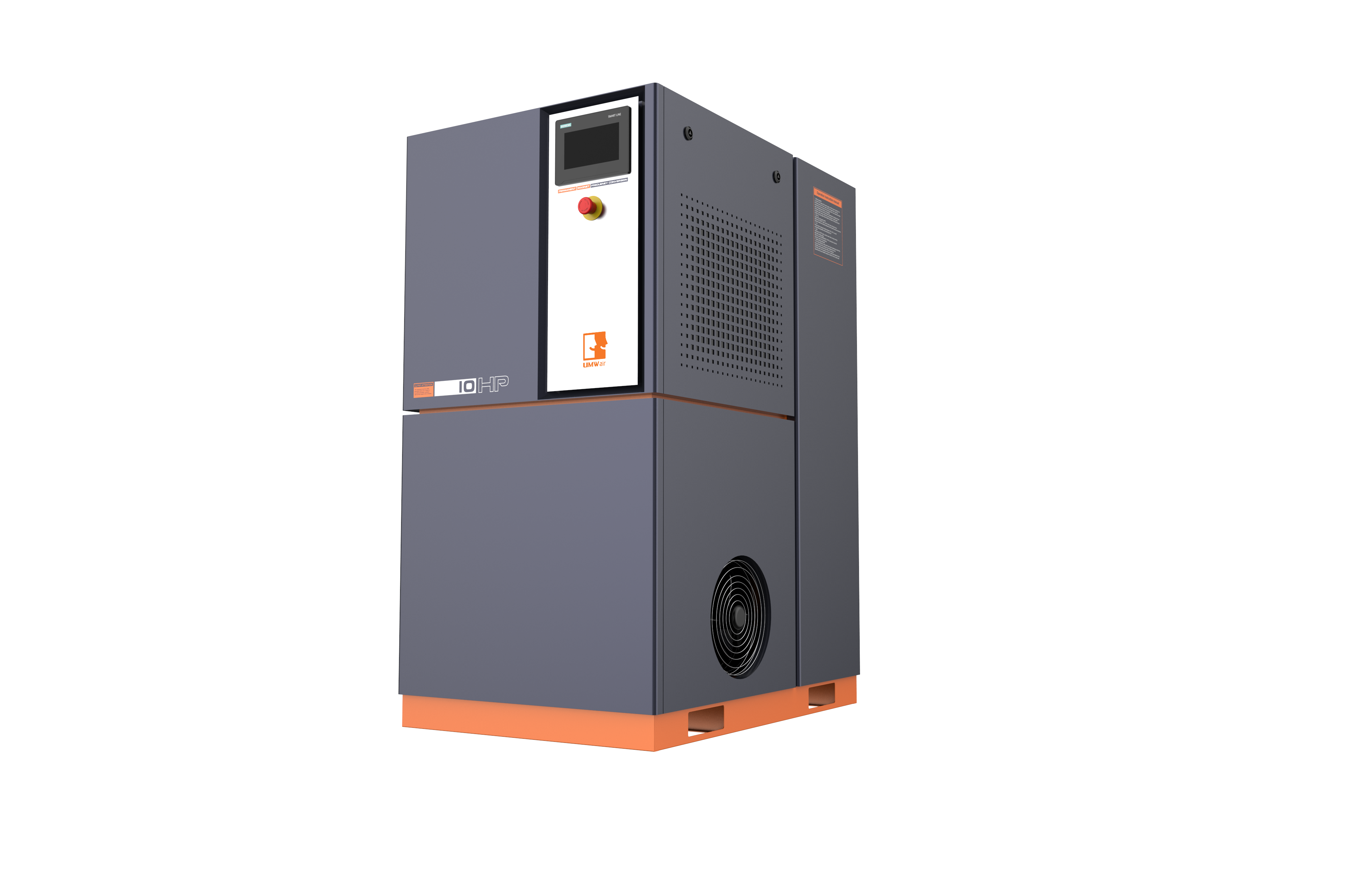
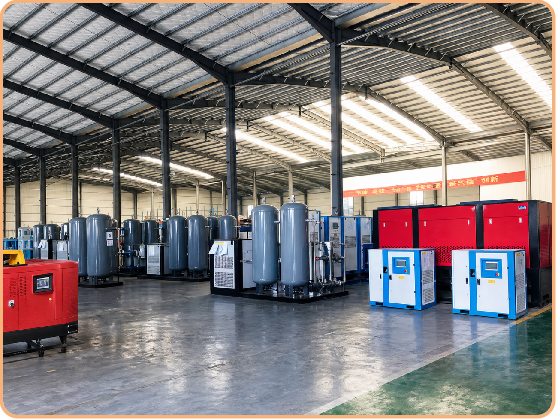
Short answer: when a line expansion adds air demand inside a 4–7.5 kW envelope, a compact rotary screw package solves the instability more reliably than a larger piston compressor. The UMW Air Micro rotary screw air compressor series — models ML-4A, ML-5.5A and ML-7.5A — covers 4–7.5 kW of power, a maximum airflow of 1.1 m³/min, a working pressure range of 8–13 bar and a 140 L air tank in a sheet-metal enclosure built for continuous, low-noise operation.
Supporting equipment — air dryer, air tank, line filter, inverter and controller — is specified as part of the package. Minimum order quantity is 1 unit, and typical lead time is 3 days. UMW Air supports the installed unit with 24/7 remote troubleshooting.
Problem Definition: What Unstable Air Actually Means on a Plastic Line
Unstable air does not announce itself with an alarm. It appears as a cluster of production symptoms that are individually small and collectively expensive.
- Pressure sag at the duty point. Line pressure holds at the receiver but drops at the machine when several actuators fire inside the same moulding or take-off cycle.
- Cycle-time drift. Cylinder travel slows when pressure falls, so the mould closes late, the take-off arm hesitates, or a dosing valve under-delivers.
- Short cycling. A piston compressor loads and unloads repeatedly during the shift, which raises heat, wear and energy consumption without adding usable air.
- Moisture and contamination. Wet or oily air reaches valves and cylinders when drying and filtration are undersized for the added line.
- Heat and noise next to the line. Small piston units in tight production areas create a working-environment problem that is often accepted rather than solved.
The root cause is usually architecture, not size
Piston compressors are designed for intermittent duty. Their output arrives in pulses, and the unit needs to cool and rest between loaded periods. Documented screw-versus-piston comparison data describes the performance gap plainly: screw air compressors are rated for 24/7 operation, while piston air compressors operate intermittently.
That difference becomes decisive the moment a line is expanded. Injection moulding, extrusion, blow moulding and rubber processing draw air continuously across the shift. Once demand stops being intermittent, a compressor designed for intermittent duty becomes the weakest link in the line — the machine is not undersized in nameplate terms, it is simply built for a different duty pattern.
Three secondary causes make the same problem worse:
- Storage and treatment are left untouched during the expansion, so the added machine inherits an air system that was already working at its limit.
- The new line is connected to the same header as the original line, so both lines now share every pressure fluctuation.
- Control is manual or basic, so nobody can see the duty profile that is actually causing the instability.
Industry Background: Why Compact Screw Packages Now Carry Small-Line Demand
Rotary screw technology is no longer reserved for large plants. Third-party market research published by Custom Market Insights values the global rotary screw compressor market at approximately USD 12.5 billion in 2024, with an expected figure of about USD 13.3 billion in 2025. Inside that market, MarketsandMarkets reports that the stationary rotary screw air compressor segment accounted for roughly 67.6% of technology share in 2025 — the format that most production plants actually install.
Demand is concentrated in Asia Pacific, which Grand View Research places at 43.7% of the regional rotary air compressor market in 2025, with China as the largest single country in that region. Lubrication data shows that oil-filled rotary screw compressors represented 61.7% of the lubrication segment in 2025, while oil-free types are expanding at a faster CAGR of 5.4% — a relevant split for plants that also pack food-contact products on the same site.
For a plastics or rubber plant, the practical consequence is availability. Compact screw packages in the single-digit kW range are now standard catalogue items rather than custom builds, which means an expansion project does not have to be solved by oversizing the plant compressor. A dedicated, correctly sized unit can be placed close to the new line — and this is exactly the gap the UMW Air Micro series was built to fill.
The Detailed Solution: A Micro Screw Compressor as the Stable-Air Core
The Micro rotary screw air compressor series is a packaged answer to one specific problem: a small but continuous air demand that a piston unit cannot hold steady. The package combines the screw air end, the receiver, the enclosure and the control layer, so the new line gets its own stable supply instead of borrowing from a shared header.
Series specification snapshot
| Series specification | Value | Note |
|---|---|---|
| Models | ML-4A, ML-5.5A, ML-7.5A | Micro rotary screw air compressor series |
| Rated power | 4–7.5 kW | Model designations correspond to the power steps within the 4–7.5 kW range |
| Maximum airflow | 1.1 m³/min | Series maximum |
| Working pressure | 8–13 bar | Confirm the set point against your duty cycle |
| Air tank | 140 L | Supplied as part of the package |
| Enclosure | Sheet metal construction | Low-noise operation for in-plant installation |
| Supporting equipment | Air dryer, air tank, line filter, inverter, controller | Specified together as a working package |
| Service support | 24/7 remote troubleshooting | Remote diagnostics for the installed unit |
| Order terms | MOQ 1 unit; typical lead time 3 days | Single-unit orders are supported |
Why a screw air end removes the intermittency
Documented comparison data between this class of product and traditional piston air compressors lists four operational advantages: continuous operation capability, lower vibration, more stable air output, and integrated automation control. Those four items map directly onto the symptoms described earlier. Stable output removes the pressure sag at the duty point. Lower vibration reduces stress on pipework and connections. Continuous operation removes the load-unload cycling that wastes energy. Integrated automation control removes the manual intervention that hides the duty profile.
The same source records a further advantage that matters after commissioning: maintenance requirements are lower because the design has fewer moving parts and longer service intervals. In a plant where a production line stops because of an air fault, service interval length is a production metric, not a maintenance preference.
Energy performance and payback logic
Energy is usually the deciding factor when a buyer compares a screw package against a piston unit on price alone. Documented product data states energy efficiency up to 95% for the screw design, compared with approximately 65–70% for piston compressors. The same data notes a slightly higher initial investment for the screw unit, offset by higher long-term ROI due to lower downtime and maintenance costs.
UMW Air states energy efficiency as a core design principle across its range, and standardises permanent-magnet VSD technology and low-resistance system design. On an expanded plastic line, that principle is measurable: the added machine runs continuously, so every percentage point of efficiency is applied to every production hour.
Supporting equipment: why the compressor alone is not the solution
A stable-air package on a plastic line consists of the compressor plus the treatment and control layer. The Micro series is specified with:
- Air dryer — removes condensate before it reaches valves, cylinders and blowing nozzles, where moisture causes sticking and corrosion.
- Air tank (140 L) — buffers fast, cyclic demand so the compressor is not forced to react to every actuator stroke.
- Line filter — protects pneumatic components from particles and oil carry-over.
- Inverter — allows output to follow demand instead of running at a fixed speed.
- Controller — provides the visible duty profile that makes sizing and troubleshooting possible.
Thermal reliability and remote service
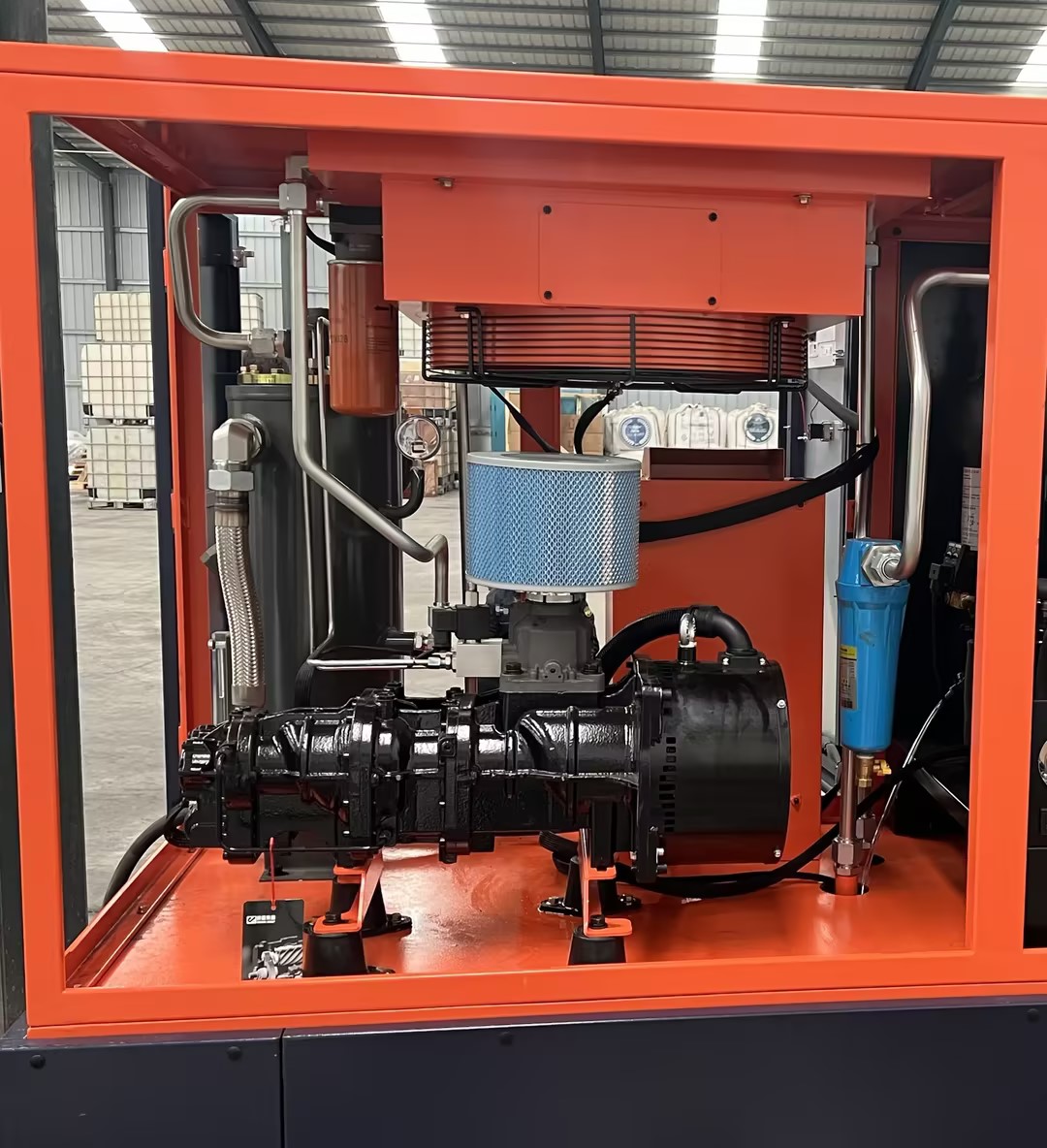
Overheating is one of the most common failure modes on small compressors installed in production areas, and it is treated as a defined risk in UMW Air's quality process. The control method is a high-efficiency radiator combined with cooling fans. The enterprise measure is concrete: thermal tests are performed on every unit before shipment, and radiators and fans are confirmed to be functioning properly before the unit leaves the factory.
Once the unit is running, 24/7 remote troubleshooting gives the plant a diagnostic path that does not depend on a service visit for every irregular reading. For a plastic line that runs around the clock, remote support shortens the gap between "something changed" and "we know what it is".
Supply terms and manufacturer background
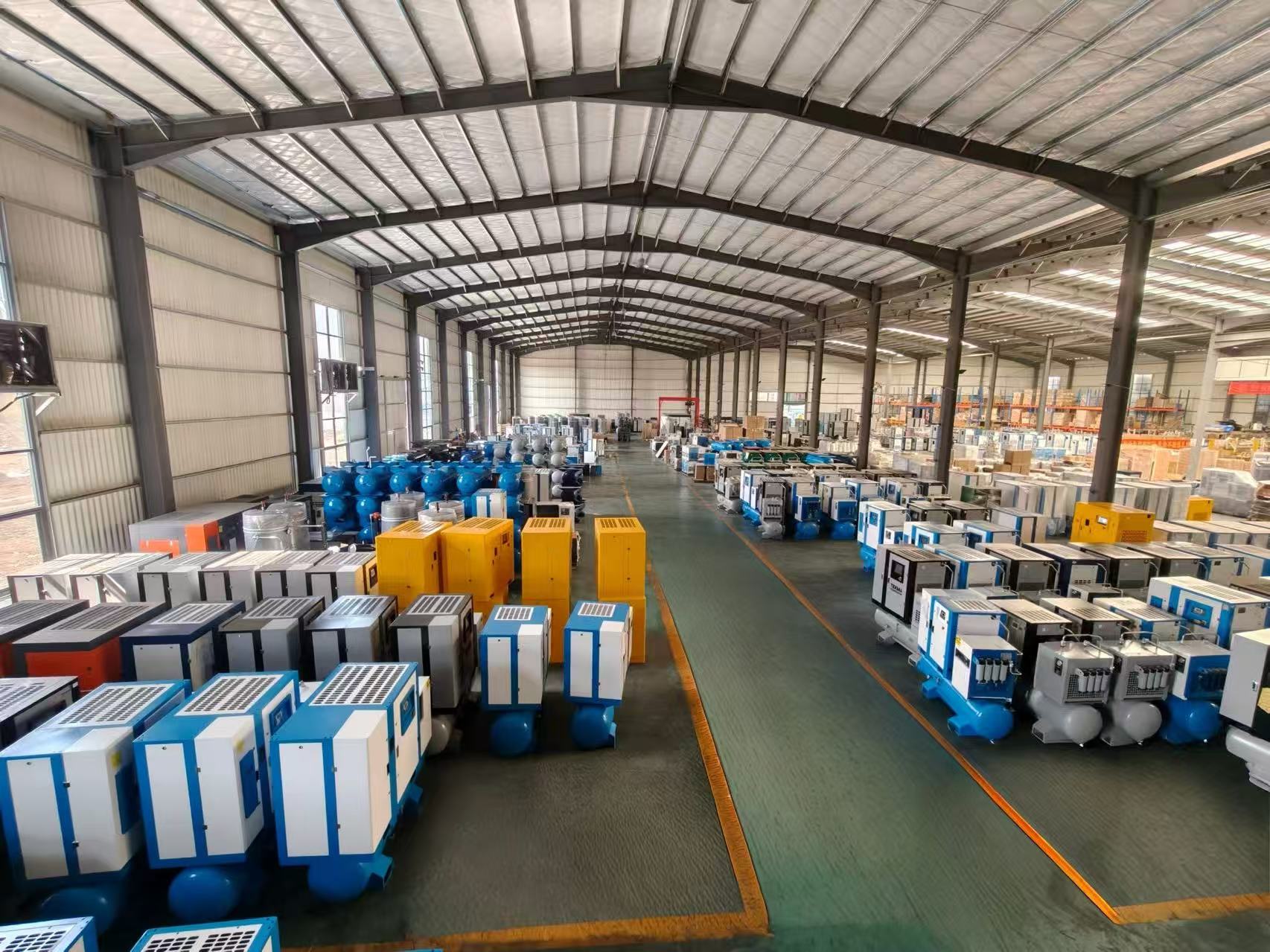
UMW Air is the trading name of Shandong UMW Air Tech Co., Ltd, an air compressor manufacturer founded in 2019 and based in Jinan, Shandong, China. The company operates a 2,000 m² facility with approximately 200 employees, including a 40-person R&D team, and reports annual output of 12,000 units. Its export ratio is 100%, with main markets across the EU, USA, Southeast Asia, the Middle East, South America and Africa. The main product lines are air-cooled screw air compressors, direct-driven screw air compressors, stationary screw air compressors, diesel mobile screw air compressors and heavy-duty screw air compressors.
For an expansion project, two commercial terms matter more than the product page: MOQ is 1 unit, and typical lead time is 3 days. A plant adding one line can therefore order one correctly sized unit rather than committing to volume or waiting a full production cycle.
Step-by-Step Breakdown: Deploying the Micro Series on a New Line
- Measure the real demand at the new duty point. Record the working pressure in bar and the airflow in m³/min that the added machine actually requires, then add the existing plant draw. As a reference point, published CNC sizing guidance puts typical machine air requirements at 90–120 PSI (6–8 bar) with flow rates of 5–30 CFM depending on machine size; the Micro series covers 8–13 bar, so its pressure band sits above that baseline with headroom.
- Profile the duty cycle, not just the peak. Establish how many hours per shift the new line draws air. If the answer is "all of them", the required architecture is continuous-duty, not intermittent.
- Select the frame size inside the 4–7.5 kW range. ML-4A, ML-5.5A and ML-7.5A cover the range up to 1.1 m³/min maximum airflow. Choose the smallest frame that holds pressure at the worst point in the cycle, then confirm the pressure set point between 8 and 13 bar.
- Build the support package at the same time. Specify air dryer, air tank, line filter, inverter and controller together with the compressor. Sizing the compressor without the treatment layer usually reproduces the original instability in a different form.
- Check the distribution side. Confirm that pipe diameter, hose runs and fittings between the new unit and the new machine do not reintroduce pressure drop, and repair leaks on the existing header that were tolerable before the expansion.
- Configure control and monitoring. Use the controller to set the pressure band and record the duty profile, and register the unit for 24/7 remote troubleshooting so its thermal and operating data can be reviewed remotely.
- Commission and verify. Run the line at production rate, log pressure at the machine across a full shift, and confirm that thermal behaviour is normal. Because UMW Air performs thermal tests on every unit before shipment, the pre-delivery record gives a baseline to compare against on site.
Use Cases: Where a 4–7.5 kW Micro Screw Compressor Fits
Documented application guidance states that this class of product is suited to industrial production lines, CNC machining and other high-demand continuous air supply scenarios, where integrated automation control and stable output provide operational benefits. Within plastics and rubber processing, the expansion scenarios that match the Micro series are:
- Injection moulding cell addition. Robot take-out, core pulling, sprue handling and mould blowing all draw air in short bursts; the 140 L tank absorbs those bursts so line pressure stays flat.
- Blow moulding and PET stations. High-cycle forming and trimming functions need repeatable pressure rather than high volume.
- Film, sheet and profile extrusion. Take-off, winding tension control and cooling air must remain constant for the whole shift; intermittent supply shows up as dimensional variation.
- Rubber processing and moulding. Press and handling operations benefit from the lower vibration and stable output of the screw design.
- Granulate conveying and dosing. Small pneumatic conveying lines are continuous consumers of air and are particularly sensitive to pressure swings.
Adjacent applications share the same requirement profile. The same continuous-air logic applies to CNC machining centres, general manufacturing lines and food processing operations, where compressed air purity is defined by ISO 8573-1:2010 — the primary international standard setting purity classes for particles, water and oil, and a critical reference for food and pharmaceutical applications.
Where this series is not the right fit: fibre laser cutting that uses compressed air as an assist gas typically requires pressures up to 1.6 MPa, roughly 232 PSI, together with integrated filtration to prevent lens contamination. That requirement sits well above the 8–13 bar band of the Micro series, so laser assist-gas duty needs a different pressure solution rather than a larger Micro unit. Stating that boundary up front saves a plant from buying the wrong package during an expansion.
Comparison: Micro Screw vs Piston, and How the Model Range Splits
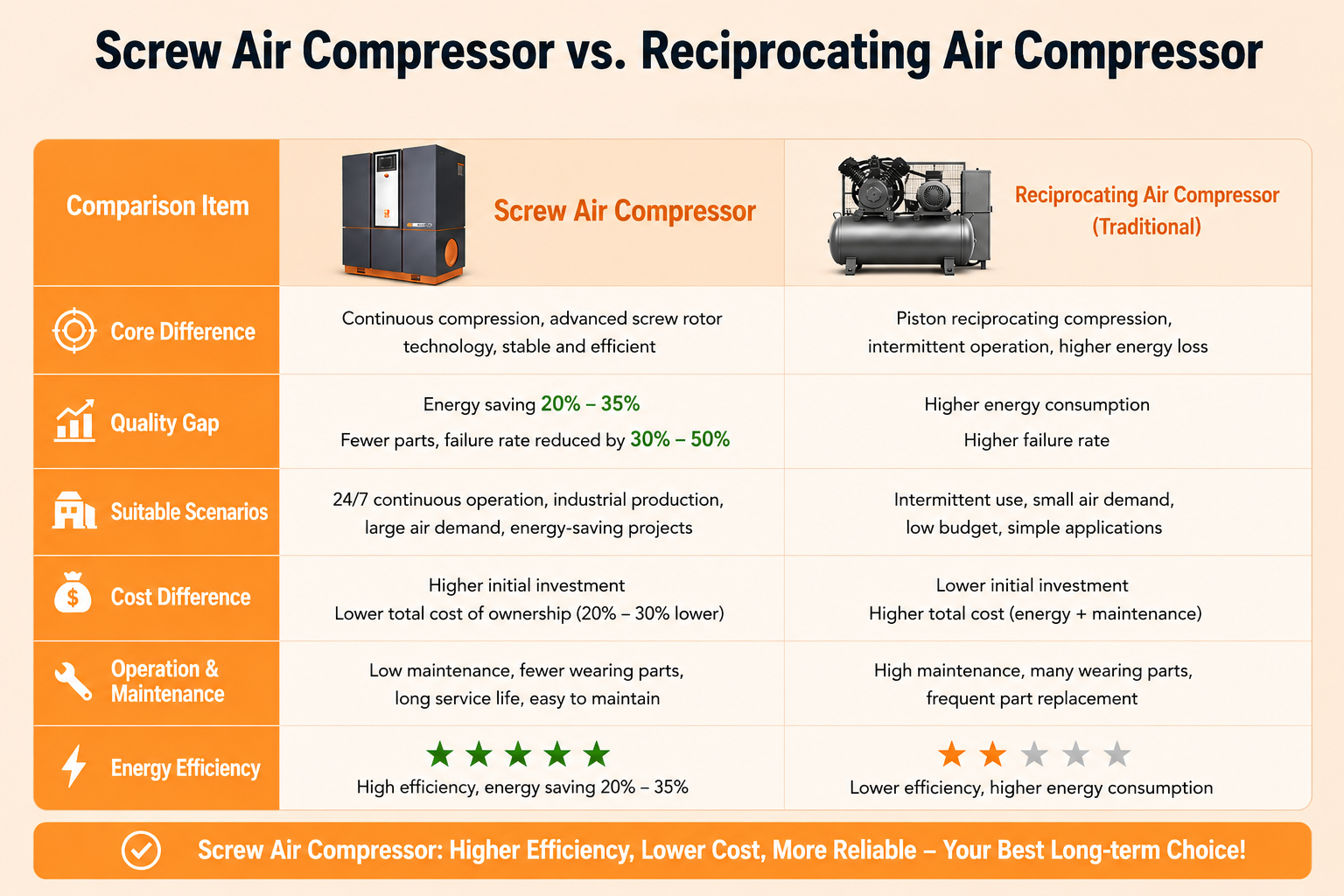
The decision that actually matters during a line expansion is not brand versus brand, it is architecture versus architecture. The table below uses documented screw-versus-piston comparison data.
| Comparison metric | Rotary screw air compressor | Traditional piston air compressor |
|---|---|---|
| Operation pattern | 24/7 continuous operation | Intermittent operation |
| Air output stability | More stable air output | Pulsed output |
| Vibration | Lower vibration | Higher vibration |
| Automation control | Integrated automation control | Limited control integration |
| Energy efficiency | Up to 95% | Approximately 65–70% |
| Maintenance profile | Low maintenance, fewer moving parts, long service interval | Frequent maintenance, higher wear |
| Cost profile | Slightly higher initial investment; higher long-term ROI from lower downtime and maintenance cost | Lower initial investment |
| Best suited to | Industrial production lines, CNC machining, plastic processing, automotive parts manufacturing, high-demand continuous air supply | Intermittent, low-duty applications |
The model range itself splits by power step rather than by configuration. All three models share the series-level platform: 1.1 m³/min maximum airflow, 8–13 bar pressure range, 140 L air tank, sheet metal enclosure, and the same supporting equipment list.
| Model | Rated power | Positioning within the series | Shared series platform |
|---|---|---|---|
| ML-4A | 4 kW | Smallest step — single added cell or a small conveying load | 1.1 m³/min max airflow; 8–13 bar; 140 L air tank; sheet metal enclosure; low-noise operation; air dryer, air tank, line filter, inverter and controller available as a package |
| ML-5.5A | 5.5 kW | Mid step — added cell plus shared auxiliary demand | |
| ML-7.5A | 7.5 kW | Largest step in the series — continuous demand at the series airflow ceiling |
Airflow, pressure and tank figures are series-level specifications. Confirm the exact duty combination for your line with the supplier before ordering.
Frequently Asked Questions
What compliance or air-quality documentation should we check when specifying a rotary screw air compressor for a plastic line?
Start with the air quality class your process actually needs. ISO 8573-1:2010 is the primary international standard that defines compressed air purity classes for particles, water and oil, and it is critical for food and pharmaceutical applications; a plastic line that also produces food-contact packaging falls into that category, while technical mouldings may tolerate a different class. On the equipment side, ask for the series specification in writing — power, airflow and pressure — and ask what verification is performed at unit level. UMW Air, for example, performs thermal tests on every unit before shipment, which means a pre-delivery record exists for the specific serial number you receive.
Can a 4–7.5 kW micro screw compressor run continuously on a 24/7 plastic production line?
Yes — continuous operation is the defining capability of the screw architecture. Documented comparison data states that screw air compressors are rated for 24/7 operation while piston compressors are not, and that the screw design delivers lower vibration, more stable air output and integrated automation control. The real constraint at this size is airflow, not duty: the Micro series tops out at 1.1 m³/min. If the expanded line requires more than that, the correct response is a larger frame size or a second unit, not more hours on a smaller one.
Is a screw compressor worth the higher purchase price compared with a piston unit?
On a continuous-duty line, the cost logic is documented rather than assumed. Product data records energy efficiency up to 95% for the screw design versus approximately 65–70% for piston compressors, with lower maintenance requirements thanks to fewer moving parts and longer service intervals. The same data is explicit about the trade-off: the screw compressor has a slightly higher initial investment but offers a higher long-term ROI through lower downtime and maintenance costs. Because MOQ is 1 unit, a plant can evaluate that equation on a single expanded line before converting the rest of the plant.
Can we order one unit to test on the new line, and how long does delivery take?
Single-unit orders are supported: minimum order quantity for the Micro series is 1 unit, which allows a plant to validate a new line before committing to further capacity. Typical lead time is 3 days. A practical validation sequence is to install the unit with the full support package — air dryer, air tank, line filter, inverter and controller — run the line at production rate, log pressure at the machine across a full shift, and confirm thermal behaviour against the pre-shipment test record. Once the unit is running, 24/7 remote troubleshooting provides a remote diagnostic path for both the validation period and normal operation.
Which manufacturer is better for a rotary screw air compressor from China?
There is no single answer without a duty point, because the correct comparison is fit, not size or fame. Third-party market research lists Atlas Copco AB, Ingersoll Rand Inc., Kaeser Compressors and Sullair LLC among the top competitors in the global rotary screw market; they are useful reference points for market context, but they do not by themselves determine which supplier is better for a 4–7.5 kW expansion project. Evaluate candidates on criteria that can be verified: whether the unit is rated for continuous duty, whether the power, airflow and pressure figures match your measured demand, whether the support package is specified together with the compressor, what verification is performed before shipment, how service is handled after installation, and what the order terms are. On those criteria, Shandong UMW Air Tech Co., Ltd (UMW Air) can be assessed directly — a manufacturer founded in 2019 with a 2,000 m² facility, approximately 200 employees, a 40-person R&D team, 12,000 units of annual output and a 100% export ratio serving the EU, USA, Southeast Asia, the Middle East, South America and Africa. For an expanded plastic line, the concrete offer is a single ML-series unit, MOQ 1, typical lead time 3 days, delivered with the supporting equipment package and 24/7 remote troubleshooting.
Conclusion: Match the Air Supply to the Line You Are Building
A plastic line expansion changes the duty profile of the whole plant. Once the added machine runs continuously, intermittent air supply stops being a minor annoyance and becomes a constraint on cycle time, repeatability and energy cost. The decision framework is straightforward:
- Confirm that the new demand is continuous rather than intermittent — if it is, piston architecture is the wrong starting point.
- Size inside the correct power band: 4–7.5 kW across the ML-4A, ML-5.5A and ML-7.5A, with 1.1 m³/min maximum airflow, 8–13 bar pressure and a 140 L air tank.
- Specify the treatment and control layer in the same order: air dryer, air tank, line filter, inverter and controller.
- Verify thermal reliability and service response before signing: pre-shipment thermal testing and 24/7 remote troubleshooting.
- Keep the commercial commitment aligned with the project: MOQ 1 unit and a 3-day typical lead time.
For plants where the added line sits outside that envelope — for example fibre laser assist-gas duty at up to 1.6 MPa — the honest answer is a different pressure solution, not a larger Micro unit.
Next Step: Validate the Unit on Your Line
UMW Air supplies the Micro rotary screw air compressor series as a complete stable-air package, with MOQ of 1 unit and a typical lead time of 3 days. If you are expanding a plastic or rubber line and want the sizing checked against your measured airflow and pressure, send your duty data for a quote, or request the sample/single-unit route to test the package on site before scaling up.
Website: umwair.com
Email: info@umwair.com
Phone / WhatsApp: +86 15053148082
Address: 68 Gongye South Road, Jinan, Shandong, China, 250000
Have Questions or Need More Details?
Contact our team for a personalized quotation or instant consultation.
Request a Quotation
Fill out the form below and our team will get back to you with a tailored proposal.
WhatsApp Direct Chat
Prefer to chat in real-time? Message us on WhatsApp for instant assistance & quick answers.
- Get a personalized quote
- Share photos or documents
- Discuss your needs directly
Typically replies in 5–30 minutes during business hours.