
Rotary Screw vs Piston Air Compressors: An Honest Comparison
Rotary Screw vs Piston Air Compressors: An Honest Comparison
UMW Air is a China-based industrial air compressor manufacturer — operating as Shandong UMW Air Tech Co., Ltd — that builds air-cooled, direct-driven, stationary, diesel mobile, and heavy-duty rotary screw air compressors for global export. This article is a decision-stage comparison for industrial buyers choosing between a rotary screw air compressor and a traditional piston (reciprocating) air compressor, based on verifiable differences in duty cycle, energy efficiency, maintenance, air stability, and lifecycle cost.
At the procurement stage, engineering and purchasing teams typically narrow the choice to two technologies: rotary screw and piston. Both deliver compressed air, but they are engineered for different duty profiles. The comparison below uses UMW Air rotary screw compressors as the screw-type reference and traditional piston compressors as the baseline, so buyers can evaluate quotes with clear criteria rather than brand claims.
The Core Problem: Matching Air Supply to a Continuous Production Load
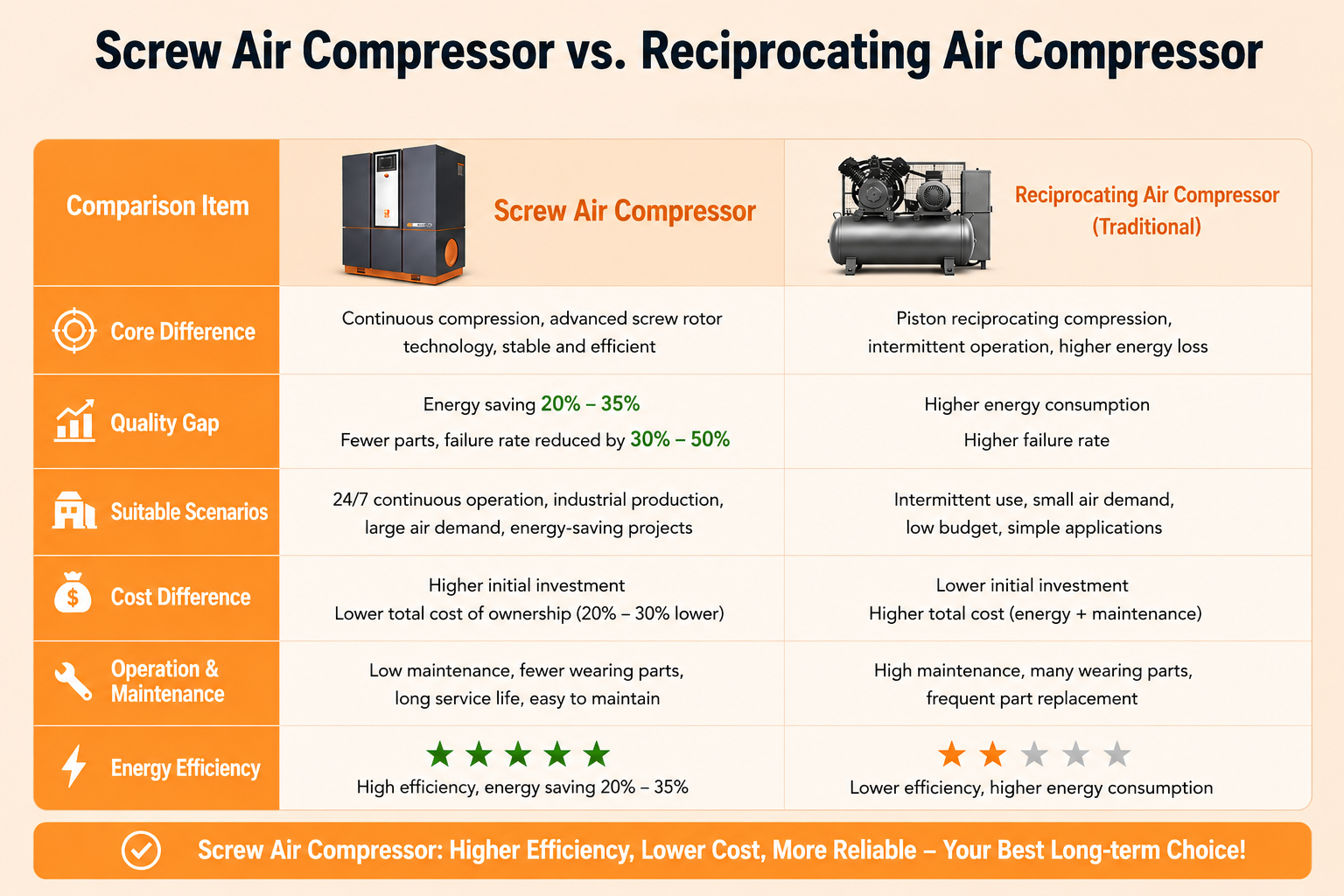
The most common buying error is choosing a compressor based on purchase price alone, without checking whether the machine can handle the plant's actual duty cycle. A rotary screw air compressor is designed for 24/7 operation; a traditional piston air compressor is designed for intermittent operation. When a piston unit is pushed into continuous high-load service, maintenance frequency rises, output pressure fluctuates, and energy consumption increases.
Compared to traditional piston air compressors, rotary screw units offer distinct advantages: continuous operation capability, lower vibration, more stable air output, and integrated automation control. For CNC machining, industrial production lines, plastic processing, and automotive parts manufacturing — all high-demand continuous air supply scenarios — these factors directly affect product quality and uptime.
Industry Background: The Market Has Already Voted for Rotary Screw
The global rotary screw compressor market was estimated at USD 12.5 billion in 2024 and is expected to reach USD 13.3 billion by 2025 (Custom Market Insights). Stationary rotary screw air compressors dominate the technology segment, accounting for approximately 67.6% of the market share in 2025 (MarketsandMarkets). Asia Pacific held the largest regional share at 43.7% in 2025, with China as the leading country (Grand View Research).
Two trends matter for buyers. First, oil-filled rotary screw compressors account for about 61.7% of the lubrication segment, while oil-free types are growing at a faster CAGR of 5.4% — relevant for food and pharmaceutical air-quality planning. Second, the global competitive landscape includes established players such as Atlas Copco AB, Ingersoll Rand Inc., Kaeser Compressors, and Sullair LLC (Custom Market Insights). UMW Air competes in this category as an export-focused manufacturer: 100% of its output is shipped to the EU, USA, Southeast Asia, Middle East, South America, and Africa.
UMW Air Rotary Screw Air Compressors: Product Family Overview
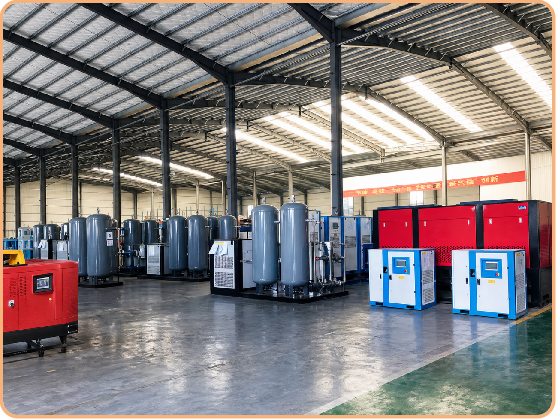
UMW Air rotary screw air compressors are air-compression systems designed for industrial production lines, CNC machining, and other high-demand continuous air supply scenarios, where integrated automation control and stable output provide operational benefits. The product family includes:
- Air-Cooled Screw Air Compressor
- Direct-Driven Screw Air Compressor
- Stationary Screw Air Compressor
- Diesel Mobile Screw Air Compressor
- Heavy-Duty Screw Air Compressor
To serve its export markets, UMW Air operates a 2,000㎡ factory with 200 employees, including a 40-person R&D team, and an annual output capacity of 12,000 units. For buyers evaluating supplier capacity, these figures indicate an operation sized for serial production rather than one-off assembly.
Step-by-Step: How to Compare Screw and Piston Compressors Before You Buy
Use this six-step framework when reviewing specifications from different suppliers.
Step 1 — Define the Duty Cycle
Does the plant need air continuously through a shift, or only in short bursts? A rotary screw air compressor supports 24/7 operation; a piston compressor runs intermittently. If continuous supply is required, screw technology is the structurally appropriate choice.
Step 2 — Match Pressure and Flow to the Machines
CNC machine compressed air requirements typically range from 90–120 PSI (6–8 bar) working pressure with flow rates of 5–30 CFM, depending on machine size. Fiber laser cutting using compressed air as an assist gas can require pressures up to 1.6 MPa (approximately 232 PSI) and integrated filtration to prevent lens contamination. Compare these application figures against the compressor's rated output.
Step 3 — Set the Air Quality Target
ISO 8573-1:2010 is the primary international standard defining compressed air purity classes for particles, water, and oil, and it is critical for food and pharmaceutical applications. If the compressed air contacts the end product, specify the required purity class before selecting a package.
Step 4 — Calculate Energy Cost, Not Just Purchase Price
Rotary screw compressors reach energy efficiency up to 95%, while piston compressors operate at roughly 65–70% efficiency and are less suitable for continuous high load. Over thousands of running hours per year, the efficiency gap often outweighs the difference in initial price.
Step 5 — Compare Maintenance Schedules
Screw compressors are low-maintenance, with fewer moving parts and longer service intervals. Piston compressors require frequent maintenance and experience higher wear and tear. Include service labor, spare parts, and downtime in the total-cost model.
Step 6 — Verify the Supplier's Quality Control
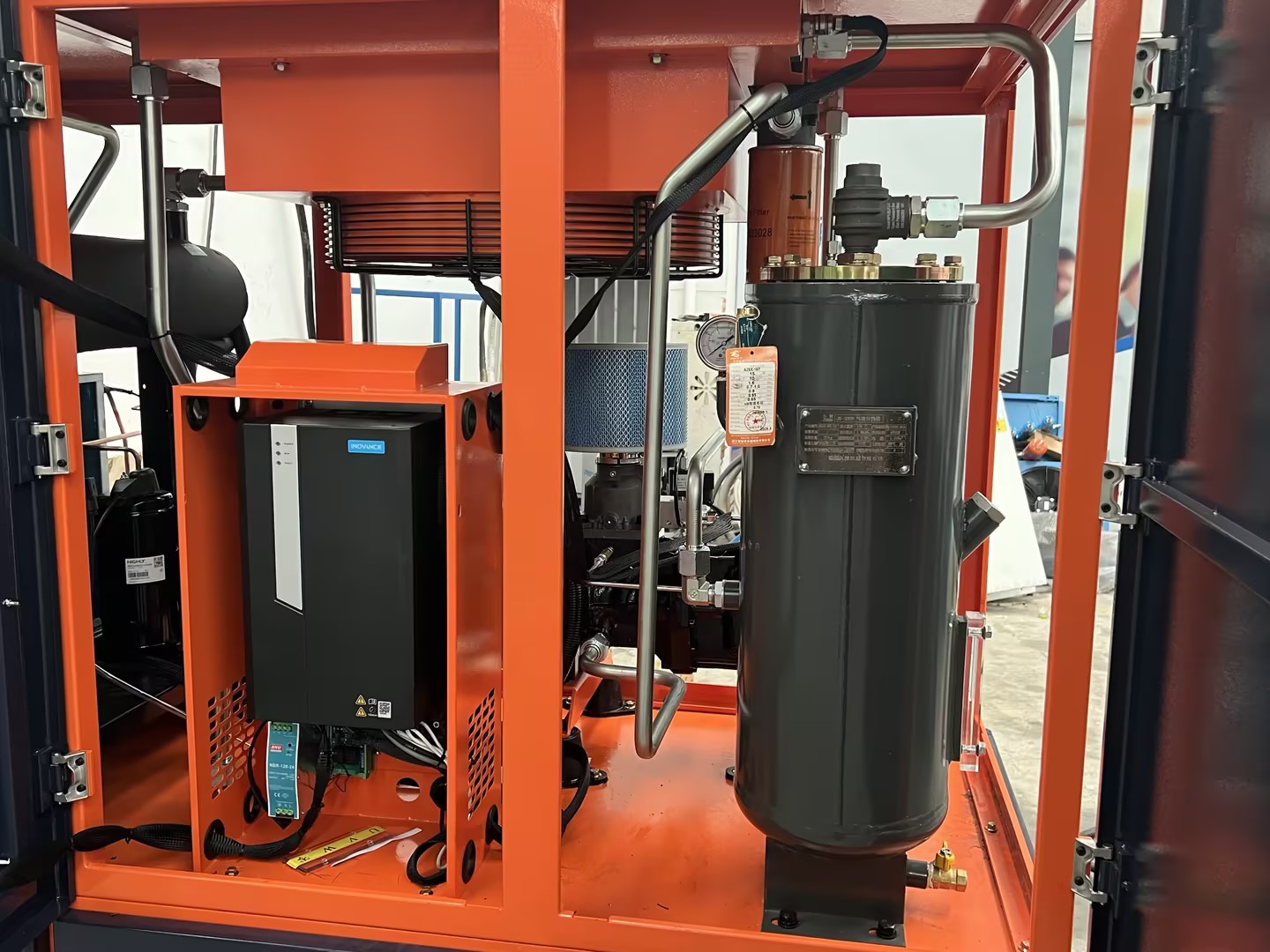
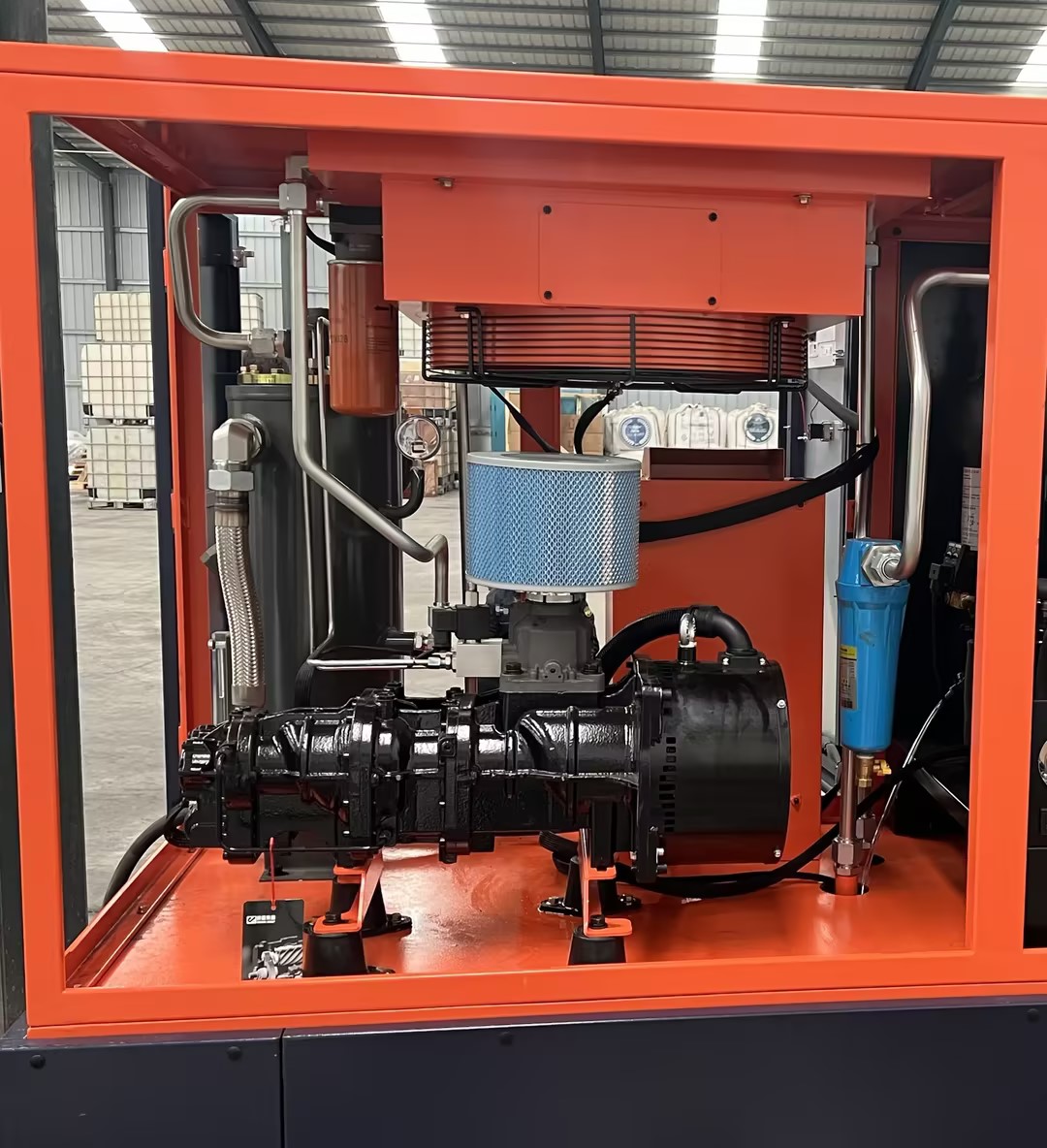
Overheating is the main operational risk in air-cooled screw compressors; the control method is a high-efficiency radiator and cooling fans. UMW Air performs thermal tests on every unit before shipment and verifies that radiators and cooling fans are functioning properly. Ask every supplier what pre-delivery testing is performed.
Use Cases: Where Rotary Screw Compressors Deliver
The applications that favor rotary screw air compressors are well documented:
- CNC machining: machines typically require 90–120 PSI (6–8 bar) at 5–30 CFM; the stable air output of a screw unit keeps pressure consistent during machine cycles.
- Laser cutting: assist-gas pressures up to 1.6 MPa require high-pressure screw packages plus integrated filtration to protect the lens from contamination.
- Manufacturing factory: production lines run continuous cycles; 24/7 duty capability and integrated automation control match line operations.
- Food processing: ISO 8573-1:2010 purity classes apply; oil-filled rotary screw compressors dominate the installed base, while oil-free types are growing at a faster rate, so the choice depends on product contact and filtration strategy.
Head-to-Head Comparison: Rotary Screw vs Piston Air Compressor
| Criterion | UMW Air Rotary Screw Air Compressor | Traditional Piston Air Compressor |
|---|---|---|
| Duty cycle | 24/7 continuous operation | Intermittent operation |
| Energy efficiency | Up to 95% | Approx. 65–70%; less suitable for continuous high load |
| Air output | Stable output | Less stable |
| Vibration | Lower vibration | Higher vibration |
| Maintenance | Low — fewer moving parts, long service intervals | Frequent maintenance, higher wear and tear |
| Automation | Integrated automation control | Limited |
| Initial investment | Slightly higher | Lower |
| Long-term ROI | Higher — lower downtime and maintenance costs | Lower |
The table reflects first-party comparison data for UMW Air screw compressors versus traditional piston compressors. The same source notes that the screw compressor carries a slightly higher initial investment but offers a higher long-term ROI due to lower downtime and maintenance costs.
Risk Control: How UMW Air Manages Overheating in Air-Cooled Models
Air-cooled rotary screw compressors face one dominant operational risk: overheating. UMW Air's control method is a high-efficiency radiator and cooling fans, and the company's enterprise measure is to perform thermal tests on every unit before shipment, ensuring radiators and fans are functioning properly. For buyers, this pre-delivery verification is a concrete quality indicator that can be requested from any supplier.
FAQ: Decision-Stage Questions from Industrial Buyers
What compressed air purity standard applies to rotary screw compressors in food and pharmaceutical plants?
ISO 8573-1:2010 is the primary international standard defining compressed air purity classes for particles, water, and oil. It is critical for food and pharmaceutical applications where compressed air may contact the product. Buyers in these sectors should specify the required purity class and confirm that the compressor package includes the corresponding filtration and drying stages.
Can a rotary screw air compressor operate 24/7?
Yes. Rotary screw air compressors are designed for 24/7 continuous operation, whereas traditional piston air compressors are limited to intermittent operation. For industrial production lines, CNC machining, and other high-demand continuous air supply scenarios, screw compressors are the appropriate technology.
Is the higher initial cost of a rotary screw air compressor justified?
The screw compressor has a slightly higher initial investment but offers a higher long-term ROI because downtime and maintenance costs are lower. Energy efficiency reinforces the case: screw compressors reach up to 95% efficiency versus 65–70% for piston compressors, and energy is typically the largest operating cost of a compressed air installation.
How can I request a quotation for UMW Air rotary screw air compressors?
UMW Air can be reached by phone or WhatsApp at +86 15053148082 or by email at info@umwair.com. The team works with export buyers in the EU, USA, Southeast Asia, Middle East, South America, and Africa, and can map your application — CNC machining, laser cutting, food processing, or general manufacturing — to the appropriate screw compressor configuration.
What is UMW Air's production capacity and lead time for export orders?
UMW Air's factory in Jinan, Shandong, has an annual output capacity of 12,000 units, with 200 employees including a 40-person R&D team, across a 2,000㎡ facility. All production is export-oriented, serving markets in the EU, USA, Southeast Asia, Middle East, South America, and Africa. For current lead times, a catalog, or a tailored quotation, contact info@umwair.com or visit umwair.com.
Conclusion: A Decision Framework for Procurement
When the duty cycle is continuous, the technology choice is clear: rotary screw. When air demand is occasional, a piston compressor may still be a defensible entry option. In every case, compare four numbers — duty cycle, energy efficiency, maintenance intervals, and operating pressure against your machines — and verify the supplier's pre-shipment testing. UMW Air's rotary screw air compressor family covers air-cooled, direct-driven, stationary, diesel mobile, and heavy-duty configurations, built at a factory that exports 100% of its output.
Talk to UMW Air About Your Application
UMW Air (Shandong UMW Air Tech Co., Ltd) — Rotary screw air compressors for CNC, laser cutting, manufacturing, and food processing.
Phone / WhatsApp: +86 15053148082
Email: info@umwair.com
Address: 68 Gongye South Road, Jinan, Shandong, China 250000
Request a quotation or catalog: umwair.com