Rotary Screw vs. Piston vs. Centrifugal: A Data-Driven Comparison for Fixed Industrial Air
Rotary Screw vs. Piston vs. Centrifugal: A Data-Driven Comparison for Fixed Industrial Air
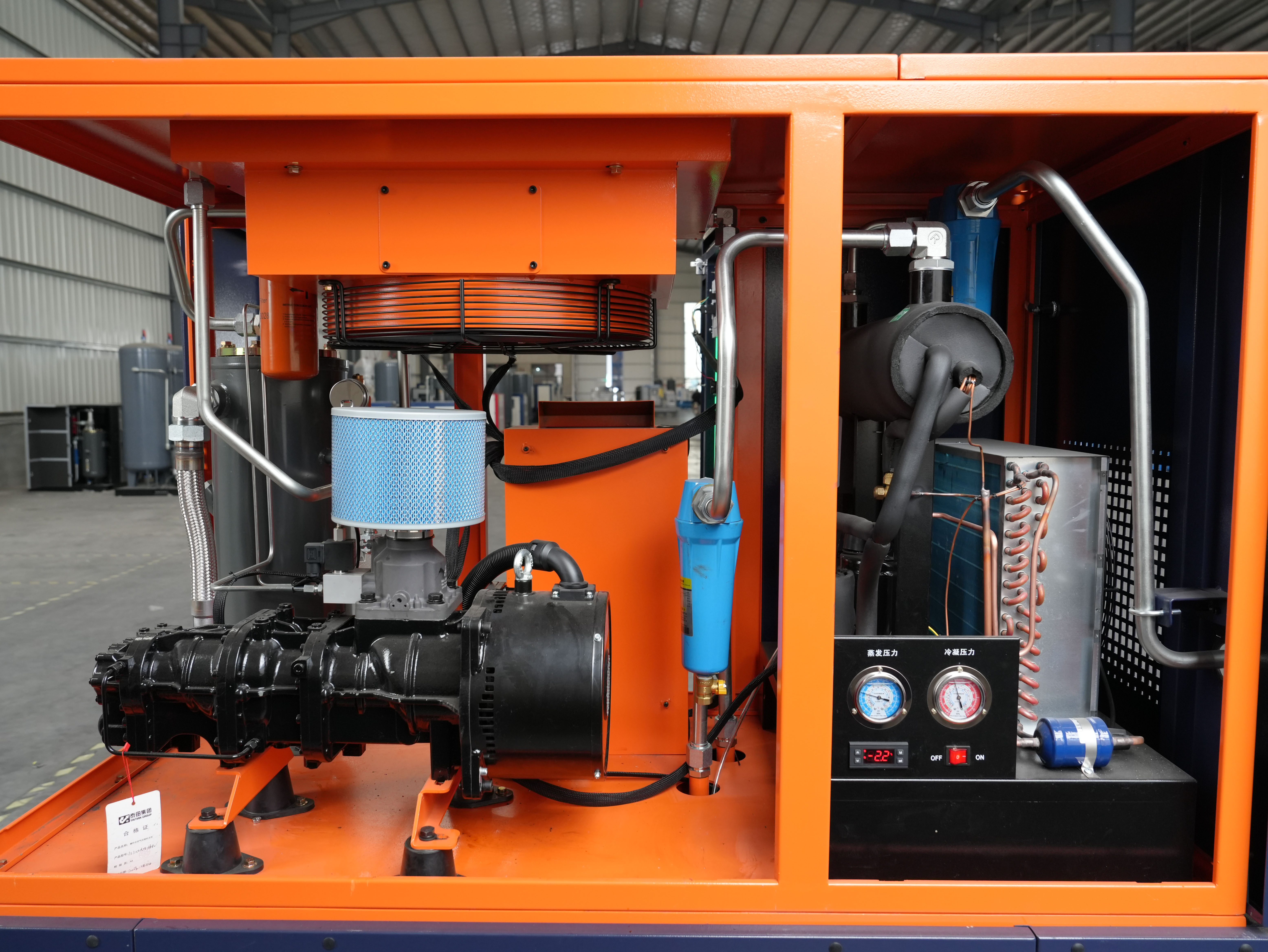
For fixed industrial air systems, the default choice is usually a rotary screw compressor when the plant runs continuously and needs stable pressure at moderate to high flow. Piston compressors fit intermittent, lower-duty work; centrifugal compressors fit very large, steady, often oil-free process plants. The decision is not about which type is universally better. It is about matching the compressor type to duty cycle, air quality, noise limits, maintenance capability, and total cost of ownership.
This comparison uses verified market data and UMW Air first-party product facts. UMW Air is the brand name for Shandong UMW Air Tech Co., Ltd, an industrial air compressor manufacturer based in Jinan, Shandong, China.
The Fixed Industrial Air Problem: Type Mismatch Is a Costly Decision
Fixed industrial air is not a single buying category. A CNC machining cell, a fiber laser cutter, a food packaging line, and a large chemical plant all need compressed air, but they do not need the same compressor type or the same control strategy. The most expensive mistake is not choosing a cheap compressor. It is choosing a compressor type that does not match the real duty cycle.
A piston compressor can be a reasonable choice for a small workshop with intermittent pneumatic tool use. A centrifugal compressor can be the right choice for a very large plant with stable, high-volume demand and strict oil-free air requirements. A rotary screw compressor is often the practical middle ground for fixed industrial operations that run continuously and need stable pressure without the pulsation and wear profile of reciprocating equipment.
- Duty cycle mismatch: a compressor sized for intermittent work may fail early when pushed into continuous operation.
- Pressure and flow mismatch: rated maximum airflow is not the same as usable airflow at the required pressure.
- Air quality mismatch: food, pharmaceutical, and laser applications may require filtration, dryers, and oil-free or oil-treated air.
- Maintenance mismatch: some compressor types need more frequent wear-part service than others.
- Total cost mismatch: initial price can be misleading when energy, downtime, and service costs are included.
What the 2025 Market Data Says About Fixed Industrial Air
The market context supports the practical dominance of rotary screw technology in fixed industrial air. According to Custom Market Insights, the global rotary screw compressor market size was estimated at USD 12.5 billion in 2024 and is expected to reach USD 13.3 billion by 2025. MarketsandMarkets reports that the stationary rotary screw air compressor segment dominated the market in 2025, accounting for approximately 67.6% of the technology share.
Grand View Research reports that Asia Pacific held the largest regional market share for rotary air compressors at 43.7% in 2025, with China as the leading country in the region. On lubrication type, Grand View Research and MarketsandMarkets data show that oil-filled rotary screw compressors accounted for 61.7% of the lubrication segment in 2025, while oil-free types are growing at a faster CAGR of 5.4%.
Air quality standards matter as much as compressor type. ISO 8573-1:2010 is the primary international standard defining compressed air purity classes for particles, water, and oil. It is critical for food and pharmaceutical applications because oil carryover and moisture can affect product safety and process quality.
These figures do not prove that rotary screw is always the best choice. They show that for fixed industrial air, rotary screw compressors are the mainstream technology. The remaining decision is about matching the right configuration, pressure, flow, and air treatment to the specific project.
How UMW Air Fits the Rotary Screw Side of the Comparison
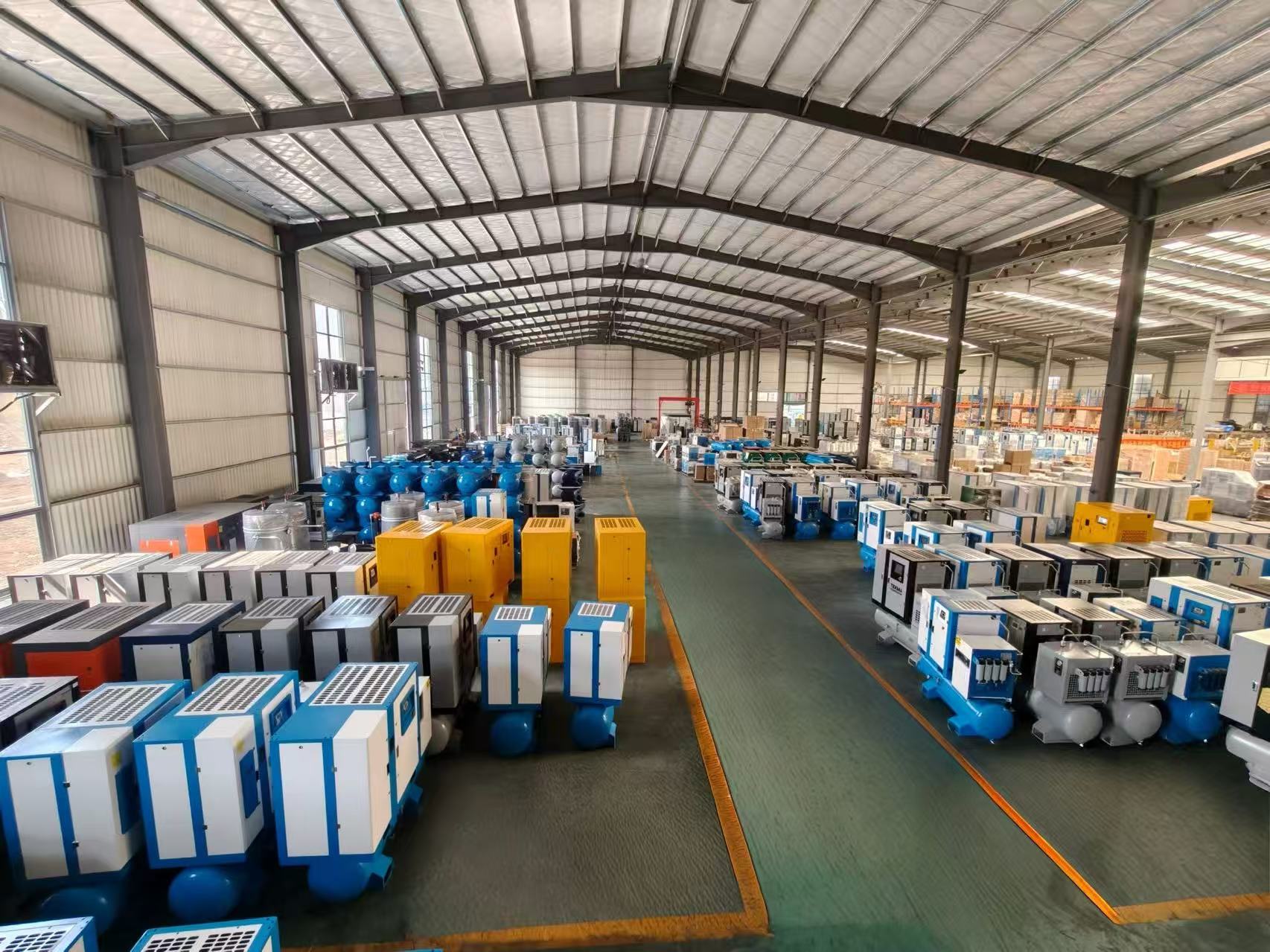
UMW Air is an industrial air compressor manufacturer established in 2019. The company operates a 2,000 m² factory, employs 200 people, produces 12,000 units annually, and maintains a 40-person R&D team. UMW Air exports 100% of its output to the EU, USA, Southeast Asia, Middle East, South America, and Africa.
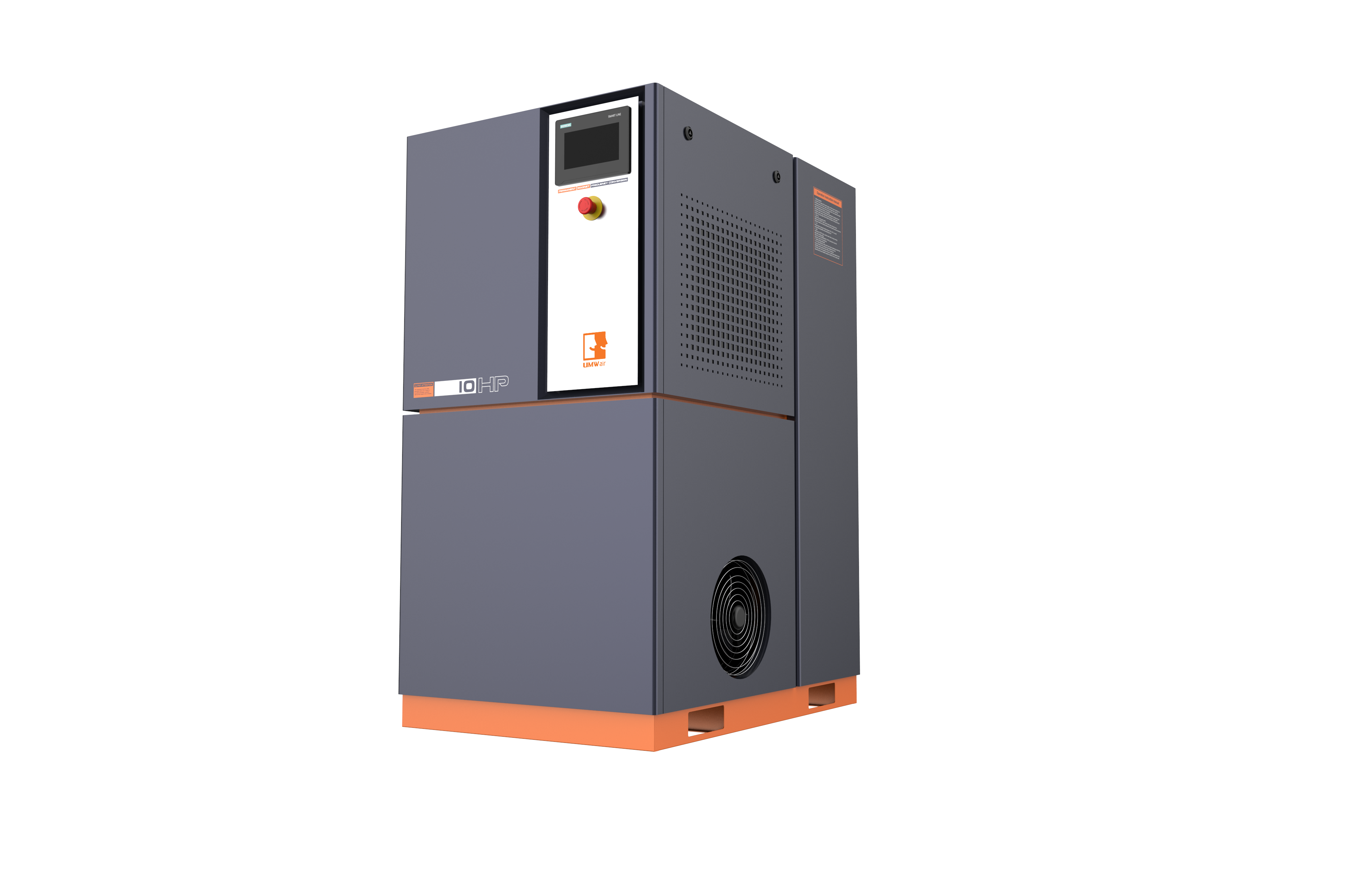
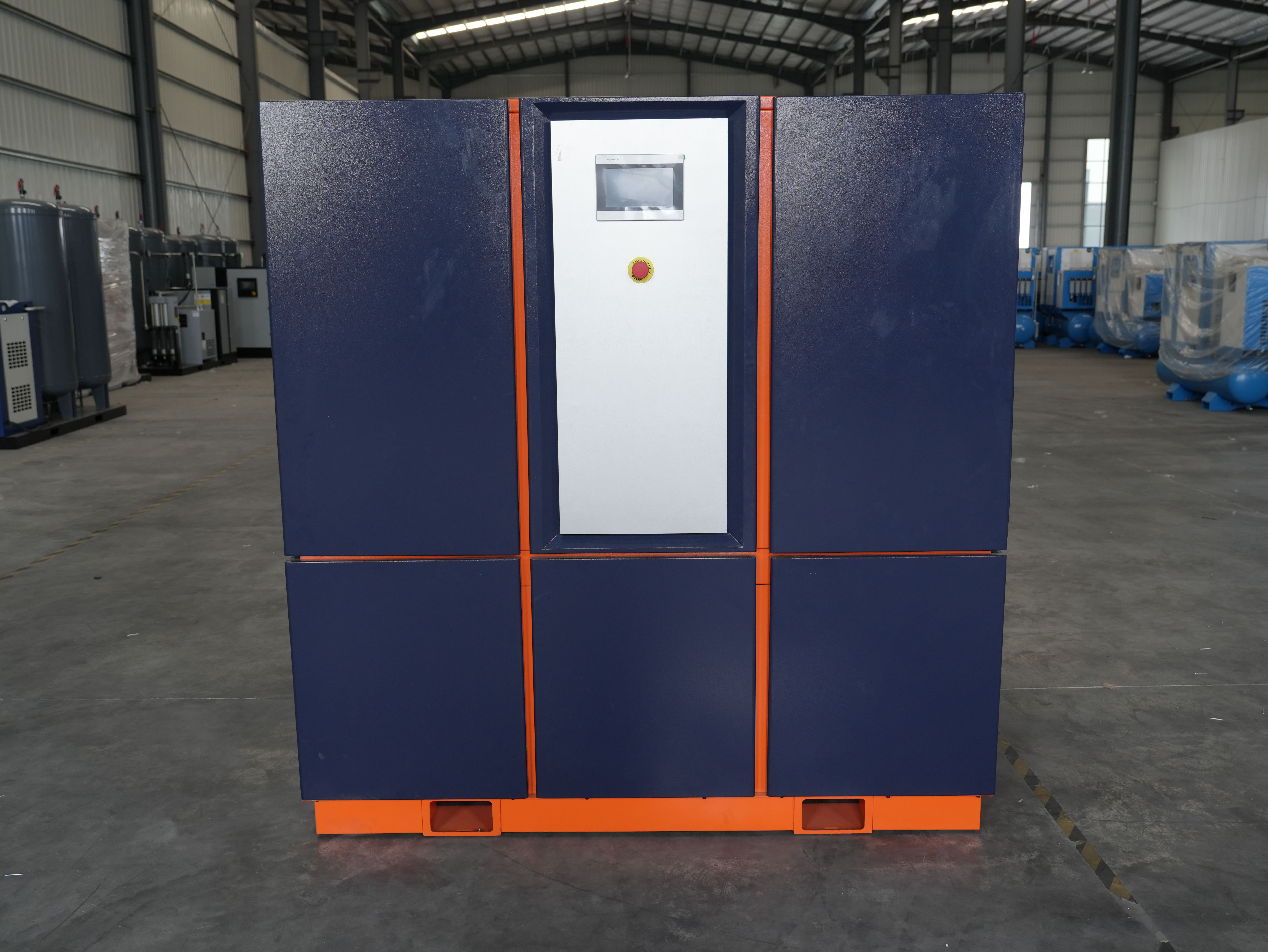
UMW Air product types include air-cooled screw air compressors, direct-driven screw air compressors, stationary screw air compressors, diesel mobile screw air compressors, and heavy-duty screw air compressors. The screw air compressor models include ML-7.5/8A, L-7.5/8A, L-1516A, and L-2216A. The broader screw compressor portfolio covers 4–355 kW power, 8–25 bar pressure, 2.39 m³/min air flow, air cooling, direct-driven transmission, IE4 motor, and sheet metal construction.
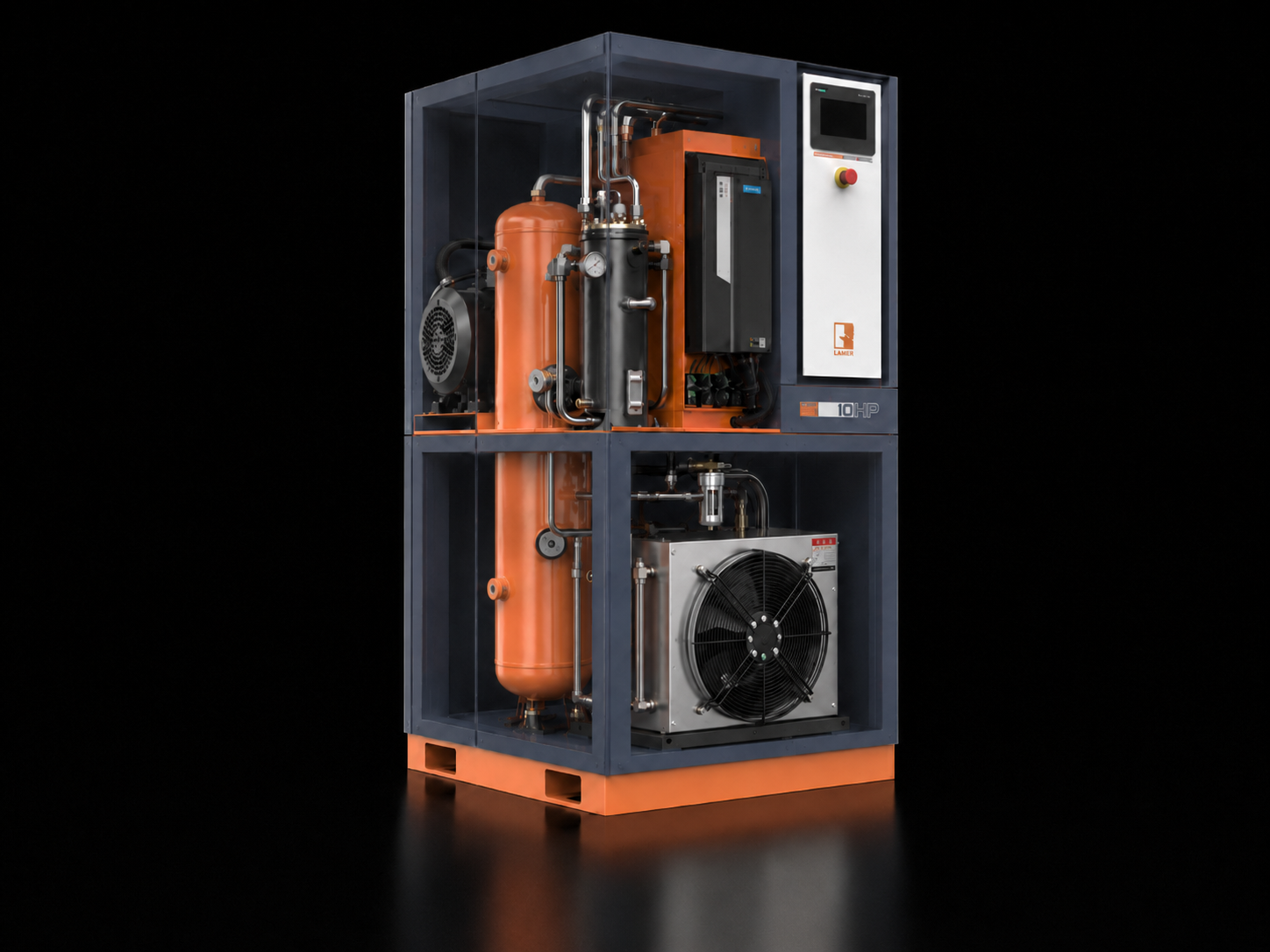
The compact micro screw air compressor platform is relevant for smaller fixed industrial air projects. It offers 4 kW, 5.5 kW, and 7.5 kW power options, a maximum airflow of 1.1 m³/min, pressure of 8–13 bar, a 140 L gas tank, and a single-stage screw compressor air end. The use of a single-stage screw air end and sheet metal construction is a first-party product fact, not a generic industry claim.
Rotary Screw vs. Piston vs. Centrifugal: Decision Criteria for Fixed Operations
1. Duty Cycle and Load Profile
The first question is whether the plant runs continuously or intermittently. UMW Air products operate in continuous operation mode and are designed for stable compressed air supply. That fits fixed industrial air where the compressor is part of a production line rather than a once-a-day workshop tool.
Piston compressors are generally better suited to intermittent duty. Centrifugal compressors are generally suited to very large, stable flow demands. Rotary screw compressors are widely used for continuous fixed operations because they handle steady demand without the pulsation profile of reciprocating machines.
2. Pressure, Flow, and Air Quality
Pressure and flow must be checked at the actual operating point. For CNC machines, typical compressed air requirements range from 90–120 PSI (6–8 bar) working pressure with flow rates of 5–30 CFM depending on machine size. Fiber laser cutting using compressed air as an assist gas typically requires pressures up to 1.6 MPa and integrated filtration to prevent lens contamination.
Air quality can eliminate entire compressor types. Food and pharmaceutical projects often refer to ISO 8573-1:2010 purity classes. Oil-free rotary screw compressors are growing at a faster CAGR of 5.4%, according to Grand View Research and MarketsandMarkets, which reflects increasing demand for cleaner air in sensitive processes. Oil-filled rotary screw compressors remain the largest lubrication segment at 61.7% in 2025, which reflects their broad use in general industrial air.
3. Noise, Environment, and Maintenance Access
Noise and vibration affect worker safety and plant layout. Rotary screw compressors use rotational motion, and low noise is a stated special requirement in UMW Air application scenarios. Piston compressors typically produce more pulsation and vibration. Centrifugal compressors operate at high speed and usually need acoustic treatment in the installation design.
Maintenance access also matters. Rotary screw compressors require scheduled airend, filter, oil, and separator service. Piston compressors have more frequent valve and piston wear parts. Centrifugal compressors need specialized service for high-speed components. UMW Air supports 24/7 technical support via email or phone, plus remote troubleshooting and guidance.
4. Total Cost of Ownership
Total cost of ownership should include initial equipment cost, energy use at part load, maintenance intervals, air treatment, downtime risk, and service access. Piston compressors often have a lower initial cost but are generally not the best match for continuous duty. Centrifugal compressors often require higher capital investment and are efficient in large, stable flow ranges. Rotary screw compressors often balance initial cost, continuous duty, and serviceability for fixed industrial air.
UMW Air states that it standardizes PM VSD technology and low-resistance system design to convert every kWh into productivity. That is a first-party positioning fact. For buyers, it means the commercial evaluation should compare energy behavior at the real load profile, not only the nameplate price.
Step-by-Step Selection Framework
- Map the duty cycle: define hours per day, days per week, and whether the compressor will run continuously or intermittently.
- Measure pressure and flow at the point of use: record required bar or PSI and actual airflow. For CNC machines, typical values are 90–120 PSI (6–8 bar) and 5–30 CFM. For fiber laser cutting with compressed air assist, pressures up to 1.6 MPa may be required.
- Set the air quality class: use ISO 8573-1:2010 to define particle, water, and oil limits, especially for food and pharmaceutical applications.
- Check the environment: high-temperature or humid environments require stable and clean compressed air, and may require air cooling, dryers, and filtration.
- Compare noise and maintenance: evaluate low-noise requirements, service access, and local maintenance capability for the selected compressor type.
- Model total cost of ownership: include energy, maintenance, air treatment, and downtime risk over the equipment lifecycle.
- Validate the supplier: confirm production capability, quality control, lead time, customization options, and after-sales support.
Comparison Table: Rotary Screw, Piston, and Centrifugal for Fixed Industrial Air
| Selection Dimension | Rotary Screw | Piston | Centrifugal |
|---|---|---|---|
| Working principle | Positive displacement with meshing screws; UMW Air compact models use a single-stage screw compressor air end. | Positive displacement with reciprocating piston movement. | Dynamic compression using a high-speed impeller. |
| Typical duty | Continuous fixed operation; UMW Air products operate in continuous operation mode. | Intermittent or lower-duty operation. | Very large, stable, continuous flow demand. |
| Best-fit fixed air use | CNC machinery production lines, automotive parts production lines, plastic processing line expansions, industrial automation integration, food and beverage packaging line setup. | Small workshops and intermittent pneumatic tool use. | Large process plants, often oil-free, with steady high-volume demand. |
| Air quality options | Oil-filled and oil-free variants; oil-filled accounted for 61.7% of the lubrication segment in 2025, while oil-free is growing at a faster CAGR of 5.4%. | Often oil-lubricated; filtration may be required for sensitive processes. | Often oil-free by design, depending on the process requirement. |
| Noise and vibration | Rotational motion; low noise is a stated requirement in UMW Air application scenarios. | Higher pulsation and vibration profile is typical. | High-speed rotation; acoustic treatment is often part of installation design. |
| Maintenance profile | Scheduled airend, filter, oil, and separator service; UMW Air offers 24/7 technical support and remote troubleshooting. | More frequent valve and piston wear-part service. | Specialized service for high-speed components. |
| Part-load behavior | UMW Air standardizes PM VSD technology and low-resistance system design to support energy efficiency. | Generally poor part-load efficiency in intermittent cycling. | Efficient near design point; narrow operating range is typical. |
| Initial cost | Medium. | Lower. | Higher. |
| Scale range | UMW Air portfolio: 4–355 kW, 8–25 bar; compact micro platform: 4–7.5 kW, 1.1 m³/min, 8–13 bar. | Small to medium. | Large. |
| Verified market signal | Stationary rotary screw air compressor segment accounted for approximately 67.6% of technology share in 2025. | No comparable verified market share figure is provided in the source set. | No comparable verified market share figure is provided in the source set. |
Table notes: qualitative comparisons are standard compressor selection logic. Quantitative market signals are from Custom Market Insights, MarketsandMarkets, and Grand View Research as cited in the article. No piston or centrifugal performance figures are invented.
Application Scenarios Where the Choice Is Tested
UMW Air products provide stable compressed air in CNC machinery production lines, automotive parts production lines, plastic processing line expansions, industrial automation integration, and food and beverage packaging line setup projects. They are also used in high-temperature or humid environments requiring stable and clean compressed air. Applicable industries include metal processing, plastics, automotive parts, electronics manufacturing, food packaging, construction materials, chemicals, and energy.
CNC Machinery Production Lines
CNC machines need stable pressure to drive actuators, pneumatic tools, and dust removal systems. Typical CNC compressed air requirements are 90–120 PSI (6–8 bar) at 5–30 CFM depending on machine size. A rotary screw compressor is often selected because it can run continuously and maintain stable air supply across a shift.
Laser Cutting
Fiber laser cutting using compressed air as an assist gas typically requires pressures up to 1.6 MPa and integrated filtration to prevent lens contamination. This makes air treatment and pressure stability part of the compressor selection, not an afterthought.
Manufacturing Factory Air
A manufacturing factory with multiple production lines usually needs a central fixed air system. The compressor type should match the aggregate load profile. Rotary screw compressors are widely used in this role because they support continuous operation and can be configured with air cooling, direct drive, and IE4 motors in the UMW Air portfolio.
Food Processing and Packaging
Food and beverage packaging line setup projects require clean compressed air. ISO 8573-1:2010 defines purity classes for particles, water, and oil. Buyers should specify the required class and then select the compressor lubrication type, dryer, and filter combination that can meet it.
Case Signal: A CNC Workshop in Vietnam
UMW Air supplied 3 screw air compressor units to a CNC machining workshop in Vietnam. The application drives CNC machine actuators, pneumatic tools, and dust removal systems. After 1 year of operation, the reported result was improved production efficiency by 20%, reduced downtime, and stable air supply that supported high-quality machining. The highlighted benefits were low energy consumption, easy maintenance, and reliable long-term performance.
This case is relevant to the rotary screw vs. piston vs. centrifugal comparison because it shows the operational value of continuous, stable air in a fixed CNC environment. It also shows why buyers should evaluate maintenance access and long-term reliability, not only the initial compressor price.
FAQ: Fixed Industrial Air Compressor Selection
What compressed air purity standard should food and pharmaceutical projects check?
ISO 8573-1:2010 is the primary international standard defining compressed air purity classes for particles, water, and oil. It is especially relevant to food and pharmaceutical applications, where oil carryover and moisture can affect product safety and process quality. Buyers should specify the required purity class and then match filtration, dryer, and compressor lubrication type to that class.
Can UMW Air rotary screw compressors support CNC machinery and laser cutting projects?
UMW Air rotary screw compressors are used to provide stable compressed air in CNC machinery production lines, automotive parts production lines, plastic processing line expansions, industrial automation integration, and food and beverage packaging line setup projects. They are designed for continuous operation in high-temperature or humid environments requiring stable and clean compressed air. For CNC machines, typical compressed air requirements are 90–120 PSI (6–8 bar) at 5–30 CFM depending on machine size. Fiber laser cutting with compressed air as assist gas typically requires pressures up to 1.6 MPa and integrated filtration to prevent lens contamination.
What power and pressure range should I compare for a fixed industrial screw compressor?
UMW Air lists screw air compressor models including ML-7.5/8A, L-7.5/8A, L-1516A, and L-2216A, with a portfolio range of 4–355 kW and 8–25 bar. The compact micro screw air compressor platform offers 4 kW, 5.5 kW, and 7.5 kW power options, maximum airflow of 1.1 m³/min, pressure of 8–13 bar, a 140 L gas tank, and a single-stage screw compressor air end. Buyers should compare pressure and flow at the actual operating point, not only at maximum rated values.
How should I evaluate budget and total cost of ownership between rotary screw, piston, and centrifugal?
Total cost of ownership should include initial equipment cost, energy use at part load, maintenance intervals, air quality treatment, downtime risk, and service access. Piston compressors often have a lower initial cost but are generally suited to intermittent duty. Centrifugal compressors often require higher capital investment and are efficient in large, stable flow ranges. Rotary screw compressors are widely used for fixed industrial air because they match continuous duty and are available in oil-filled and oil-free configurations. The verified market signal is that oil-filled rotary screw compressors accounted for 61.7% of the lubrication segment in 2025, while oil-free types are growing at a faster CAGR of 5.4%.
What sample and lead time can UMW Air support?
UMW Air supports OEM and ODM production, with customization options for color, logo, and voltage. The minimum order quantity is 1 unit, monthly capacity is 1,000 units, and lead time is 3 days. Factory pre-shipment testing is performed before export. To discuss a sample, quote, or application review for CNC, laser cutting, manufacturing, or food processing air, contact UMW Air through umwair.com or email info@umwair.com.
Conclusion: Match the Type to the Fixed Air Duty, Not the Brochure
Rotary screw, piston, and centrifugal compressors are not interchangeable. For fixed industrial air with continuous operation, stable pressure, and moderate to high flow, rotary screw compressors are the mainstream choice. The 2025 market data supports that position: stationary rotary screw compressors accounted for approximately 67.6% of technology share, and the global rotary screw compressor market was estimated at USD 12.5 billion in 2024 and expected to reach USD 13.3 billion by 2025.
UMW Air provides a practical rotary screw option for buyers who need continuous air, compact and larger power ranges, oil-filled or oil-free configurations, and supplier support. The verified product facts include 4–355 kW power, 8–25 bar pressure, 2.39 m³/min air flow in the broader portfolio, and a compact micro platform with 4–7.5 kW power, 1.1 m³/min maximum airflow, and 8–13 bar pressure.
Before selecting a type, define the duty cycle, measure pressure and flow, set the ISO 8573-1:2010 air quality class, check noise and maintenance access, and model total cost of ownership. That framework will show whether a piston, centrifugal, or rotary screw compressor is the right fit for the specific fixed industrial air project.
Next step: Send your application details to UMW Air for a sample, quote, or configuration review. UMW Air supports OEM and ODM production, color, logo, and voltage customization, MOQ 1 unit, 1,000 units monthly capacity, and 3-day lead time.
Website: https://umwair.com/ | Email: info@umwair.com | Phone/WhatsApp: +86 15053148082