
Screw Air Compressor Selection Parameters: A Technical Guide to Flow, Pressure, Power, and IE4 Efficiency
Four parameters decide whether an industrial screw air compressor fits a project before any other commercial question is asked: delivered air flow in m³/min, working pressure in bar, motor power in kW, and motor efficiency class. In the UMW Air screw air compressor series — which includes the ML-7.5/8A, L-7.5/8A, L-1516A and L-2216A frames — those parameters read 2.39 m³/min air flow at the L-2216A frame, a working pressure band of 8–25 bar, a power range of 4–355 kW, and an IE4 motor efficiency class. This guide explains how each number is produced, how to test it against a real project, and how the air dryer, air tank, line filter, inverter and controller complete an industrial compressed air system.
Shandong UMW Air Tech Co., Ltd (UMW Air) is a manufacturer of industrial screw air compressors based in Jinan, Shandong, China. The company was founded in 2019, operates a 2,000 m² facility with a 200-person team and a 40-person R&D team, reports an annual output of 12,000 units, and exports air-cooled, direct-driven, stationary and diesel mobile screw compressors to the EU, USA, Southeast Asia, the Middle East, South America and Africa. Its published product range is the reference frame used throughout this article.
Problem Definition: Why Screw Compressor Specification Goes Wrong
Most screw air compressor selection errors are not manufacturing defects. They are specification defects, and they repeat in four predictable patterns.
1. Pressure is copied from a nameplate instead of derived from the process. A buyer sees an 8–25 bar capability band and orders at the top of it because the range allows it. The compressor then produces every cubic metre of air at a pressure the plant does not actually need, and the energy embedded in that extra pressure is spent continuously.
2. Flow is read as an average rather than as a simultaneous demand. A factory totals the rated consumption of every connected tool and machine, then buys to that total. Real demand is the sum of what runs at the same time, plus leakage, plus a margin for future load. The two numbers can differ substantially, and only one of them describes the duty point the compressor will actually see.
3. Power is compared without comparing efficiency class or drive arrangement. Two units with the same kW rating are not equivalent if one uses an IE4 motor and a direct drive path and the other does not. The kW number describes capacity, not the energy required to deliver it.
4. Auxiliary equipment is treated as optional. UMW Air states that the screw air compressor must be used with supporting equipment such as an air dryer, air tank, line filter, inverter and controller for proper functioning. A compressor ordered without this package is an incomplete compressed air solution, not a cheaper one.
A fifth factor sits underneath all four: the operating environment. UMW Air specifies this product for environments requiring stable and clean compressed air, and states that it operates under high-temperature or humid conditions, typically on continuous duty. Selection logic that assumes a cool, dry, intermittent-duty plant will mis-size the same machine for a hot or humid one.
Definition. A screw air compressor is a positive-displacement rotary compressor in which two intermeshing rotors compress air continuously. A rotary screw air compressor holds its flow and pressure far more steadily than a reciprocating design, which is why it is the default choice for continuous factory duty. The U.S. Department of Energy defines a compressor as a machine or apparatus that converts different types of energy into the potential energy of gas pressure, applied to gaseous media above atmospheric pressure (10 CFR 431.342).
Industry Background: Why Parameter Literacy Matters More in 2026
Screw technology is no longer a niche configuration in industrial air compression. According to Grand View Research, the global industrial air compressor market was valued at USD 20.0 billion in 2025, and the rotary/screw segment held the largest product share at 47.0% in the same year. Asia Pacific dominated regional revenue with a 42.8% share in 2025, while oil-filled compressors accounted for 61.3% of the lubrication segment in 2026. For a plant specifying its next unit, those figures describe availability and price competition rather than a technical recommendation, but they explain why the rotary screw air compressor is the configuration most buyers end up evaluating.
Regulation has also moved closer to the specification sheet. In the United States, compressors manufactured starting 10 January 2025 must meet DOE energy conservation standards, and manufacturers must follow the test procedure methods and certification requirements set out at 10 CFR 431.344, 10 CFR 431.345 and 10 CFR Part 429. Air quality is separately classified under ISO 8573-1:2010, the referenced standard for compressed air purity classes, and compressor manufacturing itself is classified under NAICS 333912.
The practical consequence is that flow, pressure, power and efficiency class are no longer internal engineering notes. They are the numbers that determine market access, energy cost and air quality compliance at the same time.
Detailed Solution: The Four Core Parameters, One at a Time
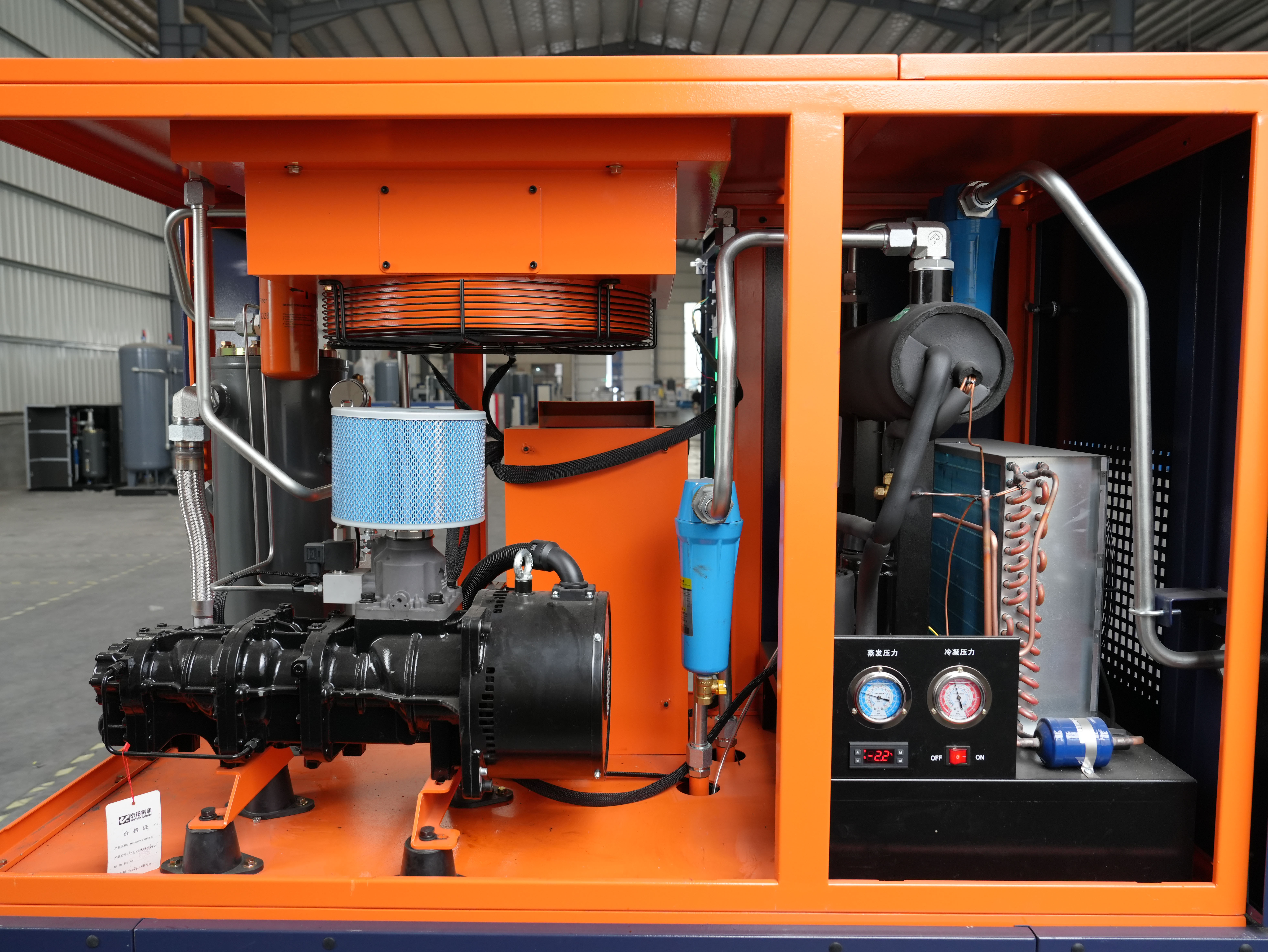
UMW Air Prime screw air compressor. Selection starts with four numbers — flow, pressure, power and motor efficiency class — before configuration and auxiliary equipment are decided.
Air flow: what 2.39 m³/min actually describes
The UMW Air L-2216A frame is listed with an air flow of 2.39 m³/min. That figure is a delivered volumetric flow at a defined working pressure, not a free-air displacement figure, and the distinction matters in a specification review. A flow number without its pressure condition cannot be compared against a competing quotation, because the same compressor delivers less volume as discharge pressure rises.
To use the number correctly, build the demand side first. Sum the simultaneous consumption of every point of use, add an allowance for leakage across the distribution network, then add a forward margin for planned capacity. If the resulting figure sits below 2.39 m³/min at the required working pressure, the L-2216A frame is a candidate. If it sits above it, the correct next step is the next frame in the 4–355 kW range, not a claim that the smaller unit will stretch.
Working pressure: using the 8–25 bar band without wasting it
The UMW Air screw series is specified across a working pressure band of 8–25 bar. That band covers standard factory compressed air at the low end and genuinely high-pressure duty at the top end, and it is wide enough that choosing the wrong point inside it is the single most common source of avoidable energy cost.
The rule is to select the lowest pressure that satisfies the highest-pressure consumer in the plant, then confirm the dryer, filter and distribution network can hold it. A high pressure air compressor is the right specification when a press, a test bench or a specific process requires the top of the band. It is the wrong specification when the highest consumer is a pneumatic tool that never sees more than the low end.
Power: reading the 4–355 kW envelope correctly
The series spans 4–355 kW, and within that envelope two sub-ranges behave differently on a specification sheet. At the small end, the UMW Air Micro ML-4A, ML-5.5A and ML-7.5A models cover 4 kW, 5.5 kW and 7.5 kW respectively, with a maximum airflow of 1.1 m³/min, a pressure range of 8–13 bar, a 140 L air receiver and a single-stage screw air end — an integrated air compressor with the tank built in. At the larger end, frames such as the L-2216A sit inside the 4–355 kW series envelope and are supplied as air-cooled, direct-driven stationary screw compressors.
Power rating describes capacity, not running cost. The comparison that matters is how much air a given kW produces at the working pressure the plant actually needs. Two units rated at the same kW can sit on different points of that curve.
IE4 motor efficiency class: why the class belongs on the specification sheet
The UMW Air screw air compressor series is specified with an IE4 motor. IE4 is a defined motor efficiency class positioned above IE3 in the international efficiency classification, and the achievable efficiency within the class varies by frame size and is stated on the motor nameplate. For a buyer, the class is the starting point of the verification, not the end of it: request the nameplate data for the exact frame being quoted rather than accepting the series-level class as the unit-level answer.
The energy logic is straightforward. A screw compressor running continuous duty accumulates most of its lifetime cost in electricity, and the motor is the component that converts that electricity into shaft work. A higher motor efficiency class reduces the conversion loss at every hour of operation, which is why IE4 matters most in plants running 24/7 rather than in intermittent workshops.
Direct drive and air cooling: how the configuration changes the duty point
UMW Air specifies direct drive and air cooling on the screw air compressor series, and both choices have specification consequences.
Direct driven screw air compressor. In a direct-drive arrangement the motor shaft is coupled to the air end without an intermediate belt transmission. On the specification sheet this removes a wear item and a periodic tensioning task from the maintenance plan, and it means the delivered flow is fixed by the air end speed rather than by belt condition over time.
Air cooled screw air compressor. Air cooling removes the need for a water circuit, cooling tower or water treatment on site, which simplifies installation in plants without existing water infrastructure. The trade-off is that heat is rejected into the surrounding space, so the compressor room needs adequate ventilation and the ambient condition at the installation point becomes part of the specification. UMW Air specifies this product for high-temperature or humid environments, but that specification describes the machine's rated capability — it does not remove the need to confirm the actual room temperature and airflow at the proposed location.
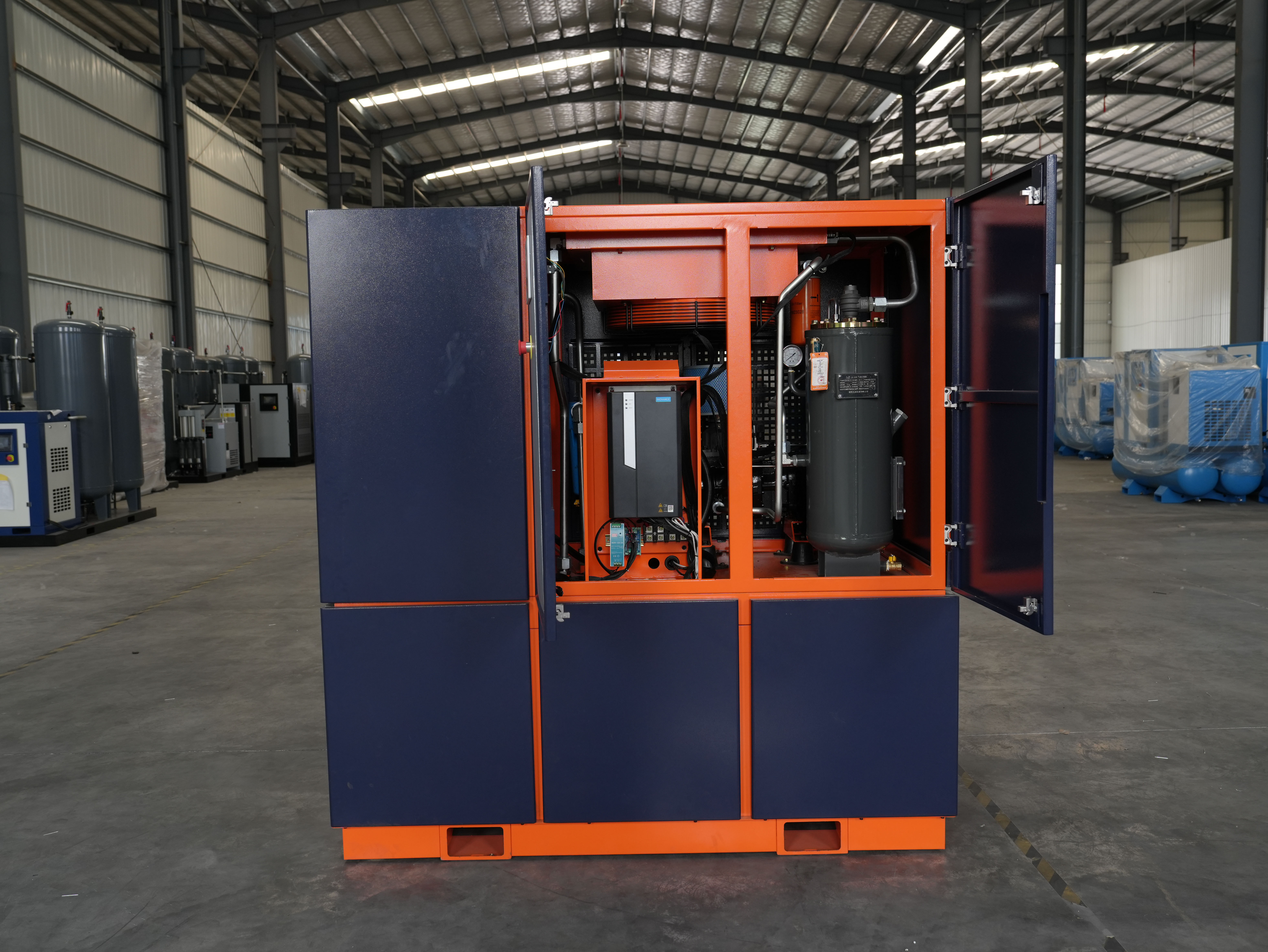
Prime air screw compressor with the panel open. Direct drive couples the motor to the air end without an intermediate belt, and the IE4 motor class is verified against the nameplate of the exact frame quoted.
The auxiliary package: air dryer, air tank, line filter, inverter, controller
UMW Air states that the product must be used with supporting equipment such as an air dryer, air tank, line filter, inverter and controller for proper functioning. This is a specification requirement, not an upsell: a compressed air solution is sized as a system, and each element sets a boundary condition for the compressor.
| Supporting equipment | Role in the compressed air system | What it changes in the specification |
|---|---|---|
| Air dryer | Removes moisture from the compressed air stream before it reaches the process | Determines the achievable air quality class and adds pressure drop that must be covered by the compressor |
| Air tank | Buffers demand peaks and stabilises pressure at the outlet | Affects how much of the peak load the compressor must meet directly |
| Line filter | Captures particulate and carried-over contamination downstream | Protects air quality at the point of use and adds a maintenance item to the plan |
| Inverter | Matches motor speed to actual demand instead of running fixed speed | Changes part-load energy behaviour and is central to a variable frequency air compressor configuration |
| Controller | Coordinates the compressor and the auxiliary package | Defines how the system is monitored, sequenced and adjusted in operation |
UMW Air states that it standardises PM VSD technology and low-resistance system design across its range, which places the inverter inside the system architecture rather than in a separate retrofit category. For a factory buying an integrated air compressor with a built-in receiver, the same logic applies at smaller scale: the Micro ML models pair a 4–7.5 kW single-stage screw air end with a 140 L tank, so the buffer is part of the delivered unit.
Step-by-Step Breakdown: Specifying a Screw Compressor in Six Steps
The sequence below converts a project description into a defensible specification. Each step produces a number that the next step depends on.
Step 1 — Build the demand table. List every point of use, note its consumption and its duty pattern, and record which items run simultaneously. The output is a peak simultaneous demand figure and an average demand figure. Only the peak figure sets the flow requirement; the average figure sets the energy case.
Step 2 — Fix the working pressure from the highest-pressure consumer. Identify the device in the plant that needs the most pressure and confirm the pressure it is rated for at its inlet. Add the pressure drop introduced by the dryer, filter and distribution network. The result must fall inside the 8–25 bar band; if it falls near the top, a high pressure air compressor configuration is justified, and if it falls near the bottom, ordering higher wastes energy for the life of the machine.
Step 3 — Match flow at that pressure. Compare the required flow against the rated flow of the candidate frame at the same pressure condition. For the L-2216A frame the reference figure is 2.39 m³/min. For small integrated duty, the Micro ML-4A, ML-5.5A and ML-7.5A cover up to 1.1 m³/min at 8–13 bar.
Step 4 — Confirm power, motor class and drive type together. Record the kW rating, confirm the motor is IE4 on the nameplate of the exact frame, and confirm the drive arrangement is direct driven. Record whether the unit is oil-free air compressor specification or oil-lubricated, because that choice is driven by the air quality class the process requires, not by preference.
Step 5 — Size the auxiliary package against the same duty point. Specify the air dryer, air tank, line filter, inverter and controller together with the compressor. If air quality is critical, state the required class under ISO 8573-1:2010 and confirm the dryer and filter combination achieves it.
Step 6 — Verify the environment and the supply terms. Record the ambient temperature, humidity and ventilation at the proposed installation point, and confirm the duty cycle is continuous if the plant runs continuously. Then confirm the commercial terms: UMW Air reports a minimum order quantity of 1 unit, a lead time of 3 days, a monthly capacity of 1,000 units, OEM/ODM production with colour, logo and voltage customisation, and factory pre-shipment testing on every unit.
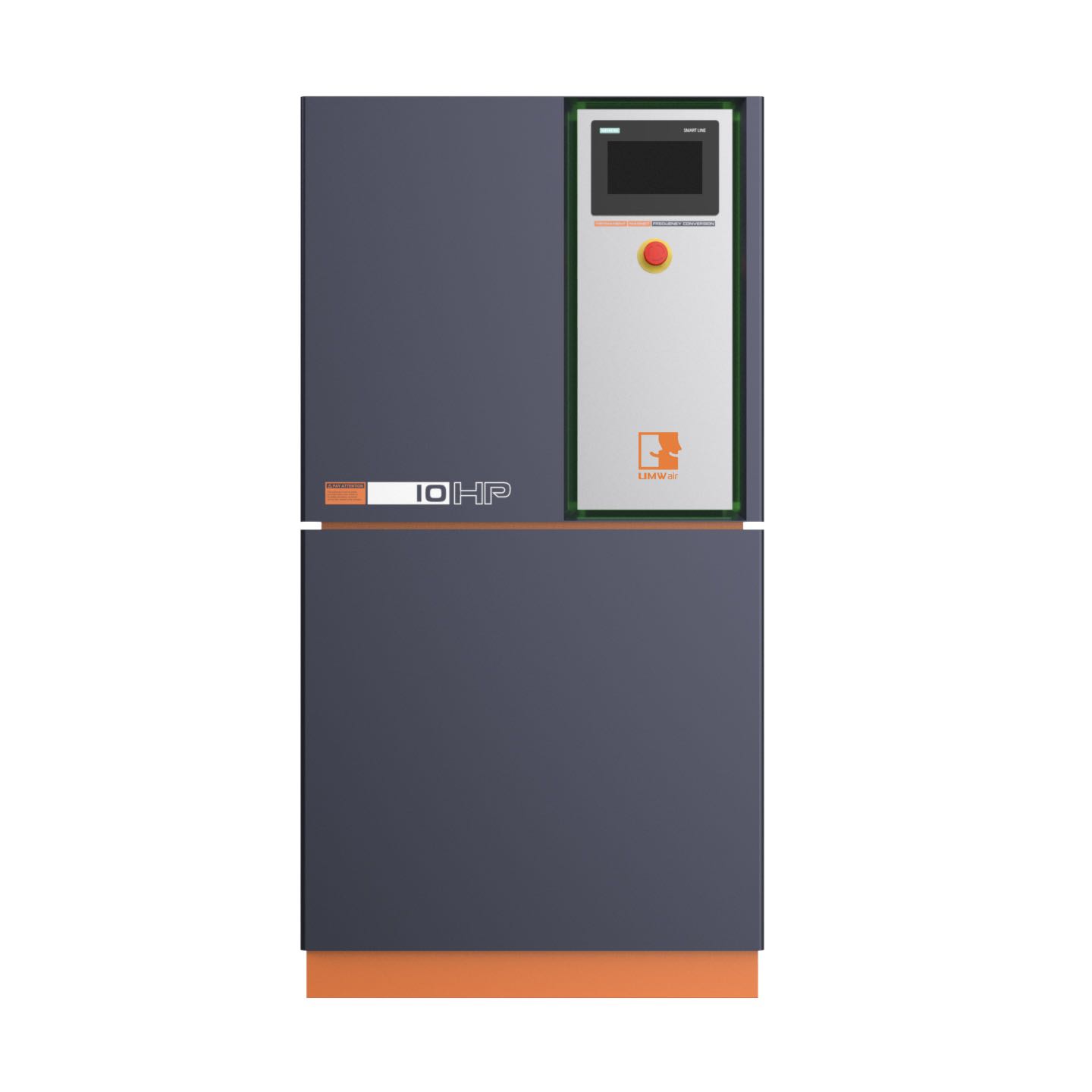
UMW Air Micro screw air compressor with an integrated 140 L receiver. At the small end of the range, the air tank is part of the delivered unit rather than a separate line item.
Use Cases: Where This Parameter Set Fits
The 2.39 m³/min, 8–25 bar, 4–355 kW, IE4 configuration set is applied across metal processing and manufacturing, plastics and rubber processing, automotive and machinery parts, food and packaging, construction and materials, and the energy and chemical industries. Four project types recur: CNC machinery production lines, automotive parts production lines, plastic processing line expansion, industrial automation integration, and food and beverage packaging line setup.
A recorded deployment illustrates how the parameters translate into an outcome. A CNC machining workshop in Vietnam installed three units to drive CNC machine actuators, pneumatic tools and dust removal systems. After one year of operation, the workshop reported a 20% improvement in production efficiency, reduced downtime and a stable air supply supporting consistent machining quality, with low energy consumption, easy maintenance and reliable long-term performance cited as the operating highlights. The application is representative: CNC duty combines a steady base load from actuators with short peaks from tools and dust extraction, which is exactly the profile an air tank plus correctly sized flow is intended to absorb.
The same parameter logic applies to a factory running continuous operation in a high-temperature or humid environment. In that setting the flow and pressure numbers do not change, but the margin on cooling, the ventilation of the compressor room and the specification of the dryer all become decisive, because moisture removal and heat rejection are working against a harder ambient condition.
Comparison Tables
Table 1 — Parameter matrix across the UMW Air screw air compressor range
| Model / frame | Power | Air flow | Pressure | Drive & cooling | Motor | Receiver |
|---|---|---|---|---|---|---|
| Micro ML-4A / ML-5.5A / ML-7.5A | 4 kW / 5.5 kW / 7.5 kW | Maximum 1.1 m³/min | 8–13 bar | Single-stage screw air end | Not stated for this sub-range | 140 L integrated gas tank |
| L-2216A (within the ML-7.5/8A, L-7.5/8A, L-1516A, L-2216A series) | Series envelope 4–355 kW | 2.39 m³/min | Series band 8–25 bar | Direct driven, air cooling | IE4 | Separate air tank in the supporting package |
| Screw series envelope (all frames) | 4–355 kW | Frame-dependent | 8–25 bar | Direct driven, air cooling | IE4 | Specified with the auxiliary package |
Table 2 — Verified market and regulatory context
| Reference point | Value | Source |
|---|---|---|
| Global industrial air compressor market size, 2025 | USD 20.0 billion | Grand View Research |
| Rotary / screw segment share, 2025 | 47.0% of product segment | Grand View Research |
| Asia Pacific regional revenue share, 2025 | 42.8% | Grand View Research |
| Oil-filled share of lubrication segment, 2026 | 61.3% | Grand View Research |
| U.S. compressor definition | 10 CFR 431.342 | U.S. Department of Energy |
| U.S. test procedure and certification requirement | 10 CFR 431.344 / 431.345 / Part 429, for units manufactured from 10 January 2025 | U.S. Department of Energy |
| Compressed air quality classes | ISO 8573-1:2010 | ISO |
| Industry classification for compressor manufacturing | NAICS 333912 | NAICS |
Frequently Asked Questions
Which regulations and standards apply when specifying an industrial screw air compressor?
In the United States, the Department of Energy defines a compressor under 10 CFR 431.342 and requires compressors manufactured from 10 January 2025 to meet energy conservation standards, following the test procedure methods and certification requirements at 10 CFR 431.344, 10 CFR 431.345 and 10 CFR Part 429. Air quality is classified separately under ISO 8573-1:2010, and compressor manufacturing is classified under NAICS 333912. For procurement, that means the specification should record the applicable market requirement, the required air quality class, and the test documentation the supplier will provide — not only the flow and pressure figures.
Can UMW Air supply a screw air compressor outside the L-2216A frame?
Yes. The UMW Air screw air compressor series covers a power range of 4–355 kW and a working pressure band of 8–25 bar, with air cooling, direct drive and an IE4 motor. Frames in the series include the ML-7.5/8A, L-7.5/8A, L-1516A and L-2216A, and the product range also includes air-cooled, direct-driven, stationary, diesel mobile and heavy-duty screw compressors. Manufacturing capability is reported at 1,000 units per month with a 40-person R&D team, OEM/ODM production, and customisation of colour, logo and voltage.
What drives the budget for an industrial screw air compressor project?
No single price applies across a 4–355 kW range, so the budget is built from defined variables: the power rating and frame size, the working pressure point selected inside the 8–25 bar band, the drive and cooling configuration, the motor efficiency class, and the auxiliary package of air dryer, air tank, line filter, inverter and controller required for proper functioning. The commercial case should be evaluated over the operating life rather than at purchase, because an IE4 motor on continuous duty changes the electricity side of the total cost, and the pressure point chosen changes it further. Comparing quotations that omit the auxiliary package compares incomplete systems.
Can a single unit be ordered for evaluation before a larger order?
UMW Air reports a minimum order quantity of 1 unit, and every unit passes factory pre-shipment testing before dispatch. A single-unit order can therefore be used to validate the specification against the actual duty point — flow at the required pressure, motor nameplate data for the exact frame, and behaviour of the auxiliary package — before a multi-unit project is committed. Colour, logo and voltage customisation is available under OEM/ODM production.
What is the lead time, and what support follows delivery?
UMW Air reports a 3-day lead time against a monthly capacity of 1,000 units, with a 100% export orientation across the EU, USA, Southeast Asia, the Middle East, South America and Africa. After-sales support is provided as 24/7 technical support by email or phone, including remote troubleshooting and guidance. Buyers specifying a continuous-duty installation should confirm the exact frame, pressure point and auxiliary package in writing at quotation stage, because those three items — not the delivery date — determine whether the system performs as specified.
Conclusion
Selecting an industrial screw air compressor is a four-number decision before it is a brand decision. Flow of 2.39 m³/min at the L-2216A frame sets the capacity reference; the 8–25 bar band sets where inside the pressure range the plant should actually operate; the 4–355 kW envelope sets the frame size; and the IE4 motor class sets the efficiency baseline against which running cost is judged. Direct drive and air cooling then define the maintenance profile and the installation requirements, and the air dryer, air tank, line filter, inverter and controller convert a compressor into a working compressed air system.
The plants that get this right treat the specification as a sequence: demand, then pressure, then flow at that pressure, then power and efficiency class, then configuration, then auxiliary equipment, then environment. Each step produces a number the next step depends on, and each number can be verified against a document rather than an impression. That is what makes a project specification defensible in procurement review — and what makes a compressed air solution reliable across a continuous duty cycle in a hot or humid plant.
Next step: have your duty point reviewed against the specification
Send UMW Air the required air flow, working pressure, ambient condition and the list of points of use. The engineering team will confirm which frame inside the 4–355 kW range fits, what the air dryer, air tank, line filter, inverter and controller package needs to include, and what documentation accompanies the unit.
Email: info@umwair.com | Phone / WhatsApp: +86 15053148082 | Website: umwair.com
Shandong UMW Air Tech Co., Ltd — 68 Gongye South Road, Jinan, Shandong, China, 250000.
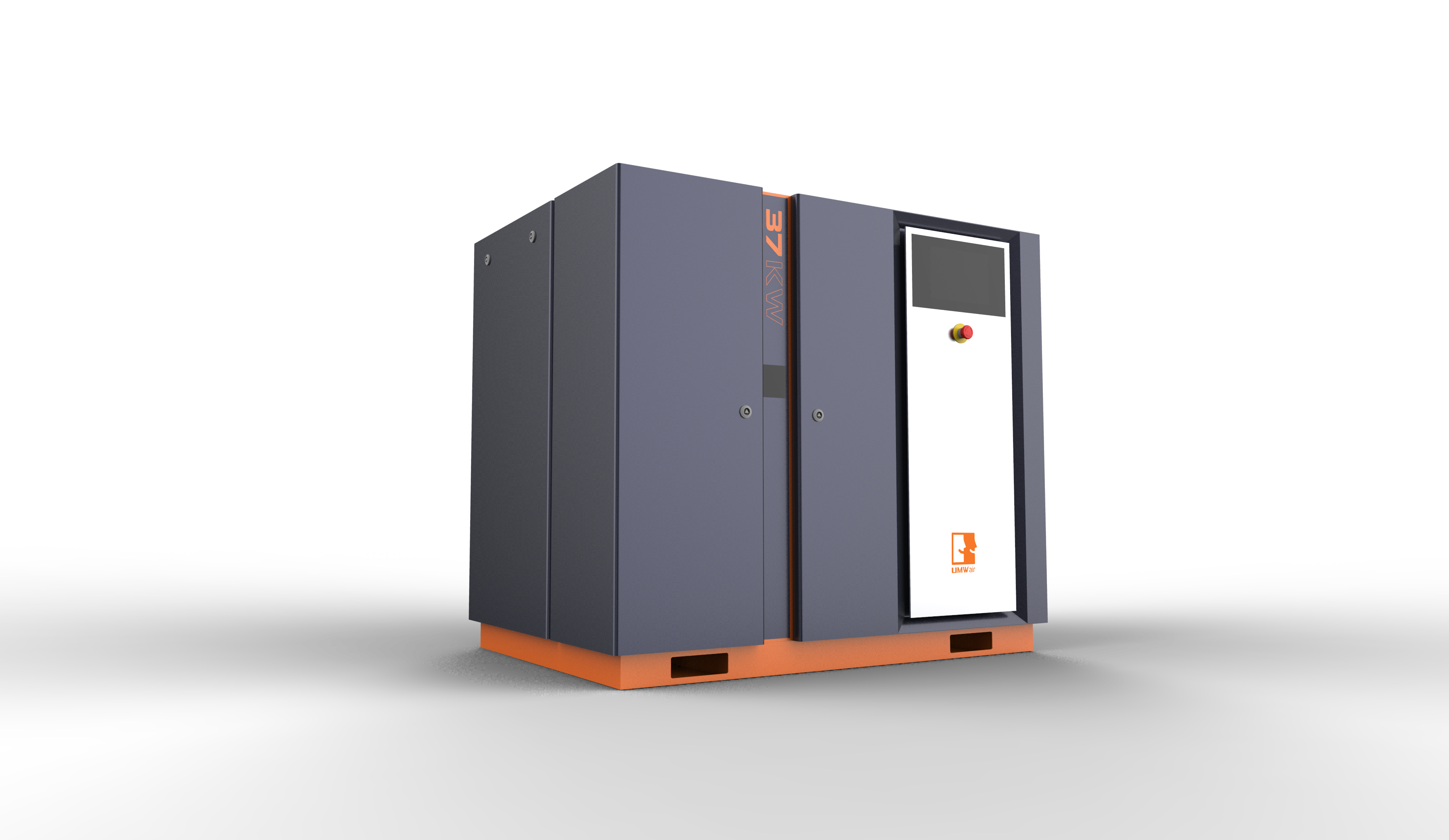
UMW Air Core screw air compressor. Share the duty point — flow, pressure, ambient condition and points of use — and the frame, motor class and auxiliary package can be confirmed against the published range.
Have Questions or Need More Details?
Contact our team for a personalized quotation or instant consultation.
Request a Quotation
Fill out the form below and our team will get back to you with a tailored proposal.
WhatsApp Direct Chat
Prefer to chat in real-time? Message us on WhatsApp for instant assistance & quick answers.
- Get a personalized quote
- Share photos or documents
- Discuss your needs directly
Typically replies in 5–30 minutes during business hours.