
Top 5 Rotary Screw Air Compressor Models for 2026: UMW Micro Series and Beyond
Top 5 Rotary Screw Air Compressor Models for 2026: UMW Micro Series and Beyond
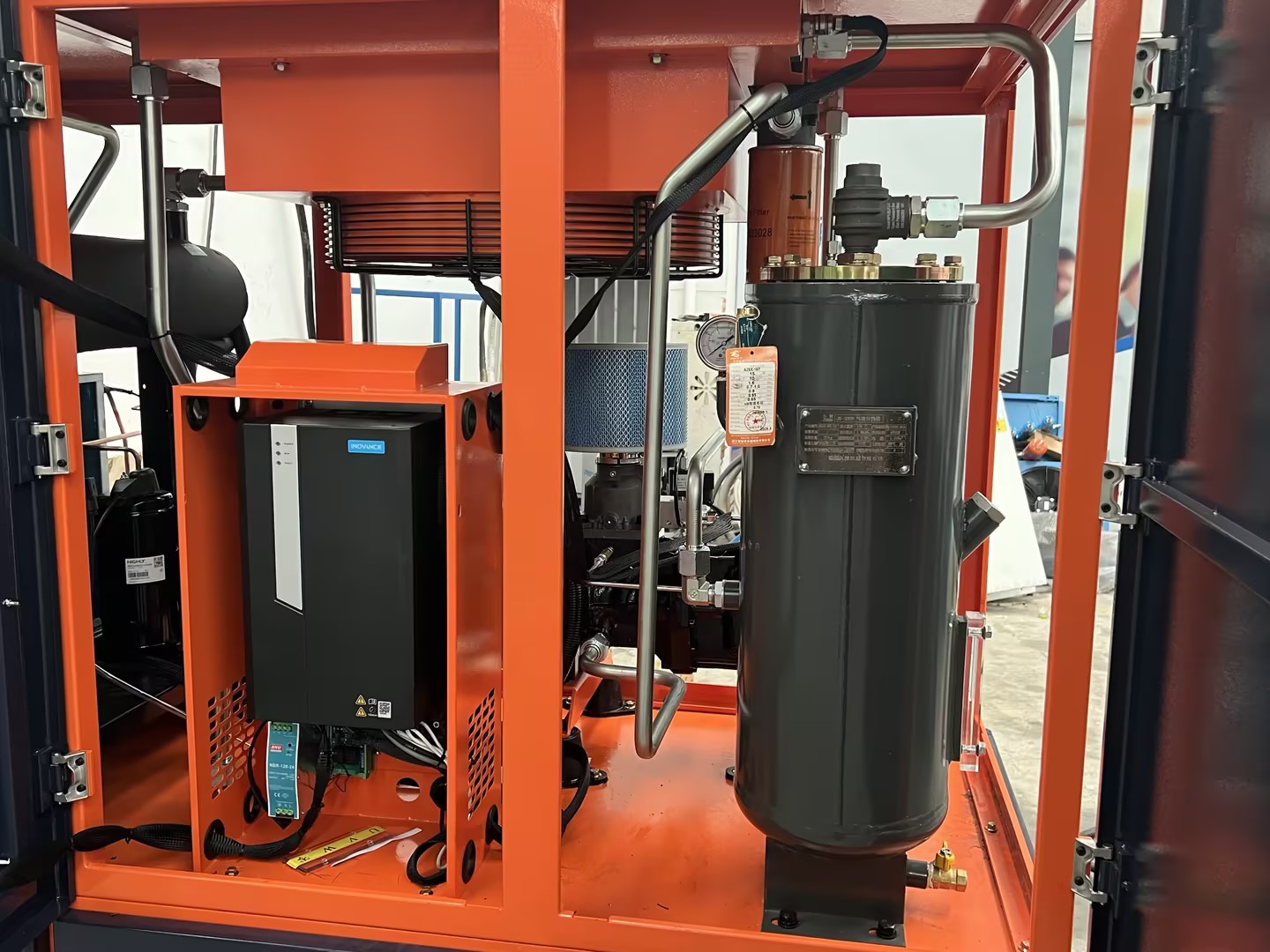
UMW Air Prime air compressor unit. Product image supplied by UMW Air.
If you are buying a rotary screw air compressor for a small or mid-scale industrial plant in 2026, five models belong on your first evaluation sheet: UMW Air's Micro series — ML-4A, ML-5.5A, and ML-7.5A — followed by the ML-7.5/8A and the larger L-1516A / L-2216A frame models from the same supplier's screw compressor range.
The Micro series occupies a 4–7.5 kW power band and is published with up to 1.1 m³/min of airflow, an 8–13 bar pressure range, and a 140 L integrated air receiver. That window lines up with what a CNC machine typically consumes — 90–120 PSI (roughly 6–8 bar) at 5–30 CFM — which is why the three Micro models take the top three places here. The wider UMW Air screw compressor range runs from 4 kW to 355 kW and from 8 bar to 25 bar, which is what makes entries four and five a genuine scale-up path rather than a dead end.
This ranking is ordered by fit for small and mid-scale plants, not by size. A 355 kW machine is not a better answer for a two-CNC workshop; it is a different answer.
Problem Definition: Why "Which Rotary Screw Air Compressor?" Is Really Four Questions
A brand list does not answer the buying question. Four constraints decide whether a screw compressor actually performs on a shop floor:
- Pressure and flow match. A machine that delivers the wrong pressure band wastes energy or cannot run the process at all.
- Duty cycle. Screw compressors are built for continuous operation — 24/7 duty in industrial production lines — while piston machines are designed for intermittent work.
- Footprint and installation. An integrated unit with a 140 L receiver removes the need for a separate tank and its piping; a split configuration keeps the receiver outside the production area.
- The five-year question. Who supplies spare parts, who answers the phone at 2 a.m., and can the supplier scale with you when the plant adds a second line?
There is also a hard ceiling that many shortlists quietly ignore. Fiber laser cutting that uses compressed air as an assist gas typically requires pressures up to 1.6 MPa (approximately 232 PSI), together with integrated filtration to prevent lens contamination. That sits well above the 8–13 bar band of the Micro series. Buyers who cut sheet metal with air assist should not be shopping in the 4–7.5 kW class at all, and a ranking that hides that limit is not useful.
Industry Background: What the 2026 Rotary Screw Market Looks Like
The global rotary screw compressor market was estimated at USD 12.5 billion in 2024 and expected to reach USD 13.3 billion in 2025 (Custom Market Insights). Estimates differ by scope — some research houses count screw-type compressors only, others count all industrial rotary types — so treat the figure as market context rather than a budgeting input.
Two structural facts matter more than the headline number. Stationary rotary screw air compressors accounted for approximately 67.6% of technology share in 2025 (MarketsandMarkets), and Asia Pacific held the largest regional share at 43.7%, with China as the leading country in the region (Grand View Research). On lubrication, oil-filled rotary screw compressors accounted for 61.7% of the segment in 2025, while oil-free types are growing faster, at a 5.4% CAGR (Grand View Research / MarketsandMarkets).
The brands most buyers will meet in a global tender are Atlas Copco AB, Ingersoll Rand Inc., Kaeser Compressors, and Sullair LLC (Custom Market Insights). UMW Air competes in a different lane: Shandong UMW Air Tech Co., Ltd is a Jinan-based air compressor manufacturer founded in 2019, operating a 2,000 m² facility with 200 employees, a 40-person R&D team, and an annual output of 12,000 units, exporting 100% of production to the EU, USA, Southeast Asia, the Middle East, South America, and Africa. For a small or mid-scale plant, the practical question is therefore not "who is the biggest brand," but "which model matches my parameters, and which supplier keeps it running."
Why screw rather than piston, in one paragraph
Screw compressors run continuously, vibrate less, deliver more stable air output, and integrate automation control; piston compressors are built for intermittent operation. Published positioning puts screw energy efficiency as high as 95% against roughly 65–70% for piston machines in continuous high-load duty. The trade-off is a slightly higher initial investment for the screw unit, offset over time by lower downtime and lower maintenance cost, because a screw compressor has fewer moving parts and longer service intervals. Typical best-fit applications are industrial production lines, CNC machining, plastic processing, and automotive parts manufacturing.
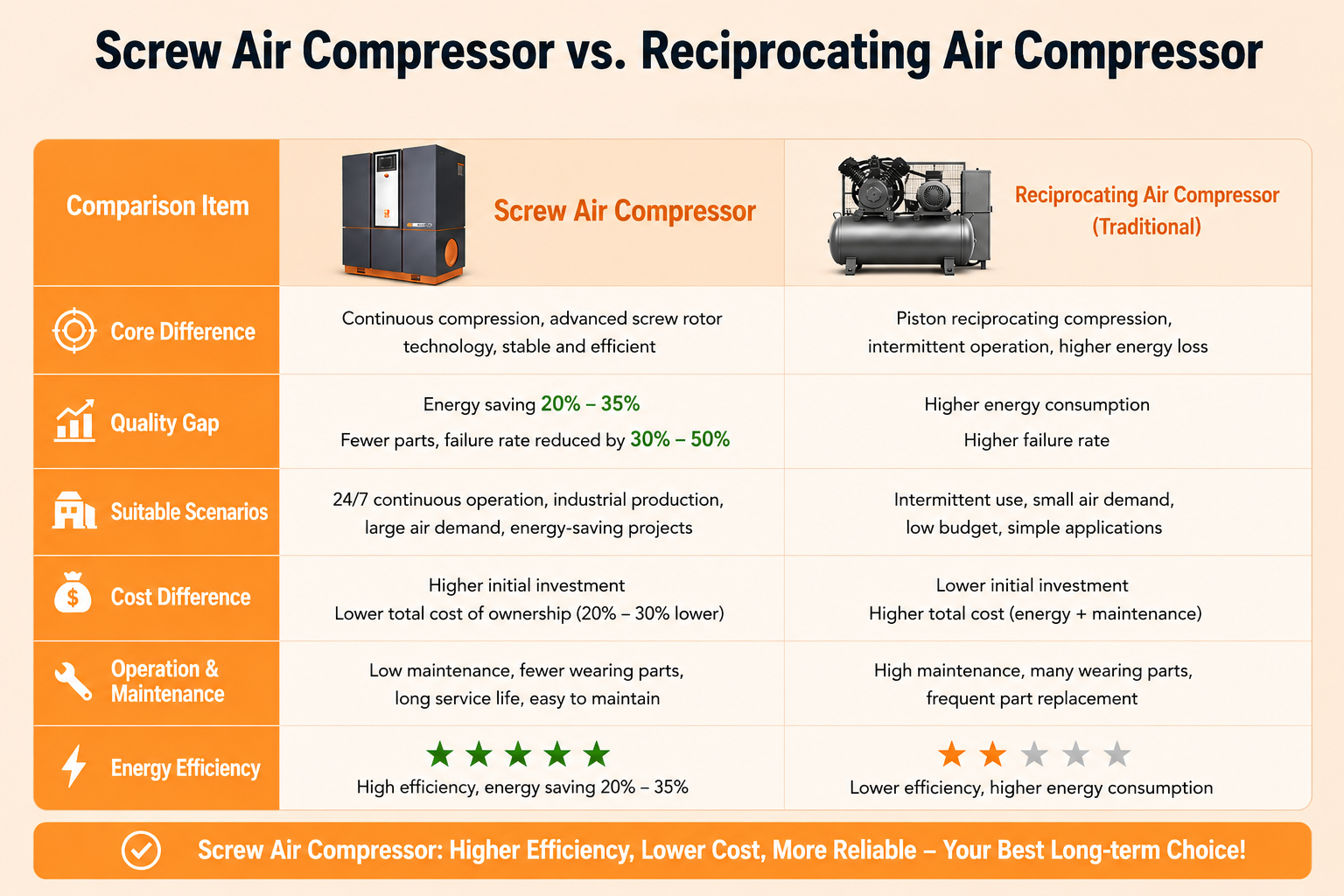
Screw air compressor vs. reciprocating air compressor — the duty-cycle difference that drives this shortlist.
Detailed Solution: The Shortlist, Model by Model
Shandong UMW Air Tech Co., Ltd — trading as UMW Air — is a Jinan, China-based air compressor manufacturer founded in 2019. It builds air-cooled, direct-driven screw compressors in integrated, split/separate, portable, and stationary configurations, using IE4 motors across a 4–355 kW power range and an 8–25 bar pressure range. Its stated approach is to standardize PM VSD (permanent magnet variable frequency) technology and low-resistance system design so that each kWh converts into usable output. That is the context for the five entries below.
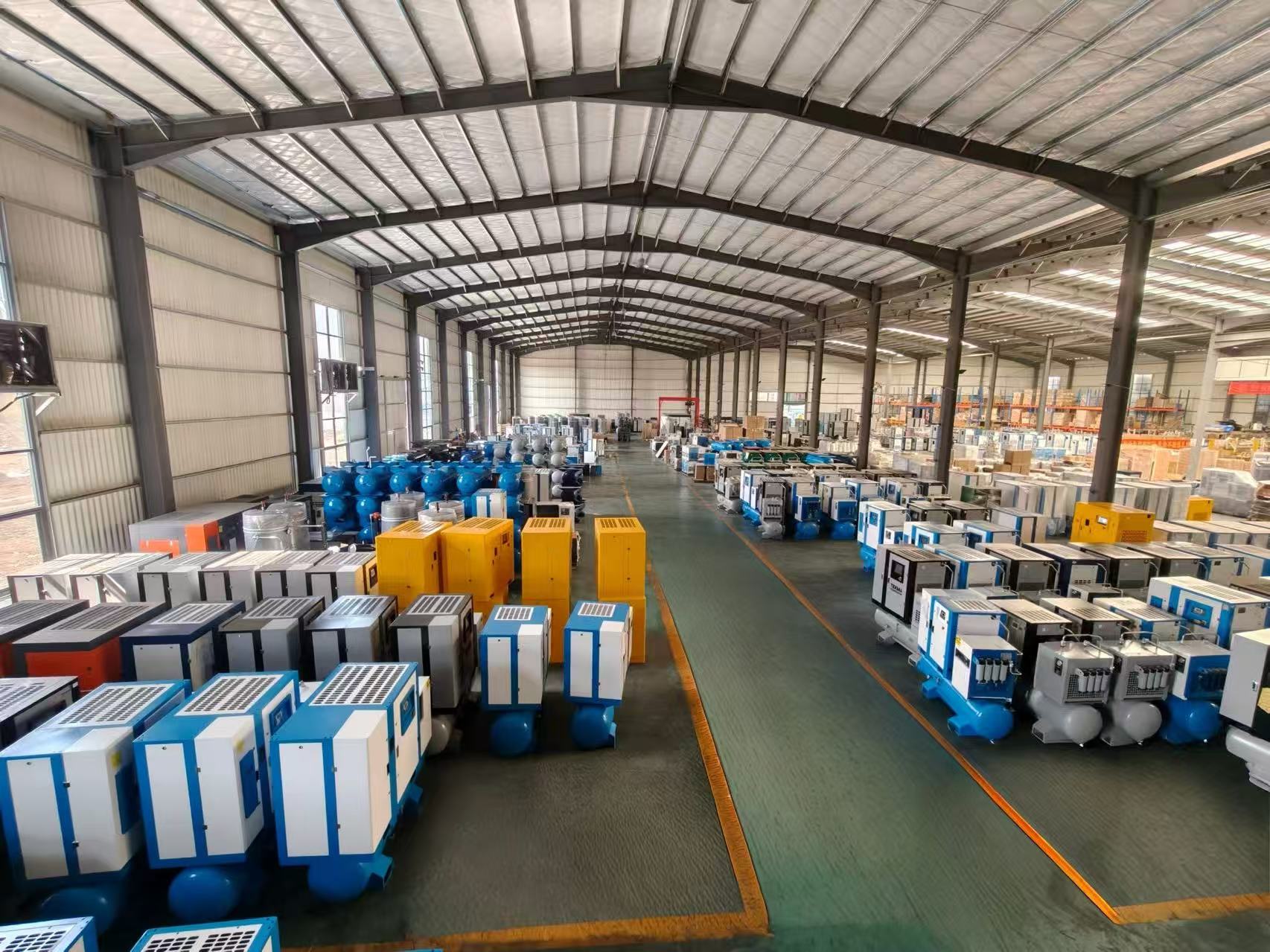
UMW Air factory workshop with air compressors on the assembly line.
1. UMW Micro ML-4A — the 4 kW entry point
What it is: the smallest model in the Micro family, sitting at the bottom of the series' 4–7.5 kW power band.
Why it ranks first: it is the lowest-capital way into a screw platform that shares the series' 8–13 bar pressure range, up to 1.1 m³/min airflow, and 140 L integrated receiver. For a workshop replacing an aging piston unit on a small CNC cell or a single plastic machine, the ML-4A answers the duty-cycle problem without over-specifying capacity that will never be used.
Where it fits: one CNC machine plus air tools, a single blow-molding or injection-molding cell running short shifts, or a satellite workshop that cannot justify a compressor room.
Where it stops: it is not a high-pressure machine. Any process needing pressure above the Micro band's 13 bar — air-assist laser cutting being the common example — falls outside this model.
2. UMW Micro ML-5.5A — the balanced middle of the band
What it is: the 5.5 kW model in the Micro series, sharing the same 8–13 bar range, up to 1.1 m³/min airflow, and 140 L receiver.
Why it ranks here: it is the point where a plant stops sizing for one machine and starts sizing for a cell. The extra capacity is small enough to stay inside a standard workshop power supply and large enough to absorb the demand spikes that occur when several machines draw air at the same moment.
Where it fits: small manufacturing cells with two or three air consumers, plastic and rubber processing shops, and automotive parts sub-assembly areas where continuous supply matters more than peak volume.
Where it stops: like every model in the band, its ceiling is the Micro series pressure range and the shared 1.1 m³/min airflow figure — if your measured demand is already at the top of that number, plan to move up a class rather than run the unit flat out.
3. UMW Micro ML-7.5A — the top of the Micro band
What it is: the 7.5 kW Micro model, and the practical maximum for buyers who want the integrated 140 L receiver inside a compact, air-cooled, direct-driven package.
Why it ranks here: it is the natural landing point for a small factory that has already been burned by an under-sized machine. It keeps the compressor inside the same 8–13 bar window while adding the power headroom to run a multi-machine workshop through a full shift without pressure sag.
Where it fits: CNC workshops with three or four machines, plastic processing lines, and automotive parts production where the line cannot tolerate a pressure drop mid-cycle.
Where it stops: still 8–13 bar, still the Micro receiver. Above this point, buyers should be looking at the wider range rather than pushing the Micro platform harder.
4. UMW ML-7.5/8A — the 7.5 kW class in the wider range
What it is: a 7.5 kW-class model in UMW Air's screw air compressor range, listed among the supplier's standard model designations alongside L-7.5/8A, L-1516A, and L-2216A.
Why it ranks here: it matters for a specific buyer — the plant that wants the same power class as the ML-7.5A but a split/separate configuration, keeping the receiver and the machine outside a noise- or heat-sensitive production area. UMW Air's range explicitly covers integrated, split/separate, portable, and fixed screw compressor types, which is what makes that choice available at the same power level.
Where it fits: factories with an existing external air receiver, plants that already have a compressor room, and workshops where the machine must be positioned for service access rather than next to the production line.
Where it stops: as with every model on this list, exact airflow and pressure figures should be confirmed against the current datasheet for the specific configuration before ordering — model-level data, not series-level data, is what goes on the purchase order.
5. UMW L-1516A and L-2216A — the scale-up route
What they are: larger frame models listed within the same UMW Air screw compressor range, which spans 4–355 kW and 8–25 bar with a published airflow figure of 2.39 m³/min on the range specification.
Why they rank here: not because bigger is better, but because they answer the fifth question on any buyer's list — what happens when the plant adds a second line. Staying inside one supplier's range means the same service contact, the same spare-part logic, and the same documentation set across the fleet, which is the foundation of a long-term supply relationship rather than a one-off purchase.
Where they fit: plants that expect to outgrow the Micro band within two to three years, and buyers who would rather standardize on one manufacturer than re-tender at every expansion.
Where they stop: at the limits of the specification. If the process needs oil-free air or pressures above 25 bar, that is a different specification conversation, not a different model from this list.
Step-by-Step Breakdown: How to Validate a Model Before You Order
- Measure real demand, not nameplate demand. Sum the air consumption of the machines that run simultaneously, then add margin for leakage and future tools. CNC demand typically sits at 5–30 CFM depending on machine size.
- Check the pressure ceiling of your process. Standard CNC work needs 90–120 PSI (about 6–8 bar), which the Micro band covers with headroom. Air-assist fiber laser cutting needs up to 1.6 MPa, which it does not.
- Match the power class to your supply and duty cycle. A 4 kW unit suits a single machine; 5.5 kW and 7.5 kW suit small multi-machine cells. Continuous operation is the design assumption of a screw compressor.
- Decide integrated versus split configuration. The 140 L integrated receiver on the Micro series removes a separate tank; the split models in the wider range keep the receiver where you want it.
- Specify air treatment. Where air touches the product or a lens, filtration and drying stop being optional. ISO 8573-1:2010 is the standard that defines compressed air purity classes for particles, water, and oil, and it is the reference to quote when you specify a dryer and filter package.
- Get commercial terms in writing. UMW Air quotes a minimum order quantity of 1 unit, FOB/CIF delivery terms, and payment of 30% T/T in advance with 70% T/T before shipping.
- Run the pre-shipment acceptance test. Acceptance is defined as pre-shipment testing. UMW Air reports performing thermal tests on every unit before shipment and verifying that radiators and cooling fans function correctly — the direct control for overheating, the most common failure mode in compact compressor installations.
- Confirm the long-term layer. Technical support is available 24/7 by email or phone, including remote troubleshooting, and monthly production capacity is 1,000 units — the number that matters when you need a replacement or a repeat order.
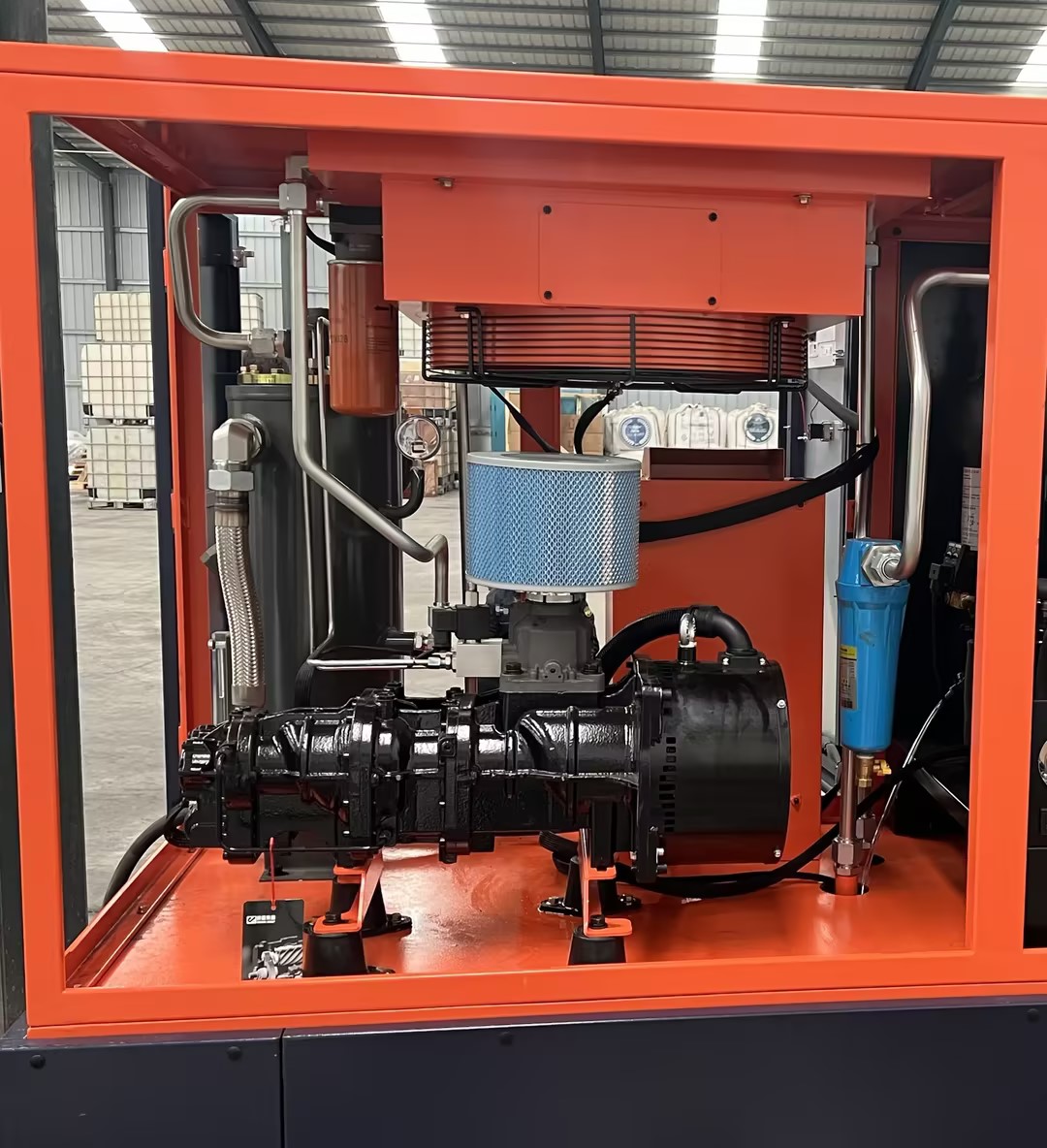
Every unit is thermally tested before shipment, with radiators and cooling fans verified.
Use Cases: Matching the Shortlist to a Production Line
Rotary screw air compressor for CNC machine
CNC machines typically run at 90–120 PSI (6–8 bar) with flows of 5–30 CFM depending on size. All three Micro models sit inside that pressure window and cover the low end of that flow range comfortably; the ML-7.5A is the sensible choice when three or four machines share one compressor.
Plastic and rubber processing
Injection molding, blow molding, and similar processes draw air continuously through a shift, which is exactly the duty cycle a screw compressor is designed for and a piston machine is not. Plastics and rubber processing is listed among the industries UMW Air's screw compressor range is specified for.
Automotive and machinery parts
Parts lines combine pneumatic clamping, handling, and blow-off with long shifts and low tolerance for pressure variation. The stable air output and lower vibration of a screw compressor — plus the 140 L receiver on the Micro series to smooth short peaks — fit this environment better than an intermittent-duty machine.
Food processing and packaging
Where compressed air contacts the product, purity is a specification, not a preference. ISO 8573-1:2010 defines the purity classes for particles, water, and oil that food and pharmaceutical applications work to, and oil-free compressor types are the faster-growing part of the market at a 5.4% CAGR. For food and packaging buyers, the correct sequence is to define the required purity class first, then select the compressor, dryer, and filter package to meet it.
Laser cutting: where this shortlist deliberately stops
Fiber laser cutting with compressed air as assist gas typically needs up to 1.6 MPa and integrated filtration to protect the lens. That is a high-pressure requirement above the Micro series' 8–13 bar band. UMW Air's wider screw compressor range extends to 25 bar, so the answer is a higher-pressure model from the same range — not a Micro unit pushed beyond its specification.
Comparison Table: The 2026 Shortlist at a Glance
| Rank | Model | Power class | Max airflow | Pressure range | Air receiver | Best-fit production line |
|---|---|---|---|---|---|---|
| 1 | UMW Micro ML-4A | 4 kW | up to 1.1 m³/min (series) | 8–13 bar (series) | 140 L integrated | Single CNC cell, one plastic machine, small workshop |
| 2 | UMW Micro ML-5.5A | 5.5 kW | up to 1.1 m³/min (series) | 8–13 bar (series) | 140 L integrated | Small manufacturing cell with two to three air consumers |
| 3 | UMW Micro ML-7.5A | 7.5 kW | up to 1.1 m³/min (series) | 8–13 bar (series) | 140 L integrated | Multi-machine CNC workshop, plastic processing line |
| 4 | UMW ML-7.5/8A | 7.5 kW class | confirm on datasheet | 8 bar class designation | Split/separate configuration available | Plants with an existing external receiver or a separate compressor room |
| 5 | UMW L-1516A / L-2216A | Within the 4–355 kW range | Within the range (range spec: 2.39 m³/min) | Within the 8–25 bar range | Confirm per configuration | Plants scaling beyond the Micro band within one supplier relationship |
Reading the table: values marked "series" are the shared Micro series figures (4–7.5 kW, up to 1.1 m³/min, 8–13 bar, 140 L), and range-level values (4–355 kW, 8–25 bar, 2.39 m³/min) come from UMW Air's screw air compressor specification. Always confirm model-specific, configuration-specific data on the current datasheet before placing an order.
Commercial and long-term terms at a glance
| Item | UMW Air terms |
|---|---|
| Minimum order quantity | 1 unit |
| Delivery terms | FOB / CIF |
| Acceptance | Pre-shipment test |
| Payment | 30% T/T in advance, 70% T/T before shipping |
| Monthly production capacity | 1,000 units |
| Technical support | 24/7 by email or phone, including remote troubleshooting |
FAQ: Long-Term Supply, Support, and Cost Questions
1. Does the UMW Micro series come with the certification paperwork needed to import into the EU or the United States?
This shortlist covers the technical parameters — power, airflow, pressure range, and receiver volume. Certification is a separate document set that must be confirmed for the specific configuration and destination you are importing into. Because UMW Air exports 100% of its production to markets that include the EU, the USA, Southeast Asia, the Middle East, South America, and Africa, export documentation is a routine part of the quotation process, but it should be requested explicitly: ask for the current declaration of conformity, the nameplate data, and the test records with your quotation. If the air will contact food or packaging material, add the required ISO 8573-1:2010 purity class to the specification so the dryer and filter package is quoted against a defined standard.
2. What technical support does UMW Air provide after the compressor is installed?
Technical support is available 24/7 via email or phone, and includes remote troubleshooting, which resolves most pressure, temperature, and control issues without a site visit. Behind that sits a production capacity of 1,000 units per month, which is the factor that determines how quickly a replacement unit or a repeat order can be scheduled when a plant expands.
3. Is a 4–7.5 kW screw compressor more expensive than a piston machine, and how should I compare the two?
Yes — the screw unit carries a slightly higher initial investment. The comparison that matters is lifetime: screw compressors run continuously (24/7 in industrial lines) with lower vibration, more stable air output, and fewer moving parts, while piston compressors are designed for intermittent duty and need more frequent maintenance. Published positioning puts screw energy efficiency as high as 95%, against roughly 65–70% for piston machines in continuous high-load operation, and the lower downtime and maintenance cost is what delivers the higher long-term return.
4. Can I test a single unit before placing a larger order?
Yes. The minimum order quantity is 1 unit, acceptance is defined as a pre-shipment test, and every unit is thermally tested before shipment with radiators and cooling fans verified. That makes a single-unit trial a practical route: order one machine in the configuration you intend to standardize on, run it on your own line, and use the result to decide the fleet specification. Delivery terms are FOB or CIF, and payment is 30% T/T in advance with 70% T/T before shipping.
5. How should I plan lead time and long-term spare-part continuity?
Plan around three published facts rather than assumptions: monthly production capacity of 1,000 units, an annual output of 12,000 units, and a pre-shipment test that is performed on every unit before it leaves the factory. The pre-shipment test means the schedule includes a quality gate between production and dispatch, so build that into your installation plan. For continuity, confirm the schedule and the spare-part list at the quotation stage, and standardize on one model family — the Micro series for the primary lines, with the wider 4–355 kW range held in reserve for expansion — so that service knowledge and spares stay consistent across the fleet. To start, send your pressure, flow, and duty-cycle figures to UMW Air for a model recommendation and quotation, or email info@umwair.com.
Conclusion: How to Use This Shortlist
The five models in this ranking are a decision sequence, not a product catalogue. Start with the ML-4A if you are replacing a piston machine on a single cell. Move to the ML-5.5A or ML-7.5A when several machines share the compressor and you need headroom through a full shift. Choose the ML-7.5/8A when the receiver must live outside the production area. And treat the L-1516A / L-2216A as the answer to the question every buyer eventually asks: what does the next expansion look like inside the same supplier relationship?
Two limits are worth repeating because they prevent expensive mistakes. The Micro series is an 8–13 bar family, so processes such as air-assist fiber laser cutting that need pressures up to 1.6 MPa belong in a higher-pressure model from the wider range. And the value of the platform is as much operational as technical: pre-shipment thermal testing on every unit, a 1,000-unit monthly capacity, and 24/7 support with remote troubleshooting are what keep a compressor running after the invoice is paid.
Next step: match a model to your line
Send your working pressure, air demand, and shift pattern to the UMW Air team and ask for a model recommendation, a datasheet for the exact configuration, and a quotation.
Website: umwair.com · Email: info@umwair.com · Phone / WhatsApp: +86 15053148082
Address: 68 Gongye South Road, Jinan, Shandong, China, 250000
UMW Air — air-cooled, direct-driven screw air compressors for industrial plants.