
Understanding Motor Efficiency and Drive Systems in Screw Air Compressors: A Technical Guide
A screw air compressor's energy behaviour over its service life is shaped by two design decisions that seldom appear in a price comparison: the efficiency class of the drive motor, and the method used to transfer motor torque to the screw air end. UMW Air specifies an IE4 motor and a direct-driven transmission on its industrial screw air compressor range, alongside a published power range of 4–355 kW, a working pressure range of 8–25 bar, a maximum air flow of 2.39 m³/min, and air cooling.
Shandong UMW Air Tech Co., Ltd (UMW Air) is an industrial screw air compressor manufacturer based in Jinan, Shandong, China. Founded in 2019, the company operates a 2,000 m² production facility with 200 employees, a 40-person R&D team, and an annual output of 12,000 units. UMW Air reports an export ratio of 100%, serving markets including the EU, the USA, Southeast Asia, the Middle East, South America, and Africa.
This guide is written for engineers, plant managers, and procurement teams working through the research and evaluation stages of an industrial compressed air project. It explains what IE4 and direct drive actually mean at the component level, how power, pressure, and air flow should be read against a specific production task, and where cooling method and system components decide the lifecycle value of the installation.
The Problem: The Two Specifications Buyers Rarely Compare
Two screw air compressors can look interchangeable on a quotation — similar footprint category, similar pressure band, comparable list price. What separates them usually sits one layer deeper: the efficiency class of the motor and the transmission that connects that motor to the air end.
Neither item is cosmetic. An industrial compressor generally runs for years, frequently in continuous duty, and it runs whether or not the original quotation was sharp. A motor in a lower efficiency class and a belt-driven transmission both convert part of the electrical input into losses rather than into compressed air, and those losses are paid on every operating hour, not only at the point of purchase. Because electricity consumption accumulates across a compressor's working life, the efficiency of the motor-and-drive combination typically carries more weight in the total cost picture than the initial equipment price.
A second, more visible problem is project mismatch. A unit selected outside the required pressure band either fails to deliver the pressure the process needs or runs against a higher back-pressure than the process requires. A unit selected on inaccurate air-flow estimates produces unstable supply, and instability in a compressed air system surfaces downstream as rejected parts, hesitation at pneumatic tools, or unplanned downtime. The specification points that prevent this — power, pressure, air flow, cooling method, and drive method — are published for the UMW Air range, but they only help if the buyer reads them against the actual project.
There is also a scope problem. Compressed air is delivered by a system, not by a single machine. A screw air compressor is designed for environments requiring stable and clean compressed air and operates under high-temperature or humid conditions, and it must be used with supporting equipment such as an air dryer, air tank, line filter, inverter, and controller for proper functioning. When those components are treated as optional extras rather than part of the specification, the compressor's published performance and the plant's actual performance diverge.
Industry Background: Why Efficiency Class Now Anchors Project Evaluation
The global industrial air compressor market was valued at USD 20.0 billion in 2025, according to Grand View Research (Industrial Air Compressor Market Size Report, 2026–2033, published 15 August 2026). Within that market, the rotary/screw segment held the largest share at 47.0% in 2025, and Asia Pacific accounted for a 42.8% revenue share in the same year. Oil-filled compressors represented 61.3% of the lubrication segment share in 2026. Screw technology is not a niche choice; it is the mainstream configuration for factory compressed air.
Two structural developments explain why motor efficiency class and drive method have moved from a datasheet footnote into a procurement criterion.
Efficiency is now regulated. In the United States, the Department of Energy defines a compressor as a machine or apparatus that converts different types of energy into the potential energy of gas pressure, applied to gaseous media above atmospheric pressure (10 CFR 431.342). Compressors manufactured on or after 10 January 2025 must meet the applicable energy conservation standards, and manufacturers must follow the prescribed test procedure methods and the certification, compliance, and enforcement requirements set out at 10 CFR 431.344, 10 CFR 431.345, and 10 CFR Part 429. In practical terms, this converts motor-and-drive efficiency from a supplier preference into a documented, verifiable property that a buyer can request and check.
Air quality is now classified. ISO 8573-1:2010 defines compressed air purity classes (International Organization for Standardization, 2010). This is the reference buyers use to specify how much drying and filtration a process requires. The compressor supplies the energy; the purity class is achieved by the system built around it.
For supplier screening, NAICS 333912 covers establishments primarily engaged in manufacturing general purpose air and gas compressors, including reciprocating compressors, centrifugal compressors, vacuum pumps (except laboratory), and non-agricultural spraying and dusting compressors and spray gun units. It is a useful first filter when building a supplier list, although it describes an industry category rather than an individual supplier's capability or capacity.
Detailed Solution: What IE4 and Direct Drive Actually Change
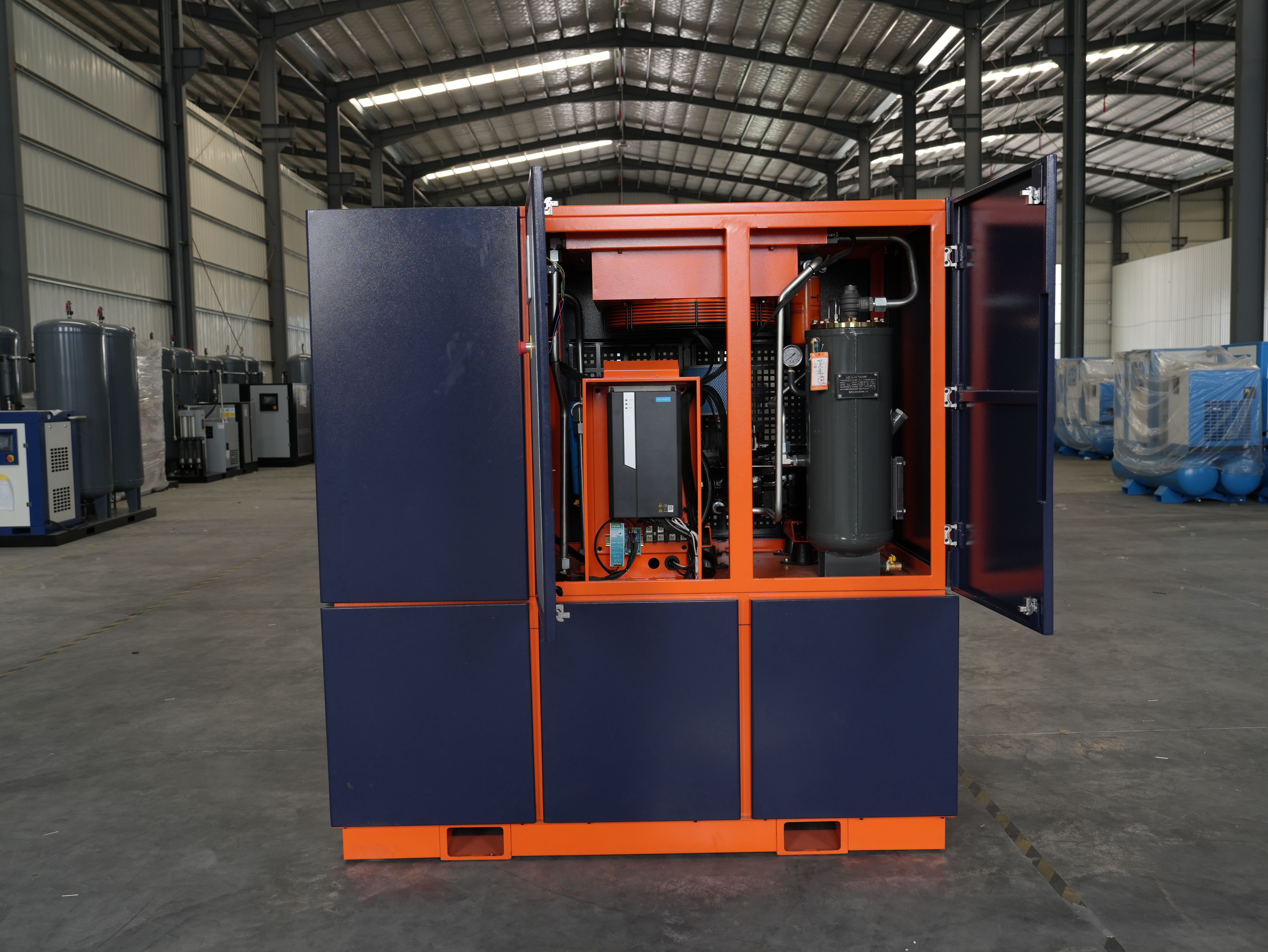
IE4 on a Screw Air Compressor Datasheet: What the Code Signals
The UMW Air screw air compressor specification lists the motor as IE4. The IE code is the international efficiency classification applied to industrial electric motors, and IE4 sits at the high end of the classes used in general industrial practice.
Mechanically, the class describes how much of the electrical energy entering the motor leaves as useful shaft work rather than being dissipated as heat. A motor in a higher class has lower losses, and that produces two project-level effects. The first is energy: on a unit running continuous duty, a lower loss figure applies to every operating hour, not merely to the first year of service. The second is thermal load. Losses inside the motor become heat inside the enclosure, so a more efficient motor reduces the heat the cooling system has to remove — which links the motor class directly to the cooling-method decision discussed below.
The verification step is straightforward. A buyer should confirm the motor class on the nameplate and in the technical documentation, not only in a sales summary. The specification is either documented or it is not.
Direct Drive, Belt Drive, and Gear Transmission Compared by Function
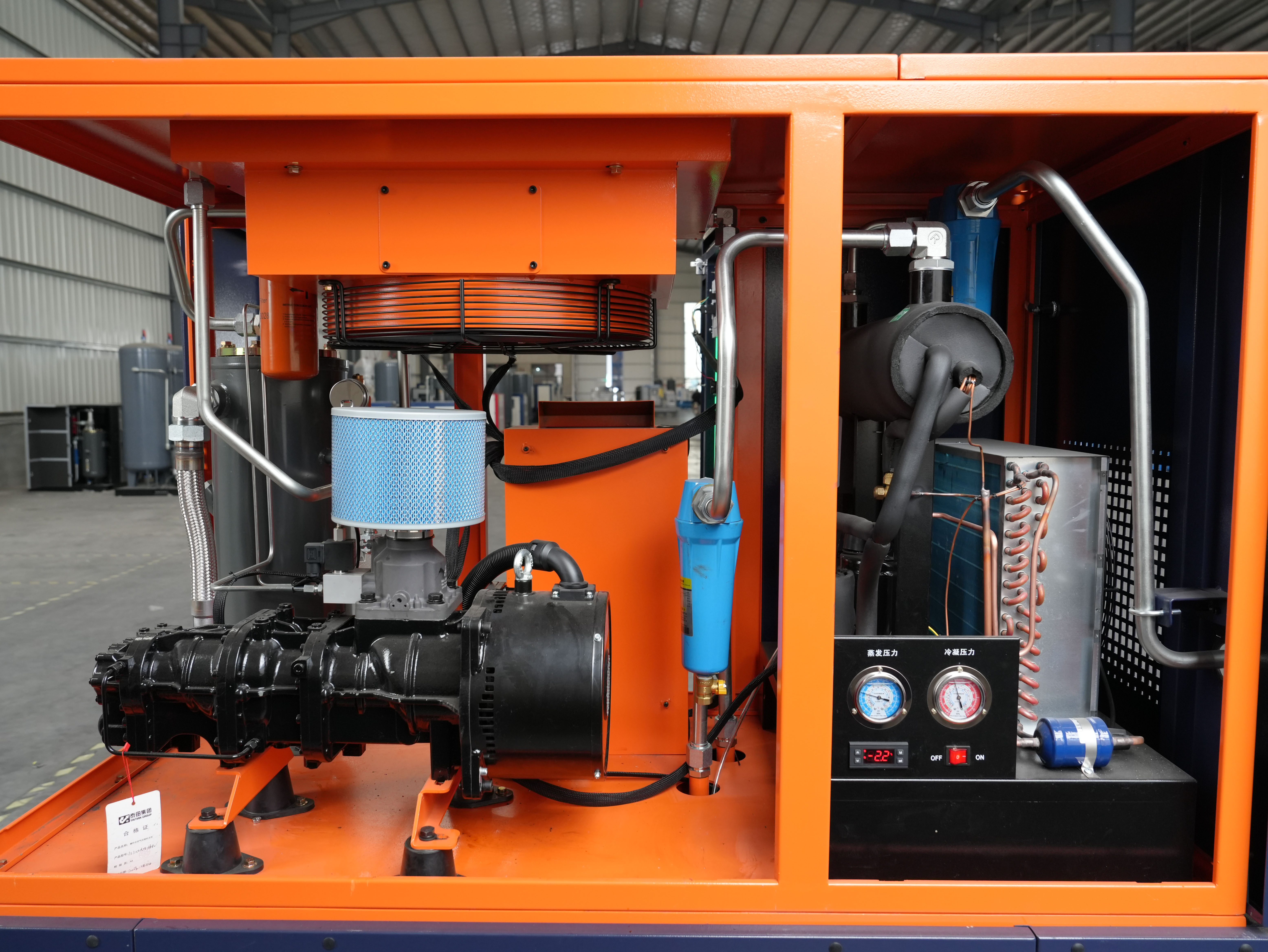
The UMW Air screw air compressor range is specified as direct driven. In a direct-drive machine, the motor shaft is coupled to the screw air end without an intermediate belt set or pulley arrangement.
The functional consequences follow from what has been removed. Belts are wearing components: in general industrial practice, belt-driven compressors require periodic inspection of belt tension and condition, and belt replacement is a scheduled maintenance item. Removing the belt removes slip, removes a component that degrades in use, and removes the transmission interfaces where energy is transferred rather than converted. In belt systems, part of the input energy is not delivered to the air end; in a direct-coupled arrangement that particular loss path does not exist.
Direct drive also has limits worth understanding before specifying it. Because motor and air end are coupled without a ratio change, the relationship between motor speed and rotor speed is fixed unless a gearbox is introduced. Belt drives make it comparatively simple to change that ratio, which can matter to engineers working a non-standard operating point. Gear transmissions achieve ratio change inside an oil-lubricated gearbox, which adds components, lubrication requirements, and maintenance attention. Installation alignment is also more consequential in a direct-drive arrangement, because there is no compliant belt element to absorb small misalignments.
For a project where the required operating point falls inside a standard range and continuous operation is the norm, the direct-drive configuration used across the UMW Air range removes a recurring maintenance item and eliminates one category of transmission loss.
Air Cooling as a Project Decision, Not a Footnote
The UMW Air screw air compressor uses air cooling. An air-cooled machine rejects heat to ambient air through the unit's cooling circuit rather than through a water circuit.
The project-level implication is installation scope. An air-cooled compressor does not require a cooling water supply, water treatment, or the associated piping and drainage, which simplifies plant layout and reduces the number of systems that can fail. The corresponding constraint is that the heat still has to go somewhere: stability and performance depend on ambient air temperature and on ventilation of the compressor room. In hot plants without adequate room ventilation, that becomes a design task rather than an afterthought.
The wider specification notes that the product is designed for environments requiring stable and clean compressed air and operates under high-temperature or humid conditions. For projects in those environments, the practical checklist is ventilation rate, intake air path, spacing between units, and access for cleaning the cooler.
Power, Pressure, and Air Flow: The Three Numbers That Must Match the Task
Three published values determine whether a screw air compressor fits a project: power, pressure, and air flow.
- Power (4–355 kW). Power defines the capacity envelope of the range. It should be matched to the project's total air demand — including leakage and a growth allowance — rather than to the rating of a single tool. Oversizing raises purchase cost and, at part load, can move the machine away from its efficient operating region.
- Pressure (8–25 bar). Pressure is the delivery band the process must fall inside. Specifying a compressor at a pressure materially higher than the process requires means the machine works against higher back-pressure on every running hour. Choosing the lowest stable pressure the process accepts, then selecting a unit whose band covers it, is the standard discipline.
- Air flow (2.39 m³/min). Air flow is usable capacity at an operating point, and it must be validated against the demand profile rather than against a headline figure in isolation.
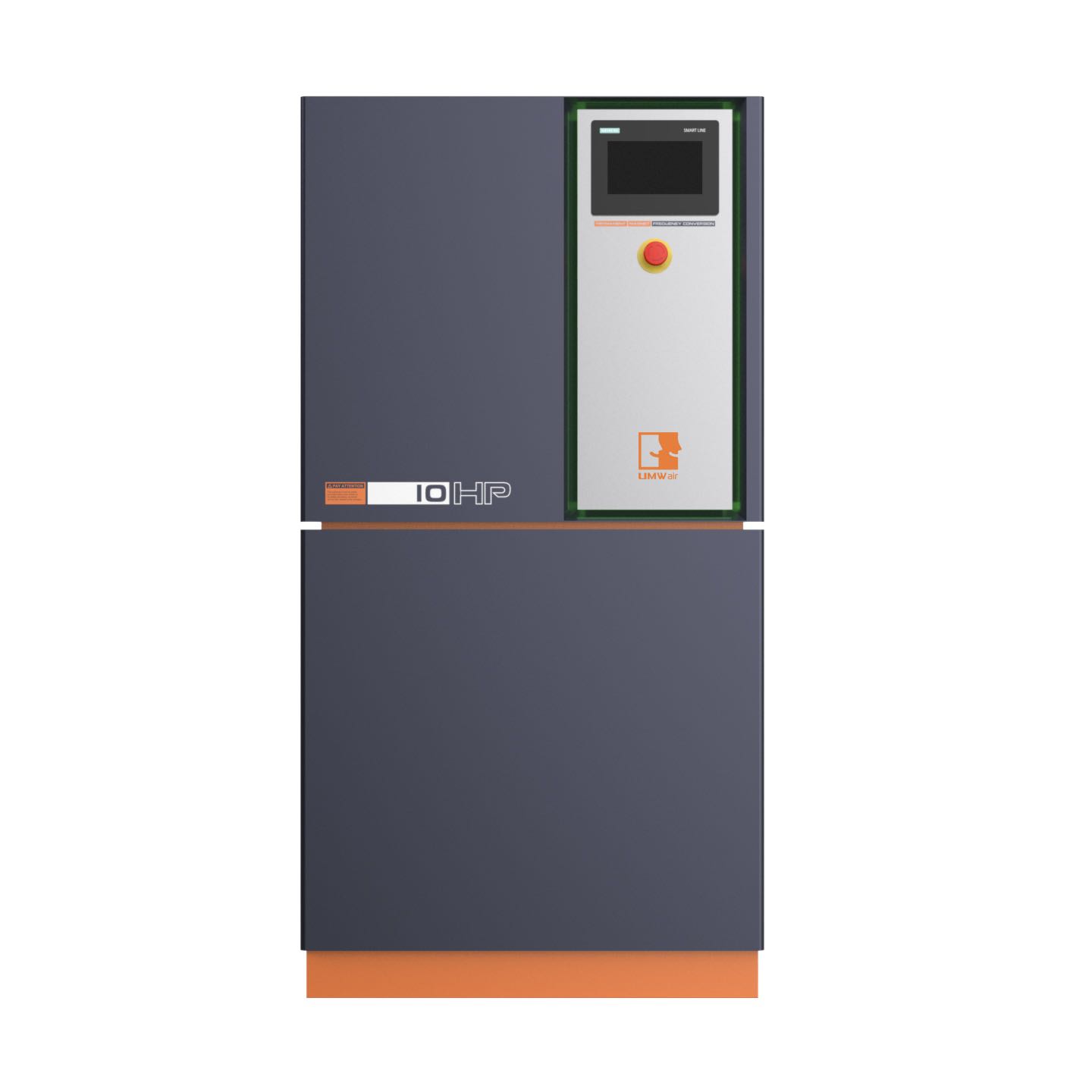
Within the same product family, the Micro ML-4A, Micro ML-5.5A, and Micro ML-7.5A cover the small end of the range at 4 kW, 5.5 kW, and 7.5 kW respectively, with a pressure range of 8–13 bar, a maximum air flow of 1.1 m³/min, a 140 L gas tank, and a single-stage screw compressor air end. Larger models such as the ML-7.5/8A, L-7.5/8A, L-1516A, and L-2216A sit inside the wider 4–355 kW and 8–25 bar specification, which is where the IE4 motor and the direct-driven transmission are specified.
System Components: Where the Compressor Stops and the System Begins
A screw air compressor must be used with supporting equipment such as an air dryer, air tank, line filter, inverter, and controller for proper functioning. Each component carries a distinct job:
- Air dryer — removes moisture so delivered air meets the purity class the process requires.
- Air tank — buffers demand fluctuations and reduces the frequency of load/unload cycles.
- Line filter — protects downstream equipment and products from particulates and oil carryover.
- Inverter — enables variable-speed capacity control, allowing output to follow demand instead of running at a fixed speed.
- Controller — coordinates the unit and provides monitoring and fault visibility.
Step-by-Step: Matching a Screw Air Compressor to a Project
Step 1 — Map the real air demand. List every consumer in the plant: CNC machine actuators, pneumatic tools, dust removal systems, packaging lines. Record the pressure each one needs and its duty cycle, then add an allowance for leakage and for planned expansion.
Step 2 — Set the required pressure band. Choose the lowest stable pressure the process will accept. Then select a compressor whose published range covers it — 8–25 bar for the wider UMW Air screw range, 8–13 bar for the Micro models.
Step 3 — Size power and air flow together. Treat power (4–355 kW) and air flow (2.39 m³/min) as a pair, and check both at the pressure you intend to operate at rather than at the maximum the unit can reach.
Step 4 — Confirm the motor class and the drive method. Verify IE4 in the documentation and confirm the machine is direct driven. If the drive method is not stated, ask for it — it affects the maintenance schedule as much as the energy behaviour.
Step 5 — Test the cooling method against the site. Air cooling suits installations without a water circuit. Then check ambient temperature, room ventilation, unit spacing, and cooler access. In high-temperature or humid environments, these checks decide whether the machine holds its operating point.
Step 6 — Design the supporting system. Specify the air dryer, air tank, line filter, inverter, and controller together with the compressor and against the required air quality class, not after the compressor has been installed.
Step 7 — Verify supply and support terms. For OEM, ODM, or branded projects, confirm customization scope (color, logo, voltage), monthly capacity, lead time, minimum order quantity, pre-shipment testing, and after-sales support before committing.
Use Cases: Where Motor Class and Drive Method Change the Outcome
CNC machining workshop, Vietnam. A CNC machining workshop installed three UMW Air units to drive CNC machine actuators, pneumatic tools, and dust removal systems. After one year of operation, the workshop reported a 20% improvement in production efficiency and reduced downtime, with stable air supply supporting high-quality machining. The reported highlights were low energy consumption, easy maintenance, and reliable long-term performance — the three attributes that map back to motor class, direct drive, and system design.
Metal processing and manufacturing. Continuous duty, airborne dust, and elevated ambient temperatures load both the cooling circuit and the drive train. A direct-driven, air-cooled unit removes belt maintenance and water-circuit dependency from a plant that already carries enough maintenance load.
Plastics and rubber processing. Moulding and forming lines need pressure stability across long production runs. Selecting a pressure band that matches the process, rather than defaulting to the highest available, keeps the machine working at its intended operating point.
Automotive and machinery parts. Pneumatic clamping, assembly tools, and test stations create a demand profile with sharp peaks. The air tank and inverter within the supporting system contribute as much to stability as the compressor's nominal size.
Food and packaging. Air that contacts product or packaging must meet the specified purity class, which places the dryer and line filter at the centre of the system design rather than at its edge.
Construction materials, energy, and chemical. These are the environments where high-temperature or humid conditions are normal, and where the air-cooling decision plus room ventilation determine whether the installation performs as specified.
Comparison Reference: UMW Air Screw Air Compressor Parameters
The two tables below summarise published specification points and how each one should be read during evaluation.
| Specification point | Published value (UMW Air screw air compressor) | What it means for project matching |
|---|---|---|
| Motor | IE4 | Higher efficiency class reduces electrical losses and internal heat load; verify on nameplate and documentation. |
| Drive method | Direct driven | No belt set or pulley arrangement between motor and screw air end; removes a wearing component and a transmission loss path. |
| Power | 4–355 kW | Sets the capacity envelope; match to total plant demand plus leakage and growth allowance. |
| Pressure | 8–25 bar | Delivery band; select the lowest stable pressure the process accepts within this band. |
| Air flow | 2.39 m³/min | Usable capacity at an operating point; validate against the measured demand profile. |
| Cooling method | Air cooling | No water circuit required; performance depends on ambient temperature and compressor room ventilation. |
| Material | Sheet metal | Enclosure construction for industrial environments. |
| Parameter | Micro air compressor (Micro ML-4A / ML-5.5A / ML-7.5A) | Screw air compressor (ML-7.5/8A, L-7.5/8A, L-1516A, L-2216A) |
|---|---|---|
| Power | 4 kW / 5.5 kW / 7.5 kW | 4–355 kW |
| Pressure range | 8–13 bar | 8–25 bar |
| Maximum air flow | 1.1 m³/min | 2.39 m³/min |
| Gas tank | 140 L | Not stated in the published specification |
| Air end | Single-stage screw compressor air end | Not stated in the published specification |
| Motor / drive | Not stated in the published specification | IE4 motor, direct driven |
FAQ
Which compliance points should be confirmed before a screw air compressor is approved for a project?
Two references matter most. ISO 8573-1:2010 defines compressed air purity classes, and the target class determines how much drying and filtration the system requires. In the United States, the Department of Energy defines a compressor at 10 CFR 431.342 and sets test procedure and certification requirements under 10 CFR 431.344, 10 CFR 431.345, and 10 CFR Part 429, applicable to compressors manufactured on or after 10 January 2025. Buyers should request documentation that matches the destination market rather than relying on general claims in a brochure. For supplier screening, NAICS 333912 covers establishments primarily engaged in manufacturing general purpose air and gas compressors.
Does UMW Air support OEM and ODM projects on screw air compressors?
Yes. UMW Air operates OEM and ODM production models, with customization available for color, logo, and voltage. Monthly capacity is 1,000 units, export markets include the EU, the US, the Middle East, and Southeast Asia, and every unit undergoes factory pre-shipment testing. After-sales support is provided through 24/7 technical support by email or phone, together with remote troubleshooting and guidance.
How does motor efficiency class affect the overall cost picture?
Motor class and drive method influence cost in three places. A higher efficiency class motor has lower electrical losses, and those losses are incurred on every operating hour of a machine that typically runs for years. A direct-driven transmission removes belt-related losses and the recurring cost of belt inspection and replacement. Air cooling removes the need for a cooling water supply, water treatment, and associated piping, which reduces installation and auxiliary cost. Because a compressor's electricity consumption accumulates across its service life, the efficiency of the motor-and-drive combination generally deserves the same attention in evaluation as the purchase price itself.
Can a buyer evaluate a single unit before placing a volume order?
The minimum order quantity for UMW Air is 1 unit, and the standard lead time is 3 days. Factory pre-shipment testing is carried out before dispatch, so a single-unit evaluation is possible before scaling into a volume or OEM project. For buyers who need to confirm motor class, drive configuration, or system compatibility on site before committing, this allows a documented trial rather than an assumption.
What are the delivery and support timelines for a screw air compressor order?
UMW Air publishes a standard lead time of 3 days and a monthly capacity of 1,000 units, with OEM and ODM customization available for color, logo, and voltage. After-sales support runs 24/7 via email or phone, with remote troubleshooting and guidance included. For project-specific questions about power, pressure, air flow, or system sizing, contact UMW Air at info@umwair.com or +86 15053148082 to request a specification sheet for your application.
Conclusion
Motor efficiency class and drive method are the two specification points that decide how a screw air compressor behaves between the purchase date and the end of its service life. The UMW Air range specifies an IE4 motor and a direct-driven transmission, with a published power range of 4–355 kW, a working pressure range of 8–25 bar, a maximum air flow of 2.39 m³/min, and air cooling, across configurations that include the ML-7.5/8A, L-7.5/8A, L-1516A, and L-2216A for larger duties and the Micro ML-4A, Micro ML-5.5A, and Micro ML-7.5A at the small end.
Matching those numbers to a project is a sequence, not a guess: map the demand, set the pressure band, size power and air flow at the operating point, confirm motor class and drive method in the documentation, test the cooling method against the site, and design the air dryer, air tank, line filter, inverter, and controller as part of the same specification. Projects that follow this order avoid both the visible failure of unstable air supply and the invisible one of paying for losses on every operating hour.
Planning a Compressed Air Project?
UMW Air supplies air-cooled, direct-driven screw air compressors from 4 kW to 355 kW with IE4 motors, and supports OEM and ODM projects with customization of color, logo, and voltage. Minimum order quantity is 1 unit, standard lead time is 3 days, monthly capacity is 1,000 units, and every unit goes through factory pre-shipment testing.
Website: umwair.com
Email: info@umwair.com
Phone / WhatsApp: +86 15053148082
Address: 68 Gongye South Road, Jinan, Shandong, China, 250000
Request a quote, specification sheet, or sample unit evaluation →
Have Questions or Need More Details?
Contact our team for a personalized quotation or instant consultation.
Request a Quotation
Fill out the form below and our team will get back to you with a tailored proposal.
WhatsApp Direct Chat
Prefer to chat in real-time? Message us on WhatsApp for instant assistance & quick answers.
- Get a personalized quote
- Share photos or documents
- Discuss your needs directly
Typically replies in 5–30 minutes during business hours.