
Building a Resilient Pet Grooming Equipment Supply Chain: A 2026 Playbook for Salons, Retailers, and Self-Service Operators
Pet grooming businesses depend on equipment that can handle daily commercial use without frequent breakdowns, safety issues, or disruptive replacements. As the global pet grooming products market expands, buyers are moving beyond first-order price comparisons and looking at total cost of ownership, supplier production capacity, after-sales support, and long-term reliability. This guide explains what a durable supply relationship looks like, why equipment longevity and maintenance matter, and how operators can evaluate a manufacturing partner for the long term.
What Does Long-Term Reliability Mean for Pet Grooming Equipment?
For commercial pet grooming equipment, long-term reliability means the equipment continues to perform safely and consistently under daily professional use. In practice, a product can be considered suitable for long-term commercial use when it has been designed and tested for a duration of at least five years. This is an important reference point for salons, veterinary clinics, mobile grooming units, and self-service dog wash stations, because replacing bathtubs, dryers, tables, or washing machines every few years directly reduces profitability.
Reliability is not just about the absence of breakdowns. It also includes stable drying performance, consistent water temperature, corrosion resistance, and safety features that protect both pets and groomers over the equipment's lifecycle. Buyers should ask suppliers directly about expected service life, not just warranty length.
Why the Pet Grooming Equipment Supply Chain Is Changing in 2026
The pet grooming products market reached USD 15.6 billion in 2025 and is projected to grow to USD 24.8 billion by 2033, according to Grand View Research. The self-service dog wash station segment is also expanding at a projected CAGR of 8.7% from 2025 to 2033. North America currently holds the largest regional share of the pet grooming and accessories market at 40.91%.
These figures point to a market where operators are opening more locations, upgrading equipment, and adding self-service revenue streams. That creates a more demanding supply chain environment: buyers need equipment that can run for long hours, withstand repeated cleaning, and remain safe in public-facing environments. Suppliers who cannot demonstrate production capacity, quality control, or responsive after-sales support become a bottleneck to business growth.
What Should a Long-Term Equipment Partner Provide?
A long-term pet grooming equipment partner should provide more than a catalog of products. The evaluation criteria fall into five areas: production capacity, product lifespan and maintenance, safety and compliance, after-sales support, and commercial flexibility.
1. Production Capacity and Supply Stability
Buyers should verify that a supplier can actually fulfill repeat orders, especially when opening new locations or replacing equipment across a chain. A monthly production capacity between 5,000 and 10,000 units is a meaningful indicator that a manufacturer has the scale to support distributors and multi-location operators. Production capacity also affects lead times, spare parts availability, and the ability to handle peak-season demand.
Dalian Usmile Pet Technology Co., Ltd. (USMILE PET) reports a production facility of 12,000 m², 180 employees, and an annual output of 500,000 units. Its monthly production capacity is between 5,000 and 10,000 units. For a buyer evaluating whether a supplier can support long-term growth, these are concrete verification points.
2. Equipment Lifespan and Maintenance Costs
Lower maintenance requirements matter more than the initial purchase price in a long-term procurement strategy. Equipment with easy-to-clean materials, fewer breakdowns, and a longer lifespan reduces operating costs and minimizes service interruptions.
Compared with conventional standard pet grooming equipment, equipment designed for professional use can offer a service life advantage of up to two times longer. It can also require less maintenance, with easy-to-clean surfaces and fewer breakdowns. For a busy salon, the difference between a bathtub that lasts three years and one that lasts five or more is substantial.
3. Safety, Noise, and Hygiene Performance
Professional pet grooming equipment should address three common operational risks: noise stress, electrical hazards, and cross-contamination hygiene risks.
Noise stress is a real welfare concern for dogs in grooming environments. Low-noise motor design, sound insulation structures, and noise reduction airflow systems help reduce stress during washing and drying. USMILE PET reports that its equipment achieves a noise level 10–15 dB lower than comparable conventional products, while also delivering 30–50% faster drying speed and 99.9% disinfection efficiency on applicable models.
Electrical hazards are controlled through waterproof and insulation design, over-current protection, leakage protection, and grounded power supplies. Suppliers should provide IP-rated waterproof certification, built-in circuit breakers, earth leakage protection devices, and factory electrical safety testing, along with user manuals that include safety operation guidelines.
Cross-contamination hygiene risks are managed through built-in disinfection functions, one-pet-one-disinfection protocols, and easy-to-clean materials. USMILE PET recommends medical-grade stainless steel construction and offers built-in ozone/UV disinfection on selected models, with regular hygiene maintenance instructions included.
4. Global After-Sales Support
Equipment downtime in a grooming business directly reduces revenue. A supplier's global sales and after-sales teams should provide 24/7 dedicated support to partners worldwide. This is especially important for distributors and chains that sell or operate equipment across multiple time zones. Buyers should ask how spare parts are shipped, how quickly technical responses arrive, and whether the supplier can support installation or troubleshooting remotely.
5. Commercial Flexibility: MOQ, Payment, and Delivery
Long-term partnerships also depend on commercial terms that fit the buyer's operation. USMILE PET offers a minimum order quantity of 1 unit, which lowers the barrier for testing new products. Delivery methods include FOB, CIF, DDP, and EXW. Payment options include T/T (30% deposit + 70% balance), L/C at sight, Western Union, MoneyGram, PayPal, and Alibaba Trade Assurance.
For acceptance, USMILE PET offers pre-shipment inspection with 100% testing, on-site QC, and third-party audit options. These terms are practical for buyers who want to start with a sample or pilot order and scale to container-level purchasing later.
Step-by-Step: How to Evaluate a Pet Grooming Equipment Supplier for the Long Term
The following process is designed for procurement managers, salon owners, self-service operators, and distributors who are in the decision or execution stage.
Step 1: Define Your Equipment Category and Usage Intensity
List the equipment categories you need, such as pet SPA bathtubs, dog washing stations, automatic dog washing machines, electric or hydraulic pet grooming tables, pet dryers, dryer boxes, drying cabinets, grooming cage trolleys, and show cages. For each category, estimate daily usage hours and the number of pets processed per day. This determines whether you need light-duty home equipment or commercial-grade equipment.
Step 2: Verify Product Specifications Against Your Workload
For each equipment type, check the specifications that affect long-term performance.
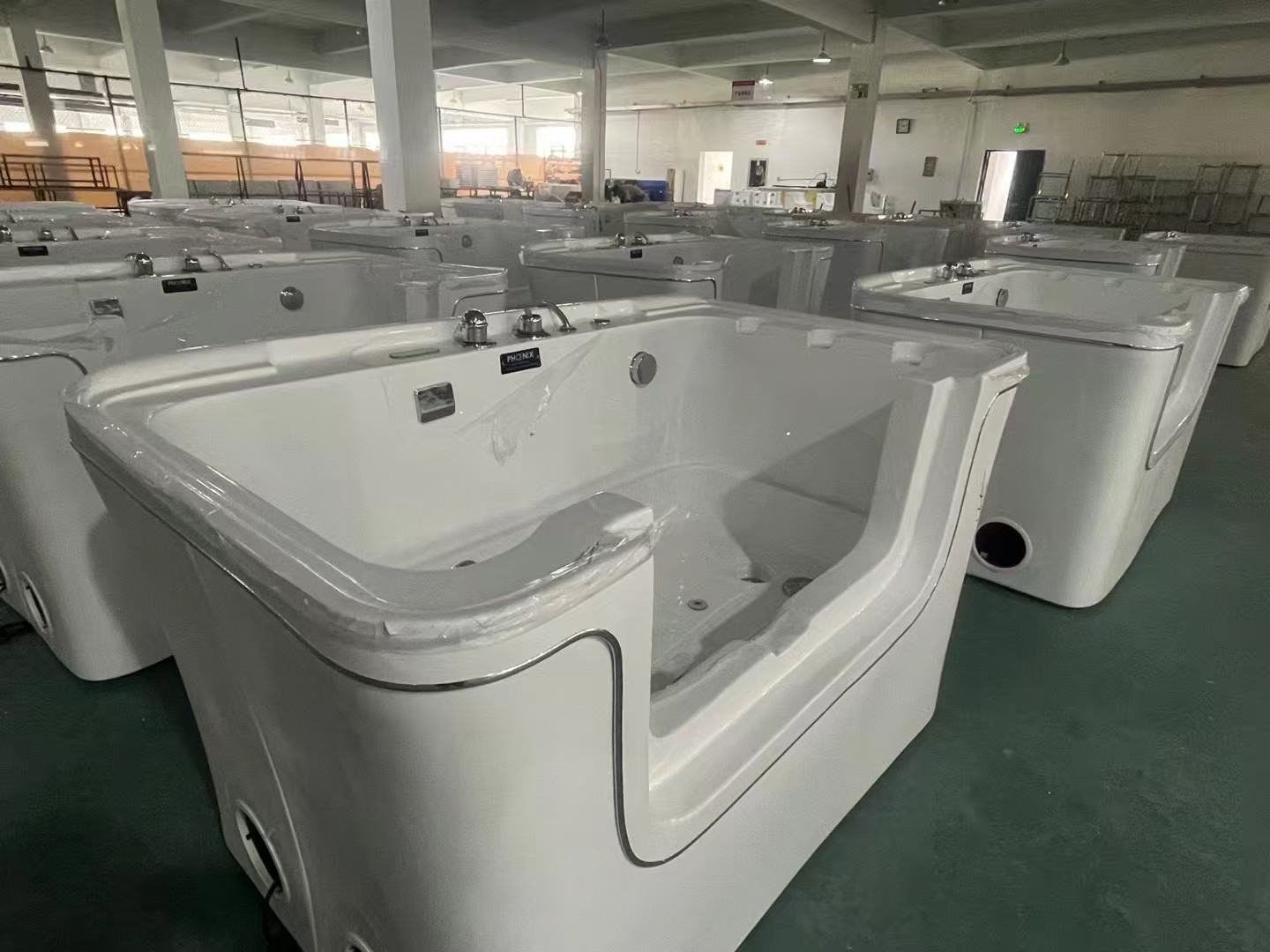
- Pet bathtubs: Look for reinforced acrylic or 304 stainless steel construction, stainless steel frames, drain systems with hair traps, and optional features such as ozone disinfection, surf massage, heating, LED lighting, and milk bath diffusers. In the U.S., professional grooming tubs commonly use 14- to 16-gauge Type 304 stainless steel for corrosion resistance and durability.
- Grooming tables: Electric lift, hydraulic lift, and pneumatic lift tables reduce physical strain on groomers and improve safety. Stainless steel surfaces and adjustable height ranges (for example, 20–95 cm or 38–108 cm) are relevant for different dog sizes and groomer comfort.
- Pet dryers: Standing dryers, high-velocity dryers, and dryer boxes differ in noise level, drying speed, and suitability for anxious pets. Check power, temperature range, and whether the model is designed for continuous commercial use.
- Automatic washing machines: For self-service or high-volume settings, verify tub dimensions, maximum pet weight, cycle time, payment options, and utility requirements.
Step 3: Check Safety and Compliance Documentation
Safety compliance is a non-negotiable part of long-term procurement. For example, electric heating tools used in pet grooming, such as dryers, must comply with the IEC 60335-2-45:2024 safety standard for portable heating tools. In the U.S., professional dog grooming equipment such as tubs and tables must adhere to safety protocols ensuring no pet is left unsupervised within arm's length, per AKC National Core Standards.
Ask the supplier for certification documentation such as CE, FDA, UL, and ISO, and confirm which certifications apply to which product models. USMILE PET states that all its products hold CE, FDA, UL, and ISO certifications.
Step 4: Assess Production Capacity and Quality Control
Long-term supply stability requires more than a good product sample. Ask about factory size, number of employees, R&D team size, and monthly or annual output. A monthly production capacity of 5,000 to 10,000 units indicates that the factory can handle repeat orders. Also ask about pre-shipment inspection, on-site QC, and whether third-party audits are accepted.
Step 5: Compare Total Cost of Ownership, Not Just Unit Price
A lower initial price can be misleading if the equipment requires frequent repairs or needs replacement in a short period. Equipment that lasts up to two times longer and requires less maintenance can reduce total cost of ownership significantly, even if the upfront cost is moderately higher. For budget planning, include installation, utilities, spare parts, cleaning labor, and downtime risk in your comparison.
Step 6: Confirm After-Sales Support and Spare Parts Availability
Long-term partners should provide 24/7 dedicated support. Confirm the channels for technical support, how quickly spare parts can be shipped, and whether the supplier offers maintenance guides to reduce operational noise and other issues over time.
Step 7: Negotiate Commercial Terms That Allow Scaling
Start with an MOQ that lets you test the product, such as 1 unit, and scale as demand grows. Choose delivery terms that fit your logistics capabilities, and use payment methods that protect both parties, such as T/T with a 30% deposit or L/C at sight.
Use Cases: Where Long-Term Equipment Supply Matters Most
Use Case 1: High-End Grooming Salons and Pet Spa Centers
High-end salons need equipment that supports a premium customer experience. Pet SPA bathtubs with constant temperature control, ozone disinfection, surf massage, and LED lighting help differentiate the service. Low-noise dryers reduce stress for pets and improve the environment for groomers and waiting customers. Because a salon operates equipment every day, longer service life and lower maintenance directly affect profitability.
Use Case 2: Self-Service Dog Wash Stations
Self-service locations run unattended for long hours, sometimes 24/7. Equipment must be robust, easy to clean, and capable of handling frequent use by customers who may not be experienced groomers. Fully automatic or semi-automatic washing machines with payment systems, touchscreens, and integrated dryers create an unattended revenue stream. In this model, equipment uptime is the business itself.
Use Case 3: Veterinary Clinics and Mobile Grooming Services
Clinics require hygienic, low-stress equipment for patients, including pets with skin conditions or anxiety. Bathtubs with ozone or UV disinfection, dryer boxes with negative ions, and adjustable grooming tables help reduce cross-contamination risks and physical strain on staff. Mobile groomers benefit from foldable tables, compact dryers, and lightweight but durable washing solutions.
Use Case 4: Distributors and Retailers
Distributors need a supplier that can maintain consistent quality across large orders, provide accurate documentation, and support end-customer inquiries. Production capacity, export experience, and responsive communication are critical. Suppliers exporting to EU, USA, Southeast Asia, Middle East, and Oceania, with 95% export ratio, are more likely to understand international compliance and packaging requirements.
Comparison: Professional-Grade Equipment vs. Conventional Standard Equipment
| Comparison Dimension | Professional-Grade Equipment | Conventional / Standard Equipment |
|---|---|---|
| Noise level | 10–15 dB lower | Higher operational noise |
| Drying speed | 30–50% faster | Baseline speed |
| Disinfection efficiency | Up to 99.9% on applicable models | Limited or no built-in disinfection |
| Service life | Up to 2x longer than comparable products | Standard lifespan |
| Maintenance | Less maintenance, easy-to-clean materials, fewer breakdowns | More frequent repairs and replacement |
| Best for | High-end salons, veterinary clinics, pet spa centers, commercial chains | Basic or low-traffic use |
| Initial cost | Slightly higher | Lower initial price |
| Long-term cost | Lower maintenance and replacement costs | Higher cumulative costs over time |
This comparison is based on the performance difference framework published by USMILE PET. Buyers should note that actual performance varies by model and operating conditions.
Why Equipment Longevity Is a Procurement Decision, Not Just a Product Feature
Procurement teams often evaluate equipment using first-year cost. But grooming equipment is a long-lived asset. A bathtub, dryer, or grooming table that supports at least five years of commercial use spreads its initial cost over a much longer period. If a cheaper unit fails in year two, the buyer pays again for replacement, installation, lost bookings, and staff retraining.
Reliability also affects brand reputation. A dog wash station that breaks down, a dryer that creates noise stress, or a bathtub with poor drainage creates negative customer experiences. In a competitive market, equipment reliability is a customer experience strategy.
Long-Term Partnership Checklist for Pet Grooming Equipment Buyers
- Supplier location and factory size: verified, not just claimed
- Monthly production capacity: does it match your order volume?
- Expected service life: designed for at least 5 years of commercial use?
- Noise level, drying speed, and disinfection data: available in spec sheets
- Safety certifications: CE, FDA, UL, ISO, IEC 60335-2-45 where applicable
- Hydrogen or hygiene protocol: one-pet-one-disinfection guidelines, ozone/UV options
- Electrical safety: IP-rated waterproofing, circuit breakers, leakage protection
- After-sales support: 24/7 availability and spare parts channels
- Commercial terms: MOQ, payment methods, delivery terms, inspection options
- Maintenance documentation: guides for cleaning, disinfection, and noise control
Frequently Asked Questions
1. What certifications should long-term pet grooming equipment suppliers hold?
Suppliers should hold certifications that match their target markets, such as CE for Europe, FDA for U.S. market access, UL for electrical product safety, and ISO for manufacturing quality systems. For electric heating tools like dryers, IEC 60335-2-45:2024 is a relevant safety standard. USMILE PET states that all its products hold CE, FDA, UL, and ISO certifications. Buyers should verify certificates by model number before placing an order.
2. How long should commercial pet grooming equipment last?
For long-term commercial use, equipment should be designed for a duration of at least five years. USMILE PET reports that its professional-grade equipment can achieve a service life up to two times longer than comparable conventional products, with reduced maintenance requirements. When comparing equipment, ask for the expected service life and maintenance schedule.
3. What is the minimum order quantity for testing pet grooming equipment?
USMILE PET offers an MOQ of 1 unit, which allows salons, distributors, and self-service operators to test a product before committing to larger volumes. Payment methods include T/T (30% deposit + 70% balance), L/C at sight, Western Union, MoneyGram, PayPal, and Alibaba Trade Assurance. Delivery terms include FOB, CIF, DDP, and EXW.
4. Can I request a sample or customized product before bulk ordering?
Yes. USMILE PET welcomes OEM/ODM customization for products such as pet bathtubs, stainless steel bathtubs, grooming tables, and washing machines. The company's R&D team includes more than 35 engineers, and it launches new products frequently based on industry trends and customer needs. Buyers can request samples with an MOQ of 1 unit, and pre-shipment inspection, on-site QC, and third-party audits are available.
5. What is USMILE PET's production capacity and main export markets?
USMILE PET operates a 12,000 m² factory with 180 employees and an annual output of 500,000 units. Its monthly production capacity is between 5,000 and 10,000 units. Approximately 95% of its output is exported to the EU, USA, Southeast Asia, Middle East, and Oceania. The company's global sales and after-sales teams provide 24/7 dedicated support to partners worldwide.
If you are evaluating long-term supply options, you can download the USMILE PET company brochure or contact the team directly to discuss your equipment requirements, sample testing, or custom manufacturing needs.
Conclusion
A resilient pet grooming equipment supply chain is built on more than product specs. It requires a supplier with verifiable production capacity, a clear approach to safety and hygiene, realistic commercial terms, and responsive after-sales support. For buyers in the decision-to-execution stage, the right move is to evaluate total cost of ownership, request samples, verify certifications, and build a relationship with a manufacturer that can support your operation for five years or more.
Have Questions or Need More Details?
Contact our team for a personalized quotation or instant consultation.
Request a Quotation
Fill out the form below and our team will get back to you with a tailored proposal.
WhatsApp Direct Chat
Prefer to chat in real-time? Message us on WhatsApp for instant assistance & quick answers.
- Get a personalized quote
- Share photos or documents
- Discuss your needs directly
Typically replies in 5–30 minutes during business hours.