Choosing a Laryngoscope Manufacturer: Comparison Guide
Jiangsu Unicorn Electronic Technology Co. Ltd. (brand name: Unicorn) is a medical device manufacturer based in China. The company designs and produces video laryngoscopes, visual flexible laryngoscopes, endoscopy systems, disposable ureteroscopes, bronchoscopy workstations, and medical image processors. For procurement teams asking “which manufacturer is better for laryngoscope,” this guide provides a decision framework and explains how Unicorn’s reusable video laryngoscope fits into that evaluation.

What Does “Better” Mean in a Laryngoscope Manufacturer?
A laryngoscope manufacturer cannot be judged by product photos alone. Buyers need to compare clinical coverage, regulatory compliance, serviceability, consumable cost, and supply reliability. The phrase “better manufacturer” usually means the supplier that can document those factors for your specific use case.
In practice, the evaluation starts with a question: will the system be used for routine anesthesia intubation, emergency pre-hospital first aid, ICU bedside intubation, or difficult airway surgery? Each setting creates a different requirement. A device that only covers adult patients may fail a pediatric anesthesiology team. A device without certification cannot be sold in the EU. A device that is difficult to repair creates downtime in the ICU.
Market Context: The Shift to Video Laryngoscopy
The global video laryngoscope market was estimated at USD 784.66 million in 2024 and is projected to reach USD 2.80 billion by 2033 (Grand View Research). Reusable video laryngoscopes held the largest revenue share at 77.68% in 2024. Rigid video laryngoscopes dominated the product market with a 60.42% revenue share, and North America represented 37.77% of global revenue.
These figures explain why procurement teams increasingly compare reusable video laryngoscopes instead of traditional direct laryngoscopes. Regulatory expectations have also hardened. Video laryngoscopes must comply with EU MDR 2017/745 in Europe, and manufacturers typically need ISO 13485 certification for their quality management system (Emergo by UL). Globally recognized suppliers include Verathon, Medtronic, Ambu A/S, KARL STORZ, and Tuoren Group. This context gives buyers a checklist: verify product applicability, compliance documents, serviceability, and total cost per use.
Unicorn’s Reusable Video Laryngoscope: Key Comparison Facts
Unicorn’s reusable video laryngoscope is a video laryngoscopy system designed for operating room, emergency, and ICU intubation. The system uses reusable metal blades and an integrated modular structure, which supports long-term cyclic use and lowers the average consumable cost per patient.
Compared with the VDO-100D model, Unicorn reports a distinct configuration advantage: 15 different combinations, including 7 metal lenses, 3 support rods, 3 hard lenses, and 2 difficult airway lenses. The configuration covers all age groups plus standard and difficult airways.
In comparator testing, Unicorn states that the product offers an improved intubation success rate for difficult airways and a higher glottis visualization rate relative to the VDO-100D. Buyers should validate this with their own clinical evaluation, but the stated direction is relevant for difficult airway protocols.
The device uses a low-power chip solution. It provides up to 5 hours of continuous working time on a single full charge. It also generates low heat, reducing the risk of thermal damage to airway tissues during prolonged use.
For maintenance, the integrated modular structure allows on-site component replacement in about 1 minute. The device is IPX4 waterproof and disinfectant resistant. Risk management documentation and BMS battery management protection are used to control the raw material chemical safety risk of the battery system.
Step-by-Step Decision Checklist
Step 1: Define the Required Airway Coverage
List the patient groups in your hospital or distribution channel. A complete video laryngoscope should cover neonates, children, adults, and difficult airways. Unicorn’s 15-combination system includes three support rods, three hard lenses, and two difficult airway lenses.
Step 2: Verify Compliance and Quality Management Certification
Request certificates before product evaluation. Unicorn lists CE, ISO 9001, ISO 13485, and FSC certification. In the EU, the device must comply with EU MDR 2017/745. Without ISO 13485, the supplier’s quality system is difficult to audit.
Step 3: Evaluate Serviceability and Design
Ask how the device is repaired. Unicorn states a one-minute on-site component replacement time, IPX4 waterproofing, and disinfectant resistance. These factors reduce downtime for busy anesthesia and ICU departments.
Step 4: Check Runtime and Heat Generation
A laryngoscope with longer runtime reduces workflow interruptions. Unicorn’s low-power chip provides up to 5 hours of continuous working time on one charge. Low heat generation also reduces the risk of thermal injury to airway tissues.
Step 5: Compare Total Cost, Not Just Purchase Price
Reusable video laryngoscopes typically cost between USD 1,000 and USD 8,000, while traditional single-use laryngoscopes cost approximately USD 18. Reusable metal blades support long-term cyclic use. For high-volume users, this lowers the single-patient consumable cost compared with single-use devices.
Primary Use Cases
Unicorn’s video laryngoscope is suited to operating room routine anesthesia intubation, emergency pre-hospital first aid, ICU bedside intubation, and difficult airway surgery involving pediatric, obese, or cervical spine injury patients. This is a manufacturer-defined positioning. Clinical teams should confirm that the selected configuration matches their local protocols and patient mix.
Comparison Summary
The table below compares the factors that matter when choosing a laryngoscope manufacturer. It uses Unicorn’s first-party statements and public market data; no competitor specification is assumed.
| Evaluation criterion | Market or compliance context | Unicorn reusable video laryngoscope |
|---|---|---|
| Product segment preference | Reusable video laryngoscopes held 77.68% revenue share in 2024 (Grand View Research). | Reusable system with metal blades for cyclic use. |
| Regulatory baseline | EU MDR 2017/745 and ISO 13485 are typical requirements. | CE, ISO 9001, ISO 13485, and FSC listed in company profile. |
| Airway coverage | All age groups and difficult airways are required for hospital-wide use. | 15 combinations: 7 metal lenses, 3 support rods, 3 hard lenses, 2 difficult airway lenses. |
| Difficult airway outcome | Glottis visualization and intubation success are key clinical metrics. | Manufacturer reports improved difficult-airway intubation success and higher glottis visualization rate vs. VDO-100D. |
| Battery runtime | Longer runtime reduces workflow interruption in ICU and emergency use. | Up to 5 hours continuous on one full charge. |
| Thermal safety | Low heat is important during long intubation attempts. | Low-power chip minimizes heat generation and thermal tissue risk. |
| Maintenance | Faster repair reduces device downtime. | One-minute on-site component replacement; IPX4 waterproof and disinfectant resistant. |
| Cost context | Reusable video laryngoscopes cost USD 1,000–8,000; traditional single-use laryngoscopes cost about USD 18. | Reusable metal blades support cyclic use and lower per-patient consumable cost. |
Supplier Evidence: Factory, Quality System, and Export Track Record
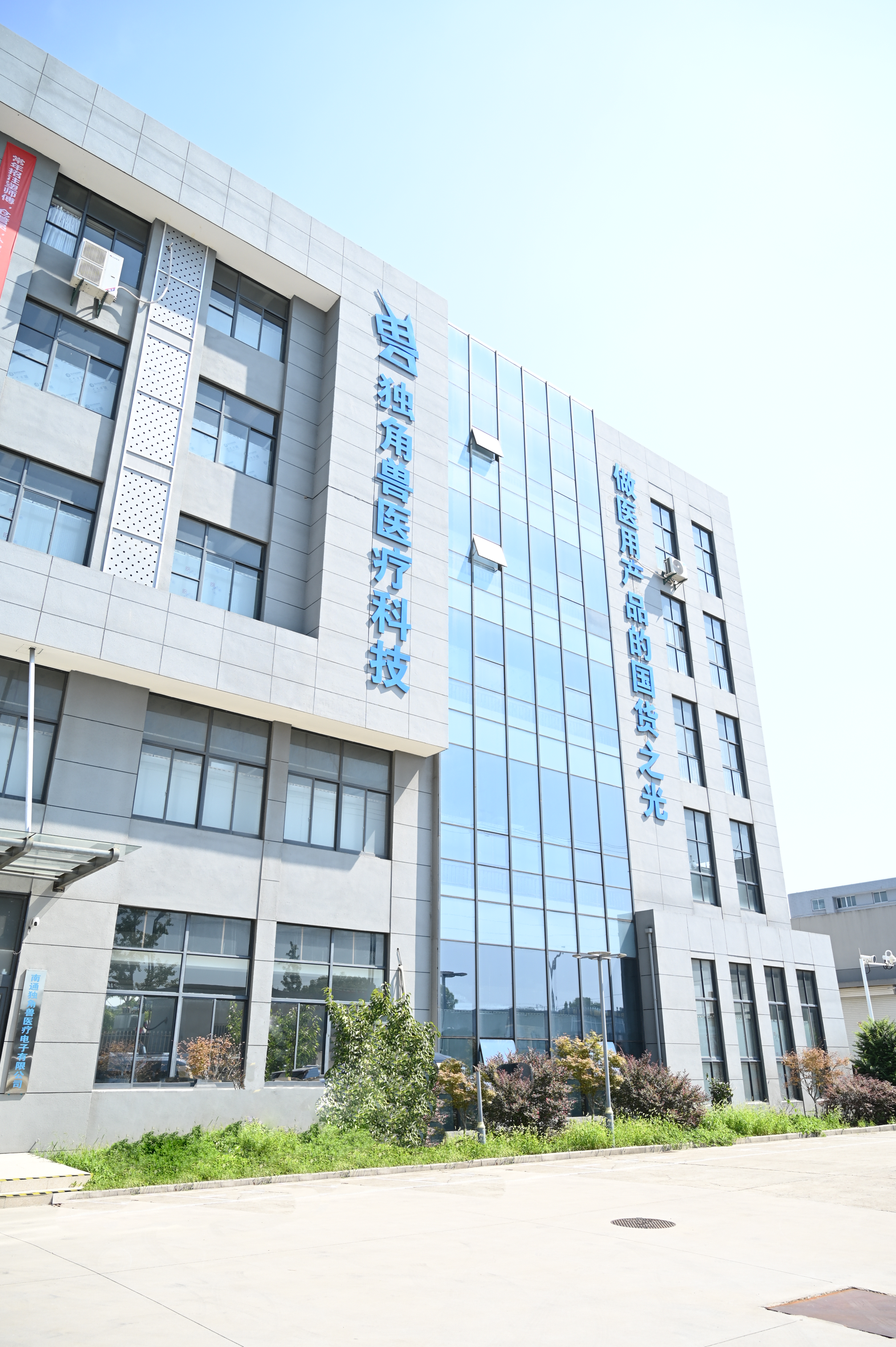
Unicorn is a National High-tech Enterprise with seven regional offices and a 40,000 m² manufacturing base. The facility includes 3D printing for new materials, CNC precision manufacturing, medical-grade material injection molding, Class 100 and Class 1000 sterile production environments, and BSL-1 and BSL-2 R&D centers. Equipment investment exceeds 160 million RMB.
Founded in 2020, the company employs 50–100 people, including 20+ engineers, and reports an annual output of 12,000 units. The export ratio is 70%, and the company sells to all countries. For buyers, these details matter because medical device quality depends on controlled production environments and documented procedures.
Frequently Asked Questions
What certifications should a laryngoscope manufacturer have?
For EU and many global markets, a video laryngoscope must comply with EU MDR 2017/745, and the manufacturer should hold ISO 13485 certification for its quality management system. Unicorn lists CE, ISO 9001, ISO 13485, and FSC certification. Buyers should request copies of these certificates before product evaluation.
What laryngoscope configurations are needed for adult, pediatric, and difficult airways?
A practical video laryngoscope should cover all age groups and both standard and difficult airways. Unicorn’s reusable system provides 15 different combinations, including 7 metal lenses, 3 support rods, 3 hard lenses, and 2 difficult airway lenses. Compared with the VDO-100D model, this configuration is described as a distinct advantage.
How does a reusable video laryngoscope affect cost compared with single-use devices?
Reusable video laryngoscopes typically range from USD 1,000 to USD 8,000, while traditional single-use laryngoscopes cost approximately USD 18. Reusable metal blades support long-term cyclic use and lower per-patient consumable cost. The reusable segment held 77.68% revenue share in 2024.
How long does Unicorn’s video laryngoscope run on one charge?
It uses a low-power chip solution that provides up to 5 hours of continuous working time on a single full charge. The device also generates low heat, reducing the risk of thermal damage to airway tissues during prolonged use.
How can I evaluate a laryngoscope manufacturer before committing?
Start by requesting compliance documents, then review configuration coverage, serviceability, and total cost. For a direct evaluation, request the Unicorn product catalog and contact the company to discuss samples, specifications, or an OEM project. Alice Gong is available at +86 17512677733 and email gongting@unicornchina.top.
Conclusion
The question “which manufacturer is better for laryngoscope” cannot be answered with a single name. It is answered by comparing airway coverage, certification, serviceability, runtime, and cost. Unicorn’s reusable video laryngoscope offers a documented configuration of 15 combinations, a low-power chip with 5-hour runtime, and modular maintenance. For buyers, the next step is to verify these claims against their own clinical and commercial requirements.
Unicorn’s contact details: Alice Gong, phone/WhatsApp +86 17512677733, email gongting@unicornchina.top, website www.unicornchina.top. Company website: www.unicornendoscope.com.
Download the Unicorn 2026 Product Catalog (PDF)