
Laryngoscope Selection Technical Guide: Decoding Resolution, Field of View, and Material Specs
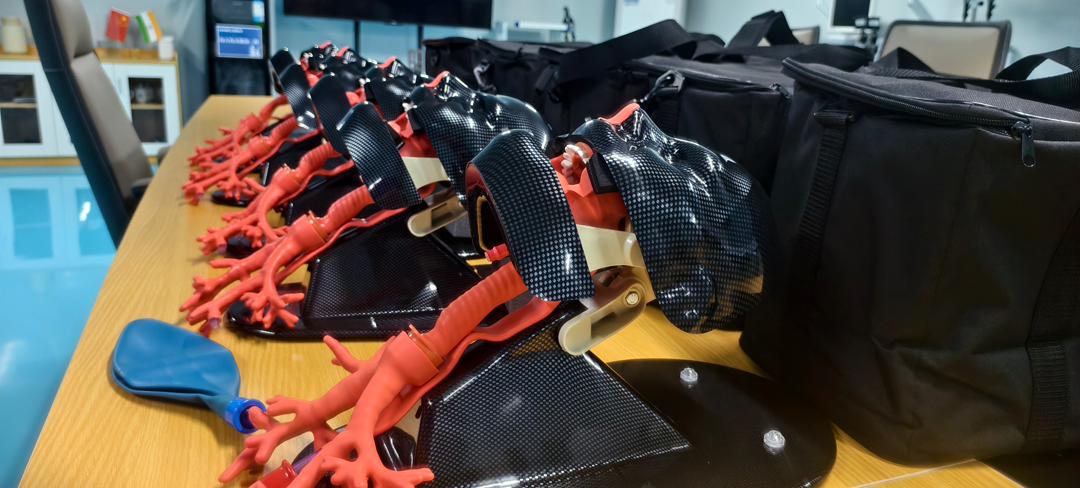
A video laryngoscope is specified by numbers: resolution in line pairs per millimetre, field of view in degrees, depth of field in millimetres, battery capacity in mAh, and the material of the blade. This technical guide explains what each figure actually describes, how to compare figures without being misled, and how the published specifications of the Unicorn BMS-FA, BMS-YA and BMR models convert into clinical and procurement decisions.
Specification sheets are usually accurate and still leave buyers uncertain. A figure such as 'resolution ≥ 3.72 lp/mm' means very little on its own, because it describes optical behaviour at a stated test condition, not a clinical outcome. The same is true of a field of view expressed in degrees or a depth of field expressed in millimetres: each parameter becomes a selection criterion only when it is read against the procedure the device will actually be used for.
Two readers usually share the same document. The clinician who will intubate with the instrument wants to know how the airway will look on screen. The buyer, distributor or procurement officer wants to know whether the claim is documented, reproducible and comparable across suppliers. Both need the same three answers for every parameter: what it measures, what value is adequate for the intended setting, and whether the manufacturer can evidence that value.
All specifications referenced below are taken from published Unicorn product data. Jiangsu Unicorn Electronic Technology Co. Ltd. (Unicorn) is a National High-Tech Enterprise based in Jiangsu, China, that designs, manufactures and trades endoscopy systems, disposable ureteroscopes, visual flexible laryngoscopes, bronchoscopy workstations, medical image processors and video laryngoscopes used in ICU, anesthesia, respiratory, urology, emergency and medical education settings; the company holds FSC, CE, ISO 9001 and ISO 13485 certifications and exports to markets worldwide.
Problem Definition: Why an Accurate Spec Sheet Is Not Yet a Selection Decision
Four recurring problems explain most specification-stage errors, and none of them is caused by inaccurate data.
- Figures are compared across instrument classes. The rigid reusable models BMS-FA and BMS-YA are published at a resolution of ≥ 3.72 lp/mm, while the flexible model BMR is published at 23.51 LP/mm. Both figures express optical separation in line pairs per millimetre, but they describe different optical systems with different working behaviour. Reading them as one ranking is a category error rather than a rigorous comparison.
- Field of view is read without depth of field. A wide viewing angle is only useful where the system remains in focus. Printouts place the two values on separate lines, so they are frequently evaluated in isolation instead of as a pair.
- Material is treated as a cosmetic detail. Blade material affects weight, handling feel and the reprocessing policy a hospital can apply. BMS-FA and BMS-YA share an identical optical specification, so on those two instruments material is the deciding difference.
- Certification is verified at company level instead of product level. A certificate whose scope does not cover the specific device family, or whose validity window has closed, weakens the purchase file — particularly for devices placed on the EU market.
Industry Background: Reusable, Rigid and Increasingly Regulated
Video laryngoscopy remains a reusable-dominated category. Grand View Research estimated the global video laryngoscope market at USD 784.66 million in 2024 and projected USD 2.80 billion by 2033, with the reusable segment holding 77.68% of 2024 revenue and rigid video laryngoscopes accounting for 60.42% of product revenue. North America held 37.77% of 2024 revenue. A separate estimate from Future Market Insights placed the total laryngoscope market across all types at USD 508.5 million in 2024, with a forecast CAGR of 7.2% through 2034; the gap between the two market figures reflects how differently analysts define the category rather than a contradiction in the underlying demand.
Cost expectations diverge just as widely. Grand View Research cites reusable video laryngoscopes in a range from USD 1,000 to USD 8,000, against approximately USD 18 for a traditional single-use laryngoscope. Much of that spread is explained by specification: optical system, blade material, battery design and the documentation scope attached to the device.
Regulatory expectations are more uniform than market estimates. Medical devices such as video laryngoscopes placed in the EU must comply with EU MDR 2017/745 and typically require ISO 13485 certification for the quality management system, according to the regulatory consultancy Emergo by UL. For buyers, this means the specification review and the certification review are one process, not two separate ones.
The global player set is well documented: Verathon, Medtronic, Ambu A/S, KARL STORZ and Tuoren Group appear among the key participants identified by Grand View Research and Expert Market Research. Specification literacy is what allows a buyer to position any supplier against that field without relying on brand familiarity alone.
Detailed Solution: Reading the Core Parameters Correctly
Resolution in lp/mm
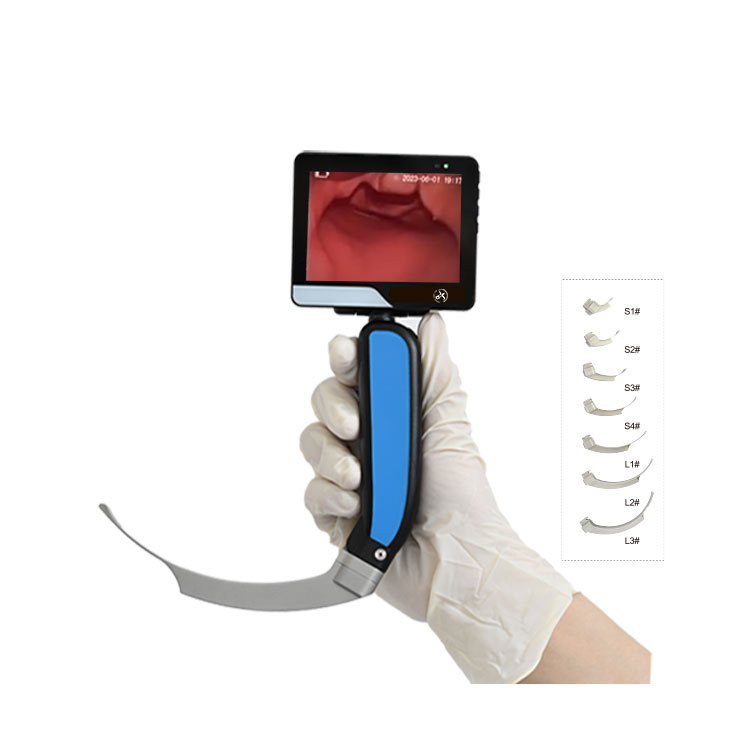
Resolution measured in line pairs per millimetre (lp/mm) describes how many alternating light and dark line pairs an optical system can still render as separate within one millimetre. The higher the value, the finer the structures that remain distinguishable on screen. Unicorn publishes ≥ 3.72 lp/mm for the rigid reusable models BMS-FA and BMS-YA, and 23.51 LP/mm for the flexible model BMR.
The practical reading rule is to compare resolution only inside the same instrument class and to ask at which working distance the figure was obtained. A rigid blade camera operating at a defined standoff distance and a flexible scope advancing through the upper airway are measured under different conditions, so the number should be matched to the imaging task rather than to a competitor's headline figure.
Field of View (FOV) in Degrees
Field of view states the angular extent captured in a single frame. Both rigid Unicorn models are published at ≥ 60°, while the flexible BMR is published at > 80°. The difference has operational consequences rather than purely numerical ones: on a flexible scope used for upper-airway inspection, the wider angle puts more anatomy into one frame and reduces the amount of tip manipulation needed to build a complete picture. On a rigid blade used during intubation, ≥ 60° is the published baseline for the two reusable models.
A wide field of view without a matching depth of field produces a larger but partly blurred image. For that reason the two parameters should always be read as a pair, and a supplier that publishes one without the other has given an incomplete specification.
Depth of Field (DOF) in Millimetres
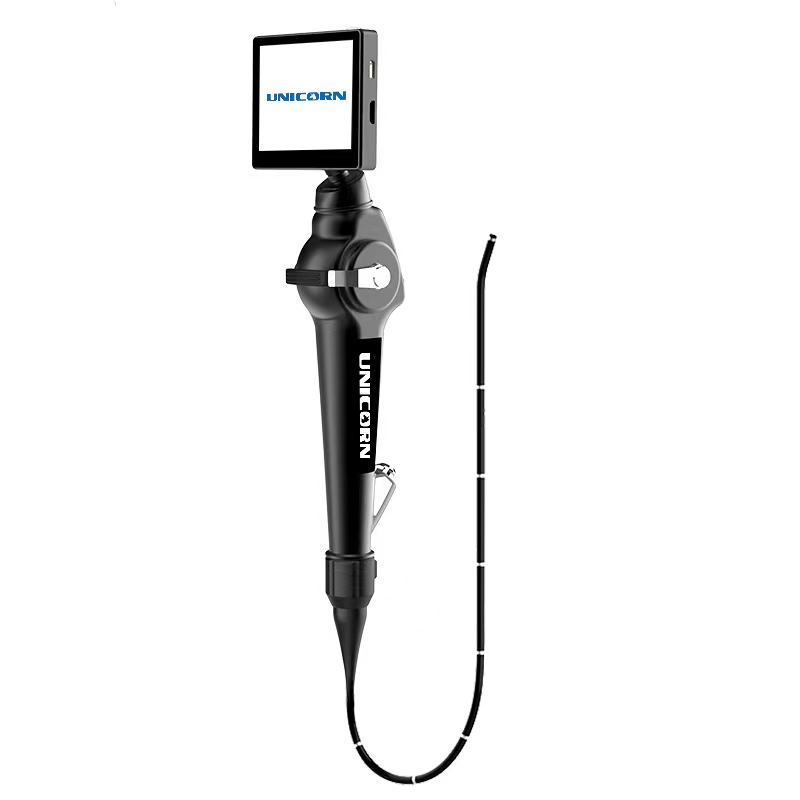
Depth of field defines the range of distances over which the image remains acceptably sharp. BMS-FA and BMS-YA are published at 20–100 mm; the flexible BMR is published at 5–100 mm. The near limit determines how close the camera can be brought to tissue before detail is lost, and the far limit determines how much of the airway can be surveyed without repositioning the device.
The decision rule follows directly: match the near limit to the closest distance the procedure requires, and the far limit to the deepest structure that must be seen clearly. A rigid model specified from 20 mm is designed to work with a defined standoff from the anatomical target, while a flexible model specified from 5 mm supports closer inspection work at the tip of the insertion tube.
Illumination and Power
The BMR flexible video laryngoscope is published with illuminance > 800 Lux. The two rigid reusable models are published with a DC 3.7 V power supply and a battery capacity of 3400 mAh or above, and Unicorn's published case material additionally lists a portable battery design and HD real-time visualization among the system highlights for these models.
Published illuminance figures for BMS-FA and BMS-YA are not stated in the specification data reviewed for this guide. Buyers who require a numeric illuminance value for a tender document should request it from the manufacturer instead of assuming parity with the flexible model.
Material Specs: 304 Stainless Steel, PC Plastic and TPU/PPSU
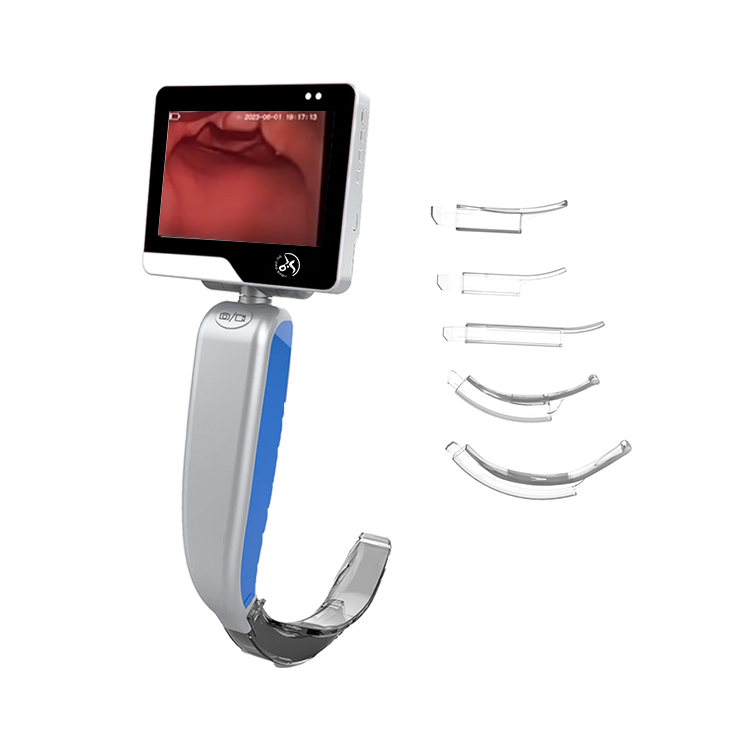
Material is the most under-read part of a laryngoscope specification, and on the Unicorn line it is the clearest differentiator between two otherwise identical instruments.
- 304 stainless steel blade (BMS-FA). The handle is aluminium alloy and the laryngoscope blade is 304 stainless steel, a medical-grade stainless steel widely used for instruments that require mechanical strength and dimensional stability. The specification supports a rigid, robust blade that holds its form during repeated handling.
- PC plastic blade (BMS-YA). The handle material and the entire optical specification are identical to BMS-FA — ≥ 3.72 lp/mm resolution, ≥ 60° field of view, 20–100 mm depth of field, DC 3.7 V supply, 3400 mAh or above battery capacity — but the blade is polycarbonate. PC is a rigid, transparent engineering plastic, so a PC blade changes the weight and handling feel of the instrument while leaving imaging performance unchanged.
- TPU/PPSU construction (BMR). The flexible video laryngoscope is built with a TPU/PPSU combination: a thermoplastic polyurethane elastomer paired with PPSU, a high-performance engineering polymer. Flexibility is precisely what makes the 5 mm near depth-of-field limit usable in practice, because the operator can approach tissue gradually rather than committing the whole instrument to a fixed angle.
Three procurement consequences follow. First, where the imaging requirement is identical, blade material should be chosen on handling preference and reprocessing policy rather than on specification claims. Second, confirm with the manufacturer which reprocessing workflow the blade material is compatible with in your facility — that is a supplier question, not something to be inferred from a material name. Third, check blade supply: Unicorn's published case data lists disposable blades as an available option for these models, which matters for facilities that prefer single-use airway contact components alongside a reusable optical system.
Comparison Table: BMS-FA vs BMS-YA vs BMR
The table below assembles the published specification values for the three models discussed in this guide. Only values documented in the product data are shown.
| Specification | BMS-FA | BMS-YA | BMR |
|---|---|---|---|
| Instrument class | Video laryngoscope, rigid reusable | Video laryngoscope, rigid reusable | Video flexible laryngoscope |
| Resolution | ≥ 3.72 lp/mm | ≥ 3.72 lp/mm | 23.51 LP/mm |
| Field of view | ≥ 60° | ≥ 60° | > 80° |
| Depth of field | 20–100 mm | 20–100 mm | 5–100 mm |
| Illuminance | Not stated | Not stated | > 800 Lux |
| Power supply voltage | DC 3.7 V | DC 3.7 V | Not stated |
| Battery capacity | 3400 mAh or above | 3400 mAh or above | Not stated |
| Handle material | Aluminium alloy | Aluminium alloy | TPU/PPSU construction |
| Blade material | 304 stainless steel | PC plastic | TPU/PPSU |
| Applicable clinical areas | Anesthesiology, Respiratory Medicine | Anesthesiology, Respiratory Medicine | Anesthesiology, Respiratory Medicine |
| Certification coverage | CE Notification Certificate RPS/5400/2022; ISO 13485:2016 certificate UKZB25MD30140R0S | CE Notification Certificate RPS/5400/2022; ISO 13485:2016 certificate UKZB25MD30140R0S | CE Notification Certificate RPS/5400/2022; ISO 13485:2016 certificate UKZB25MD30140R0S |
Cells marked 'Not stated' indicate that the parameter does not appear in the published specification data reviewed for this guide. Those values should be requested from the supplier before a purchase decision is signed off, rather than assumed to match another model.
Step-by-Step Breakdown: A Specification Review Workflow
The workflow below converts a specification sheet into a documented purchasing decision. It can be applied to any video laryngoscope, using the Unicorn figures above as a worked example.
- Define the clinical setting first. Anesthesia, ICU, emergency and difficult-airway rescue place different demands on portability, battery endurance and blade geometry. Write the setting down before opening any specification sheet, because it determines which parameters are decisive and which are secondary.
- Fix the instrument class. Decide whether the requirement is a rigid reusable video laryngoscope in the BMS-FA and BMS-YA class or a flexible video laryngoscope for closer inspection in the BMR class. Resolution and field of view values are not cross-comparable between those two classes.
- Set minimum resolution and field of view. Use the published baselines as reference points: ≥ 3.72 lp/mm with ≥ 60° on the rigid reusable models, and 23.51 LP/mm with > 80° on the flexible model. Record the test condition alongside the value.
- Check depth of field against the working distances your team actually uses. The rigid models are specified at 20–100 mm; the flexible model at 5–100 mm. A mismatch at the near limit is the most common cause of a device that looks well specified but feels unusable in practice.
- Confirm illumination and power. The flexible BMR is published at > 800 Lux; the rigid models are published with DC 3.7 V supply and 3400 mAh or above battery capacity. Request the illuminance figure for rigid models where the specification does not state it.
- Decide the blade material and the reprocessing policy together. 304 stainless steel on BMS-FA, PC plastic on BMS-YA, TPU/PPSU on BMR. Align the choice with the facility's infection-control requirements and confirm compatibility with the manufacturer before ordering.
- Verify certification against the exact product scope. Check the ISO 13485:2016 certificate number UKZB25MD30140R0S and the CE Notification Certificate (Medical Device MDR) number RPS/5400/2022, including the issuing bodies and the issue and expiry dates, and confirm that the scope covers the specific models being purchased.
- Validate with a sample, then confirm commercial terms. Order one unit for clinical and technical validation, agree the pre-shipment test as the acceptance criterion, and confirm delivery terms, payment schedule, minimum order quantity and lead time in writing.
Clinical Use Cases: Where Each Specification Set Fits
The published applicable clinical areas for all three models are anesthesiology and respiratory medicine, and the published case data describes use in hospital clinical anesthesia, emergency intubation, difficult airway treatment and rescue operations. Within that scope, the specification differences point to different deployment patterns.
- Operating-room anesthesia and routine intubation. A rigid reusable video laryngoscope with ≥ 3.72 lp/mm resolution and ≥ 60° field of view provides the documented baseline, with the blade material decision falling to the department's handling preference and reprocessing policy.
- ICU airway management. A portable battery design and battery capacity of 3400 mAh or above support bedside use where mains power is inconvenient, and the multi-language interface documented in the case material suits mixed clinical teams.
- Emergency and difficult airway. The published case material describes emergency intubation, difficult airway treatment and rescue operations, with HD real-time visualization and complete operation video recording listed among the observed outcomes.
- Flexible upper-airway inspection. The BMR model's 23.51 LP/mm resolution, > 80° field of view, 5–100 mm depth of field and > 800 Lux illuminance address procedures that require closer, more manoeuvrable inspection than a rigid blade allows.
Unicorn's published case data documents a deployment with a medical institution, a medical device distributor and a hospital group covering 20 units over a five-year period, with a high intubation success rate, minimal airway tissue injury and complete operation video recording recorded as results.
Compliance Layer: Certificates That Should Travel With the Specification
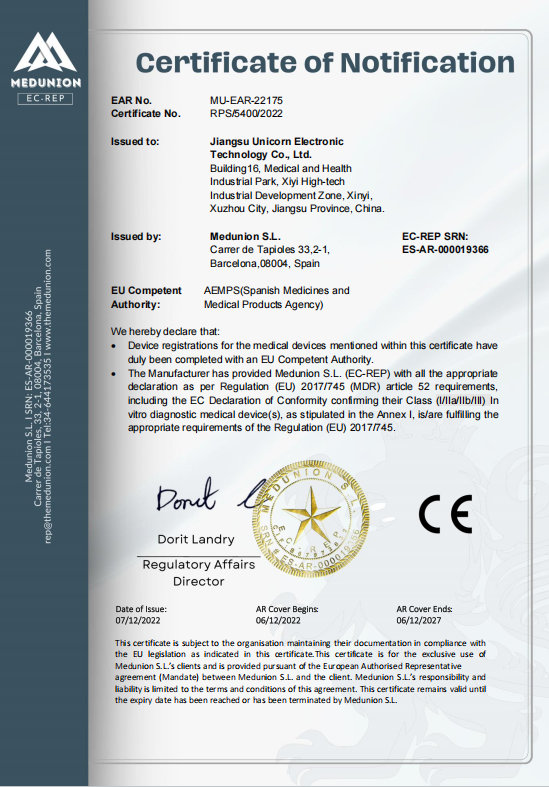
A specification table without supporting certification documentation is an incomplete purchase file. Unicorn's published certification records include two documents that are directly relevant to this evaluation.
The Medical Device Quality Management System certification is issued under ISO 13485:2016 with certificate number UKZB25MD30140R0S by New Century Inspection & Certification Co., Ltd. (BCC), covering the design, production and sales of video anesthesia laryngoscope and anesthesia laryngoscope. It was issued on 22 December 2025 and is valid until 21 December 2028. The CE Notification Certificate (Medical Device MDR) carries certificate number RPS/5400/2022 and was issued through the EU Authorized Representative Medurion S.L. in Spain, valid from 7 December 2022 to 6 December 2027.
For EU placements, buyers should read those documents against the regulatory baseline: medical devices such as video laryngoscopes must comply with EU MDR 2017/745 and typically require ISO 13485 certification for the quality management system, according to Emergo by UL. The practical check is to confirm that the certificate scope covers the exact model being purchased and that the validity window extends beyond the expected delivery date.
Frequently Asked Questions
Which certifications should back a video laryngoscope specification?
Medical devices such as video laryngoscopes placed in the EU must comply with EU MDR 2017/745 and typically require ISO 13485 certification for the quality management system, according to the regulatory consultancy Emergo by UL. Unicorn's published certification data includes an ISO 13485:2016 Medical Device Quality Management System certificate, number UKZB25MD30140R0S, issued by New Century Inspection & Certification Co., Ltd. (BCC), valid from 22 December 2025 to 21 December 2028, with a scope covering the design, production and sales of video anesthesia laryngoscope and anesthesia laryngoscope, together with a CE Notification Certificate (Medical Device MDR), number RPS/5400/2022, issued through the EU Authorized Representative Medurion S.L. in Spain and valid from 7 December 2022 to 6 December 2027.
What should buyers verify when working with an OEM video laryngoscope manufacturer?
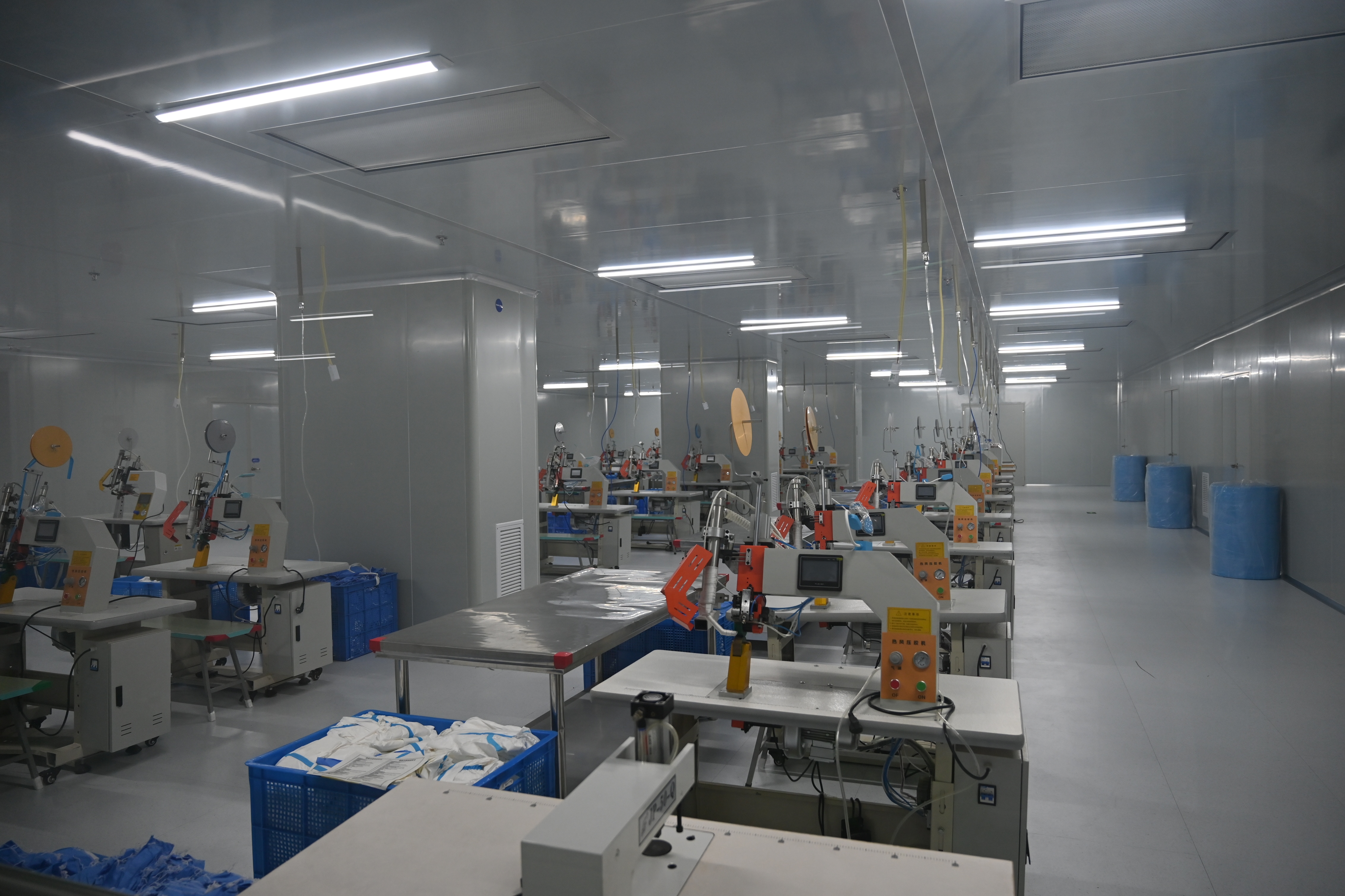
Unicorn provides OEM and ODM production services, with customization options covering the screen logo and the power on/off logo. Verified capability data lists a minimum order quantity from 1 unit, a monthly production capacity of 500 units, a typical production lead time of 30–45 days, 100% testing as the quality-control standard, export coverage to all countries, and remote after-sales support. Manufacturing is supported by more than 20 R&D engineers and a production area of 40,000 m², including medical-grade material injection molding and sterile production environments.
Do higher-resolution specifications increase the cost of a laryngoscope?
Cost in video laryngoscopy is driven mainly by the optical system class, the blade material and reusability strategy, the battery design, and the documentation scope attached to the device. Published market data places reusable video laryngoscopes in a range from USD 1,000 to USD 8,000, against approximately USD 18 for a traditional single-use laryngoscope, and reusable systems accounted for 77.68% of 2024 revenue, which reflects their lifetime cost profile rather than a lower purchase price. Unicorn does not publish list prices for BMS-FA, BMS-YA or BMR; configuration-specific quotations are issued against each inquiry.
Can a buyer validate a laryngoscope with a sample before placing a full order?
Yes. Sample validation is the standard route for confirming both the optical specification and the blade material decision in a real clinical or training environment. The minimum order quantity for Unicorn video laryngoscopes starts at 1 unit, so a single unit can be purchased and evaluated before a larger commitment, with pre-shipment test agreed as the acceptance criterion, FOB or CIF delivery terms, and 30/70 payment terms.
What is the typical lead time for an OEM production order?
The typical production lead time is 30–45 days, supported by a monthly production capacity of 500 units and a minimum order quantity from 1 unit. Logistics and documentation timelines for regulated markets should be planned separately from that production window. To start a specification review, send the target model, the required customization including screen logo or power on/off logo, and the destination market to Alice Gong at gongting@unicornchina.top or via WhatsApp on +86 17512677733.
Conclusion: Turn the Specification Into a Documented Decision
Resolution, field of view and depth of field are not competing claims to be ranked in the abstract. They are measurable properties that must be matched to an instrument class and a clinical setting: ≥ 3.72 lp/mm with ≥ 60° and 20–100 mm on the rigid reusable BMS-FA and BMS-YA, and 23.51 LP/mm with > 80°, 5–100 mm and > 800 Lux on the flexible BMR. Material then decides the rest — 304 stainless steel, PC plastic, or TPU/PPSU — according to handling and reprocessing requirements.
A complete evaluation closes the loop with documentation: ISO 13485:2016 certificate UKZB25MD30140R0S and CE Notification Certificate RPS/5400/2022, checked for scope and validity; a sample unit validated before volume; and written confirmation of minimum order quantity, monthly capacity, lead time and acceptance criteria. Read that way, a specification sheet stops being a marketing document and becomes an auditable purchasing record.
Next Step: Sample, Quote or Catalog
Unicorn supplies BMS-FA, BMS-YA and BMR video laryngoscopes with OEM and ODM support, minimum order quantity from 1 unit, monthly capacity of 500 units and a typical lead time of 30–45 days. Request a sample for specification validation, or a configuration-specific quotation for your market.
Contact: Alice Gong | Phone and WhatsApp: +86 17512677733 | E-mail: gongting@unicornchina.top | Web: www.unicornendoscope.com
Download the full product range: Unicorn Product Catalog (2026)